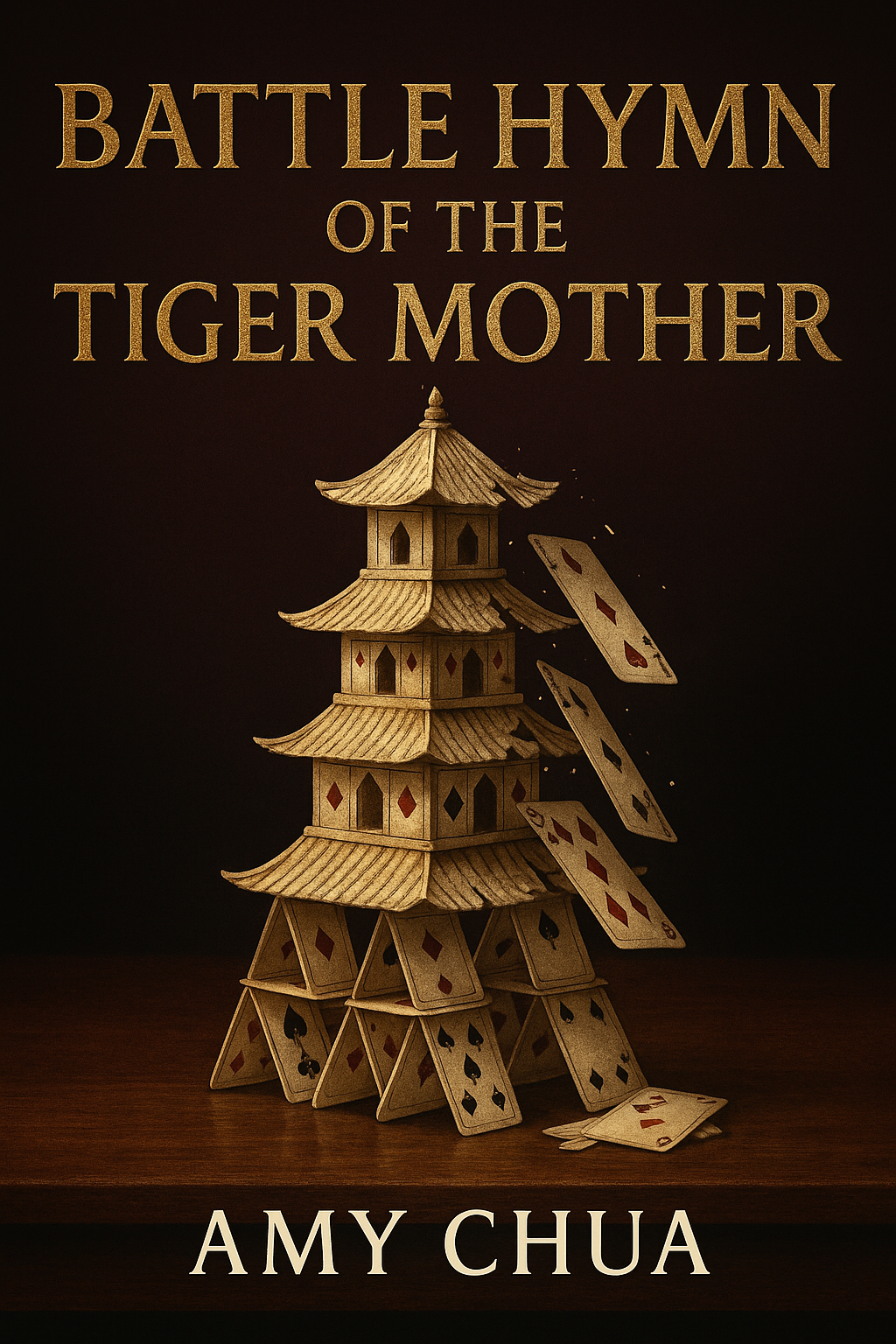
Battle Hymn of the Tiger Mother
Chapter Summaries
What's Here for You
Embark on a provocative and deeply personal journey into the heart of what it takes to raise exceptional children, as acclaimed author Amy Chua pulls back the curtain on the famously demanding yet remarkably effective "Chinese parenting" philosophy. This isn't just a book; it's an invitation to question everything you thought you knew about success, discipline, and the true meaning of parental love. Through vivid anecdotes of her own daughters, Sophia and Lulu, you'll witness firsthand the intensity of high-stakes musical training, the clash of cultural expectations, and the unwavering commitment to pushing boundaries. Prepare to be both challenged and inspired as Chua navigates the delicate balance between rigorous expectation and unwavering devotion, exploring how the pursuit of excellence can forge resilience, cultivate talent, and ultimately, shape character. You'll gain a unique perspective on the generational legacies that shape us, the surprising lessons learned from furry family members, and the profound moments of rebellion and reconciliation that define family life. This book offers a compelling, often humorous, and always honest look at the sacrifices, triumphs, and unexpected joys of a parent determined to unlock their children's fullest potential. It’s a story that will resonate with anyone seeking to understand the drive for achievement, the complexities of cultural identity, and the powerful, enduring bond between parent and child.
The Chinese Mother
Amy Chua, in her chapter 'The Chinese Mother,' pulls back the curtain on the often-asked question of how Chinese parents cultivate such remarkably successful children, a question born from observing math whizzes and music prodigies. She asserts, with the authority of lived experience, that this success is forged through a deliberate, often intense, approach to parenting. Chua outlines a stark contrast to Western norms, listing a series of prohibitions her daughters, Sophia and Louisa, never experienced: no sleepovers, no playdates, no TV, no video games, no choosing their own extracurriculars, and crucially, no grade less than an A, no being anything but the top student in most subjects. She clarifies that 'Chinese mother' is a broad term, encompassing parents of various backgrounds whose parenting style reflects a deep-seated belief in rigorous discipline and high expectations, much like the working-class father of a 'supersuccessful white guy' she met. Conversely, she notes that some mothers of Chinese heritage, particularly those born in the West, may not adhere to this model. The core tension lies in the vastly different philosophies of parenting. Studies, Chua points out, reveal quantifiable differences: while many Western mothers prioritize fostering the idea that learning is fun and that stressing academic success is detrimental, a near-unanimous majority of Chinese mothers believe their children *can* be the best, that academic achievement is a direct reflection of parental success, and that failure indicates a lapse in parental duty. This translates into practice, with Chinese parents spending ten times as long drilling academic activities compared to Western parents, who are more likely to focus on sports. The author dismantles the notion that the 'American sports parent' is an equivalent, emphasizing that for the Chinese mother, schoolwork reigns supreme, an A-minus is a failure, children must be two years ahead in math, public praise is avoided, teachers' words are gospel, and only activities with the potential for a gold medal are permitted. It's a system that builds formidable skills, though the emotional cost and the definition of success are left for the reader to ponder, revealing a profound cultural divergence in the pursuit of excellence.
Sophia
Amy Chua introduces her firstborn daughter, Sophia, a child whose very name, Sophia, echoes the wisdom her mother, Si Hui, intended. From infancy, Sophia displayed a remarkable temperament, a blend of her father Jed’s Jewish heritage and her mother’s Chinese roots, marked by a rare rationality and intense concentration. As a baby, Sophia seemed to intuitively understand her mother’s urgent need to finish writing a law article, a quiet, contemplative presence that allowed Chua to focus. This precocious intellect became evident early; at eighteen months, Sophia grasped the alphabet, a feat so advanced it defied her pediatrician’s initial skepticism, as demonstrated when she astutely identified letters disguised on a whimsical chart. While her American peers learned counting with tangible aids, Sophia, guided by her mother, delved into the Chinese method of rote learning, mastering addition, subtraction, multiplication, division, fractions, and decimals by the time she was three. This upbringing, a unique fusion of Chinese discipline and Jewish intellectual probing, positioned Sophia to absorb the best of both worlds. Chua observes a fundamental difference in parenting philosophies: Chinese parents, she posits, hold higher dreams for their children and a deeper understanding of their capacity to endure challenges, a stark contrast to what she perceived as the often-effusive, lower-expectation praise of American parents. Yet, Chua also harbored a distinct fear of the 'Asian automaton,' a child crushed by pressure, and thus sought to cultivate well-roundedness. This led to the introduction of the piano, not as a casual pastime, but as a pursuit demanding depth, virtuosity, and rigorous discipline, a challenging endeavor that began when Sophia was just three years old, the same year her younger sister was born.
Louisa
Amy Chua introduces her younger daughter, Lulu, whose given name, Louisa, means 'famous warrior,' a fitting prelude to the tempestuous spirit she embodies. Lulu, even in infancy, exhibited a willfulness that defied conventional solutions, famously rejecting formula and pediatrician-recommended alternatives, leading to a hunger strike accompanied by violent colic, a stark contrast to the meditative fasting of figures like Gandhi. It was a Chinese nanny, Grace, who discovered a culinary peace offering in silken tofu, a delicate dish that appeased the infant warrior. Chua reflects on her own fiery, yet quick-to-forgive, personality, noting its uncanny resemblance to Lulu's, a shared trait that fuels their intense, often nuclear-level, battles. The author marvels at the accuracy of the Chinese Zodiac, assigning Sophia the curious and task-oriented Monkey and Lulu the obstinate, yet fundamentally warm-hearted, Boar, while identifying herself as a powerful, magnetic Tiger. The core tension ignites when Chua decides to introduce three-year-old Lulu to the piano, a seemingly simple request to play a single note three times. Lulu, however, rebels, her small hands smashing the keys with defiant abandon. This initial standoff escalates dramatically when Chua, determined to raise an 'obedient Chinese child' where obedience is a supreme virtue, banishes Lulu to the freezing New Haven porch, clad only in a sweater and skirt. The wind chill bites at twenty degrees, yet Lulu remains unyielding, her teeth chattering, her defiance absolute. In this moment of chilling stillness, Chua realizes she has profoundly underestimated her daughter; Lulu would sooner freeze than concede. This stark realization forces an immediate tactical retreat, a shift from stern discipline to desperate pleading and bribery. The scene concludes with Lulu, found by her father and sister, contentedly sipping hot chocolate and devouring a brownie, a picture of calm after the storm. But Chua, ever the strategist, reveals the battle is far from over, merely paused, with the lines drawn for future conflicts. This chapter illuminates the profound and often paradoxical nature of parenting, particularly when a parent's deep-seated beliefs about discipline clash with a child's equally formidable will, revealing that true understanding often emerges not from victory, but from the humbling recognition of a child's unyielding spirit.
The Chuas
The author, Amy Chua, invites us into the rich tapestry of her family's history, weaving a narrative that begins in the scholarly province of Fujian, China, and stretches across continents to the Philippines and then America. We learn of ancestors like Chua Wu Neng, a royal astronomer and philosopher, whose handwritten treatise on the I Ching stands as the family's most cherished heirloom, a testament to a legacy of intellectual pursuit. The story then transitions to her grandparents, who, seeking opportunity, emigrated to the Philippines. Here, the narrative unfolds with contrasting personalities: a mild-mannered schoolteacher grandfather and his devout Buddhist wife who yearned for material success, and a good-natured fishpaste merchant grandfather whose wife, the formidable 'Dragon Lady,' built a plastics empire after World War II, amassing wealth and adopting American customs, including forks and spoons over chopsticks. Chua recounts her mother's harrowing childhood experiences during the Japanese occupation, a stark reminder of the fragility of peace, juxtaposed with the joy of liberation. Her mother's academic brilliance shines through, graduating summa cum laude in chemical engineering. The author's father, a man of deep intellect drawn to astronomy and philosophy, defied his family's business expectations to pursue his dream at MIT, later proposing to and marrying Chua's mother. Their arrival in Boston as a young couple, with only scholarships and enduring two harsh, unheated winters, underscores their initial struggles and unwavering determination. Growing up in the Midwest, Chua and her sisters experienced a unique duality: the strictures of Chinese upbringing, including mandatory Chinese at home and rigorous academic and musical training, clashed with the American landscape of bologna sandwiches and sleepovers. The author shares a poignant memory of her father's disappointment when she placed second in a history contest, a moment that highlights the immense pressure and expectation for perfection. Yet, this tension between cultural heritage and the desire to belong is resolved through shared experiences of American life—from tacos and Dairy Queen to Girl Scouts and roller skating—and the profound pride of their parents' naturalization. The family's move to Berkeley marked a shift, with her father embracing a more bohemian image, but his patriarchal roots resurfaced when it came to his daughters' college choices. Chua's act of forging her father's signature to apply to an East Coast university, and his subsequent shift from anger to pride upon her acceptance to Harvard, reveals a crucial insight into his evolving perspective. The narrative culminates in reflections on America's transformative power, evident in her father's acceptance of her non-Chinese husband and her mother's profound personal growth in caring for their daughter, Cynthia, who was born with Down syndrome. This journey from perceived shame to patient devotion, marked by Cynthia's Special Olympics success, encapsulates the chapter's emotional arc. Chua concludes by acknowledging a lingering regret about not fully embracing her Chinese heritage but expresses immense gratitude for the freedom and opportunity America has afforded her, finding her own sense of belonging not as an outsider, but as a privilege.
On Generational Decline
The author, Amy Chua, confronts a deep-seated fear: the decline of her family across generations, a pattern she observes is common among successful Chinese immigrants. She paints a vivid picture of the immigrant generation, her parents, who arrived in America with little but built immense success through relentless hard work, strict frugality, and unwavering dedication to their children's education. This foundational generation, often engineers or scientists, poured everything into ensuring their offspring, like Chua herself, would be high-achieving first-generation Americans, excelling in prestigious careers and artistic pursuits, a stark contrast to the perceived austerity of their parents' lives. Yet, Chua worries intensely about the next generation, her daughters Sophia and Lulu, who are born into comfort, accustomed to luxuries, and imbued with a sense of individual rights that clashes with traditional parental authority. This perceived softening, this entitlement, feels like the first crack in the family's hard-won prosperity, a descent into decadence reminiscent of the fall of empires. Determined to break this cycle, Chua launches an 'anti-decline campaign.' She recognizes she can't replicate the immigrant struggle but resolves to cultivate a deeper, more cultivated spirit in her children, using classical music as a bridge to a high cultural tradition and a personal achievement she herself hadn't attained. This campaign also involves rigorous academic standards, demanding fluency in Chinese and perfect grades, alongside physical labor, a stark reminder of the sacrifices her own parents made—like digging a swimming pool or carrying heavy boulders—to instill toughness and resilience. While her husband, Jed, often worried about the girls' physical strain, Chua pressed on, recalling her mother's lessons of humility and her father's principle of overcoming adversity through sheer hard work. She aimed to instill the same respect for parental guidance that she felt, though she found American culture, with its emphasis on snappy backtalk and independence, made this the most challenging aspect of her campaign, a persistent tension between immigrant tradition and the American ethos.
The Virtuous Circle
Amy Chua's journey to find the right piano teacher for her daughter Sophia begins with a series of misfires, each an attempt to imbue Sophia with musical discipline. First, there was Elina, the dour Bulgarian, whose hour-long personal performances left young Sophia playing with paper dolls, a scene that evoked a quiet desperation in Chua. Then came MJ, the enigmatic, military-attired figure who declared Sophia musically gifted but vanished after only three weeks, leaving behind a mystery and a vacant house. Richard, the soft-spoken jazz musician, offered a philosophy of improvisation and self-expression, a stark contrast to Chua's own upbringing and aspirations. He preached that there were no rules, only what felt right, a notion that clashed fundamentally with Chua's need for clear goals and measurable success, a direct legacy of her Chinese immigrant heritage and her desire to honor her family. This is where the author reveals her affinity for the Suzuki method, a structured approach with seven progressive books, where mastery and advancement are directly tied to rigorous practice. It's a system designed to produce prodigies, a path Chua embraced with unwavering conviction. By age five, Sophia found her match in Michelle, a patient Suzuki teacher who recognized Sophia's aptitude and, crucially, fostered a genuine love for music. This structured environment, coupled with Chua's intense supervision—often ninety minutes or more of daily practice, including weekends—created a powerful dynamic. While Western parents might offer rewards or excuses, Chua’s approach was unyielding. She states plainly, "What Chinese parents understand is that nothing is fun until you're good at it." This leads to the core insight of the virtuous circle: tenacious practice, even rote repetition, breeds excellence. As a child excels, they receive praise and satisfaction, building confidence and transforming the once-arduous task into an enjoyable pursuit, which in turn fuels further effort. This cycle, though demanding, is what Chua believes is essential for cultivating talent, a stark contrast to the perceived indulgence of liberal Western parenting. The author admits her methods were extreme, citing phrases like "If the next times not PERFECT, Im going to TAKE ALL YOUR STUFFED ANIMALS AND BURN THEM," yet she frames these harsh realities as effective, creating a synergy where her drive and Sophia's maturity complemented each other. The payoff arrives when a nine-year-old Sophia masterfully performs Grieg's 'Butterfly,' a piece demanding grueling practice to achieve its apparent lightness. Watching her daughter's fingers dance across the keys, Chua experiences a profound sense of pride, exhilaration, and hope, a testament to the power of structured discipline and unwavering parental commitment in forging a path to excellence. The chapter concludes with Chua's anticipation of continued shared musical endeavors, a quiet triumph born from a determined, albeit unconventional, approach to nurturing talent. This narrative explores the tension between discipline and enjoyment, ultimately suggesting that true enjoyment often emerges from mastery, a mastery forged through persistent, guided effort.
Tiger Luck
Amy Chua, in her chapter 'Tiger Luck,' invites us into the often circuitous journey of self-discovery, revealing how life's most significant decisions can arise from seemingly arbitrary or even 'wrong' reasons. We see her early academic path, a series of shifts from applied mathematics to economics, driven not by passion but by a desire to please her parents or a pragmatic avoidance of other, more daunting fields. This pattern of making choices for the path of least resistance, or as a reaction to external pressures, continues into her professional life. Despite excelling in law school and landing prestigious roles at a Wall Street firm and later on the Harvard Law Review, Chua confesses to a persistent feeling of 'playacting,' a sense that the legal world, with its intense focus on minutiae and adversarial stances, was not her true calling. This internal dissonance is amplified by the stark contrast with her husband, Jed, a man who not only found his passion in law but excelled at it, his natural talent and dedication a beacon against her own perceived misfit. The tension mounts as Jed achieves significant academic success, becoming a celebrated professor at Yale Law. When Chua contemplates following suit, her initial attempts to articulate her intellectual interests to Jed's colleagues result in a paralyzing inability to speak, a stark realization of her disconnect from that world. This moment of profound self-doubt, compounded by the realization that established authors had already captured the narrative territory she'd envisioned for a novel, could have led to despair. Instead, a crucial insight emerges: embracing one's background and interests, even those that seem unconventional, can forge a unique path. By combining her legal expertise with her fascination for ethnicity and development, she finds a new academic focus. Her initial rejection from Yale, a painful stumble, paradoxically clears the way for an offer from Duke Law School, a testament to how perceived setbacks can be 'huge breaks' in disguise. The chapter, therefore, illuminates a core truth: luck is often not about fortunate circumstances but about the courage to redefine one's direction, to find strength in one's perceived weaknesses, and to navigate life's labyrinthine choices with a growing sense of self-awareness, even when the initial steps are taken for the 'wrong' reasons.
Lulu’s Instrument
The author, Amy Chua, navigates the complex currents of academic life and family, finding herself in Manhattan for a six-month visiting professorship at NYU, a period fraught with the anxieties of job interviews and the hyper-competitive world of New York City schools. While Sophia, the elder daughter, is placed in a public school, the younger, Lulu, faces a daunting preschool admissions process where her unconventional approach to counting—muttering answers internally—nearly derails her chances. Chua intervenes, offering a lollipop and a bookstore trip as incentive, a moment that reveals Lulu’s innate, albeit rebellious, spirit. The admissions director, recognizing Lulu's unique way of thinking, ultimately accepts her, a decision that highlights a cultural appreciation for individuality, a stark contrast to what Chua imagines might happen in China. This Manhattan interlude concludes, and the family returns to New Haven as Chua accepts a tenured position at Yale, finally anchoring the family. Lulu, meanwhile, begins piano lessons with the same teacher as Sophia. Despite her natural musical talent, evidenced by near-perfect pitch and a captivating performance style that compensates for technical flaws, Lulu despises the rigid practice required. Her grandmother, Florence, an adventurous art critic, suggests a more unconventional instrument like the gamelan gong, inspired by her travels and a fascination with Indonesian music, while her grandfather, Sy, a psychotherapist, advocates for the less demanding recorder. Chua, however, driven by a desire for Lulu to forge her own path and escape Sophia’s shadow, rejects these gentler suggestions. She believes that true value lies in difficulty and accomplishment, a philosophy that leads her to choose the violin for Lulu, an instrument demanding immense discipline and virtuosity, thus setting the stage for a new chapter of intense training and familial tension, a decision she recognizes as pivotal. The narrative weaves through the challenges of parental expectations, the differing personalities of her daughters, and Chua’s own deeply ingrained beliefs about the nature of success and the pursuit of excellence, framing the choice of Lulu's instrument as a defining moment in their journey.
The Violin
Amy Chua, in 'The Violin,' plunges us into the heart of a cultural clash and a mother's relentless pursuit of excellence for her daughter, Lulu. She begins by exploring the often jarring Chinese practice of overt child comparison, a habit she herself experienced and, in her youth, even benefited from, recalling her grandmother's sharp, often cruel, pronouncements. Yet, Chua defends this practice, arguing that parental favoritism isn't exclusive to Chinese culture and that comparisons can, paradoxically, stem from confidence rather than denigration. This tension between cultural norms and Western sensibilities forms the backdrop for Lulu's introduction to the violin. Despite Lulu's initial resistance, even a threat of spanking and no dinner, she is ultimately saved by the extraordinary Mr. Carl Shugart, a Suzuki violin teacher who possesses an almost magical ability to connect with children. Shugart's genius lies in translating complex musical concepts into vivid, child-friendly narratives – like imagining the ache of a broken promise for a sad musical passage, or visualizing a rag doll for relaxation. This approach, however, contrasts sharply with Chua's own intense, high-stakes practice sessions at home, where she and Lulu often 'fought like jungle beasts.' The author reveals a core insight: the immense difficulty of the violin itself, from the physical discomfort of holding it and achieving precise intonation to the mental fortitude required. She frames this as a race against time, a cultural imperative to practice ten hours a day, a stark contrast to her American husband Jed's belief in a childhood filled with fun. This relentless drive, though creating friction, also forged a unique bond between Sophia and Lulu, who became 'comrades-in-arms' against their 'insane' mother. A pivotal moment arrives when Sophia and Lulu perform a violin-piano duet at a gala honoring Jessye Norman, a performance that, despite the underlying tension and Chua's critical eye, is deemed a success. The chapter concludes with Chua reflecting that despite the fights, these were 'some of the best days of my life,' hinting at a profound resolution: that the struggle, the intensity, and the shared experience, however fraught, created a powerful, albeit unconventional, form of connection and preparation for the future.
Teeth Marks and Bubbles
Amy Chua’s chapter, "Teeth Marks and Bubbles," delves into the stark contrasts between Chinese and Western parenting styles, revealing a fundamental divergence in beliefs about children’s resilience and parental authority. The author recounts a personal anecdote where calling her daughter Sophia “garbage” in English, a phrase that would be deeply damaging in a Western context and led to social ostracism for Chua, was perceived differently by her daughter due to the underlying knowledge of her mother’s love and high expectations—a crucial insight into cultural nuances of discipline. This cultural chasm is further illustrated by the vastly different approaches to academic achievement; while Western parents often tiptoe around difficult conversations about performance, focusing on effort and self-esteem, Chinese parents, Chua explains, demand perfection, believing that failure stems from insufficient effort and that children are robust enough to withstand harsh criticism and shame, which ultimately drives them to excel. This demanding approach, however, is underpinned by a profound parental sacrifice and a deeply ingrained belief, likely rooted in Confucian filial piety, that children owe their parents a lifetime of repayment through obedience and pride. Chua contrasts this with her husband Jed’s upbringing, where his American parents, themselves having endured difficult childhoods, prioritized individual choice and independence, fostering a sense of children owing nothing beyond their own future contributions. The author ultimately adopts the Chinese model in her own household, a decision influenced by her primary role in parenting, Jed’s agreement on the necessity of strictness, and, most importantly, the undeniable early successes: Sophia and Lulu excelled academically, musically, and linguistically, embodying the very image of the successful Chinese child, yet a poignant moment in China reveals they are seen as outsiders, a bittersweet realization of their dual identity. The narrative culminates in Sophia’s triumphant performance of a difficult Mozart piece, a testament to rigorous, often brutal, practice, where the author’s intense drill-sergeant approach, focused on breaking down complex musical passages into minute details like articulation and tempo, finally yields a sparkling, effervescent performance. Yet, a fleeting memory of Sophia gnawing on the piano surface—a child’s primal response to pressure—surfaces as a quiet counterpoint to the public triumph, hinting at the complex emotional landscape beneath the polished veneer of achievement and the enduring tension between parental drive and a child’s innate needs.
“The Little White Donkey”
Amy Chua recounts a pivotal struggle with her daughter Lulu over a challenging piano piece, "The Little White Donkey," a story that vividly champions a particular brand of Chinese-style parental coercion. At seven years old, Lulu found herself unable to reconcile the distinct, almost schizophrenic rhythms required by the piece, her hands failing to cooperate despite a week of relentless, separate practice. The tension escalates when Lulu, in utter frustration, declares she's giving up. Chua, however, refuses to yield, initiating a battle of wills that transforms the home into a 'war zone.' She insists Lulu return to the piano, a demand met with physical resistance—punches, kicks, and the destruction of the music score, which Chua painstakingly repairs and encases in plastic. The stakes are raised with escalating threats: the dollhouse to be donated, then withholding meals, and even future holidays and birthdays. Chua’s husband, Jed, intervenes, questioning the effectiveness of insults and threats, suggesting Lulu might genuinely lack the coordination, a possibility Chua dismisses by accusing him of not believing in her, contrasting Lulu with her more adept sister, Sophia. Chua, embracing the role of the 'hated' but determined parent, vows to persist, recognizing that this arduous process is about more than just mastering a piece of music; it's about building a deep-seated confidence. After an intense, all-night session where Lulu was denied breaks even for basic needs, an unexpected breakthrough occurs. Lulu’s hands suddenly synchronize, the complex rhythms falling into place effortlessly. This moment of triumph ignites a profound shift; Lulu, beaming, declares it 'easy' and eagerly plays the piece repeatedly. The emotional resolution is palpable: Lulu seeks comfort in her mother's bed, and later, at a recital, her performance is met with admiration, even from Jed. Chua reflects on the Western parental tendency to prioritize self-esteem over achievement, arguing that true confidence is forged in overcoming perceived impossibilities. She posits that the Chinese approach, while seemingly harsh, is rooted in a profound belief in a child's potential and a commitment to arming them with skills and resilience for the future, a stark contrast to Western methods that emphasize individuality and passion but might inadvertently allow children to falter. This chapter reveals that sometimes, the most loving act is to push a child beyond their perceived limits, proving to them, and to yourself, what they are truly capable of.
The Cadenza
Amy Chua, in "The Cadenza," navigates the often-turbulent waters of intense parental expectation, particularly through the lens of her daughter Lulu's violin practice and the cultural differences that shape her approach. The chapter opens with Chua's frustration over the demands of private school projects – elaborate medieval costumes, authentic dishes, and meticulously crafted dwellings – a stark contrast to her own upbringing, which prioritized rigorous academic study over such "fun." This sets the stage for the central tension: Lulu's resistance to her demanding violin practice, her pleas for a pet, and Chua's unwavering belief in the power of relentless effort. Chua reflects on cultural divergences, noting the Western perception of pets as companions versus a more utilitarian view in some Asian cultures, a perspective she initially embodies by calling Lulu's violin her "pet." Lulu's practice sessions are depicted as a battleground, filled with complaints, distractions, and theatrical collapses, yet punctuated by moments of genuine musicality and passion that keep Chua from giving up. Chua reveals her highest hopes for Lulu, envisioning her as a top-tier violinist, and explains that this ambition fuels her insistence on long, arduous practice sessions, sometimes stretching until midnight. She contrasts this with the perceived permissiveness of Western parenting, citing an instance where allowing Sophia a sleepover led to exhaustion and misery, reinforcing her belief that some Western practices can be detrimental. A key insight emerges through the concept of "extra credit": Chua argues that for Chinese immigrant families, it's not an option but a fundamental tenet of success, a principle Lulu eventually internalizes after a confrontation about choosing recess over extra math problems. The narrative culminates in the challenge of the Viotti Concerto's cadenza, a notoriously difficult solo passage. Chua's obsession with mastering this section leads to an epiphany: she strikes a deal with Lulu, offering an unimaginable reward – a puppy – in exchange for a spectacular performance of the cadenza. This unexpected offer, born from Chua's deep understanding of what might truly motivate Lulu, marks a pivotal, life-altering moment, bridging the gap between her relentless drive and her daughter's desires, and ultimately outsmarting herself into a new family dynamic.
Coco
Amy Chua introduces Coco, a Samoyed puppy, her first dog and a departure from the intense academic rigor she applied to her daughters. This initial foray into pet ownership, however, quickly reveals a familiar pattern: Chua's instinct is to apply her 'Chinese parenting' philosophy to animal training, seeing potential for extraordinary achievement even in a breed known for its gentle, friendly, and somewhat obstinate nature. Early on, Coco is established as timid and fearful, a stark contrast to the high-achieving dogs Chua had read about, like Fridtjof Nansen's sled dogs. The author's attempts to train Coco, beginning with housebreaking which proves unexpectedly challenging, highlight the family's differing approaches. While Jed and the girls are content with basic affection and play, Chua is driven by a desire to unlock Coco's 'hidden talent,' embarking on extensive research and enrolling Coco in obedience classes. The narrative tension mounts as Coco exhibits behaviors that defy typical training: destructive chewing, an inability to respond to commands like 'Come' or 'No' (unless from Jed, the perceived 'alpha'), and a tendency to sprint rather than walk, often dragging Chua at dangerous speeds. This struggle intensifies when Chua learns, through a chance encounter with friends and their highly intelligent Australian Shepherds, Millie and Bascha, that Samoyeds rank only average (33 out of 79) on Dr. Stanley Coren's dog intelligence list. This revelation initially causes nausea and despair, but Chua's persistent research uncovers a crucial distinction: Samoyeds are not unintelligent, but 'nontraditional obedience dogs'—exceptionally bright, independent, and thus obstinate, requiring a different approach that respects their intelligence and earns their respect, rather than simply demanding obedience. This insight resolves the central dilemma: the perceived failure is not a lack of potential, but a mismatch in training philosophy. The chapter culminates in a moment of emotional connection and a subtle shift in perspective, where Chua, after an argument with Jed about her demanding approach, questions his 'dreams for Coco,' leading to his affectionate laughter and a shared, albeit still unclear, resolution to 'work things out,' suggesting a softening of her rigid expectations.
London, Athens, Barcelona, Bombay
Amy Chua, the author, reveals a deep-seated passion for combating provincialism, a fervor that ignites when her daughters, Sophia and Lulu, exhibit any hint of closed-mindedness, especially towards foreign names. She passionately argues that a foreign accent is a badge of bravery, a testament to those who have crossed oceans, a stark contrast to her own childhood experiences of being mocked. This conviction fuels her commitment to raising cosmopolitan children, a goal that shapes their extensive travels from London to Bombay. These journeys, often undertaken with Jed and her parents, were meticulously planned not just for cultural immersion but also for relentless musical practice. The central tension emerges here: the clash between the pursuit of artistic excellence and the desire for a relaxed family vacation. Chua recounts instances where practice became an ordeal, such as Sophia needing to find pianos in unlikely places, even a basement storage room in Maui, or Lulu facing strictures on practicing her violin in their hotel room in London, a city that, surprisingly, proved difficult for finding practice spaces. The author’s unwavering discipline, exemplified by her belief that "serious musicians don't see it that way" and the mantra, "Every day that you don't practice is a day that you're getting worse," often led to conflict, turning vacations into tense, argumentative affairs, like the unfortunate incident in Crete where practice disputes led to missing the opening of the Palace of Knossos. Yet, the narrative pivots towards insight: despite the hardship and tears, the girls’ musical progress was undeniable, stunning their teachers upon their return home and leading to prestigious opportunities. This resolution underscores a core insight: pushing past comfort zones, even in the face of resistance and conflict, can yield extraordinary results, fostering resilience and exceptional skill, transforming potential bitterness into cherished memories, like Sophia performing for a restaurant overlooking the Mediterranean, earning bravos and hugs, a testament to the profound, albeit challenging, efficacy of Chua's methods.
Popo
In the quiet of January 2006, a diagnosis shattered the ordinary: Florence, the author's mother-in-law, was told she had acute leukemia, a stark turn after a recent breast cancer battle fought with her characteristic, indomitable spirit. Amy Chua, the author, felt a jolt of disbelief, a natural human reflex when faced with the fragility of a vibrant seventy-five-year-old. Florence, a woman described with the allure of Rita Hayworth in her youth and a sharp, discerning eye for art and life, had always possessed a unique blend of sophistication and a fascination with the grotesque, building a successful art investment portfolio by spotting the overlooked. She cherished independence, turning down marriage proposals, and found her greatest joy in simple pleasures: swimming in Crystal Lake, hosting friends, and most of all, spending time with her granddaughters, Sophia and Lulu, whom she affectionately called Popo. Though Florence entered remission after six weeks of chemotherapy, the remission was a fragile reprieve, a temporary pause in an aggressive battle doctors knew she would likely lose within a year. Yet, Florence remained remarkably obtuse to the gravity of her situation, her spirit stubbornly buoyant, talking surrealistically of regaining her muscle tone. This brought the author and her husband, Jed, to a profound dilemma: the Chinese cultural imperative to care for aging parents clashed with the reality of Florence's difficult personality and the already strained dynamic between her and Amy, whose parenting philosophies diverged sharply – Florence advocating for freedom and spontaneous discovery, Amy emphasizing caution and character building, a tension exemplified by a childhood incident with Sophia and garden shears. Jed, caught between his devotion to his mother and his wife's struggles, ultimately agreed to bring Florence to New Haven, a decision steeped in the Chinese tradition of filial piety, where she would live with them. Despite constant medical crises, Florence rallied in their home, her appetite and spirit returning, even gracing Sophia's Bat Mitzvah looking glamorous. However, just a week later, Florence returned to her New York apartment, and on May 21, 2006, she died suddenly of a stroke, her final moments marked by plans for an evening out, unaware of her imminent end. At her funeral, Sophia and Lulu's heartfelt eulogies, speaking of Popo's love for happiness and her strong spirit, resonated deeply with Amy, prompting a reflection on the stark contrast between the enduring gratitude of Asian children towards their parents, even after strict upbringings, and the often-fractured relationships in Western families. This led to a core insight: while Chinese parenting might not explicitly focus on happiness, it cultivates a profound sense of duty and gratitude that can, paradoxically, lead to a different, perhaps more resilient, form of familial connection, challenging the notion that Western approaches to freedom and happiness inherently produce better outcomes for parent-child relationships in the long run.
The Birthday Card
The author, Amy Chua, recounts a pivotal moment from her daughters' childhood that would echo years later at a funeral. It begins with a seemingly small act: a hastily made birthday card from her then-young daughter Lulu. Instead of the expected gentle praise, Chua rejects it, demanding more effort, more thought, creating immediate tension and a stark contrast to her husband Jed's more lenient approach. This sets the stage for a core insight: Chua believes that true love and appreciation are demonstrated through effort and intentionality, not mere presence or minimal gestures. She insists on higher standards, a reflection of her deeply held Chinese parenting values, even at the risk of alienating her children. Years later, during the unexpected death of their grandmother, Florence, Chua tasks her daughters, Sophia and Lulu, with writing eulogies. The emotional weight of grief and the pressure to perform create a new crucible. Sophia's initial draft is rejected by Chua with harsh words, triggering a fierce backlash from her daughter, who accuses Chua of hypocrisy and misunderstanding Florence. This confrontation reveals another critical insight: the painful gap between a parent's intentions and a child's perception, and how deeply held cultural values can be misunderstood or weaponized in the heat of emotion. Sophia, in a powerful moment of self-assertion, rewrites her speech, delivering it with dignity and subtle critique, a testament to her own burgeoning independence and understanding. Lulu also delivers a perceptive eulogy. The chapter concludes with Chua acknowledging the emotional cost – her daughters are angry – but framing it through her cultural lens: as a Chinese mother, she prioritizes the long-term outcome, believing that pushing her children towards excellence, even through conflict, is ultimately an act of love, leaving us with the poignant insight that parental love can be a complex, often uncomfortable, negotiation between expectation and emotional reality. The narrative arc moves from childhood discipline to the profound grief of loss, culminating in a moment of truth about perception, love, and the enduring power of parental conviction, even when it stings.
Caravan to Chautauqua
The summer following a significant loss was a crucible for Amy Chua, marked by a jarring accident involving her daughter Sophia, whose foot was caught under the car, leading to surgery and a summer of crutches and a brooding mood. Yet, amidst this turmoil, a beacon of solace emerged in Coco, the family's dog, whose simple presence and unwavering affection offered a profound lift to everyone's spirits. Chua reflects on her shifting ambitions for Coco, moving from grand expectations to a singular desire for her happiness, recognizing the inherent differences in potential between an animal and her children. This period of introspection was punctuated by a life-altering conversation with her friend Peter, a polymath and musician, who, after attending Sophia's recital, subtly challenged Chua's parenting approach by questioning her goals and suggesting Sophia might be ready for more rigorous musical training at Yale. This external nudge resonated deeply, especially as another friend posed a similar question about her other daughter, Lulu. Driven by these provocations, Chua initiated contact with elite music instructors, setting in motion a rapid chain of events. Professor WeiYi Yang, a renowned Yale piano faculty member, was already familiar with Sophia's talent, agreeing to a meeting. Simultaneously, Lulu was introduced to the esteemed violin instructors Almita and Roland Vamos, leading to an invitation to audition at the Chautauqua Institution. The next twenty days became an intense period of practice for Lulu, with Chua investing heavily in private lessons, a financial strain that Jed, her husband, noted with concern, prompting Chua to frame it as a worthwhile investment in their children. The impending journey to Chautauqua revealed another layer of challenge: the nine-hour drive, far longer than initially anticipated, complicated by Sophia's injury and the logistics of bringing Coco, their recently house-trained dog, and their music instructors, Kiwon and her boyfriend Aaron, whose presence was secured with considerable expense and accommodation. The arduous drive itself became a microcosm of the family's dynamic: Jed's stoic, tense driving, Sophia's discomfort, and Chua's own physical confinement amidst instruments and pet supplies, all while Lulu, outwardly calm, was likely battling her own internal anxieties. This chapter, therefore, navigates the complex interplay of parental ambition, the unexpected gifts of animal companionship, and the profound challenges of pushing children towards their potential, even when it demands significant personal sacrifice and uncomfortable journeys.
The Swimming Hole
Amy Chua, in 'The Swimming Hole,' invites us into a pivotal moment that hinges on a deeply felt, almost uncontrollable urge: the desire to purchase a truly exceptional violin for her daughter, Lulu. This impulse triggers a cascade of events, beginning with a tense conversation with her husband, Jed, who questions the financial logic of cashing in pension funds for such an indulgence. Chua frames this not as mere shopping, but as a pursuit of something extraordinary, a venture akin to acquiring fine art or real estate, where she and Lulu find immense joy in the process of discovery, unwrapping new instruments like treasures, comparing their origins and unique personalities. Their shared passion, however, is a double-edged sword, characterized by an intense, almost volatile connection that Jed struggles to comprehend, witnessing their explosive arguments followed by profound moments of tenderness. The narrative then shifts to Chautauqua, where they meet the formidable violin instructor, Mrs. Vamos, a sharp, opinionated woman who immediately recognizes Lulu's musicality but also her technical deficiencies. Mrs. Vamos delivers a bracing diagnosis: Lulu's progress is too slow, her technique lacking the rigor needed for true mastery. She challenges Lulu, emphasizing the necessity of relentless practice—hours of scales and etudes—to build impeccable muscle memory and perfect intonation, a stark contrast to Lulu's desire for a break and dinner. This creates a central tension: the clash between a child's immediate desires and the demanding path to excellence. After a fierce, exhausting battle of wills that night, Lulu eventually returns to practice the next morning, a small victory. The ultimate resolution comes not in Mrs. Vamos taking Lulu on as a direct student, but in her strategic recommendation that Lulu work intensively with her former student, Kiwon, for a year, with the ultimate goal of auditioning for Juilliard's Pre-College program. This guidance underscores a crucial insight: true mentorship often involves identifying the right path and resources, even if it’s not the most direct or desired one. The chapter concludes with a reflective scene at a serene swimming hole, a moment of natural beauty where Chua contrasts the instinctual, applauded abilities of a dog paddling to safety with the complex, vigilant responsibility of raising a daughter. This poignant observation crystallizes the chapter's core message: the demanding, ongoing work required to cultivate potential, a journey that demands unwavering focus and a clear understanding that, unlike a dog's natural talent, a child's success requires diligent, purposeful cultivation. The swimming hole, a place of natural wonder, becomes a metaphor for this essential, often challenging, work of nurturing growth.
How You Get to Carnegie Hall
Amy Chua recounts a pivotal period in her daughter Sophia's musical development, a journey that pivots from the familiar anxieties of local competitions to the daunting prospect of an international piano contest with a coveted Carnegie Hall performance at stake. Initially, Sophia's mother, Chua, harbors doubts about a seemingly simple Prokofiev piece, Juliet as a Young Girl, proposed by the esteemed Professor WeiYi Yang. Yet, Professor Yang, a figure of immense authority and expertise, quickly dispels these notions, asserting the piece's profound difficulty and the high caliber of students he typically mentors. This encounter marks a profound shift, not just for Sophia, but for Chua herself, who transforms from a critical observer into an eager student, meticulously taking notes and working alongside Sophia to absorb the master's nuanced instruction. The narrative captures the intense pressure and the delicate artistry required to imbue music with emotional depth, particularly as Sophia grapples with conveying the character of Juliet and Romeo through her playing. Professor Yang's unconventional teaching methods—asking Sophia to consider the 'temperature' and 'color' of the music—push her beyond mere technical accuracy to a deeper emotional interpretation. This transformation is vividly illustrated when Sophia learns to let the character of Juliet, a fourteen-year-old experiencing first love, inhabit her hands, moving from a technical performance to an expressive one. The process culminates in a grueling recording session for Sophia's competition CD, a traumatic yet ultimately successful endeavor that tests their resolve. The tension of capturing the perfect take, especially on challenging pieces like Beethoven's sonata, mirrors the high-stakes nature of the competition itself, where even a slight misstep can be devastating. Through this rigorous training and the shared experience of striving for excellence under a master's guidance, both mother and daughter discover new wells of resilience and a deeper understanding of artistic expression, moving towards the ultimate goal of performing at Carnegie Hall.
How You Get to Carnegie Hall, Part 2
The relentless pursuit of excellence, a hallmark of the Chinese parenting philosophy, continues as Amy Chua sets her sights on her younger daughter, Lulu. Despite Lulu's initial protestations and her father Jed's reservations, Chua decides Lulu will audition for the prestigious Juilliard Pre-College program, a crucible for young musical prodigies. This decision ignites a familiar tension: Chua's unwavering conviction versus her family's hesitations. Jed, himself a former Juilliard drama student who was famously expelled for insubordination, carries a complex history with the institution, a story that, while a hit at Western parties, elicits deep concern from Chua's more traditional parents, who initially struggled to accept Jed's unconventional path and his significant career sacrifices for public service. The narrative artfully weaves between Chua's demanding schedule, juggling her own academic and writing endeavors with Lulu's intensive preparation, and the underlying anxieties of pushing a child towards an intensely competitive environment. We see the sheer scale of the challenge: thousands of ambitious young musicians vying for scarce spots, a process designed to maximize pressure, demanding scales, études, concertos, and contrasting pieces, all from memory, before a panel of esteemed faculty. Yet, amidst this storm of expectation, a glimmer of hope emerges. While meticulously preparing Lulu, Chua receives news that her elder daughter, Sophia, has achieved first prize in her piano competition and will perform at Carnegie Hall. This triumph, however, arrives with a poignant temporal collision: Sophia's performance is scheduled for the very evening before Lulu's crucial Juilliard audition, amplifying the emotional stakes and the precarious balance of familial ambition and individual well-being.
The Debut and the Audition
The author, Amy Chua, recounts two pivotal moments for her daughters, Sophia and Lulu, that lay bare the intense pressures and profound emotional stakes of pursuing musical excellence. Sophia's Carnegie Hall debut in 2007 was a spectacle of parental ambition, a grand production marked by an extravagant gown, a lavish reception at the St. Regis with multiple food stations, and exhaustive last-minute practice sessions, pushing Sophia to her limits the night before. Chua acknowledges her own tendency to "show off and overdo things," a trait she attributes to her father, contrasting with her mother’s modesty. Despite her anxieties, Sophia delivered a "brilliant, jubilant" performance, finding her own emotional improvisation within the mastery. Chua, observing from a distance, felt a quiet pride, a departure from the expected celebratory embrace, recognizing her daughter's independent triumph. This success ignited new dreams for an even grander stage: the Isaac Stern Auditorium at Carnegie Hall. However, the joy was tinged with shadows: the absence of a family member, a strained relationship with a former teacher, and Lulu’s severe food poisoning on the day of her crucial Juilliard audition. Despite being ill and frail, Lulu bravely proceeded, her mother witnessing the sea of determined Asian parents and reflecting, "I'm not like them. I don't have what it takes." The agonizing wait for the audition results, culminating in a thin, two-line rejection letter, brought a wave of self-recrimination for Chua, who felt she had "set [Lulu] up for such a disappointment." Yet, in a remarkable turn, Lulu declared, "I'm glad I didn't get in. You're the one who forced me to do it." This raw honesty was met by an unexpected call from Naoko Tanaka, a judge and renowned teacher, who praised Lulu's "unusual musicality" and offered her a coveted spot in her private studio, transforming a moment of despair into an exclusive opportunity, highlighting how perceived failures can pivot towards unexpected, profound growth.
Blowout in Budapest
The narrative unfolds in Budapest, a city steeped in musical legacy, where Amy Chua's daughter Sophia is invited to perform at the prestigious Old Liszt Academy during Museum Night. This invitation, extended by family friends Oszkr and Krisztina Pogny, presents a dazzling opportunity, a chance for Sophia to play on one of Liszt's own pianos for a paying audience. However, this grand stage for Sophia casts a shadow over her sister, Lulu, who is still reeling from a Juilliard rejection. Chua, driven by a philosophy that views children as extensions of the self and where success is paramount, feels compelled to ensure Lulu achieves parity, believing this is precisely what Lulu needs for confidence and pride, even if it means breaking a promise of rest. She enlists her mother to orchestrate a plan, exaggerating Lulu's recent musical achievements to Krisztina, ultimately securing a spot for Lulu to perform a duet with Sophia. The chosen piece, Bartk's Romanian Folk Dances, requires intense, round-the-clock practice, pushing both girls and their mother to their limits, a grueling process that strains their relationships. The central tension escalates with the arrival of a renowned violin teacher, Mrs. Kazinczy, whose severe, old-world Russian teaching methods clash violently with Lulu's temperament. In a scene that crackles with raw emotion, Mrs. Kazinczy's harsh critiques and physical reprimands, including a pencil strike, push Lulu to her breaking point. Lulu's defiance, a stark departure from the expected Chinese filial obedience, erupts into tears and a refusal to return to the lesson, a moment that deeply mortifies Chua, who grapples with her ingrained respect for authority versus her daughter's profound distress. The ensuing argument with her husband, Jed, highlights the deep cultural divide and the potential for her stringent methods to backfire. Yet, in a remarkable turn, Krisztina intervenes, offering gentle reassurance and subtly undermining Mrs. Kazinczy's harshness, allowing Lulu to find the strength to perform. The concert itself becomes a triumph, a standing ovation for both sisters, yet the experience leaves an indelible mark: Lulu, disillusioned with a cultural model that seemed to demand such harsh treatment, begins to question the very foundations of her mother's approach. For Amy Chua, this marked a significant shift, a sense of losing control as Lulu asserted her own will, a deviation from the strictures of Chinese parenting that left the anchor unmoored.
Pushkin
Amy Chua recounts the curious acquisition of a second dog, Pushkin, a Samoyed puppy so awkward and ungainly that her family initially questioned her very dog-ness, even wondering if she was blind. This initial struggle with Pushkin's perceived shortcomings—her clumsy gait, her inability to fetch, her tendency to get stuck—mirrors a deeper tension Chua explores: the stark contrast between the solitary, often adversarial nature of Western parenting and the communal, yet intensely demanding, approach of Chinese parenting. While friends like Anne suggest dogs are simply substitutes for children preparing for an empty nest, Chua reveals a profound difference: raising a dog is comparatively simple, requiring patience and love, whereas Chinese parenting, particularly in the West, is a relentless, lonely uphill battle against an entire value system, demanding constant resilience, creativity, and the ability to swallow pride. She illustrates this with vivid examples of the intensely detailed, almost militaristic practice notes she left for her daughters, a stark departure from the nurturing, supportive persona she projected to her students. The dogs, especially the endearing Pushkin, offer a different kind of relationship—one free from the immense pressure of shaping another human being. With Pushkin, there are no demands, no attempts to mold her future, just a simple, profound acceptance and love for who she is, flaws and all. This acceptance, born from the contrast with the high-stakes endeavor of raising children, offers a moment of resolution, a glimpse into a relationship where unconditional affection, unburdened by expectation, can truly flourish, highlighting that sometimes, the most profound connections arise not from perfect execution, but from embracing imperfection. The narrative arc moves from the initial tension of doubt and struggle with Pushkin's development and the author's own overwhelming schedule, through the insightful exploration of cultural parenting differences, to a resolution found in the uncomplicated, unconditional love for her dogs, offering a poignant counterpoint to the intense demands of raising children.
Rebellion
The author, Amy Chua, recounts a pivotal moment in her parenting journey with her thirteen-year-old daughter, Lulu, where the meticulously planned 'Chinese virtuous circle' of academic and artistic achievement begins to unravel. Despite Lulu’s outward successes—securing the prestigious concertmaster position in a youth orchestra at a young age, earning statewide prodigy awards, and achieving top academic honors—her internal response is not confidence or gratitude, but a deep-seated rebellion. This defiance seeps into every aspect of her life, challenging not only her violin practice but the very values Chua holds dear. The author details the strain of pulling Lulu from school for extra practice, a practice Lulu increasingly dreaded, and the mortifying moments when Lulu openly disrespects her instructors, even her mother's trusted friend, Kiwon. A particularly sharp rebuke comes from Kiwon's boyfriend, Aaron, a liberal Westerner who criticizes Lulu's disrespect, forcing Chua to confront the harsh reality that her methods, while perhaps effective for her elder daughter Sophia, are alienating Lulu. The tension escalates as Lulu begins talking back to Chua, a profound transgression in their household, leading Chua's own parents to express deep concern, urging her to abandon the 'Chinese way' and acknowledge Lulu's distinct personality. Yet, Chua remains steadfast, convinced her approach is superior, even as her mother voices a chilling worry: 'There's something wrong in her eyes.' This marks a descent into a 'vicious spiral,' with Lulu growing alienated, apathetic, and resentful, questioning her place in the family and rejecting her mother's vision of a meaningful life. While Lulu finds joy and friendship in the orchestra itself, the conflict with her mother intensifies, exacerbated by Chua's comparisons to Sophia. Her husband, Jed, attempts to introduce balance with family activities, but the core conflict remains. Lulu's rebellion then takes a public turn, as she deliberately creates scenes—arguing loudly in public, announcing her mother forces her to practice—leveraging the Western societal aversion to perceived 'pushy' immigrant parenting to her advantage. While Lulu's academic performance remains stellar, a testament to her underlying capabilities, she voices profound feelings of isolation, believing no one likes her and blaming her mother for her lack of social freedom. The chapter culminates in a dramatic act of self-haircutting, a raw, visceral expression of Lulu's distress and a clear signal that something fundamental has broken. Despite the emotional turmoil and Jed's plea for change, Chua initially dismisses the severity, clinging to her belief in her ability to manage the situation, signaling a deep-seated resistance to altering her deeply ingrained parenting philosophy.
Darkness
The author, Amy Chua, begins by recounting cherished childhood memories of her younger sister, Katrin, a vibrant presence with a "rosebud lips" and a knack for winning hearts and contests. In their early years, Amy, the bossy older sister, took on the role of caretaker and playmate, orchestrating imaginative games of restaurant and school, forging a bond that would endure for decades. Thirty-five years later, this deep connection would be tested by unimaginable darkness. Amy received a devastating call from Katrin, a successful Stanford academic, revealing a diagnosis of a rare and almost certainly fatal leukemia. The shock was profound, a cruel twist of fate as the disease was caused by the very cell mutation Katrin studied. "I'm probably not going to live very long," Katrin sobbed, her voice cracking with the weight of her children's futures. "What's going to happen to Jake? And Ella won't even know me." This plea, "You have to make sure she knows who I was. You have to promise me, Amy," pierced through Amy's disbelief, forcing her into a familiar "big-sister, can-do, invulnerable mode." Yet, Katrin's subsequent email, stark and scientific, laid bare the brutal reality: "Amy, it's really really bad. Sorry I'll need chemotherapy then bone marrow transplant if possible, then more chemo, and low chance of survival." The chapter plunges into the heart of familial love, the fragility of life, and the unexpected strength found even in the face of terminal illness, highlighting how profound bonds are forged and tested in the crucible of tragedy.
Rebellion, Part 2
Amy Chua recounts the escalating tensions with her younger daughter, Lulu, in this installment of 'Battle Hymn of the Tiger Mother.' The narrative opens with Lulu's defiant haircut, a clear act of adolescent rebellion that leaves Chua feeling a sting of helplessness, a precursor to the deeper conflicts ahead. Chua's attempts to connect with Lulu after the incident, offering reassurances of love and future focus, are met with a chilling apathy, signaling a growing chasm between mother and daughter. The stage is set for a pivotal battle when Chua demands that both Lulu and her sister Sophia prepare toasts for Jed's fiftieth birthday party. While Sophia, ever the compliant and talented daughter, crafts a 'minimasterpiece' that perfectly honors her father, Lulu balks, her refusal escalating into a fierce argument about gratitude, privilege, and parental expectations. Chua employs every tactic—threats, bribes, inspiration, shame—ultimately issuing an ultimatum: perform the toast or face cancellation of the party. Lulu's steadfast refusal, culminating in her silent defiance at the party itself, marks a significant loss for Chua, the first time she has been bested on something she deemed important. This defeat ignites Chua's fury, leading to sharp accusations of dishonor, met by Lulu's retort that her mother is a 'showoff' seeking to control her, mirroring the very pressures Lulu feels. The once-fluid relationship, characterized by passionate arguments followed by affectionate reconciliations, solidifies into a wall; Lulu retreats, no longer seeking nightly comfort, and her anger extends to Jed and Sophia. Despite these hostilities, their lives remain intertwined through a grueling schedule of violin practice and lessons, a cycle that feels 'miserable' yet punctuated by rare moments of deep connection, like Lulu describing playing Bach as 'time traveling.' This duality—the intense conflict and the profound artistic moments—redefines their struggle. The chapter culminates with a new battleground: Lulu's Bat Mitzvah. Chua insists Lulu play a specific Hebrew melody on the violin, a demand Lulu finds inappropriate and performative, contrasting it with her genuine desire for a party and gifts. This clash highlights Lulu's strong Jewish identity and her passion for the religious observance, while Chua sees it as another opportunity to push and mold her daughter, threatening to cancel the party if her demand isn't met, leaving the outcome uncertain and the parental conflict at a fever pitch.
Katrin
The narrative unfolds with a devastating diagnosis, as Amy Chua's parents, typically pillars of strength, are shattered by the news of Katrin's cancer. Katrin, refusing to leave her children, Jake and Ella, behind, makes the courageous decision to uproot her family and move to Boston for treatment at the renowned Dana-Farber Harvard Cancer Center. The speed of events is breathtaking: within three days, the family is settled, with friends Jordan and Alexis assisting in finding a rental home, a school for Jake, and daycare for Ella. The gravity of Katrin's aggressive leukemia becomes starkly clear as doctors insist on an immediate bone marrow transplant, a path fraught with immense challenges. First, intensive chemotherapy is required to induce remission, a prospect with uncertain odds. Second, a suitable donor match must be found – another hurdle where luck plays a significant role. Even if these initial steps succeed, the transplant itself carries a high risk. In those two days before hospitalization, a poignant scene emerges as Katrin insists on doing laundry, carefully folding her children's clothes, a quiet act of normalcy amidst chaos. She entrusts her jewelry to Amy, a whispered "In case I don't make it back." At the hospital, despite the grim surroundings and the unsettling presence of inexperienced medical interns, Katrin exhibits remarkable composure, her first act being to display photos of her family. She reflects on her past as a student in such a place, a moment of quiet introspection amid her fight. The initial weeks of chemotherapy, surprisingly, bring a temporary surge of energy due to blood transfusions, allowing Katrin to continue her work, publishing a scientific paper from her hospital room and managing her lab remotely. Even as the chemo's debilitating effects—fever, pain, injections, and the presence of a Hickman line—take hold, her spirit remains unbroken, conveyed through witty emails that mask her suffering with dark humor. One such email reads, "Yay. Starting to feel SICK. Chemo is working . . . all according to plan." This resilience, the narrator realizes, is fueled by an fierce determination to live for her children. Her medical training becomes an asset, enabling her to meticulously manage her own treatment, double-checking protocols and researching trials. Her doctors and the hospital staff grow to admire her intellect and strength, with one M.D./Ph.D. student even seeking her professional advice. Katrin maintains a rigorous routine, walking twenty minutes twice daily with her IV stand, a testament to her commitment to staying as strong as possible. The family rallies, making weekend trips to Boston, finding solace in spending time with Katrin and the children, Sophia adoring Ella, and Lulu and Jake, best friends who look remarkably alike. Yet, the central tension remains: the agonizing wait for remission. Day 20 brings a critical biopsy, but the results are dispiriting. Despite losing her hair and enduring severe complications, Katrin is not in remission. The doctor's optimistic "It's not the end of the world" rings hollow, as the family knows that without remission, the chances of a successful transplant—her last hope—are vanishingly small.
The Sack of Rice
Amy Chua, the author, recounts a tense evening where a spilled fifty-pound sack of rice becomes the catalyst for a profound confrontation with her sixteen-year-old daughter, Sophia. Returning home exhausted, Chua discovers the kitchen floor carpeted in rice, the dogs barking, and a shredded burlap sack. Her immediate reaction is an explosion of frustration, a disproportionate response, as she accuses Sophia of carelessness, lamenting her daughter's perceived lack of responsibility and concern. Sophia, however, pushes back, challenging her mother's outburst and highlighting her own sacrifices and good behavior, contrasting herself with peers who engage in risky behaviors. She points out the hypocrisy in her mother's parenting, particularly the differing treatment between her and her younger sister, Lulu, who is perceived as more rebellious. This heated exchange reveals a core dilemma in Chua's parenting: the clash between her 'Tiger Mother' methods, which worked for the diligent Sophia, and their ineffectiveness with the more resistant Lulu. Sophia’s unexpected kindness and insight, suggesting her mother's current struggles with Lulu are a phase, soften Chua. She begins to see Sophia not just as the dutiful eldest child, but as an individual who, like herself, may have experienced hidden adolescent misery, a topic rarely discussed in their immigrant household. Chua reflects on the cultural differences in parenting, contrasting the Western narrative of the 'good daughter' needing a breakdown with her own belief that winning and achieving opportunities is true freedom. This moment of vulnerability leads to a poignant resolution: Chua, moved by an image of Sophia's dedicated rush home from school, offers to clean the mess herself, acknowledging Sophia's need for piano practice, a quiet gesture of understanding amidst the storm.
Despair
The narrative of Amy Chua's sister, Katrin, facing leukemia plunges into the raw vulnerability of 'Despair,' a chapter that tests the bonds of family and the resilience of the human spirit. Initially, a flicker of hope arises as Amy and her sister Michelle are tested as potential bone marrow donors for Katrin, a standard procedure where siblings offer the best chance of a match. Yet, fate intervenes with a cruel twist of irony: while Michelle and Amy are perfect matches for each other, neither can help Katrin, dramatically shrinking the odds of finding a donor, particularly for those of Asian descent. This realization casts a long shadow, as the search shifts to national registries, a process fraught with uncertainty and the ticking clock of Katrin's deteriorating health. The brutal second round of chemotherapy intensifies the crisis, leaving Katrin weak and isolated, her days marked by painful infections and agonizing side effects. Communication dwindles to terse, disheartening updates, or even silence, as Amy grapples with the fear of the unknown and the gnawing anxiety of waiting for Katrin's blood counts to rise, a silent barometer of her survival. This period of intense waiting, punctuated by unanswered calls and brief, strained exchanges, culminates in a devastating moment when Katrin herself voices the crushing sentiment, 'Its no use, Amy. Im not going to make it. Theres no hope.' It is in this abyss of despair that Amy, recalling their shared parenting struggles and the pressure on their children like Lulu, manages to evoke a faint, humanizing laugh from her sister. This fragile connection, this shared memory of everyday life amidst the extraordinary medical battle, serves as a poignant reminder of the person beneath the illness. The chapter concludes with a renewed, albeit cautious, sense of hope as a donor is found, Katrin’s counts begin to rise, and she is released from the hospital, cherishing simple moments with her children before the next daunting phase: a final, aggressive round of chemotherapy to prepare for the transplant. The narrative culminates on Christmas Eve, the day of the transplant, with family gathered, a quiet testament to their enduring love and the shared hope for Katrin's future, highlighting the profound emotional landscape of illness, family support, and the persistent human drive for survival.
“Hebrew Melody”
The year 2009 dawned not with festive cheer, but with the exhaustion of a family returning from Boston, where Katrin lay in an intensive care bone marrow ward. The author, Amy Chua, recounts the strain of dealing with her parents' anxieties and the stark reality of their cold, dark, and damaged home in New Haven after a brutal snowstorm. As a new semester loomed, so did Lulu's looming concerts and, crucially, her Bat Mitzvah, a milestone that became the epicenter of an intensifying conflict between mother and daughter. Lulu's short, jagged hair, a result of her illness, served as a constant, vexing reminder of the underlying tension. Katrin's release from the hospital, though a relief, brought its own anxieties; her frailty and vulnerability to infection cast a long shadow, with the ever-present threat of acute graft-versus-host disease. Amidst this fragile recovery, the preparations for Lulu's Bat Mitzvah, held unconventionally at home, escalated the battle over violin practice. Chua, channeling a 'Chinese mother' even for Hebrew studies, relentlessly pushed Lulu to master her haftarah portion and, most fiercely, the 'Hebrew Melody.' The violin became a battlefield, with Lulu retaliating, "Not everyone's Bat Mitzvah has to be special, and I don't want to practice." The decibel level in the house, Chua admits, went "off the charts." Yet, on the day of the Bat Mitzvah, Lulu performed with a poise and confidence that belied their struggles, her rendition of the 'Hebrew Melody' filling the room with "hauntingly beautiful tones" that moved guests to tears. This profound performance, born from deep within her, left listeners, including a friend who marveled at Lulu's "gift, something no one can teach," captivated. Chua grappled with the paradox of Lulu's apparent hatred for the violin contrasted with her mesmerizing performances, a dilemma that led to a conversation with a friend, Caren, who acknowledged the yelling but also the enduring value of the "sense of their own abilities, of the value of excellence" Chua had instilled. Despite the lingering trauma and the uncertainty of Lulu's willingness to even play, the Bat Mitzvah was a success, highlighted by Katrin's presence, a symbol of hard-won recovery. Later, seeking a moment of connection, Chua found Lulu gracious but distracted, her quiet "You can take the credit" a testament to her resilience, yet also a subtle signal that the author's days of absolute control might be numbered, marking a quiet shift in their dynamic.
Red Square
Amy Chua and her family embark on a long-anticipated vacation to Russia, a journey that quickly becomes a crucible of escalating tension. Arriving in Moscow, the initial optimism of exploring a new land is quickly overshadowed by logistical frustrations and the dawning realization of how much her daughters, Lulu and Sophia, have grown into independent teenagers. The author observes this passage of time with a pang, reflecting on the fleeting nature of childhood and her own efforts to 'buy more time' by maximizing every moment, a strategy that now seems to be backfiring. The visit to Red Square, a place of immense historical weight and imposing scale, becomes the backdrop for a profound clash. While Jed attempts to impart historical context, the true drama unfolds at an outdoor cafe. A simple request to try blinis and caviar devolves into a bitter confrontation. Chua’s 'Tiger Mother' instincts flare as Lulu refuses, leading to a torrent of accusations, from 'uncultured savage' and 'barbarian' to 'juvenile delinquent.' The exchange escalates dramatically, with Lulu’s defiant 'I hate you' echoing through the square, a raw declaration of her pain and resentment. She accuses her mother of selfishness, of doing everything for herself, and of not truly loving her, revealing a deep-seated struggle with her identity and her mother's expectations, particularly around her Chinese heritage and her hatred for the violin. This emotional explosion culminates in Lulu smashing a glass, an act of desperate rebellion. Overwhelmed and mortified, Chua flees into the vastness of Red Square, a poignant image of a mother's pursuit of control colliding with a daughter's desperate need for autonomy, leaving the reader to ponder the immense gap between parental intention and adolescent experience, and the profound challenge of navigating love, expectation, and identity across generations.
The Symbol
Amy Chua, in 'The Symbol,' delves into the profound meaning a single object can hold within a family, revealing how the violin in her household transcended mere musicality to become a potent emblem of deep-seated values and aspirations. For Chua, the violin was not just an instrument; it was a tangible representation of excellence, refinement, and a rich cultural heritage, standing in stark opposition to the perceived superficiality of Western consumerism. It embodied a respect for mastery, hierarchy, and the wisdom passed down through generations, a stark contrast to the casualness of modern leisure. This instrument, with its burnished wood and delicate construction, symbolized a connection to ancient Chinese traditions, a lineage of sages who revered the seven-stringed qin, a testament to a civilization that valued deep intellectual and artistic pursuit. More profoundly, the violin became a symbol of control—control over the inevitable erosion of generational ambition, over the perceived predictable trajectories of birth order, and ultimately, over the very destiny of her children, a powerful assertion of the efficacy of the Chinese parenting model. Yet, this potent symbol also carried a dual meaning. For her daughter, Lulu, the violin had morphed into an emblem of oppression, a source of immense struggle and misery. As Chua finds herself reflecting, walking across Red Square, the weight of this realization dawns on her: the violin had indeed begun to symbolize oppression for her too. The very thought of Lulu's violin case, left behind for the first time, conjures years of arduous labor, conflict, and profound unhappiness, prompting a critical self-examination. This moment of vulnerability leads her to question the 'why' of her relentless pursuit, acknowledging the painful truth that she was dreading what lay ahead. It’s in this space of shared dread that she begins to understand the perspective of Western parents, their inclination to allow children to abandon difficult pursuits, a stark divergence from her own deeply ingrained convictions. The central tension crystallizes: the deeply held belief in the necessity of pushing through difficulty versus the undeniable emotional toll on both parent and child. In a poignant moment of surrender, standing before her family, Chua declares, 'You win. It's over. We're giving up the violin,' a resolution born from the painful recognition that the symbol had become a source of shared suffering, marking a significant, albeit difficult, turning point in her understanding of parenting and the true cost of symbolic control.
Going West
Amy Chua, grappling with the profound impact of her father's past, confronts a pivotal moment with her daughter Lulu, who, unlike the author's father who found his Chinese upbringing stifling, expresses a desire to lessen the intensity of her violin practice. This realization strikes at the core of Chua's deeply held beliefs about Chinese parenting, which she had always seen as a foolproof method for ensuring filial devotion and success, a belief shattered by her father's estrangement from his own family after a childhood of unfair comparisons and a lack of respect for his individual pursuits. The author, recounting her father's story of rebellion and escape from a family that disdained his passion for science and cars, reveals a painful truth: Chinese parenting, while powerful, is not universally successful. Her father's narrative serves as a stark, cautionary tale, illustrating that the very methods Chua championed could lead to deep resentment and a complete severing of familial ties. This insight forces a reckoning, a 'going west' from her own rigid parenting philosophy. The central tension arrives when Lulu, sensing her mother's unwavering expectations, surprisingly declares she doesn't want to quit the violin but rather to "not be so intense about it." This nuanced desire, a far cry from outright rebellion, necessitates a Western concession: offering Lulu a choice. The immediate repercussions are heartbreaking for Chua: Lulu steps down from her concertmaster position in the orchestra and relinquishes their coveted spot with a prestigious Juilliard teacher for a local instructor, practicing only thirty minutes daily. The author feels adrift, her mission seemingly lost, a sentiment echoed when a Yale professor, Elizabeth Alexander, recognizes her daughters' former musical brilliance, only to inquire about their current diminished engagement, a question that pierces Chua like a "knife to my heart." She reflects on her own transformation, a "Western parent" who has "failed" by her own previous standards, yet she honors her promise, allowing Lulu to pursue tennis with newfound freedom. Watching Lulu embrace the sport, even with a humbling 0-6, 0-6 loss in her first novice tournament, brings a different kind of satisfaction. Chua, recalling Bill Clinton's words about the necessity of love for greatness, acknowledges that love alone doesn't guarantee success without work, a thought that lingers with her as she observes her daughter charting her own path, a path no longer dictated by the author's unwavering pursuit of a specific definition of excellence, but by Lulu's own evolving desires and choices.
The Ending
The author, Amy Chua, navigates the complex terrain of the 'ending' of her intensive parenting experiment, revealing a profound shift in perspective through her daughters' evolving journeys. The narrative opens with a high-stakes performance by Sophia, her younger daughter, for esteemed international judges. Chua admits to a lingering 'Chinese mother' intensity, pushing Sophia with phrases like, 'Don't blow this. Everything turns on your performance.' The anxiety is palpable, a tight knot in the author's chest, as she watches Sophia play, unable to fully enjoy the brilliance until the final piece, Chopin's Fantaisie Impromptu. It is in that moment, seeing Sophia's radiant smile, that Chua realizes the music is making her daughter happy, and the struggle, the relentless practice, suddenly feels worth it. This pivotal insight—that a child's genuine joy can be the ultimate validation of parental effort—marks a turning point. In contrast, Lulu, the older daughter, has found her own path in tennis, a sport her mother had initially introduced more for family activity than serious pursuit. Lulu's unexpected success, her fierce determination, and her own drive to improve, even after losses, begin to reshape Chua's understanding of parenting and success. When Lulu vehemently rejects her mother's attempts to 'help' by researching trainers and clinics, stating, 'Don't wreck tennis for me like you wrecked violin,' a raw truth emerges: the child’s agency and passion must be respected, even when it diverges from the parent's vision. Chua recognizes Lulu's indomitable spirit, a resilience that transcends specific activities. This leads to a crucial understanding: the true success of parenting lies not in imposing one's will, but in adapting and fostering the child's own burgeoning strengths and interests, even if they seem 'un-Chinese' or unconventional, like improv. The author’s own flexibility becomes a learned skill, a testament to her evolving perspective. The ending is not a definitive conclusion, but a dynamic recalibration, a shift from control to observation, from dictation to a more subtle, almost 'guerrilla' form of support, planting seeds through coaches and occasional, often-fought-over, directives, acknowledging that the ultimate goal is the child's happiness and self-discovery, even as the author privately harbors hopes for a return to music. The narrative concludes with a powerful realization: that true parental wisdom lies in recognizing when to step back, adapt, and allow the child's own 'virtuous circle' of passion and effort to unfold, embracing the messy, beautiful, and unpredictable nature of their growth.
Coda
Amy Chua, the author, embarks on the arduous process of writing "Battle Hymn of the Tiger Mother," a journey that begins impulsively after a family trip to Russia in the summer of 2009. Initially, the words flow with an unexpected ease, consuming the first two-thirds of the book in a mere eight weeks, a stark contrast to her usual struggles with writer's block. Yet, the final act proves agonizing, a deeply personal excavation of memory and family dynamics, where the author actively involves her daughters, Sophia and Lulu, and husband, Jed, in the narrative's construction. Their initial resistance, with Lulu quipping it was "your book, Mommy, not ours," gradually transforms into a collaborative, albeit challenging, dialogue. The writing itself becomes a therapeutic act, unearthing forgotten moments, both good and bad, with Jed and the girls serving as anchors to the past, their childhood seeming to vanish in the blink of an eye as Sophia nears college. This creative endeavor is far from simple; it demands constant revision, multiple drafts, and the courage to confront objections, even tears, from her daughters. Chua grapples with the delicate balance of portraying her family authentically, acknowledging that the story of Jed, in particular, is a separate narrative. The daughters' reactions highlight the inherent subjectivity of memory and storytelling: Lulu questions if she is being cast as the "dumb one" Pushkin, while Sophia wonders about the purpose of the dog metaphors, revealing the complex emotional landscape the author navigates. The core tension crystallizes around the perceived exaggeration of differences between the sisters and the author's struggle to reconcile her "Chinese way" of parenting with Western ideals, a dilemma that fuels the book's unresolved ending. Sophia's logical probing, "are you trying to tell the truth in this book or just a good story?" forces Chua to confront the fluidity of truth and memory, leading to a profound realization about choice. The author's reflection on her own parenting, questioning whether forcing her daughters into rigorous practice was truly a choice, or if her father's perceived choice about violin lessons was equally constrained, reveals a subtle shift in perspective. Lulu's unexpected declaration of gratitude for being pushed, even her "great choices" to drill exponents and study Chinese, complicates the narrative, suggesting that the perceived damage was perhaps unfounded. Chua vehemently rejects what she sees as the passive conformity of Western parenting, criticizing the "party line" and the avoidance of difficult conversations, contrasting it with the perceived value of rigor and hard work, even invoking the Founding Fathers' supposed adherence to these principles. The chapter concludes with a poignant reflection on her sister Katrin's resilience in the face of illness, underscoring the fragility of life and the imperative to live fully, prompting Chua to consider acquiring another dog, a symbol perhaps of embracing life's unpredictable joys.
Conclusion
Amy Chua's "Battle Hymn of the Tiger Mother" offers a visceral, often uncomfortable, yet ultimately illuminating exploration of cultural parenting philosophies, particularly the stark contrast between the rigorous "Chinese Mother" approach and more permissive Western ideals. The book’s core takeaway is that extreme dedication, unwavering high expectations, and disciplined practice, while demanding and conflict-ridden, can forge exceptional talent and resilience. However, Chua's narrative powerfully illustrates the emotional cost of such intensity, revealing the critical importance of balancing ambition with empathy, and recognizing a child's individual nature and well-being. The emotional lessons are profound: the pain of parental coercion, the child's struggle for autonomy, and the eventual, hard-won understanding that true success may not always align with outward achievement. The practical wisdom lies in the nuanced realization that cultural blueprints for parenting are not monolithic; they require adaptation, self-awareness, and an acknowledgment of the child's unique spirit. Ultimately, the book challenges readers to question their own definitions of success and love, suggesting that while discipline can build a formidable edifice, it is connection, understanding, and a child's genuine happiness that form its most enduring foundation. The journey, marked by rebellion, illness, and profound personal reflection, underscores that the most impactful parenting is not about imposing will, but about navigating the complex terrain of familial love with both conviction and compassion.
Key Takeaways
The 'Chinese Mother' parenting style is characterized by extremely high, non-negotiable academic expectations and strict discipline, contrasting sharply with Western emphasis on fun and intrinsic motivation in learning.
Academic achievement is viewed by Chinese mothers as a direct measure of parental success and a child's potential, creating a high-stakes environment where anything less than top performance signifies a problem.
The rigorous practice and drilling of academic skills by Chinese parents, often for many hours daily, is a cornerstone of their approach, distinct from Western parents' focus on broader extracurriculars or shorter practice sessions.
Compliments and public praise are intentionally withheld by Chinese mothers to maintain humility and drive, a stark departure from encouraging feedback often seen in Western parenting.
The pursuit of excellence under the Chinese Mother model is narrowly defined by measurable success and awards, suggesting that only activities with the potential for winning are deemed worthwhile.
Cultural background significantly shapes parenting philosophies, leading to divergent views on childhood development, the role of parents, and the definition of a successful outcome.
Parenting styles can be intentionally hybridized, drawing strength from different cultural approaches to foster a child's unique potential.
Early intellectual precocity in children, while sometimes met with skepticism, can be nurtured through dedicated, culturally informed educational methods.
The Chinese approach to education emphasizes higher expectations and a belief in children's capacity for rigorous discipline, contrasting with Western tendencies towards lower expectations and excessive praise.
The pursuit of excellence requires not just innate talent but diligent, disciplined skill-building, a principle applicable across diverse fields.
Balancing demanding academic or skill-based pursuits with a child's overall well-being is crucial to avoid the pitfalls of excessive pressure.
Meaningful hobbies and high-difficulty activities, when pursued with discipline, can cultivate depth, virtuosity, and character.
Parenting often involves a profound clash between deeply held cultural beliefs about discipline and a child's innate, unyielding will, requiring parents to recognize when their strategies are fundamentally mismatched with their child's nature.
A child's defiance, while challenging, can also be a powerful indicator of their core character and resilience, prompting a parent to reassess their approach rather than rigidly imposing their will.
True understanding in a parent-child relationship may arise not from achieving outward obedience, but from acknowledging and adapting to a child's fundamental nature, even when it means admitting a tactical defeat.
The author's experience highlights the cultural differences in the perception of obedience, contrasting Western associations with subservience against the Chinese view of it as a paramount virtue, creating a central dilemma in her parenting.
Identifying and understanding personality archetypes, whether through methods like the Chinese Zodiac or personal observation, can offer parents crucial insights into their child's motivations and reactions, guiding their approach.
The initial strategy of forceful imposition can backfire spectacularly when met with an equally strong will, necessitating a swift and humbling pivot to negotiation and empathy.
The tension between inherited cultural expectations and the pursuit of personal freedom can forge a unique identity, revealing that true belonging often arises from navigating these dualities.
Immigrant families often carry a dual legacy: the weight of ancestral achievements and the drive for future success, creating a powerful engine for resilience and ambition.
The 'Dragon Lady' archetype, while potentially intimidating, can represent a powerful force of entrepreneurial spirit and adaptive strategy, transforming challenges into wealth.
Parental expectations, even when seemingly rigid, can evolve in response to a child's determination and success, demonstrating the dynamic nature of familial influence.
Embracing vulnerability, particularly in the face of perceived societal shame or disability, can lead to profound personal growth and deeper human connection.
America, for immigrants, represents not just a land of opportunity, but a crucible where cultural identities are tested, transformed, and ultimately, redefined.
The immigrant success story often contains the seeds of generational decline, as comfort and individualism can erode the discipline and work ethic of subsequent generations.
Intentional cultivation, through rigorous practice in areas like classical music and academics, can serve as a deliberate countermeasure against perceived cultural and personal decadence.
Instilling a strong work ethic and resilience requires more than just aspiration; it necessitates the deliberate imposition of discipline and physical or mental challenges, mirroring the struggles of previous generations.
The tension between traditional parental authority and the American emphasis on children's individual rights presents a significant challenge for immigrant parents aiming to preserve cultural values and family discipline.
True humility is often forged not from inherent modesty, but from the hard-won achievement that provides a foundation for it.
Overcoming perceived unfairness or hardship is best achieved not through complaint, but by proving oneself through exceptional effort and performance.
True mastery and enjoyment of any skill are often preceded by rigorous, disciplined practice, challenging the notion that activities must be immediately fun to be pursued.
A structured, goal-oriented approach, like the Suzuki method, can be highly effective in cultivating talent by providing clear pathways for progress and measurable success.
Parental conviction and unwavering commitment are crucial for overriding a child's initial resistance to difficult tasks, creating a 'virtuous circle' where effort leads to excellence, and excellence leads to enjoyment.
The perceived indulgence of some Western parenting styles, which may prioritize immediate comfort or avoid conflict, can hinder a child's development of resilience and long-term achievement.
The emotional and psychological benefits of achieving excellence, such as pride and satisfaction, are powerful motivators that can transform challenging activities into sources of genuine pleasure.
A parent's own disciplined approach and presence during practice sessions can not only guide the child but also serve as a parallel learning experience, deepening the parent's own understanding and connection.
Significant life choices can stem from 'wrong' or pragmatic reasons, but self-awareness allows for redirection toward genuine calling.
External validation and societal expectations can lead individuals down paths that feel inauthentic, creating internal tension.
Identifying and leveraging unique personal background and interests, even if initially overlooked, can forge a distinct and successful professional identity.
Perceived failures or rejections can serve as pivotal moments, redirecting individuals toward unexpected opportunities and greater fulfillment.
True 'luck' is often a byproduct of resilience, adaptability, and the courage to redefine one's path when initial directions prove misaligned.
Parental expectations, particularly those shaped by cultural values and personal philosophies, can create significant tension when they clash with a child's innate personality and learning style.
True individuality and unconventional thinking, while potentially challenging in structured environments, can be a source of strength and unique contribution if recognized and nurtured.
The definition of 'success' is subjective; the author's belief in difficulty and accomplishment as pathways to value contrasts with alternative views that prioritize enjoyment and personal exploration.
Sibling dynamics can influence parental decisions, as the desire to prevent one child from living in another's shadow may lead to choices that are either supportive or overly burdensome.
The process of choosing a path, whether academic or artistic, often involves navigating external advice and internal conviction, underscoring the complexities of decision-making for oneself and one's children.
Overt child comparison, while culturally ingrained and often perceived negatively, can be reframed as a form of expressing confidence and a belief in a child's potential to meet high standards.
Effective teaching, particularly for complex skills like playing the violin, relies on translating abstract concepts into relatable, imaginative narratives that resonate with a child's understanding.
The inherent difficulties of mastering an instrument like the violin—physical discomfort, precise intonation, and emotional expression—require immense dedication and can be a crucible for building resilience.
Parental ambition, even when perceived as extreme or 'insane,' can inadvertently foster strong sibling bonds as children unite against a common, formidable force.
The pursuit of excellence, characterized by intense practice and high expectations, can be a source of profound, albeit challenging, familial connection and a powerful tool for preparing children for future rigor.
The emotional landscape of intense parental ambition is complex, often marked by conflict and resistance, yet can ultimately lead to deeply cherished memories and a sense of accomplishment.
Chinese parenting, characterized by high expectations and harsh criticism, operates on the assumption of child resilience, contrasting sharply with Western anxieties about preserving fragile self-esteem.
The concept of filial piety and parental sacrifice fosters a belief among Chinese parents that children owe them a profound debt, influencing expectations of obedience and achievement.
Western parenting often emphasizes individual choice and parental responsibility for providing a positive experience, leading to a view where children owe their parents nothing.
Cultural context dramatically shapes the interpretation and impact of parental discipline; a seemingly harsh word or action can be perceived differently based on the underlying relationship and cultural norms.
The pursuit of exceptional achievement, as exemplified by Sophia’s musical prowess, often requires intense, structured parental intervention and a willingness to push children beyond their perceived limits.
Despite outward markers of success, children raised under demanding parenting models may grapple with their sense of identity and belonging, as seen in the daughters’ experience in China.
The tension between parental ambition and a child's emotional well-being is a complex, often unspoken, undercurrent in high-achieving families.
True confidence is cultivated not by avoiding difficulty, but by overcoming challenges deemed insurmountable, proving one's hidden capabilities.
Parental coercion, when driven by a deep belief in a child's potential and a commitment to future resilience, can be a profound act of love, distinct from Western approaches focused on immediate self-esteem.
Mastering a difficult skill through sheer persistence, even under duress, builds an unshakeable inner confidence that external validation cannot replicate.
The 'war zone' of intense practice, though fraught with conflict, can ultimately lead to profound emotional connection and shared triumph between parent and child.
Resilience and robust life skills are forged through deliberate struggle and the refusal to permit surrender, preparing children for future adversities.
Differing cultural approaches to parenting reflect divergent philosophies on how best to prepare children for life's challenges and foster their ultimate well-being.
The intensity of parental ambition, especially when influenced by cultural background, can create significant friction with a child's desires, necessitating creative solutions that bridge these divides.
Cultural differences in child-rearing, particularly regarding academic rigor versus holistic development and the perception of leisure, shape parental expectations and lead to divergent approaches.
The concept of 'extra credit' serves as a powerful metaphor for the drive for excellence and the commitment to going above and beyond, a principle that can be instilled through persistent reasoning and demonstration.
True motivation often lies in understanding a child's deepest desires, which can sometimes be leveraged, albeit unconventionally, to achieve ambitious goals that benefit the entire family.
Relentless practice and dedication, even when met with resistance, can unlock exceptional talent and lead to moments of profound musicality and personal achievement.
The definition of 'fun' and 'success' can differ vastly across cultures and individuals, requiring parents to critically examine their own assumptions and be open to unexpected resolutions.
The author's ingrained 'Chinese parenting' approach, focused on rigorous training and high achievement, is initially misapplied to pet ownership, revealing a core tension between demanding excellence and accepting inherent nature.
Understanding breed-specific intelligence and temperament is crucial; Samoyeds, while not ranking high on traditional obedience tests, possess a distinct, independent intelligence that requires a different training philosophy than brute force or rote learning.
Perceived obstinance or lack of trainability in animals (or humans) can often stem from a failure to earn their respect or acknowledge their intelligence, leading to a 'works with his master or not at all' dynamic.
The pursuit of external validation, like dog intelligence rankings, can create anxiety and blind one to the intrinsic qualities and potential of an individual, whether canine or human.
Family dynamics reveal differing perspectives on raising children and pets, highlighting the tension between demanding discipline and fostering emotional connection, and the importance of shared dreams and breathing space.
True mastery in any domain, including training, often involves adapting one's methods to suit the unique characteristics of the subject, rather than forcing the subject to conform to a predetermined mold.
Cultivating cosmopolitanism requires active, often challenging, exposure to diverse cultures and names, combating the instinct towards provincialism.
Unwavering dedication to practice, even during vacations, is presented as a non-negotiable path to achieving elite musical proficiency, creating a tension between discipline and leisure.
The author posits that a foreign accent is a symbol of bravery and resilience, a perspective intended to instill pride and counter prejudice in her children.
The pursuit of excellence can necessitate creating uncomfortable situations and facing conflict, a difficult but potentially rewarding trade-off for significant achievement.
Despite the emotional toll and parental conflict, consistent practice while traveling demonstrably accelerated the children's musical development and opened doors to new opportunities.
The memory of hardship can be reframed by the ultimate success and positive experiences derived from it, suggesting that difficult lessons can forge valuable and even cherished recollections.
Filial piety, deeply ingrained in Chinese culture, often dictates the unquestioning care of aging parents, presenting a profound ethical and emotional tension when individual family dynamics are challenging.
Divergent parenting philosophies, particularly regarding childhood freedom versus structured discipline, can create significant friction between generations, highlighting cultural differences in valuing spontaneity versus character development.
Despite the pursuit of happiness and freedom in Western parenting, the enduring filial devotion observed in many Asian cultures, even after demanding upbringings, suggests an alternative model for long-term familial connection and gratitude.
The author's struggle to balance her own emotional well-being with cultural obligations underscores the complex negotiation of personal desires against societal or familial expectations.
Resilience and a strong spirit, even in the face of terminal illness, can profoundly impact those around an individual, leaving a legacy of strength and inspiration.
The definition and pursuit of happiness in childhood and adulthood may be culturally conditioned, with contrasting approaches yielding different, yet not necessarily unequal, outcomes in familial relationships.
Genuine affection and appreciation are best demonstrated through demonstrable effort and thoughtful intention, rather than passive acceptance.
Parental expectations, particularly those rooted in cultural values, can be perceived and experienced very differently by children, leading to profound misunderstandings.
The conflict arising from high parental expectations, while painful in the moment, can forge resilience and self-awareness in children.
A parent's intention to foster excellence does not always align with a child's immediate emotional needs or interpretation of events.
Cultural parenting philosophies, when applied rigorously, can create significant friction but also shape character and drive achievement.
Grief can expose underlying tensions in family relationships, forcing confrontations that lead to deeper, albeit difficult, understanding.
True respect for a loved one's memory may involve challenging the narratives of those who claim to have understood them best.
Parental ambition must be balanced with a realistic understanding of individual potential and a deep-seated desire for a child's happiness, whether human or animal.
External perspectives, even subtle ones, can serve as powerful catalysts for re-evaluating one's parenting goals and the educational paths chosen for children.
Significant personal and financial sacrifices are often inherent in pursuing elite opportunities for children, requiring a re-prioritization of family resources and values.
The journey towards achieving ambitious goals, particularly in the arts, can be fraught with logistical complexities and emotional strain, testing the resilience of the entire family unit.
Even in moments of intense pressure and discomfort, a child's outward composure can mask deep-seated fear, highlighting the importance of emotional attunement.
The presence of a pet can offer profound emotional support and a unique form of unconditional love, serving as a vital buffer during challenging life transitions.
The pursuit of exceptional skill requires confronting financial and personal comfort zones, as the desire for mastery can necessitate significant sacrifice and unconventional approaches.
Intense parent-child relationships, though capable of deep conflict, can also be a powerful engine for shared growth and understanding when channeled towards a common goal.
True mentorship involves not just instruction, but the strategic guidance to the right resources and pathways, even if they require significant, dedicated effort.
Developing high-level talent demands rigorous, often unglamorous, technical practice, emphasizing the importance of discipline over innate ability alone.
The journey of nurturing a child's potential is a continuous, vigilant process, distinct from applauding instinctual abilities, requiring deliberate effort and strategic focus.
Recognizing and respecting a child's need for breaks, while still holding firm to the long-term goals of disciplined practice, is a delicate balance in fostering resilience and commitment.
True mastery transcends technical proficiency, requiring a deep emotional and interpretive connection to the material.
The guidance of an expert can illuminate hidden complexities and inspire profound growth, transforming perceived simplicity into profound challenge.
The pressure of high-stakes performance can both break and forge an individual, revealing their capacity for resilience and adaptation.
Learning is a collaborative act, particularly between parent and child, where shared struggle and mutual understanding deepen the educational journey.
Interpreting abstract concepts like 'temperature' or 'color' in music can unlock a deeper, more nuanced emotional expression than literal instruction.
The Chinese parenting method, characterized by relentless dedication, demands constant effort without respite, even as other familial achievements unfold.
Parental ambition can clash with a child's willingness, necessitating a strategic approach to preparation that masks underlying pressure.
Past experiences, particularly those involving failure or expulsion, can shape parental decisions and anxieties regarding their children's future paths.
Cultural differences in defining success and valuing unconventional career choices can create significant intergenerational conflict and misunderstanding.
The pursuit of elite education often involves extreme pressure, with the audition process itself designed to test resilience and mastery under duress.
Triumphs in one area of a child's development can inadvertently create logistical and emotional conflicts with parallel ambitions in another.
The pursuit of high achievement in artistic disciplines often involves a complex interplay between parental ambition and the child’s internal experience, where external validation can be less significant than the internal mastery and emotional resonance of the performance.
Parental flaws, such as a tendency toward extravagance or overcompensation, can inadvertently create immense pressure on children, leading to potential disappointment and emotional strain, even when rooted in love and a desire for the child's success.
True resilience is often revealed not in the absence of setbacks, but in how individuals, particularly children, process and articulate their feelings about failure, sometimes demonstrating a clarity and self-awareness that surpasses their parents.
The path to artistic mastery is rarely linear; unexpected detours and perceived failures can unexpectedly open doors to more exclusive and potentially more nurturing opportunities, underscoring the importance of adaptability and a long-term perspective.
The author’s self-reflection on her parental style, acknowledging both her driven nature and her father’s influence, demonstrates a critical self-awareness that allows for learning and adjustment, even amidst intense pressure and emotional turmoil.
The immigrant or minority experience in competitive fields like classical music can be characterized by a heightened sense of pressure and a perception of music as a primary vehicle for social mobility or validation, a dynamic the author grapples with in distinguishing her own motivations.
The author posits that the Chinese parenting model, while fostering intense discipline and achievement, can struggle to accommodate or process failure, creating immense pressure to succeed at all costs.
Cultural expectations around authority and obedience can create profound internal conflict when a child's emotional well-being clashes with a parent's deeply ingrained values.
Parenting decisions, even when perceived by the parent as being solely for the child's benefit, can lead to significant emotional strain and relationship challenges.
A child's act of defiance, born from a violation of their sense of right and wrong, can serve as a catalyst for questioning deeply held cultural norms and parental authority.
The author reveals that true parental control may be an illusion, and that a child's growing autonomy, even if it stems from negative experiences, can lead to a profound re-evaluation of the parent-child dynamic.
The vulnerability of a child experiencing injustice, when met with external validation and reassurance, can empower them to overcome immense pressure and perform successfully.
The perceived 'ugliness' or awkwardness in a new endeavor or being can mask a unique beauty and endearing quality, requiring patience to reveal.
Parenting styles are deeply influenced by cultural values, creating a fundamental tension between individualistic Western approaches and collectivist, demanding Eastern philosophies.
The immense pressure and isolation of Westernized Chinese parenting can lead to unconventional, highly structured methods, starkly contrasting with the simpler, unconditional nature of animal companionship.
True acceptance in relationships, particularly with children or pets, lies not in demanding perfection but in embracing their inherent nature and offering unwavering support.
The author's detailed, relentless practice notes for her daughters reveal the extreme measures taken in 'Chinese parenting' to push for excellence, highlighting the emotional toll and the stark contrast with supportive student interactions.
The uncomplicated, unconditional love offered by pets, free from the burden of expectation and future-shaping, can provide a vital emotional respite and a different model of fulfilling relationships.
The unintended consequence of relentless external achievement pressure can be profound internal rebellion and alienation, even when outward success is met.
Parenting strategies effective for one child may be detrimental to another, necessitating a flexible approach that recognizes individual personality and needs.
Cultural parenting norms, when rigidly applied without adaptation, can create significant intergenerational conflict and misunderstanding, especially in cross-cultural contexts.
A child's outward compliance can mask deep-seated resentment, and their rebellion may manifest in subtle yet powerful ways, including public defiance and self-harm.
The pursuit of parental vision must be balanced with a child's developing autonomy and need for social connection, or the parent-child relationship risks irreparable damage.
Acknowledging and responding to a child's emotional distress, even when it stems from challenging behaviors, is crucial for healing and maintaining connection.
The 'virtuous circle' of success can quickly become a 'vicious spiral' when the emotional cost to the child is not recognized and addressed.
Deep sibling bonds, nurtured through shared childhood experiences, can provide profound strength and resilience when faced with life-altering crises.
The stark reality of a terminal diagnosis can strip away pretense, revealing the raw emotional core of relationships and the urgent need for connection.
The instinct to protect and care for loved ones, particularly younger siblings, can resurface powerfully in the face of extreme adversity, activating a 'can-do' mode.
Even in the darkest moments of despair, the scientific and analytical mind can coexist with profound emotional vulnerability, offering a dual perspective on tragedy.
The fear of being forgotten by one's children underscores the deep human desire for legacy and the importance of ensuring one's life and love are remembered.
Life's fragility can be starkly illuminated by unexpected illness, prompting a re-evaluation of what truly matters and the enduring power of familial love.
Parental control, when wielded as a blunt instrument, can paradoxically breed rebellion and emotional distance rather than compliance.
True connection in strained relationships often emerges not from forced activities, but from shared moments of genuine passion, however fleeting.
Adolescent rebellion is a complex negotiation of identity, often expressed through acts that challenge parental authority to establish autonomy.
The pursuit of excellence can become a double-edged sword, fostering remarkable talent while simultaneously creating immense pressure and conflict.
When parental expectations clash with a child's developing sense of self and cultural identity, the conflict can become deeply personal and emotionally charged.
Even in the midst of significant conflict, recognizing and nurturing a child's unique gifts can offer a path toward understanding and potential reconciliation.
The profound impact of a devastating diagnosis can shatter even the strongest individuals, revealing deep vulnerabilities.
Faced with life-threatening illness, a fierce maternal instinct can become a powerful motivator, driving an unwavering will to survive for the sake of one's children.
Maintaining composure and a sense of purpose, even amidst immense physical suffering and uncertainty, is a testament to inner strength and resilience.
Leveraging one's professional expertise, even in a personal crisis, can provide a sense of control and agency in managing complex medical treatments.
Humor, particularly dark humor, can serve as a vital coping mechanism to process trauma and mask deep emotional pain.
The odds of survival in critical medical situations are often terrifyingly slim, underscoring the precariousness of life and the importance of every chance.
Parenting strategies effective for one child may fail with another, necessitating adaptability and acknowledging individual differences, especially across birth orders.
Disproportionate emotional reactions to minor oversights can escalate conflict and obscure the underlying issues in parent-child relationships.
Open communication about adolescent struggles, even difficult topics, is crucial for understanding and connection, despite cultural norms that discourage it.
The value placed on 'winning' and achievement as a source of freedom and opportunity, versus societal narratives that emphasize rebellion or emotional breakdowns, highlights differing cultural perspectives on success.
Recognizing and validating a child's sacrifices and efforts, even when they make mistakes, is essential for fostering a sense of mutual respect and emotional safety.
Self-reflection on personal flaws and insecurities can sometimes lead to hardening one's stance rather than fostering empathy, a pattern that can damage relationships.
The stark reality that biological ties, while offering the highest probability of a match, do not guarantee a solution, forcing a confrontation with the limitations of familial relationships in life-or-death medical crises.
The amplified despair experienced by patients from minority ethnic backgrounds due to lower probabilities of finding bone marrow donors in registries, revealing systemic inequities within healthcare.
The profound psychological toll of prolonged medical uncertainty and isolation, where dwindling communication and agonizing waiting periods can erode hope and amplify feelings of abandonment.
The power of shared human connection and memory, even in the darkest moments, to re-establish a sense of self and provide a fragile anchor of hope amidst overwhelming despair.
The necessity of confronting and expressing despair directly, as seen in Katrin's admission, can paradoxically open a pathway for comfort and shared resilience, rather than being a sign of final surrender.
The critical role of small, everyday moments of joy and connection, such as observing children or engaging in simple family rituals, in sustaining a patient's spirit during intense periods of medical treatment and recovery.
The understanding that hope is not a constant state but a fluctuating tide, requiring active cultivation and support, especially when faced with overwhelming odds and profound physical and emotional pain.
The pursuit of excellence, even when fraught with intense parental pressure and child resistance, can ultimately forge deep-seated capabilities and a sense of accomplishment within the child.
External pressure and internal resistance can coexist, creating significant emotional conflict, yet the act of overcoming that resistance can lead to profound, internally driven performances.
The parent-child relationship, particularly during challenging developmental stages, involves a delicate balance between pushing for growth and respecting the child's emerging autonomy, a balance that often feels precarious and uncertain.
Moments of intense struggle and conflict can paradoxically pave the way for moments of unexpected beauty and emotional resonance, demonstrating the complex nature of achievement and human connection.
Even when a child acknowledges parental influence, the true source of their success often lies in an internalized drive and talent that transcends the external push.
The aftermath of trauma and illness can amplify existing family tensions, requiring a renewed focus on core values and resilience to navigate the path forward.
The perceived speed of children's growth can trigger parental anxiety and a desperate attempt to control time, often leading to increased pressure.
Cultural expectations and parental ambition can create a profound identity crisis for children, manifesting as rebellion against perceived imposed identities.
The desire for control, when driven by parental fear or ambition, can become a destructive force in parent-child relationships, alienating rather than connecting.
Teenage rebellion, particularly when fueled by feelings of not being seen or understood, can be a raw and painful expression of unmet emotional needs.
The gap between a parent's intentions (love, success) and a child's experience (feeling bad, unloved) can be vast and deeply wounding.
Public confrontations can amplify parental shame and a daughter's defiance, turning intimate struggles into a spectacle.
A mother's own deep-seated insecurities and past experiences can unconsciously shape her parenting style and reactions to her children's behavior.
Family symbols, like the violin, can encapsulate profound cultural values and parental aspirations, representing a desired ideal that stands in contrast to prevailing societal norms.
The pursuit of excellence, particularly through demanding disciplines like playing a musical instrument, can symbolize a deep respect for tradition, expertise, and generational continuity.
Parental symbols of control, intended to guide children toward success and overcome perceived generational decline, can inadvertently become potent symbols of oppression for the child.
The emotional toll of enforcing a strict parenting model, even when driven by deeply held beliefs, can lead parents to question their methods and recognize the shared suffering experienced by both themselves and their children.
Understanding the emotional impact on a child can prompt a parent to re-evaluate the efficacy and necessity of forcing engagement with a difficult pursuit, potentially leading to a shift in perspective.
The ultimate surrender in a parental struggle, symbolized by giving up the violin, can represent a difficult but necessary resolution, acknowledging the limits of control and the importance of shared emotional well-being.
The perceived universality of 'Chinese parenting' success is challenged by the author's father's experience of estrangement, highlighting that rigid demands without respect for individuality can lead to deep resentment.
True parental success lies not in imposing one's own definition of excellence, but in recognizing and respecting a child's evolving desires and self-determination.
Offering children genuine choice, even when it deviates from parental expectations, can foster a stronger, more authentic connection and self-discovery.
The author's internal conflict between her 'Tiger Mother' identity and a more 'Western' approach to parenting represents a significant shift in understanding the balance between discipline and autonomy.
Even when a child's choices lead to a perceived decline in a specific skill, allowing them to pursue passions they genuinely love, like tennis, can be a profound success in itself.
The author's painful realization of her own 'failure' by past standards marks a crucial step toward self-compassion and a more adaptable parenting philosophy.
Genuine child happiness is the ultimate metric of parenting success, superseding external accolades or achieved perfection.
Parental control, while sometimes effective in the short term, can stifle a child's natural passion and lead to resentment, necessitating a shift towards respecting their autonomy.
Adaptability and flexibility in parenting are crucial skills, allowing parents to evolve their strategies as children develop and their interests change.
A child's innate drive and work ethic, once recognized and respected, can be a powerful engine for growth, even in activities initially deemed less promising.
The 'Chinese virtuous circle' of intense practice can be applied to diverse activities, but its effectiveness hinges on the child's internal motivation, not external imposition.
Parenting effectiveness can involve 'espionage and guerrilla warfare' – subtle, indirect support and encouragement when direct intervention is rejected, reflecting a strategic adaptation to the child's boundaries.
The act of writing can be a therapeutic journey of self-discovery and memory retrieval, even when initially challenging.
Family narratives are inherently subjective, with each member experiencing and remembering events differently, leading to potential conflicts and the need for negotiation in storytelling.
The author's struggle to end the book reflects a deeper dilemma about reconciling strict, demanding parenting philosophies with the Western emphasis on individual choice and passion.
True parental guidance may involve a complex interplay of structure and freedom, where perceived 'forced' choices can, in retrospect, be seen as valuable.
Apparent adherence to a specific cultural parenting style might mask an underlying lack of critical questioning, mirroring the very conformity the style aims to avoid.
Life's fragility, especially when confronted with illness, highlights the importance of embracing each moment and making deliberate choices about how to live fully.
Action Plan
Focus on building competence before expecting enjoyment, understanding that mastery often precedes intrinsic motivation.
Identify and critically evaluate your own core beliefs about academic success and childhood development.
Examine the balance between discipline and encouragement in your current parenting or educational approach.
Consider setting specific, measurable, and challenging academic goals for yourself or your children.
Explore the practice of delayed gratification and sustained effort in skill development.
Reflect on the potential impact of withholding public praise to foster internal motivation and humility.
Research and understand the cultural contexts that shape different parenting philosophies.
Determine which aspects of rigorous practice align with your values and goals, and how they might be integrated.
Identify and integrate elements from different cultural parenting styles to create a unique approach for your child.
Provide structured, disciplined learning opportunities in areas of perceived talent or interest, rather than relying solely on praise.
Set high expectations for your children, coupled with a genuine belief in their capacity to meet those challenges through effort.
Choose challenging, meaningful activities for children that require deep practice and offer potential for mastery.
Actively seek to understand your child's limits and capabilities, providing support without sacrificing the pursuit of excellence.
Introduce foundational skills in subjects like math or language early, using methods that encourage deep understanding and retention.
Observe and acknowledge your child's core personality traits, even those that present challenges, rather than solely focusing on changing them.
When faced with a significant power struggle, pause and assess if your current strategy is truly effective or if it's exacerbating the conflict.
Be willing to admit when you have underestimated your child and be prepared to pivot your approach, even if it means abandoning a deeply held disciplinary tactic.
Research and understand the cultural values that shape your own parenting beliefs and compare them with other perspectives.
Identify moments when your child's defiance stems from a deep-seated conviction rather than mere obstinacy, and consider how to navigate that strength.
Practice recognizing the emotional triggers that lead to intense conflict and explore alternative responses that foster understanding rather than escalating tension.
Reflect on your own family's 'heirlooms,' both tangible and intangible, and consider the values they represent.
Identify a situation where you experienced a tension between your cultural heritage and personal desires, and explore the outcome.
Consider how perceived 'shame' or societal judgment can be transformed into personal strength and connection, as seen in the author's mother's journey.
Examine a moment when parental expectations were challenged, and analyze the resulting shift in relationships or perspectives.
Acknowledge the unique blend of struggles and triumphs that define your family's immigrant or outsider experience.
Articulate your gratitude for the freedoms and opportunities you have experienced, connecting them to your personal growth.
Consider how embracing both your roots and your adopted environment can lead to a richer, more nuanced sense of self.
Identify and actively counter the potential for comfort to breed complacency in your own life or family.
Integrate rigorous practice in a chosen discipline, such as music, academics, or a skill, to cultivate depth and resilience.
Incorporate elements of physical or demanding labor into your routine, or that of your children, to build toughness and appreciation for effort.
Communicate the core principles of hard work, perseverance, and proving oneself through achievement, rather than complaint.
Seek ways to connect with cultural heritage or high traditions as a means of enriching personal identity and counteracting perceived decline.
Consciously reflect on the balance between fostering independence and maintaining respectful adherence to guidance and advice.
Identify a skill or activity that requires practice and commit to a consistent, daily practice schedule, even if it feels difficult initially.
Break down the learning process into smaller, manageable steps with clear goals, mirroring the structure of methods like Suzuki.
When supervising a child's practice, provide focused, constructive feedback rather than solely offering praise or rewards.
Resist the urge to make learning immediately easy; embrace the initial struggle as a necessary part of developing grit and resilience.
Seek out structured learning methods that offer clear progression and opportunities for measurable achievement.
Reflect on your own parenting or self-guidance style: are you prioritizing immediate comfort over long-term growth?
Reflect on past decisions: identify any made for external reasons and assess their current impact.
Articulate your core interests and passions, even if they seem unrelated to your current professional trajectory.
Explore how your unique background or experiences can inform a new direction or specialization.
Reframe perceived setbacks or rejections as potential opportunities for redirection.
Seek out environments and conversations that align with your genuine intellectual curiosity, even if they feel intimidating at first.
Reflect on your own definition of success and how it might influence your expectations for yourself and others.
Observe and acknowledge the unique ways in which children or individuals approach tasks, even if they differ from your own methods.
Consider the advice of others, but ultimately trust your intuition when making significant decisions, especially those impacting loved ones.
When faced with resistance to a particular activity, explore the underlying reasons rather than immediately resorting to pressure or coercion.
Seek to understand the balance between pushing for excellence and respecting an individual's natural inclinations and preferences.
When offering constructive criticism, consider framing it as a belief in the recipient's ability to achieve a higher standard, rather than a deficiency.
Translate complex or abstract concepts into vivid stories or metaphors that resonate with the learner's imagination.
Acknowledge and address the physical and mental challenges inherent in mastering a difficult skill, normalizing the struggle.
Recognize that intense practice, even when met with resistance, can forge unique and lasting bonds within families.
Identify moments of shared struggle and accomplishment, even amidst conflict, and cherish them as significant experiences.
Explore the underlying motivations for high expectations, distinguishing between a desire for control and a genuine effort to prepare someone for future challenges.
Practice mindful observation during a child's learning process, noticing subtle details without immediate vocal judgment, to avoid creating unnecessary tension.
Reflect on the core assumptions driving your own parenting or educational approach: are they based on perceived fragility or inherent strength?
Examine the cultural context influencing your disciplinary methods and their potential impact on a child's self-perception.
Consider the balance between demanding excellence and nurturing a child's emotional well-being, particularly in high-pressure pursuits.
Evaluate the unspoken 'debts' or expectations that may exist within family relationships and their origins.
Experiment with breaking down complex tasks (academic, musical, etc.) into smaller, manageable components for focused practice, similar to the author's approach with Sophia's music.
Identify a specific skill your child struggles with and is tempted to abandon.
Reframe the struggle not as a sign of inadequacy, but as an opportunity for profound growth.
Develop a consistent, albeit potentially intense, practice regimen, setting clear expectations and boundaries.
When faced with resistance, explore escalating forms of consequence and encouragement, testing the limits of perseverance.
After a breakthrough, actively nurture the child's newfound confidence and enjoyment of the mastered skill.
Reflect on your own parenting philosophy and consider how it aligns with or differs from the 'Chinese' approach of pushing for mastery.
Communicate to your child that your demanding approach stems from a deep belief in their potential, even if it causes present discomfort.
Reflect on your own cultural influences and how they shape your parenting or personal goals.
Identify areas where your expectations might be creating resistance in yourself or others, and consider alternative approaches.
Explore the concept of 'extra credit' in your own pursuits—look for opportunities to go beyond the minimum requirement.
Seek to understand the deepest desires of those you are guiding, as this may unlock novel motivational strategies.
Practice patience and persistence in skill development, recognizing that resistance can often precede breakthrough.
When facing a difficult challenge, break it down into smaller, manageable parts, much like preparing a complex musical piece.
Consider the power of unexpected rewards or incentives when encouraging dedication towards a significant goal.
Commit to dedicated, focused practice sessions, breaking down complex skills into smaller, manageable components like scales and etudes.
Reflect on areas in your life where you might be applying a rigid, one-size-fits-all approach to training or development, and consider if a more tailored strategy is needed.
When faced with perceived obstinance or lack of progress in another being, explore whether their unique nature and intelligence are being respected and engaged.
Investigate the specific characteristics and needs of any breed (or individual) you are responsible for, rather than relying solely on general intelligence rankings or preconceived notions.
Practice earning respect by seeking to understand the perspective of the individual you are guiding, rather than solely demanding compliance.
Identify potential 'boredom thresholds' in training or skill development, for yourself or others, and find ways to maintain engagement and motivation.
Engage in open dialogue with family members or partners about differing approaches to shared responsibilities, seeking common ground and understanding.
Challenge your own assumptions about 'potential' by looking for unique strengths and talents that may not fit conventional definitions of success.
Actively challenge any tendency toward provincialism by learning about and engaging with different cultures and names.
Reframe the concept of 'vacation' to include dedicated time for skill development, even if it requires finding unconventional practice spaces.
Emphasize the bravery and resilience of individuals with foreign accents to foster empathy and understanding.
When faced with resistance to practice, clearly articulate the long-term benefits and the competitive landscape.
Seek out opportunities for performance, even in informal settings, to build confidence and provide tangible rewards for practice.
Reflect on challenging experiences and identify the underlying lessons and achievements that ultimately stemmed from them.
Integrate short, focused practice sessions into travel routines to maintain momentum and skill development.
Reflect on your own cultural background and how it shapes your views on family obligations and caregiving.
Identify and articulate the core differences in values and parenting philosophies between yourself and key family members.
Seek to understand the simple joys and pleasures that bring happiness to elderly loved ones, even amidst difficult circumstances.
Practice active listening and empathy when discussing sensitive topics with family, particularly regarding differing life philosophies.
Consider the long-term impact of your parenting or caregiving approach on your children's future relationships with you and the concept of gratitude.
Examine your personal definition of a 'well-lived' life, considering both the pursuit of happiness and the cultivation of character and duty.
If facing a difficult family situation, explore ways to honor cultural imperatives while also maintaining personal boundaries and well-being.
Reflect on the balance between demanding effort and nurturing a child's emotional expression.
Consider how your own cultural background influences your expectations of your children.
When faced with a child's perceived lack of effort, pause to consider their perspective before reacting.
During times of grief or stress, be mindful of how your words might be interpreted by others.
Seek to understand the underlying values and intentions behind a loved one's actions, even if they differ from your own.
Practice communicating expectations clearly, while also creating space for emotional processing.
Acknowledge and validate a child's feelings, even when their actions don't meet your standards.
Reflect on your core motivations for pursuing specific goals for your children, distinguishing between external validation and genuine well-being.
Seek out trusted mentors or friends who can offer candid feedback on your parenting approach and your children's developmental trajectory.
Evaluate the financial and emotional resources required for ambitious pursuits and make conscious decisions about prioritization and sacrifice.
Practice mindful presence during challenging family journeys, observing both outward behavior and potential underlying emotions.
Acknowledge and appreciate the unique contributions of all family members, including pets, to the emotional ecosystem of the household.
Develop strategies for managing logistical complexities when embarking on significant family endeavors, anticipating potential challenges.
Consider the role of unconditional love and simple joy, as exemplified by a pet, as a vital counterpoint to high-pressure environments.
Identify an area where you or your child possesses a strong, almost uncontrollable urge for mastery and explore the necessary steps, however unconventional, to pursue it.
Engage in open, albeit potentially challenging, conversations with your partner or support system about significant financial or personal sacrifices for a developmental goal.
Seek out mentors or expert instructors who can provide clear, actionable feedback on technical skills and offer a strategic roadmap for improvement.
Practice the art of balancing demanding expectations with appropriate moments of rest and reward, recognizing the importance of sustainability in the pursuit of excellence.
Reflect on the difference between appreciating natural talent and the deliberate cultivation of skill, adjusting your approach to nurturing potential accordingly.
Seek out mentors or experts who challenge your current understanding and push you beyond perceived limitations.
Practice interpreting abstract qualities (like color, temperature, or emotion) when performing or creating to deepen your expressive range.
Embrace the discomfort of rigorous practice and recording sessions as opportunities for growth, even when they feel draining.
Collaborate with your child or partner on challenging tasks, fostering a shared learning environment rather than solely directing.
Analyze the emotional arc and character of a piece or project, and consciously translate that understanding into your performance or execution.
View setbacks, like missed notes or imperfect takes, not as failures, but as data points to inform the next attempt.
Identify and acknowledge the core motivations behind your child's pursuits, distinguishing between their dreams and your own.
Develop a preparation strategy that builds skills and confidence, while being mindful of the psychological toll on the child.
Reflect on your own past experiences with ambition and potential setbacks, considering how they influence your current parenting decisions.
Seek open communication with your child about their feelings and anxieties regarding demanding activities, even if you ultimately proceed.
When faced with conflicting important events, proactively seek solutions or compromises that minimize stress for all involved.
Recognize and appreciate the unique strengths and contributions of all family members, even when their paths differ from expectations.
Acknowledge and separate your own ambitions from your child's authentic desires and emotional capacity, especially during high-pressure events.
Practice self-awareness by identifying personal traits or inherited tendencies that might lead to overcompensation or excessive pressure on children.
When a child faces a significant setback, focus on validating their feelings and acknowledging their effort, rather than immediately trying to 'fix' or reframe the disappointment.
Seek external validation and mentorship from experienced individuals, even after a perceived failure, as they may offer unique insights and opportunities.
Reframe 'failure' not as an endpoint, but as a potential pivot point, recognizing that unexpected paths can lead to profound growth and specialized learning.
After a high-stakes performance or audition, allow space for both the child’s and your own emotional processing, rather than rushing to the next event or immediate analysis.
Cultivate a mindset where the learning process and the development of unique skills are valued as highly as, if not more than, achieving a specific external goal or acceptance.
Reflect on whether your parenting or leadership approach prioritizes achievement over emotional well-being, and identify areas for balance.
When faced with a child's strong emotional reaction to perceived injustice, actively seek to validate their feelings before imposing your own expectations.
Examine your own deeply held beliefs about authority and obedience, and consider how they might conflict with fostering a child's independent judgment.
Seek external perspectives, like Krisztina's in the chapter, to help mediate conflicts and offer reassurance to a struggling child.
Recognize moments when your child's resistance signals a deeper need for autonomy or a rejection of a particular method, and be open to recalibrating your approach.
After a high-pressure event, proactively schedule time for rest and emotional processing, rather than immediately pushing towards the next goal.
When confronting resistance, consider the child's perspective, acknowledging their exhaustion or the unfairness of a situation, before resorting to stern measures.
Reflect on the cultural influences shaping your own parenting or life expectations.
Identify areas in your life where you apply excessive pressure and explore opportunities for acceptance.
Seek out relationships, whether with people or pets, that offer unconditional positive regard.
Schedule moments of simple, unburdened observation and appreciation for loved ones, much like watching a pet sleep.
If overwhelmed, consider how small, consistent efforts (like the detailed practice notes) could be replaced with broader, more trusting guidance.
Practice offering comfort and encouragement during moments of perceived failure or awkwardness, both in yourself and others.
Evaluate the balance between striving for excellence and nurturing well-being in your own life and the lives of those you care for.
Reflect on whether external achievements are genuinely fostering internal growth or creating hidden resentment in children.
Observe and actively listen for signs of distress or rebellion in children, even amidst their successes.
Consider the unique personality and needs of each child when applying parenting strategies, rather than relying on a one-size-fits-all approach.
Seek feedback from trusted individuals, including partners and family members, regarding parenting methods and their impact.
Engage in open communication with children about their feelings, social needs, and desires for autonomy, even when it's uncomfortable.
Recognize when a child's behavior, however challenging, is a signal for deeper emotional issues that require a shift in approach.
Be willing to adapt long-held beliefs and strategies when evidence suggests they are causing harm or significant distress.
Prioritize the child's emotional well-being and the health of the parent-child relationship, even when it conflicts with personal visions of success.
Reflect on significant childhood relationships and how they might offer strength in present challenges.
Reach out to a loved one to express appreciation and deepen your connection, especially if distance or time has intervened.
When faced with overwhelming news, acknowledge your immediate emotional response before shifting into problem-solving or supportive action.
Consider how you are creating a legacy, ensuring that important memories and values are passed on to future generations.
Practice mindful acceptance of difficult truths, allowing both scientific understanding and emotional processing to coexist.
Prioritize open and honest communication with family members, even when discussing sensitive or painful topics.
Reflect on a recent conflict with a child and identify the underlying needs or fears driving both your actions and theirs.
Seek out moments of shared passion or interest with a family member, even if they are brief, to nurture connection.
When setting expectations, consider whether the demand is fostering growth or merely compliance, and adjust accordingly.
Practice active listening during disagreements, striving to understand the other person's perspective before formulating a response.
Identify one area where a child demonstrates genuine passion or talent and offer support for that interest, separate from your own aspirations for them.
Recognize that 'winning' every battle may not be as important as preserving the long-term relationship with a loved one.
When facing a serious diagnosis, prioritize the immediate needs of your children, even in small, everyday ways.
Cultivate a sense of agency by actively engaging with your medical team and understanding your treatment plan.
Seek out and utilize sources of support, whether friends, family, or professional networks, to navigate difficult circumstances.
Explore the use of humor, even dark humor, as a way to process challenging emotions and maintain perspective.
Maintain routines and engage in activities that provide a sense of normalcy and purpose, even when physically compromised.
Continuously research and educate yourself about your condition and treatment options to empower your decision-making.
When faced with a child's mistake, pause before reacting to avoid disproportionate anger and assess the situation calmly.
Actively listen to your child's perspective and acknowledge their feelings, even during conflict.
Reflect on whether your parenting approach needs adjustment for different children or at different developmental stages.
Initiate conversations about difficult adolescent experiences, even if it feels uncomfortable, to foster deeper understanding.
Recognize and verbally appreciate your children's efforts and sacrifices, not just their achievements.
Practice self-compassion when you realize you've made a parenting mistake, and be willing to change your approach.
When facing medical uncertainty, actively seek information about donor registries and potential matches, understanding the statistical realities for different demographics.
Recognize that periods of silence or terse communication from a loved one undergoing intense medical treatment may stem from exhaustion and pain, not a lack of care.
Actively cultivate moments of shared normalcy and connection, even brief ones, by recalling shared memories or discussing everyday life, to offer comfort during difficult times.
Validate and acknowledge feelings of despair when they arise, both in oneself and others, understanding that expressing hopelessness can be a precursor to finding resilience.
Prioritize finding and celebrating small joys and moments of peace, such as observing loved ones or enjoying simple activities, to sustain emotional well-being during protracted challenges.
Understand that hope is not always a constant, radiant presence but can be a fragile, flickering light that requires consistent effort and support to maintain.
When communicating with someone undergoing medical treatment, balance the need for updates with sensitivity to their energy levels and emotional state, offering support without adding pressure.
Identify a skill or activity where you've experienced intense pushback from a child or protégé, and reflect on the ultimate outcome.
Consider moments when external pressure was met with internal resistance, and explore the resulting performance or achievement.
Acknowledge the emotional toll of pushing for excellence, both for yourself and for those you are guiding, and seek moments of connection amidst the struggle.
Recognize that a child's acknowledgment of your influence does not negate their internal drive and the depth of their own capabilities.
Look for instances where conflict and struggle ultimately led to moments of unexpected beauty or profound success, and learn from that paradox.
Practice offering credit and acknowledgment to those who have achieved success, even when the path was difficult, allowing them to claim their accomplishment.
Reflect on moments when your desire for control might be overshadowing your child's autonomy and emotional needs.
Practice active listening with your teenager, seeking to understand their perspective even when it clashes with your own.
Identify cultural or personal expectations you may be projecting onto your child and consider their impact on their identity.
When faced with defiance, pause and assess whether your reaction is escalating the conflict or de-escalating it.
Seek to validate your child's feelings, even if you disagree with their behavior or expression of those feelings.
Consider the underlying message behind your child's resistance – is it about the specific issue, or a broader feeling of being misunderstood?
Practice self-compassion when parenting challenges arise, recognizing that perfection is unattainable for both parent and child.
Identify a symbol in your family or personal life and reflect on the values and aspirations it represents.
Consider whether this symbol aligns with your deeply held beliefs or has become a source of unintended pressure.
Examine the balance between pushing for excellence and acknowledging the emotional cost for yourself and others.
If you are a parent, pause to consider the potential dual meanings of your expectations for your children.
Practice empathy by trying to understand the perspective of those on the receiving end of your strong convictions.
Recognize moments of intense struggle and evaluate whether continuing the fight serves a greater purpose than the immediate emotional well-being of those involved.
Reflect on personal experiences with parental expectations and consider their long-term impact.
Evaluate whether current parenting or guidance strategies prioritize a child's intrinsic motivation over external achievement.
Practice offering genuine choices to children or mentees, allowing them to set their own pace and direction in areas of interest.
Acknowledge and process the emotional discomfort that arises when a loved one's choices diverge from your own deeply held beliefs.
Seek to understand the unique strengths and passions of individuals, rather than measuring them solely against a predefined standard of success.
Recognize that allowing a child to pursue a passion they love, even if it doesn't lead to elite status, can be a significant victory.
Practice self-compassion when your actions or outcomes don't align with your past ideals or perceived failures.
Observe your child for genuine moments of joy and passion, and let these be guiding indicators for your parenting approach.
When a child expresses strong resistance to your involvement in an activity, respect their boundary and explore ways to support them indirectly.
Identify areas where you might be imposing your will rather than fostering your child's intrinsic motivation, and consciously adapt your strategy.
Practice flexibility by being open to your child pursuing interests that differ from your expectations or cultural norms.
Recognize and acknowledge your child's unique strengths and resilience, even when they manifest in unexpected ways.
If direct coaching is rejected, consider subtle support through coaches or occasional, well-timed, and often-debated interventions.
Reflect on your own definition of success and consider how it aligns with your child's well-being and happiness.
Embrace the ongoing process of adaptation in your parenting, viewing it as a sign of wisdom and effective long-term strategy.
Reflect on a significant family memory and consider how different family members might recall it, noting any discrepancies.
Engage in a dialogue with family members about a shared experience, actively listening to their perspectives without immediate judgment.
Examine a past decision where you felt pressured into a certain path; consider what might have happened if alternative choices were made.
Challenge a commonly accepted belief or norm in your own life, questioning its origins and your personal adherence to it.
Identify one area where you might be adhering to a 'party line' without critical thought and explore alternative viewpoints.
Consider how the fragility of life might influence your current priorities and the way you choose to spend your time.
Initiate a conversation with your children (if applicable) about the choices you've made for them, inviting their retrospective thoughts.