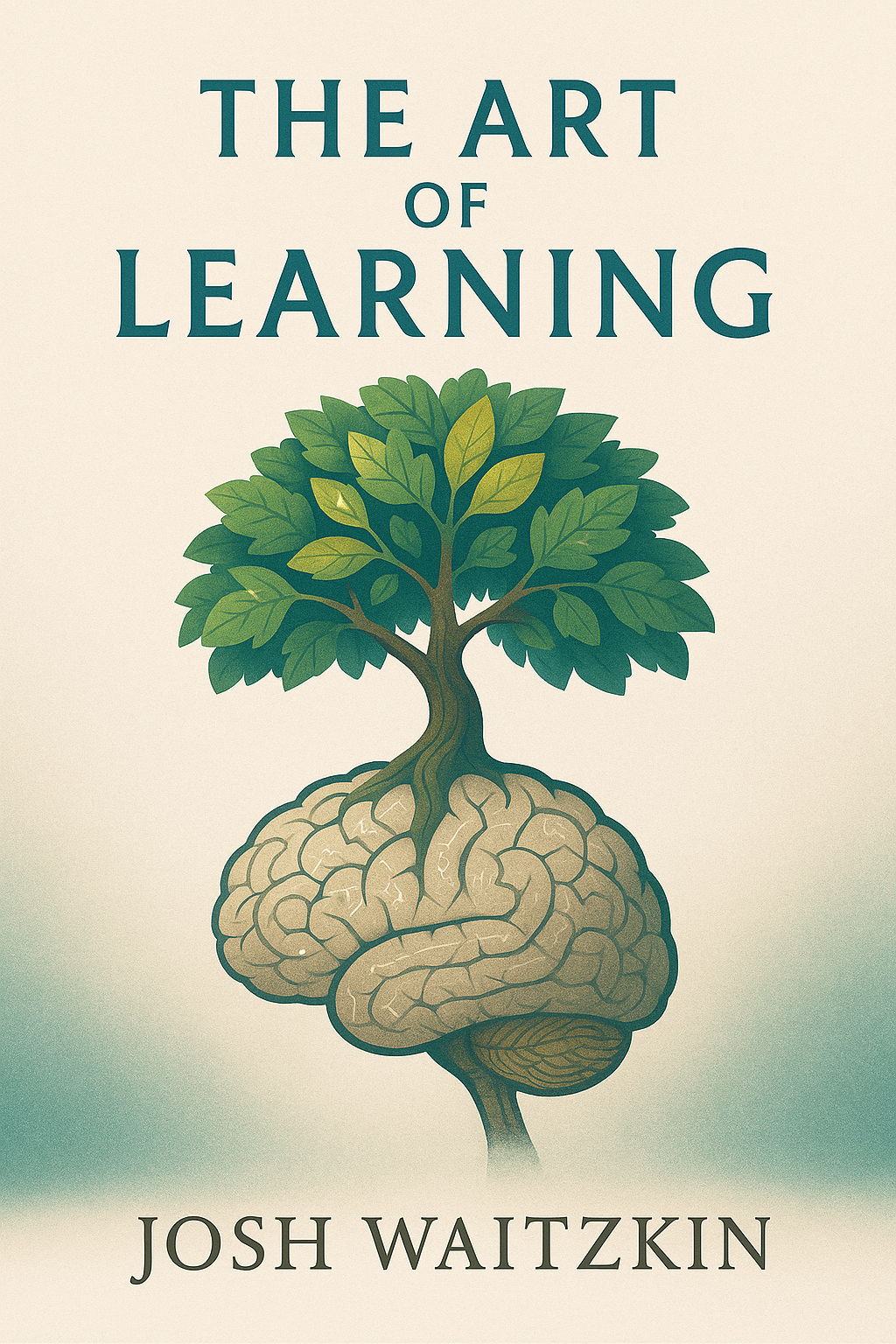
The Art of Learning
Chapter Summaries
What's Here for You
Embark on a transformative journey with Josh Waitzkin, a former chess prodigy and martial arts champion, as he unveils the universal principles that unlock peak performance and profound mastery in "The Art of Learning." This isn't just a book; it's your personal guide to navigating the intricate landscape of skill acquisition, drawing from Waitzkin's unique experiences that span the intellectual intensity of chess to the physical discipline of martial arts. You'll discover that the path to excellence isn't about innate talent, but about cultivating a powerful, adaptable learning system. Prepare to explore the exhilarating spark of initial fascination, the crucial lessons hidden within defeat, and the distinct mindsets that propel individuals towards genuine achievement. Waitzkin will demystify the 'soft zone' and the elusive 'zone' of peak performance, revealing how to intentionally cultivate these states rather than passively wait for them. You'll learn to embrace adversity, not as an obstacle, but as a powerful catalyst for growth, transforming challenges into opportunities for deeper understanding and resilience. The book delves into the art of intentional practice, the power of presence, and the subtle yet profound ways we can harness our emotions, even anger, to fuel our progress. Through vivid anecdotes and insightful analysis, Waitzkin illuminates how to break free from limiting beliefs, develop a 'beginner's mind' regardless of your expertise, and ultimately, how to integrate all these elements to express your truest potential. This is an invitation to engage with learning on a deeper, more soulful level, fostering not just skill, but a lifelong love for the process of becoming. The tone is one of profound insight, intellectual rigor, and inspiring encouragement, offering practical wisdom that resonates across all disciplines and life's endeavors.
INNOCENT MOVES
The journey into mastery often begins with an unexpected spark, a moment of pure, unadulterated fascination. For the young Josh Waitzkin, this spark ignited on a cold winter afternoon in Washington Square Park, not on a football field or a bike jump, but before a chessboard. He was captivated by the 'mysterious figurines,' the 'forest' of pieces that seemed to hold 'strange potential,' a battlefield where nimble fingers exploded into action with 'lightning speed and precision.' This initial encounter, a glimpse into a world of intense focus and strategic depth, felt strangely familiar, like discovering a lost memory. Driven by this nascent curiosity, Josh sought out the game, surprising an old man with his raw, intuitive talent, a talent so profound it led to whispers of 'Young Fischer' and a prediction that he'd be reading about him in the paper someday. Washington Square Park became his unconventional university, a place where he honed his skills against a motley crew of 'alcoholics, homeless geniuses, wealthy gamblers, junkies, eccentric artists'—a 'bizarre school' that forged him into a 'protg of the street,' tough and feisty. This unique environment presented a central tension: how to reconcile the raw, uninhibited play learned on the street with the disciplined, classical approach required for true mastery. His parents and a master player named Bruce Pandolfini recognized his extraordinary gift, but understood that forcing him into a rigid structure would stifle his innate passion. Bruce, embodying a different kind of wisdom, became a guide rather than an authority, fostering camaraderie and allowing Josh to discover principles through play and questioning. He learned that true learning isn't about blindly accepting instruction, but about developing the capacity to analyze one's own thought process, to ask 'Were there other ways?' and to 'check yourself before you wreck yourself.' The key insight here is that the most effective learning integrates raw intuition with disciplined analysis, a fusion that allows one's natural voice to flourish without being suppressed. Bruce nurtured this balance, ensuring that technical material never 'smother[ed] his innate feeling for the game.' This duality became the engine of Josh's rapid ascent; the 'street-tough competitor' fused with the 'classically trained, patient player.' His innate confidence, unhindered by internal conflict, allowed him to thrive in chaos, turning adversity into a predator's advantage. This period of 'innocence,' deliberately protected from competitive pressures, allowed his love for the game to deepen, ultimately leading him to become the highest-ranked player for his age in the country, poised for the National Championship, a testament to the power of a learning environment that honors both passion and precision.
LOSING TO WIN
The chessboard, a microcosm of life's grand battles, often reveals our deepest vulnerabilities and greatest strengths. Josh Waitzkin, at eight years old, stood on the precipice of national chess glory, the favorite, the one to beat. Yet, in the final round of the Primary School National Chess Championship, the weight of expectation proved a heavy crown, transforming the throne of the top board into a solitary prison. His opponent, David Arnett, a prodigy with a mind that grasped complex mathematics at an age when most children were learning to tie their shoes, presented a formidable, unexpected challenge. A seemingly innocuous pawn capture, a moment of overconfidence, and suddenly Waitzkin found himself fighting for survival, the cool composure of invincibility shattering under the pressure. This wasn't just a game; it was a crucible, forcing him to confront his own fragility, the stark realization that his identity was perhaps too tightly bound to winning. The fall from grace was brutal, leaving him reeling with questions of worth and identity. But in the aftermath, as the sting of defeat began to fade, Waitzkin's family offered a powerful antidote: the ocean. Their annual summer fishing trips to Bimini, far from the intense glare of competition, became a sanctuary—a space for renewal, for reconnection with family and nature, and for regaining perspective. These weren't vacations; they were rigorous immersions in the raw power of the sea, demanding constant presence and the surrender of control, lessons that echoed in the unpredictable currents of life and competition. This forced pause allowed his conscious mind to step back, creating space for new insights to emerge, a testament to the profound wisdom found in stepping away from the fray. His mother, a figure of quiet strength and boundless compassion, served as an anchor, her unwavering support a reminder that vulnerability is not weakness. His father, a devoted companion in ambition and emotion, shared the highs and lows, a constant presence in the relentless pursuit of excellence. Returning from these restorative journeys, Waitzkin found a renewed sense of purpose and a deeper understanding of the game. He learned that true resilience isn't about avoiding defeat, but about how one responds to it. The rivalry with Jeff Sarwer, another young chess prodigy whose intense, almost feral, dedication mirrored Waitzkin's own drive, became a defining conflict. Sarwer, a 'chess machine' forged in an authoritarian environment, represented a raw, aggressive approach to the game. Their matches were brutal, pushing Waitzkin to confront his own capacity for both intense focus and emotional fortitude. The ultimate showdown at the Nationals, a tense endgame where Waitzkin, down material, found an unexpected, counterintuitive path to a draw, secured him the championship. This victory, however, was not simply about outmaneuvering an opponent; it was about navigating the internal landscape of fear, self-doubt, and the profound realization that his worth extended far beyond the outcome of a single game. He emerged not just as a champion, but as a more resilient, self-aware individual, understanding that the greatest lessons are often learned not in victory, but in the moments when everything seems to be falling apart.
TWO APPROACHES TO LEARNING
The relentless pursuit of excellence, whether on the scholastic chess board or in any ambitious field, often hinges not just on talent, but on a fundamental approach to learning itself. Josh Waitzkin, reflecting on his early experiences, reveals a critical distinction: the entity theory versus the incremental theory of intelligence. Entity theorists, often shaped by praise for innate ability like 'I am smart,' see their skills as fixed, leading them to avoid challenges for fear of shattering a fragile self-image, much like a hermit crab refusing to seek a larger shell. Conversely, incremental theorists, who attribute success to effort and hard work—'I got it because I worked very hard'—embrace challenges as opportunities for growth. Dr. Carol Dweck's research illuminates this, showing that when faced with difficulty, incremental theorists persist and learn, while entity theorists often falter and quit, their confidence eroded. This dynamic is deeply ingrained, often by well-meaning parents and teachers whose feedback focuses on outcomes rather than process. The author illustrates this with the stark contrast between studying chess openings for quick wins—a path that leads to a superficial understanding and a brittle mindset—and deeply exploring fundamental endgame principles, which builds a robust, intuitive grasp of the game. This foundational approach, focused on understanding the 'why' and the 'how' rather than just the 'what,' cultivates resilience and a genuine love for the learning process itself. For Waitzkin, embracing the struggle, learning from painful losses as much as from wins, and maintaining a long-term perspective, even under immense pressure, is the very essence of the art of learning. The true journey, he suggests, is not about immediate glory but about the wisdom and character forged through persistent, mindful engagement with challenges, transforming setbacks into stepping stones for deeper mastery and enduring happiness.
LOVING THE GAME
The author, Josh Waitzkin, recounts how his early chess career, marked by a string of national championships and international competitions, was fueled by a deep-seated passion that transformed the complex game into a profound avenue for self-discovery. He explains that his unique strength lay in embracing chaos, deliberately steering games into intricate, 'sharky' positions where his personality thrived, seeing logic in what others perceived as mayhem. This ability to dictate the tone of the battle, unlike rivals who clung to predictable openings and rating points, was a significant advantage. The narrative then shifts to the challenges faced when Waitzkin began competing in adult tournaments, a stark contrast to the scholastic circuit. Here, seasoned players often steered the game into closed, strategic battles, forcing him to develop abstract thinking and a keen eye for improvement. This toughened him, making him introspective and more resilient, while also granting him confidence when returning to scholastic events. A crucial lesson emerged from the demand for endurance in adult tournaments, where games could stretch for grueling hours, testing a young player's stamina and mental fortitude, as exemplified by a ten-hour marathon that taught him the necessity of mental endurance. Waitzkin emphasizes that even amidst dominance, losing was a regular and important experience, fostered by his father’s deliberate search for stronger opponents, which maintained a healthy perspective and tempered the fear of failure with an intense love for the game itself. He poignantly describes the visceral pain of losing a chess match, where every fiber of one’s being is poured into the struggle, making defeat feel like a brutal tearing of the heart. This emotional intensity leads to a critical insight on the balance between process and results: while a focus on learning is vital, completely shunning results can stunt growth and erode the toughness needed to overcome obstacles. He uses the analogy of learning to swim, stressing that one must get in the water to truly learn. Waitzkin then illustrates this with the dilemma of a young chess player named Danny and his mother, highlighting how a parent should navigate a child's disappointment. The advice is not to dismiss the loss, as it matters deeply to the child, but to offer empathy, validate their feelings, and then, with quiet introspection, help them identify the psychological or mental factors behind the mistake, turning each loss into a learning opportunity. This approach, he suggests, liberates an ambitious child to face challenges head-on. The author further reflects on his own journey, detailing the constant leaps into the unknown, adapting to unfamiliar chess styles, challenging new rivals, and navigating foreign cultures and customs, such as arriving late to a tournament in Romania with an unfamiliar chess set. He recounts the emotional transition of changing coaches, moving from Bruce Pandolfini to Victor Frias, and the added pressure from the public attention surrounding his father's book and subsequent film. Despite the spotlight and the inherent plateaus in growth, Waitzkin's burning love for chess propelled him forward, leading him to become a Chess Master at thirteen. He concludes by underscoring that true happiness and long-term success are not derived from external glory, but from the relentless pursuit of learning and the internal drive to push beyond one's limits, finding that even after winning a major championship, the world remained the same, and the real joy lay in the ongoing process of engagement and growth.
THE SOFT ZONE “Lose Yourself”
Josh Waitzkin, at sixteen, found himself in the sweltering heat of Calicut, India, facing the World Junior Chess Championship, a crucible of intense concentration and psychological warfare where fierce rivals were also intimate mirrors of one's own struggles. He recounts a pivotal moment during a grueling match against the Indian National Champion, where, after hours of grinding effort, he began to lose himself in the complex variations of the game. This wasn't mere focus; it was a surrender into a state of pure presence, an energetic flow where the chess position consumed his consciousness, erasing the concept of 'I' in a moment of blissful engagement. Then, an earthquake struck. Amidst the chaos, the shaking ground, and the panicked screams of spectators, Waitzkin remained within the chess problem, experiencing a surreal synergy of self and no-self, pure thought and the awareness of a thinker. This external cataclysm, ironically, became an internal catalyst, spurring a revelation that solved the critical chess position and ultimately led to his victory. This profound experience became the launching point for his deep investigation into performance psychology, revealing a fundamental tension: how to navigate the inevitable 'mini earthquakes' of life and competition. Waitzkin introduces the concept of 'The Soft Zone,' contrasting it with the brittle 'Hard Zone' of tension. The Soft Zone, he explains, is a state of quiet, intense focus, characterized by resilience and the ability to flow with, rather than fight against, distractions. It's like a blade of grass bending in a hurricane, not a dry twig snapping. He illustrates this with an ancient Indian parable: faced with a land covered in thorns, one can pave the road or make sandals. The Soft Zone is the internal solution, achieved through intelligent preparation and cultivated resilience, much like making sandals. Waitzkin's own journey with distraction began with a simple, yet maddening, Bon Jovi song echoing in his mind during a critical chess game, leading to a blunder. He realized that the more he fought the distraction, the louder it became. The breakthrough came when he learned to think *to the beat* of the music, integrating it into his calculations. This led to a systematic training regimen, much to the chagrin of his family, where he deliberately exposed himself to noise and discomfort—blasting music, enduring smoky chess shops, and playing in the cacophony of Washington Square Park—to build mental resilience. He learned to adapt his play style to the distraction, turning potential hindrances into creative prompts. The chapter then delves into more insidious forms of distraction, recounting how rivals employed psychological tactics like subtle tapping to disrupt his concentration or outright cheating, such as kicking him under the table or discussing moves in Russian. These challenges, particularly from a new wave of highly trained Soviet émigrés, tested his resolve. Waitzkin initially reacted with anger, which threw him off his game, but he eventually understood that the solution wasn't to deny emotions but to channel them into heightened focus, a lesson honed years later in martial arts. He emphasizes that mental resilience is the bedrock of world-class performance, cultivated not by avoiding discomfort but by becoming at peace with it, transforming pain or chaos into fuel for growth. This internal work, he suggests, can be practiced in everyday moments, like leaving a card hand disorganized to practice mental organization, or consciously leaving a window open to the disruptive sound of a lawn mower, embracing the 'madness' to foster inner calm. The core dilemma, therefore, is how to move from being a victim of external circumstances and internal noise to becoming a master of one's own mental landscape, capable of generating inspiration from within.
THE DOWNWARD SPIRAL
Josh Waitzkin, reflecting on his years coaching young chess prodigies at Public School 116, delves into the insidious nature of the 'downward spiral'—that devastating chain reaction of errors that can derail even the most talented performers. He observed firsthand how a single mistake, often minor, could lead to a cascade of poor decisions, particularly in young, enthusiastic learners whose raw curiosity contrasted with the pressure of competition. This phenomenon, Waitzkin explains, isn't limited to chess; it's a universal human tendency, a psychological wave that can pull individuals under when their mental clarity falters. The author illustrates this with a vivid, almost cinematic scene: a highly skilled chess Master, having meticulously built a winning advantage over three hours, makes a subtle error that equalizes the game. The Master's emotional attachment to the previous state of control creates a chasm, leading to a rejection of correct variations and a desperate, overconfident push that ultimately leads to defeat. This isn't just about chess; it's about the brittle dependence on perfection that triggers fear and muddies decision-making. Waitzkin powerfully connects this to a tragic real-life event he witnessed: a young woman, distracted by music, steps into traffic, narrowly avoids a cyclist, but then, instead of regaining presence, becomes angry and turns her back to oncoming traffic, only to be struck by a taxi. This incident, he shares with his students, becomes a profound lesson: the first mistake is often forgivable, but the reaction to it—the anger, the clinging to what was—is what creates the true disaster, a parallel to the chess player lost in memory rather than the present moment. He uses the metaphor of two lines, one of time and one of perception, diverging when we become frozen in the past, leading to the metaphorical 'taxicab' of life's consequences. Waitzkin imparts strategies for regaining presence, from simple deep breaths and splashing cold water to more dramatic physiological resets like sprinting outside. The core insight is that great performers, whether actors improvising a missed line or musicians recovering from a falter, learn to ride these psychological waves, not be swept away by them. He emphasizes that brilliant creations are often born from minor errors, but only if the performer doesn't succumb to fear. The chapter culminates in a powerful anecdote: Ian Ferguson, one of Waitzkin's former students, now competing in the National Championships, nearly loses a crucial game after 'hanging his bishop.' Just as he's about to make a game-losing move to capture his opponent's queen, he recalls the lesson of the woman and the bike, takes deep breaths, regains his composure, and ultimately wins the game, demonstrating the profound impact of learning to snap back into the present moment. This journey from recognizing the destructive pattern of compounding errors to developing strategies for resilience underscores the crucial skill of maintaining presence, turning potential disaster into a moment of clarity and triumph.
CHANGING VOICE
As a young chess prodigy, Josh Waitzkin found himself at a crossroads, the glare of the spotlight and Hollywood's portrayal of his life beginning to eclipse his genuine love for the game. He recounts how, at sixteen, amidst winning championships and becoming America's youngest International Master, an internal shift began; the organic joy of chess was slowly being replaced by the pressure to live up to external expectations, a peculiar detachment creeping into his play, as if observing himself from across the room. This period also saw him train with a Russian Grandmaster who advocated for a more conservative, systematic style, urging him to emulate players like Petrosian and Karpov, masters of subtle maneuvering rather than aggressive dynamism. While intellectually engaging, this imposed style felt alien, stifling his natural, creative, and attacking voice, making the game feel less like an extension of his being. Simultaneously, Waitzkin navigated the complexities of adolescence and the unique environment of the Professional Children's School, a haven for young artists and performers that offered flexibility and intellectual stimulation, exposing him to great literature and fostering a broader sense of self. Yet, the combined weight of unprepared fame and alienation from his art fueled a hunger for escape, leading him to defer college and embark on a formative journey through Eastern Europe. There, as a young man of nineteen and twenty, his relationship with chess deepened, infused with a more sophisticated consciousness, wrestling with self-doubt and alienation away from the pressures of celebrity. He discovered a new private relationship with the game, driven less by ambition and more by a yearning for self-discovery, meticulously sifting through critical positions from past tournaments in his secluded Slovenian village. This intensive, introspective study, which he termed 'numbers to leave numbers,' involved dissecting errors and moments of confusion, allowing his mind to thaw and eventually dissolve complications until understanding emerged, not as variations, but as an elemental, intuitive grasp of the game. A profound realization emerged as he saw the direct correlation between his chess errors and his life's struggles, particularly his difficulty with transitions – a homesickness for stability manifesting as an inability to adapt to sudden shifts in chess positions. This awareness spurred a dual approach: consciously embracing change in life and using deep breaths to clear his mind during critical moments in chess. He began to view chess study as a form of psychoanalysis, unearthing subtlest foibles, recognizing that opponents' psychological nuances mirrored his own, allowing him to tailor his approach to exploit their tendencies. Returning to America at twenty-one, Waitzkin found himself more in love with the study of chess than ever, seeing it as a path to self-discovery and an unattainable truth. However, he was in a vulnerable stage, spiritually enriched but lacking the fierce competitive drive of his youth, a paradox of being a profound learner yet artistically constrained. He explains that 'numbers to leave numbers,' or 'form to leave form,' is the integration of technical information into natural intelligence, much like a beginner learning the numerical value of pieces eventually transcends calculation to feel their power intuitively, transforming mathematical understanding into felt wisdom.
BREAKING STALLIONS
The author, Josh Waitzkin, invites us to consider life's ambitious pursuits as a delicate act on a balance beam. In childhood, this beam feels wide, a playground for fearless leaps and rapid learning, where falling is merely a temporary setback. But as awareness of risk and consequence grows, the beam narrows, transforming into a high-wire act where any misstep becomes a crisis, the air thick with pressure. This transition from playful exploration to stressful performance, Waitzkin reveals, is a critical juncture in high-level learning. The core challenge is cultivating a resilient awareness, an older, conscious embodiment of a child's natural obliviousness, to navigate these pressures without losing one's center. He illustrates this through his experience with two towering figures in Russian chess: Yuri Razuvaev and Mark Dvoretsky. Razuvaev, described as a serene, Yoda-like figure, possessed a profound ability to understand and nurture a student's unique disposition, calming and focusing their inner world. His approach was akin to a spiritual retreat, emphasizing individualized growth and harmony with the student's natural voice. In stark contrast, Mark Dvoretsky, a genius of chess theory, employed a more brutal, systematic method. His approach, as Waitzkin experienced it, was like Orwell's prison scenes, designed to break down a student and fit them into a rigid, preconceived mold of excellence. This "shock and awe" method, as Waitzkin likens it to one way of taming a wild horse, prioritized submission over spirit. The author recounts a pivotal disagreement during his teenage years: Dvoretsky and his protégé advocated for a defensive, "anaconda-like" style of play, urging Waitzkin to suppress his natural attacking instincts. Razuvaev, however, championed nurturing his "natural voice" as an attacking player, suggesting that even the acquisition of defensive skills could be achieved by studying great players of a similar attacking nature. This divergence, Waitzkin explains, led him to lose his "center of gravity" as a competitor, alienating him from his authentic self. The chapter draws a powerful analogy to training horses: one method "breaks" the animal through fear and exhaustion, while the other, the "horse whisperer's" way, involves gentle, consistent handling from a young age, synchronizing desires until the horse willingly follows, its unique spirit intact. This gentle approach, harmonizing intention and fostering a bond, is what Razuvaev embodied. Waitzkin concludes that his journey, from the brink of losing his creative spark to rediscovering a relationship with ambition aligned with his "unique disposition," is at the heart of true success. This experience, though painful, became a crucible for growth, teaching him the vital importance of integrating new knowledge without violating one's core identity, a lesson learned from the "brutal testing ground" of his final chess years.
BEGINNER ’S MIND
In the summer of 1994, amidst the high-stakes preparation for the World Under 18 Chess Championship, Josh Waitzkin found an unexpected spark in Jack Kerouac’s "On the Road." This wasn't just a book; it was an electric current, a reminder of the sheer joy hidden in the mundane, a stark contrast to the oppressive pressures of his chess career. This newfound passion fueled his performance in Hungary, leading him to a dramatic tie for first place with Peter Svidler. Yet, in a moment that defined his "leave-it-on-the-field" style, Waitzkin declined a draw, pushing for a win and ultimately suffering a heartbreaking loss. The emotional turmoil of this defeat, compounded by a painful breakup with his girlfriend in Slovenia, could have been crushing. However, traveling through wartorn Croatia and finishing "On the Road" amidst a storm on an Austrian train, Waitzkin experienced a bizarre aliveness, a profound sense of being more alive than ever despite the losses. This period of intense personal upheaval also marked a turning point in his philosophical exploration, leading him from the energetic rebellion of the Beat Generation to the introspective wisdom of Zen Buddhism through Kerouac's "The Dharma Bums," and then to the Tao Te Ching. He discovered in Lao Tzu’s ancient text a framework for understanding his complicated relationship with ambition, a call to "blunt his sharpness" and move away from the superficial towards an "underlying essence." This philosophical grounding became crucial as his approach to chess shifted from intense competition to introspection. Seeking to embody these ideas, Waitzkin discovered William C. C. Chen’s Tai Chi Chuan studio in New York. Here, the objective wasn't winning, but simply "being," a stark contrast to the competitive arena he knew. He observed Chen, a sixty-four-year-old master, moving with an ageless grace, his body a conduit of "strange electrical connection," demonstrating a profound simplicity and precision. Waitzkin, initially stiff and awkward, felt the immediate challenge of "relaxing, relaxing, relaxing," a direct antidote to years of tension honed over a chessboard. He learned to coordinate breath and mind, understanding that natural breathing, not forced methods, was key to unlocking the body’s potential, much like the ebb and flow of water. This practice became a sanctuary from the suffocating pressures of his chess career, a place where his physical and mental selves, once estranged, began to reconnect. Through the subtle, almost osmotic teaching of Master Chen, who could "read the body like a great chess player reads the board," Waitzkin learned to release obstructions, allowing mind and body to flow together. This journey, from the thrill of a Kerouac-inspired road trip to the quiet discipline of Tai Chi, illustrates a profound shift: the realization that true learning and vitality emerge not from relentless pursuit of victory, but from embracing a beginner's mind, releasing tension, and finding the flow within. The invitation to Push Hands practice marked the beginning of a new, transformative chapter.
INVESTMENT IN LOSS
The author, Josh Waitzkin, recounts his initial trepidation upon being invited to join Push Hands classes in Tai Chi. Initially viewing his Tai Chi practice as a personal, meditative haven, he feared that engaging in its martial aspect might shatter this sanctuary, especially after the combative nature of his chess career. Yet, he recognized the potential for growth, seeing it as a natural progression to test his ability to maintain relaxation under pressure, understanding that the art's essence lay not in clashing, but in yielding and blending with an opponent's energy. Stepping onto the floor for his first Push Hands class, the atmosphere felt heightened, a stark contrast to his beginner sessions. Under the guidance of Master William Chen, Waitzkin experienced firsthand the profound principle of yielding, finding himself effortlessly sent airborne by Chen's minimal effort, a stark realization of the martial philosophy to 'defeat a thousand pounds with four ounces.' This initial encounter revealed the subtle mechanics of redirection, where Chen's body seemed to dissolve into emptiness, luring Waitzkin into overextension. The author introduces the core concept of 'investment in loss,' emphasizing that true growth requires relinquishing the ego’s need to resist or appear competent, much like Charlie Brown repeatedly losing the football. This means embracing vulnerability, allowing oneself to be 'tossed around' to unlearn ingrained habits of tension and resistance, a difficult leap for many, particularly those accustomed to physical dominance. Waitzkin describes his own rapid progress through this humility training, contrasting it with other students who became 'frozen in place,' justifying their errors rather than learning from them, a pitfall he himself had experienced in chess when pressure numbed his ability to grow. He connects this to his chess experience, recognizing that his earlier success was built on a similar willingness to be open and learn from every mistake, a stark contrast to the 'desperate need to win' that had later crippled his growth. As Waitzkin internalized Tai Chi's technical foundation, his chess-honed strategic thinking began to manifest, allowing him to recognize structural flaws and play with unexpected combinations. The narrative then shifts to a more intense phase, introducing Evan, a powerful practitioner who served as a brutal training partner, forcing Waitzkin to confront his fear and resistance head-on. For months, Waitzkin endured being 'hammered' by Evan, literally experiencing plaster falling from the walls, a period he describes as deeply challenging but crucial for developing resilience and the ability to absorb blows without tensing. This intense 'investment in loss' eventually led to a breakthrough, where Evan’s attacks began to slow down in his perception, allowing him to anticipate and neutralize them, ultimately reversing their dynamic. Waitzkin reflects that Evan's own unwillingness to 'invest in loss' by learning from Waitzkin's improvement led to his stagnation. The chapter concludes by extending these principles to broader life applications, emphasizing that periods of vulnerability and breakdown are inevitable in any discipline, whether it's learning a new skill, adjusting to a new role, or refining a technique. He stresses the importance of allowing oneself protected periods for cultivation, a liberating incremental approach that permits times of not being in peak performance, a lesson he learned too late in his chess career after public scrutiny. Like Michael Jordan, who missed more game-winning shots than anyone but was willing to take them, true greatness is found not in avoiding failure, but in the courage to repeatedly put oneself on the line, embracing the 'fire' of learning to sharpen one's skills.
MAKING SMALLER CIRCLES
In the quest to uncover the fundamental principles that bind disciplines like chess, martial arts, and the broader landscape of learning, Josh Waitzkin guides us toward a profound insight, echoing Robert Pirsig's exploration of depth. He presents the tale of a student paralyzed by a broad assignment, liberated by focusing on a single brick of the opera house, a powerful metaphor for the art of learning. This anecdote reveals a core tension: our modern, attention-deficit culture bombards us with information, fostering a superficial engagement with the world. This tendency, Waitzkin observes, infects the learning of martial arts, where students often chase quantity—numerous flashy forms—over quality, becoming 'form collectors' with impressive but ultimately hollow techniques. The author advocates for a different path, exemplified by his deep dive into Tai Chi Chuan. By focusing on the most simplified movements, like pushing hands six inches through the air, practitioners can cultivate an acute awareness of internal sensations, releasing tension and discovering a new world of feeling. This meticulous refinement of the micro, the 'detailed mystery of the micro,' unlocks understanding of the macro. Waitzkin illustrates this with his chess studies, where dissecting simple endgame positions revealed high-level principles applicable to complex scenarios. The resolution lies in the concept of 'Making Smaller Circles': internalizing the essence of a skill through deep, focused practice, and then incrementally condensing its outward manifestation without losing potency. This is akin to a boxer refining a jab, making it so efficient it's almost invisible, or a Grandmaster controlling the chess center without overtly occupying it. The ultimate aim is to transform large, obvious movements into condensed, potent expressions, where mastery resides not in breadth, but in a profound, almost unconscious, internalization of fundamental principles, leading to a quiet, devastating effectiveness.
USING ADVERSITY
In the crucible of competition, where even the air crackles with anticipation, Josh Waitzkin recounts a pivotal moment during the SuperHeavyweight Finals of the Wong Fei Hung All Kung Fu Championships in 2001. Facing a much larger, enraged opponent, Waitzkin, a middleweight champion, found himself in a precarious situation, a gamble for extra training that quickly turned serious. He had neutralized his opponent's strength in the first round, but in the second, a brutal attack led to a sickening crack—his hand was broken. This moment of intense physical pain, however, became a catalyst for profound mental clarity. Time seemed to slow, his perception heightened, transforming the incoming violence into 'clouds,' easily dodged and neutralized, a state of pure flow akin to a chess game. This mirrors an earlier revelation during an earthquake in India, where external chaos spurred an internal breakthrough. Waitzkin articulates three crucial steps for resilient performers: first, embracing imperfection, like a blade of grass bending in the wind; second, using that imperfection as a tool for performance, transforming a shaking world into a catalyst for insight; and third, proactively creating internal jolts to maintain inspiration, not waiting for external crises. The broken hand, though a severe setback seven weeks before the National Championships, became an unexpected gift. Doctors advised against competing, citing a spiral fracture and the certainty of atrophy. Yet, Waitzkin resolved to compete, embracing the challenge. He began training with his weaker side, engaging in slow, meditative Push Hands to heighten sensitivity, and discovered the importance of undulating between concrete physical training and abstract internal work, a balance often neglected in the grind of competition. This forced him to cultivate his left side, developing a remarkable new martial insight: controlling two of an opponent's limbs with one of his own, a principle applicable across many disciplines, from chess to corporate negotiations. This injury also spurred an innovative approach to physical recovery; through intense visualization, he channeled the energy of his left-side workouts into his immobilized right arm, a 'shot in the dark' that stunned his doctor. Four days before the Nationals, his bone was healed, atrophy minimal, and he competed, winning with a slightly favored left arm. Waitzkin emphasizes that true greatness demands embracing risks, optimizing learning from every moment, and transforming adversity into a creative advantage, not merely recovering from setbacks. He calls this the 'internal solution'—learning to internalize the growth triggered by external events without needing the actual crisis, thereby manufacturing helpful growth opportunities and becoming inspired by adversity itself.
SLOWING DOWN TIME
Josh Waitzkin, in 'The Art of Learning,' unveils a profound idea: the mastery of time perception is not a mystical gift but a cultivated skill, born from the depths of focused expertise. He begins by recalling a childhood fear of an overflowing mind, a fear that hints at a deeper truth about navigating vast amounts of knowledge. This leads to the central tension: how can we consciously slow down our perception of time, much like the instinctual surge during moments of crisis, to enhance our performance at will? Waitzkin posits that the key lies in understanding and harnessing the power of intuition, that subtle bridge between the unconscious and conscious mind. He illustrates this through the concept of 'chunking' and 'carved neural pathways.' In chess, for instance, stronger players don't just memorize more; they group information into meaningful clusters, creating efficient mental pathways. Imagine the mind as a dense jungle; initial learning is hacking through thick foliage, but with practice, these become well-trodden paths, then paved roads. As knowledge deepens, individual pieces and principles merge into interconnected networks, where their value becomes relational, not absolute. This leads to an essential insight: true mastery involves embracing paradox and navigating competing truths, rather than clinging to rigid rules. The author reveals that at the highest levels of performance, the distinction between conscious and unconscious processing blurs. It's not about thinking faster, but about the conscious mind processing less, allowing the unconscious to handle the intricate details, much like expanding peripheral vision while maintaining sharp focus on a central object. This cultivated state allows for a perception where, within the same objective time, the master experiences hundreds of 'frames' of information while an opponent sees only a few. Waitzkin uses a vivid analogy of a camera, where the conscious mind's capacity is like a computer screen; when presented with less information, it can zoom in on details with incredible precision, making time *feel* slower. He draws a parallel to martial arts, where a complex throw, appearing as a blur to an untrained observer, is for the master a series of interconnected, deeply understood steps, each with numerous potential variations. The resolution comes not from ignoring external awareness, but from converting extraneous information into unconsciously integrated data, allowing the conscious mind to operate with laser-like precision on critical elements. This trained perception, he argues, is the disciplined evolution of the same instinctual focus seen in life-or-death moments, transforming the chaotic into the elegantly controlled.
THE ILLUSION OF THE MYSTICAL
The author, Josh Waitzkin, delves into the profound misconception of "mystical" elements in high-level performance, arguing that what appears supernatural is, in fact, the culmination of deeply understood principles of intention, perception, and subtle manipulation. He begins by wrestling with the paradoxical Tai Chi adage, "If the opponent does not move, then I do not move. At the opponent's slightest move, I move first," a concept that initially baffled his chess-honed precision. Waitzkin reveals that this isn't about psychic foresight but about reading and controlling intention, a skill honed through years of chess where "Jedi Mind Tricks"—penetrating insight combined with technical virtuosity—were paramount. He illustrates this with early chess experiences, feigning distress to lure opponents into traps, a rudimentary form of psychological conditioning. As his skills sharpened, the deception evolved, becoming as subtle as a change in breathing patterns or the deliberate manipulation of his own emotional tells, using his outgoing personality to dictate the psychological tone of the game. Waitzkin draws a parallel between the subtle reveals in chess and the seemingly mundane moments in life, suggesting that character tendencies manifest even off the board, informing one's approach to tension and discomfort. Transitioning to martial arts, he applied these principles to physical confrontations, demonstrating in a Push Hands scenario how to mentally program a larger, stronger opponent. By observing and provoking a predictable pattern of action-reaction—engaging the opponent's ego and establishing a rhythm of push-and-pull—Waitzkin could then exploit the opponent's programmed response with a precise, subtle movement, leading to an unexpected throw. He clarifies that this "magic" is not supernatural but a sophisticated interplay of awareness and technique, akin to an illusionist subtly guiding a volunteer's choice before the trick even begins. The key lies in "Making Smaller Circles" and "Slowing Down Time" to perceive and influence micro-moments, such as the almost imperceptible shift in weight or the brief lapse in awareness during an opponent's blink. Waitzkin emphasizes that the battle is won not through brute force, but by understanding these underlying dynamics, whether on the mat, the chessboard, or in a negotiation. He shares a powerful training anecdote with Daniel Caulfield, where the intense psychological warfare led to moments where one would blink and find themselves airborne, a testament to the refined control of intention. Ultimately, Waitzkin asserts that these skills, far from being mystical, are learnable, requiring condensed technique and enhanced perception to exploit the subtle tells—like breath patterns, eye movements, or weight shifts—that betray an opponent's intention, allowing one to "move first" by controlling the very intention to move.
THE POWER OF PRESENCE
Josh Waitzkin, in "The Art of Learning," transports us deep into the Amazon jungle, a place where the primal struggle for survival is starkly real, a world away from our buffered lives. Here, the author recounts an encounter with his guide, Manuel, and the chilling story of Jos, a man intimately familiar with the jungle's rhythms, who faced a jaguar. Jos, a master of his environment, possessing an almost supernatural awareness, found himself tested not by the jaguar's physical prowess, but by the unbearable tension of waiting, the psychological battle that preceded the physical one. When the jaguar finally moved, Jos, his resolve frayed by the prolonged, agonizing anticipation, inadvertently made a fatal mistake—he backed away. This moment, the subtle concession under immense pressure, led to his spirit being broken, a stark illustration of how internal states can dictate outcomes even for the most skilled. Waitzkin draws a powerful parallel to his own experiences in high-stakes chess, where the mounting pressure felt like a vise, leading to small concessions that sealed his defeat against world-class opponents. He realized that true mastery wasn't just about skill, but about cultivating an immunity to this internal pain, about learning to be at peace with mounting pressure. This led to a profound insight: the ability to remain clearheaded and present under fire is a critical differentiator between the best and the mediocre. In the absence of external validation, like in solitary pursuits such as writing or learning, this inner presence becomes our most vital tool, our own monitor of quality. The chapter argues that excellence isn't achieved by going through the motions, but by maximizing each moment's creative potential through deep, fluid presence, making it as natural as breathing. The secret, Waitzkin reveals, is that 'everything is always on the line,' and cultivating this presence in practice is the foundation for performing optimally under any pressure, be it in competition, the boardroom, or the quiet pursuit of knowledge.
SEARCHING FOR THE ZONE
Josh Waitzkin, in "The Art of Learning," delves into the elusive 'zone,' a state of peak performance, exploring its nature and how to cultivate it intentionally. He recounts his early chess experiences, oscillating between moments of profound immersion where the world dissolved into a singular focus, and days of distraction, a hit-or-miss reality that his parents and coach had to navigate. As he matured and entered adult tournaments, the intense focus that had served him well began to backfire; distractions like music or ambient noise, which he initially tried to suppress, became amplified, hindering his play. His breakthrough came not from eliminating distractions, but from embracing them, learning to think 'to the beat of the song,' finding an inner focus that could withstand external chaos. This hard-won skill was soon tested on a much larger stage when the movie "Searching for Bobby Fischer" thrust him into a Hollywood spotlight, a whirlwind of fans, cameras, and jealous rivals. He initially responded as he had in his youth, by pouring immense energy into each game, a 'wildly energetic focus' that led to brilliant, albeit fleeting, performances, often leaving him profoundly depleted and unable to sustain his play through grueling tournaments. This realization that his sprint-like intensity was unsustainable in the marathons of high-level competition marked a critical turning point. He discovered the necessity of learning the science of long-term, healthy, self-sustaining peak performance, leading him to the Human Performance Institute (formerly LGE) in Orlando. There, surrounded by elite athletes and performers from various fields, he encountered a holistic approach that integrated physical and mental conditioning. A pivotal insight emerged from a simple question: 'whether or not I believed the quality of a chessic thought process was higher if it was preceded by a period of relaxation.' Analyzing his game notations, Waitzkin discovered a pattern: short, crisp thinking periods yielded better results than prolonged, deep calculations that often devolved into inaccuracy. This led to understanding the concept of Stress and Recovery, a principle observed in elite performers like Michael Jordan and Tiger Woods, who masterfully utilized brief moments of inactivity to reset and sharpen their focus. The liberating notion that he didn't need to maintain feverish concentration every second allowed him to experiment with releasing tension, stepping away from the board, and returning with renewed energy. This shift, facilitated by intense physical training like cardiovascular interval training, where the body learns to rapidly recover from exertion, translated directly to his mental game. He learned that the ability to recover, to let go and then re-engage, was paramount. This principle, applied to everything from chess to weightlifting to martial arts, revealed a profound physiological connection between physical recovery and mental clarity. The core lesson is that mastering the zone isn't about eliminating stress, but about developing the capacity to ebb and flow between intense effort and deliberate recovery, creating tiny havens for renewal even under immense pressure, ultimately unlocking creativity and intuition by tapping into the unconscious mind. This rhythm of stress and recovery, practiced consistently, forms the physiological foundation for becoming a resilient, dependable performer, capable of accessing peak states not just in isolated moments, but as a sustainable way of life.
BUILDING YOUR TRIGGER
The author, Josh Waitzkin, delves into a fundamental challenge faced by high performers: the fear of losing focus once achieved, often stemming from early conditioning that equates concentration with 'goodness' and distraction with failure. This insecurity can lead to meltdowns under pressure, a stark contrast to Waitzkin's own childhood strategy of energy preservation, like playing catch with his father during chess tournaments, which allowed him to surge later. He observes this self-destructive exhaustion is common, with coaches often pushing analysis between rounds instead of allowing rest, highlighting that the ability to recover is paramount, even for Grandmasters. In martial arts, seasoned competitors understand the necessity of conserving energy during long waits, while less experienced ones remain in a constant state of feverish alertness, burning out before the match. Waitzkin posits that we must not just be good at waiting, but learn to love it, recognizing that life unfolds in the unglamorous hours, not just the climactic moments. He introduces the concept of building a 'trigger' – a personalized routine that physiologically connects to a desired state of serene focus. This isn't about finding a perfect external catalyst, but creating one internally. Waitzkin uses the example of Dennis, a producer struggling with focus, who discovered his serene state while playing catch with his son. By reverse-engineering this, they built a multi-step routine: a light snack, meditation, stretching, and listening to music. This routine, practiced consistently, became physiologically linked to the feeling of calm focus, allowing Dennis to export it to stressful work situations. The core principle is incremental growth; the routine is gradually condensed, maintaining its efficacy while becoming more flexible. Waitzkin shares his own experience, condensing his Tai Chi meditative movements into a brief, internalized practice, enabling him to adapt to the unpredictable nature of martial arts tournaments. This ability to access peak performance on demand, even in chaotic environments, is not just for competition; it transforms everyday awareness, making the banal exquisite and enriching life by allowing us to see the world with new eyes, like a pianist learning flow from rain or a controller learning to let go from a leaf. The ultimate resolution is a profound presence, where each moment becomes rich and interconnected, leading to a higher quality of life.
MAKING SANDALS
The author, Josh Waitzkin, embarks on a profound exploration of how to navigate the turbulent waters of human emotion, particularly anger, not by denying or suppressing it, but by learning to 'make sandals'—to harness its power and transform it into fuel for deeper focus and creativity. He illustrates this through his early experiences in chess, where a rival named Boris employed psychological tactics, including outright cheating and physical provocations like kicking him under the table, to disrupt his concentration. Initially, Waitzkin attempted to block out his anger, a strategy that proved unsustainable as Boris escalated his tactics. This led Waitzkin to a pivotal realization: denial was not the answer. The true path lay in observing, accepting, and then channeling these potent emotions. This transformative insight solidified during his martial arts journey, particularly in Tai Chi Push Hands. A defining moment came in a national championship final when an opponent headbutted him, causing him to 'see red' and lose control momentarily. This experience, though disturbing, revealed a critical vulnerability: his deeply held commitment to non-violence was tested not just in peaceful settings, but under direct aggression and pain. He dedicated himself to training with 'creeps' and sparring partners like Frank, who deliberately attacked vulnerable areas like the neck. Through this rigorous process, Waitzkin learned to recognize that his anger stemmed from fear and a lack of technical preparedness. By consciously practicing neutralizing these attacks and confronting his fear, he transformed his reactive anger into a source of sharp focus. This led to a dramatic shift in his performance, as seen when he faced the same opponent a year later, this time unswayed by headbutts, ultimately winning with ease. He extends this principle to other domains, citing athletes like Reggie Miller, who used hecklers like Spike Lee as fuel, and Michael Jordan, who thrived on intimidating opponents. Even Garry Kasparov, a famously aggressive chess player, would 'play the chess moves he would have played if he were feeling confident,' effectively triggering his peak state. The core lesson emerges: rather than being a victim of our emotions, we can learn to sit with them, accept their natural eruption, and channel them into intensity, sharpening our game and forging a unique, resilient approach to performance. This process involves cultivating a 'Soft Zone,' transforming weaknesses into strengths, and discovering one's personal emotional triggers for peak inspiration, ultimately allowing us to 'make sandals' for any thorny road ahead.
BRINGING IT ALL TOGETHER
The true art of learning, as Josh Waitzkin reveals in 'Bringing It All Together,' unfolds not merely in acquiring proficiency, but in transcending it to express one's deepest essence. This journey is deeply personal, acknowledging that each learner possesses unique strengths and dispositions, requiring a tailored approach to mastery. Waitzkin recounts his rigorous preparation for the 2004 Chung Hwa Cup, the World Championships of Tai Chi Chuan Push Hands, highlighting the stark difference in skill levels between the U.S. and Taiwan, where the discipline is a national sport. His initial defeat in Taiwan in 2000, despite being a U.S. champion, was a stark reality check, demonstrating that even perfect composure couldn't overcome a significant skill gap; his opponent was simply better. This humbling experience ignited a two-year period of intense study, dissecting hours of video footage of top Taiwanese competitors, revealing that their prowess stemmed not from mysticism, but from profoundly dedicated refinement of fundamental skills, particularly subtle unbalancing techniques. Training with powerful internal martial artists like Tom Otterness forged a resilience in Waitzkin, forcing him to develop greater subtlety and a stronger 'root'—the ability to hold one's ground and channel force. By 2002, Waitzkin returned to Taiwan, improved and prepared, yet faced another formidable opponent in Chen ZeCheng, a fighter whose speed, athleticism, and technical virtuosity were breathtaking. The match was a grueling war of attrition, with Chen's relentless pressure and strategic conditioning wearing Waitzkin down, leading to his defeat. This loss, however, was not an endpoint but a catalyst. The subsequent two years became a mission to elevate his game, focusing on building a unique competitive repertoire rooted in his strategic strengths. Waitzkin's recovery from injury led to a period of deep study, breaking down the subtle techniques and footwork of the Taiwanese masters, understanding that the gap between good and great was mountainous. He emphasizes that high-level learning principles spring from a deep, creative plunge into a focused pool of information, like practicing a single technique until its essence is felt, then condensing it into an invisible arsenal. This method of penetrating the macro through the micro, Waitzkin explains, is crucial for developing exceptional skill. At the highest levels, victory often hinges not on knowing more, but on dictating the tone of the battle. For Waitzkin, this meant leveraging his strategic mind against more physically gifted opponents, turning their strengths into vulnerabilities. His training partner, Dan Caulfield, a gifted natural athlete, became instrumental in developing this strategy. Together, they honed an approach dubbed 'the Anaconda,' a game based on squelching an opponent's talents by stifling their attacks, cutting off escape routes, and exploiting the slightest overextensions—a strategy mirroring chess grandmasters like Karpov and Petrosian. This process involved countless hours of brutal sparring, meticulously analyzing video recordings of their most inspired moments, and converting fleeting moments of creative inspiration into accessible techniques. By dissecting the 'why' behind instinctive breakthroughs, like triggering a throw at the precise moment an opponent shifts their weight, they built a higher foundation of knowledge, transforming flashes of genius into reliable weapons. This iterative cycle of inspiration, analysis, and technical conversion allowed them to construct a personalized, psychologically driven arsenal, ready for the ultimate test.
TAIWAN
The air crackled with the raw energy of an approaching typhoon as Josh Waitzkin stood on Elephant Mountain, overlooking Taipei, forty hours before the Chung Hwa Cup Tai Chi Chuan World Championships. This wasn't just another competition; it was the culmination of two years of brutal, relentless training, a deep dive into the intricate dance of Fixed Step and Moving Step Tai Chi. Waitzkin explains that the Moving Step is a fast, explosive contest of athleticism and strategy, while the Taiwan-style Fixed Step is a more restrictive, profound test, stripping away athleticism to reveal the pure internal principles of the art, a minimalist duel akin to martial haiku. The central tension emerged dramatically when tournament officials, without warning, removed the pedestals used for Fixed Step, a seemingly small change that fundamentally altered the game and favored local competitors who had trained under these new conditions. This unexpected rule change, a stark example of 'house rules' on the road, forced Waitzkin and his team, including his friend Max Chen, into a frantic overnight recalibration of their strategies, demonstrating a core principle: resilience is forged in the crucible of adaptation. Waitzkin reveals that facing such adversities, especially when national pride is at stake and opponents are groomed from childhood, requires a solid foundation in principles, allowing tactics to flow naturally. He learned to embrace the unexpected, transforming a past injury—his shoulder—into a strategic advantage by developing mastery of the outside position in grappling, effectively turning a perceived weakness into a weapon that surprised his opponents. The author highlights the deceptive nature of competition, where even the most dominant athletes, like his eventual Moving Step opponent, the 'Buffalo,' might conceal vulnerabilities beneath a dazzling display of power and technique. Waitzkin’s narrative unfolds with a palpable sense of tension, particularly during the Fixed Step semifinals where questionable judging, a familiar tactic against foreign competitors, threatened to derail his progress. His resolution came not from fighting the system directly, but from maintaining presence, scoring decisively, and refusing to be rattled, a testament to the power of inner focus amidst external chaos. Ultimately, in the Moving Step finals against the Buffalo, Waitzkin faced an opponent he considered the greater athlete, yet he trusted his strategic mind, his ability to 'think in more frames than his opponent,' to find openings. The dramatic conclusion, marked by disputed calls and a nearly unprecedented clock malfunction, underscored the profound emotional and physical toll of elite competition, leading to a shared championship where camaraderie ultimately triumphed over the martial fury, a poignant resolution that spoke volumes about the true spirit of the art.
Conclusion
Josh Waitzkin's "The Art of Learning" offers a profound and deeply personal exploration of mastery, revealing that the path to excellence is not a linear ascent but a dynamic, often counterintuitive journey. At its core, the book emphasizes that true learning is ignited by an authentic spark of fascination, a passion that must be protected from premature competitive pressure and external validation. Waitzkin argues against the brittle resilience fostered by an 'entity theory' of intelligence, advocating instead for an 'incremental theory' that embraces challenges as opportunities for growth. This is achieved by integrating intuitive expression with disciplined analysis, learning from setbacks not as failures but as investments, and cultivating a 'beginner's mind' that remains open to the unknown. The emotional lessons are equally potent. Waitzkin teaches us to navigate adversity not by avoiding it, but by learning to flow with chaos, transforming distractions and even emotional eruptions like anger into catalysts for heightened focus and creativity. He highlights the importance of decoupling self-worth from outcomes, recognizing that true fulfillment stems from the internal passion for the pursuit itself. The concept of 'making sandals' for life's challenges resonates deeply, suggesting that instead of trying to pave the world, we must build our inner capacity to withstand turbulence. Practically, Waitzkin provides a rich toolkit for developing mental endurance and peak performance. This includes mastering the 'soft zone' of resilient focus, understanding the 'downward spiral' of errors and learning to recover instantly, and consciously cultivating states of presence and calm amidst pressure. He reveals that 'slowing down time' is not mystical but a result of trained perception and efficient information processing. Ultimately, "The Art of Learning" is a testament to the idea that deep mastery is a lifelong process of self-discovery, characterized by continuous adaptation, unwavering resilience, and the artful integration of struggle and joy into a unique expression of one's essence.
Key Takeaways
Mastery is often ignited by an unexpected spark of fascination, revealing a hidden potential that feels intuitively familiar.
Unconventional learning environments, though seemingly chaotic, can forge exceptional talent by demanding resilience and adaptability.
True mastery requires the integration of raw, intuitive expression with disciplined, analytical rigor, not the suppression of one for the other.
Effective teaching fosters genuine camaraderie and guides discovery through questioning, rather than imposing authoritarian instruction.
Learning is most potent when it nurtures innate passion and allows for self-expression, preventing technical instruction from smothering the learner's natural feel for the subject.
Thriving amidst adversity and chaos is a hallmark of deep learning, stemming from unhindered self-expression and confidence.
Protecting a period of 'innocence' from premature competitive pressure allows for a deeper, more sustainable love for the learning process.
Overconfidence creates brittle resilience, making individuals susceptible to self-destruction when control is lost.
Periods of strategic disengagement from intense pursuits, particularly in nature, are crucial for renewal, perspective, and creative insight.
True resilience is forged not in the absence of adversity, but in the capacity to regroup and fight back after facing setbacks.
An individual's sense of well-being can become unduly tied to competitive outcomes, necessitating a conscious effort to decouple self-worth from results.
Internalizing lessons from loss and heartbreak through dedicated, self-motivated hard work can lead to profound personal growth and a deeper commitment to one's craft.
The pursuit of mastery often involves embracing counterintuitive strategies and trusting subtle, unconscious alerts that guide the way forward.
The distinction between an 'entity theory' (intelligence is fixed) and an 'incremental theory' (intelligence can be developed) profoundly impacts a learner's resilience and success when facing challenges.
Praise focused on innate ability ('you are smart') fosters an entity mindset, leading to avoidance of difficulty and fragility, while feedback emphasizing effort ('you worked hard') cultivates an incremental mindset, promoting persistence and growth.
Focusing on immediate results and superficial tactics (like memorizing chess openings) creates a brittle foundation, whereas a deep, foundational understanding of core principles builds true mastery and adaptability.
Learning to embrace challenges and view setbacks not as failures but as opportunities for growth is crucial for long-term development and resilience, akin to a hermit crab shedding its old shell.
The author's early chess training, focusing on fundamental endgame principles rather than memorizing openings, exemplifies how building from the ground up fosters a deeper, more intuitive understanding and a love for the learning process itself.
The pursuit of excellence is more about the lessons learned from the struggle and the development of character than about immediate trophies or glory.
Embrace complexity and chaos as opportunities for personal strength and unique expression, rather than avoiding them.
Develop mental endurance and resilience by deliberately exposing yourself to challenging environments and opponents that push your limits.
Balance a process-oriented approach to learning with the acknowledgment and healthy processing of short-term results, both wins and losses, to build toughness.
Navigate disappointment with empathy and introspection, transforming setbacks into actionable learning opportunities rather than dismissing their significance.
Continuous growth requires embracing the unknown and adapting to new challenges, even when they are uncomfortable or unfamiliar.
True fulfillment stems from the internal passion for the game or pursuit itself, not solely from external validation or accolades.
The 'Soft Zone' is a state of resilient, quiet focus that allows integration of distractions, unlike the brittle 'Hard Zone' which fights them.
Internal preparation and cultivated resilience, symbolized by making sandals rather than paving the world, are key to navigating life's challenges.
Distractions, whether internal (like a song) or external (like noise or an earthquake), can be transformed from hindrances into catalysts for insight and performance by learning to flow with them.
Emotional responses to adversity, like anger from cheating, should not be suppressed but channeled into heightened focus for improved performance.
Mental resilience is built by actively seeking and becoming at peace with discomfort, rather than avoiding it, fostering psychological impregnability.
Everyday moments can serve as training grounds for mental resilience by consciously embracing mild chaos and practicing mental organization amidst external disarray.
The 'downward spiral' is a chain reaction of errors triggered by an initial mistake, amplified by emotional attachment to a past state and a fear of imperfection, leading to a loss of present-moment clarity.
Maintaining presence after an error is crucial; clinging to the 'what was' disconnects perception from the unfolding reality of 'what is,' creating a dangerous detachment.
Great performers don't avoid errors but develop the skill to recover instantly, using them as opportunities to regain focus and even enhance performance through mindful improvisation.
Physiological resets—like deep breathing or brief physical exertion—can be powerful tools to disrupt negative emotional states and snap back into a clear, present state of mind.
The ability to recognize and consciously disengage from the emotional pull of a past mistake is fundamental to preventing compounding errors and achieving sustained success.
The external pressures of fame and imposed stylistic changes can alienate individuals from their authentic creative voice, turning a passion into a burden.
True mastery involves integrating technical knowledge ('numbers') into intuitive understanding ('leaving numbers'), allowing for fluid, natural intelligence.
Recognizing and addressing personal psychological patterns, such as difficulty with transitions, is crucial for overcoming weaknesses in both competitive performance and life.
Chess, and by extension any complex skill, can serve as a profound tool for self-discovery, revealing and helping to resolve deeper personal challenges.
Adapting to change and embracing uncertainty, rather than resisting them, is a key to resilience and growth, manifesting in both intellectual and emotional spheres.
Observing and understanding the psychological tendencies of others can provide strategic advantages, by mirroring or counteracting their ingrained patterns.
The transition from childhood's fearless exploration to adult high-pressure performance requires cultivating a resilient awareness that honors one's natural disposition, preventing the pursuit from becoming a source of anxiety.
Effective learning and high performance are found not in rigid systems, but in the 'grey area' of balancing relentless self-pushing with self-preservation, and absorbing new information without losing one's authentic voice.
True mastery involves integrating disparate skills and knowledge, learning new concepts by drawing parallels to one's existing strengths and nature, rather than forcing oneself into an alien mold.
The "shock and awe" method of training, which breaks down an individual through pressure and submission, can be detrimental to spirit and creativity, leading to a loss of inner balance and authentic expression.
The "horse whisperer's" approach to development—gentle, consistent handling that synchronizes desires and respects the individual's spirit—is a more sustainable and enriching path to high performance than forceful domestication.
Losing touch with one's natural voice and intuition, by trying to conform to an external ideal, results in a loss of one's 'center of gravity,' making it difficult to navigate challenges and maintain course.
Embrace a 'beginner's mind' to unlock new levels of learning and experience, even amidst significant personal loss or turmoil.
True mastery involves releasing external ambition and focusing on the underlying essence, as inspired by Taoist philosophy.
Cultivating physical and mental stillness, through practices like Tai Chi, is essential for releasing accumulated tension and reconnecting disparate aspects of the self.
Learning often happens subtly, through mindful observation and absorption, rather than explicit instruction, requiring an open and receptive state.
The coordination of breath and mind, allowing for natural, unforced breathing, is a powerful tool for energizing and calming the body and mind.
Releasing physical and mental obstructions is key to achieving fluidity and allowing natural insight to emerge.
Embracing 'investment in loss' requires consciously relinquishing ego and the need for immediate success to facilitate deep learning and skill acquisition.
True mastery involves unlearning ingrained patterns of resistance and tension, replacing them with a receptive, yielding response to challenges.
Periods of vulnerability and breakdown are essential phases of growth, requiring protected space for cultivation rather than immediate high performance.
The ability to learn from mistakes, rather than repeating them, is a primary driver of rapid progress in any discipline.
Cultivating a 'beginner's mind,' even when experienced, allows for continuous openness to new information and a willingness to be 'tossed around' for the sake of improvement.
Greatness is not defined by the absence of failure, but by the consistent willingness to put oneself on the line, learning from every outcome, positive or negative.
The pervasive attention-deficit culture encourages superficial learning, creating an obstacle to deep mastery.
True understanding and skill emerge from intensely focusing on the 'detailed mystery of the micro' rather than acquiring a broad but shallow repertoire.
The principle of 'Making Smaller Circles' involves internalizing the essence of a skill and then incrementally condensing its outward expression while maintaining potency.
Mastery is achieved not through the quantity of learned techniques, but through the profound internalization and refinement of fundamental principles.
Effective learning requires moving from slow, deliberate practice of fundamentals to increasingly complex applications, always anchored by a deep feeling of correctness.
High-level performance often appears deceptively simple because the underlying complex mechanics have been condensed into an almost invisible, potent form.
Adversity, whether a broken bone or an earthquake, can be a powerful catalyst for heightened focus and profound insight by jolting the mind into a state of deeper awareness.
Mastery involves developing the capacity to proactively create internal conditions for high performance, rather than relying solely on external crises to trigger peak states.
The process of resilience involves three stages: accepting imperfection, using that imperfection to one's advantage, and actively cultivating internal jolts to foster continuous inspiration.
Undulating between concrete, external training and abstract, internal work is critical for holistic skill development, as the internal tends to be neglected in the intensity of the grind.
Controlling multiple opposing forces with a single point of leverage, a principle observed in martial arts, chess, and negotiation, creates significant strategic advantages.
True growth lies not in avoiding setbacks but in actively seeking to learn from them, optimizing their potential for developing new skills and deepening resolve, even through injury or loss.
The 'internal solution' allows individuals to harness the growth-inducing effects of adversity by internalizing its lessons without experiencing the actual hardship, thus manufacturing opportunities for creative development.
Mastery of time perception is a cultivated skill, achieved by transforming conscious processing of information into unconscious, integrated patterns through deep practice.
Intuition acts as a vital bridge between the unconscious and conscious mind, guiding complex decision-making at elite performance levels.
Chunking and carved neural pathways allow experts to group vast amounts of information into accessible mental files, drastically improving processing efficiency.
Advanced learning involves embracing paradox and the tension of competing truths, rather than adhering to rigid, absolute principles.
Elite performance is characterized by the conscious mind processing less information, allowing the unconscious mind to operate with greater depth and speed.
Trained perception allows individuals to experience more informational 'frames' within the same objective time, creating the sensation of slowed time.
The heightened perception observed in crisis situations can be consciously cultivated by converting extraneous data into unconscious knowledge, rather than ignoring it.
What appears "mystical" in high-level performance is the result of deeply understood and applied principles of intention, perception, and subtle manipulation, rather than inherent supernatural ability.
Controlling an opponent's intention, the core of "moving first" in Tai Chi, is achieved through a combination of keen psychological insight and technical virtuosity, allowing one to anticipate and dictate reactions.
Subtle "tells" or predictable patterns of behavior, observable in both competitive and everyday situations, can be consciously exploited to gain a strategic advantage.
The ability to "slow down time" through enhanced perception allows practitioners to identify and act upon micro-moments, such as an opponent's blink or weight shift, before their conscious mind can react.
Mastery in any discipline involves developing condensed techniques and enhanced perception to exploit an opponent's subconscious responses and weight distribution.
Psychological warfare is central to high-level competition, where awareness of subtle cues and the ability to mask one's own intentions are crucial for controlling the flow of interaction.
The intense psychological pressure of anticipation and waiting can be more debilitating than the actual threat, leading even skilled individuals to make critical errors.
True mastery in any discipline requires developing an immunity to psychological pain and learning to remain at peace amidst mounting pressure.
In solitary pursuits, where external reinforcement is absent, an individual's quality of presence serves as the primary gauge of their performance and potential.
Excellence is cultivated not through rote action, but by maximizing the creative potential of each moment through deep, fluid presence.
The ability to remain clearheaded and present under pressure is a fundamental differentiator between high performers and the mediocre.
Developing a lifestyle of consistent presence in practice is essential for performing optimally when stakes are high.
Peak performance, or 'the zone,' is not solely about intense focus but about mastering the rhythm of stress and recovery, allowing for deliberate periods of release to enhance subsequent effort.
Distractions can be transformed from hindrances into catalysts for deeper focus by learning to embrace and integrate them, rather than trying to suppress them.
Long-term, sustainable high performance requires a shift from relying solely on raw intensity to understanding and implementing a systematic approach to energy management and mental resilience.
The ability to recover quickly from mental and physical exertion is a trainable skill, directly linked to physiological processes, that significantly enhances endurance and performance under pressure.
Applying the principle of stress and recovery across various life activities, from physical training to daily tasks, strengthens the mind-body connection and fosters a more integrated and effective approach to learning and performance.
Tapping into unconscious creativity and intuition is facilitated by learning to relax under pressure, allowing conscious awareness to take micro-breaks and create space for deeper insights to emerge.
The fear of losing focus, often rooted in childhood conditioning, leads to self-destructive exhaustion rather than sustained performance.
True mastery involves not just performing in peak moments but cultivating the ability to recover and conserve energy during inevitable downtime.
Developing a personalized 'trigger' routine, built through incremental steps and physiological association, allows for reliable access to a state of serene focus.
The process of building a trigger is one of gradual condensation, transforming a complex preparatory sequence into a short, potent cue.
The ability to access a peak performance state on demand, cultivated through these routines, profoundly enhances moment-to-moment awareness and enriches everyday experiences.
Embracing the 'waiting' periods of life with presence and engagement, rather than just anticipating future climaxes, unlocks a richer quality of existence.
Denying or suppressing emotions like anger is an unsustainable strategy that leads to breakdowns under pressure; instead, one must learn to accept and channel these emotions constructively.
True mastery over emotions involves recognizing their root causes, such as fear or ego, and developing the technical skills and mental fortitude to address them directly.
Transforming emotional 'weaknesses' into sources of strength requires conscious practice, such as deliberately seeking out challenging situations to build tolerance for 'turbulence.'
Peak performance is achieved not by eliminating disruptive emotions, but by learning to use them as fuel, converting them into heightened focus, creativity, and intensity.
Developing self-sufficiency in performance means understanding one's unique emotional triggers and proactively creating inspiring conditions, rather than relying on external stimuli.
The ability to 'make sandals' for life's challenges lies in embracing emotional reality, transforming personal eruptions and fears into catalysts for deeper concentration and inspiration.
True mastery transcends technical proficiency, evolving into a unique expression of one's essence, requiring a personalized approach to learning.
Humbling defeats in high-level competition serve as critical reality checks, revealing skill gaps and igniting a dedicated pursuit of deeper understanding and refinement.
Exceptional skill is forged not through mysticism, but through profound dedication to refining fundamental techniques, particularly subtle strategies that exploit an opponent's weaknesses.
Developing a strong 'root'—the ability to maintain stability and channel force—is essential for withstanding and redirecting an opponent's power.
Penetrating the macro through the micro, by deeply understanding a focused skill, provides a foundation for expanding into more complex scenarios and achieving higher levels of performance.
At the peak of any discipline, victory is often determined by one's ability to dictate the tone of the battle and leverage unique strengths, rather than simply possessing more knowledge.
Creative breakthroughs, whether in sports or other fields, can be systematically analyzed and converted into reliable techniques by dissecting the underlying principles and moments of inspiration.
Embrace unexpected rule changes and environmental shifts as opportunities to adapt and innovate, rather than obstacles, by relying on core principles over rigid tactics.
Transform perceived weaknesses, such as past injuries or strategic disadvantages, into unique strengths by developing mastery in unconventional approaches.
Maintain inner composure and focus on execution, scoring decisively and refusing to be drawn into emotional reactions, even when faced with biased officiating or external pressures.
Recognize that true mastery involves perceiving the game at a deeper level, anticipating opponents' moves by understanding their intentions and exploiting subtle vulnerabilities.
The highest levels of competition often require not just physical prowess but a profound mental game, where strategic thinking and emotional resilience are paramount to overcoming formidable opponents and systemic challenges.
The pursuit of excellence is a marathon of sprints, demanding both the ability to perform intensely in short bursts and the capacity for recovery and sustained effort over multiple days.
Action Plan
Seek out environments that spark your curiosity and allow for uninhibited exploration, even if they seem unconventional.
Identify the core tension in your own learning process (e.g., intuition vs. structure) and explore ways to integrate both.
Approach mentors or teachers as guides for discovery rather than unquestionable authorities; ask 'why' and 'what if.'
Practice self-reflection by questioning your own decisions: 'What was my thought process?' and 'Were there other options?'
Prioritize nurturing your passion for a skill or subject, ensuring that technical learning enhances, rather than diminishes, your innate enjoyment.
Develop resilience by embracing challenging situations, recognizing that complexity can be a powerful catalyst for growth.
Consider creating 'innocent' periods in your learning journey, free from intense competitive pressure, to deepen your foundational understanding and love for the craft.
Identify and acknowledge moments of overconfidence to prevent brittle resilience.
Schedule regular periods of intentional 'disengagement' from high-pressure activities to foster renewal and perspective.
Practice regrouping and strategizing after setbacks, rather than dwelling on the loss.
Consciously work to decouple your self-worth from specific outcomes in competitions or work.
When facing a difficult challenge, lean into dedicated, self-motivated practice, even when motivation wanes.
Pay attention to subtle intuitions or 'gut feelings' during complex problem-solving, and explore them systematically.
Seek out mentors or supportive figures who offer perspective and emotional grounding during intense periods.
When facing a difficult task, reframe your self-talk from 'I'm not good at this' to 'I need to work harder on this.'
Seek feedback that focuses on your effort and strategies rather than just the outcome of your performance.
Instead of aiming for quick wins, dedicate time to understanding the fundamental principles of a skill or subject.
When you experience a setback, analyze what went wrong and identify specific lessons learned, rather than dwelling on failure.
Actively seek out challenges that push your boundaries, understanding that discomfort is a sign of growth.
Share your learning process, including struggles and efforts, with others to reinforce an incremental mindset.
When teaching or guiding others, praise their effort, perseverance, and learning strategies, not just their innate talent.
Identify situations where you tend to shy away from complexity and intentionally lean into them, seeking to find order and advantage.
Seek out opponents or challenges that are slightly beyond your current comfort level to foster growth and resilience.
When experiencing a setback or loss, resist the urge to dismiss it; instead, practice empathy with yourself and identify one specific psychological or strategic element to learn from.
When you achieve a success, consciously acknowledge the effort and journey that led to it, then allow yourself to enjoy the moment before focusing on the next challenge.
Actively seek out new experiences and environments that require adaptation, even if they initially feel uncomfortable or unfamiliar.
Reflect on your core motivations for pursuing a skill or goal; prioritize the intrinsic passion for the process over external rewards or recognition.
Practice consciously accepting and observing distractions (e.g., background noise, intrusive thoughts) without immediate judgment or resistance.
Experiment with integrating minor distractions into focused tasks; try thinking to the rhythm of music or a ticking clock.
Identify one small area of daily life where you can intentionally introduce mild chaos (e.g., not perfectly organizing your desk) to practice mental organization amidst disarray.
When faced with frustration or anger during a task, pause and try to channel that energy into a more intense, focused effort rather than suppressing the emotion.
Reframe a current discomfort or annoyance as an opportunity to build mental resilience, asking 'How can I become at peace with this?'
Engage in activities that require sustained concentration but are not necessarily about 'winning,' to practice the state of 'losing yourself' in the activity.
When encountering unexpected problems, first seek to adapt and flow with the situation before attempting to force a solution.
Practice 'intelligent preparation' by anticipating potential distractions and developing internal strategies to manage them, rather than relying on external quiet.
Practice immediate physiological resets after noticing a mistake (e.g., take three deep breaths, splash cold water on your face).
Consciously acknowledge the mistake without judgment, then deliberately shift focus to the present situation.
Develop a pre-performance routine that includes strategies for regaining composure if things go awry.
When facing a complex situation, actively identify and accept variations that lead to equality, rather than rejecting them based on an outdated advantage.
Visualize the 'two lines' metaphor: one for time, one for perception, and strive to keep them aligned by staying present.
Seek brief moments of physical activity to physiologically 'flush' negative emotional states during prolonged challenges.
Identify areas where external expectations might be stifling your authentic expression and explore ways to reconnect with your intrinsic motivations.
When learning a new skill, consciously work on moving beyond rote memorization and calculation towards a more intuitive feel for the underlying principles.
Observe your reactions to significant life changes; note any patterns of resistance or difficulty and intentionally practice embracing transitions.
Use a challenging aspect of your work or skill as a mirror for personal growth, analyzing difficult moments to uncover underlying psychological patterns.
Study the people you interact with, considering their underlying tendencies and how they might influence their decisions, and reflect on how this mirrors your own patterns.
After a period of intense effort or learning, pause to reflect on moments of confusion or difficulty, allowing for deeper understanding to emerge organically.
Identify your core strengths and natural inclinations in your pursuit, and consciously seek learning methods that nurture rather than suppress them.
When facing pressure, consciously recall the sense of playful exploration from your childhood or early learning experiences to regain perspective.
Seek mentors or guides who understand and value your unique disposition, rather than those who try to fit you into a standardized mold.
When learning new skills or concepts, actively look for connections to your existing talents and experiences, rather than treating them as entirely separate disciplines.
Practice integrating new information by asking, 'How does this enhance my natural voice?' rather than 'How do I become someone else?'
Recognize when a learning or performance method feels like it's 'breaking' your spirit, and seek alternative approaches that allow for willing participation and harmony.
Cultivate awareness of your 'center of gravity'—your authentic self—and check if your current actions align with it, especially during challenging times.
Seek out experiences that connect you to the simple joys of everyday life, even amidst pressure.
Explore philosophical texts like the Tao Te Ching to gain perspective on ambition and material pursuits.
Practice mindful breathing exercises, focusing on natural inhalation and exhalation, perhaps by placing your mind on your fingertips.
Incorporate a practice that encourages relaxation and physical awareness, such as Tai Chi or gentle stretching.
Pay attention to subtle cues from your body and mind, and practice releasing tension as it arises.
Cultivate a 'beginner's mind' by approaching new skills or situations with openness and a willingness to learn without judgment.
Observe masters in your field, not just for their technique, but for their presence and underlying principles.
Actively seek out situations where you are not the most skilled person in the room and embrace the discomfort as a learning opportunity.
When facing a challenge, consciously pause before reacting and ask yourself: 'What can I learn from this, rather than how can I win or avoid it?'
Identify a specific habit of resistance or tension in your body or mind and practice deliberately yielding or relaxing in that situation.
Set aside dedicated time for 'practice' where the primary goal is experimentation and learning, not immediate performance or success.
When you make a mistake, instead of justifying it, analyze its root cause and consider how to approach a similar situation differently next time.
Reflect on recurring errors in your work or personal life and develop strategies to proactively address the underlying themes.
Practice a 'liberating incremental approach' by breaking down large goals into smaller steps that allow for experimentation and learning without high stakes.
When feeling overwhelmed by external expectations, remind yourself that your growth requires personal responsibility and protected periods for cultivation.
Identify a core skill or concept in your field and focus intensely on its most fundamental elements.
Practice simplified versions of a technique repeatedly, paying close attention to subtle internal sensations and body mechanics.
When a refined feeling for a basic movement is achieved, incrementally condense its outward expression while maintaining that internal feeling.
Resist the urge to acquire a vast array of superficial techniques; prioritize deepening your mastery of a few essential ones.
Engage in slow, deliberate practice before attempting speed or complexity, ensuring correct mechanics are deeply ingrained.
Seek to understand the underlying principles of complex actions by dissecting simpler, analogous situations.
When faced with overwhelming information, intentionally narrow your focus to a single, detailed aspect to foster deeper understanding.
Identify a recent challenge or 'imperfection' in your practice and consider how you can use it to enhance your performance, rather than merely overcome it.
Dedicate time to 'internal work' – visualization, meditation, or abstract analysis – in addition to your physical or concrete training, even for short periods.
Practice controlling two elements of a task or situation with one focused effort, looking for opportunities to create strategic imbalances.
When faced with a setback, consciously ask, 'What can I learn from this right now?' and 'How can this deepen my resolve or skill?' instead of focusing on recovery.
Experiment with training your weaker side or less-practiced skills to build a more balanced and adaptable capability.
Develop a personal 'internal solution' by reflecting on how you can simulate the learning benefits of a challenging experience without actually undergoing the hardship.
Deliberately practice 'chunking' by identifying underlying patterns and principles in your field of study and grouping related information.
Engage in activities that foster intuition, such as journaling about gut feelings or reflecting on moments of sudden insight.
Consciously try to process less information at a time, focusing on a few critical details with precision, while allowing your peripheral awareness to remain active.
When learning new skills, start with fundamental movements and principles, gradually building complex 'carved neural pathways' through repetition.
Embrace ambiguity and paradox in your learning, recognizing that true mastery often involves holding conflicting ideas simultaneously.
Seek out challenging situations that push your perceptual limits, and afterward, break down the experience to understand the underlying mechanics.
Cultivate a relaxed yet focused state of mind, allowing your unconscious processing to support, rather than hinder, conscious decision-making.
Observe and identify predictable "tells" or patterns of behavior in yourself and others during everyday interactions.
Practice "slowing down time" by intensely focusing on micro-expressions or subtle physical cues during conversations or activities.
Experiment with subtle, low-force movements to establish a rhythm with a partner, then practice exploiting their expected reaction.
Analyze your own emotional responses in competitive or challenging situations to understand what "tells" you might be revealing.
Consciously practice masking your intentions by deliberately misdirecting focus or creating subtle misdirection.
Seek to understand the fundamental principles behind complex skills rather than accepting them as "mystical" or innate.
Develop condensed techniques by breaking down movements into their most efficient components.
Practice remaining calm and centered during mundane tasks, treating them as opportunities to build presence.
Identify situations that create significant psychological pressure and consciously work to stay present rather than retreating.
Engage in solitary activities that require sustained focus, such as meditation, journaling, or deep work, to strengthen your inner monitor.
Reframe challenges not as threats to be endured, but as opportunities to cultivate resilience and a higher threshold for discomfort.
Consciously observe your internal reactions during moments of tension and acknowledge them without letting them dictate your actions.
Set aside dedicated time for deep practice, focusing on the quality of your presence rather than just the quantity of time spent.
Engage in interval training (e.g., biking, running, swimming) that involves alternating periods of high exertion with deliberate rest, gradually increasing intensity and decreasing rest time.
When facing distractions during focused tasks, practice embracing them rather than suppressing them, attempting to find a rhythm or integrate them into your concentration.
Analyze your own performance patterns to identify when prolonged effort leads to diminishing returns, and intentionally incorporate short 'release' periods.
Practice mindful breathing or short meditation sessions daily, focusing on the natural ebb and flow of breath to train the mind-body connection for recovery.
When feeling mentally drained during a task, step away briefly, perform a quick physical action (like walking or washing your face), and then return with a fresh perspective.
Incorporate structured rest periods into physical training routines, precisely monitoring and gradually shortening the time between sets to improve recovery capacity.
Seek out activities that require dynamic shifts between tension and relaxation, such as martial arts or certain forms of yoga, to build inherent recovery skills.
Apply the stress-and-recovery principle to daily activities: if focus wanes while reading, take a brief pause and reset before continuing.
Identify an activity that reliably brings you a state of serene focus, however simple.
Break down this serene activity into its core components (e.g., nutrition, mindfulness, physical movement, sensory input).
Create a short, multi-step routine based on these components that you can practice consistently.
Gradually condense each step of your routine over time, maintaining the physiological connection while reducing the duration.
Practice your condensed routine before non-critical events to build its association with your desired mental state.
When faced with unpredictable situations, consciously employ your condensed trigger routine to access your optimal state.
Seek out opportunities to practice presence and engagement in mundane daily activities, observing the subtle richness they hold.
Identify specific situations or individuals that trigger strong negative emotions like anger or fear.
Practice observing your emotional reactions without immediate judgment, noting the physical sensations and thoughts associated with them.
Consciously reframe challenging situations by asking how they might expose a weakness that can be trained, rather than just being a source of frustration.
Experiment with consciously channeling a heightened emotional state (e.g., frustration, excitement) into a task requiring intense focus, observing the effect on your performance.
Reflect on past peak performances and identify the emotional states or conditions that were present; consider how to recreate them proactively.
Seek out controlled opportunities to practice dealing with 'dirty play' or unexpected disruptions to build emotional resilience and technical responses.
Identify your unique strengths and disposition, and tailor your learning approach to leverage them.
Seek out challenging environments or competitors who expose your weaknesses and push you to improve.
Deeply analyze the foundational skills of your chosen discipline, breaking them down to their most subtle components.
Practice a single technique or concept until you deeply feel its essence before expanding its application.
When experiencing moments of inspired performance, meticulously analyze the contributing factors to understand and replicate them.
Converse with mentors or peers to collaboratively break down inspired moments into technical principles.
Focus on controlling the 'tone of the battle' by strategically guiding interactions toward your strengths.
When faced with a sudden change in rules or environment, identify the core principles of your practice and brainstorm new tactics that align with them.
Analyze a past weakness or injury and brainstorm ways it could be leveraged into a unique strategic advantage.
Practice maintaining focus and executing your plan effectively even when external conditions are unfair or frustrating.
Develop a habit of observing opponents not just for their actions, but for their intentions and potential vulnerabilities.
Engage in training methods that simulate intense effort followed by rapid recovery to build endurance for prolonged challenges.
Cultivate an attitude of calm observation and strategic response, even when facing overwhelming aggression or perceived injustice.