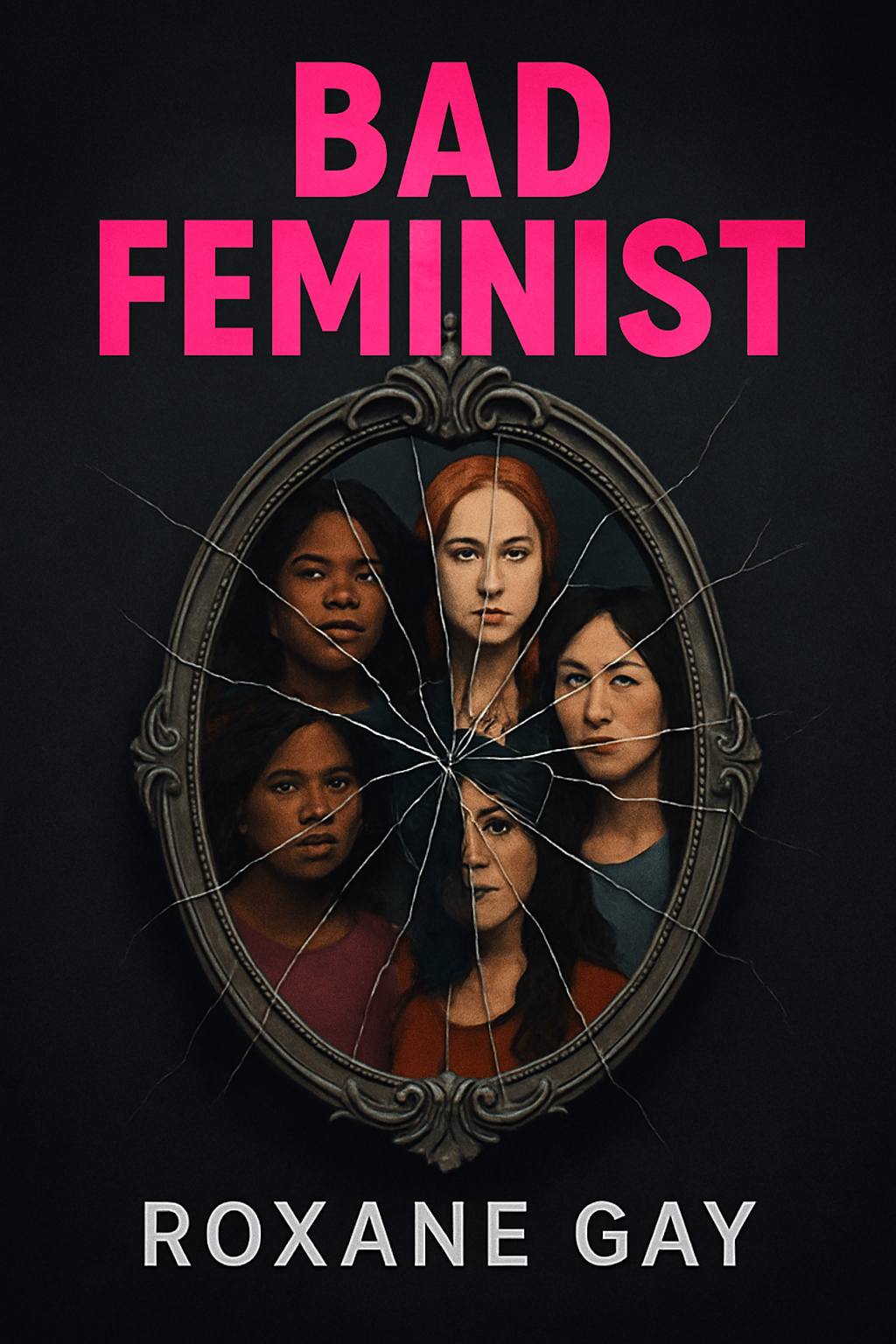
Bad Feminist
Chapter Summaries
What's Here for You
Prepare to be challenged, comforted, and captivated. In *Bad Feminist*, Roxane Gay fearlessly dissects the messy realities of modern life through a feminist lens. This isn't a lecture; it's a conversation. You'll grapple with contradictions, question cultural norms, and confront uncomfortable truths about gender, race, and identity. Expect sharp wit, unflinching honesty, and a refreshing dose of self-awareness as Gay explores everything from Scrabble tournaments to trigger warnings, from Tyler Perry films to fairy tales. You'll gain a deeper understanding of the world and your place in it, armed with new perspectives and a renewed sense of critical thinking. Prepare to laugh, to cringe, and, most importantly, to think.
Feminism (n.): Plural
In this chapter, Roxane Gay grapples with the complex and often contradictory landscape of modern feminism, acknowledging its flaws while passionately defending its necessity. She begins by painting a vivid picture: a world changing so rapidly it leaves us disoriented, especially women navigating issues like reproductive rights and pervasive misogyny in media. Gay highlights the tension between the ideals of feminism and the imperfect individuals who champion it, suggesting that we often unfairly hold the movement to impossible standards, conflating it with 'Professional Feminists' who may falter. She introduces the concept of the 'bad feminist' as a way to reconcile personal imperfections with feminist ideals, advocating for a more inclusive and forgiving approach. Gay recounts her own past disavowal of feminism, driven by fear of ostracism and the distorted image of feminists as angry, sex-hating figures. Now, she understands the importance of fighting for women's rights, even for those who reject the feminist label, emphasizing that feminism should support diverse choices. She advocates for an intersectional feminism that includes women of color, queer women, and transgender women, who have historically been marginalized. The chapter builds to a resolution: embracing a pluralistic feminism where different perspectives are respected, and individual actions contribute to collective progress. Gay encourages readers to become the feminists they wish to see in the world, leading by example and raising their voices, even imperfectly, to advocate for a more equitable world, acknowledging that feminism is not a monolithic entity but a spectrum of beliefs and actions united by the common goal of gender equality.
Feel Me. See Me. Hear Me. Reach Me.
In this reflective chapter, Roxane Gay navigates the complexities of connection, loneliness, and belonging in the digital age and beyond, casting a critical eye on niche dating sites and their promise of finding a 'known quantity.' She reveals her own ambivalence towards seeking commonality in relationships, admitting a penchant for dating those quite different from herself, a choice that sparks both interest and occasional isolation. Gay then pivots to a searing critique of BET, lamenting the limited and often stereotypical representations of Black experiences in media, a landscape where Shonda Rhimes's shows stand out as exceptions in a numbing sea of whiteness. This scarcity of diverse narratives leads Gay to reflect on her time advising a Black student association, a role that exposed her to the vast disparities in educational opportunities and the crushing weight of unmet expectations. She vividly recalls the struggles of students unprepared for college, burdened by family responsibilities, and grappling with a system that often fails them, a stark contrast to her own privileged upbringing, a privilege she acknowledges with both awareness and a sense of responsibility. The emotional toll of this work culminates in burnout, yet also in unexpected moments of gratitude and connection, as students express their appreciation for her unwavering support. Later, as a faculty member, Gay wrestles with the pressure to prove herself, haunted by past insecurities and the fear of being seen as an affirmative action hire. She channels this anxiety into relentless work, striving for excellence while yearning for acceptance and respect, a universal desire masked by the specific challenges of race and representation. Ultimately, Gay finds solace in writing, in building bridges through shared stories and unexpected connections, recognizing that while algorithms may offer the illusion of belonging, true community is forged through kindness, empathy, and a willingness to embrace the irreducible complexities of human experience, a reminder that the search for connection is ongoing, imperfect, and deeply human.
Peculiar Benefits
In “Peculiar Benefits,” Roxane Gay navigates the complex terrain of privilege, opening with a childhood lens observing stark contrasts in Haiti, a jarring introduction to global inequality that etched itself into her understanding long before she could fully grasp its implications. The author explains that privilege, often discussed in abstract terms, is a tangible advantage, a peculiar benefit granted to some but not all; she notes that the term has become diluted, almost white noise, through overuse and misuse. Roxane Gay grapples with acknowledging her own privilege, a difficult but necessary process, admitting the discomfort in recognizing the advantages she has while simultaneously navigating the challenges of being a black woman in a world that constantly reminds her of her place, like random interrogations in parking lots, a constant hum of invalidation. The core tension lies in how accusations of privilege often feel like personal attacks, implying an easy life, a sentiment quickly resented because life is hard for nearly everyone. Gay suggests that the acknowledgment of privilege isn't about guilt or apology, but about understanding its extent and consequences, recognizing that others move through the world with experiences fundamentally different from our own, like navigating a maze where some walls are invisible to those with privilege. She cautions against the “Game of Privilege,” a futile exercise in comparing demographic characteristics to determine a winner, emphasizing that such comparisons are unproductive and distract from meaningful dialogue. The author advocates for a shift in how we discuss privilege—from accusation to observation and acknowledgment, creating space for multiple truths to coexist, and understanding that privilege is relative and contextual, particularly within intellectual communities where access and freedom of expression are often taken for granted. Ultimately, Roxane Gay urges readers to recognize their own privilege as a starting point for empathy and action, to level the playing field and work towards social justice rather than hoarding advantages.
Typical First Year Professor
Roxane Gay, in this reflective piece, paints a vivid portrait of her initial foray into academia, a world far removed from the romanticized ideals often depicted. She secures a tenure-track position in a small town, a seemingly idyllic achievement, yet the initial excitement soon gives way to the realities of teaching. Gay grapples with the fear of public speaking, a surprising vulnerability for a professor, and the challenge of connecting with students who often seem disengaged, lost in their own worlds of cell phones and fleeting interests. The initial weeks are a blur of names, color-coded students, and the dawning realization that she is, in fact, the authority figure. She finds herself straddling the line between relatable and respectable, navigating the unspoken rules of academia while trying to maintain her own identity, tattoos and all. The weight of being the only black professor in her department is a constant undercurrent, a reminder of the lack of diversity in academic spaces. Gay confronts the disheartening reality of becoming the very teacher she swore she’d never be, the one delivering lectures to a sea of glazed-over eyes. Yet, amidst the struggles, there are moments of genuine connection, students seeking her guidance, and the simple joy of winning a Scrabble tournament. The chapter crescendos with Gay's honest appraisal of her performance through student evaluations, leading to a moment of vulnerability and self-doubt. The loneliness of her new life in the cornfields of the Midwest is palpable, a stark contrast to the vibrant intellectual life she craved. Ultimately, Roxane Gay’s experience underscores the tension between expectations and reality, the pursuit of a dream, and the quiet battles fought in the pursuit of purpose, all framed by the cyclical nature of academic life—semesters beginning and ending, each with its own set of challenges and triumphs, a cycle as relentless as the turning of the earth itself. It is a testament to the quiet resilience required to navigate the early years of a career, especially when that career places you squarely in the public eye.
To Scratch, Claw, or Grope Clumsily or Frantically1
In Roxane Gay's exploration of competitive Scrabble, we witness a microcosm of life itself, where confidence clashes with vulnerability and the pursuit of victory intertwines with personal struggles. Gay recounts her initial foray into the intense world of tournament Scrabble, a stark contrast to the casual games of her past, realizing quickly that, as she puts it, 'Scrabble is very serious business.' The author's early confidence, fueled by a desire to belong in a new town, soon meets the harsh reality of defeat, teaching her that even in games, overconfidence can be a dangerous illusion. We see Gay's nemesis, Henry, emerge as a symbol of the cutthroat competition, their rivalry a stage for exploring themes of sportsmanship and the sting of male anger. Even amidst the wordplay, life's heavier realities intrude; a frantic call about her father's health underscores the fragility of life, a poignant reminder that some things matter far more than winning or losing. Gay's journey is punctuated by moments of triumph and humiliation, each loss a lesson in resilience, each win a fleeting validation. The image of serious Scrabble players, with their bulging fanny packs and intense focus, becomes a metaphor for the single-minded pursuit of mastery, a path that often obscures the simple joy of the game. Ultimately, Gay discovers that competitive Scrabble, like life, is a dance between delusion and reality, where the ego is constantly tested and the true victory lies not in the final score, but in the ability to endure and learn from every match, understanding that what 'Scrabble giveth, another player, at another tournament, will taketh away'.
How to Be Friends with Another Woman
In "How to Be Friends with Another Woman," Roxane Gay dismantles the pervasive cultural myth that female friendships are inherently toxic or competitive, likening this belief to restrictive heels that slow women down. She urges readers to actively reject narratives that perpetuate this damaging stereotype. Gay challenges the notion of being 'mostly friends with guys' as a badge of honor, suggesting introspection for those who view female friendships as inherently problematic, prompting a crucial question: Is it them, or is it you? She acknowledges the inevitable challenges, such as friends dating unsuitable partners, offering practical advice—honesty, or a humorous, self-deprecating explanation. Gay emphasizes the importance of celebrating friends' successes, understanding that their happiness contributes to one's own, while also granting permission for private moments of envy, so long as it doesn't poison the friendship. The author encourages collaboration and mutual support among women in the same field, advocating for a form of 'sister-nepotism' to counter male-dominated systems. She draws a line between constructive criticism and destructive tearing down, highlighting the need for mindful communication. Roxane Gay delves into the nuances of gossip, advocating for it to be at least entertaining, while cautioning against self-righteous claims of never lying or gossiping. She underscores the significance of extending love and support to friends' children, even without a personal affinity for children. Further, Gay champions the courage to deliver hard truths with finesse, balancing honesty with consideration. She paints a vivid picture of true friendship: a bond where one can be uninhibitedly themselves, complete with drunken escapades and unwavering support. Finally, Gay lays down clear boundaries against betrayals involving significant others and even extends to preventing friends from sartorial missteps. The chapter culminates with a call for radical honesty in everyday interactions, urging women to share their true feelings rather than masking them with a superficial 'fine.' She presents a pragmatic approach to shared expenses and emphasizes the importance of timely support during crises, advocating patience and understanding in the face of repeated issues. Roxane Gay concludes with her mother's proverb, 'Qui se ressemble sassemble,' reminding us that our friends reflect who we are, urging us to choose wisely.
Girls, Girls, Girls
Roxane Gay, in "Girls, Girls, Girls," navigates the complexities of representing girlhood and womanhood in popular culture, particularly through the lens of television and film. She begins with a semi-autobiographical sketch of a lost young woman, a character adrift in her twenties, highlighting the messy realities often absent from mainstream narratives. The author then pivots to discuss the immense pressure placed on works like *Bridesmaids* and Lena Dunham's *Girls* to be revolutionary representations of women, a burden she argues is unfair and often leads to inevitable shortcomings. Gay observes that while *Bridesmaids* was a step forward, it still relied on familiar tropes, and *Girls*, despite its groundbreaking aspects, is limited by its narrow scope and privileged perspective. The central tension emerges: our desperate need for authentic representation clashes with the impossibility of any single work capturing the totality of female experience. The author explores the critique of *Girls* for its lack of diversity, acknowledging the validity of these concerns while also pointing out the broader systemic issues within artistic communities that perpetuate such exclusions. It’s like a hall of mirrors, where the flaws of one show reflect the deeper biases of the industry. Ultimately, Gay underscores the rarity of seeing women of color, and specifically black women, portrayed with authenticity and complexity, praising shows like *Girlfriends* for offering such representation. The challenge, she suggests, is to temper our expectations, recognize the limitations of individual works, and continue pushing for a wider, more inclusive range of stories that reflect the multifaceted nature of women's lives; it’s about acknowledging that one size never fits all, and striving for a richer tapestry of representation. Gay invites us to consider the unspoken question: are we asking too much of a single artifact when the real revolution lies in dismantling the structures that limit representation in the first place?
I Once Was Miss America
Roxane Gay, in this reflective chapter, explores the complex interplay between personal identity, cultural ideals, and the yearning for acceptance. She begins with Vanessa Williams' historic Miss America win in 1984, a watershed moment that broadened the scope of American beauty, yet also highlights the pervasive influence of the traditional, white, blond ideal epitomized by the Sweet Valley High book series. Gay poignantly recounts her own childhood longing to fit into the golden, popular circles of her school, a desire fueled by the perceived exoticism of American freedom compared to her conservative Haitian upbringing; she felt like an outsider looking in, a poignant tension between two worlds. A pivotal moment arrives when, in response to teasing, young Roxane proclaims she will become Miss America, a declaration met with mockery but which underscores her deep-seated desire for validation. The author reveals that identifying with Jessica Wakefield, the 'bad twin,' was a way of imagining herself as confident and interesting, a stark contrast to her shy and awkward reality. Gay understood the unrealistic nature of Sweet Valley, yet found solace and friendship within its pages, a constant in the face of frequent moves and social challenges. Nostalgia's powerful grip is examined when Gay revisits the updated Sweet Valley Confidential, only to be disappointed by its poor execution, which underscores how deeply personal and formative those early reading experiences were. Ultimately, Gay recognizes that while she never became Miss America, the dream symbolized a broader aspiration for visibility and worth. The chapter culminates in a vivid fantasy of winning an Oscar, a symbolic reclaiming of power and recognition, where she acknowledges both the influences of Sweet Valley and Vanessa Williams, and even calls out her childhood tormentors, thus emphasizing how childhood dreams continue to shape adult aspirations and self-perception. The author understood the books were more than just stories; they were a reflection of the girls they wanted to become, a vital means of escape and understanding during their formative years.
Garish, Glorious Spectacles
In "Garish, Glorious Spectacles," Roxane Gay embarks on a compelling exploration of femininity as performance, drawing inspiration from Judith Butler's theories and weaving through the narratives of Kate Zambreno's "Green Girl," Joan Didion's "Play It as It Lays," and the spectacle of reality television. She observes how women often find themselves on a cultural stage, performing roles dictated by societal expectations, sometimes willingly, sometimes not. The author unpacks the central tension: the relentless pressure on women to embody prescribed ideals of beauty and behavior, leading to a pervasive sense of being on display, a feeling of internal hollowness. Gay uses Zambreno's Ruth as a starting point, a young woman navigating London, selling perfume, a character who embodies both boldness and vulnerability. She is always being watched, always aware, a mirror reflecting women's intimate understanding of being on display. Then, the narrative shifts to Didion's Maria Wyeth, a woman who has tired of the game, a green girl in decline, disillusioned, detached, almost clinically observing her own life. Maria's weariness is palpable, a heavy cloak of exhaustion from constantly performing. The author then throws a spotlight on the women of reality television, the green girls interrupted, their lives garishly exposed, performing for attention, love, fame, a stark contrast to the self-awareness, however painful, of Ruth and Maria. Jennifer Pozner’s critique of reality television reveals how these shows manipulate women into becoming caricatures, playing into harmful stereotypes. Roxane Gay suggests that these women, often stripped of their self-awareness, become spectacles of our own making, reflecting back at us our own vulnerabilities and complicities. She illuminates the commodification of female suffering, where women are incentivized to perform their pain for entertainment. Ultimately, Gay argues that these 'garish, glorious spectacles' are not so distant from our own realities, as we, too, navigate the complex and often contradictory expectations of gender. The chapter concludes with a haunting question: are we watching these shows to reassure ourselves that we are not that desperate, or because we see ourselves reflected in their interrupted lives? The author posits that the quest for authenticity is ongoing; like Ruth who seeks rebirth, or Maria Wyeth, who understands the meaning of nothing, these women, in their own ways, seek a way to scream, a way to be heard, a way to break free from the performance.
Not Here to Make Friends
In Roxane Gay's exploration of likability, she begins with a personal anecdote, a stark note from high school hinting at a past self perceived as "mean," a label that clashes with her own evolving self-perception. This launches an insightful examination into society's expectations of women, particularly the pressure to be likable, a burden Gay dissects through the lens of reality television tropes and film criticism, notably Charlize Theron's character in *Young Adult*. The author observes how unlikability in women is often pathologized, demanding explanations and diagnoses that reduce complex human behavior to easily digestible flaws. Gay challenges the very premise of likability as a literary criterion, questioning why characters must meet our moral approval or affection to be deemed worthy. She contrasts the flat likability of characters like Elizabeth Wakefield with the intriguing complexity of Countess Olenska, who dares to defy social conventions. A central tension emerges: the conflict between societal expectations of female behavior and the desire for authentic, even flawed, representation. Gay champions unlikable characters as more human, more alive, because they resist the temptation to pretend, to conform to prescribed roles. They reflect the truth, and as Gay emphasizes, the truth hurts, exposing our own vulnerabilities and challenging our comfort. She references novels like *Treasure Island*, *You Take It from Here*, *Dare Me*, *Magnificence*, and *Gone Girl* to illustrate the power of unlikable female characters who exhibit boldness, resolution, independence, and honesty. In Gillian Flynn's *Gone Girl*, Amy's unlikability stems from her refusal to play the "Cool Girl," a construct that demands women suppress their true selves. Ultimately, Gay suggests that embracing unlikability in fiction allows for a deeper exploration of the human condition, freeing characters and readers alike from the constraints of superficial charm, revealing that sometimes, the most honest characters are the ones we are not supposed to like, but are ultimately drawn to, like moths to a flame.
How We All Lose
In Roxane Gay's incisive chapter, she navigates the complex and often polarizing discussions surrounding gender, challenging the notion that progress for women must inherently come at the expense of men. She critiques books like Hanna Rosin's *The End of Men*, which, while insightful, sometimes fall into the trap of framing gender dynamics as a zero-sum game, a perspective Gay finds ultimately limiting. Gay acknowledges the strides women have made, particularly in fields like pharmacy, but tempers this with the reminder that significant disparities persist, such as the gender pay gap, a shadow that still darkens the landscape. She argues that focusing solely on women's gains without addressing the systemic issues that hold them back—and the cultural narratives that excuse male misbehavior—misses the larger point, a critical flaw in Caitlin Moran's *How to Be a Woman*, which, despite its humor, often generalizes about women and overlooks cultural nuances. Gay highlights the dangers of selective data and the importance of considering the broader context, especially when discussing sensitive issues like sexual violence. The chapter underscores that true progress requires a more nuanced understanding of power dynamics, one that acknowledges the continued existence of the patriarchy and resists settling for incremental improvements. Gay points to Kate Zambreno's *Heroines* as an example of criticism that rises from emotion, advocating for a more subjective and vulnerable approach to discussing gender. Ultimately, Gay suggests that the real loss occurs when we allow ourselves to be confined by entrenched positions and resist the complexities of these vital conversations, hindering our collective ability to create a more equitable world, a world where progress isn't a battle but a shared horizon. Like squinting at a faulty compass, we need to recalibrate our understanding, ensuring it points not just to individual victories, but to systemic change.
Reaching for Catharsis: Getting Fat Right (or Wrong) and Diana Spechler’s Skinny
In "Bad Feminist," Roxane Gay masterfully dissects Diana Spechler's novel "Skinny," using it as a lens to explore the complex and often painful relationship women have with their bodies. Gay recounts her own experience at fat camp, a place she describes as the "worst place on earth," where she learned to smoke and manipulate the scale, highlighting the performative nature of weight loss. She draws a parallel between her experiences and the character Gray in "Skinny," who becomes obsessed with her body while working as a fat camp counselor. Gay observes that our bodies are inescapable, serving as both a source of pleasure and pain, and often feel like personal territories that are sometimes betrayed by ourselves or others. The author pinpoints a central tension: the societal obsession with weight often overshadows the underlying emotional and psychological factors driving our behaviors. She argues that the novel, while well-written, falters in its portrayal of a character only "thirty pounds overweight" as experiencing the same struggles as someone significantly larger, which diminishes the credibility of Gray's suffering. Gay reflects on her own snap judgments of others, recalling an instance where she judged overweight individuals, only to feel guilty afterward, recognizing our shared complicity in societal biases. She then critiques the trend of televised fat-shaming, where trainers push contestants to dramatic catharsis, superficially addressing deeper issues. Gay reveals that people often seek a "genealogy of obesity," a reason or explanation for weight gain, often ignoring the complex interplay of trauma, emotions, and personal history. She underscores that fat is often about the mind more than the body, a visible manifestation of hidden parts of ourselves. Ultimately, Gay concludes that "Skinny" misses an opportunity to explore the full spectrum of the fat experience, settling instead for a superficial portrayal driven by the author's own prejudices. The chapter closes with Gay's return from fat camp, having lost weight due to the restrictive environment, but soon regaining it, realizing that true catharsis and change come from within, not from external pressures or fleeting physical transformations.
The Smooth Surfaces of Idyll
In "The Smooth Surfaces of Idyll," Roxane Gay grapples with the challenge of portraying happiness in art and literature, a pursuit she finds surprisingly complex. She notes how fiction often defaults to unhappiness, a space where writers find easy company, yet she remains deeply intrigued by happy endings, viewing many of her own stories as fairy tales tinged with darkness but ultimately resolving in salvation. Gay unpacks this tension by examining her novel, *An Untamed State*, where she deliberately shattered a fairy tale to explore piecing together a semblance of happiness from the fragments. The chapter pivots to Thornton Dial’s artwork, specifically the *Hard Truths* exhibit, as a study in contrasts. Dial masterfully uses pain and suffering as artistic fuel, particularly in pieces addressing racism and exploitation, yet culminates in a room saturated with bright colors, showcasing redemption and hope—a testament to the artist's exploration of both light and dark. This contrast illuminates how art can effectively weave together experiences of joy and sorrow. Gay then reflects on Dawn Tripp's *Game of Secrets*, a novel laden with secrets and potential for unhappiness, yet ultimately delivering subtle, incomplete but resonant happy endings for its characters. This analysis leads Gay to question how to complicate themes of darkness in fiction to achieve a more complete understanding of happiness, suggesting that happiness itself can be subtle and multifaceted. Gay concludes that happiness isn't uninspiring if imagination doesn't fail, emphasizing the need to find something substantial even in the face of idyllic smoothness, urging writers and artists to embrace the challenge of rendering happiness with depth and complexity, recognizing its power to coexist with and even emerge from darkness. Like a gardener tending to both vibrant blooms and thorny stems, Gay advocates for a nuanced portrayal of the human experience, acknowledging that true happiness often bears the marks of past struggles.
The Careless Language of Sexual Violence
In "Bad Feminist," Roxane Gay confronts the unsettling normalization of sexual violence in contemporary culture, dissecting how careless language and media representation contribute to a permissive environment for rape. She begins with a visceral example: a *New York Times* article that, in reporting the gang rape of an eleven-year-old girl, seemed more concerned with the futures of the perpetrators than the trauma inflicted upon the victim, revealing a disturbing cultural tendency to prioritize the aggressors. Gay suggests that the phrase 'rape culture' exists because male aggression towards women is often rationalized, even deemed inevitable, highlighting the insidious ways sexual violence is ingrained in our collective consciousness. The author challenges the casual appropriation of 'rape' in everyday language, from 'rape showers' to metaphorical workplace violations, arguing this desensitization makes atrocities like the one in Texas almost palatable to some. Gay scrutinizes television and film, noting how depictions of sexual violence, once potentially educational, have devolved into ratings-driven plot devices, citing examples from *Beverly Hills 90210* to *Law & Order SVU*, questioning whether constant exposure has led to numbness. She then recalls Rosie O'Donnell's early criticism of *SVU*, framing it as a prophetic warning against the exploitation of sexual assault for entertainment. Gay grapples with the responsibility of writers, particularly those who, like herself, explore sexual violence in their work, wondering if their narratives contribute to the problem, or illuminate a dark reality. The author references Margaret Atwood’s short story, Rape Fantasies, as an example of how to critique rape culture intelligently. Gay also recalls her own experiences writing her novel, An Untamed State, and her internal struggle to depict violence authentically without sensationalizing it. She argues that the language used to describe sexual violence often sanitizes its brutality, advocating for a 'rereading of rape' that restores the violence to the body, making excuses for perpetrators impossible. Ultimately, Gay calls for a more careful, deliberate discourse around sexual violence, one that shifts the focus from the supposed complexities of the perpetrators' lives to the undeniable devastation of the victims—a shift from 'rape culture' to 'rapist culture.'
What We Hunger For
In Roxane Gay's "What We Hunger For," the author delves into her unexpected obsession with "The Hunger Games," using it as a lens to explore themes of strength, survival, and the often-unacknowledged costs of trauma. She confesses her initial resistance to becoming deeply invested in fictional worlds, only to find herself captivated by Katniss Everdeen's journey. Gay admits to finding herself drawn to the characters and the brutal yet compelling world Collins created, and how it moved her to tears. However, beyond the escapism, Gay reflects on a more profound connection, dissecting the narrative's portrayal of female strength—a strength born not from inherent power, but from the crucible of necessity. She juxtaposes Katniss's resilience with her own past vulnerabilities, recounting a painful adolescent experience of manipulation and self-sacrifice, a time when her body felt like mere "meat and bones around that void," illustrating how easily young girls can lose themselves in the desperate pursuit of validation. The author criticizes the societal pressure to sanitize reality for young readers, arguing that literature, even its darkest corners, can offer solace and recognition to those grappling with their own unacknowledged traumas. She sees in Katniss a reflection of the damaged yet resilient self, a heroine who embodies both strength and vulnerability. Gay underscores the importance of narratives that acknowledge the lasting impact of suffering, offering a tempered hope—a vision of finding love and acceptance with someone who understands and embraces one's scars. Ultimately, Gay suggests that our hunger for stories like "The Hunger Games" stems from a deep-seated need to see our own battles mirrored, our own wounds acknowledged, and our own potential for healing affirmed, even amidst the brutality of the world; a world where sometimes, you become the girl in the woods.
The Illusion of Safety/The Safety of Illusion
In "The Illusion of Safety/The Safety of Illusion," Roxane Gay delves into the complex and often contradictory nature of trigger warnings and the broader human desire for safety in a world that inherently offers none. She begins with a visceral account of her own triggers—sensory reminders that catapult her back to past traumas, illustrating how deeply ingrained and unpredictable these reactions can be. The author explains the societal impulse to create protective measures, such as television ratings and internet trigger warnings, designed to shield individuals from potentially harmful content. However, Gay argues that these measures often provide a mere illusion of control, akin to airport security—a performance that offers comfort without necessarily ensuring genuine safety. She notes how trigger warnings, intended to create safe spaces, particularly in feminist communities, can paradoxically function as censorship, limiting the scope and intensity of expression. Gay grapples with the tension between the intellectual understanding of why trigger warnings might be necessary and her personal resistance to them, stemming from a belief that individuals cannot be truly protected from their histories. For Gay, trigger warnings presume to know what others need protection from, and she questions the practicality and effectiveness of anticipating every potential trigger. The author suggests that perhaps, instead of relying on external safeguards, individuals should be empowered to develop their own resilience and coping mechanisms for dealing with triggers, acknowledging that access to resources for healing is a privilege. Ultimately, Gay embraces a philosophy of fearless vulnerability, recognizing that true freedom lies not in the illusion of safety but in the acceptance of one's own brokenness and the preparedness to endure further challenges, understanding that life is more about enduring than living, and that even when spaces try to err on the side of safety, there will always be a finger on the trigger.
The Spectacle of Broken Men
In "The Spectacle of Broken Men," Roxane Gay navigates the uncomfortable intersection of sports, celebrity, and culpability, particularly regarding athletes and their transgressions. She begins by grounding the narrative in Nebraska, a place where football, specifically the Huskers, borders on religious fervor, and where figures like coach Tom Osborne are held in near-divine regard. The author elucidates how, during the 1990s, the university seemed willing to overlook criminal behavior—violence against women, drug offenses—as long as players could deliver victories on the field, painting a stark picture of priorities. This sets the stage for a broader examination of how society often turns a blind eye to the misdeeds of celebrated athletes, creating a culture of reverence that tacitly condones criminality. Gay then pivots to the Jerry Sandusky case, a harrowing example of institutional failure and the difficulty of presuming innocence in the face of overwhelming evidence, confessing her own struggle to reconcile the image of a moral paragon with the heinous allegations. The author dissects Sandusky's revealing interview, noting how his very defense exposes a brokenness, a distortion of values that enabled his alleged crimes, and she makes it unequivocally clear that her sympathies lie with the victims, choosing to err on the side of caution. The chapter crescendos with the understanding that Sandusky is not an isolated case but part of a constellation of broken men, from enablers to silent bystanders, each contributing to a system where young lives are shattered, and it is here that Gay reveals the most uncomfortable truth: that the spectacle of sports often demands a willful blindness to the humanity of those hurt in its wake. In the end, she juxtaposes this with a visceral act of paternal justice—a father killing his daughter's abuser—to underscore the pervasive nature of brokenness and the lengths to which people will go when systems fail, leaving us to confront the unsettling reality that these spectacles of brokenness are everywhere, demanding our attention and challenging our complicity.
A Tale of Three Coming Out Stories
In her chapter “A Tale of Three Coming Out Stories,” Roxane Gay navigates the complex terrain of public versus private identity, particularly concerning sexuality. She observes our culture's insatiable need to categorize individuals, a desire that intensifies when public figures don't readily fit established norms, highlighting how this classification often serves mere curiosity rather than tangible impact. Gay introduces the central tension: the conflict between the right to privacy and the public's perceived right to know, especially for those in the spotlight. She references Garret Keizer's work, emphasizing how privacy acts as a crucial test of our civilization, reflecting our willingness to recognize the inherent sacredness and rights of every individual, regardless of their public profile. The narrative then pivots to class and privilege, noting how access to privacy isn't uniformly distributed; it's often a luxury afforded to the privileged, a shield that those marginalized by race, gender, or sexuality often lack. Anderson Cooper's public coming out serves as a case study, illustrating the mixed reactions and the societal pressure on public figures to represent underrepresented groups. Gay underscores the unfair burden placed on marginalized individuals to carry the weight of representation, to make inroads for societal acceptance, a burden heterosexuals never shoulder. She juxtaposes Cooper's experience with Frank Ocean's, highlighting the particular challenges faced by black men in the hip-hop community, revealing the nuanced layers of risk and reward in choosing to live openly. Gay exposes a deeper tension, the existence of a ‘right kind of gay,’ where certain individuals are celebrated for coming out while others are ignored, based on societal biases. The chapter crescendos with a call to action, urging readers to confront their own complicity in perpetuating injustice, even in seemingly small ways, like remaining silent when slurs are used or supporting artists who propagate harmful stereotypes. It's a reminder that while societal progress relies on visible figures taking a stand, true change requires collective effort and a willingness to challenge our own prejudices. Gay concludes by questioning what sacrifices we, as individuals, are willing to make for the greater good, suggesting that the sacrifices of public figures should inspire us to examine our own levels of helplessness in the face of injustice, urging us to move from passive observation to active participation in the fight for equality, to become the role models we expect others to be. A somber scene emerges, the image of Sally Ride, celebrated pioneer, yet her long-term partner denied federal benefits, a stark reminder of the gap between admiration and equality. The chapter serves as a mirror, reflecting not just societal progress, but also the distance yet to travel, a potent blend of hope and responsibility.
Beyond the Measure of Men
In "Bad Feminist," Roxane Gay navigates the complex terrain of gender inequality within the literary world and beyond, painting a vivid picture of 'trickledown misogyny' that seeps from legislature to the living room. She observes the frustratingly repetitive cycle: the acknowledgment of gender disparity followed by denial, excuses, or demands for more proof. Gay suggests that the solutions are not mysterious but require intentional effort. Stop excusing, stop deflecting, stop publishing the same old stories. Instead, amplify women's voices, read widely, and challenge conventional measures of excellence. The label 'women's fiction,' Gay argues, is often wielded with disdain, a marketing tool that diminishes the work of women writers by pigeonholing them into narrow, domestic themes, while similar themes explored by men are elevated as 'literary.' She unveils the underlying bias: male experiences are often seen as universal, while female experiences are often marginalized. Gay asks a piercing question: When did men become the measure, and why do we collectively decide that writing is more worthy if men embrace it? She suggests that the literary establishment, with its historical dominance of male voices, has perpetuated this imbalance. Instead of aspiring to male readership as the ultimate validation, Gay urges a shift toward excellence as the true measure. She passionately defends women writers and challenges the reader to broaden their horizons, to read without prejudice, and to recognize the shared humanity in all stories. Gay reminds us that reading should be a source of joy, not a battleground of biases, and hopes that someday, conversations will center on the joy and complexity of the stories we share, not the struggles they face to be heard, emphasizing that great books remind us what matters most.
Some Jokes Are Funnier Than Others
In this chapter, Roxane Gay navigates the treacherous waters of humor, particularly when it veers into the territory of tragedy and social injustice. She begins with a childhood memory of the Challenger explosion, a stark reminder of how quickly humor can turn from unifying to alienating, depending on the context and the sensitivities involved. Gay grapples with the idea that inappropriate humor can sometimes be the most insightful, admiring comedians like Patrice O'Neal, who fearlessly test boundaries and expose uncomfortable truths, seeking a transformative power through the ‘ugly truth.’ However, she contrasts this with the comedy of Daniel Tosh, whose jokes, particularly about rape, lack grace and instead perpetuate a culture of entitlement and misogyny; his humor, unlike O'Neal's, fails to elevate or provoke meaningful thought, instead reinforcing harmful attitudes. The central tension emerges: where is the line between free speech and the social responsibility of a comedian? Gay argues that while the First Amendment protects our right to speak, it doesn't shield us from the consequences of our words, highlighting the importance of conscience and common sense in comedy. She illustrates this with the story of a woman who challenged Tosh's rape jokes, underscoring that silence in the face of injustice equates to consent. Gay emphasizes that rape humor, far from being harmless, contributes to a culture where sexual violence is normalized and women's concerns are dismissed, painting a stark picture of a society where ‘rape culture’ isn't just a phrase but a lived reality. Ultimately, Gay champions the courage to speak out against harmful humor, urging readers to take a stand against the normalization of sexual violence and to recognize that sometimes, saying what others are afraid to say is simply being an asshole, free to do so, but not without consequence.
Dear Young Ladies Who Love Chris Brown So Much They Would Let Him Beat Them
In this unflinching chapter from *Bad Feminist*, Roxane Gay addresses young women seemingly willing to endure abuse for a brush with celebrity, specifically the allure of Chris Brown. She begins with disbelief, a stark challenge to their flippant acceptance of violence, emphasizing that abuse is never a joke; it is a sacrifice of dignity for fleeting attention, a mirage in the desert of their lives. Gay contrasts this with BDSM, where consent is paramount—a safe word offering control even in vulnerability, a power utterly absent in abuse. She dissects the disturbing details of Brown's assault on Rihanna, illustrating a pattern of rage and lack of contrition, a man unlikely to value or respect his partner. The author then broadens her critique, lamenting a culture that consistently fails women, where abusers like Brown, Sheen, and Polanski face minimal consequences, sending a chilling message: abuse is tolerated, even rewarded. It's a societal failure, a constant devaluation of women that has led these young women to believe celebrity attention is worth the pain. Gay confesses her own struggles with separating artistry from the artist's personal failings, citing Richard Pryor's brilliance tarnished by his abusive behavior, a reminder that even feminists grapple with these complexities. Ultimately, the chapter is a sorrowful apology for a world that has normalized the suffering of women, urging them to recognize their worth beyond the distorted reflections of celebrity culture, to reclaim their right to consent, and to demand better from society and themselves.
Blurred Lines, Indeed
In "Blurred Lines, Indeed," Roxane Gay navigates the complex terrain where personal enjoyment clashes with feminist values, dissecting the cultural landscape that normalizes misogyny. She begins with Robin Thicke's controversial hit, "Blurred Lines," acknowledging its catchiness even as she confronts its problematic undertones of sexual coercion, a song that embodies the disturbing notion that 'no' sometimes means 'yes.' Gay extends this critique to Kanye West's music, where brilliance is often overshadowed by blatant misogyny, creating an uncomfortable tension between artistic merit and ethical concerns. She grapples with the idea of creative freedom, even when it manifests in forms that are deeply offensive, such as rape jokes, illustrating a personal struggle between censorship and freedom of expression. The author then shifts focus to societal acceptance of male entitlement, highlighting examples from high school prom invitations to science fiction conventions, where women's boundaries are routinely violated, revealing a culture that often prioritizes male desires over female safety and autonomy. It's like watching a kaleidoscope of microaggressions, each shard reflecting a deeper, systemic issue. Gay articulates the frustration of constantly recognizing misogyny, both overt and subtle, and the dismissal of these concerns with the phrase 'lighten up,' a sentiment that threatens to erase women's experiences. This leads to a broader examination of how cultural attitudes toward women are mirrored in political actions, specifically restrictive abortion legislation, suggesting a direct link between objectification in entertainment and the erosion of reproductive rights. Gay poignantly illustrates the impact of these policies through the hypothetical yet deeply personal story of a woman facing a life-threatening pregnancy complication, underscoring the very real consequences of limiting women's choices. Ultimately, Roxane Gay challenges the reader to recognize the pervasive nature of misogyny and its impact on women's lives, urging a critical examination of the cultural norms that perpetuate inequality, even when those norms are packaged in catchy tunes or casual jokes. The chapter serves as a call to action, a demand for a more equitable world where women's voices are heard, respected, and valued.
The Trouble with Prince Charming, or He Who Trespassed Against Us
In Roxane Gay's insightful exploration, she dissects the pervasive fairy tale trope of Prince Charming, revealing how these narratives often demand a steep price from women in exchange for their 'happily ever after.' Gay uses the Twilight series and Fifty Shades of Grey as modern examples, illustrating how these stories, while seemingly about romance and desire, subtly reinforce problematic power dynamics. She observes that Prince Charming, often bland and uninteresting, is frequently redeemed by the sacrifices and compromises made by the female protagonist, creating a troubling pattern where a woman's worth is tied to her ability to 'save' a flawed man. Gay notes that the popularity of Fifty Shades, with its explicit content and questionable portrayal of BDSM, has sparked a cultural frenzy, raising uncomfortable questions about female desire and the normalization of controlling relationships. The author points out how Christian Grey's character embodies the dark side of this trope: his wealth and good looks mask deep-seated emotional issues and a need for control that manifests as borderline abusive behavior. Roxane Gay challenges us to critically examine the messages we internalize from these stories, messages that can shape our expectations and tolerance for unhealthy relationship dynamics. She argues that these narratives often prioritize a man's redemption over a woman's well-being, perpetuating a harmful cycle of sacrifice and forgiveness. The author urges readers to recognize that a relationship should not demand the surrender of one's autonomy or the acceptance of abusive behaviors, no matter how charming the perpetrator may appear. Ultimately, Gay warns against romanticizing controlling tendencies, advocating for a more equitable and self-respecting vision of love, where a woman's happiness isn't contingent on 'fixing' a flawed Prince Charming, and where the price of admission isn't her own sense of self.
The Solace of Preparing Fried Foods and Other Quaint Remembrances from 1960s Mississippi: Thoughts on The Help
In her discerning critique of "The Help," Roxane Gay navigates the complexities of race, representation, and the discomfort of witnessing history filtered through a skewed lens. She begins by illustrating the need for emotional distance after confronting narratives of racial injustice, likening it to needing a 'Rosewood day'—a period of voluntary segregation to recover from the trauma of misrepresented history. Gay grapples with the pervasive 'magical negro' trope in Hollywood, where black characters exist primarily to serve the growth and redemption of white protagonists, noting that "The Help" overflows with such characters, who conveniently uplift the white characters. The author unpacks her frustration with the novel and film's narrow depiction of black life in 1960s Mississippi, one that often overlooks the agency and activism of African Americans during the Civil Rights Movement. Gay illuminates the inherent challenge of writing across racial lines, questioning whether white authors can authentically portray black experiences without perpetuating harmful stereotypes, and also admits her own biases in approaching such works. The line, 'Frying chicken tend to make me feel better about life,' becomes a focal point, symbolizing how easily narratives can slip into caricature, revealing how far society still has to go in achieving genuine understanding and respect. She argues that the oversimplified dialect and the focus on white saviors diminish the realities of black individuals, reducing them to supporting roles in their own stories. Ultimately, Gay challenges readers and writers alike to confront their own biases and strive for more nuanced, truthful representations of race, even as she acknowledges the difficulty of doing so, and admits that the film, despite its flaws, has moments that resonate, forcing her to confront her own biases. The chapter is a call for greater awareness, sensitivity, and accountability in storytelling, advocating for narratives that honor the full humanity and complexity of all individuals.
Surviving Django
Roxane Gay grapples with the disquieting experience of watching Quentin Tarantino's 'Django Unchained,' a film that uses the backdrop of slavery to tell a story of revenge. She observes the audience's laughter, often misplaced, and questions their comfort with the pervasive use of racial slurs. Gay reflects on how the black experience in cinema is frequently filtered through a white lens, a mediation that feels both constant and inadequate. She makes it clear that her unease isn't merely academic; it's deeply personal, stemming from the recognition that she, too, could have been a slave. The film's artistic liberties clash with the raw, painful reality of history, igniting a desire to confront Tarantino himself. Gay acknowledges the historical presence of the N-word, yet questions its gratuitous use in the film, suggesting a selective approach to historical accuracy. She points out that 'Django Unchained' isn't truly about slavery, but rather a spaghetti western that exploits a traumatic past. The movie is like a funhouse mirror reflecting America's racial demons back at itself. She concedes the film's technical merits—sound design, acting, direction—but argues that these are overshadowed by Tarantino's problematic handling of race. Gay dissects the character of Django, a one-dimensional figure whose freedom is contingent on the actions of a white man, and Broomhilda, a marginalized heroine whose suffering is put on display. Ultimately, Gay concludes that 'Django Unchained' is a white man's slavery revenge fantasy, one that centers whiteness and marginalizes black voices. She contrasts this with her own vision of a slavery revenge fantasy, one rooted in self-determination and the reclamation of dignity on her own terms. She juxtaposes the film with the Haitian fight for independence, a story of self-liberation, highlighting the stark difference between externally granted freedom and the freedom that is seized. For Gay, the film serves as a stark reminder that despite progress, the echoes of the past continue to resonate in the present.
Beyond the Struggle Narrative
In "Beyond the Struggle Narrative," Roxane Gay navigates the complex terrain of black representation in Hollywood, particularly within the context of Oscar-worthy films. She begins with Hattie McDaniel's historic win, shadowed by the limited roles available to black actresses at the time, a theme that echoes in Octavia Spencer's later success. Gay observes a pattern: critical acclaim for black films often hinges on portrayals of suffering or subjugation, a cinematic altar upon which black stories are frequently sacrificed. Examining films like *Fruitvale Station*, *Lee Daniels' The Butler*, and especially *12 Years a Slave*, Gay questions the necessity of constantly revisiting black trauma. She confesses her own muted reaction to *12 Years a Slave*, finding it brutal yet somehow unaffecting, a relentless depiction of violence that left her broken rather than moved. The film’s artistic choices felt jarring, like fleeting moments of plantation beauty amidst unbearable cruelty, and the narrative, in her view, disproportionately used the suffering of women, such as Eliza and Patsey, to amplify Solomon Northup's story. As Gay sees it, these characters, trapped in their individual hells, are reduced to mere devices, while Solomon's pain is elevated. The relentless focus on suffering, the author suggests, risks fetishizing black pain, turning it into a spectacle divorced from genuine empathy. The author's exhaustion with slavery narratives underscores a deeper yearning: a desire for narrative complexity, for black joy and love to find their place on the silver screen, for black filmmakers to transcend the struggle narrative. Gay challenges the industry's narrow expectations, advocating for more diverse and contemporary black experiences, a sentiment that extends beyond Hollywood into broader cultural perceptions. The author suggests that while stories of struggle are important, they should not be the only stories told, urging audiences and filmmakers alike to embrace a wider spectrum of black experiences, breaking free from the vicious cycle where only certain narratives are deemed worthy of recognition. The author suggests it’s time to expand the lens, to allow for a richer, more nuanced portrayal of black lives, one that includes triumph, love, and everything in between, a cinematic landscape where black stories are not solely defined by their pain but by their full humanity. The author’s reflection serves as a call for a more inclusive and imaginative representation of black lives in cinema, and beyond.
The Morality of Tyler Perry
In Roxane Gay's exploration of Tyler Perry's work, a complex portrait emerges—one where success is intertwined with problematic portrayals. The author begins by acknowledging Perry's undeniable achievement as a black man who owns his studio in a predominantly white industry, a beacon of independent creation. Yet, this initial admiration quickly dims as Gay delves into the recurring themes in Perry's films. She argues that Perry often builds his narratives on the backs of black women and the working class, using them as vehicles for morality tales that are, at best, reductive and, at worst, harmful. Gay dissects films like 'Temptation,' where female characters are punished for seeking fulfillment outside traditional roles, revealing a troubling message: 'You should be grateful for what you’ve got.' A scene unfolds: Judith, seduced and then seemingly violated, becomes a cautionary figure, her ambition and sexuality leading to her downfall, a stark contrast to the 'good' men who remain content with their lot. Perry's obsession with fetishizing the working class takes center stage, a recurring motif where characters find salvation by returning to their roots, almost as if wealth and ambition are inherently corrupting forces. Gay highlights the irony of Perry amassing wealth from a working-class audience while simultaneously demonizing those who strive for more. The author then pivots to 'Peeples,' a film written and directed by a black woman, holding out hope that Perry might evolve into an incubator of black talent, but its box office failure underscores a disheartening truth: audiences seem to crave Perry's familiar caricatures and heavy-handed moralism. The central tension then becomes clear: is Perry's success due to or in spite of his problematic messages? Roxane Gay grapples with the possibility that his films resonate because of their moralism and their sneering at women, a bitter pill to swallow. Yet, she also acknowledges the 'real, honest moments of human interaction' that flicker within his work, a testament to the complexities of Perry's appeal. Ultimately, Gay is left clinging to the hope that Perry might someday rise to his potential and create truly good art for black people, even as she recognizes the unreasonableness of that expectation, a somber reflection on the compromises made in the pursuit of representation.
The Last Day of a Young Black Man
In Roxane Gay's poignant analysis of Fruitvale Station, she illuminates the fraught landscape of contemporary black cinema, a space burdened by expectation and limited representation. Gay sets the stage by describing the anticipation surrounding Ryan Coogler's film, a beacon of hope for nuanced storytelling. She notes how black films often carry the weight of being everything to everyone, a consequence of scarcity. The film itself, a dramatization of Oscar Grant's death, becomes a lens through which Gay examines the complexities of black male identity and the pervasive issue of police brutality. She observes how Fruitvale Station humanizes Oscar, portraying his multiple identities – a loving father, a dutiful son, a man navigating a world of limited options. The film, though verging on sentimentality, succeeds in creating a space for mourning and reflection. Gay underscores Coogler's deliberate choice to avoid anger, instead crafting an intimate portrait that fosters empathy. She then pivots to the broader context of Oakland, highlighting the statistical disparities that plague young black men, statistics that often become dehumanizing myths. Gay emphasizes how Fruitvale Station compellingly treats Oscar Grant as a man, challenging these distorted narratives. The film serves as a stark reminder of the consequences of demonizing young black men, a demonization that contemporary black cinema can help to counter. Gay also touches on the commercial pressures faced by black filmmakers, where the success or failure of one film can have cascading effects. Ultimately, she concludes with the chilling reality that Oscar Grant's story is not an isolated incident, but a reflection of a systemic issue. Each goodbye in the film, each expression of love, carries the weight of knowing it might be the last, an uncanny burden borne by too many.
When Less Is More
Roxane Gay, in "Bad Feminist," navigates the complex terrain of representation in popular culture, specifically focusing on the television series "Orange Is the New Black." She acknowledges the show's celebrated diversity but questions whether mere representation is enough. The author observes a pervasive cultural expectation that people of color should be grateful for any acknowledgment, any 'scraps from the table,' a sentiment she finds tiresome. Gay grapples with the show's merits, such as nuanced portrayals of sexuality and Laverne Cox's outstanding performance, against its shortcomings, including inconsistent characterizations and the centering of 'White Girl Problems.' The narrative tension arises from this dichotomy: the show is both progressive and problematic, original and stereotypical. Gay highlights how the diverse characters often orbit Piper's (the white female lead) narrative, lacking fully developed stories of their own. This leads to an insight about tokenism: true diversity isn't just about presence; it's about depth and agency. Roxane Gay suggests that the overwhelmingly positive reception of shows like "Orange Is the New Black" reveals a settling, a lowering of expectations for marginalized representation. The author longs for pop culture that reflects not just differences, but shared humanity, a world where representation isn't a feast or famine, but a balanced diet. She also points out that smarter and subtler seems like so much more than it actually is because the bar is so low for portrayals of people out of the mainstream. Ultimately, Roxane Gay's critique serves as a call for more authentic, nuanced storytelling that resists easy tropes and celebrates the multifaceted experiences of all people.
The Politics of Respectability
In her chapter, Roxane Gay explores the insidious nature of respectability politics, a concept where marginalized groups, particularly black individuals, are pressured to conform to dominant cultural norms as a means of mitigating the effects of racism. Gay dissects how figures like Bill Cosby and Don Lemon, despite potentially good intentions, perpetuate this idea by suggesting that adherence to certain behaviors—such as avoiding the N-word, staying in school, or pulling up one's pants—will make black people 'good enough' for white acceptance. The author argues that this perspective dangerously overlooks the deeply entrenched systemic issues that perpetuate racial inequality, creating a mirage where individual behavior is seen as the primary determinant of racial justice. Gay highlights the inherent flaw in respectability politics: it places the onus of ending oppression on the oppressed, rather than addressing the root causes of injustice. Like a hall of mirrors, respectability offers endless self-correction but no escape. She uses Oprah Winfrey's experience with racism in a Zurich boutique as a stark reminder that wealth and status offer no immunity from prejudice, demonstrating that racism transcends individual achievement. Gay emphasizes that true progress lies not in mimicking an ideal, often 'white,' standard, but in dismantling systemic barriers and supporting the most vulnerable members of society. She references President Obama's historic speech on race, acknowledging its progress while also noting its shortcomings in addressing the specific needs of black girls. Ultimately, Gay advocates for a shift in focus from individual respectability to collective action and systemic change, urging leaders to acknowledge the reality of institutional racism and work towards creating a truly equitable society where everyone, regardless of their behavior, is treated with dignity and respect. It’s about extending the ladder, not just climbing it and pulling it up behind you.
When Twitter Does What Journalism Cannot
In Roxane Gay's exploration of the evolving media landscape, she recounts the pivotal moment when Texas State Senator Wendy Davis filibustered against Senate Bill 5, a move largely ignored by major news networks, yet amplified by social media. Gay highlights the tension between traditional journalism's slow, verified approach and social media's immediate, though sometimes unreliable, dissemination of information, a gap that reveals a shift in how we receive and process news. The author underscores Jessica W. Luther's tireless activism on Twitter, which ignited Gay's own awareness and concern, illustrating how a single, passionate voice can catalyze broader engagement. Social media, often a repository for trivial updates, transforms into a vital tool during crises like Hurricane Sandy, providing real-time information and fostering community support, yet it also presents the risk of misinformation and exploitation. Gay notes the recurring pattern of learning about significant events first through Twitter—from the Aurora shootings to the Boston Marathon bombings—revealing social media's role as an early warning system, a digital town square buzzing with unfiltered accounts. The silence of major news networks during the Davis filibuster becomes a stark example of their failure to keep pace with unfolding events, a dereliction of duty that forces average citizens to step in, researching and sharing crucial information, effectively becoming citizen journalists. The chapter acknowledges the Supreme Court's decision on the Voting Rights Act and the Defense of Marriage Act, illustrating how social networks broaden conversations and offer diverse perspectives, enriching public discourse beyond the confines of traditional media. Ultimately, Gay argues that social networks offer a flawed but necessary conscience, a constant reminder of the need for commitment, compassion, and advocacy, urging us to balance the immediacy of social media with the grounding and context provided by traditional journalism, appreciating the present while remaining mindful of the past and future. Like a lighthouse cutting through the fog, social media can illuminate events obscured by the mainstream media, but it requires a discerning eye to navigate its ever-shifting currents.
The Alienable Rights of Women
In "The Alienable Rights of Women," Roxane Gay navigates the fraught territory of reproductive freedom, revealing how women's rights, unlike those of wealthy white men enshrined in America's founding, are perpetually negotiable. She observes the cyclical nature of history, drawing parallels between the witch hunts that demonized contraception and abortion in the 14th and 15th centuries and contemporary political ploys that distract from societal issues by controlling women's bodies. Gay highlights the tension between pregnancy as a private, personal experience and its inevitable intrusion into public discourse, where the female body becomes a battleground for legislative control. She critiques the insensitive and bizarre ways legislatures shape the abortion experience, from mandatory ultrasounds to narrated sonograms, portraying these as punishments for women daring to make choices about motherhood. The author laments the erosion of reproductive freedom into a mere talking point, a campaign issue, rather than an inalienable right, and she shares her frustration at living in a world where her body is a legislative matter, a world where she doesn't feel free. Gay recalls Margaret Sanger's fight for birth control access and expresses dismay at the resurgence of arguments against affordable contraception, even to the point of slut-shaming women for using it. The narrative culminates in Gay's vision of an underground birth control network, a testament to the potential need for women to safeguard their reproductive health in an increasingly hostile climate, a network where reproductive health care providers treat women humanely because the government does not. She argues that debates about birth control and reproductive freedom continually force the female body into being a legislative matter because men refuse to assume their fair share of responsibility, as though women's bodies are merely smoke screens, while men’s bodies remain untouched by legislation. The author emphasizes that women, unlike these forgetful politicians, remember the brutal lengths women have gone to when abortion was illegal, and that women will resort to any means necessary again if backed into that terrible corner, because women do not have short memories about our rights that have always, shamefully, been alienable.
Holding Out for a Hero
In "Holding Out for a Hero," Roxane Gay delves into our cultural obsession with heroism, revealing how this ideal both inspires and burdens us. She begins by observing our aspirational culture, always striving to bridge the gap between who we are and who we wish to be, often projecting unattainable ideals onto superheroes. Gay highlights how the concept of heroism has become so diluted, applied to athletes, parents, and survivors alike, potentially obscuring true greatness. She draws a parallel between comic book heroes and real-life figures, noting how both often carry the weight of sacrifice and suffering. The author then pivots to the George Zimmerman trial, a stark example of justice failing to protect a young black man, Trayvon Martin. Gay uses the trial to illustrate how racial biases can warp perceptions of justice, turning victims into villains. The courtroom becomes a stage where fear and prejudice overshadow the principles of equality, and justice, ideally blind, is anything but. She argues that the demonization of young black men, as seen in the trial, reflects deep-seated societal issues. Justice, Gay suggests, often serves as a mere palliative for victims, never truly balancing the scales. She urges readers to learn from the tragedy of Trayvon Martin, to overcome their own prejudices, and to recognize the humanity in others, even those without capes, for true greatness lies not in superhuman feats, but in seeing each other as fully human.
A Tale of Two Profiles
In this chapter of *Bad Feminist*, Roxane Gay dissects the contrasting narratives surrounding Dzhokhar Tsarnaev and Trayvon Martin, revealing a disquieting truth about how society perceives danger through a racialized lens. She begins by recounting the Rolling Stone cover featuring Tsarnaev, a seemingly normal, even attractive young man, juxtaposed against the horrific acts he committed at the Boston Marathon. Gay observes how Janet Reitman's reportage, filled with empathy, seeks to understand Tsarnaev’s motivations, painting him as a victim of circumstance. This contrasts sharply with the relentless scrutiny and judgment faced by Trayvon Martin after his death, where his past was weaponized to justify his murder. The author illuminates a disturbing double standard: society's willingness to humanize a white terrorist while simultaneously dehumanizing a young Black victim. Gay argues that this disparity stems from deeply ingrained racial profiling, a cultural reflex that equates blackness with criminality, a delusion born of our belief that we can profile danger. She evokes the image of news media, constantly parading images of Black deviance, searing negative stereotypes into our collective consciousness. The chapter powerfully argues that racial profiling isn't just a law enforcement issue, but a pervasive societal bias that shapes our perceptions and fuels injustice. Gay urges us to confront our own prejudices and recognize that true safety lies not in reinforcing stereotypes, but in dismantling them. The core insight being: We must stop projecting our fears onto profiles built from stereotypes.
The Racism We All Carry
In Roxane Gay's exploration of the racism we all carry, she navigates the uncomfortable truth that prejudice, to some degree, resides within us all. She begins with the provocative lyrics from Avenue Q, "Everyone's a Little Bit Racist," suggesting that our judgments are often unconsciously shaped by race due to cultural conditioning. The narrative pivots to Paula Deen, whose public downfall after a workplace harassment lawsuit exposed her blithely ignorant racial attitudes, a stark example of how deeply ingrained these prejudices can be, especially within certain cultural contexts like the American South. Gay isn't surprised by Deen's revelations, more so by the public's shock, hinting at a collective denial or willful ignorance about the prevalence of racism. The deposition reveals unspoken rules about racism—a complex matrix of when and with whom racist sentiments can be expressed, highlighting the duplicity between public and private behavior. It's like a dance, Gay implies, where everyone knows the steps but pretends not to see the music. The author recounts a personal anecdote involving a white receptionist's casual racism, illustrating how these unspoken rules operate even in multiracial settings, creating an "us versus them" dynamic. Gay's discomfort in that moment underscores the challenge of confronting everyday racism and the internal conflict between speaking out and remaining silent. She ultimately acknowledges the pervasive nature of racism, not as an excuse, but as a call to recognize and challenge our own biases, even when it's uncomfortable or requires us to confront those closest to us; it is a mirror reflecting back the uncomfortable truths we often avoid.
Tragedy. Call. Compassion. Response.
In this poignant chapter, Roxane Gay grapples with the complex human responses to tragedy, interweaving the aftermath of the Norway massacre with the untimely death of Amy Winehouse. She explores the inherent tension between our need to categorize and comprehend suffering and the often-inadequate language we possess to articulate such profound experiences. Gay notes how the media's focus on the perpetrator's appearance in the Norway tragedy revealed a societal bias, highlighting our tendency to expect extremism from certain groups while overlooking it in others; this is a world where compassion is too easily forgotten. She observes how tragedies often become politicized, with individuals using them as platforms for self-righteousness, obscuring genuine empathy, and careful thought. Like dust motes dancing in a sunbeam, social media becomes a space where grief is both shared and exploited, revealing our struggle to balance connection with the need for thoughtful reflection. The author then pivots to the death of Amy Winehouse, lamenting the public's judgment and the lack of privacy afforded to celebrities even in death, emphasizing that every life, regardless of its struggles, warrants mourning and respect. Gay challenges the impulse to create a hierarchy of tragedy, arguing that compassion should not be a finite resource; instead, she advocates for recognizing the inherent worth and pain in every human experience, whether it's a mass shooting or the loss of a beloved artist. She ultimately urges readers to resist the urge to judge and instead cultivate a deeper sense of empathy in the face of suffering, recognizing that tragedy, in its various forms, calls for a compassionate response rooted in our shared humanity.
Bad Feminist: Take One
In this foundational chapter, Roxane Gay grapples with the complexities of identifying as a feminist in a world rife with conflicting expectations. She begins by highlighting Su's succinct definition of feminism: simply not wanting to be treated like shit. However, Gay immediately confronts her own feelings of inadequacy, a sense of not measuring up to an idealized feminist standard. She references Judith Butler's work on gender performativity, illustrating how the pressure to perform gender and, by extension, feminism correctly creates constant tension. This tension manifests in societal beauty standards and expectations of female behavior. Gay then dissects the idea of "essential feminism," a rigid set of beliefs and behaviors often misconstrued as the only valid way to be a feminist, a caricature that demands anger, humorlessness, and unwavering adherence to prescribed rules. The author critiques figures like Elizabeth Wurtzel, who suggest that economic success and conventional beauty are feminist prerequisites, pointing out the inherent contradiction in defining a woman's worth based on her appearance—one of the very things feminism aims to dismantle. Gay shares personal anecdotes, such as being labeled an "angry blogger woman" and being chastised by a man for speaking her mind, revealing the sting of the feminist label when used as a weapon. She notes how even successful women like Melissa Leo and Marissa Mayer shy away from the term, fearing its negative connotations. Audre Lorde's concept of intersectionality is invoked to address the exclusion of women of color from mainstream feminist discourse, highlighting the need for inclusivity and recognition of unique struggles. Gay laments the constant stream of articles critiquing women's choices, particularly regarding work-life balance, and questions the unrealistic expectations placed on feminists to be everything to everyone. She examines Sheryl Sandberg's "Lean In," acknowledging its value for a specific demographic of privileged women but also pointing out its limitations and the unfair criticism Sandberg faces as a public woman. Ultimately, Gay's exploration reveals the central dilemma: the feminist label, while representing a vital pursuit of equality, is often weaponized and narrowly defined, creating a sense of inadequacy and exclusion. She argues that true feminism should embrace complexity, diversity, and individual experiences, rather than adhering to a rigid, unattainable ideal, like a reflection in a warped mirror, showing only distorted images of what it means to be a woman, of what it means to be a feminist. The chapter concludes with a call for a more inclusive and nuanced understanding of feminism, one that acknowledges the diverse realities of women's lives and resists the pressure to conform to a single, prescriptive mold.
Bad Feminist: Take Two
In this introspective chapter, Roxane Gay grapples with the complexities of identifying as a feminist while acknowledging her own contradictions and imperfections. She opens by confessing her sense of 'failing' as both a woman and a feminist, a sentiment born from the warped perceptions of feminism she feels burdened by. Gay wrestles with wanting independence yet craving care, professional strength alongside the desire to sometimes surrender. The author vividly illustrates this internal conflict with the image of listening to thuggish rap, despite its degrading lyrics conflicting with her feminist values, revealing how cultural consumption can be a minefield of contradictions. She admits to liking traditionally feminine things like pink and dresses, challenging the stereotype of the humorless, man-hating feminist. Gay's vulnerability peaks as she confesses to shaving her legs and caring about fashion, questioning if these desires undermine her critique of unrealistic beauty standards. The chapter reveals the core tension: the pressure to embody a perfect feminist ideal versus embracing the messy reality of being human. Gay acknowledges her reliance on her father for car advice and her tolerance of 'nonsense from unsuitable men,' showcasing the dissonance between her feminist ideals and personal choices. She unpacks the guilt she feels for not always prioritizing orgasms, fearing disapproval from an imagined 'sisterhood,' highlighting the internal policing that can occur within feminist circles. The narrative shifts as Gay confronts her desire for marriage and children, fearing she'll be seen as less evolved for wanting these traditional milestones. Despite these perceived failures, Gay passionately reaffirms her commitment to feminist issues like misogyny, unequal pay, and reproductive freedom, yet disrupts the notion of a singular, essential feminism. Ultimately, Gay embraces 'bad feminism' as a way to reconcile her imperfections with her unwavering belief in gender equality, choosing to be open about her flaws and aspirations, and finding liberation in the act of writing and self-acceptance; she would rather be a bad feminist than no feminist at all.
Conclusion
Roxane Gay's 'Bad Feminist' is not a rigid manifesto, but a nuanced exploration of feminism's messy realities. It acknowledges inherent flaws and celebrates progress. The core takeaway is the embrace of 'bad feminism' – accepting personal contradictions while striving for equality. Emotionally, the book is a validation for those who feel alienated by perfectionist ideals, offering solace and a sense of belonging. Practical wisdom lies in advocating for inclusivity, challenging media stereotypes, and prioritizing self-care in activism. It's a call to action, encouraging readers to be the imperfect feminists they wish to see, fostering empathy, and dismantling societal norms that perpetuate inequality. The journey is ongoing, filled with complexities, but grounded in a commitment to justice and self-acceptance.
Key Takeaways
The justice system's limitations in addressing the deep emotional and psychological damage inflicted on victims.
Question the fairy tale trope of the 'perfect' partner and seek relationships based on equality and mutual respect.
Confront the discomfort of addressing casual racism, even when it means disrupting social harmony.
Accept that recognizing personal biases is the first step towards dismantling systemic racism.
Be aware of how nostalgia for the past can sometimes mask or excuse racist attitudes.
Feminism is a flawed movement because it is driven by people, and people are inherently imperfect; expecting unwavering perfection is unrealistic.
The focus should be on disavowing the failures of feminism rather than rejecting the movement entirely, acknowledging its successes and progress.
Embracing the label of 'bad feminist' allows for personal imperfections and contradictions, fostering a more inclusive and accessible movement.
Feminism should champion the choices of all women, even when those choices differ from personal preferences, underscoring the importance of individual autonomy.
An intersectional approach is crucial, ensuring that the needs and experiences of women of color, queer women, and transgender women are central to the feminist project.
Individual actions and personal conduct can contribute to feminist success, even when larger systemic changes seem daunting.
Cultivate feminism by being the feminist you wish to see in the world, leading by example and raising your voice, even imperfectly.
Embrace the tension between seeking connection and celebrating difference, recognizing that true belonging often arises from unexpected places.
Critically examine media representations, challenging the limited and stereotypical narratives that perpetuate inequality and erase diverse experiences.
Acknowledge and address the disparities in educational opportunities, actively working to support and uplift those who are marginalized or underserved.
Recognize the emotional toll of advocacy and mentorship, prioritizing self-care and seeking support to avoid burnout and maintain long-term commitment.
Confront internalized insecurities and the pressure to prove oneself, understanding that worthiness is inherent and not contingent on external validation.
Cultivate empathy and understanding by engaging with diverse perspectives, bridging differences through shared stories, kindness, and a willingness to connect on a human level.
Acknowledge your privilege not as an admission of guilt but as a foundation for understanding the diverse experiences of others.
Shift the discourse on privilege from accusation to observation to foster empathy and productive dialogue.
Recognize that privilege is relative and contextual, varying across different environments and social interactions.
Avoid engaging in the 'Game of Privilege,' as comparing levels of privilege is unproductive and undermines meaningful conversation.
Understand that acknowledging privilege does not negate personal struggles or experiences of marginalization.
Use your privilege to advocate for social justice and create opportunities for those who are disenfranchised.
Acknowledge the gap between idealized expectations and the everyday realities of a chosen career path, and prepare to navigate the inevitable disillusionment.
Embrace vulnerability as a strength, recognizing that authenticity can foster deeper connections with students and colleagues alike.
Find pockets of joy and personal fulfillment outside of work to combat the isolation and monotony that can accompany academic life.
Recognize and address the unique challenges faced by minority individuals in predominantly white spaces, fostering a more inclusive and equitable environment.
Reflect on student feedback, using it as an opportunity for growth while maintaining a strong sense of personal values and teaching philosophy.
Balance the desire to be liked with the need to maintain professional boundaries, recognizing that respect is more valuable than popularity.
Find healthy coping mechanisms for the stress and self-doubt that inevitably arise in demanding professions, such as seeking support from friends or engaging in enjoyable activities.
Overconfidence can lead to brutal awakenings; temper ambition with self-awareness.
Finding community in unexpected places can provide solace, even amidst intense competition.
Sportsmanship reveals character; handle both victory and defeat with grace.
Personal struggles inevitably intersect with competitive pursuits; maintain perspective during stressful times.
Nemesis relationships can be powerful catalysts for self-improvement, pushing you beyond perceived limitations.
Early success can be fleeting; prepare for setbacks and cultivate resilience.
The pursuit of mastery can overshadow the simple joy of the activity itself; remember to enjoy the process.
Challenge the cultural myth of toxic female friendships by actively rejecting narratives that promote competition and negativity.
Introspectively examine your own role in difficulties experienced with female friendships before blaming others.
Balance honesty with empathy when addressing sensitive issues or offering constructive criticism to friends.
Cultivate a supportive environment where friends' successes are celebrated and mutual aid is freely offered.
Establish clear boundaries in friendships, particularly regarding romantic relationships and personal well-being.
Practice radical honesty in communication, expressing genuine feelings rather than defaulting to superficial responses.
Extend patience and understanding in times of crisis, recognizing that support may be needed reciprocally over time.
Authentic representation of girlhood and womanhood is inherently challenging due to the vastness and individuality of experience.
Placing excessive expectations on single pop culture artifacts to be 'revolutionary' for women is unfair and often sets them up for failure.
Privilege and nepotism significantly shape the narratives and opportunities available in the entertainment industry, limiting diverse representation.
The absence of racial diversity in media like *Girls* reflects broader societal segregation and insular artistic communities.
Media representations often fail to portray women of color with authenticity and complexity, perpetuating marginalization and exclusion.
The desire for relatable and important voices in media is valid, yet it's crucial to recognize the limitations of individual works and advocate for broader, more inclusive representation.
Instead of seeking perfect representation, focus on acknowledging the limitations of existing media and supporting diverse voices to create a richer tapestry of stories.
Cultural representation, like Vanessa Williams's Miss America win, can inspire marginalized individuals to envision new possibilities for themselves, challenging conventional beauty standards.
The yearning for acceptance and popularity, especially during childhood, can be a powerful motivator, shaping one's identity and aspirations, even if those aspirations are rooted in unrealistic ideals.
Childhood experiences, both positive and negative, profoundly influence adult fantasies and desires, highlighting the enduring impact of early social interactions and personal dreams.
Nostalgia can powerfully reshape memories, making past experiences seem better than they were, and revisiting those experiences can lead to both disappointment and a deeper understanding of personal growth.
Finding solace and escape in books can provide a sense of belonging and friendship, particularly for those who feel like outsiders in their real lives, offering a constant in the face of change and uncertainty.
Identifying with flawed or 'bad' characters can be a way of exploring and embracing aspects of oneself that are typically suppressed or discouraged, fostering a sense of self-acceptance and individuality.
Early exposure to unrealistic or narrow ideals of beauty and success can create a tension between one's authentic self and the desire to conform, leading to a lifelong negotiation of identity and worth.
Recognize the performative nature of gender, understanding how societal expectations shape our behaviors and identities.
Cultivate self-awareness to identify and challenge the roles we are expected to play, rather than blindly accepting them.
Acknowledge the internal conflict between the desire to be seen and the need to protect oneself from objectification.
Question the entertainment value derived from the exploitation and suffering of women in media, considering its impact on our perceptions.
Strive for authenticity by embracing vulnerability and rejecting the pressure to conform to unrealistic standards of beauty and behavior.
Understand that detachment can be a shield against emotional pain, but it also hinders genuine connection and fulfillment.
Challenge the pressure to be likable by valuing honesty and authenticity over social expectations.
Recognize that unlikability in women is often unfairly pathologized, reflecting societal biases rather than inherent flaws.
Question the criteria of likability in literature, prioritizing complex, human characters over those designed for easy affection.
Embrace flawed characters in fiction as a means of exploring the full spectrum of human behavior and emotion.
Resist the temptation to conform to prescribed roles and expectations, prioritizing self-expression and individuality.
Acknowledge that the truth can be uncomfortable, and that engaging with unlikable characters can lead to deeper self-awareness.
Seek out stories that feature bold, independent women who defy conventions and challenge societal norms.
Framing gender discussions as zero-sum games hinders progress by creating unnecessary opposition and obscuring shared goals.
Progress for some women does not equate to the dismantling of the patriarchy; systemic change requires addressing power imbalances and cultural norms.
Selective data and generalizations can distort the reality of gender dynamics, necessitating a nuanced and contextualized approach to analysis.
True progress demands a shift from merely being right to actively making things better, requiring a willingness to overcome entrenched positions and embrace complexity.
Cultural conversations about gender should be expansive and inclusive, reaching both backward and forward to challenge and explode limiting vacuums.
The personal and the political are intertwined, and emotional honesty is essential for meaningful criticism and progress in gender equality.
Acknowledging privilege and celebrating victories should not lead to complacency; feminists must continue to strive for a world where all women have comfort and opportunity.
Acknowledge the complex interplay of emotions, trauma, and societal pressures that underlie body image issues, rather than solely focusing on weight as a matter of personal failing.
Recognize and challenge personal biases and snap judgments towards individuals struggling with their weight, understanding that these biases reflect broader societal prejudices.
Critically evaluate the narratives presented in media, such as fat-shaming television, questioning whether they offer genuine solutions or merely perpetuate harmful stereotypes for entertainment.
Seek inner catharsis and healing by addressing the root causes of emotional eating and body image issues, rather than relying on temporary external fixes like restrictive diets or weight loss programs.
Understand that the body is a personal territory, and our relationship with it is shaped by a complex interplay of personal experiences, societal expectations, and emotional needs.
Happiness is challenging to portray in fiction because its perceived lack of texture contrasts with the readily available complexities of unhappiness.
Fairy tales, even those containing darkness, often provide a structure for exploring salvation and achieving a form of peace.
Art can serve as a narrative for social commentary, transforming personal pain and anger into culturally responsive expressions.
Exploring both light and dark aspects of experience allows artists to achieve a more complete and complex understanding of the human condition.
Happy endings, though subtle and incomplete, can still resonate deeply by mirroring the often nuanced nature of happiness itself.
Imagination is crucial in preventing happiness from becoming uninspiring, allowing for the discovery of substance even in idyllic situations.
The media's tendency to humanize perpetrators of sexual violence over victims perpetuates a culture of permissiveness and victim-blaming.
The casual appropriation of the term 'rape' in everyday language desensitizes individuals to the severity and trauma of sexual violence.
While representations of sexual violence in media can be educational, their exploitation for entertainment can normalize and trivialize the issue.
Writers who explore sexual violence bear a responsibility to depict it authentically and ethically, avoiding gratuitousness and exploitation.
Language that sanitizes or euphemizes sexual violence obscures its brutality and minimizes the harm inflicted on victims.
Shifting the focus from 'rape culture' to 'rapist culture' reframes the conversation to hold perpetrators accountable and address the root causes of sexual violence.
True strength in women often arises from necessity and carries a hidden cost, demanding recognition and understanding.
Literature, even with its darker themes, can provide solace and validation for those grappling with personal trauma, offering a sense of not being alone.
The pressure to sanitize reality for young readers can be detrimental, as confronting difficult situations through fiction can be a source of strength and resilience.
Unacknowledged trauma can create a "gaping void" of need, making individuals vulnerable to manipulation and self-sacrifice in the pursuit of validation.
Narratives that depict the lasting impact of suffering are essential, as they offer a more realistic and hopeful path towards healing and acceptance.
Finding a partner who understands and embraces one's vulnerabilities is crucial for navigating the darkest memories and fostering a better life.
Trigger warnings and safety measures often provide an illusion of control rather than genuine protection from potential harm.
Individual triggers are deeply personal and unpredictable, making it impossible to create universally effective safeguards.
An over-reliance on trigger warnings can inadvertently censor expression and limit the scope of public discourse.
Developing personal resilience and coping mechanisms can be more empowering than seeking external protection from triggers.
True freedom lies in accepting one's vulnerability and preparing to endure challenges rather than striving for an unattainable state of safety.
The debate around trigger warnings highlights the tension between respecting individual experiences and avoiding unnecessary coddling.
Societal reverence for athletes can lead to overlooking criminal behavior, creating a culture of tacit condonement.
The difficulty of presuming innocence in high-profile cases, especially when accusations involve vulnerable victims, challenges the principles of justice.
Broken men, whether perpetrators or enablers, contribute to systems where abuse and injustice thrive.
Spectacles of sports and celebrity often demand a willful blindness to the suffering of victims.
Institutional failures and cover-ups perpetuate cycles of abuse, highlighting the need for accountability.
Confronting the uncomfortable reality of pervasive brokenness requires acknowledging our own complicity in enabling harmful systems.
The public's desire to categorize individuals, especially public figures, often stems from mere curiosity rather than a genuine need or impact.
Privacy is not uniformly accessible; it is often a privilege correlated with class, race, gender, and sexuality, creating disparities in who can control their own narrative.
Public figures from marginalized groups face immense pressure to represent their communities, bearing a disproportionate burden to advance social acceptance and equality.
The concept of a 'right kind of gay' reveals societal biases that celebrate certain individuals for coming out while ignoring others, perpetuating harmful stereotypes.
Collective action is essential for driving social change; individuals must actively challenge injustice, even in small ways, rather than relying solely on public figures to lead the way.
True allyship requires self-reflection on one's own complicity in perpetuating inequality and a willingness to make personal sacrifices for the greater good.
The cycle of acknowledging gender inequality followed by denial or excuses perpetuates the problem; intentional effort is required to break it.
The label 'women's fiction' often diminishes the work of women writers by confining them to domestic themes, while similar themes explored by men are elevated.
The literary establishment's historical dominance of male voices has created an imbalance where male experiences are seen as universal, and female experiences are marginalized.
Aspiring to male readership as the ultimate validation perpetuates inequality; excellence should be the true measure.
Reading should be a source of joy, not a battleground of biases; broader reading habits can challenge preconceived notions.
Humor's impact hinges on context and sensitivity; what unites can quickly divide depending on the audience and the subject matter.
Comedians who test boundaries can reveal uncomfortable truths, but their effectiveness depends on whether their humor elevates or merely reinforces harmful attitudes.
The First Amendment protects free speech but not from its consequences; comedians, like everyone, must be accountable for the impact of their words.
Silence in the face of injustice implies consent, highlighting the moral imperative to challenge harmful humor and social norms.
Rape humor normalizes sexual violence, contributing to a culture where women's concerns are dismissed and their safety is compromised.
Taking a stand against harmful humor requires courage but is essential to challenge the normalization of violence and injustice.
Abuse is never a fair exchange for attention, regardless of how fleeting or seemingly valuable that attention may seem.
True power lies in the ability to withdraw consent, a stark contrast to the control lost in abusive relationships.
Society often fails women by minimizing the consequences for men who commit abuse, perpetuating a cycle of violence and devaluation.
The allure of celebrity can distort perceptions of worth, leading individuals to accept mistreatment in exchange for proximity to fame.
It is crucial to separate artistic talent from an individual's abusive behavior, acknowledging the harm caused while still recognizing their contributions.
Recognizing and challenging the normalization of abuse is essential to breaking the cycle and creating a safer, more equitable society for women.
The popularity of songs with misogynistic undertones reveals a broader cultural acceptance of harmful attitudes towards women.
There is a tension between appreciating artistic expression and condemning the problematic or offensive content it may contain.
Society often normalizes male entitlement and the violation of women's boundaries, from casual interactions to systemic policies.
Dismissing concerns about misogyny with phrases like 'lighten up' invalidates women's experiences and perpetuates harmful behavior.
Cultural attitudes that objectify women are directly linked to political actions that restrict their rights and autonomy.
Personal stories and testimonies are powerful tools for raising awareness, but they should not be the sole burden of those who are marginalized.
Challenge the romanticized notion of 'saving' a flawed partner; prioritize your own well-being over the desire to change someone.
Critically examine the power dynamics in popular narratives and how they shape expectations for romantic relationships.
Recognize and reject controlling or abusive behaviors disguised as love or protectiveness.
Understand that BDSM, when portrayed inaccurately, can normalize abusive behaviors.
Be aware of the cultural messages that encourage women to tolerate unhealthy behaviors in the name of love.
Prioritize self-respect and autonomy in relationships, refusing to compromise your values for a 'happily ever after.'
Confronting narratives of racial injustice necessitates emotional distance to process the trauma of misrepresented history.
The 'magical negro' trope in media often reduces black characters to serving the growth and redemption of white protagonists, perpetuating harmful stereotypes.
Oversimplified depictions of black life during the Civil Rights Movement can erase the agency and activism of African Americans.
Writing across racial lines presents inherent challenges, requiring careful navigation to avoid perpetuating stereotypes or appropriating cultural experiences.
Seemingly innocuous cultural references can reveal underlying biases and perpetuate harmful caricatures.
The focus on white saviors in narratives of racial injustice can diminish the realities and agency of black individuals.
Achieving genuine understanding and respect requires confronting personal biases and striving for nuanced, truthful representations of race.
The mediation of black history through a white lens in film can perpetuate a distorted and incomplete understanding of the black experience.
The gratuitous use of racial slurs in art, even when justified by historical accuracy, can desensitize audiences and perpetuate harm.
Exploiting traumatic cultural experiences for entertainment can trivialize the suffering of marginalized groups and prioritize spectacle over substance.
Artistic merit should not excuse problematic messages, particularly those that perpetuate harmful stereotypes or distort historical realities.
The centering of white characters in narratives about slavery can undermine the agency and experiences of black people.
True liberation involves self-determination and the reclamation of dignity on one's own terms, rather than relying on external validation or assistance.
Engaging with art that depicts historical trauma requires critical awareness of its perspective, intent, and potential impact on marginalized communities.
Critical acclaim for black films is often contingent on portraying black suffering or subjugation, limiting the diversity of black narratives.
The constant revisiting of slavery narratives, while important, can risk fetishizing black pain and overshadowing other aspects of the black experience.
Black women's suffering is often used to further a man's narrative in films about slavery, diminishing their individual experiences and agency.
Hollywood's narrow expectations for black films perpetuate a cycle where only certain narratives are deemed worthy of recognition, hindering the representation of diverse black experiences.
Audiences are ready for more narrative complexity and a wider range of black experiences in film, including stories of joy, love, and triumph, not just struggle.
There is a need for more black screenwriters and directors to be allowed to use their creative talents beyond the struggle narrative.
Tyler Perry's success is complicated by his reliance on harmful stereotypes of black women and the working class to convey moral lessons.
Perry's films often punish female characters for ambition and sexual expression, reinforcing traditional gender roles and expectations.
A recurring theme in Perry's work is the glorification of working-class roots as a path to salvation, while wealth and ambition are often portrayed as corrupting influences.
The failure of 'Peeples,' a film written and directed by a black woman, suggests that audiences may prefer Perry's more stereotypical and moralistic narratives.
Perry's films may be successful because of, rather than in spite of, their problematic messages and caricatures.
Despite his flaws, Perry's work sometimes contains moments of genuine human interaction, contributing to his complex appeal.
Contemporary black cinema faces immense pressure to represent diverse experiences due to limited opportunities and representation.
Films like 'Fruitvale Station' humanize individuals affected by systemic issues, challenging dehumanizing statistics and stereotypes.
The film underscores the importance of empathy and understanding in addressing issues of racial injustice, advocating for intimate portraits over anger-fueled narratives.
Systemic biases and limited opportunities create a reality where young black men face disproportionate challenges and a lack of room for error.
The commercial success or failure of black films carries significant weight, influencing future opportunities and representation within the industry.
Tokenistic diversity, while seemingly progressive, falls short when diverse characters lack depth, agency, and narratives independent of the dominant group.
Cultural expectations often pressure marginalized groups to be grateful for any representation, even if that representation is flawed or stereotypical.
The overwhelmingly positive reception of media featuring diverse casts can sometimes indicate a societal willingness to settle for minimal or shallow representation.
Authentic representation requires nuanced storytelling that reflects both the differences and commonalities among people from various backgrounds.
Centering narratives around privileged characters, even within diverse casts, perpetuates the marginalization of other experiences and perspectives.
The bar for portrayals of people outside the mainstream is so low that smarter and subtler seem like so much more than it actually is.
The lack of diverse narratives in popular culture limits the imagination and understanding of the experiences of marginalized communities.
Respectability politics place the burden of overcoming systemic oppression on the oppressed, diverting attention from the necessary institutional reforms.
Conforming to dominant cultural norms does not guarantee protection from racism, as prejudice transcends individual behavior and achievements.
Focusing on individual exceptions, like high-achieving black individuals, distracts from the need to support the most vulnerable and address systemic inequalities.
True progress requires dismantling institutional barriers and challenging the root causes of racism, rather than promoting superficial changes in behavior.
Leaders who advocate for respectability politics may unintentionally perpetuate harmful stereotypes and undermine efforts towards genuine equality.
Systemic change necessitates acknowledging the reality of institutional racism and working towards creating a truly equitable society for all.
A single, passionate voice on social media can catalyze widespread awareness and action, demonstrating the power of individual advocacy in shaping public discourse.
Social media serves as an early warning system for significant events, often outpacing traditional news outlets in immediacy, but requiring critical evaluation of information.
The gap between traditional journalism and social media highlights the need for citizens to engage in informed participation, acting as both consumers and disseminators of news.
Social networks broaden conversations around critical issues, offering diverse perspectives and enriching public discourse beyond the confines of mainstream media.
Social media acts as a constant reminder of the need for commitment, compassion, and advocacy, urging individuals to remain engaged and informed.
Balancing the immediacy of social media with the grounded context of traditional journalism is essential for a comprehensive understanding of current events.
Recognize the historical cycles of control over women's reproductive rights and resist their modern manifestations.
Acknowledge the inherent tension between the private nature of pregnancy and its exploitation as a public, political issue.
Understand that restrictive abortion legislation punishes women for making choices about motherhood, their bodies, and their futures.
Advocate for reproductive freedom as an inalienable right, not a negotiable political point.
Challenge the disproportionate burden placed on women for birth control and demand shared responsibility.
Prepare for potential threats to reproductive freedom and support networks that ensure safe access to reproductive healthcare.
The idealization of heroism, while inspiring, can set unrealistic expectations and dilute the recognition of genuine human greatness.
Societal biases, particularly racial prejudices, can significantly distort the application of justice, leading to the demonization of victims and the exoneration of perpetrators.
The pursuit of justice is often palliative rather than restorative, rarely providing true balance or comfort to victims of crime.
True greatness lies not in superhuman feats or idealized heroism, but in recognizing and valuing the inherent humanity of all individuals, especially those marginalized or misunderstood.
Aspiring to heroism can be a double-edged sword, leading to self-sacrifice and the potential denial of one's own needs and desires.
The justice system, while founded on principles of equality and fairness, often fails to deliver true justice due to systemic biases and societal prejudices.
Society often extends empathy and understanding to white criminals, while simultaneously scrutinizing and judging Black victims, revealing deep-seated racial biases.
Cultural narratives shape our perceptions of who 'looks' dangerous, often influenced by racial profiling and media portrayals.
Racial profiling is a delusion, born from the desire to predict danger, reinforcing harmful stereotypes and perpetuating injustice.
Media representation plays a significant role in shaping public perception, often reinforcing negative stereotypes about Black individuals and communities.
The willingness to see humanity in some criminals while denying it to victims exposes a troubling disparity in how society values different lives.
Acknowledge that everyone is susceptible to internalizing racist biases due to cultural conditioning.
Recognize the unspoken rules governing how racism is expressed in different social contexts.
Understand that the shock surrounding public displays of racism often stems from a denial of its pervasiveness.
Challenge the 'us versus them' mentality that perpetuates racial division in everyday interactions.
Societal biases often shape our expectations of who commits atrocities, leading us to overlook extremism in unexpected places.
Tragedies are often politicized, with individuals using them for self-righteousness, obscuring genuine empathy and thoughtful reflection.
Social media can both connect us in grief and exploit our emotions, revealing our struggle to balance connection with the need for thoughtful reflection.
Every life, regardless of its struggles, warrants mourning and respect, challenging the impulse to judge or create hierarchies of tragedy.
Compassion should not be a finite resource; instead, we should recognize the inherent worth and pain in every human experience.
Cultivate a deeper sense of empathy in the face of suffering, resisting the urge to judge and embracing our shared humanity.
The pressure to perform feminism correctly creates a constant tension, fueled by societal expectations and the fear of being labeled a 'bad feminist'.
Essential feminism, with its rigid rules and expectations, often excludes diverse experiences and perspectives, particularly those of women of color.
Defining a woman's worth based on economic success or conventional beauty contradicts the core principles of feminism.
The feminist label is often weaponized, used to silence and discredit women who challenge misogyny.
Successful women often shy away from the feminist label due to its negative connotations and the unrealistic expectations associated with it.
True feminism should embrace inclusivity, diversity, and individual experiences, rather than adhering to a rigid, unattainable ideal.
The expectation that feminists must be everything to everyone is unrealistic and ultimately detrimental to the movement.
The pressure to embody a perfect feminist ideal can be self-defeating, hindering genuine progress and self-acceptance.
Internal contradictions and personal preferences do not negate one's commitment to feminist principles; feminism can encompass diverse experiences and desires.
Acknowledging and embracing one's flaws and imperfections is crucial for authentic self-expression and challenging rigid societal expectations.
Cultural consumption, even when problematic, can be a source of pleasure and connection, highlighting the complexities of navigating personal values and societal norms.
The fear of judgment from an imagined 'sisterhood' can create internal conflict and stifle individual expression within feminist communities.
True feminism involves fighting fiercely for equality while simultaneously disrupting the notion that there is an essential feminism.
Action Plan
Reflect on personal biases and preconceived notions about feminism.
Identify specific ways to support the choices of women, even when those choices differ from your own.
Actively seek out and amplify the voices of marginalized women within the feminist movement.
Challenge instances of sexism and misogyny in everyday conversations and interactions.
Educate yourself on feminist history and key texts, while remaining open to diverse perspectives.
Lead by example by embodying the feminist values you wish to see in the world.
Speak out against injustices and inequalities, even when it feels uncomfortable or risky.
Support organizations and initiatives that promote gender equality and women's rights.
Practice self-compassion and forgive yourself for imperfections in your feminist journey.
Reflect on your own media consumption habits and seek out diverse and authentic representations of marginalized communities.
Identify ways to support educational initiatives and mentorship programs that empower underserved students.
Challenge your own assumptions and biases by engaging in conversations with people from different backgrounds.
Acknowledge your own privileges and use them to advocate for equity and inclusion in your community.
Share your own stories and experiences to connect with others and build bridges across differences.
Practice self-compassion and recognize that worthiness is inherent, regardless of external validation.
Seek out opportunities to learn about and engage with different cultures, perspectives, and experiences.
Volunteer your time or resources to organizations that are working to promote social justice and equality.
Reflect on your own experiences and identify areas where you hold privilege.
Listen actively to the experiences of individuals who are different from you, without interrupting or dismissing their perspectives.
Educate yourself on the systemic inequalities that exist in society.
Use your voice and platform to advocate for social justice and equality.
Challenge discriminatory behavior when you witness it, even if it's uncomfortable.
Support organizations and initiatives that are working to dismantle systems of oppression.
Be willing to learn and grow as your understanding of privilege evolves.
Create space for marginalized voices to be heard and amplified.
Reflect on personal expectations versus the reality of your current role and identify areas where adjustments can be made.
Seek out mentorship or support from experienced colleagues to navigate the unspoken rules and challenges of your profession.
Identify and engage in activities outside of work that bring joy and fulfillment, combating potential feelings of isolation.
Actively work to create a more inclusive and equitable environment in your workplace, addressing any biases or microaggressions you observe.
Solicit and reflect on feedback from students or colleagues, using it as an opportunity to refine your skills and approach.
Establish clear boundaries between your personal and professional life, prioritizing self-care and avoiding over-commitment.
Practice self-compassion and acknowledge the challenges inherent in new roles, allowing yourself time to adjust and learn.
Reflect on a time when overconfidence led to a setback, and identify what you learned from the experience.
Seek out a community or club related to a hobby you enjoy, even if it seems intimidating at first.
Practice handling both victory and defeat with grace, focusing on the learning process rather than the outcome.
When facing personal challenges, make a conscious effort to maintain perspective and prioritize what truly matters.
Identify a 'nemesis' in your life and consider how their presence motivates you to improve.
Prepare for setbacks by cultivating resilience and developing a growth mindset.
Take time to appreciate the simple joys of your hobbies or activities, rather than solely focusing on achieving mastery.
Identify and challenge any internalized biases or negative stereotypes you hold about female friendships.
Reflect on your past experiences in friendships to understand your own patterns and contributions to relationship dynamics.
Initiate open and honest conversations with your friends about your needs and expectations.
Actively seek out opportunities to support and celebrate your friends' accomplishments.
Practice setting healthy boundaries in your friendships, respecting both your own limits and those of your friends.
Offer constructive criticism with empathy and a genuine desire to help your friends grow.
Be willing to listen and offer support during challenging times, even when it requires patience and understanding.
Surround yourself with friends who uplift and inspire you, reflecting the qualities you value in yourself.
Critically analyze media representations of women, identifying stereotypes, biases, and limitations.
Support and promote media created by and featuring diverse voices and perspectives, especially those of women of color.
Advocate for greater diversity and inclusion in artistic communities and the entertainment industry.
Reflect on your own social and professional circles, identifying areas where diversity is lacking and taking steps to address it.
Challenge the expectation that any single work of art can perfectly represent an entire group or experience.
Seek out and engage with media that offers nuanced and authentic portrayals of marginalized communities.
Use your own creative platforms (writing, art, social media) to amplify underrepresented voices and stories.
Reflect on a childhood dream you once had and consider how it continues to influence your aspirations today.
Identify a time when you felt like an outsider and explore the emotions associated with that experience.
Examine your own media consumption habits and consider how they may be shaping your self-perception.
Revisit a book or movie from your childhood and analyze its impact on your personal development.
Consider how your cultural background has influenced your identity and aspirations.
Write a short story or essay about a time when you felt misunderstood or marginalized.
Embrace a 'bad' or flawed character trait within yourself and explore its potential strengths.
Identify a moment when you felt the tension between your authentic self and the desire to conform, and consider how you can better align with your true values.
Reflect on the roles you perform in your daily life and identify which ones feel authentic and which ones feel forced.
Challenge one societal expectation you feel pressured to meet and explore alternative ways of expressing yourself.
Analyze your media consumption habits and identify shows or platforms that perpetuate harmful stereotypes about women.
Practice self-compassion by acknowledging your vulnerabilities and imperfections without judgment.
Engage in conversations with others about the pressures of gender performance and create a supportive space for authenticity.
Identify one area where you feel you are sacrificing your own needs to meet the expectations of others and set a boundary to protect your well-being.
Seek out representations of women in media that challenge traditional stereotypes and celebrate diverse experiences.
Practice mindfulness to become more aware of your thoughts and feelings in the moment, allowing you to respond authentically rather than reactively.
Reflect on instances where you felt pressured to be likable and consider the cost of that performance.
Identify female characters in fiction who resonate with you, regardless of their likability, and analyze what makes them compelling.
Challenge your own biases by seeking out stories that feature unlikable women and try to understand their motivations.
Practice expressing your authentic self, even if it means risking disapproval or judgment.
Support writers and artists who create complex and flawed female characters.
Question the societal norms that dictate how women should behave and challenge those that feel limiting or oppressive.
Actively challenge the notion that progress for women comes at the expense of men in conversations and media consumption.
Seek out diverse perspectives and data to gain a more nuanced understanding of gender dynamics.
Question generalizations and stereotypes about women and men, and challenge them when you encounter them.
Engage in open and honest conversations about power imbalances in your own life and community.
Support organizations and initiatives that promote gender equality and address systemic issues.
Reflect on your own biases and assumptions about gender, and be willing to change your perspective.
Amplify the voices of marginalized women and support their efforts to achieve equality.
Advocate for policies and practices that promote gender equality in the workplace and in society.
Be willing to acknowledge privilege and use it to advocate for those who are less privileged.
Reflect on personal experiences and identify potential emotional triggers that contribute to unhealthy eating habits or negative body image.
Challenge internal biases and snap judgments towards individuals struggling with their weight, practicing empathy and understanding instead.
Critically analyze media portrayals of weight loss and body transformation, questioning the underlying messages and potential harm they may cause.
Practice self-compassion and focus on self-acceptance, recognizing that self-worth is not determined by physical appearance.
Seek professional help from a therapist or counselor to address underlying emotional issues contributing to unhealthy eating habits or body image issues.
Engage in activities that promote self-care and body positivity, such as exercise, mindfulness, or creative expression.
Advocate for more inclusive and diverse representations of bodies in media and society, challenging harmful stereotypes and promoting body acceptance.
Reflect on personal narratives: Identify stories where happiness emerged from challenging circumstances.
Explore art that portrays both light and dark themes: Visit a museum or gallery and analyze how artists convey complex emotions.
Challenge assumptions about happiness: Consider how subtle and incomplete happy endings can still be meaningful.
Incorporate personal experiences into creative work: Use both positive and negative emotions to add depth and authenticity.
Practice gratitude: Recognize and appreciate small moments of joy and contentment in everyday life.
Reframe perspectives: Actively look for the light within darkness, seeking redemption and hope in difficult situations.
Embrace imagination: Allow creativity to flourish by exploring unconventional or fantastical elements in storytelling.
Critically analyze media representations of sexual violence, paying attention to the language used and the focus of the narrative.
Challenge the casual use of the term 'rape' in everyday language and promote more accurate and sensitive terminology.
Support writers and artists who depict sexual violence responsibly and ethically.
Advocate for media outlets to prioritize the voices and experiences of survivors of sexual violence.
Educate yourself and others about the root causes of sexual violence and the ways in which it is perpetuated by societal norms and attitudes.
Engage in conversations about consent, healthy relationships, and respect for bodily autonomy.
Support organizations that provide services and advocacy for survivors of sexual violence.
Examine your own biases and assumptions about sexual violence and challenge any beliefs that contribute to victim-blaming or the normalization of violence.
Promote a culture of accountability for perpetrators of sexual violence and challenge impunity.
Reflect on the sources of your own strength and acknowledge any hidden costs associated with it.
Seek out literature and narratives that resonate with your personal experiences, particularly those that address trauma and resilience.
Examine your own expectations of strength in women and challenge any unrealistic or harmful stereotypes.
If you have experienced trauma, consider seeking support from a therapist or counselor to process your experiences.
Identify individuals in your life who understand and embrace your vulnerabilities and cultivate those relationships.
Challenge the pressure to sanitize reality for young people and encourage open and honest conversations about difficult topics.
Explore your own "gaping voids" of need and identify healthy ways to fill them.
Advocate for narratives that depict the lasting impact of suffering and offer realistic paths towards healing.
Identify your personal triggers and reflect on the specific sensory details or situations that evoke strong emotional reactions.
Practice mindfulness techniques to manage visceral reactions to triggers in the moment, such as deep breathing or grounding exercises.
Explore resources for developing coping mechanisms and resilience, such as therapy, support groups, or self-help materials.
Engage in open and honest conversations about trigger warnings and their impact on free expression, considering diverse perspectives.
Advocate for trauma-informed practices in online communities and educational settings, focusing on empowerment and support rather than censorship.
Challenge your own assumptions about safety and protection, recognizing the inherent vulnerability of the human experience.
Reflect on your own consumption of sports and entertainment, and consider whether you are inadvertently supporting harmful behavior.
Practice actively listening to and believing victims of abuse, even when it is uncomfortable or challenges your existing beliefs.
Support organizations and initiatives that advocate for victims of abuse and hold perpetrators accountable.
Challenge the culture of silence and complicity by speaking out against injustice, even when it is unpopular.
Examine your own biases and assumptions about gender, power, and violence, and how they might influence your perceptions of abuse.
Consider how institutions can be reformed to prioritize the safety and well-being of individuals over reputation and profit.
Educate yourself and others about the dynamics of abuse and the importance of consent.
Reflect on your own biases and assumptions about individuals based on their public persona or perceived identity.
Actively challenge the urge to categorize people and respect their right to define themselves.
Support public figures who come out, but also advocate for the privacy and autonomy of those who choose not to.
Speak out against the use of derogatory language and stereotypes, even in casual conversation or media consumption.
Educate yourself on the issues facing LGBTQ+ individuals and advocate for policies that promote equality and inclusion.
Examine your own privilege and how it affects your access to privacy and control over your personal narrative.
Vote for political candidates who support LGBTQ+ rights and challenge discriminatory legislation.
Support artists and media that promote positive and diverse representations of LGBTQ+ individuals.
Actively seek out and read books written by women from diverse backgrounds and genres.
Challenge the use of the term 'women's fiction' and advocate for more inclusive categorization.
Support and promote the work of women writers through reviews, recommendations, and social media.
Reflect on personal biases and assumptions about gender in literature and media.
Engage in conversations about gender inequality in the literary world and advocate for change.
If you are in a position of influence (editor, reviewer, publisher), actively work to promote gender parity.
Reflect on jokes you find funny but suspect you shouldn't, and consider why they appeal to you.
When encountering humor that normalizes or trivializes violence, speak out against it, even if it's uncomfortable.
Support comedians and artists who use humor to challenge harmful social norms and promote empathy.
Be mindful of the potential impact of your own words and actions on others, especially when it comes to sensitive topics.
Educate yourself about the prevalence and impact of sexual violence in our society.
Challenge the notion that humor is always harmless, and recognize that it can reinforce harmful attitudes and behaviors.
Amplify the voices of those who are marginalized or silenced by harmful humor.
Practice active listening and empathy when engaging in conversations about sensitive topics.
Support organizations and initiatives that work to prevent sexual violence and support survivors.
Consider the consequences before speaking, especially when humor targets marginalized groups.
Reflect on personal values and identify what truly constitutes a healthy and respectful relationship.
Educate yourself about the dynamics of abuse and the importance of consent in all interactions.
Challenge societal norms that normalize or excuse abusive behavior, speaking out against injustice whenever possible.
Support organizations and initiatives that work to prevent domestic violence and empower survivors.
Critically examine the media's portrayal of relationships and challenge harmful stereotypes.
Practice self-compassion and prioritize your own well-being, refusing to accept mistreatment from anyone.
Set clear boundaries in relationships and communicate them assertively.
Seek professional help if you have experienced or are at risk of experiencing abuse.
Critically analyze the media you consume, questioning the underlying messages about gender and power.
Speak out against instances of misogyny, even when they seem small or insignificant.
Support artists and creators who promote positive and respectful representations of women.
Actively listen to and validate the experiences of women who share their stories of sexism and discrimination.
Advocate for policies that protect women's rights and promote gender equality.
Challenge the idea that women should 'lighten up' or ignore harmful behavior.
Examine your own attitudes and behaviors to identify any unconscious biases or assumptions about gender.
Support organizations that work to combat sexual violence and promote women's empowerment.
Identify and challenge internalized messages about what women should tolerate in relationships.
Evaluate your own relationships for signs of controlling or abusive behavior, and seek help if needed.
Set clear boundaries in your relationships and communicate them assertively.
Prioritize your own needs and desires, refusing to compromise your well-being for a partner.
Critically analyze the media you consume, questioning the messages it sends about love and relationships.
Seek out healthy relationship role models and resources that promote equality and respect.
Educate yourself about BDSM and challenge inaccurate or harmful portrayals.
Practice self-compassion and recognize your worth, regardless of your relationship status.
Reflect on your emotional response to media portrayals of historical events and consider the need for emotional distance.
Identify and challenge instances of the 'magical negro' trope in the media you consume.
Seek out diverse perspectives and narratives that authentically represent the experiences of marginalized communities.
Examine your own biases and assumptions about race and identity through self-reflection and open dialogue.
Support and amplify the voices of writers and artists from underrepresented backgrounds.
Critically analyze the media you consume, paying attention to issues of representation, cultural appropriation, and historical accuracy.
Engage in conversations about race and representation with friends, family, and colleagues to promote greater awareness and understanding.
Reflect on your own consumption of media that depicts historical trauma and consider the perspectives and experiences of marginalized communities.
Engage in conversations about the ethics of representation and the impact of artistic choices on social perceptions.
Support artists and storytellers from marginalized backgrounds who are creating authentic and nuanced narratives about their own experiences.
Critically examine the use of language in media and consider the potential harm caused by the perpetuation of stereotypes and slurs.
Seek out diverse perspectives and voices to broaden your understanding of history and social issues.
Advocate for more inclusive and equitable representation in media and entertainment.
Challenge narratives that center whiteness or marginalize the experiences of people of color.
Consider how personal experiences and identities shape your interpretation of art and media.
Seek out and support films that portray diverse black experiences beyond the struggle narrative.
Critically analyze the representation of black characters in media and challenge stereotypical portrayals.
Advocate for more black screenwriters and directors to be given opportunities to tell their stories.
Engage in conversations about the limitations of struggle narratives and the need for more nuanced representations of black lives.
Support independent filmmakers who are creating diverse and innovative black stories.
Challenge the industry's narrow expectations for black films by supporting projects that break free from conventional tropes.
Critically analyze the portrayal of women and minorities in the media you consume.
Reflect on your own biases and assumptions about success, ambition, and gender roles.
Support diverse voices and perspectives in the entertainment industry.
Engage in discussions about the impact of media representation on cultural perceptions.
Consider the complexities of supporting artists whose work contains problematic elements.
Seek out and promote films and television shows that offer nuanced and empowering portrayals of marginalized groups.
Seek out and support films that offer nuanced portrayals of marginalized communities.
Challenge dehumanizing statistics and stereotypes by promoting individual stories and experiences.
Engage in conversations about racial injustice and systemic inequalities with empathy and understanding.
Advocate for policies and initiatives that address the root causes of racial disparities.
Support organizations working to empower young black men and provide them with opportunities for success.
Reflect on personal biases and assumptions about race and identity.
Actively listen to and amplify the voices of marginalized communities.
Critically analyze media for tokenistic representation and consider whose stories are being centered.
Support media projects that prioritize authentic and nuanced portrayals of diverse characters.
Challenge the expectation that marginalized groups should be grateful for any representation, regardless of its quality.
Seek out and engage with media created by and for marginalized communities.
Advocate for greater diversity and inclusion in the media industry, both in front of and behind the camera.
Reflect on personal biases and assumptions about different groups of people and how these biases might be reinforced by media consumption.
Use social media and other platforms to amplify the voices of underrepresented groups and advocate for more equitable representation.
Critically examine instances where you might be engaging in or perpetuating respectability politics.
Actively support initiatives and organizations that address systemic inequalities and advocate for institutional change.
Challenge stereotypes and biases in your own thinking and behavior.
Listen to and amplify the voices of marginalized communities, particularly those who are most vulnerable.
Educate yourself on the history and ongoing impact of institutional racism.
Advocate for policies and practices that promote equity and justice in education, employment, and the justice system.
Identify a social issue you care about and follow activists and organizations working on it to stay informed.
Critically evaluate the information you encounter on social media, seeking out multiple sources and perspectives.
Share reliable information and resources with your network to amplify important messages and counter misinformation.
Support independent journalism and media outlets that prioritize accuracy and in-depth reporting.
Engage in constructive dialogue on social media, respecting diverse viewpoints and challenging harmful narratives.
Use social media to advocate for policies and initiatives that align with your values.
Balance your consumption of social media with traditional news sources to gain a more comprehensive understanding of current events.
Educate yourself about the history of reproductive rights and current legislation in your area.
Support organizations that advocate for reproductive freedom and provide access to reproductive healthcare.
Engage in political activism by contacting your representatives and voicing your concerns about reproductive rights.
Challenge the stigma surrounding birth control and openly discuss its importance for women's health and autonomy.
Support policies that promote shared responsibility for birth control between men and women.
Be prepared to support or participate in networks that ensure access to safe reproductive healthcare if rights are further restricted.
Reflect on your own biases and prejudices, and actively seek out opportunities to challenge and overcome them.
Engage in conversations about social justice and inequality, listening to and amplifying the voices of marginalized communities.
Support organizations and initiatives that work to promote fairness and equity within the justice system.
Recognize and appreciate the everyday acts of kindness and compassion that often go unnoticed, rather than solely focusing on idealized notions of heroism.
Advocate for policies and practices that address systemic racism and promote equal opportunities for all individuals.
Educate yourself about the history of racial injustice and its ongoing impact on society.
Challenge narratives that perpetuate harmful stereotypes and dehumanize marginalized groups.
Practice empathy and strive to understand the perspectives of those who have different experiences than your own.
Reflect on your own implicit biases and assumptions about who 'looks' dangerous.
Critically analyze media portrayals of different racial groups, paying attention to stereotypes and biases.
Support organizations and initiatives that combat racial profiling and promote racial justice.
Engage in conversations with people from different racial backgrounds to broaden your understanding and perspective.
Challenge racist jokes, comments, or stereotypes whenever you encounter them.
Advocate for policy changes that address racial disparities in the criminal justice system.
Seek out diverse sources of information to counter biased narratives.
Reflect on your own unconscious biases and how they might influence your judgments of others.
Pay attention to the unspoken rules governing how race is discussed in different social settings.
Challenge the 'us versus them' mentality by actively seeking out and engaging with people from different racial backgrounds.
Speak up against casual racism, even when it's uncomfortable or socially awkward.
Educate yourself about the history of racism and its ongoing impact on society.
Support organizations and initiatives that are working to promote racial justice and equality.
Be willing to listen to and learn from the experiences of people of color.
Examine your own nostalgia for the past and how it might be influencing your views on race.
Reflect on your initial reactions to tragedies and identify any biases that may have influenced your perceptions.
Practice active listening and empathy when others are sharing their grief or sorrow, resisting the urge to judge or compare their experiences.
Limit your exposure to social media in the immediate aftermath of a tragedy to allow yourself time for thoughtful reflection and emotional processing.
Challenge yourself to find common ground with those who hold different political views, especially in times of crisis, and focus on shared humanity.
Extend compassion to individuals struggling with addiction or mental health issues, recognizing their inherent worth and the challenges they face.
Engage in acts of kindness and support for those affected by tragedy, whether through volunteering, donating, or simply offering a listening ear.
Advocate for policies and practices that promote social justice and equality, addressing the root causes of violence and discrimination.
Take time for self-care and emotional processing after witnessing or experiencing tragedy, allowing yourself to grieve and heal.
Reflect on your own definition of feminism and how it aligns with your values and experiences.
Challenge rigid expectations of feminist behavior and embrace diverse perspectives.
Actively listen to and amplify the voices of marginalized women within the feminist movement.
Recognize and challenge the weaponization of the feminist label.
Support women in leadership positions and advocate for equal opportunities.
Critically analyze media portrayals of feminism and challenge harmful stereotypes.
Engage in conversations about feminism with an open mind and a willingness to learn.
Identify and acknowledge your own internal contradictions and challenge the pressure to be perfect.
Explore your personal preferences and desires without feeling guilty or compromising your feminist values.
Question the stereotypes and myths you hold about feminism and seek out diverse perspectives.
Engage in open and honest conversations about the complexities of being a feminist in today's world.
Challenge societal norms and expectations that limit women's choices and opportunities.
Support and uplift other women, regardless of their personal choices or beliefs.
Advocate for gender equality in all aspects of your life, both personal and professional.
Practice self-compassion and forgive yourself for not always living up to your own ideals.