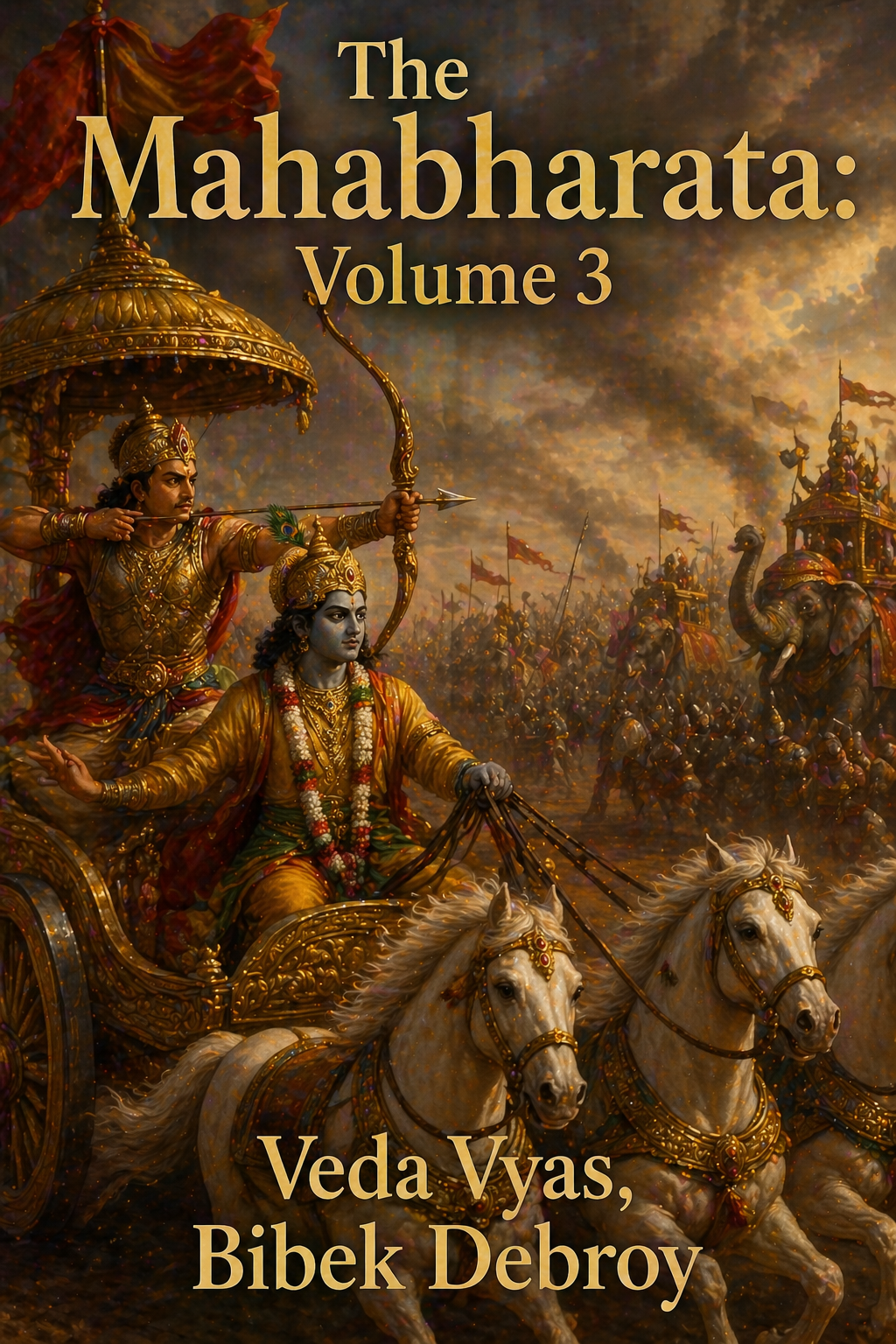
The Mahabharata: Volume 3
Chapter Summaries
What's Here for You
Embark on a journey through the intricate moral landscape of *The Mahabharata, Volume 3*. Within these pages, you'll traverse the Pandavas' forest exile, encountering trials of dharma, desire, and destiny. From pilgrimages and perilous encounters with rakshasas to profound dialogues on duty and domesticity, this volume offers a rich tapestry of human experience. Prepare to grapple with complex questions of fate, sacrifice, and the cyclical nature of existence, all while witnessing the epic struggle between good and evil. Expect a thought-provoking and emotionally resonant exploration of timeless themes, brought to life through vivid storytelling and insightful translation.
Tirtha-yatra Parva
In the Tirtha-yatra Parva, the narrator sets the stage with the Pandavas' forest exile, overshadowed by Arjuna's quest for divine weapons, and the sage Narada's timely arrival. Narada, revered, addresses Yudhishthira’s quest to understand the merit of earthly pilgrimages, then introduces Pulastya's wisdom imparted to Bhishma, emphasizing that true pilgrimage lies in controlling one's senses and mind, achievable even by the poor through pure intentions, a concept that challenges notions of wealth-dependent spirituality. Pulastya then guides Bhishma through an elaborate itinerary of tirthas—Pushkara, Prabhasa, Dvaravati, and many more—each tied to specific rituals and blessings, painting a vivid map of spiritual destinations, a sensory tapestry woven with promises of purification and celestial boons. A key tension emerges: can external rituals guarantee inner transformation? The tales of Agastya, Rishyashringa, and others serve as narrative diversions, each subtly reinforcing the theme that devotion and inner purity are paramount, more so than mere physical presence at a tirtha. Pulastya cautions against those who are liars, uncontrolled, or ignorant, for they cannot truly benefit from these sacred journeys. The chapter culminates with the arrival of the sage Lomasha, sent by Indra, bearing news of Arjuna's success and further underscoring the value of austerities, resolving the initial anxiety over Arjuna's absence with a renewed focus on inner strength and dharma. The cinematic journey thus becomes an allegorical one, urging the listener to seek the sacred within, transforming the external pilgrimage into a quest for internal harmony.
Jatasura-vadha Parva
In the Jatasura-vadha Parva of the Mahabharata, Veda Vyas, as narrated by Vaishampayana and translated by Bibek Debroy, presents a gripping tale of deception and retribution. The Pandavas, enjoying a period of comfort, are soon threatened by Jatasura, a rakshasa disguised as a learned brahmana. This imposter, feigning service and biding his time, eventually abducts Dharmaraja, the twins, and Krishna, seizing their weapons and shattering their peace. Dharmaraja Yudhishthira, even in captivity, attempts to reason with Jatasura, reminding him of the dharma that binds all beings and the reciprocal relationship between humanity and other species, a delicate balance easily disrupted by acts of unprovoked injury. Sahadeva, managing to escape, alerts Bhimasena, whose timely arrival ignites a fierce confrontation. Bhima, initially hesitant to harm one who appeared to be a brahmana, now sees Jatasura's true nature revealed through his treacherous actions. Like a coiled spring, Bhima unleashes his wrath, engaging the rakshasa in a brutal wrestling match, a clash of titans amidst uprooted trees and shattered rocks. Ultimately, Bhima triumphs, severing Jatasura's head and restoring order, demonstrating that true strength lies not only in physical prowess but also in the discernment to recognize and confront evil, even when it wears a mask of piety. The narrative underscores the importance of upholding dharma, the consequences of deceit, and the protective role of the righteous warrior, whose duty it is to safeguard the innocent and restore balance to the world.
Yaksha-yuddha Parva
In the *Yaksha-yuddha Parva*, Veda Vyas and Bibek Debroy weave a tale of anticipation and confrontation as the Pandavas await Arjuna's return, a period marked by both marvel and inner conflict. Yudhishthira, ever mindful of dharma, guides his brothers through the treacherous Himalayan terrain, leading them to the sage Arshtishena's hermitage, a sanctuary promising respite and wisdom. Yet, Droupadi’s desire for celestial flowers ignites a spark, sending Bhima on a collision course with yakshas and rakshasas, a battle testing the boundaries of strength and righteousness. Bhima's encounter with the rakshasa Maniman escalates the tension, culminating in Maniman's death and drawing the attention of Kubera, lord of riches, revealing that even acts of violence can serve a hidden cosmic purpose, freeing Kubera from a curse. Arshtishena's counsel serves as a moral compass, cautioning against venturing too far into the divine realms, a boundary underscored by the rakshasas' swift retribution against transgressors. The narrative pauses, allowing us to reflect: true strength lies not only in physical prowess but in understanding one's place within the grand tapestry of dharma. Kubera's arrival shifts the tone from confrontation to reconciliation. He is initially angered by Bhima’s actions, but ultimately reveals that these events were predetermined, with Bhima merely an instrument of fate. Vaishravana emphasizes the importance of perseverance, steadfastness, and understanding the right place and time for action, principles vital for success and ethical leadership. The chapter culminates with Arjuna's triumphant return, laden with celestial weapons, a moment of elation tempered by the responsibility that accompanies such power. Arjuna's retelling of his celestial journey, his battles with the nivatakavacha demons and the inhabitants of Hiranyapura, serves as a reminder that true mastery requires both skill and adherence to dharma, a balance that defines the path of a righteous warrior. Yudhishthira expresses the underlying tension—how does one reconcile power with dharma? Narada appears, cautioning Arjuna against the indiscriminate use of divine weapons, underscoring that true strength lies in restraint and wisdom, not just in the possession of power. Like seeds carefully sown, these weapons, when used judiciously, promise prosperity, but when wielded carelessly, threaten destruction. The chapter resolves with the Pandavas reunited, their bond strengthened by trials and tempered by wisdom, ready to face the challenges that lie ahead, guided by the principles of dharma and the lessons learned on Mount Gandhamadana.
Ajagara Parva
In the Ajagara Parva of the Mahabharata, Veda Vyas, through Bibek Debroy's translation, presents a compelling drama of strength, dharma, and the cyclical nature of fate. The Pandavas, reunited with Arjuna, find temporary respite, but Bhima's impulsive nature soon leads him into peril. Nahusha, a fallen king transformed into a boa constrictor, ensnares Bhima, creating a gripping tension. This capture isn't merely physical; it's a clash of past karma and present action. Nahusha's predicament—once a powerful ruler, now a serpent due to disrespecting brahmanas—highlights how arrogance can lead to downfall. Yudhishthira arrives, and their dialogue becomes the crux of the narrative, exploring the true nature of a brahmana. Yudhishthira asserts that a brahmana is defined not by birth but by conduct: truthfulness, charity, forgiveness, and compassion. This challenges the rigid varna system, suggesting that virtue transcends social standing. The serpent argues that nothing is free from happiness or unhappiness, but Yudhishthira counters with the idea of a neutral state, a balance between extremes. Nahusha's curse is lifted through Yudhishthira's wisdom, illustrating that knowledge and dharma can redeem even the most dire circumstances. The revelation that even the mighty can be deluded by prosperity serves as a cautionary tale. Nahusha's transformation back to his celestial form underscores the possibility of redemption and the cyclical nature of karma. The Pandavas, reminded of the importance of dharma and humility, continue their journey, carrying the weight of these lessons. The forest, once a place of refuge, now echoes with the profound understanding that true strength lies not in physical prowess but in moral integrity and wisdom. The resolution comes as Nahusha sheds his serpentine form, ascending back to the heavens, a visual metaphor for the release from karmic bondage through righteous action and insightful dialogue.
Markandeya Samasya Parva
In the "Markandeya Samasya Parva" of *The Mahabharata, Volume 3*, Veda Vyas and Bibek Debroy present a profound exploration of dharma, time, and the cyclical nature of existence through the sage Markandeya’s visit to the Pandavas; Markandeya, a figure who has lived for thousands of years, arrives as a radiant sun, ready to illuminate the Pandavas' understanding of their suffering—he embodies the concept that true wisdom arises from experiencing the full spectrum of time's passage; Yudhishthira, grappling with his perceived misfortune, questions the very nature of divine agency, setting the stage for Markandeya's teachings, which reveal that human actions dictate destiny, not an external god, and that happiness and unhappiness are the fruits of one's own deeds across lifetimes; Markandeya recounts the creation of beings, their fall from grace, and the cyclical nature of yugas eras, illustrating that time is not linear but a grand, repeating pattern of creation and destruction; He details the characteristics of each yuga, from the pure Krita to the degenerate Kali, cautioning that falsehood and moral decay are harbingers of destruction, but also promising a return to righteousness with the arrival of Kalki, a figure of renewal; The sage shares stories of virtuous kings, devoted wives, and the power of brahmanas, reinforcing the idea that dharma is the bedrock of a meaningful life, even when obscured by the fog of suffering; One striking image is that of Vaivasvata Manu and the fish, which becomes Brahma, representing the power of dharma to preserve life through cosmic floods, illustrating that adherence to dharma acts as a vessel of salvation amidst chaos; Markandeya's narrative underscores that even in the darkest times, the path to righteousness remains open, and the choices individuals make ripple through eternity—the lesson being, embrace dharma, for it is the truest agent of destiny.
Droupadi–Satyabhama-sambada Parva
In the "Droupadi–Satyabhama-sambada Parva," Bibek Debroy presents a fascinating dialogue, a window into the domestic sphere of epic heroes. Satyabhama, Krishna's beloved queen, seeks from Droupadi the secret to controlling her powerful husbands, a question laden with societal expectations and insecurities. Droupadi, with a firmness that echoes through the ages, rejects the notion of control through manipulation, be it mantras or herbs, emphasizing instead the importance of genuine service and devotion. She paints a vivid picture: a wife's duty is not to ensnare, but to serve without vanity, anger, or desire, placing her soul within theirs, anticipating their needs. Droupadi reveals that true influence stems not from spells, but from unwavering respect and tireless service, a constant tending to the household's needs, both material and emotional. The home is described as a kingdom and Droupadi its steadfast steward. She underscores the importance of maintaining a clean and orderly environment, managing resources wisely, and always prioritizing her husbands' comfort and well-being, which is a reflection of her love. This is contrasted sharply with the destructive path of 'evil women' who resort to manipulation. Droupadi advises Satyabhama to worship Krishna with all her heart, love, and affectionate deeds, emphasizing that a husband is like a god, and his favor is the source of all desires. The discussion shifts as Droupadi outlines her rigorous daily routine, from managing thousands of servants to overseeing vast resources, showcasing a life dedicated to selfless service. Finally, Droupadi imparts wisdom on maintaining harmony within the household, advising Satyabhama to protect her husband's secrets and surround him with those who wish him well, solidifying the idea that a supportive environment is as crucial as personal devotion. The chapter closes with Satyabhama's departure, carrying with her not a recipe for control, but a profound understanding of devotion, service, and the quiet strength of a woman's heart within the home.
Ghosha Yatra Parva
In the Ghosha Yatra Parva of the Mahabharata, Veda Vyas and Bibek Debroy weave a tale rich with irony and moral complexity. The narrative tension sparks when Dhritarashtra, swayed by Duryodhana's desires and Karna's goading, permits an expedition to Dvaitavana, where the Pandavas reside in exile. Duryodhana, fueled by envy, seeks to flaunt his prosperity before his exiled cousins, a decision that swiftly descends into chaos. The instructor notes that prosperity flaunted without humility invites unforeseen challenges. As Duryodhana's entourage encroaches upon a lake favored by the gandharvas, celestial beings clash with mortal arrogance. The air crackles with tension as Duryodhana's forces are humiliated and captured, their cries for help echoing towards the very men they sought to mock. It's a vivid reminder that pride often precedes a fall, and the wheel of fortune turns unpredictably. Yudhishthira, ever bound by dharma, orders his brothers to rescue the Kouravas, teaching us that compassion towards one’s enemies, even those deserving of scorn, elevates the spirit. Arjuna, with celestial weapons at his command, confronts the gandharvas, creating a spectacle of divine power tempered by fraternal duty. Chitrasena, the gandharva king, reveals that their actions were orchestrated by Indra to humble Duryodhana, exposing the puppet strings of fate. The instructor emphasizes that external forces often shape our destinies, and recognizing these influences brings wisdom. Duryodhana, freed but seething with shame, resolves to fast unto death, a dramatic act of self-pity that Karna, Shakuni, and Duhshasana attempt to dissuade. The scene becomes a tableau of despair, illustrating that unchecked pride leads to self-destructive paths. Ultimately, Duryodhana is swayed by a vision orchestrated by the danavas, who promise him victory through deceit and manipulation, solidifying his resolve for future conflict. The instructor warns that succumbing to the allure of promised triumphs, especially those rooted in darkness, corrupts the soul. He returns to Hastinapura, the seeds of future war sown deep within his heart, a stark reminder that unresolved conflict festers and spreads, poisoning all it touches.
Mriga-Svapna-Bhaya Parva
In the Mriga-Svapna-Bhaya Parva of the Mahabharata, as narrated by Vaishampayana to Janamejaya, we find Yudhishthira grappling with a moral dilemma that tests the Pandavas' commitment to dharma. The narrative tension rises as deer, their voices choked with tears, appear to Yudhishthira in a dream, a poignant cry for help from the dwindling inhabitants of Dvaitavana. This dream isn't merely a nocturnal vision but a mirror reflecting the impact of the Pandavas' presence on the delicate ecosystem. The deer's plea underscores a critical insight: even righteous actions, such as hunting for survival, can inadvertently disrupt the balance of nature. Yudhishthira, ever compassionate, recognizes the validity of their fear, illustrating the principle that true dharma extends beyond human concerns to encompass the welfare of all beings. His immediate decision to relocate reveals a profound understanding of leadership, one where empathy and responsibility outweigh personal convenience. The Pandavas' swift departure towards Kamyaka forest, guided by dharma and followed by their retinue, symbolizes a commitment to minimizing harm, even when unintended. This act of leaving Dvaitavana highlights the idea that wisdom lies in recognizing the broader consequences of one's actions and adapting to ensure the well-being of the community, both human and animal. The parva culminates with the Pandavas' arrival at the sacred hermitage of Kamyaka, a haven of peace and asceticism, offering a visual metaphor for the potential harmony between humanity and nature when guided by compassion and foresight. Their entry into this sanctuary suggests a resolution: that true strength lies not only in physical prowess but in the ability to act with kindness and consideration for all life, ensuring the preservation of the delicate seeds of the future.
Vrihi-Drounika Parva
In the Vrihi-Drounika Parva, Vyasa visits the Pandavas during their exile, a period marked by immense hardship, their spirits are as parched as the dry earth they walk upon. Yudhishthira, burdened by the weight of his past decisions, finds himself restless, a stark contrast to his inherent dharma. Vyasa, with the wisdom of ages etched in his voice, reminds him that happiness and unhappiness are transient, urging him to embrace austerities, for there is nothing superior to it. He emphasizes the virtues of truthfulness, honesty, and non-violence, the cornerstones of a pure life. When Yudhishthira questions the relative merits of giving versus austerities, Vyasa elevates charity, especially when wealth, earned justly, is given to the virtuous at the right time and place. To illustrate this, Vyasa narrates the tale of Mudgala, a sage living in Kurukshetra, whose life was a testament to generosity. Mudgala, subsisting on a drona of rice, never wavered in his hospitality, a beacon of selflessness. His unwavering commitment drew the attention of the sage Durvasa, who tested Mudgala's resolve repeatedly, arriving unannounced to consume all his food. Yet, Mudgala's temperament remained unperturbed, his generosity as boundless as the sky. Impressed by Mudgala's virtue, Durvasa revealed the fruits of his actions: an invitation to ascend to heaven in his mortal body. However, Mudgala, wise beyond measure, questioned the messenger of the gods about the qualities and shortcomings of heaven. Upon learning of its taints—the inevitable fall and the discontentment that follows—Mudgala declined the offer, desiring instead an infinite region free from sorrow and dislodgement. Through yoga and meditation, Mudgala attained supreme wisdom and eternal salvation. Vyasa concludes by reminding Yudhishthira that like the rim of a wheel, happiness follows unhappiness, urging him to discard his sorrow and reclaim his kingdom through his own austerities, echoing the cyclical nature of life's trials and triumphs.
Droupadi Harana Parva
In the Droupadi Harana Parva, Veda Vyas and Bibek Debroy recount the tale of Jayadratha's attempt to abduct Droupadi, setting in motion a chain of events that reveal deeper truths about dharma, desire, and consequence. Jayadratha, consumed by lust upon seeing Droupadi, embodies unchecked desire, a stark contrast to the Pandavas' commitment to dharma. When Kotikashya tries to learn about Droupadi, she reveals her husbands have gone hunting, emphasizing the vulnerability that arises when dharma is temporarily absent. Jayadratha's abduction attempt, a rash act fueled by his arrogance, illustrates the peril of underestimating those who uphold dharma, for he views the Pandavas as weakened, failing to recognize their inner strength. Droupadi's fierce resistance, even in the face of overwhelming force, is like a flame refusing to be extinguished, showcasing her unwavering devotion and inner power. Once the Pandavas learn of the abduction, their swift and furious pursuit underscores the protective nature of dharma and the inevitable repercussions for those who violate it. Jayadratha’s subsequent defeat and humiliation serve as a potent reminder that actions have consequences and that dharma, though sometimes tested, ultimately prevails. Markandeya then tells Yudhishthira the story of Rama and Sita, and Savitri and Satyavan, where both Rama and Savitri face immense challenges, but their unwavering commitment to dharma and love ultimately leads to the restoration of balance. This tale underscores the cyclical nature of life's trials and the enduring power of devotion and righteousness, and Savitri's determination is a beacon, illustrating that even death can be overcome through unwavering resolve and love. The chapter concludes with these stories, reinforcing the idea that while suffering is inevitable, adherence to dharma and unwavering devotion can ultimately lead to redemption and the restoration of order.
Kundala-aharana Parva
In the Kundala-aharana Parva of the Mahabharata, Veda Vyas and Bibek Debroy present a profound exploration of dharma, fame, and sacrifice, narrated with the wisdom of an insightful instructor. The chapter opens with Janamejaya's curiosity about Karna's concealed fears, setting the stage for a revelation of Karna's origin and his fateful encounter with Surya. Surya, in a dream, warns Karna of Indra's impending request for his divine earrings and armor, treasures that ensure his invincibility. This sets up the central tension: Karna's commitment to his vow of giving versus the preservation of his own life and dharma. Karna, unwavering in his resolve, declares that ill-fame is worse than death, a sentiment that underscores his dedication to upholding his reputation for generosity. Surya's attempts to dissuade Karna highlight the conflict between worldly preservation and eternal fame. The narrative then shifts to Kunti's backstory, her service to Durvasa, and the boon that leads to Karna's birth through Surya's intervention, revealing the divine origins of Karna’s protective gear. Kunti's abandonment of Karna and his subsequent adoption by Adhiratha, a charioteer, adds layers of complexity to Karna’s identity. The chapter builds to the pivotal moment when Indra, disguised as a brahmana, approaches Karna for his earrings and armor. Karna, aware of Indra's true identity, agrees to give them in exchange for Indra's invincible spear—a transaction that seals his fate and tests the boundaries of sacrifice. This exchange is not merely a transaction but a symbolic representation of choosing fame over life, a choice that defines Karna's character. In a sensory scene, Karna slices off his armor and earrings, his face devoid of pain, showcasing his unflinching resolve as celestial drums sound and divine flowers shower down—a vivid testament to his sacrifice. The chapter concludes with the aftermath of Karna's deception, the Dhritarashtras' despair, and the Pandavas' relief, setting the stage for future conflicts. The instructor emphasizes that true dharma often demands difficult choices, where personal preservation clashes with unwavering commitments to honor and reputation. The ultimate insight is that Karna's life, marked by both divine blessings and tragic choices, embodies the complex interplay between fate, free will, and the pursuit of eternal fame, a theme that resonates throughout the Mahabharata.
Araneya Parva
In the Araneya Parva of the Mahabharata, Veda Vyas and Bibek Debroy recount a pivotal period in the Pandavas' exile, a time of profound testing and revelation. The narrative opens with the Pandavas resettling in Dvaitavana, only to be disrupted by a brahmana's plea for lost kindling, setting in motion a chase after a deer and a confrontation with a Yaksha. This pursuit becomes a crucible, testing the brothers' dharma and resilience. As Nakula, Sahadeva, Arjuna, and Bhima fall, one by one, by ignoring the Yaksha's warnings, Yudhishthira arrives at a pond shimmering like a mirage of hope and death, where he faces the ultimate trial: a barrage of philosophical questions. The Yaksha, representing Dharma itself, probes Yudhishthira's understanding of truth, duty, and wisdom. Yudhishthira’s insightful answers—defining learning through sacred texts, greatness through austerities, and intelligence through serving elders—reveal his unwavering commitment to dharma, even when faced with the deaths of his brothers. His wisdom illuminates that true dharma isn't rigid adherence to rules, but a flexible application of principles, adapting to circumstances while maintaining integrity. When asked about the divine and human traits of different classes, Yudhishthira illustrates that true character lies not in birth but in conduct. His preference for reviving Nakula, his stepbrother, underscores his commitment to impartiality and upholding dharma above personal desires, showcasing that true justice balances competing needs. Yudhishthira’s final boon requests highlight his selfless nature. In the end, the Yaksha reveals himself as Dharma, Yudhishthira’s father, satisfied with his son's unwavering adherence to righteousness. The Pandavas are restored, and granted the boon of remaining unrecognized during their final year of exile, demonstrating that trials, when faced with wisdom and integrity, lead to unexpected blessings and deeper understanding. This transformative encounter underscores that dharma is not a passive acceptance of fate, but an active engagement with moral choices, guiding one through the darkest forests towards enlightenment.
Conclusion
Volume 3 of the Mahabharata, meticulously translated by Bibek Debroy, delves into the Pandavas' exile, a crucible forging their understanding of dharma. The narratives underscore that true pilgrimage resides in inner purity, not mere physical presence at sacred sites. Austerity, devotion, and discerning righteousness from deception are paramount. The volume highlights the reciprocal nature of actions, emphasizing that dharma's protection extends to defending the innocent and confronting evil, even when disguised. True strength balances physical prowess with moral understanding, demanding vigilance against deceptive appearances. Ethical leadership necessitates understanding the right time and place for action, while mastery demands both skill and adherence to dharma. Arrogance, especially towards wisdom, invites downfall. A brahmana is defined by conduct, not birth, showcasing virtue transcending social standing. The cyclical nature of karma and redemption are constant themes, urging continuous self-reflection. Ultimately, human actions determine destiny. Cultivating self-control, truthfulness, and devotion are vital for navigating life's challenges. The Droupadi-Satyabhama dialogue reveals the power of selfless service and devotion in relationships, while the Ghosha Yatra Parva exposes the consequences of unchecked pride and deceit. Compassion, even towards enemies, elevates the spirit. The narrative stresses the transience of happiness and unhappiness, urging the cultivation of virtues like truthfulness and non-violence. Selfless giving and equanimity in adversity lead to inner peace. Unchecked desire leads to destruction, and dharma's protective nature ensures repercussions for violations. Commitment to dharma and love restores balance. Upholding vows, even at great cost, defines character. Divine gifts entail responsibilities, and maintaining one's reputation is crucial. True dharma requires flexible application, and character is defined by conduct, not birth. Trials strengthen adherence to righteousness. The book leaves the reader with the understanding that devotion, humility, and dharma are the keys to navigate life's complexities.
Key Takeaways
True pilgrimage lies in controlling the senses and mind, accessible to all regardless of wealth.
Physical presence at sacred sites alone does not guarantee spiritual merit; intention and inner purity are essential.
Austerity and devotion are powerful tools for achieving spiritual growth and overcoming adversity.
The path to dharma requires discernment, distinguishing between true righteousness and deceptive appearances.
Spiritual journeys can lead to both external rewards and profound internal transformation.
It is important to protect dharma and ensure its endurance, even in the face of adversity.
Upholding dharma requires defending the innocent and confronting evil, even when disguised.
True strength involves both physical prowess and the wisdom to discern true intentions.
Deceptive appearances can mask treacherous intentions, demanding constant vigilance.
Actions have reciprocal consequences, impacting not only individuals but also the broader cosmic balance.
The duty of a protector extends to maintaining order and ensuring the well-being of the community.
True strength lies in balancing physical prowess with moral understanding.
Even acts of violence can serve a larger, predetermined cosmic purpose.
Ethical leadership requires understanding the right time and place for action.
Mastery demands both skill and adherence to dharma.
Restraint and wisdom are essential components of true power.
Indiscriminate use of power can lead to destruction.
True strength lies not in physical prowess but in moral integrity and adherence to dharma.
Arrogance and disrespect, especially towards those who possess wisdom, can lead to a catastrophic downfall.
A brahmana is defined not by birth but by conduct: truthfulness, charity, forgiveness, and compassion.
Virtue transcends social standing, and righteous actions can redeem even the most dire circumstances.
Even the mightiest can be deluded by prosperity, underscoring the importance of humility.
Knowledge and dharma are powerful tools for overcoming adversity and breaking free from karmic bondage.
The cyclical nature of karma and the possibility of redemption are constant themes, emphasizing the importance of continuous self-reflection and moral correction.
Human actions, not external forces, primarily determine one's destiny and experiences across lifetimes.
Time operates cyclically, with repeating patterns of creation, destruction, and renewal across the yugas.
Adherence to dharma serves as a vessel of salvation, preserving life and righteousness amidst chaos and suffering.
Moral decay and falsehood are key indicators of societal decline, heralding the end of an era.
True wisdom arises from enduring experiences across time, granting a deeper understanding of dharma.
Cultivating self-control, truthfulness, and devotion to dharma are paramount for navigating life's challenges and achieving lasting fulfillment.
True influence in a marriage stems from selfless service and devotion, not manipulation or control.
Maintaining a harmonious household requires diligence, resourcefulness, and unwavering respect for one's husband.
A wife's role involves not only meeting physical needs but also safeguarding her husband's reputation and surrounding him with positive influences.
Deceitful practices ultimately erode trust and happiness within a relationship.
Genuine love is expressed through consistent acts of service and prioritizing the well-being of one's partner.
A supportive and well-managed home environment is crucial for a husband's success and happiness.
Prosperity flaunted without humility invites unforeseen challenges and karmic retribution.
Compassion towards one’s enemies, even those deserving of scorn, elevates the spirit and upholds dharma.
External forces often shape individual destinies; recognizing these influences cultivates wisdom and understanding.
Unchecked pride leads to self-destructive paths, blinding individuals to reason and empathy.
Succumbing to the allure of promised triumphs, especially those rooted in deceit, corrupts the soul and ensures future conflict.
Unresolved conflict festers and spreads, poisoning relationships and communities, necessitating proactive resolution.
Even actions intended for survival can disrupt natural harmony.
True dharma encompasses the welfare of all beings, not just humans.
Effective leadership requires empathy and responsibility towards all life.
Wisdom involves recognizing and adapting to the broader consequences of one's actions.
Strength lies in acting with kindness and consideration for all life.
Embrace the transient nature of happiness and unhappiness, understanding that both are temporary phases in life's cyclical journey.
Cultivate virtues like truthfulness, honesty, and non-violence as fundamental pillars for a pure and fulfilling life.
Practice selfless giving, especially when resources are obtained justly, to foster spiritual growth and positive karma.
Maintain equanimity in the face of adversity, recognizing that unwavering generosity and compassion can lead to profound inner peace.
Question the allure of transient rewards, like heaven, and seek instead the eternal and infinite, free from sorrow and impermanence.
Use meditation and self-reflection to achieve supreme wisdom, transcending praise and blame to attain a state of serene detachment.
Unchecked desire leads to destructive actions and unforeseen consequences.
Vulnerability arises when dharma is temporarily absent, testing one's resolve.
Underestimating those who uphold dharma is a dangerous act rooted in arrogance.
True strength lies in unwavering devotion and inner power, even when facing overwhelming odds.
The protective nature of dharma ensures that violations will inevitably face repercussions.
Commitment to dharma and love ultimately leads to the restoration of balance and redemption.
Suffering is an inevitable part of life, but unwavering devotion can overcome even death.
Uphold your vows, even at great personal cost, to maintain your integrity and honor.
Recognize that true fame often requires sacrificing personal safety and immediate gains.
Understand that choices between worldly preservation and eternal values define one's character.
Be aware that divine gifts come with inherent responsibilities and moral dilemmas.
Acknowledge that maintaining one's reputation can be as vital as preserving one's life.
Balance the pursuit of personal welfare with the broader implications of one's actions on family and lineage.
True dharma requires a flexible application of principles, adapting to circumstances while maintaining integrity.
Character is defined not by birth or social class, but by one's conduct and adherence to virtuous traits.
Upholding dharma often demands impartiality and balancing competing needs, even at personal cost.
Selfless actions and a commitment to non-violence can lead to unexpected blessings and deeper understanding.
Trials and tribulations serve as opportunities to test and strengthen one's adherence to righteousness and moral values.
Action Plan
Identify a mentor or guide to help navigate complex ethical dilemmas.
Practice daily self-reflection to identify and control negative impulses.
Seek out opportunities for selfless service, focusing on intention over outcome.
Identify a personal 'tirtha'—a place or activity that fosters inner peace—and commit to visiting it regularly.
Cultivate discernment by studying ethical teachings and seeking wise counsel.
Incorporate acts of austerity, such as fasting or silence, into your routine to strengthen self-discipline.
Reflect on the deeds of virtuous figures like Shibi and Yayati, drawing inspiration for ethical conduct.
Prioritize inner purity and devotion over external displays of piety in your spiritual practice.
Reflect on your own moral compass and identify areas where you can better uphold dharma.
Practice discernment in your interactions, looking beyond surface appearances to understand true intentions.
Consider the consequences of your actions and how they impact the broader community.
Cultivate both physical and mental strength to effectively address challenges and protect the vulnerable.
Stand up against injustice and deceit, even when it requires courage and sacrifice.
Reflect on a situation where you used power. Was it balanced with ethical considerations?
Practice restraint in decision-making, considering the long-term consequences of your actions.
Cultivate wisdom through continuous learning and reflection on your experiences.
Seek to understand the larger purpose behind your actions, aligning them with your values and principles.
Reflect on your own actions and identify areas where arrogance or lack of humility may be present.
Practice truthfulness, charity, forgiveness, and compassion in your daily interactions.
Evaluate your conduct based on ethical principles, not just social expectations or personal gain.
Seek knowledge and wisdom from reliable sources to guide your decisions and actions.
Cultivate humility and recognize that even in positions of power, one is susceptible to delusion.
Continuously strive for self-improvement and moral correction to break free from negative karmic cycles.
Consider how your actions impact others and strive to create positive outcomes through ethical behavior.
Practice self-reflection to identify and address any tendencies towards arrogance or disrespect.
Reflect on personal actions and identify areas where greater adherence to dharma can be practiced.
Cultivate self-awareness to recognize and mitigate the influence of desire, anger, and greed in decision-making.
Practice truthfulness and integrity in all interactions, recognizing truth as the foundation of dharma.
Seek out and learn from virtuous individuals to deepen understanding of dharma and righteous conduct.
Engage in acts of compassion and service to others, embodying the principle of benevolence towards all beings.
Study sacred texts and teachings to cultivate wisdom and navigate life's challenges with greater clarity.
Embrace the cyclical nature of time and view setbacks as opportunities for growth and renewal.
Prioritize ethical considerations in all endeavors, aligning actions with the principles of dharma.
Practice forgiveness and compassion towards oneself and others, recognizing the shared human experience of imperfection.
Practice selfless service towards your partner, anticipating their needs without expecting immediate returns.
Cultivate a clean and orderly home environment to promote peace and well-being.
Actively manage household resources and finances responsibly.
Protect your partner's reputation and secrets, fostering trust and loyalty.
Surround your partner with positive influences and distance yourselves from those who wish them ill.
Communicate openly and respectfully, avoiding manipulation or deceit.
Prioritize your partner's well-being and happiness in your daily actions.
Practice humility in moments of success and prosperity, reflecting on the source of your good fortune.
Cultivate empathy towards your enemies, seeking to understand their perspectives and motivations.
Recognize and acknowledge the external forces influencing your decisions and actions.
Challenge your own pride and arrogance through self-reflection and honest feedback from others.
Resist the temptation to seek victory through deceit or manipulation, choosing instead to uphold ethical principles.
Actively work to resolve conflicts in your relationships and communities, seeking peaceful and just solutions.
Reflect on the cyclical nature of conflict and violence, recognizing the importance of breaking destructive patterns.
Seek out mentors or guides who can offer wisdom and guidance in navigating ethical dilemmas.
Reflect on the unintended consequences of your daily actions on the environment and other beings.
Seek to understand the perspectives of all stakeholders affected by your decisions.
Prioritize empathy and compassion when making choices that impact others.
Actively seek ways to minimize harm and promote the well-being of all life.
Practice mindful consumption and reduce your ecological footprint.
Support organizations that work to protect endangered species and habitats.
Practice giving, even in small ways, to cultivate generosity and detach from material possessions.
Reflect on personal values and commit to acting with truthfulness, honesty, and non-violence in daily interactions.
Meditate regularly to cultivate inner peace and detach from external circumstances.
Question the motivations behind pursuing material rewards and consider the potential for transient happiness.
Seek opportunities to practice selflessness and compassion towards others, understanding that these actions lead to spiritual growth.
Embrace life's ups and downs with equanimity, recognizing that both happiness and unhappiness are temporary.
Cultivate contentment with what you have, understanding that true happiness comes from within.
Reflect on personal desires and ensure they align with ethical principles.
Identify moments of vulnerability and strengthen your commitment to dharma.
Recognize and respect the strength of those who uphold righteousness.
Cultivate inner power and devotion as a source of resilience in challenging times.
Accept that actions have consequences and strive to act with integrity.
Seek inspiration from stories of devotion and righteousness to overcome adversity.
Apply the lessons of dharma to leadership and ethical decision-making.
Identify a personal value or principle that you are unwilling to compromise, regardless of the consequences.
Reflect on how you can prioritize your reputation and honor in your daily actions and decisions.
Consider the long-term impact of your choices, weighing immediate gains against lasting fame.
Examine your own motivations for seeking fame and recognition, ensuring they align with your core values.
Practice making difficult decisions that require sacrificing personal comfort for the greater good.
Cultivate a mindset of generosity and sacrifice, being willing to give even when it is personally challenging.
Reflect on how societal expectations and cultural values influence your understanding of dharma and ethical behavior.
Reflect on a recent ethical dilemma and consider how a flexible application of dharma could guide your decision.
Identify a personal trait you wish to improve and seek guidance from an elder or mentor.
Practice impartiality by considering the needs of all parties involved in a conflict before taking action.
Commit to a daily act of selflessness, no matter how small, to cultivate a habit of generosity.
Examine your own values and identify areas where you can strengthen your commitment to righteousness and moral principles.
Cultivate non-violence in your thoughts, words, and actions, striving to resolve conflicts peacefully.
Seek opportunities to learn from sacred texts and apply their wisdom to your daily life.
Practice self-control in managing your emotions, particularly anger and desire, to ensure prosperity and happiness.