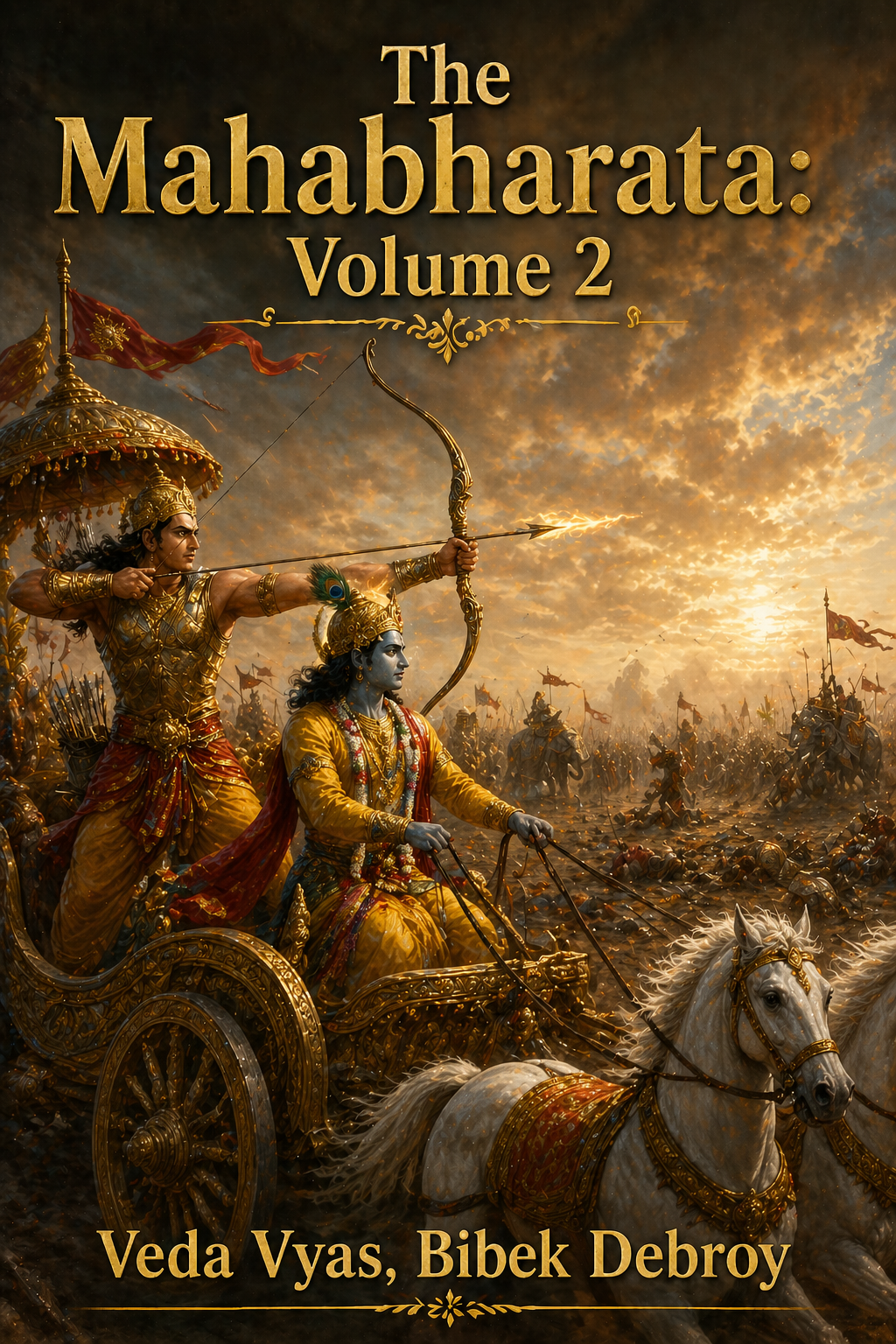
The Mahabharata: Volume 2
Chapter Summaries
What's Here for You
Embark on a journey through the intricate tapestry of the Mahabharata, Volume 2. This volume plunges you into the heart of the Pandavas' trials and triumphs, from Arjuna's daring escapades and celestial encounters to the devastating game of dice that shatters their world. Witness the fiery destruction of Khandava, the political machinations surrounding Yudhishthira's rajasuya sacrifice, and the profound moral dilemmas that test the limits of dharma. Prepare to grapple with themes of love, duty, envy, and resilience as you witness the rise and fall of kingdoms and the enduring strength of the human spirit in the face of unimaginable adversity. Experience a blend of strategic intrigue, philosophical depth, and emotional resonance as the seeds of future conflict are sown, promising a compelling and thought-provoking exploration of this epic tale.
Arjuna-vanavasa Parva
In the Arjuna-vanavasa Parva of the Mahabharata, Veda Vyas, as narrated by Bibek Debroy, sets the stage with Janamejaya's eager inquiry about the Pandavas' life after obtaining Indraprastha, specifically how they maintained harmony with their shared wife, Krishna. The arrival of Narada introduces a tension: how to prevent discord among the brothers. Narada recounts the tale of Sunda and Upasunda, two asura brothers inseparable in their power, mirroring the Pandavas' bond. Their undoing came through Tilottama, an apsara whose beauty ignited fatal jealousy. This story serves as a cautionary metaphor—a vivid reminder that even the strongest bonds can shatter over desire. Narada's wisdom plants a seed: the Pandavas must establish rules to protect their unity. Yudhishthira, ever the embodiment of dharma, agrees, leading to a pact where any brother intruding on another's private time with Droupadi must undergo twelve years of forest exile. This agreement, born of potential conflict, ironically sets the stage for Arjuna's banishment. When a brahmana seeks help after thieves steal his cattle, Arjuna faces a moral collision: uphold his dharma to aid the distressed or honor the agreement made to his brother. Choosing duty, Arjuna enters the room where Yudhishthira is with Droupadi, retrieves his weapons, and recovers the brahmana's wealth. The act, though righteous, forces Arjuna into exile, a consequence he accepts with stoic resolve. His journey becomes a pilgrimage, leading him to encounters with Ulupi, a Naga princess who claims him, and Chitrangada, a princess he marries under specific conditions ensuring her lineage continues. These unions, seemingly digressions, highlight the complexities of dharma and duty. Arjuna's travels further lead him to liberate apsaras trapped as crocodiles, showcasing his unwavering commitment to righteousness. The parva culminates in a reunion with Krishna in Prabhasa, solidifying their bond and underscoring the cyclical nature of duty, consequence, and ultimate connection.
Subhadra-harana Parva
In the Subhadra-harana Parva of the Mahabharata, Veda Vyas unveils a tale of love, strategy, and dharma, narrated through the eyes of Vaishampayana. The grand festival on Mount Raivataka sets the stage, a sensory explosion of music, dance, and vibrant colors, where Arjuna first beholds Vasudeva's daughter, Subhadra. Struck by love, Arjuna's desire ignites a crucial dilemma: how can a forest-dweller, bound by dharma, pursue such a captivating woman? Krishna, ever the strategist, illuminates the path, revealing that while a svayamvara is customary, abduction is permissible for kshatriyas, a revelation that underscores the flexible interpretation of dharma in the face of desire and destiny. This introduces the first key insight: dharma is not always rigid; it can be adapted to circumstance, especially when intertwined with duty and desire. Arjuna, with Krishna's sanction, seeks permission from Dharmaraja, highlighting the importance of familial and kingly approval in significant life decisions. The narrative tension escalates as Arjuna, astride a golden chariot, abducts Subhadra, a bold act that sends shockwaves through the Vrishni assembly hall. The scene is set for conflict, the Vrishni warriors, intoxicated and enraged, clamor for war, their fury a storm threatening to break. But Vanamali, wise and perceptive, tempers their rage, urging them to heed Krishna's counsel, reminding them that rash action without understanding is folly. This pause reveals a second insight: restraint and wisdom are paramount, especially when emotions run high, a principle applicable to leadership and personal relationships alike. Kamapala's impassioned speech underscores the perceived insult to the Vrishni lineage, questioning Arjuna's audacity and challenging Krishna's silence. The chapter thus illuminates a third core idea: actions have consequences, and even well-intentioned deeds can be perceived as transgressions, demanding careful consideration of their impact on others. The stage is now set, not just for potential conflict, but for a deeper exploration of duty, honor, and the complex interplay of human relationships, leaving the listener poised on the edge of anticipation.
Harana Harika Parva
In the *Harana Harika Parva*, Veda Vyas and Bibek Debroy unveil a narrative rich with dharma and strategic alliances, focusing on Subhadra's abduction by Arjuna and the subsequent gifts exchanged. Vasudeva, a voice of reason, skillfully reframes Arjuna’s act not as dishonor, but as a calculated move to ensure an appropriate union, understanding that the Satvatas do not lust after riches and that a *svayamvara* holds uncertain outcomes; he sees Arjuna’s choice as sidestepping the potential sale of a daughter, an act he deems unrighteous. Thus, Vasudeva proposes appeasement rather than confrontation, averting a potential loss of fame. Arjuna, accepting this counsel, marries Subhadra, and after a year of dwelling there, returns to Khandavaprastha, where the complexities of love and duty unfold, as Draupadi voices her poignant concerns about a second wife diluting her bond, a sentiment that casts a shadow despite Arjuna’s attempts at reassurance. Subhadra's entry into the household, marked by her humility and grace even in simple attire, begins to heal the rifts, symbolizing the delicate balance between tradition and personal emotions. The arrival of Krishna, Rama, and other Vrishni warriors transforms the scene, bringing a deluge of gifts—golden chariots, cows, horses, and riches—that flood the Pandavas with prosperity, likened to a river merging into an ocean, enriching their kingdom while disheartening their adversaries. These gifts, more than mere wealth, signify alliance and strength, reinforcing the bonds between the Kurus, Vrishnis, and Andhakas, culminating in joyous celebrations. The birth of Abhimanyu to Subhadra, and the subsequent birth of Draupadi's five sons, further solidifies the lineage, each child embodying unique strengths and virtues, nurtured in vedic knowledge and martial arts, ensuring the prosperity and continuity of their line, thus weaving a tapestry of familial duty, strategic alliances, and the enduring quest for dharma.
Khandava-daha Parva
In the Khandava-daha Parva of the Mahabharata, Veda Vyas and Bibek Debroy recount the fiery destruction of the Khandava forest, orchestrated by Arjuna and Krishna, a tale resonating with themes of duty, sacrifice, and the inexorable force of destiny. The narrative begins with the Pandavas' prosperous rule in Indraprastha, a golden age mirroring the harmony of dharma, artha, and kama, yet this tranquility is disrupted when Agni, the fire god, seeks to consume the Khandava forest, a task thwarted by Indra's protection. Agni's plea sets in motion a chain of events, revealing the first core insight: sometimes, fulfilling a greater purpose requires confronting seemingly insurmountable obstacles, as Agni's hunger symbolizes a necessary cleansing. Arjuna, initially lacking the divine weaponry, embodies the human struggle of inadequacy when facing a monumental task; the acquisition of Gandiva and Krishna’s chakra from Varuna underscores the idea that true strength often comes from unexpected sources, highlighting that preparation is key to seizing opportunities. As the fire rages, consuming all in its path, the plight of the forest's inhabitants—serpents, creatures, and the Sharngaka birds—highlights the indiscriminate nature of destruction, reminding us that chaos spares no one, and tests the limits of compassion. The escape of Takshaka's son, Ashvasena, despite Arjuna's efforts, illustrates that even in the face of overwhelming power, fate can intervene, and absolute control is an illusion. A pivotal moment arrives with Maya's surrender, saved by Arjuna's intervention, demonstrating that empathy and protection can emerge amidst destruction, offering a beacon of hope. The tale of the Sharngaka birds, spared by Agni due to a promise to their father, the rishi Mandapala, reveals that past commitments and virtues can act as shields in times of crisis. As Indra unleashes torrential rains, Arjuna's unwavering resolve to protect Agni underscores that dedication to a cause demands resilience against external pressures; the eventual divine acknowledgment of Krishna and Arjuna's prowess marks a resolution, accepting destiny's course. Ultimately, the burning of Khandava is not merely an act of destruction but a necessary prelude to a new beginning, a reminder that sometimes, the old must be consumed to pave the way for the new, and that duty, even when harsh, can lead to unexpected alliances and divine recognition, as the smoke clears, it reveals not just ashes, but the seeds of future growth and transformation.
Sabha Parva
In the Sabha Parva of The Mahabharata, Veda Vyas and Bibek Debroy set the stage for a kingdom defined by both divine artistry and the seeds of future conflict. It begins with Maya, the asura saved by Arjuna, offering his service. Krishna, with foresight, directs Maya to construct an unparalleled assembly hall for Dharmaraja Yudhishthira, a space that transcends mortal craftsmanship, reflecting designs of gods, asuras, and humans—a microcosm of the cosmos itself. This hall, built with golden pillars and gem-encrusted walls, becomes more than just a structure; it's a symbol of Yudhishthira's reign and a magnet for kings and sages alike, drawing them into the Pandava's orbit. As the hall nears completion, Krishna departs, leaving the Pandavas with Maya's gifts: a supreme club for Bhima and the conch shell Devadatta for Arjuna. The hall, guarded by rakshasas, possesses an illusory tank, a reminder that perception can be deceptive, ensnaring even kings. During the grand opening, sages like Asita, Devala, and Krishna Dvaipayana, alongside kings from distant lands, gather, creating a vibrant tapestry of wisdom and power. Narada’s arrival elevates the parva, he tests Yudhishthira with a barrage of questions about governance, ethics, and dharma, serving as a mirror reflecting the king's responsibilities and potential pitfalls. Narada then recounts the celestial sabhas of Indra, Yama, Varuna, Kubera, and Brahma, each a unique expression of divine order and cosmic power, to provide a comparative framework for Yudhishthira's own assembly hall. Each sabha reflects the values of its presiding deity, like Yama's hall populated by righteous kings, or Varuna's, adorned with aquatic life and nagas, and Brahma's sabha, where creation itself is in constant play. The tension peaks as Narada praises King Harishchandra, who rivals even Indra, leading Yudhishthira to contemplate performing the rajasuya sacrifice, a path fraught with obstacles and potential war, a heavy decision weighing on the newly established kingdom.
Mantra Parva
In the Mantra Parva of the Mahabharata, Veda Vyas and Bibek Debroy present Yudhishthira grappling with the monumental decision of whether to perform the rajasuya sacrifice, a rite reserved for emperors. The chapter opens with Yudhishthira, restless and conflicted, seeking counsel from his advisors, brothers, and revered priests like Dhoumya and Dvaipayana. The initial advice is encouraging, painting the rajasuya as a path to universal sovereignty, a tempting vision for a king already known for his dharma. However, Yudhishthira’s wisdom compels him to consider the potential for ruin if the endeavor is driven by mere ambition. Thus, the narrative tension escalates as Yudhishthira, like a careful architect surveying unstable ground, turns to Krishna for guidance. Krishna’s arrival marks a shift; he doesn't offer simple encouragement but a stark assessment of the political landscape, dominated by the formidable Jarasandha, a king who has imprisoned numerous rulers and poses a direct threat to Yudhishthira’s ambitions. Krishna reveals that true leadership requires a strategic understanding of power dynamics, a willingness to confront obstacles, and the courage to act decisively, even when faced with overwhelming odds. He underscores that Jarasandha’s defeat is not merely a prerequisite for the rajasuya, but a moral imperative to liberate the imprisoned kings. Bhima, ever the embodiment of strength, urges action, seeing in Krishna's plan a path to consume Magadha like a sacrificial fire. Arjuna reinforces this call to action, emphasizing that a kshatriya's duty lies in valor and righteous conquest. Yudhishthira, however, remains hesitant, his concern for the safety of Krishna, Bhima, and Arjuna highlighting his deep-seated compassion. Krishna then recounts the birth and rise of Jarasandha, a tale of miraculous origins and ruthless ambition, painting a vivid portrait of the adversary they must overcome. He elucidates that true dharma involves protecting the vulnerable and confronting injustice, even when it demands immense personal risk. The chapter concludes with Krishna subtly guiding Yudhishthira towards accepting the challenge, framing it not as a selfish pursuit of power, but as a necessary act of dharma. Ultimately, Krishna underscores that strategic alliances and calculated risks are essential for overcoming seemingly insurmountable challenges, subtly shifting Yudhishthira's perspective towards embracing decisive action.
Jarasandha-vadha Parva
In this chapter of the Mahabharata, Veda Vyas, as interpreted by Bibek Debroy, sets the stage for a critical confrontation. Vasudeva, also known as Krishna, recognizing the opportune moment after the fall of Hamsa and Dibhaka and the death of Kamsa, articulates the necessity of eliminating Jarasandha, a seemingly invincible king. Krishna lays out a strategic plan: his policy, Bhima's power, and Arjuna's valor will act in concert, like three fires converging on a single target. Yudhishthira, initially hesitant, is reassured by Krishna's unwavering confidence, understanding that true leadership means leveraging the strengths of each individual. The journey to Magadha is depicted as a symbolic quest, the travelers adorned as brahmanas, yet radiating the inner fire of warriors, their anger at injustice palpable. As they approach Girivraja, Krishna points out the city's defenses, its mountains and history, a land both beautiful and fortified. A central tension emerges: Jarasandha, secure in his righteousness and power, questions the intruders' motives, leading Krishna to condemn Jarasandha’s cruel abductions and planned human sacrifices, acts that violate dharma. The confrontation escalates as Krishna reveals their true identities—himself, Bhima, and Arjuna—and challenges Jarasandha to a duel, offering him a choice: release the captive kings or face death. Jarasandha chooses battle, specifically with Bhima, leading to a grueling thirteen-day duel, a brutal dance of strength and endurance. On the fourteenth night, Krishna subtly guides Bhima, reminding him not to crush a weakened foe completely, a lesson in strategic patience. Ultimately, Bhima, fueled by Krishna’s guidance and his own divine strength, defeats and kills Jarasandha by splitting him in two, a visceral resolution of the long-standing threat. The liberated kings, grateful, pledge their allegiance to Yudhishthira, paving the way for the rajasuya sacrifice. The chapter concludes with Krishna's departure, leaving behind a legacy of strategic brilliance, righteous action, and the restoration of dharma, his chariot a symbol of divine intervention and decisive victory, its flagstaff reaching towards the heavens.
Digvijaya Parva
In the Digvijaya Parva of the Mahabharata, Veda Vyas, as narrated by Bibek Debroy, unveils a strategic imperative: Yudhishthira's ambition to establish sovereignty, a desire ignited by Arjuna's martial prowess and the acquisition of divine weaponry. Arjuna, ever the pragmatist, sees their newfound strength as a catalyst for expanding their kingdom and demanding tribute, setting in motion a series of conquests across the cardinal directions. Like a carefully planned military campaign, each brother sets forth, Bhimasena to the east, Sahadeva to the south, Nakula to the west, and Arjuna to the north, each tasked with subduing kingdoms and amassing wealth. Arjuna's northern campaign illustrates a nuanced approach to power; he doesn't merely seek to dominate, but to secure allegiance, as seen in his diplomatic interactions with King Bhagadatta, prioritizing Yudhishthira's sovereignty over personal glory. The narrative highlights the importance of understanding local customs and respecting boundaries, exemplified by Arjuna's encounter with the doorkeepers of Harivarsha, where he chooses tribute over forced entry, recognizing the limits of conquest. Bhimasena's eastern campaign shows a blend of brute force and strategic alliances, understanding that sometimes conciliation is as effective as combat, turning former adversaries into allies. Sahadeva's southern campaign presents a unique challenge: the fiery defense of Mahishmati, forcing him to appease the god Agni, a reminder that true leadership requires navigating not just military but also spiritual landscapes. Nakula's western campaign underscores the value of familial ties in diplomacy, leveraging his relationship with his maternal uncle Shalya to secure alliances and tribute, proving that personal connections can be as valuable as military strength. Ultimately, the Digvijaya Parva is not just a tale of conquest, but a masterclass in statecraft, illustrating how strategic vision, diplomatic finesse, and respect for cultural boundaries are essential to achieving lasting sovereignty.
Rajasuya Parva
In the Rajasuya Parva of the Mahabharata, Veda Vyas and Bibek Debroy set the stage for Yudhishthira's ambitious royal sacrifice, a testament to his reign of dharma, where prosperity flourished and subjects lived without deceit. The arrival of Krishna, described as the soul of the Vedas and the universe's origin, infuses the city with joy, likened to the sun dispelling darkness, signaling divine approval for Yudhishthira's intentions. Yudhishthira, acknowledging Krishna's pivotal role in his kingdom's success, seeks permission to proceed with the rajasuya, understanding that true authority stems from divine sanction and fraternal support. Krishna, in turn, validates Yudhishthira's imperial status, offering his complete support and tasking Yudhishthira to appoint him in whatever office he wants, highlighting the necessity of humility even in greatness. The preparations commence with Sahadeva meticulously organizing resources and Dvaipayana appointing officiating priests, each a personification of Vedic knowledge, reflecting the importance of meticulous planning and skilled execution in any grand endeavor. Messengers are dispatched to invite a vast assembly of kings, brahmanas, and respected figures, transforming the kingdom into a confluence of power and wisdom, where dwelling places adorned with jewels and stocked with every comfort mirrored the opulence of the gods. As the invitees arrive, including Bhishma, Dhritarashtra, and Duryodhana, Yudhishthira assigns roles, entrusting responsibilities to each according to their strengths, revealing that effective leadership requires recognizing and utilizing the unique talents within one's circle. The sacrifice unfolds with unparalleled generosity, gifts flowing like a river, satisfying all, reminiscent of Shakra's abundance in the world of the gods, thus demonstrating that true prosperity lies not just in accumulation but in selfless distribution and universal satisfaction.
Arghabhiharana Parva
In the Arghabhiharana Parva, Veda Vyas and Bibek Debroy set the stage within Yudhishthira's sacrificial enclosure, a space vibrant with learned brahmanas and kings, their debates as sharp as hawks vying for meat. Narada, observing this assembly, recalls the divine incarnations and recognizes Krishna as the embodiment of Narayana, a god among men, destined to shape the events to come. Bhishma, wise in dharma, advises Yudhishthira to offer arghya, a sign of veneration, to the most deserving, and he identifies Krishna, whose energy illuminates the gathering like the sun dispelling darkness. This sets off a chain reaction, a spark in the tinder of egos, as Shishupala vehemently protests, seeing it as an affront to the assembled kings and elders. He accuses the Pandavas of naiveté and Bhishma of favoritism, igniting a conflict that threatens the very fabric of the sacrifice. Yudhishthira attempts to placate Shishupala, but Bhishma stands firm, asserting Krishna's supreme worthiness, grounded in his knowledge, strength, and universal presence. Sahadeva further escalates the tension, offering to place his foot on the heads of any who disagree, a challenge met with silence, underscoring Krishna's undeniable influence. The scene culminates with Sunitha stirring the disgruntled kings towards potential battle, the air thick with unspoken threats. The narrative underscores a critical insight: that true veneration stems not from tradition or hierarchy, but from recognizing inherent worth, even when it challenges established norms. The chapter suggests that conflict often arises when perceived slights to ego overshadow deeper truths, and that unwavering conviction, as demonstrated by Bhishma and Sahadeva, can both inspire and incite. Ultimately, the Arghabhiharana Parva reveals how honoring the divine in the human can become a flashpoint, testing the boundaries of respect, tradition, and the delicate balance of power.
Shishupala-vadha Parva
In the Shishupala-vadha Parva of the Mahabharata, Veda Vyas, as narrated by Bibek Debroy, sets the stage for a profound moral and philosophical crisis. Yudhisthira, overwhelmed by the agitated assembly of kings, seeks guidance from Bhishma, his wise grandfather. Bhishma assures him that the uproar is merely the barking of dogs before a lion, referring to Krishna. This sparks Shishupala's vehement dissent, a torrent of accusations against Krishna and Bhishma, painting them as અધાર્મિક. Shishupala questions Krishna's worthiness of worship, recounting deeds that he deems unremarkable or even immoral. He criticizes Bhishma's past actions and adherence to dharma, comparing him to a swan who preaches virtue but secretly devours eggs. Bhishma, unperturbed, reveals the prophecy surrounding Shishupala's birth—that he would be slain by the one on whose lap his extra limbs disappeared, which was Krishna. This divine decree underscores the futility of Shishupala's defiance, yet it does not deter his arrogance. Shishupala's insults escalate, challenging Krishna to battle and denouncing the Pandavas for honoring one who is 'not a king.' Krishna, with measured calm, recounts Shishupala's long history of offenses, a litany of transgressions against his family and dharma. Like a dam about to burst, Krishna's patience reaches its limit, and he swiftly decapitates Shishupala with his chakra. The kings witness a divine energy rise from Shishupala's body and merge into Krishna, a visual metaphor for the restoration of cosmic order. The chapter culminates with the Pandavas performing Shishupala's funeral rites and installing his son on the throne, a gesture of reconciliation amidst divine justice. The rajasuya sacrifice proceeds, protected by Krishna, symbolizing the triumph of dharma over अधર્મ, leaving Duryodhana and Shakuni simmering in resentment, foreshadowing future conflict. Through this dramatic episode, Vyas emphasizes that true dharma involves not just adherence to rules, but also the recognition and honoring of divine order, even when it challenges conventional understanding.
Dyuta Parva
In the *Dyuta Parva* of *The Mahabharata*, Veda Vyas and Bibek Debroy present a masterclass in escalating tension, narrated by Vaishampayana. Duryodhana, consumed by envy after witnessing Yudhishthira's opulence at the rajasuya sacrifice, becomes a vessel for spite. Shakuni, ever the manipulator, fans the flames, proposing a game of dice—a game at which Yudhishthira is skilled neither in the play nor the deceit. Dhritarashtra, blind in more ways than one, allows the game to proceed, ignoring Vidura's warnings, setting the stage for disaster as Kali's influence grows. The game begins, and Yudhishthira, bound by his kshatriya vows, cannot refuse the challenge. He stakes and loses his wealth, his kingdom, his brothers, and finally, Droupadi. The sabha becomes a crucible of morality, testing the dharma of all present. Droupadi's question—whose lord was Yudhishthira when he staked her—hangs heavy, unanswered by those bound by societal constraints or personal cowardice. Bhima's rage simmers, barely contained, a volcano threatening to erupt. Karna's cruel words and Duhshasana's actions further inflame the situation, yet Yudhishthira remains bound by dharma, a study in agonizing restraint. Dhritarashtra, witnessing the unfolding catastrophe, attempts to intervene, granting boons that temporarily restore what was lost, but the seeds of enmity have been sown too deeply. The chapter illustrates how envy, unchecked ambition, and the lure of easy victory can unravel the fabric of dharma, leading to inevitable conflict, and reveals that true wisdom lies in recognizing the long-term consequences of one's actions, rather than being blinded by immediate gratification, ultimately demonstrating that even the most righteous individuals can be ensnared by fate when they compromise their values.
Anudyuta Parva
In the aftermath of the disastrous dice game, the Anudyuta Parva reveals the insidious nature of unacknowledged vice, as Vaishampayana recounts the events following the Pandavas' initial banishment. Duryodhana, fueled by insatiable avarice and egged on by Karna and Shakuni, convinces the blind King Dhritarashtra to call for another game, preying on Yudhishthira's dharma-bound sense of obligation. Despite warnings from wise counselors like Vidura and Gandhari, Dhritarashtra's love for his son blinds him to the impending doom. Gandhari, in a moment of clarity, foresees the destruction Duryodhana will bring, a lone voice of reason against the chorus of malice. The second game results in the Pandavas' further humiliation and a twelve-year exile into the forest, a visual of their despair as they trade royal garments for deerskins. Duhshasana's cruel taunts and Bhima's barely restrained rage highlight the deep personal cost of this political maneuvering. Bhima, like a cornered lion, vows vengeance, a promise echoed by Arjuna, Sahadeva, and Nakula, each swearing retribution against those who wronged them. As the Pandavas depart, omens fill the sky—lightning in a cloudless sky, Rahu swallowing the sun—signs of the impending doom of the Bharata lineage. Narada's appearance confirms the prophecy of destruction, a doom that even Drona acknowledges, though he pledges to stand by the Kouravas. Dhritarashtra, finally realizing the gravity of the situation, seeks counsel from Vidura, who paints a vivid picture of the Pandavas' departure, each gesture a symbol of their pain and resolve. Vidura emphasizes that true defeat comes from acting against dharma, a principle Yudhishthira embodies even in his loss. Ultimately, the Anudyuta Parva serves as a stark reminder that unchecked greed and the failure to heed wise counsel lead to inevitable destruction, and that dharma, though tested, remains a potent force.
Aranyaka Parva
In the Aranyaka Parva of the Mahabharata, Vaishampayana recounts the Pandavas' exile following their defeat in the dice game, a narrative steeped in themes of dharma, suffering, and resilience. Janamejaya inquires about the Pandavas' hardships, setting the stage for an exploration of their twelve years in the forest. The citizens of Hastinapura, lamenting the Pandavas' departure and censuring the Kauravas' deceit, attempt to follow them, a poignant illustration of the Pandavas' virtuous influence. Yudhishthira, ever mindful of dharma, persuades them to return, prioritizing the care of their elders. As the Pandavas journey deeper into the forest, they are joined by brahmanas, whose devotion prompts Yudhishthira's deep concern for their well-being. Shounaka consoles Yudhishthira, reminding him that true knowledge tempers grief, like water calming a fire; he emphasizes detachment as a means to alleviate suffering, highlighting that attachment is the root of unhappiness. Yudhishthira, however, expresses his desire for riches not for personal gain but to sustain the brahmanas, underscoring the duties of a householder. Dhoumya then advises Yudhishthira to seek refuge in Surya, the sun god, leading Yudhishthira to undertake severe austerities. Pleased, Surya grants Yudhishthira a boon, ensuring an abundance of food throughout their exile. Meanwhile, in Hastinapura, Dhritarashtra, tormented by guilt, seeks Vidura's counsel, only to reject it, foreshadowing the impending doom of the Kurus. Vidura, in turn, seeks out the Pandavas in the forest, offering his unwavering support and wise counsel. Dhritarashtra, regretting his actions, implores Sanjaya to bring Vidura back, highlighting the value of righteous guidance. Duryodhana, however, remains defiant, plotting against the Pandavas, a darkness that Krishna Dvaipayana and Maitreya foresee. Vyasa urges Dhritarashtra to restrain his son, while Maitreya's curse portends the shattering of Duryodhana's thighs in the inevitable war, a stark reminder that choices bear consequences. The chapter thus navigates the complex interplay of dharma, desire, and destiny, illuminating the path of righteousness amidst adversity.
Kirmira-vadha Parva
In this chapter of the Mahabharata, Veda Vyas, through the narration of Bibek Debroy, unveils the tale of Kirmira's demise, a rakshasa whose path tragically crosses with the Pandavas during their exile. Dhritarashtra seeks to understand the encounter between Bhimasena and the rakshasa, setting the stage for Vidura to recount the events. The Pandavas, having lost their kingdom in a dice game, find themselves in the Kamyaka forest, a place haunted by maneaters in the dead of night. Kirmira, brother of Baka, emerges as a formidable obstacle, his terrifying appearance and booming roar causing fear among the forest's inhabitants. Like a storm cloud tinged with lightning, he obstructs their path, seeking vengeance for his brother's death at the hands of Bhima. Yudhishthira's attempt at diplomacy is met with Kirmira's thirst for revenge, revealing a deep-seated conflict fueled by past grievances. A fierce battle ensues between Bhima and Kirmira, a clash of raw strength and ancient grudges, trees uprooted and rocks hurled. Bhima, fueled by memories of Duryodhana's oppression and the sight of Krishna's gaze, unleashes his full power. The battle culminates in Bhima's triumph, crushing Kirmira and freeing the forest from his terror. This victory not only ensures the Pandavas' safety but also underscores the themes of justice and retribution that permeate the epic. The forest, once a place of fear, is transformed into a peaceful haven, symbolizing the restoration of order through Bhima's might. The Pandavas, with Droupadi, find solace and renewed purpose in their exile, their bonds strengthened by the trials they face. Vidura's account serves as a reminder of the cyclical nature of vengeance and the enduring power of dharma.
Kairata Parva
In the *Kairata Parva*, we witness the Pandavas grappling with the complexities of dharma and the burning desire for retribution, a tension that simmers beneath their exile. Vaishampayana sets the stage, recounting how Krishna and others arrive to console the grief-stricken Pandavas, igniting a spark of hope and a thirst for vengeance. Krishna, ever the strategist, fuels their anger, only to be calmed by Arjuna, who reminds him—and us—of Krishna's own past austerities and boundless nature, a history Phalguna recites like a sacred hymn. The narrative then pivots to Draupadi’s anguish, a raw and visceral cry against the injustice she suffered, her words painting a stark picture of humiliation and the Pandavas' seeming inaction; her sorrow is a tempest, each tear a wave of grief threatening to engulf their resolve. Krishna, in turn, vows retribution, promising Draupadi a queen's justice, his words a soothing balm to her wounds. Yudhishthira, however, embodies the dilemma of dharma, torn between righteous anger and the principles of forgiveness, sparking a debate with both Draupadi and Bhimasena. Draupadi argues, citing the wisdom of Prahlada, that forgiveness isn’t always virtuous, that there is a time for energy, for decisive action against those who perpetuate harm; Yudhishthira counters with the idea that anger is destructive, and only through restraint can true prosperity be found. Bhimasena, impatient and war-like, echoes Draupadi’s sentiments, urging Yudhishthira to reclaim their kingdom through strength, not passive acceptance. Ultimately, Vyasa appears, a beacon of wisdom, foretelling Arjuna's journey to obtain divine weapons and offering guidance on how to overcome their seemingly invincible foes—Bhishma, Drona, Karna—whose martial prowess is like an unyielding fortress; Vyasa then bestows upon Yudhishthira the knowledge of *pratismriti*, empowering Arjuna for the trials ahead. Finally, Arjuna, following dharma's call, embarks on his celestial quest, the chapter closing with his encounter with Indra disguised as an ascetic, hinting at the divine trials and rewards that await him, as he walks the razor's edge between earthly duty and cosmic destiny.
Indralokabhigamana Parva
In the Indralokabhigamana Parva of The Mahabharata, Vaishampayana recounts Arjuna's celestial journey to Indraloka, a realm shimmering with divine power and profound tests. As Matali guides Arjuna through star-strewn paths, the narrative tension builds: can a mortal truly navigate the world of gods without losing himself? Arjuna's arrival in Amaravati is a sensory explosion—fragrant breezes, celestial songs, and the awe-inspiring presence of Indra himself. The embrace and shared throne symbolize not just honor, but a deeper integration into a cosmic order. However, this elevation tests Arjuna’s humility; he must learn to balance earthly values with divine expectations, understanding that true strength lies in virtuous action, not just celestial favor. Indra tasks Arjuna with mastering divine weapons and arts, setting the stage for future battles, but also subtly warning against complacency. The arrival of Maharshi Lomasha introduces a crucial insight: Arjuna's journey isn't merely about acquiring power, but fulfilling a predestined role as Nara, an ancient rishi reborn to ease the earth's burden. Shakra's reassurance to Yudhishthira through Lomasha underscores that Arjuna’s trials are essential, his acquisition of skills necessary for the Pandavas' ultimate victory. Dhritarashtra’s lamentations, tinged with regret and fear, highlight the looming consequences of his sons' actions, a stark reminder that even divine intervention cannot avert the repercussions of flawed choices. As Brihadashva begins the tale of Nala, it becomes clear that the chapter serves as a prelude to understanding dharma, resilience, and the cyclical nature of loss and redemption. This divergence into Nala's narrative suggests that true heroism isn’t about avoiding trials, but enduring them with integrity, a theme resonating deeply with Arjuna’s own path, a path that is not always lit by celestial glory but grounded in the human struggle to uphold righteousness.
Conclusion
The Mahabharata, Volume 2, as interpreted by Debroy, presents a complex tapestry of dharma, desire, and destiny. It highlights the pitfalls of unchecked ambition, the importance of strategic alliances, and the constant need for self-reflection in leadership. Key takeaways include the dangers of envy, the necessity of ethical governance, and the enduring power of resilience in the face of adversity. The emotional lessons center on managing resentment, understanding diverse perspectives, and balancing personal desires with societal obligations. Practical wisdom emphasizes the value of restraint, the importance of planning, and the recognition of individual strengths within a community. Ultimately, the volume underscores that true strength lies not only in power but in upholding dharma and protecting the vulnerable, even when faced with seemingly insurmountable obstacles. The Pandavas journey exemplify that even in the face of injustice and exile, dedication to truth and righteous action can earn respect, forge stronger bonds, and lead to the restoration of balance and order. The volume serves as a guide to navigate moral complexities, make difficult choices, and strive for a just and harmonious world.
Key Takeaways
True authority is legitimized not just by power but by divine sanction and fraternal support.
Shared resources or relationships can breed conflict without clear boundaries and agreements.
Tales of the past offer warnings, providing insight into the complexities of human nature and potential pitfalls.
Adherence to dharma often requires difficult choices between competing duties and personal desires.
Commitment to a personal code of conduct can sometimes lead to unforeseen consequences, testing one's resolve.
True righteousness involves aiding those in need, even when it conflicts with established rules.
Personal journeys, though born from adversity, can lead to unexpected connections and the fulfillment of dharma.
Dharma is not always a rigid construct; it can be adapted to circumstance, especially when intertwined with duty and desire.
Restraint and wisdom are paramount, especially when emotions run high, a principle applicable to leadership and personal relationships alike.
Actions have consequences, and even well-intentioned deeds can be perceived as transgressions, demanding careful consideration of their impact on others.
Reframe challenging actions with wisdom: Look for underlying strategic value instead of immediate dishonor.
Balance tradition and personal feelings: Acknowledge emotional complexities when navigating cultural norms and expectations.
Recognize the power of alliances: Strategic partnerships, strengthened by generosity, can lead to prosperity and discourage adversaries.
Respect diverse emotional responses: Appreciate the varying reactions to change and strive for understanding and reconciliation.
Value family lineage: Nurture the strengths of future generations through knowledge, skills, and moral guidance.
Embrace humility in new roles: Entering new relationships with grace and respect can ease transitions and foster harmony.
Fulfilling a greater purpose often requires confronting seemingly insurmountable obstacles.
True strength often comes from unexpected sources; preparation is key to seizing opportunities.
Chaos spares no one, testing the limits of compassion and demanding difficult choices.
Even in the face of overwhelming power, fate can intervene; absolute control is an illusion.
Empathy and protection can emerge amidst destruction, offering a beacon of hope.
Past commitments and virtues can act as shields in times of crisis.
Dedication to a cause demands resilience against external pressures; resolution comes with accepting destiny.
True leadership requires a delicate balance of power, diplomacy, and adherence to dharma, as exemplified by Yudhishthira's interactions with Maya and Krishna's guidance.
A kingdom's strength lies not only in its physical infrastructure but also in the wisdom and virtue of its leaders and the diverse perspectives of its advisors.
Appearances can be deceiving, and the pursuit of power must be tempered with discernment and ethical considerations, symbolized by the illusory tank in Maya's assembly hall.
Ethical governance demands constant self-reflection and scrutiny, as highlighted by Narada's probing questions to Yudhishthira about his conduct and administration.
Ambition must be weighed against potential consequences, recognizing that the pursuit of greater power can lead to unforeseen conflicts and destruction, prompting Yudhishthira's contemplation of the rajasuya sacrifice.
True leadership demands careful consideration of one's capabilities and the prevailing political landscape before embarking on ambitious endeavors.
Strategic alliances and calculated risks are essential for overcoming formidable obstacles in the pursuit of dharma.
A ruler's moral obligation extends to protecting the vulnerable and confronting injustice, even at great personal risk.
Genuine wisdom involves balancing ambition with compassion, ensuring that the pursuit of power does not compromise ethical principles.
Overcoming internal hesitation and self-doubt is crucial for a leader to embrace decisive action when circumstances demand it.
Understanding the history and motivations of one's adversaries is vital for formulating effective strategies to defeat them.
True leadership lies in recognizing and strategically utilizing the unique strengths of each individual towards a common goal.
Even the seemingly invincible can be defeated through a combination of strategic planning, individual strengths, and timely execution.
Acts of cruelty and injustice, especially by those in power, are a violation of dharma and invite righteous opposition.
Strategic patience and understanding an opponent's weaknesses are crucial for achieving victory in any conflict.
Upholding dharma and protecting the vulnerable often requires decisive action, even if it means challenging established authority.
True victory lies not only in defeating an enemy but also in restoring justice and liberating the oppressed.
Divine guidance and strength, when combined with individual effort, can lead to the accomplishment of seemingly impossible tasks.
Strategic alliances are as crucial as military might in expanding influence; cultivate relationships with potential allies to minimize resistance.
Respecting cultural boundaries and local customs can be more effective than brute force in securing lasting allegiance.
True leadership requires understanding and navigating both military and spiritual landscapes.
Diplomacy and conciliation can be as potent as combat in achieving strategic objectives; prioritize peaceful resolution when possible.
Leveraging familial ties and personal connections can significantly enhance diplomatic efforts and secure alliances.
Humility and recognizing the source of one's achievements are essential attributes of a great leader.
Meticulous planning and the skilled execution of tasks are critical for the success of any grand endeavor.
Effective leadership involves recognizing and utilizing the unique talents and strengths of individuals within a community.
True prosperity manifests not only in the accumulation of wealth but in its selfless distribution and the satisfaction of all.
True respect should be based on inherent worth rather than tradition or social standing, even if it disrupts established hierarchies.
Conflict often arises from perceived insults to ego, clouding judgment and obscuring deeper truths.
Unwavering conviction in one's beliefs can both inspire and incite conflict, testing the boundaries of social harmony.
The act of honoring the divine in human form can challenge existing power structures and social norms.
Maintaining dharma requires discerning true worthiness amidst competing claims of tradition and ego.
Arrogance and defiance against divine will are ultimately self-destructive, as seen in Shishupala's fate.
True dharma requires discernment in honoring divine order, even when it clashes with societal norms or personal ego.
Krishna's actions demonstrate that justice, though sometimes severe, is necessary to uphold dharma and protect the virtuous.
The chapter highlights that suppressed resentment, as seen in Duryodhana and Shakuni, can fester and lead to future conflict.
Reconciliation and continuity, symbolized by installing Shishupala's son on the throne, are crucial for healing and maintaining societal harmony after conflict.
Unchecked envy can lead to destructive actions, clouding judgment and inciting harmful behavior.
The pursuit of immediate gratification often blinds individuals to the long-term consequences of their choices.
Adherence to dharma can be tested when societal roles conflict with moral principles, leading to agonizing dilemmas.
True wisdom lies in recognizing and resisting manipulative influences, even when they appear advantageous.
Societal constraints and personal cowardice can silence voices of reason, enabling injustice to prevail.
Compromising one's values, even for the sake of duty, can have devastating repercussions.
Fate ensnares those who stray from their values.
Unacknowledged greed, when left unchecked, escalates conflict and destroys relationships.
Blind affection for one's offspring can override wisdom and lead to disastrous decisions.
True dharma requires fulfilling obligations, even when those obligations lead to personal ruin.
Vengeance, born from deep personal injustice, can become a powerful motivator for future action.
Omens and prophecies often serve as warnings, but are ignored by those blinded by their desires.
Acting against dharma ultimately leads to defeat, regardless of temporary gains.
True dharma requires balancing personal desires with the needs of others, especially those who depend on you.
Detachment from material possessions and outcomes is essential for mitigating suffering and maintaining inner peace.
The consequences of one's actions, whether virtuous or malevolent, inevitably manifest in the future.
Righteous counsel, though often unwelcome, serves as a crucial guide in navigating moral complexities.
Unwavering devotion to truth and dharma, even in the face of adversity, earns respect and loyalty.
Ignoring wise counsel and clinging to arrogance leads to inevitable downfall.
Vengeance, though seemingly justified, perpetuates cycles of violence and suffering, highlighting the need for breaking these patterns through dharma.
True strength lies not only in physical power but also in the ability to channel emotions and memories into righteous action, as demonstrated by Bhima's victory.
Adversity and exile can forge stronger bonds and reveal hidden strengths within individuals and communities, fostering resilience in the face of hardship.
Justice, when served, can transform environments of fear and chaos into havens of peace and order, restoring balance to the world.
Past grievances can fuel present conflicts, underscoring the importance of addressing and resolving underlying issues to prevent future strife.
The fulfillment of dharma often requires confronting and overcoming formidable obstacles, testing one's resolve and commitment to righteousness.
True strength sometimes lies in restraint, but not at the expense of allowing injustice to prevail, demanding a careful balance between dharma and righteous action.
Unchecked anger can be a destructive force, blinding individuals to reason and leading to moral compromise, emphasizing the need for emotional regulation.
Forgiveness, while virtuous, should not enable further harm, highlighting the importance of discerning when to exercise compassion and when to assert justice.
Align your actions with dharma to ensure lasting fame and validation, but also know when to protect yourself.
True support comes from those who see the need for tough decisions and are willing to help you enact it.
The right knowledge, like Vyasa's *pratismriti*, can empower individuals to overcome seemingly insurmountable obstacles, underscoring the importance of seeking wisdom and guidance.
Embrace the path of dharma, but also recognize that the ends do not always justify the means, challenging one to remain true to one's values even in the face of adversity.
True strength lies in balancing earthly values with divine expectations, understanding that virtuous action surpasses celestial favor.
Acquiring power is secondary to fulfilling one's predestined role and easing the burdens of the world.
Trials and tribulations are essential for growth, serving as necessary steps toward ultimate victory and self-discovery.
Even divine intervention cannot avert the consequences of flawed choices, highlighting the importance of ethical action.
True heroism lies not in avoiding trials, but in enduring them with integrity and unwavering commitment to dharma.
Action Plan
Identify potential sources of conflict in shared relationships or resources and establish clear boundaries.
Reflect on past experiences where competing duties created a dilemma and consider alternative resolutions.
Define your personal code of conduct, anticipating potential conflicts and consequences.
When faced with a moral dilemma, prioritize the needs of those who are vulnerable or seeking help.
Seek guidance from stories or mentors who have navigated similar ethical challenges.
Embrace the journey of self-discovery that may arise from unexpected consequences.
Reflect on a situation where you had to adapt your principles to fit the circumstances.
Consider how societal expectations influence your personal decisions.
Practice restraint when faced with emotional reactions, seeking wise counsel before acting.
Evaluate the potential consequences of your actions on others, even when your intentions are good.
Seek to understand the perspectives of those who disagree with you, fostering empathy and better communication.
When faced with a controversial decision, seek to understand the strategic reasoning behind it.
In situations involving multiple stakeholders, acknowledge and address diverse emotional responses.
Strengthen alliances by offering meaningful support and generosity.
When entering a new family or social structure, demonstrate humility and respect for existing relationships.
Invest in the education and development of future generations, nurturing their unique strengths.
Strive to balance personal desires with ethical considerations and societal expectations.
Practice reframing negative situations to identify potential benefits or opportunities for growth.
Reflect on a time when you faced a seemingly insurmountable obstacle and identify the unexpected sources of strength that emerged.
Consider a situation where you had to make a difficult decision between duty and compassion; journal about the factors that influenced your choice.
Identify a personal commitment or virtue that can serve as a shield during times of crisis; reaffirm your dedication to it.
Analyze a challenging situation in your life and consider how it might be a necessary prelude to a new beginning.
Embrace the concept that even in chaos, opportunities for empathy and protection can arise; seek ways to offer support to those affected.
Reflect on the ethical implications of your ambitions and consider the potential consequences of your actions.
Seek diverse perspectives and counsel from wise advisors before making important decisions.
Cultivate discernment to recognize and avoid deceptive appearances in your personal and professional life.
Prioritize ethical conduct and adherence to principles, even when faced with difficult choices.
Regularly assess your actions and motivations to ensure they align with your values and dharma.
Assess your capabilities and the external environment before pursuing ambitious goals.
Seek counsel from trusted advisors who are free from personal motives.
Prioritize the protection of the vulnerable and the fight against injustice.
Develop strategic alliances to overcome formidable challenges.
Confront internal doubts and hesitations to embrace decisive action.
Study the history and motivations of your adversaries to formulate effective strategies.
Balance ambition with compassion to ensure ethical leadership.
Identify your own strengths and how they can be combined with others to achieve a common goal.
Reflect on the ethical implications of your actions and ensure they align with your values.
Practice strategic patience and learn to identify the weaknesses of your opponents (or challenges).
Stand up for what is right, even when it means challenging authority or facing difficult situations.
Seek guidance from wise mentors or advisors when making important decisions.
Use your power and influence to protect the vulnerable and promote justice.
Cultivate resilience and persevere in the face of adversity, remembering that even seemingly impossible tasks can be accomplished with determination and divine help.
Identify key individuals or groups whose allegiance would benefit your goals.
Research the cultural norms and values of those you seek to influence; adapt your approach accordingly.
Cultivate personal relationships with key stakeholders to foster trust and mutual understanding.
Prioritize diplomatic solutions and peaceful negotiations whenever possible.
Assess your own strengths and weaknesses; leverage your unique abilities to achieve your objectives.
Reflect on the sources of your own authority and acknowledge those who support your endeavors.
Identify the unique talents of individuals within your sphere of influence and delegate tasks accordingly.
Practice humility by recognizing and expressing gratitude for the contributions of others to your success.
Prioritize meticulous planning and preparation when undertaking significant projects.
Seek opportunities to distribute your resources and wealth in ways that benefit the broader community.
Cultivate a mindset of selfless service and generosity, recognizing that true prosperity lies in giving.
Strive to create an environment where all members of your community feel valued, respected, and satisfied.
Reflect on situations where you prioritized tradition over recognizing inherent worth in others.
Identify personal biases that might lead to ego-driven conflicts.
Practice active listening to understand the perspectives of those who challenge your beliefs.
Evaluate your own motivations when offering or withholding respect.
Seek opportunities to honor individuals who may be overlooked by societal norms.
Reflect on your own potential for arrogance and identify areas where you might be resisting a greater purpose.
Cultivate discernment in recognizing and honoring individuals who embody true dharma, even if they are unconventional.
Practice forgiveness and compassion, but also recognize when justice requires decisive action.
Identify and address any suppressed resentments in your own life to prevent them from escalating into conflict.
Seek opportunities to promote reconciliation and healing in your community or relationships.
Strive to uphold dharma in your daily actions, even when it is difficult or unpopular.
Reflect on personal sources of envy and identify strategies to mitigate their influence.
Consider the long-term consequences of decisions before pursuing immediate gains.
Identify personal values and create strategies to uphold them, even when facing difficult choices.
Cultivate awareness of manipulative influences and develop the courage to resist them.
Speak out against injustice, even when it is unpopular or uncomfortable.
Examine personal motivations and ensure they align with ethical principles.
Learn from the mistakes of the characters in the *Dyuta Parva* and strive to make choices that promote dharma.
Reflect on personal areas where unchecked greed or ambition may be influencing decisions.
Seek out counsel from wise and trusted advisors before making important choices.
Examine personal obligations and determine if they align with personal well-being and ethical principles.
Identify sources of anger and resentment, and develop constructive strategies for addressing them.
Pay attention to warning signs and omens in personal and professional life, and consider their implications.
Act in accordance with dharma, even when it is difficult or unpopular, to ensure long-term integrity and success.
Reflect on your attachments and identify areas where detachment could reduce suffering.
Seek out and cultivate relationships with individuals who embody virtuous qualities.
Prioritize dharma in your decision-making, even when it conflicts with personal desires.
Practice mindfulness to observe and manage the arising of negative emotions.
Offer support and guidance to those facing adversity, embodying compassion and empathy.
Actively seek counsel from wise and trusted advisors when facing complex moral dilemmas.
Cultivate contentment and gratitude for what you have, rather than craving what you lack.
Reflect on personal grievances and consider ways to address them constructively rather than through vengeance.
Identify personal strengths and how they can be channeled to overcome challenges.
Cultivate resilience by focusing on the bonds and support systems available during difficult times.
Seek to create environments of peace and order in personal and professional settings.
Practice empathy and understanding to prevent conflicts from escalating.
Commit to upholding dharma in daily actions and decisions, even in the face of adversity.
Reflect on a situation where you struggled to balance forgiveness and justice, and identify what you could have done differently.
Identify a personal value that is important to you and commit to upholding it, even when faced with adversity.
When faced with an ethical dilemma, seek guidance from trusted mentors or sources of wisdom.
Examine your own emotional responses to injustice and develop strategies for managing anger and frustration.
Cultivate self-awareness to recognize your strengths and weaknesses, and seek opportunities to develop your skills and knowledge.
Consider the long-term consequences of your actions and strive to make decisions that align with your values and goals.
Identify a mentor or role model who embodies the qualities of wisdom and integrity, and seek their guidance and support.
Take time for self-reflection and introspection to gain clarity on your values, goals, and purpose in life.
Reflect on your personal 'Indraloka': identify the areas where you seek external validation or power.
Consider your 'predestined role': how can you use your skills to ease the burdens of those around you?
Identify a recent trial: what essential skills or insights did you gain from enduring it?
Examine your choices: are you aligning your actions with ethical principles to avoid future regret?
Practice humility: balance your pursuit of excellence with a recognition of your limitations and reliance on something greater than yourself.