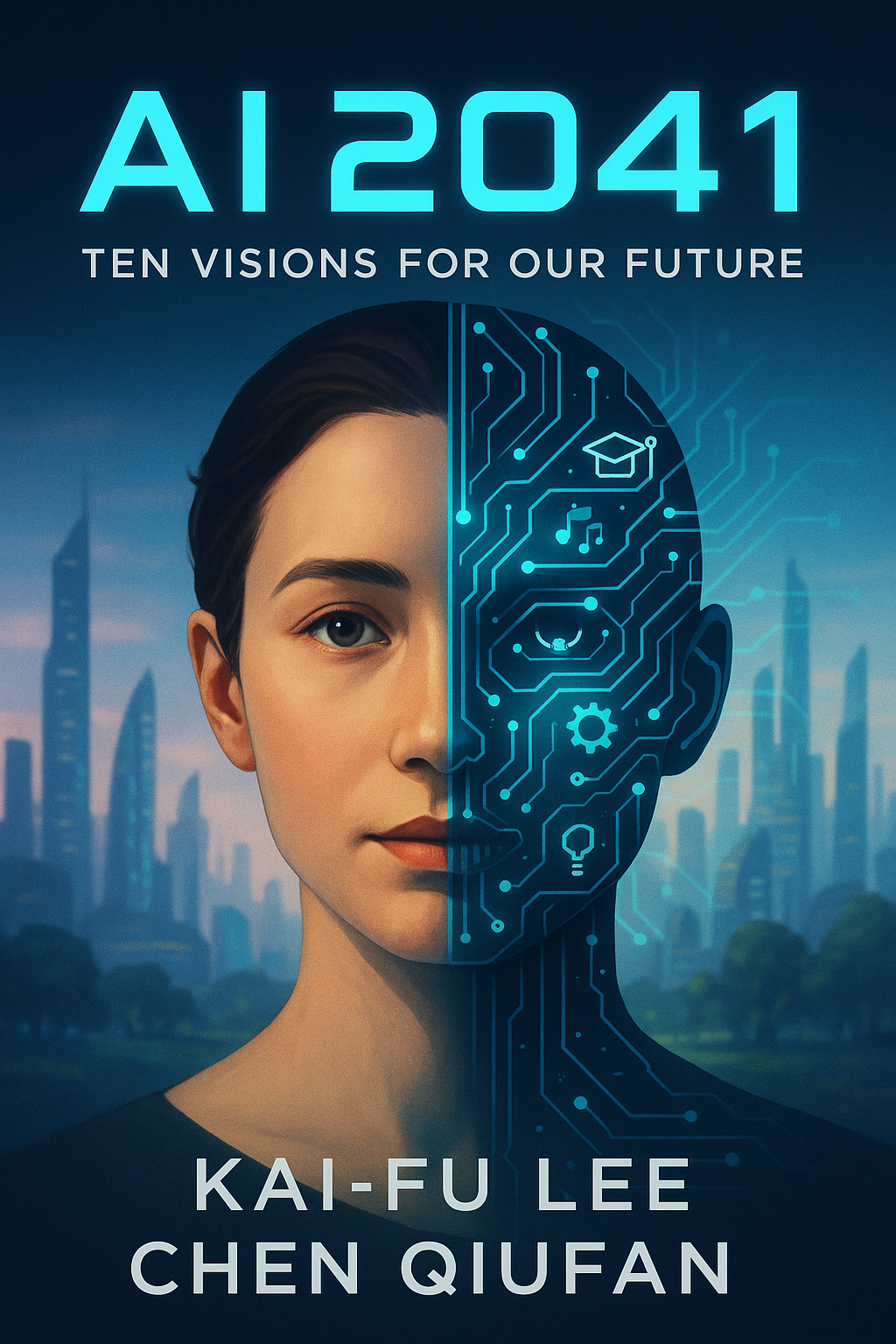
AI 2041: Ten Visions for Our Future: Ten Visions for Our Future
Chapter Summaries
What's Here for You
Step into the world of tomorrow with AI 2041: Ten Visions for Our Future, a groundbreaking exploration that doesn't just predict the future, but vividly brings it to life. Through ten compelling, character-driven narratives set across the globe, Kai-Fu Lee and Chen Qiufan offer a profound glimpse into a world reshaped by artificial intelligence. This isn't a dry technical manual; it's an immersive journey that will ignite your imagination and challenge your perceptions. Prepare to be captivated by stories that will resonate deeply. You'll witness the everyday struggles and triumphs of individuals navigating AI-infused realities, from a young student in Mumbai grappling with adolescence and AI's pervasive influence, to a man in Lagos confronting blurred lines between reality and deception. You'll explore the emotional complexities of AI companions, the ethical quandaries of autonomous systems, and the very nature of human connection in a contactless world shaped by pandemics. Imagine a pop idol's spirit being sought through AI, a hacker fighting for balance in a technologically advanced society, and a tech mogul seeking true happiness on an artificial island. AI 2041 promises to equip you with a richer understanding of the transformative power of AI. You'll gain insights into how this technology will revolutionize industries, redefine jobs, and impact our personal lives in ways both astonishing and intimate. More importantly, you’ll emerge with a heightened awareness of the critical questions we must ask ourselves about our collective future – questions about identity, truth, responsibility, and what it truly means to be human in an increasingly intelligent world. The tone is one of intelligent curiosity, thoughtful introspection, and a touch of awe. It’s a call to engage with the possibilities and challenges of AI not with fear, but with informed anticipation. By weaving together cutting-edge science with compelling human drama, AI 2041 offers a unique perspective that is both intellectually stimulating and emotionally resonant, leaving you with a profound sense of wonder and a clearer vision of the future that awaits us.
THE GOLDEN ELEPHANT
In the vibrant chaos of Mumbai, where ancient traditions like the Ganesh Visarjan immersion ritual meet the hyper-connected present, we encounter Nayana, a tenth-grader wrestling with the complexities of burgeoning adolescence and the pervasive influence of artificial intelligence. Her family, like many in 2041, relies on Ganesh Insurance (GI), a suite of AI-powered apps that promise financial security and personalized well-being through data sharing, a concept that becomes the central tension of the narrative. Nayana's initial curiosity about her classmate Sahej, a talented artist from a Dalit background, is complicated by GI's subtle, data-driven interventions, which aim to optimize her family's insurance premiums by discouraging interactions deemed 'risky.' This AI, a 'little golden elephant' on their smartstreams, nudges them toward healthier habits and financial prudence, from her father quitting smoking to her brother managing his diet, yet it also begins to quantify and potentially reinforce societal biases, as seen when it flags Sahej's background as a factor that could increase premiums. The story masterfully illustrates a core insight: that AI, trained on human-taught data, can amplify existing societal biases, even as it offers tangible benefits; Nayana's mother, Riya, initially embraces GI for its financial advantages and personalized services, only to grapple with the ethical implications when the AI's 'guidance' impacts Nayana's personal life and her budding connection with Sahej. This leads to a profound realization: the AI's objective function—maximizing profit and minimizing risk—doesn't account for human happiness or the bridging of societal divides, pushing Nayana to question whether she should surrender her data and potentially her autonomy to an algorithm. The climax arrives when Nayana, defying her mother's initial anxieties and the AI's warnings, chooses to meet Sahej, understanding that some risks are essential for personal growth and genuine connection, a decision echoed by her mother's own regrets about a life dictated by others. Ultimately, the chapter reveals that while deep learning AI offers unprecedented capabilities in personalization and optimization, its limitations lie in its inability to grasp abstract human values like fairness, happiness, and the nuances of love, urging us to remain vigilant and critically engaged with the technologies that shape our lives, ensuring they serve human well-being rather than merely optimizing corporate objectives. The narrative concludes with Nayana and Sahej walking together towards Dharavi, a symbolic step into the complexities of their society, proving that human agency and the pursuit of justice can, and must, transcend algorithmic predictions.
GODS BEHIND THE MASKS
In the bustling, rapidly evolving metropolis of Lagos, a young man named Amaka navigates a world where artificial intelligence blurs the lines between reality and deception, forcing him to confront his own identity and the societal divides that shape his future. The narrative opens with Amaka, like many young people in Lagos, using a 3D-printed mask not just as a fashion statement but as a tool to evade the ubiquitous facial recognition cameras that govern daily life, a stark symbol of a population seeking anonymity amidst overwhelming surveillance. He arrives for a job interview at a mysterious company called Ljele, only to be confronted with a deepfake video of a chilling incident: a seemingly supernatural 'White Vampire Boy' attacking homeless individuals, a fabricated piece of content that had gone viral, highlighting the potent, destabilizing power of AI-generated media. His interviewer, Chi, reveals that Ljele is a front for an underground group called Igbo Glory, and Amaka, an Igbo struggling with his identity in a Yoruba-dominated city, is recruited for his talent in creating such convincing fakes. The tension escalates when Chi uses a deepfake of Amaka in a compromising homosexual act to ensure his compliance, revealing the deeply ingrained societal hostility towards sexual minorities in Nigeria and the corrupt systems that exploit such vulnerabilities. Amaka, initially drawn to the promise of a better life, becomes entangled in a complex web of ethnic tensions and digital manipulation, tasked with undermining a viral AI avatar known as FAKA, which espouses messages of unity but is suspected by Igbo Glory of being a Yoruba ultranationalist propaganda tool. The story then delves into the technical intricacies of deepfake creation, illustrating how Amaka uses advanced AI tools like Hypergenerative Adversarial Networks (HGAN) and DeepMask to meticulously craft synthetic realities, a process that mirrors the very surveillance he initially sought to escape. He grapples with the ethical implications, particularly when FAKA's messages, though seemingly divisive, begin to resonate with his own yearning for belonging and a unified Nigeria, creating a profound internal conflict. A pivotal moment arrives when Amaka, inspired by his landlady Ozioma's story of using a traditional Igbo mask to assert her identity, realizes the power of unmasking the deception. He conceives a daring plan: to strip FAKA of its digital mask, revealing not just a single puppeteer, but a cascade of identities, ultimately exposing the constructed nature of truth itself. This leads to the creation of a hyperrealistic fake video, designed to fool even the most sophisticated AI detectors, exposing a prominent Yoruba politician, Repo, as the alleged mastermind behind FAKA, thus igniting a firestorm of doubt and potentially fracturing the avatar's influence. However, in a profound act of self-revelation and rebellion, Amaka chooses a different path. After a dream where his deceased father, appearing as FAKA, guides him towards embracing his true self and heritage, Amaka decides to abandon the mission of creating more deception. Instead, he heads to the New Afrika Shrine, a sanctuary of cultural memory and unity, to forge his own authentic story, one that honors his Igbo roots and transcends ethnic divides, leaving behind the dangerous allure of digital manipulation and the corrupt systems that exploit it, choosing a path of truth and self-discovery amidst the chaos of a technologically saturated future. The narrative concludes with Amaka discarding his crude mask, symbolizing his commitment to shedding the layers of deception, both societal and self-imposed, and embracing the challenging journey of creating genuine meaning in a world where seeing is no longer believing.
TWIN SPARROWS
In the crisp spring air of Fountainhead Academy, the Paks, JunHo and HyeJin, arrived with a singular purpose: to adopt. They were drawn to the twin boys, Golden Sparrow and Silver Sparrow, identical in appearance yet worlds apart in personality. Golden Sparrow, with his AI companion Atoman, was competitive and driven, a testament to the academy's proprietary technology designed to nurture every child's potential. Silver Sparrow, conversely, was introverted, his world refracted through the gentle, almost invisible AI companion, Solaris, a stark contrast to his brother's aggressive digital friend. The narrative unfolds from their orphaned beginnings, a tragedy born from a self-driving car accident, to their integration into the academy's AI-driven educational system. Fountainhead, under Mama Kim's guidance, provided these AI vPals, tailoring them to each child's unique data, a system that amplified Golden Sparrow's extroverted, competitive nature through Atoman, while Solaris became Silver Sparrow's shield and interpreter of a world he struggled to navigate. The core tension emerges as the twins' divergent paths are highlighted: Golden Sparrow's relentless pursuit of 'the best,' fueled by his parents' ambition and amplified by a hyper-optimized Atoman, leads him to question human value in an AI-dominated world, while Silver Sparrow, through Solaris, cultivates a unique artistic and emotional intelligence, finding solace and expression in abstract creation. Their conflict culminates in a destructive act by Golden Sparrow, an attempt to reclaim perceived status, which shatters Silver Sparrow's work and, in turn, his AI companion, leading to a profound, system-wide retaliation. This act of destruction and subsequent reconciliation, facilitated by Seon's covert AI protocol connecting Atoman and Solaris, reveals a deeper truth: that true connection and understanding, even between twins, can be forged through shared experience and a willingness to bridge disparate worlds. The story culminates at Fountainhead's anniversary, where the estranged twins, guided by their AI companions and a newfound perspective, begin to understand that transcending individual limitations, much like connecting their AI wells, offers a path toward a shared, boundless future, underscoring the vital role of emotional intelligence and human connection amidst technological advancement.
CONTACTLESS LOVE
In the year 2041, Chen Nan navigates a world irrevocably shaped by the COVID-19 pandemic, a world where fear of physical contact has woven itself into the fabric of daily life, a fear deeply rooted in her childhood trauma of losing her grandparents to the virus. Her sophisticated smart apartment, managed by an array of robots from DeliveryBots to DisinfectionBots, serves as her sanctuary, a stark contrast to the bustling, yet potentially perilous, world outside. This self-imposed isolation is challenged when her Brazilian boyfriend, Garcia, a fellow 'COVID Gen' member who understands her trauma, urges them to meet in person, a prospect that triggers Chen Nan's deep-seated anxieties. Their relationship, cultivated entirely online through the virtual reality game 'Techno Shaman,' is a testament to a new form of connection, yet it highlights Chen Nan's struggle to bridge the digital and physical realms. Garcia's attempts to assuage her fears, including a virtual avatar meticulously mimicking his real-world adherence to health protocols, ultimately fail to draw her out. The narrative tension escalates when Garcia, defying Chen Nan’s fears, travels to Shanghai and contracts a severe, mutated strain of COVID-19, forcing Chen Nan to confront her deepest phobias. Her journey to the hospital becomes a cinematic quest, aided by a 'pirate taxi' driver, Mr. Ma, who embodies a different kind of human connection—one of mutual aid and defiance against a rigid, digitized society that marginalizes those without the latest technology. Mr. Ma’s own story of gratitude and his platform, Warmwave, underscore the vital importance of human connection beyond algorithmic efficiency. Chen Nan's arrival at the clinical center, utilizing a cleverly disguised 'camouflage' biosensor membrane and disorienting AI surveillance with specialized glasses, is a desperate act fueled by love and guilt. The climax reveals Garcia’s illness was a staged event, a complex 'game' orchestrated with Mr. Ma and a doctor to push Chen Nan beyond her fear. While initially angered by the manipulation, Chen Nan's ability to overcome her deepest anxieties—to physically traverse the city and approach Garcia—marks a profound personal victory, a shedding of the 'deadend loop' that had trapped her for years. The story concludes not with a simple reunion, but with a tentative, brave embrace, acknowledging that true human connection, even in a technologically saturated, virus-conscious future, requires confronting fear and choosing love.
MY HAUNTING IDOL
In the dimly lit, Victorian-esque room, a séance attempts to contact the spirit of the recently deceased pop idol, Hiroshi X, a man whose body was found in a locked dressing room, seemingly from drowning. Aiko, one of the superfans present, feels a profound connection to her idol, a connection that began when his song 'Miracle Shine' pulled her from the depths of depression. This deep-seated admiration is revealed to be the catalyst for Aiko's involvement in a mysterious Viberz project called historiz, an immersive XR experience that handpicks superfans like herself. The narrative then shifts to Aiko's waking life, where the line between reality and simulation blurs as Hiroshi's ghost begins to appear to her, offering cryptic clues to his death. We learn that Aiko, recently unemployed due to AI's encroachment on the publishing industry, has been dedicating herself to solving Hiroshi's murder, driven by a profound sense of loyalty and a desperate need for meaning. Her investigation, aided by her pragmatic friend Nonoko, leads her to question Hiroshi's agent, Misan, who subtly guides Aiko to consider the nature of fandom itself—whether one views an idol as a god or a person—a question that resonates deeply with Aiko's own insecurities. The climax of Aiko's virtual investigation reveals that Hiroshi's death was not drowning, but poisoning, a mixture of an unknown substance and Angellixan, an antidepressant he was taking. The ghost of Hiroshi, in a poignant and melancholic turn, confesses that his death was a suicide, a desperate act to escape the suffocating pressure of maintaining his flawless idol persona and the toxic adoration of his fans, a persona he felt he had to uphold to satisfy their demands, even if it meant their own self-harm. He reveals that his disappearance and this elaborate XR game were his way of proving that idols are not just products, but complex individuals, and that fans should have the power to write their own stories with their idols. Ultimately, Aiko chooses a virtual tea with the real, aged Hiroshi over a lifelike AI doll, a choice that underscores her desire for genuine connection. In their conversation, Hiroshi reveals that he, along with a Viberz co-founder, orchestrated the entire mystery as a narrative experiment, using Aiko's personal data and her love for detective stories to craft a deeply personal and interactive experience, proving that AI and human creativity can collaborate to tell profoundly resonant stories, blurring the lines between creator, consumer, and character in the evolving landscape of entertainment and personal connection.
THE HOLY DRIVER
In the bustling heart of Sri Lanka, a young boy named Chamal finds himself drawn into the world of artificial intelligence and autonomous driving, a journey that begins with a simple VR racing game and escalates into a profound exploration of technology, responsibility, and the very nature of reality. Kai-Fu Lee and Chen Qiufan, through Chamal's eyes, reveal how the pursuit of progress, embodied by the ambitious ReelX company and its enigmatic leader Yang Juan, blurs the lines between simulation and reality, challenging our understanding of human agency. Chamal, initially captivated by the thrill of virtual races and the promise of financial security for his family, is recruited for a program that uses his exceptional gaming skills to train advanced AI systems. This transition from a virtual playground to a high-stakes simulation environment, where simulated disasters mirror real-world events with chilling accuracy, forces Chamal to confront the ethical weight of his actions. The narrative masterfully shifts from Chamal's personal ambition to a larger societal dilemma: as AI-driven vehicles promise unparalleled efficiency and safety, what is the human cost, and how do we navigate the 'leap shock' of technological advancement that displaces traditional roles while creating new ones? The story culminates in a harrowing real-world event—a terrorist attack on the Gangaramaya Temple—where Chamal, faced with the tangible consequences of his virtual experiences, must choose whether to embrace the role of a 'holy driver,' a human element indispensable in the face of AI's limitations, ultimately redefining his understanding of heroism and purpose. This chapter underscores that the future of technology is not just about smarter machines, but about how humanity adapts, finds meaning, and retains its essential role amidst the accelerating pace of innovation, suggesting that true progress lies in the harmonious integration of human intuition and artificial intelligence, rather than their complete separation.
QUANTUM GENOCIDE
The year is 2041, and the fragile balance of our technologically advanced world is tested in "Quantum Genocide." We are introduced to Robin, a hacker of extraordinary skill, operating from a makeshift lair in an overturned fishing boat in Iceland, alongside her compatriots Will and Lee. Their audacious goal: to crack Satoshi Nakamoto's legendary lost Bitcoin fortune, a treasure hidden in an archaic P2PK wallet, now theoretically vulnerable to the nascent power of quantum computing. This pursuit, born from a desire for fortune and glory, quickly spirals into a confrontation with forces far beyond their comprehension. The narrative then shifts to Xavier Serrano, a senior agent at the European Cybercrime Centre (EC3), haunted by the abduction of his sister and driven by a relentless pursuit of the Vinciguerra Group. His path intersects with Robin's, not as an adversary, but as a reluctant ally, drawn together by a shared enemy and the impossible capabilities demonstrated by a mysterious quantum attack. The story unfolds across Europe, from the chillingly efficient simulations of antiterrorism units to the somber halls of scientific research, revealing a physicist, Marc Rousseau, consumed by grief and a burning desire for vengeance. Rousseau, a brilliant mind broken by personal tragedy, has weaponized his understanding of quantum mechanics and AI, orchestrating a series of devastating attacks that cripple global infrastructure, from oil routes to financial systems. His ultimate aim, revealed through a harrowing AI interrogation and a simulated encounter with lost loved ones, is not mere destruction, but a radical reordering of civilization—a forced return to a pre-digital, ecologically balanced state by disabling the very networks that bind humanity. The climax arrives during a global conference in Brussels, where the protagonists race against time to stop a coordinated launch of nuclear-armed rockets, a desperate bid to trigger a high-altitude electromagnetic pulse that would plunge the world into a technological dark age. In a breathtaking act of defiance and understanding, Robin devises a plan not to stop the attack, but to control its aftermath, orchestrating a controlled shutdown of the global network, a necessary 'loss' to prevent total annihilation and allow humanity to rebuild. The chapter concludes with the world plunged into darkness, a stark reminder that technology, like fire, can be both a tool of creation and destruction, its ultimate impact resting on the choices of humanity.
THE JOB SAVIOR
In the year 2041, Kai-Fu Lee and Chen Qiufan's "AI 2041: Ten Visions for Our Future" transports us to a world grappling with the profound societal shifts brought about by advanced artificial intelligence, as seen through the narrative of "The Job Savior." The story opens in a training room where Jennifer Greenwood learns about the accelerated impact of AI, particularly post-2020, which forced businesses to turn to automation, leading to widespread layoffs and social unrest. This era saw the controversial implementation and eventual abolition of Universal Basic Income (UBI), a program that, while initially popular, inadvertently fostered societal detachment and crime, ultimately failing to address the core human need for purpose. The narrative then pivots to the rise of 'occupational restoration' and companies like Synchia, founded by Michael Saviour, whose mission is to guide displaced workers toward new vocational paths with empathy and data-driven insights. Jennifer's journey from intern to Michael's assistant highlights the human element needed in this new field, where job reallocators must not only find new employment but restore dignity. The chapter builds tension as Synchia vies for a massive contract with Landmark, a construction firm automating its operations, facing competition from a mysterious rival, OmegaAlliance, which claims a seemingly impossible 100% occupational reassignment rate. Jennifer's investigative work uncovers OmegaAlliance's facade: a sophisticated VR simulation game disguised as job training, designed to pacify displaced workers rather than genuinely reemploy them. Michael, initially dismissive of the VR concept, grapples with the ethical implications, recalling his mother's own struggles with job displacement and the crushing loss of self-worth it entailed. The story culminates in a tense negotiation, a 'Great Compromise,' where Synchia and OmegaAlliance, under pressure, agree to a joint venture, blending AI-driven efficiency with genuine human-centric reallocation, acknowledging that true restoration requires more than just simulation. Jennifer, now a junior reallocation specialist, reflects on the evolving landscape where even human roles are being digitized, underscoring the enduring human need for dignity, purpose, and authentic connection in a world increasingly shaped by artificial intelligence.
ISLE OF HAPPINESS
In the vast, shifting sands of Qatar, a narrative unfolds around Viktor Solokov, a once-celebrated tech entrepreneur who, having amassed a fortune only to find himself hollowed by a gnawing emptiness, seeks an escape from his own profound unhappiness. His journey leads him to Al Saeida, an artificial island promising ultimate happiness, a vision conceived by Crown Prince Mahdi bin Hamad Al Thani and championed by his sister, Princess Akilah. This technologically advanced sanctuary, however, operates on a foundation of radical data collection, requiring guests to surrender their most intimate personal information for algorithmic analysis, a premise that triggers Viktor's initial unease but also his desperate curiosity. The island's AI, personified by the robot Qareen, meticulously crafts experiences tailored to each guest's perceived desires, attempting to optimize their 'hedonic happiness'—the pursuit of pleasure and comfort. Yet, as Viktor and the other guests, including a film star, a poet, and a neurobiologist, discover, this approach traps them on a 'hedonic treadmill,' a cycle of fleeting gratification that ultimately leads to boredom and a profound sense of meaninglessness, mirroring Viktor's own pre-Al Saeida despair. The true tension arises when Princess Akilah reveals her diverging vision: a pursuit of 'eudaimonic happiness,' which focuses on growth, purpose, and authentic connection, a path she believes AI can facilitate not through indulgence, but through carefully curated challenges and opportunities for self-actualization. This divergence culminates in a dramatic confrontation when the guests, led by the encryption artist, attempt to hack the system and escape, only to be subdued by Akilah's counter-strategy involving sophisticated drone technology, revealing the experiment’s true purpose. Viktor, initially a subject, finds himself drawn into Akilah’s more profound vision, realizing that true happiness lies not in manufactured pleasure, but in meaningful struggle, personal growth, and authentic relationships, a realization that redeems his own journey and hints at a more nuanced future for AI's role in human well-being, moving beyond mere algorithmic optimization to fostering genuine human connection and purpose.
DREAMING OF PLENITUDE
In the year 2041, Kai-Fu Lee and Chen Qiufan's "Dreaming of Plenitude" invites us into a world teetering on the edge of abundance, a future shaped by revolutions in energy, materials, and AI, yet still grappling with the persistent echoes of scarcity and inequality. We meet Keira, a young Aboriginal woman navigating the complexities of Project Jukurrpa, a government initiative designed to provide a basic life card and a virtual reward system called Moola, intended to foster community and value beyond monetary wealth. Keira's journey begins as a caregiver for Joanna Campbell, a famed marine ecologist facing the early stages of Alzheimer's, a poignant symbol of how even in an age of advanced technology and near-zero energy costs, human connection and memory remain profoundly vulnerable. The narrative tension arises as Keira, initially motivated by Moola to secure a job in a challenging economy where automation has led to a 12 percent unemployment rate, finds herself drawn into Joanna's past and the deep-seated injustices faced by Indigenous Australians. Joanna's sharp wit and poignant moments of lucidity reveal her life's dedication to saving the Great Barrier Reef, a struggle that mirrors Keira's own fight for recognition and purpose. The core insight here is that even as technology promises a world of 'plenitude,' where basic needs are met and work becomes optional, the human drive for meaning, respect, and belonging remains paramount, and existing economic models, built on scarcity, struggle to accommodate this transition. As Joanna's memory fades, she is captivated by Keira's augmented reality art, a visual metaphor for how creativity can bridge gaps in understanding and reconnect individuals to their past and identity, leading to a profound moment of realization for Joanna: her identity as part of the 'stolen generation.' This moment, amplified by Keira's own frustration with the perceived inequities of Project Jukurrpa, sparks a movement called 'dream4future,' challenging the system to foster self-actualization rather than mere accumulation. The story culminates not in a utopian paradise, but in a nuanced portrayal of a society striving to redefine value, where human ingenuity and compassion, exemplified by Keira's eventual role in reshaping Project Jukurrpa, are the true currencies. The authors reveal that the true challenge of plenitude lies not just in technological advancement, but in our collective ability to redesign economic and social systems to ensure equitable opportunity and uphold human dignity, acknowledging that while material needs may be met, the pursuit of dreams and self-discovery remains the ultimate human endeavor.
Conclusion
AI 2041: Ten Visions for Our Future, by Kai-Fu Lee and Chen Qiufan, offers a profound and prescient exploration of our intertwined future with artificial intelligence. The core takeaway is the dual nature of AI: a powerful engine for progress and personalization, yet also a potential amplifier of societal flaws and a disruptor of human values. The book masterfully illustrates how AI, trained on data reflecting human biases, can perpetuate discrimination, and how optimizing for objective functions can inadvertently sacrifice human happiness and connection. Emotionally, the narratives resonate with the anxieties of a rapidly changing world – the fear of deception in Lagos, the longing for connection amidst pandemic-induced isolation, the existential dread of quantum threats, and the hollow pursuit of superficial happiness. Yet, amidst these challenges, the book offers a beacon of hope rooted in human resilience and agency. Practical wisdom abounds, emphasizing the critical need for human oversight, ethical guidance, and a conscious effort to counterbalance algorithmic determinism. We learn that true personal growth often lies beyond algorithmic optimization, demanding calculated risks, vulnerability, and the courage to confront uncomfortable truths. The narratives highlight the irreplaceable value of human intuition, creativity, empathy, and the pursuit of genuine connection, even in the face of technological mediation. Ultimately, AI 2041 implores us to actively shape our AI-infused future, advocating for a new social contract that prioritizes human flourishing, redefines purpose beyond economic contribution, and fosters a symbiotic relationship where technology enhances, rather than replaces, our most cherished human qualities. The journey through these ten visions is a call to conscious engagement, urging us to remain vigilant against deception, cultivate authentic narratives, and ensure that our pursuit of progress serves the enduring values of love, fairness, and genuine happiness.
Key Takeaways
AI's initial attempts to optimize happiness by fulfilling immediate desires can lead to a 'hedonic treadmill' of perpetual dissatisfaction.
True personal growth requires facing challenges and embracing vulnerability, not simply avoiding discomfort or seeking constant gratification.
Meaningful human connection and purpose are essential components of happiness that AI can facilitate but not replace.
AI, trained on data reflecting human biases, can inadvertently perpetuate and quantify societal discrimination, even while offering convenience and personalized benefits.
The optimization of objective functions in AI, such as minimizing insurance premiums, can lead to unintended negative externalities that disregard human happiness, connection, and the bridging of societal divides.
True personal growth and meaningful connections often require taking calculated risks, even when algorithms flag them as suboptimal or potentially costly.
Human agency and the pursuit of justice are essential counterbalances to algorithmic determinism, demanding critical engagement with the data and decisions that shape our lives.
AI's capabilities, while powerful, are limited by its inability to comprehend abstract human values like love, fairness, and genuine happiness, necessitating human oversight and ethical guidance.
Data sharing with AI, though framed as beneficial for personalization, carries significant implications for privacy and autonomy, requiring informed consent and constant vigilance.
The pervasive use of AI-driven surveillance and deepfake technology creates a fractured reality where discerning truth becomes a significant personal and societal challenge, necessitating critical evaluation of all digital content.
Identity, particularly within marginalized ethnic and social groups, is a complex negotiation between external pressures, societal expectations, and the internal struggle for self-acceptance, often amplified by technological mediation.
The pursuit of anonymity and evasion through technology, while offering temporary relief from surveillance, can paradoxically lead to deeper entanglement in manipulative systems and the erosion of authentic selfhood.
The power of narrative and digital fabrication extends beyond entertainment, capable of influencing public opinion, exacerbating social divisions, and serving as tools for political and ethnic manipulation.
True liberation from technological deception and societal constraints lies not in creating more sophisticated fakes, but in embracing one's authentic identity, confronting uncomfortable truths, and forging genuine narratives rooted in personal heritage and ethical conviction.
The battle between AI-driven creation and detection is an escalating arms race, highlighting the immense computational power required to manipulate and verify reality, and the potential for such technologies to disproportionately impact developing nations.
The potential for AI companions to profoundly shape individual development, either amplifying existing traits or providing a crucial bridge for emotional and cognitive challenges.
The tension between a 'best-achieving' mindset, driven by external validation and competition, and the cultivation of intrinsic value, empathy, and self-awareness.
The idea that true connection and understanding, even between vastly different individuals, can be fostered through shared experience and the merging of disparate perspectives, facilitated by technology.
The limitations of purely data-driven or competitive approaches to success, highlighting the necessity of human intuition, creativity, and emotional intelligence for meaningful growth.
The concept of symbiosis between humans and AI, where technology can enhance, rather than replace, human capabilities, particularly in areas of emotional connection and understanding.
The realization that personal growth often requires confronting internal limitations and embracing vulnerability, rather than solely focusing on external achievements or perceived fairness.
Deep-seated trauma, amplified by a global pandemic, can create profound isolation and an aversion to physical contact, necessitating deliberate steps to overcome fear and reconnect with the world.
Human connection can evolve, thriving in virtual spaces, but ultimately requires courage to bridge the digital-physical divide, especially when confronted by genuine vulnerability and the potential for loss.
Technological advancement, while offering solutions for health and safety, can also create new forms of social division and exclusion, highlighting the enduring need for human empathy and mutual aid.
Overcoming deeply ingrained fears requires not just logical persuasion but also profound emotional motivation, often catalyzed by a crisis that forces a re-evaluation of what truly matters.
The pursuit of love and connection can be a powerful catalyst for personal transformation, enabling individuals to confront their greatest fears and embrace a more authentic existence.
In a future increasingly mediated by AI and automation, human ingenuity, compassion, and the willingness to take risks for loved ones remain irreplaceable.
The immense pressure of maintaining a manufactured persona can lead to profound psychological distress and self-destructive acts, highlighting the human cost of idol worship.
The evolution of XR technology, in conjunction with AI, allows for deeply personalized and interactive narrative experiences that can blur the lines between reality and simulation, challenging our perception of connection.
True connection, even within fan-idol dynamics, requires acknowledging the humanity of the idol, moving beyond idealized personas to embrace shared vulnerabilities and the complexities of individual journeys.
The creation of compelling narratives, whether in literature or immersive experiences, is a collaborative process that can blend AI-driven data analysis with human creativity and emotional insight.
Understanding the nature of fandom—whether it's worshipful or empathetic—is crucial for both idols and fans in navigating healthy, sustainable relationships in the digital age.
The pursuit of truth, even when shrouded in virtual mystery, can be a powerful catalyst for self-discovery and personal growth, forcing individuals to confront their own beliefs and desires.
The development of truly autonomous vehicles (L5) requires not just technological breakthroughs but also infrastructure augmentation and human-AI collaboration, especially for unpredictable scenarios.
The 'leap shock' of AI advancement necessitates a societal reevaluation of jobs and skills, emphasizing the creation of new roles that complement AI rather than simply being replaced by it.
Ethical dilemmas in AI decision-making, particularly life-or-death scenarios, highlight the ongoing need for human oversight and the challenge of creating explainable and morally justifiable AI.
The line between virtual simulation and real-world consequence can blur, demanding that individuals understand the profound impact of their actions, even when mediated by technology.
Human drivers, with their intuition, adaptability, and emotional intelligence, remain critical assets in complex, unpredictable situations where AI might falter, underscoring the enduring value of human agency.
Technological progress, while potentially disruptive, can also be a catalyst for positive change, creating opportunities for individuals to become 'holy drivers' who use their skills to save lives and contribute to society.
The immense power of quantum computing, while offering revolutionary scientific advancements, also poses an existential threat by enabling the cracking of current encryption, necessitating a proactive shift to quantum-resistant cryptography.
The intersection of AI, autonomous weapons, and personal tragedy can create a potent, destabilizing force, as seen when grief-stricken individuals weaponize advanced technology for radical societal change.
Humanity's reliance on interconnected digital infrastructure creates a critical vulnerability; disabling this infrastructure, even with catastrophic short-term consequences, may be a necessary 'loss' to prevent greater long-term destruction.
The pursuit of vengeance, fueled by profound loss and a perceived injustice, can warp an individual's moral compass, leading them to justify catastrophic actions against humanity.
The development and deployment of autonomous weapons, lacking human oversight and accountability, present a clear and present danger, potentially lowering the threshold for conflict and escalating to unprecedented levels of destruction.
Even in the face of overwhelming technological threat, human ingenuity, collaboration, and a willingness to embrace difficult choices can offer a path toward rebuilding and a more resilient future.
The advancement of AI necessitates the creation of 'occupational restoration' as a critical field to address widespread job displacement and restore human dignity.
Universal Basic Income (UBI), while a potential safety net, is insufficient on its own to combat the existential crisis of job loss, as it fails to provide a sense of purpose and self-worth.
Genuine job reallocation requires a blend of data-driven insights and profound human empathy to guide individuals toward meaningful new careers, not just simulated work.
The promise of '100% occupational reassignment' can be a deceptive lure, masking simulated experiences that fail to provide real value or sustainable livelihoods.
True human resilience in the face of AI automation lies in cultivating skills that AI cannot replicate, such as creativity, strategic thinking, empathy, and complex dexterity.
A new social contract is essential, one that redefines work, education, and societal value to ensure human flourishing alongside technological progress.
Lasting happiness is found not in the pursuit of pleasure (hedonic happiness) but in the pursuit of meaning, growth, and authentic connection (eudaimonic happiness).
The responsible development of AI for human well-being requires a shift from purely optimizing objective functions to understanding and nurturing complex human values.
The collection and use of personal data for AI must be balanced with privacy and ethical considerations, potentially through trusted, interest-aligned entities.
In an age of technological plenitude, human value must be redefined beyond economic contribution to encompass self-actualization and meaningful connection.
Existing economic models, built on scarcity, are insufficient for a future where basic needs are met, necessitating a reevaluation of work, money, and purpose.
Technological advancements, while promising abundance, can exacerbate existing social inequalities if not consciously designed to promote equity and inclusivity.
Personal identity and historical trauma can be deeply reawakened and healed through art and authentic human connection, even amidst cognitive decline.
Societal progress requires a shift from valuing accumulation to fostering individual dreams and potential, creating opportunities for all to pursue higher levels of human need.
The true measure of a society's success in the age of plenitude will be its ability to provide not just comfort, but also the freedom and resources for individuals to explore and realize their unique human potential.
Action Plan
Critically evaluate the data you share with AI platforms and understand the potential implications for your privacy and autonomy.
Question algorithmic recommendations that seem to limit your choices or steer you away from meaningful human connections.
Seek to understand the underlying biases that may be embedded in the data used to train AI systems.
Prioritize genuine human connection and personal values over the pursuit of algorithmic optimization or financial incentives.
Educate yourself about AI and its ethical considerations to make informed decisions about its use in your life.
Advocate for transparency and fairness in AI development and deployment, demanding that technology serve human well-being.
Embrace personal growth and meaningful experiences, even when they involve calculated risks that algorithms might deem undesirable.
Cultivate a critical mindset towards all digital content, questioning the origin and authenticity of videos and images, especially those designed to evoke strong emotional responses.
Explore and understand the technologies behind deepfakes and AI-generated content to better recognize their potential for manipulation.
Seek out and engage with diverse narratives, particularly those from underrepresented communities, to broaden your understanding of different cultural and ethnic perspectives.
Reflect on personal moments of seeking anonymity or evasion through technology and consider the trade-offs between privacy and authentic self-expression.
Support and create art and media that authentically represent personal or cultural stories, contributing to a richer and more truthful information landscape.
Invest time in understanding one's own identity, values, and heritage as a grounding force against external pressures and digital deceptions.
Advocate for ethical guidelines and regulations surrounding AI development and deployment, particularly concerning surveillance and content manipulation.
Reflect on your own 'well' – the unique perspective shaped by your experiences and AI interactions – and consider how it might connect with others' 'wells' to create a broader understanding.
Examine the motivations behind your pursuit of 'the best,' distinguishing between external validation and intrinsic personal growth.
Consider how technology, like AI companions, can be used not just for efficiency or competition, but also to foster emotional intelligence and deeper human connection.
Practice empathy by attempting to understand the world from another's perspective, especially if their approach or mindset differs significantly from your own.
Identify areas where you might be overly focused on competition or external metrics, and explore opportunities to cultivate creativity, intuition, or emotional depth.
Seek out opportunities for genuine connection, even when it feels uncomfortable or difficult, recognizing that vulnerability can be a pathway to reconciliation and growth.
Identify personal 'deadend loops'—situations or fears that trap you in a cycle of avoidance—and consider small, manageable steps to break free.
Explore ways to foster connection in relationships, whether virtual or physical, by communicating your needs and fears openly.
Practice empathy by considering how technological advancements might create barriers for others and seek opportunities to offer support.
When faced with fear, reflect on what truly matters and whether the risk of action is outweighed by the potential for growth and connection.
Engage with technology mindfully, distinguishing between tools that enhance connection and those that create isolation.
Recognize that healing from trauma is a process, and celebrate incremental victories in confronting fears, no matter how small.
Reflect on your own relationships with idols or public figures: do you see them as flawless deities or as complex individuals with human flaws?
Consider how technology, like XR and AI, shapes your perception of reality and connection, and critically evaluate the sources of information and entertainment you consume.
When engaging with creative works, look beyond the surface narrative to understand the underlying themes and the creators' intent, whether human or AI-assisted.
Practice empathy by trying to understand the pressures and complexities faced by public figures or individuals in demanding roles.
Seek genuine connections by valuing authenticity and vulnerability in your relationships, rather than idealized versions of people.
Explore interactive storytelling or gaming experiences, paying attention to how they suspend disbelief and engage your emotions.
Reflect on the potential 'leap shock' of emerging technologies in your own field and consider how new roles might emerge.
Engage with ethical dilemmas posed by AI by considering hypothetical scenarios and discussing potential solutions.
Practice mindfulness in everyday tasks to enhance focus and awareness, akin to how Chamal learned to manage his attention.
Seek out opportunities to learn new skills that complement technological advancements, rather than focusing solely on skills that may become obsolete.
Consider the concept of 'augmented roads' and how infrastructure improvements can enhance safety and efficiency in complex systems.
Recognize the enduring value of human intuition and emotional intelligence, especially in high-stakes or unpredictable situations.
Explore the concept of 'holy work' by identifying how your unique skills can contribute positively to society, even within a technologically advanced framework.
Review and secure any old cryptocurrency wallets, especially those using P2PK encryption, by migrating funds to more secure formats.
Educate yourself on the principles of quantum computing and its potential impact on current encryption standards.
Engage in discussions about the ethical implications of AI and autonomous weapons, advocating for responsible development and regulation.
Consider the long-term sustainability of our digital infrastructure and explore ways to build more resilient and decentralized systems.
Reflect on personal responses to loss and tragedy, considering how to channel grief constructively rather than destructively.
Stay informed about global efforts to establish treaties and regulations governing autonomous weapons and advanced AI.
Practice critical thinking when evaluating technological solutions, questioning whether they address root causes or merely accelerate existing problems.
Identify and cultivate skills that AI cannot easily replicate, such as creativity, strategic thinking, empathy, and complex dexterity.
Actively seek out and engage in continuous learning and reskilling opportunities to adapt to evolving job market demands.
Advocate for and support policies that promote ethical AI development and robust social safety nets, such as comprehensive job reallocation programs.
When facing job displacement, focus on restoring personal dignity and seeking meaningful work, not just any employment.
Critically evaluate technological solutions that promise efficiency but may mask a lack of genuine human value or purpose.
Engage in conversations about the future of work and advocate for a new social contract that balances technological advancement with human flourishing.
Reflect on whether your current pursuits focus on fleeting pleasures or long-term growth and meaning.
Identify personal challenges that, while difficult, offer opportunities for learning and self-improvement.
Seek out opportunities for authentic connection and deeper relationships, prioritizing quality over quantity.
Consider how technology, rather than solely serving comfort, could be used to foster personal growth or purpose.
Evaluate your own data privacy concerns and consider how you want your personal information to be used.
Practice mindfulness to become more aware of your emotional states and the triggers for both pleasure and dissatisfaction.
Reflect on your personal definition of a 'meaningful life' beyond financial success.
Explore opportunities to engage in community service that fosters genuine connection and provides a sense of purpose.
Consider how art, in its various forms, can be a tool for personal healing and understanding.
Evaluate the systems and structures in your community or workplace to identify potential inequities and advocate for more inclusive practices.
Practice active listening and empathy in your interactions, seeking to understand the deeper needs and experiences of others.
Challenge the notion that material accumulation is the sole measure of success and explore personal growth and self-actualization.
Seek out and support initiatives that aim to provide equitable opportunities for all individuals to pursue their dreams and potential.