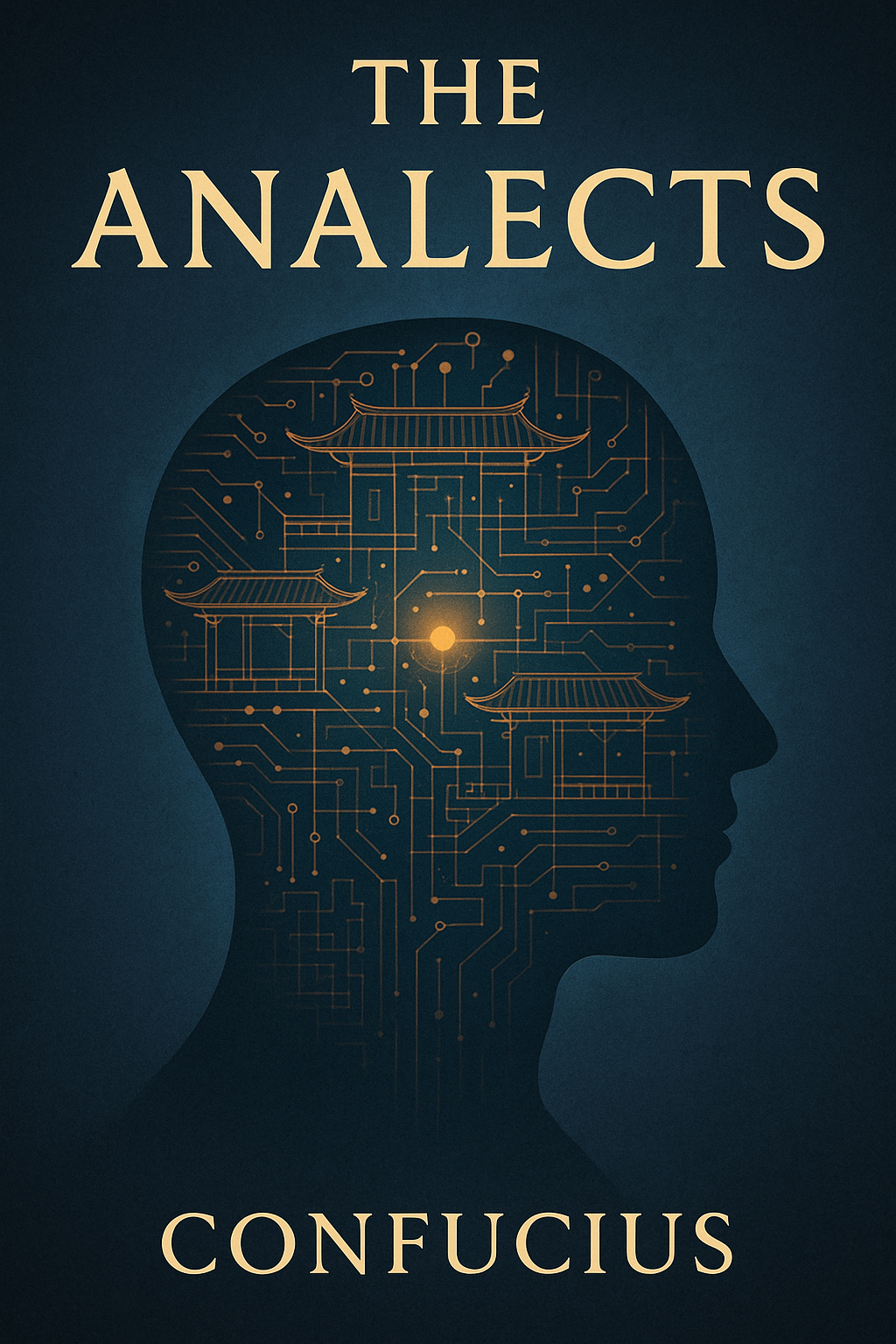
The Analects
Chapter Summaries
What's Here for You
Embark on a profound journey into the heart of ethical living and personal cultivation with The Analects, the timeless wisdom of Confucius. This collection, meticulously curated over centuries, offers not abstract philosophy, but practical guidance for navigating the complexities of life with integrity and grace. You will discover the foundational principles of a virtuous existence, learning how to cultivate benevolence, practice propriety, and embody the essence of a true gentleman or noble person. The Analects promises to illuminate the path to self-awareness, revealing the subtle yet powerful connection between inner character and outward conduct. Through engaging dialogues and insightful pronouncements, you will gain a deeper understanding of effective leadership, harmonious relationships, and the pursuit of the Way – the ultimate principle guiding a meaningful life. The tone is one of contemplative wisdom, gentle instruction, and unwavering commitment to ethical excellence. It's an invitation to reflect, to grow, and to discover the profound joy and satisfaction that comes from living a life aligned with virtue. Uncover the enduring truths that have shaped civilizations and find within these pages the tools to build a more meaningful and ethical life for yourself.
BOOK I
In the quiet dawn of wisdom, as captured in the foundational Book I of The Analects, Confucius invites us into a contemplative space, revealing the subtle architecture of a life well-lived. It begins not with grand pronouncements, but with the simple, resonant joys of learning and connection: 'Is it not a pleasure, having learned something, to try it out at due intervals? Is it not a joy to have friends come from afar?' This sets the stage, a gentle reminder that growth thrives in both internal mastery and external fellowship. The narrative then pivots to the bedrock of character, as Yu Tzu explains that a man good as a son and obedient as a young man is rarely inclined to transgress against superiors, and almost never to rebellion. This is the root, the essential starting point from which the Way, the path of virtue, will grow. Confucius then offers a sharp discernment: 'It is rare, indeed, for a man with cunning words and an ingratiating face to be benevolent,' cautioning us against the superficial sheen of insincerity. Tseng Tzu offers a profound practice of self-examination, three times daily probing: 'In what I have undertaken on anothers behalf, have I failed to do my best? In my dealings with my friends have I failed to be trustworthy in what I say? Have I passed on to others anything that I have not tried out myself?' This disciplined introspection is the crucible where integrity is forged. Confucius extends this to governance, advising leaders to approach their duties with reverence, trustworthiness, and mindful resourcefulness, employing the people's labor only in the right seasons, a delicate dance of responsibility and care. He paints a picture of the ideal young man: filial at home, respectful abroad, sparing in speech yet reliable, loving the multitude while cherishing true friendship, and dedicating any surplus energy to self-cultivation. The narrative highlights the importance of appreciating excellence, mirroring how others appreciate beauty, and the unwavering commitment to parents and lords, underpinned by trustworthiness in friendships, as Tzuhsia illustrates. A gentleman, Confucius clarifies, is not driven by comfort but by purpose; he is swift in action, cautious in speech, and seeks correction from those who embody the Way. He is eager to learn, understanding that 'It is not the failure of others to appreciate your abilities that should trouble you, but rather your failure to appreciate theirs.' This shift in focus, from seeking external validation to internal growth and mutual recognition, is a powerful resolution to the tension of being unseen. The rites, as Yu Tzu reminds us, are crucial not just for harmony, but for regulating it, preventing a descent into mere pleasantries without substance. Ultimately, Book I lays bare the essential tension between outward appearance and inner substance, between seeking recognition and cultivating virtue, resolving it through diligent self-cultivation, sincere relationships, and a commitment to the Way that transcends personal comfort and external acclaim.
BOOK II
In the profound depths of BOOK II of The Analects, Confucius, speaking through the voice of a wise instructor, unfolds a tapestry of wisdom, guiding us toward a more virtuous and self-aware existence. He begins by likening the power of virtue to the Pole Star, a celestial anchor that, without moving, commands the silent reverence of countless stars, suggesting that true leadership and influence stem not from frantic activity but from steadfast inner principle. This unwavering path, Confucius asserts, is the essence of the three hundred Odes—a life lived without swerving from righteousness. He then pivots to the crucial distinction between governing through laws and punishments versus leading through virtue and ritual. While edicts and penalties might ensure compliance and prevent outward transgression, they leave the people devoid of shame, fostering a superficial order. Conversely, guiding individuals with virtue and aligning them with proper rites cultivates an inner sense of shame and encourages genuine self-reform, a far more enduring foundation for society. The narrative then shifts to a deeply personal reflection on Confucius's own life journey, a remarkable arc of learning and self-discovery: at fifteen, the pursuit of knowledge; at thirty, establishing his principles; at forty, overcoming doubt; at fifty, understanding the divine mandate; at sixty, attuning his ear to wisdom; and finally, at seventy, achieving a state where his desires flowed naturally and harmoniously, never overstepping the bounds of propriety. This personal testament sets the stage for exploring the very heart of filial piety, a cornerstone of his philosophy. When Meng Yi Tzu inquires, Confucius’s simple yet profound answer is 'Never fail to comply,' a directive clarified by the need to serve parents with reverence during their lives, and to honor them with the same rites in their burial and ancestral sacrifices after their passing. This is not mere obligation, but a deep, embodied respect. Meng Wu Po’s question about filial duty is met with the admonition to give parents no cause for anxiety save their health, highlighting a life lived with such care that illness is the only conceivable worry. Tzuyu, however, points out a contemporary, hollow understanding of filial duty—providing mere sustenance, a practice no different from feeding animals if reverence is absent. The true measure, Tzuhsia suggests, lies not in the outward acts of service, but in the sincerity of one’s demeanor, the subtle expression on one's face, for that is where genuine care is revealed. Confucius then turns his keen observation to his most devoted disciple, Hui, recognizing that true understanding is not always immediately apparent; Hui’s quiet contemplation after instruction illuminates the Master's teachings, revealing a profound depth beneath a seemingly passive exterior. He offers a timeless method for discerning character: observe a person's motivations, examine their chosen path, and note where they find comfort and belonging, for these elements reveal the hidden contours of one's true self. The path of a teacher, he explains, is one of continuous growth, learning the new by deeply understanding the familiar. The true gentleman, in contrast to a mere 'vessel,' is defined by his actions, which precede his words, embodying integrity. Such a gentleman associates with those who share common purpose, not forming exclusive cliques, a stark contrast to the small-minded individual. Confucius issues a powerful caution against learning without reflection and thinking without learning, a precarious balance that can lead to bewilderment or peril. He emphasizes the importance of addressing tasks from the correct perspective, warning that attacking a problem from the wrong end guarantees harm. True knowledge, he defines with striking clarity, is the simple, honest recognition of what one knows and what one does not know. For those aspiring to public service, like Tzuchang, Confucius advises a path of broad observation, cautious repetition, and careful practice, leading to fewer mistakes and regrets, making an official career a natural consequence of such wisdom. Duke Ai seeks guidance on earning the people's respect, and Confucius’s answer is stark: elevate the upright and place them above the crooked, for the people will only look up to true integrity. Chi Kang Tzu’s question on cultivating virtue in the populace is met with a strategy of ruling with dignity to inspire reverence, treating them with kindness to elicit their best efforts, and uplifting the good while instructing the backward to foster enthusiasm. When asked why he doesn't actively govern, Confucius points to the Book of History, suggesting that embodying filial piety and fraternal respect is itself a profound form of public service, a quiet influence that resonates through society. He underscores the critical importance of trustworthiness, comparing a lack of it to a missing pin in a cart's harness—rendering the entire endeavor useless. Looking to the future, Confucius explains how the patterns of history, the additions and omissions in rites and governance, can allow us to understand generations hence, revealing an enduring continuity. Finally, he addresses the moral imperative: offering sacrifice to an unacknowledged spirit is sycophancy, and facing what is right but failing to act is cowardice, concluding this section with a call to courage and authentic allegiance.
BOOK III
Confucius, in Book III of The Analects, navigates a world where propriety and true virtue often diverge, revealing a profound tension between outward observance and inner sincerity. He begins by questioning the ostentatious displays of the Chi Family, who dared to employ eight rows of eight dancers, a spectacle far exceeding the dignity of their station and the spirit of ancient rites. This sets the stage for a series of reflections on the essence of ritual and governance. Confucius posits that rites and music are hollow without benevolence, asking poignantly, 'What can a man do with the rites who is not benevolent? What can a man do with music who is not benevolent?' This core insight underscores that true adherence to tradition is not mere performance, but a reflection of one's moral character. He champions frugality over extravagance, especially in mourning, emphasizing that genuine grief holds more weight than elaborate ceremony. Even in matters of state, Confucius subtly prioritizes ethical conduct, noting that 'There is no contention between gentlemen,' their disputes, if any, marked by respect and shared dignity, unlike the petty rivalries of lesser men. He laments the lack of historical evidence for certain ancient rites, like those of the Hsia and Yin dynasties, highlighting a recurring dilemma: how to uphold tradition when its living memory and supporting scholarship have faded. Confucius expresses a deep aversion to superficiality, refusing to witness parts of sacrifices that felt performative and stating, 'Unless I take part in a sacrifice, it is as if I did not sacrifice,' revealing his belief in complete engagement. He contrasts the superficial adherence to rules, exemplified by Kuan Chung's elaborate but hollow displays, with genuine understanding, suggesting that true mastery of rites is rare. When Duke Ting inquires about the duties of rulers and subjects, Confucius offers a principle of reciprocal respect: rulers should employ subjects according to rites, and subjects should serve with their utmost effort. Ultimately, Confucius finds the culture of the Chou dynasty resplendent, advocating for its traditions, yet his relentless questioning, even within the Grand Temple, reveals a deeper truth: 'The asking of questions is in itself the correct rite.' This emphasis on inquiry, on the active seeking of understanding, is the resolution to the tension between rote observance and genuine virtue, suggesting that a mind that questions is a mind that truly engages with the Way, a mind that Heaven itself might use as a 'wooden tongue for a bell' to awaken others.
BOOK IV
In Book IV of The Analects, Confucius invites us to a profound exploration of benevolence, the very essence of a life well-lived. He begins by asserting that benevolence is the most beautiful quality of a neighborhood, questioning the wisdom of anyone who chooses not to reside in its embrace. This isn't merely a passive preference; Confucius reveals that benevolence is a magnetic force, attracting both the wise, who see its advantage, and the benevolent themselves, for whom it feels like home. He posits that only the truly benevolent can genuinely like or dislike others, for their judgment is rooted in this fundamental virtue. The path of benevolence, he assures us, is a shield against evil, a principle so powerful that a gentleman would not abandon it, not even for the duration of a meal, stumbling only in his haste to embody it. Yet, Confucius observes with a touch of melancholy that true devotion to benevolence, a strength capable of sustaining it for a single day, remains elusive, a testament to its demanding nature. He then pivots, offering a subtle yet powerful diagnostic tool: a person's errors reveal their true character. Observe these missteps, he suggests, and you will know the individual. This leads to a striking declaration: a life dedicated to understanding and living the Way, even ending on the very day it is grasped, is a life not lived in vain. However, Confucius cautions against seeking the wisdom of those who, while devoted to the Way, are ashamed of their humble circumstances, highlighting that true worth transcends outward appearances. The gentleman, he clarifies, navigates the world not by rigid adherence to personal likes or dislikes, but by aligning with what is moral, a stark contrast to the small man who prioritizes personal gain or narrow loyalties. This pursuit of morality over profit, Confucius warns, is key to avoiding ill will. The efficacy of governance, he illustrates, hinges on observing rites and showing deference; without these, even power is meaningless. True leadership, therefore, stems not from a desire for position, but from cultivating one's qualifications and worthiness. Tseng Tzu, reflecting Confucius's teachings, distills the Master's way into a single thread: doing one's best and using oneself as a measure for others. This profound simplicity underscores the chapter's central dilemma: how to cultivate and embody benevolence in a world often driven by self-interest. Confucius concludes with guidance on familial duty, urging gentle dissuasion from wrongdoing, unwavering reverence even in disagreement, and mindful consideration of one's parents' well-being and age. The chapter closes with the observation that virtue, like a well-tended garden, never stands alone but draws strength from its surroundings, and a reminder that importunity, whether with lords or friends, leads to ruin.
BOOK V
In the fifth book of The Analects, Confucius, through his insightful observations and dialogues, offers a nuanced portrait of character, capability, and the pursuit of the Way. We see him discerning potential in individuals, sometimes with gentle praise, other times with measured caution. He speaks of Kungyeh Chang, finding him suitable for marriage even while imprisoned, a testament to his inherent goodness not being defined by circumstance. Then there is Nanjung, whose steadfastness in times of both prosperity and decline in the state speaks volumes about his integrity. Confucius, like a seasoned sculptor, examines the raw material of his disciples, recognizing Tzukung as a valuable sacrificial vessel, yet perhaps not as profoundly understanding as Hui, who grasps ten ideas from one. The Master’s interactions reveal a deep concern for authenticity; he laments the lack of men who truly reflect on their own errors, and he shifts his own approach, now observing deeds after listening to words, a change spurred by the unreliability he witnessed in Tsai Y. He identifies qualities like reverence, generosity, and justice in figures like Tzuchan, and praises Yen Pingchung’s enduring respect in friendship. Yet, he also points to the limitations of mere adherence to custom, as seen in his assessment of Tsang Wenchung’s elaborate tortoise housing, and cautions against superficiality, noting that Tzuchan’s steady demeanor, while commendable for its constancy, doesn't necessarily equate to wisdom or benevolence. The tension between outward appearance and inner substance is palpable, particularly when Confucius remarks that while Chi Wen Tzu's triple contemplation before action is diligent, 'twice is quite enough,' suggesting a need for decisive action rather than excessive deliberation. He even acknowledges the paradoxical intelligence of Ning Wu Tzu, brilliant when the Way prevailed, and seemingly foolish when it did not, highlighting how context shapes even the sharpest minds. Ultimately, Confucius reveals his own heart's desire: to bring peace to the elders, to be trustworthy with friends, and to cherish the young, a profound encapsulation of a life dedicated to fostering harmony and progress.
BOOK VI
In the quiet halls of ancient wisdom, Confucius, through the lens of his disciples' inquiries and observations, illuminates the subtle yet profound path of the gentleman. The Master, reflecting on his students, identifies Yen Hui as a paragon of eager learning, noting his unwavering benevolence and his refusal to repeat mistakes, a rarity now lost. Confucius champions Yung's approach to governance, emphasizing a dignified simplicity in leadership, while cautioning against excessive austerity that can border on churlishness, a stark contrast to refinement that becomes mere pedantry. The Master reveals a core principle: true learning is not just about knowing, but about being fond of a subject, and even more so, finding joy in it. This joy, he suggests, is akin to the wise finding delight in water – ever-moving, adaptable – while the benevolent find peace in mountains, steadfast and enduring. He posits that a gentleman is defined by a balanced admixture of innate substance and cultivated refinement, a harmonious blend that avoids the extremes of being either too rough or too ostentatious. The narrative then touches upon the integrity of character, noting that survival through deception is merely fortune, while living with uprightness is the mark of true character. Confucius gently guides his disciples, like Tzuhsia, to become gentlemen who are broadly cultured yet grounded in essential rites, not mere scholars lost in superficialities. He speaks of the profound rarity of the Mean, a moral virtue that has long eluded common practice, and defines benevolence not by grand gestures of charity, but by the empathetic act of helping others ascend as one wishes to ascend oneself. This empathetic reach, this ability to use what is near at hand as an analogy for guiding others, is the very method of benevolence, a quiet strength that resonates across the ages.
BOOK VII
Step into the quiet contemplation of Confucius in Book VII of The Analects, where the Master reveals a life dedicated not to invention, but to the diligent transmission of ancient wisdom, a commitment he likened to the steadfastness of Old Peng. He speaks of the profound satisfaction found in the ceaseless pursuit and sharing of knowledge, a process he never found burdensome, likening the quiet storing of understanding in his mind to a deep, internal reservoir. Yet, his concern was not for external accolades but for the internal landscape: the cultivation of virtue, the deepening of learning, the swift action towards righteousness, and the courage to confront and reform one's own flaws. This internal focus remained even in moments of leisure, where he maintained a posture of correctness, albeit relaxed. He muses on how long it has been since he dreamt of the Duke of Chou, a symbol of idealized leadership, suggesting a yearning for a return to foundational principles. His heart, he explains, is set on the Way, grounded in virtue, supported by benevolence, and finding recreation in the arts—a holistic approach to existence. Confucius extended his teachings generously, never denying instruction to those who offered even the humblest gift, yet he believed in the power of struggle, refusing to enlighten those not driven to understand a difficulty or articulate their thoughts; if a student couldn't grasp one corner of a square after being shown, he wouldn't guide them further. His empathy shone through in his restraint, never eating his fill in the presence of mourners, nor singing on days he had wept, demonstrating a deep emotional attunement. He praised Yen Yuan for his unique ability to both advance when called and recede when set aside, contrasting this with Tzulu’s bolder, perhaps reckless, approach to leadership, where Confucius favored caution and meticulous planning over bare-handed bravery. He declared that if wealth were attainable through less scrupulous means, he would stoop to the lowest tasks, but since it was not, he would follow his own path, highlighting a principled stance against material gain pursued immorally. Fasting, war, and sickness were the only matters over which he exercised significant care, underscoring a focus on essentials. The profound impact of music, specifically the *shao*, is illustrated by his three-month loss of taste for food, so captivated was he by its beauty. When questioned about his allegiance, Confucius artfully revealed his admiration for the ancient virtues of Po Yi and Shu Chi, men who sought and found benevolence, thereby answering indirectly that his loyalty lay with such principles, not partisan politics. He found joy in simple living—coarse rice, water, an elbow for a pillow—contrasting it sharply with wealth and rank obtained through immoral means, which he dismissed as fleeting as clouds. His aspiration was not for immediate perfection but for continued growth, hoping for more years to study and reach a point of fewer errors by fifty. He meticulously preserved the correct pronunciation for classical texts and rituals, valuing precision in tradition. When asked about him, Confucius described himself through his relentless dedication to problem-solving, his joy in learning, and his forgetfulness of personal hardship when engrossed, a testament to his passion. He admitted to not being born with innate knowledge but to actively seeking it, valuing antiquity. His discourse deliberately avoided prodigies, brute force, chaos, and the supernatural, focusing instead on human conduct and governance. He saw learning as a constant, collaborative process, believing that even walking with two others offered opportunities to learn from their strengths and correct his own weaknesses. He expressed unshakeable faith in his own virtue, attributing it to Heaven and dismissing any threat. He assured his disciples of his transparency, sharing his thoughts and actions openly. His teaching method encompassed culture, moral conduct, diligence, and trustworthiness. Confucius harbored no grand hopes of meeting a sage, content with a gentleman, and no hopes of meeting a good man, but one with constancy—a virtue he found rare, especially in those who feigned abundance when empty or comfort when in distress. His practical approach extended to his activities; he used a fishing line but not a net, and a corded arrow but not to hunt birds at rest, showing respect for life and method. He reiterated his method of learning: wide observation through ears and eyes, retaining what is good, a process he termed a 'lower level of knowledge,' implying there was more. He navigated social complexities with grace, accepting a boy from Hu Hsiang with understanding, recognizing that one purifies oneself for an encounter but cannot vouch for one's past. He affirmed the accessibility of benevolence, stating that the moment he desired it, it was present. He responded to a subtle critique of Duke Chao's adherence to rites by acknowledging his own fallibility, grateful that others noticed his mistakes, turning a potential criticism into a moment of self-awareness. His appreciation for music was so deep that he would ask to hear a song again before joining in, showing reverence for art. He humbly admitted to excelling in effort but falling short in being a practicing gentleman. He again deflected claims of sagehood or benevolence, instead highlighting his tireless learning and teaching. When gravely ill, he saw prayer to the gods as a continuous act of living rightly, a prayer he had long been offering. He favored frugality over extravagance, preferring to be seen as shabby rather than ostentatious. The chapter concludes by contrasting the gentleman's peace of mind with the small man's anxiety, and by painting a portrait of Confucius himself: cordial yet stern, awe-inspiring yet not fierce, respectful yet at ease—a complex and compelling figure embodying the very virtues he espoused.
BOOK VIII
In Book VIII of The Analects, Confucius guides us through the profound principles of leadership and personal cultivation, revealing that true virtue isn't about grand gestures, but about the quiet, unwavering commitment to the Way. He begins by reflecting on Tai Po, a figure of immense virtue whose legacy, though unacclaimed by the masses, speaks to a deeper form of integrity. Confucius then delves into the essence of the rites, cautioning that without the right spirit, respect can become exhausting, caution timid, courage unruly, and forthrightness intolerant. The narrative shifts to the poignant moments of Tseng Tzu, who, on his deathbed, recalls the Odes, emphasizing the deep-seated fear and reverence required to navigate life's moral landscape, a fear that ultimately brings a sense of being spared from error. Tseng Tzu further articulates the values of a gentleman: maintaining a serious countenance to avoid violence, a proper expression to inspire trust, and measured tones to prevent boorishness, all while recognizing that the 'business of sacrificial vessels' belongs to designated officials, a subtle nod to understanding one's role and responsibilities. He then illuminates the path to mastery, not through accumulating power or talent, but by seeking advice from those less endowed, appearing to want when full, and accepting transgressions without resentment—a path his friend diligently pursued. The weight of leadership, Confucius suggests, is carried by the gentleman who can safeguard an orphan and a state, remaining steadfast through crisis, for his burden is benevolence, a heavy load only relinquished in death. The Master then offers a powerful synthesis: be stimulated by poetry, grounded in rites, and perfected by music, for while the common people can be led, they cannot always grasp the underlying reasons. He warns that a love of courage coupled with a fear of poverty breeds recklessness, and an excessive disdain for the unbenevolent can provoke them. Even the brilliance of the Duke of Chou, he notes, would be diminished by arrogance and miserliness. The pursuit of learning, Confucius stresses, demands unwavering dedication, for even three years without thought of salary is rare, and the journey requires steadfast faith, adherence to the good way until death, and discernment in choosing one's path—showing oneself when the Way prevails and hiding when it falters, finding shame in poverty when the Way is present and wealth when it is absent. He advises against concerning oneself with affairs outside one's official duty, likening the profound impact of music to the clarity of government. Those who reject discipline yet remain undisciplined, are ignorant yet not cautious, or incapable yet untrustworthy, are beyond his comprehension. The relentless pursuit of self-improvement is paramount, as Confucius fears even the most diligent student might fall short. He admires the lofty detachment of rulers like Yao and Shun, who, despite their power, maintained a profound connection to Heaven's greatness and governed with boundless, ineffable virtue. The chapter concludes by celebrating the talent of past eras, noting the wisdom of Tang and Y, and highlighting the exceptional virtue of the Chou dynasty, which served the Yin even when possessing two-thirds of the Empire. The Master finds no fault with Y, who, despite living simply, devoted himself to ancestral rites and public works, embodying a life of profound integrity.
BOOK IX
In the quiet corridors of thought, we find Confucius, a figure whose wisdom, though vast, often eluded easy categorization. The Master himself acknowledged this, noting that occasions for discussing profit, destiny, or benevolence were rare, a subtle hint at the depth and breadth of his focus. When a villager in Ta Hsiang remarked on his wide learning without a singular claim to fame, Confucius playfully turned the question inward, musing on proficiency in driving or archery, a touch of humility amidst profound insight. He navigated the complexities of tradition versus practicality, as seen in his adherence to the spirit of ancient rites—the linen cap, the pre-ascension bow—even when custom shifted, demonstrating a commitment to underlying principles over mere conformity. Four things the Master refused to engage with: conjecture, rigidity, self-insistence, and egotism, revealing a mind dedicated to open inquiry and self-awareness. Besieged in Kuang, he faced existential questions, positing that if culture’s flame was meant to endure, it resided within him, a testament to the enduring power of cultivated wisdom against external threats. When the tai tsai marveled at his myriad skills, Confucius attributed them to his humble beginnings, a craftsman's practicality born of necessity, not a gentleman's pursuit. He confessed his knowledge was not innate but forged through persistent questioning, like a rustic hammering out a problem until clarity emerged. The poignant image of the Phoenix’s absence and the River’s silent chart signaled a personal unease, a sense that the opportune moment for his teachings had perhaps passed. Yet, his profound respect for the grieving, the robed, and the blind, rising to his feet and quickening his step, showed a deep empathy that transcended societal status. Yen Yuan, grappling with the Master's teachings, described them as an ever-ascending, elusive peak, a journey of cultural breadth and ritualistic grounding that left him striving, ever reaching, yet feeling the ultimate height just beyond grasp. Even in illness, Confucius revealed his core values, gently chiding Tzulu for proposing false retainers, preferring an honest death among friends to a deceptive show of status, a powerful statement on authenticity. He likened himself to a precious jade, waiting for the right buyer, eager to share his worth when the moment and the appreciative audience aligned. His desire to live among the 'uncouth' Nine Barbarian Tribes, confident that a gentleman’s presence would naturally cultivate refinement, speaks volumes about his belief in transformative influence. He saw the flow of time, like a river, relentlessly passing, a constant reminder of impermanence and the urgency of the present. Confucius yearned for a love of virtue as strong as the love for female beauty, a stark contrast highlighting the challenge of prioritizing moral excellence. His analogy of mound-making and ground-levelling underscored the critical importance of continuous effort; stopping short of the final basket dooms the endeavor, while even a single basket forward signifies progress. He recognized Yen Yuan's exceptional capacity for attentive learning, yet lamented that his student never fully realized his potential, a bittersweet reflection on greatness unfulfilled. He saw the potential in youth, cautioning against dismissing them, for only after decades without distinction could one truly say they were not worthy of awe. The Master emphasized that mere agreement with wise words or pleasure in tactful speech is insufficient; true change requires self-rectification and reform. He urged his followers to strive for sincerity, trustworthiness, and continuous self-improvement, never fearing to mend their ways after a mistake. He declared that while armies can lose commanders, a common person’s purpose is inviolable. He saw in Tzulu a steadfastness, unashamed of humble means, yet cautioned that such resilience alone, without the broader cultivation of the Way, was insufficient. The enduring pine and cypress in winter served as a metaphor for steadfast virtue, revealed in times of hardship. He defined wisdom, benevolence, and courage not by their absence of doubt, worry, or fear, but by their unwavering presence. He differentiated the stages of companionship, from study partners to those who share in the pursuit of the Way, common stands, and moral discretion, acknowledging that proficiency in one does not guarantee it in all. Finally, he interpreted a lamenting poem, suggesting that true longing transcends physical distance, a subtle lesson on the nature of connection and the power of presence. This ninth book, a tapestry of Confucius’s personal reflections, interactions, and philosophical musings, reveals a leader deeply concerned with authenticity, continuous learning, the cultivation of virtue, and the enduring impact of a life lived with purpose.
BOOK X
In the quietude of daily life, Confucius presented a figure of humble deference, almost inarticulate in the local community, yet in the hallowed ancestral temple and the formal court, his words flowed with measured grace, never uttered lightly. His bearing shifted with rank: affable with lower counsellors, frank yet respectful with those above, and with his lord, a composed, profound reverence. When summoned to usher guests, his face grew serious, his steps quickened, his robes settling perfectly as he moved with an almost winged glide, reporting the guest's departure with precision. Navigating the court felt like entering a sacred space; he drew himself in, mindful of every threshold, every step, his expression solemnity itself when near his lord, only relaxing once the duty was done. Holding a jade tablet, he bore its weight as if it were a sacred burden, his hands positioned to give or receive, his expression a mask of fearful respect, his feet tracing an invisible line. His attire spoke volumes: avoiding ostentatious colors, layering thoughtfully, and donning appropriate furs and robes for season and occasion, even a special night robe. His rituals extended to diet: no overindulgence, only fresh, properly prepared food, eaten at the right times, with sauces in place, and never more meat than rice, save for wine, which he enjoyed but never to excess. Even simple meals or sacrificial offerings were met with solemnity. He sat only on straight mats, and at village gatherings, departed with the elders. During purification rites, he adopted a simpler diet and demeanor. His respect for tradition was evident in his handling of sacrificial meat, never kept beyond three days. Meals and even sleep were times of quiet reflection, not idle chatter. He observed strict decorum, bowing twice when inquiring about distant friends, accepting gifts like medicine with caution, and prioritizing human safety over possessions, as when the stables burned. Gifts from his lord were treated with utmost respect—cooked food tasted, uncooked offered to ancestors, live animals nurtured. He began meals with rice, a gesture of humble gratitude. Even in illness, he maintained courtly attire. Summoned, he departed without delay. He sought knowledge in the Grand Temple, asking about everything. His empathy extended to friends without kin, offering his home for their funerals. Gifts of carriages, lacking the solemnity of sacrificial meat, were not met with the same deep bow. He rested not like a corpse, nor sat casually when alone. Grief, ceremony, and even sudden thunder commanded a solemn, respectful posture. Climbing into a carriage, he stood firm, grasping the cord, and within, he remained composed, never pointing or shouting. In a moment of startled flight from a bird, Confucius saw a parallel to timely action, a profound observation on the rhythm of life and response. This meticulous attention to detail, from attire and diet to social interactions and rituals, reveals a man deeply attuned to order, respect, and the subtle currents of human conduct, demonstrating that true cultivation lies in the mindful embodiment of principle across every facet of existence.
BOOK XI
In the eleventh book of The Analects, Confucius guides us through a series of reflections on his disciples, revealing the nuanced tapestry of character and the enduring pursuit of virtue. He begins by noting how those who first embraced his teachings, though perhaps 'rustics,' were more adept at embodying the spirit of rites and music, while later disciples, more 'gentlemen,' excelled in application. This distinction highlights a core tension: the difference between intellectual understanding and lived practice. Confucius then offers poignant assessments of his students, praising Min Tzuchien for his impeccable character, evident even to his family, and lamenting the untimely death of Yen Hui, the most eager of learners, whose passing felt like a profound loss to Heaven itself. The Master's deep sorrow over Yen Hui's death, a grief that seemed 'undue' to his followers, underscores the profound bond between teacher and student, a relationship where the teacher feels a parental loss. This emotional depth is contrasted with his more measured response to Li's death, demonstrating an understanding of propriety and social hierarchy. Confucius also delicately navigates the complexities of governance and personal conduct, differentiating between true ministers and those merely filling roles, and gently correcting disciples like Yu and Chiu for their distinct approaches to leadership and learning. He challenges Tzulu's eagerness to serve spirits before serving men, and Tzukung's focus on wealth, reminding them that understanding life and humanity precedes understanding the unknown. A particularly illuminating passage unfolds as Confucius asks his disciples to articulate their aspirations for governing a state. Tzulu envisions immediate order and courage, Chiu focuses on population and infrastructure, and Chih on ceremonial roles, while Tien expresses a simple, profound desire for communal joy and artistic expression by the Yi River. Confucius’s reaction—a smile at Yu’s over-eagerness, a nod to Chiu’s practical concerns, an acknowledgment of Chih’s dedication, and a heartfelt endorsement of Tien’s vision—reveals his appreciation for diverse talents and aspirations, ultimately favoring the serene, harmonious vision of Tien. This exchange serves as a powerful metaphor for leadership, suggesting that true governance requires not just ambition or practicality, but also a deep appreciation for the simple, beautiful rhythms of life, a harmonious blend of order and spirit. The chapter concludes with Confucius’s thoughtful explanations of why he reacted as he did to each disciple, emphasizing that while rites govern a state, the spirit behind the actions, the underlying intention and modesty, are paramount.
BOOK XII
In the twelfth book of The Analects, Confucius, through dialogue with his disciples, illuminates the multifaceted nature of benevolence and the qualities of a true gentleman, revealing that true virtue is not a passive state but an active, disciplined practice rooted in self-governance and ethical conduct. When Yen Yan inquires about benevolence, Confucius defines it as overcoming oneself to return to the observance of rites, a commitment so profound that if practiced for a single day, the entire empire would deem a person benevolent, emphasizing that this noble pursuit rests solely on individual effort, not external validation. He further breaks this down into actionable principles: see nothing, hear nothing, speak nothing, and move nothing that is not in accordance with propriety. Chungkung, seeking similar guidance, learns that benevolence in action means treating others with the gravity of a distinguished guest when abroad, and with the solemnity of a sacred ritual when employing common people, all underpinned by the Golden Rule: do not impose on others what you do not desire for yourself, a practice that liberates one from ill will. Ssuma Niu’s anxieties about benevolence and the gentleman’s character are addressed by Confucius, who posits that true benevolence is characterized by a reluctance to speak, not out of timidity, but because acting righteously is difficult, and a gentleman's freedom from worry and fear stems from an unblemished self-examination, a quiet confidence born from integrity. Tzuchang’s quest for perspicacity leads to the insight that true discernment lies in resisting the sway of repeated slander and immediate sympathy, hinting at a deeper, farsighted wisdom. The crucial element of trust in governance is highlighted when Tzukung asks about what the people need most; Confucius asserts that while food and arms are important, trust is the very foundation upon which a society stands, for without it, the people have nothing to hold onto. The very essence of a gentleman is debated, with Confucius and Tzukung contrasting mere outward appearance with inner substance, likening a tiger or leopard’s pelt without fur to a dog or sheep’s—true character transcends superficial refinement. When Duke Ai faces a fiscal crisis, Yu Juo offers a stark economic lesson: when the people lack, the ruler must also lack; when the people have abundance, the ruler can share in it, underscoring that a ruler’s sufficiency is tied to the people’s prosperity. Confucius then offers guidance on exalting virtue and avoiding misguided judgment, advocating for consistent trustworthiness and a commitment to righteousness, warning against the emotional tides that can lead one to wish for a person's death after desiring their life, a dangerous emotional volatility. In a crucial exchange about government with Duke Ching of Chi, Confucius articulates the principle of 'rectification of names'—each person must fulfill their role: ruler, subject, father, son—for social order and prosperity to exist, even the grain would be meaningless otherwise. Confucius reveals a unique approach to justice, suggesting that while he can discern truth in disputes, his greater aim is to prevent litigation altogether, a testament to his focus on proactive harmony. He also stresses the importance of enduring in daily duties and giving one's best to any task. The gentleman, Confucius explains, is one whose broad cultural understanding is grounded by the rites, ensuring steadfastness, and who fosters the good in others while the small man cultivates their negative traits. Addressing Chi Kang Tzu’s concerns about governance, Confucius reveals that true leadership lies in personal integrity and the absence of excessive desire, for if the ruler is free from covetousness, the people will not be tempted to steal. When asked about eliminating dissenters, Confucius powerfully illustrates that governing through virtue, like the wind bending grass, is far more effective than coercion; genuine goodness in leadership inspires goodness in the populace. The chapter concludes with a sharp distinction between 'being known' and 'getting through,' where true success, or 'getting through,' is defined by innate uprightness, sensitivity, and modesty, not mere superficial fame or a deceptive facade of benevolence. Fan Chih’s questions lead to further elucidation on virtue, reforming the depraved, and avoiding misguided judgment, linking service over reward to virtue, addressing vice impartially to reform, and recognizing rash anger as a dangerous misstep. Finally, Confucius defines benevolence as loving fellow humans and wisdom as knowing them, illustrating this with the principle of elevating the upright to guide the crooked, a concept that Tzuhsia elaborates upon through historical examples of great leaders who appointed virtuous individuals to positions of influence. The chapter closes with advice on friendship: offer sincere counsel and guidance, but know when to withdraw to avoid disrespect, and Tseng Tzu’s reflection that a gentleman cultivates himself for friendship but leans on friends for support in benevolence, weaving a tapestry of ethical conduct, personal discipline, and communal support. This profound exploration reveals that true leadership, personal fulfillment, and societal harmony are not accidents but the deliberate outcomes of cultivating inner virtue and acting with unwavering integrity.
BOOK XIII
In the thirteen book of The Analects, Confucius, speaking through dialogues with his disciples, crafts a profound exploration of effective governance and personal conduct, revealing that true leadership is less about wielding power and more about embodying virtue. When Tzulu inquires about governing, Confucius emphasizes the leader's role in setting an example, urging diligence and unwavering effort. This principle extends to administration, where Chungkung learns that leading officials requires personal integrity, recognizing talent, and fostering an environment where merit is rewarded. The very foundation of order, Confucius argues with Tzulu, lies in the rectification of names – ensuring that words align with reality. Without this precision, communication falters, affairs become chaotic, and societal harmony crumbles, much like a building collapsing without a solid foundation. He illustrates this with Fan Chih, who seeks practical advice on farming, only to be redirected by Confucius to the far more fundamental task of cultivating virtuous leadership; when rulers embody respect, righteousness, and trustworthiness, the populace naturally follows, rendering the specifics of crop cultivation secondary. The effectiveness of learned knowledge, particularly the Odes, is questioned if it doesn't translate into practical initiative and responsible action. This underscores a central tension: the gap between knowing and doing. Confucius posits that personal rectitude is the bedrock of obedience; a leader who is upright inspires compliance without decree, while one who is not will find their commands ignored. He paints a picture of states mirroring each other, highlighting the universal principles of governance, and even notes Prince Ching of Wei's measured approach to his dwelling, suggesting a leader's contentment with adequacy rather than extravagance. The flourishing of a population, Jan Yu learns, is a three-tiered process: first, growth, then wealth, and finally, education. Confucius expresses confidence that with his guidance, order could be established swiftly, and results achieved within years, a stark contrast to the century it might take to overcome deep-seated cruelty through benevolent rule. He asserts that a generation is the minimum time for true benevolence to take root, and for any individual, the ability to govern oneself is the prerequisite for governing others. Even in absence from office, Confucius remains attuned to affairs of state, demonstrating an unwavering commitment to principled observation. Duke Ting's query about a single saying to bring prosperity is met with a nuanced response: prosperity hinges on a ruler understanding the difficulty of their role and subjects understanding theirs, while ruin stems from a ruler whose unchallenged commands, even if flawed, are blindly followed. The Governor of She learns that good governance attracts the distant and pleases the near, and Tzuhsia, as prefect, is cautioned against impatience and the pursuit of petty gains, which derail larger objectives. In a striking divergence from conventional morality, Confucius praises a village's 'Straight Body' for prioritizing familial loyalty over external justice, suggesting that societal cohesion sometimes requires a more complex understanding of 'straightness.' Benevolence, he explains, is demonstrated through respectful conduct at home, reverence in office, and sincerity with others, qualities essential even in foreign lands. A true gentleman, he defines, possesses shame, upholds their lord's commission abroad, and is distinguished from those merely praised for filial piety or steadfastness, noting the limited capacity of many in public life today. In the absence of virtuous associates, Confucius suggests a pragmatic choice between the enterprising but undisciplined and the scrupulous but rigid. He echoes a southern saying about constancy being vital for shamans and doctors, extending it to virtue itself, where a lack of constancy leads to shame. The gentleman, unlike the sycophantic small man, agrees without simply echoing, seeking genuine accord. Popularity, Confucius reveals, is a poor metric for character; true worth lies in the approval of the virtuous and the disapproval of the wicked. The gentleman is approachable yet demanding of righteousness, while the small man is the opposite, serving easily but requiring perfection. Ease without arrogance marks the gentleman, while arrogance without ease defines the small man. Unbending strength, resoluteness, simplicity, and reticence are close to benevolence, and a gentleman is earnest and keen with friends, genial with brothers. Finally, Confucius stresses that training the populace for seven years makes them ready for arms, and sending them to war untrained is a form of abandonment. The overarching message is clear: the cultivation of personal virtue is the indispensable catalyst for effective leadership, societal order, and enduring prosperity.
BOOK XIV
In the fourteenth book of The Analects, Confucius, through a series of dialogues and pronouncements, navigates the complex terrain of virtue, leadership, and the pursuit of the Way, revealing that true character is forged not in outward success, but in inner integrity. The central tension arises from the perennial human struggle to align one's actions with principle, especially when faced with the temptations of power, wealth, and personal ambition. Confucius, speaking as a wise instructor, guides us through this landscape, emphasizing that the pursuit of salary without regard for the Way is shameful, and that a gentleman's commitment to virtue means more than mere adherence to social graces. He illustrates this by contrasting the fates of skilled archers and farmers, suggesting that true accomplishment lies not in worldly success, but in the cultivation of character. The Master posits that while gentlemen may falter in benevolence, the small man can never be truly benevolent, a profound insight into the nature of moral development. He challenges the notion of the 'complete man,' suggesting that modern completeness lies in remembering what is right when profit beckons, facing danger with readiness, and holding fast to one's lifelong sentiments even in hardship. The narrative arc tightens as Confucius reflects on the craftiness versus integrity of historical figures like Duke Wen of Chin and Duke Huan of Chi, ultimately championing Kuan Chung not for his personal ethics, but for his profound impact on stabilizing the empire and benefiting the common people, even at personal cost. This leads to a resolution that true worth is measured by one's contribution and the enduring positive consequences of their actions, a stark contrast to petty faithfulness leading to unnoticed demise. Confucius reveals that learning is for self-improvement, not for impressing others, and that true understanding comes from diligent study and inner alignment, a journey perhaps only understood by Heaven itself. The chapter resolves with a powerful call to focus on one's own cultivation, for it is not the lack of recognition from others that should trouble us, but our own lack of virtue. He cautions against immodest claims, highlighting that true substance speaks for itself, and that a good horse is praised for its virtue, not just its strength. Ultimately, Confucius offers a path forward: repaying injury with straightness and kindness with kindness, embracing the Way even when its realization seems hopeless, and understanding that the cultivation of oneself brings peace and security to all. The chapter closes with a vivid scene of Yuan Jang's disrespect, prompting Confucius to label such behavior a 'pest,' underscoring the ongoing need for reverence and self-cultivation in the face of moral laxity.
BOOK XV
In the hushed halls of ancient wisdom, Confucius, in Book XV of The Analects, navigates the complexities of leadership, character, and the enduring pursuit of virtue. When Duke Ling of Wei seeks counsel on military might, Confucius, ever the philosopher, deflects, admitting his expertise lies not in commanding troops but in understanding the profound principles of governance. This sets a recurring theme: the true measure of a leader is not in brute force, but in the cultivation of character. We see this vividly when his followers face starvation in Chen; while Tzulu laments their dire straits, Confucius reminds him that a gentleman, though tested, maintains his inner resolve, a stark contrast to the 'small man' who would abandon all restraint. This inner compass, Confucius suggests, is unified by a single thread of understanding, a core principle that binds his vast knowledge. He laments the rarity of those who truly grasp virtue, contrasting the effortless order of Shun, who ruled by simply embodying respect, with the common struggle to embody such principles. The path forward, he reveals to Tzuchang, is paved with unwavering trustworthiness in word and single-minded reverence in deed, a commitment so profound it should be etched into one's very being, a constant reminder to face life with integrity, even in unfamiliar lands. The sage distinguishes between those like Shih Y, unyielding in their rectitude regardless of circumstance, and Ch Poy, who prudently adapts his service to the prevailing conditions, highlighting different facets of principled action. Confucius underscores the importance of not letting talent or wisdom go to waste, whether by failing to engage capable individuals or by expending words on the ineffectual. He asserts a profound truth: gentlemen of purpose would sooner die than abandon benevolence, a commitment that elevates them beyond mere survival. To cultivate this benevolence, Tzukung learns, one must seek out the most distinguished mentors and benevolent companions, much like a craftsman sharpens his tools. When discussing governance, Confucius advises a blend of historical wisdom—the Hsia calendar, the Yin carriage, the Chou cap—while cautioning against the 'wanton' tunes of Cheng and the 'dangerous' plausibility of certain men, revealing a nuanced understanding of cultural influence and the need for discernment. He forewarns that ignoring future challenges invites present distress, a timeless piece of advice for any endeavor. His wistful observation that he has yet to find someone who cherishes virtue as much as physical beauty reveals a deep concern for the state of human aspiration. He critiques those who fail to recognize true worth, like Tsang Wenchung, and offers a powerful principle for harmonious relationships: hold yourself to high standards but be forgiving of others, a key to avoiding resentment. Confucius emphasizes the need for self-reflection, chiding those who don't constantly ask, 'What am I to do?' He finds it remarkable when people spend time together without discussing morality, highlighting the superficiality that can pervade social interactions. The true gentleman, he explains, grounds himself in morality, expresses it through rites and modesty, and solidifies it with trustworthy speech. His core concern lies not in external recognition but in his own potential for growth, distinguishing himself from the 'small man' who seeks validation externally. Gentlemen, he notes, possess a quiet confidence, collaborating without forming exclusive factions. He wisely advises against judging a man solely by his words or dismissing them based on the speaker, advocating for a balanced assessment. When Tzukung seeks a single guiding principle, Confucius offers 'shu'—reciprocity: 'Do not impose on others what you yourself do not desire.' He speaks of 'common people' as a touchstone for judging integrity, a standard that guided ancient dynasties. In a moment of reflection on changing times, he recalls scribes who once allowed others to use their horses, lamenting the perceived decline in such generosity. He warns that artful words can corrupt virtue and small failures can derail grand plans, underscoring the importance of both eloquent speech and disciplined execution. Confucius urges careful consideration of those both loved and disliked by the multitude, suggesting that true understanding requires examining all perspectives. He powerfully states that it is humanity that shapes the Way, not the other way around, emphasizing our agency in living ethically. He reiterates that failing to correct one's mistakes is the true error. Reflecting on his own intense, unproductive contemplation, he concludes that learning is a more fruitful endeavor. The gentleman, he insists, prioritizes the pursuit of the Way over material security, finding sustenance in purpose rather than possessions. He outlines a sophisticated understanding of leadership: one must possess wisdom and benevolence to retain influence, govern with dignity, and align actions with rites to achieve true perfection. The gentleman is appreciated for his larger vision, while the small man excels in minor matters. Benevolence, Confucius declares, is more essential than even fire and water, a life-giving force that cannot be fatal. In the practice of benevolence, he even prioritizes it over deference to one's teacher. The true gentleman balances principled conviction with flexibility in minor details. When serving, he emphasizes reverence for duty over the mere pursuit of pay. He champions a universal approach to instruction, acknowledging no artificial divisions, and advises that those on different paths should not attempt to counsel each other, promoting clarity in discourse. Finally, he suggests that language need only be clear enough to convey meaning, illustrating this with a story of politely acknowledging a musician's arrival and presence, demonstrating how thoughtful interaction, even in seemingly small gestures, can assist and affirm others.
BOOK XVI
In the halls of power, a disquieting tension arises. The head of the Chi family contemplates an aggressive move against Chuan Y, a decision that prompts concern from Confucius's disciples, Jan Yu and Chiu. Confucius, with the wisdom of ages, gently steers them away from the precipice of conflict, revealing a profound truth: the true measure of a leader lies not in expanding territory, but in ensuring the well-being and stability of their people. He laments that the Chi family's focus on military action betrays a deeper instability within their own walls, a classic symptom of a state more worried about internal rot than external threats. This sets the stage for Confucius's broader reflections on governance and order. He articulates how the erosion of authority, marked by the feudal lords, then counselors, and finally officials, initiating policies once reserved for the Emperor, signals a decay of the Way, leading inevitably to instability. This decline, he notes, unfolds predictably over generations, a slow unravelling of societal fabric. He then pivots, offering a more personal compass for navigating the complexities of life and leadership. Confucius outlines the benefits of choosing virtuous companions—the straightforward, the trustworthy, the well-informed—contrasting them with those who offer only flattery and superficial charm. He similarly distinguishes between beneficial pursuits, like the cultivation of rites and music and the appreciation of goodness, and detrimental ones, such as ostentation and dissolute living. The path of the gentleman, he explains, requires constant vigilance and self-correction, guarding against youthful impetuosity, middle-aged aggression, and elderly avarice. This inner discipline stems from a deep respect for the cosmic order, for great individuals, and for the wisdom of sages, a reverence absent in the small-minded. The pursuit of knowledge itself is charted, from innate understanding to diligent study, emphasizing that even difficulty can be a catalyst for learning. Ultimately, Confucius paints a picture of a life lived with purpose, where one strives to emulate goodness as if fearing to fall behind, and recoils from evil as if touching fire, a dedication to the Way that transcends mere personal gain or fleeting praise, echoing the enduring legacy of those who lived virtuously, unlike the Duke of Chi, whose vast possessions were forgotten while the principled starvation of Po Yi and Shu Chi is still remembered. This chapter, then, is a masterclass in discerning true value, urging us to cultivate inner strength and moral integrity as the bedrock of a stable and meaningful existence, a stark contrast to the ephemeral allure of power and possessions.
BOOK XVII
In the seventeenth book of The Analects, Confucius navigates a world of shifting allegiances and profound ethical questions, revealing the enduring principles of the gentleman. We see him pragmatically engage with figures like Yang Huo and Kungshan Fujao, not out of personal affinity, but driven by a belief that even in turbulent times, one must seek opportunities to enact good, likening it to creating a new Chou dynasty in the east. This reveals a core tension: the desire to serve versus the need to maintain integrity. Confucius explains that true benevolence is not about hoarding personal gain but about contributing to the state's well-being. He underscores the importance of continuous learning, warning that qualities like courage or trustworthiness, when divorced from learning, can devolve into their destructive opposites—insubordination, intolerance, or even brigandage. Imagine the quiet hum of a lute played just so, a deliberate sound cutting through the silence, a subtle act of defiance and self-affirmation when refused an audience. This leads to a vital insight: wisdom is not passive; it requires active cultivation, a constant striving to understand the nuances of human nature and societal harmony. He challenges the superficiality of mere rituals and music, emphasizing that their true value lies in their underlying spirit and the sincerity of the practitioner. The Master also reflects on the inherent malleability of human nature, noting that only the exceptionally wise or foolish remain unchanged, a stark reminder that personal growth is a continuous journey. He laments the decline of certain ancient virtues, observing how modern folly manifests not as simple naivete but as craftiness. The emotional arc here is one of confronting the imperfections of the world and of people—the difficulty of dealing with women and small men, the sting of gossip, the hollowness of a mean spirit—and ultimately resolving to uphold the Way with unwavering dedication, even when faced with misunderstanding, as seen in the poignant exchange with Tsai Wo over the mourning rites. Confucius's own actions, like singing to be heard after declining a meeting, speak volumes about his commitment to subtle communication and his refusal to be entirely silenced. The chapter concludes with a sobering reflection on the consequences of a life unexamined, suggesting that by forty, a man's character is largely set, urging us to embrace self-improvement with urgency.
BOOK XVIII
In the annals of the Yin dynasty, a time of profound societal upheaval, Confucius reflects on the nature of benevolence and integrity, even in the face of corruption and decline. He speaks of three virtuous men: the Viscount of Wei, who departed rather than compromise; the Viscount of Chi, who became a slave to his principles; and Pi Kan, who met his end for speaking truth to power. This sets a somber tone, a recurring theme of Confucius navigating a world where his ideals often clash with the prevailing realities. We see Liu Hsia Hui, a man of unwavering principle, dismissed thrice from his post as judge, prompting Confucius to ponder the difficult choice between bending the Way to serve or holding firm and risking exile. The Duke Ching of Chi, recognizing Confucius's extraordinary talent, attempts to honor him but ultimately places him in a position of ambiguous significance, a subtle rejection that leads Confucius to depart, sensing his talents would not be fully utilized. This sense of being misunderstood or undervalued is amplified when the men of Chi, in a display of misplaced affection or perhaps a subtle attempt to distract, send singing and dancing girls, a spectacle that causes Chi Huan Tzu to neglect his duties, prompting Confucius to leave once more. The world outside the court is equally complex. The Madman of Chu, Chieh Y, sings a lament for virtue's decline, a poignant metaphor for the state of the times, and eludes Confucius's attempt to engage, highlighting the chasm between the sage's pursuit of connection and the world's retreat into disillusionment. Even Confucius's own disciples grapple with these themes. Chang Ch and Chieh Ni, reclusive farmers, question Tzulu's dedication to a master who seems to navigate the complexities of service rather than fully withdraw from the world, forcing Confucius to articulate his commitment to humanity, even amidst the chaos, stating, 'While the Way is to be found in the Empire, I will not change places with him.' Later, Tzulu encounters an old man, a symbol of simple, honest labor, who questions the purpose of following a master who toils with words rather than hands, and who seemingly avoids the world's harsh realities. This encounter prompts Confucius to reflect on the duty of a gentleman to serve, acknowledging the difficulty of putting the Way into practice while understanding that withdrawal is not his path. He contrasts his own approach with historical figures like Po Yi and Shu Chi, who maintained their purpose unblemished, and Liu Hsia Hui, who compromised his position but remained consistent, ultimately declaring his own path as one without rigid preconceptions. The chapter concludes with a poignant image of musicians and officials departing for distant lands, a final testament to the pervasive sense of displacement and the search for a place where the Way can flourish. The Duke of Chou's counsel to the Duke of Lu offers a glimpse of ideal leadership: valuing relationships, heeding counsel, and recognizing that true leadership doesn't demand perfection in a single individual, a quiet wisdom amidst the chapter's persistent tension between principle and pragmatism.
BOOK XIX
This segment of The Analects, particularly BOOK XIX, unfolds as a tapestry woven with the wisdom of Confucius's disciples, primarily Tzuchang and Tzuhsia, and their reflections on the nature of the gentleman, virtue, and the path of learning. A central tension emerges as Tzuchang grapples with the essence of true worth, questioning how one can be considered to possess anything if virtue is not held with all might, or the Way not believed in with all heart. This leads to a profound exploration of character, contrasting the gentleman's approach to relationships and self-improvement with that of the 'small man.' Tzuhsia, in his teachings, emphasizes the importance of continuous self-awareness and learning, suggesting that one should be eager to learn by recognizing daily deficiencies and monthly progress. He likens the gentleman's perfection of his way through learning to an artisan mastering his trade in his workshop, highlighting that true growth requires dedicated practice. The narrative arc builds through discussions on humility and leadership: Tzuhsia advises that one must first gain the trust of the common people or the lord before expecting them to labor or accept counsel, a subtle reminder that influence is earned, not demanded. Tzukung, when asked about Confucius's (Chungni's) learning, eloquently describes his teacher's vastness not as a finite body of knowledge, but as an embodiment of the enduring ways of King Wen and King Wu, comparing Confucius's walls of wisdom to impenetrable ancestral temples that few can fully comprehend. This comparison provides a vivid micro-metaphor for Confucius's unparalleled stature. The chapter resolves with a powerful affirmation of Confucius's greatness, as Tzukung states that the Master cannot be equaled, just as the sky cannot be scaled, and his influence, were he to lead, would bring about a state of natural harmony and order, earning him honor in life and remembrance in death. Ultimately, BOOK XIX underscores that true cultivation lies not just in skill, but in the unwavering pursuit of virtue, continuous self-reflection, and the profound humility that accompanies genuine understanding.
BOOK XX
In the twilight of ancient wisdom, the echoes of sage pronouncements resonate, guiding us toward the enduring principles of good governance and personal virtue. BOOK XX of The Analects opens with the solemn words of Yao, entrusting the mantle of leadership to Shun, a charge underscored by the critical imperative to 'hold thou truly to the middle way,' lest the empire falter and Heaven's favor be withdrawn. This weighty responsibility, a stark reminder of the precariousness of leadership, is mirrored in Tang's humble yet resolute declaration before the divine, offering himself as the sole bearer of guilt for any transgressions of the 'ten thousand states.' The narrative then shifts, painting a portrait of effective governance through tangible actions: establishing standard weights and measures, reviving disused posts, restoring annexed states, and bringing back to prominence those who have withdrawn from public life. These acts, Confucius suggests, are the keys to winning the hearts of the common people, who, in turn, value food, mourning, and sacrifice above all else. The tension between effective leadership and the potential for tyranny is explored as Tzuchang probes Confucius on the requirements for participating in government. The Master delineates the 'five excellent practices'—generosity without cost, diligent work without complaint, desires without greed, casualness without arrogance, and awe without fierceness—contrasting them with the 'four wicked practices' that lead to cruelty, tyranny, injury, and officiousness. It is a profound insight that true leadership is not about wielding power, but about cultivating virtue and understanding the human condition. The chapter culminates in a powerful distillation of the gentleman’s path: to understand Destiny, to adhere to Rites, and to discern truth through words. Like a seasoned craftsman carefully selecting tools, the aspiring leader must grasp these fundamental elements to navigate the complexities of the world and govern justly.
EVENTS IN THE LIFE OF CONFUCIUS
The author begins by illuminating the challenging task of reconstructing the life of Confucius, noting that while Ssuma Chien's 'Records of the Historian' offers a lengthy biography, much of its content, perhaps seventy to eighty percent, is unreliable, born from the sage's burgeoning reputation and the machims of rival schools. This historical haze, like a mist obscuring ancient pathways, necessitates a rigorous approach, adhering to the principle that only accounts supported by early works—primarily the Analects, supplemented by Mencius and the Tso chuan—can be trusted. The narrative then carefully traces Confucius's lineage, his humble youth in Lu, and his early entry into official life, marked by a keen interest in rites and governance, even as he held minor posts. A pivotal tension emerges as Confucius navigates the complexities of public service, exemplified by his commentary on the Chi Family's excessive use of dancers, a clear indication of his adherence to propriety even in his youth. His travels abroad, particularly his visits to Wei, Chen, and Tsai, reveal a period of seeking patronage and offering counsel, often met with frustration or political turmoil, as seen in the incident with Yang Huo and the subsequent departure from Lu after the failed attempt to demolish the Three Families' strongholds. This era of foreign travel, spanning from 497 to 484 B.C., was not merely a journey of places but a profound exploration of political and social ideals, underscored by his encounters with figures like Duke Ling of Wei and the Governor of She, and his poignant reflections on the state of his home, Lu. His return to Lu, marked by his role as ssu kou, brought him into contact with Duke Ai and Chi Kang Tzu, offering mature counsel on governance and virtue, a resolution born from years of experience and philosophical refinement. Crucially, the author dissects the often embellished traditions found in later works like the Shih chi, exposing the gradual inflation of Confucius's official positions and the invention of apocryphal stories meant to portray him as extraordinary, from unusual births to miraculous knowledge, highlighting a central dilemma: the struggle to discern historical truth from legend. The examination culminates in a detailed deconstruction of the Shao Cheng Mao story, revealing its likely Legalist origins, a stark contrast to Confucius's own philosophy of governance by virtue, not by execution, thus reinforcing the importance of critical scrutiny in understanding the sage's true legacy.
THE DISCIPLES AS THEY APPEAR INTHE ANALECTS
The enduring legacy of Confucius, as illuminated in The Analects, is not solely etched in his own profound pronouncements, but vividly reflected in the diverse tapestry of his disciples, whose numbers, though historically debated and often exaggerated from the apocryphal three thousand down to a more grounded seventy or even seventy-seven, ultimately coalesce around a core group whose influence proved pivotal in propagating his teachings. The author navigates this complex historical landscape, revealing that a close examination of The Analects itself suggests a more intimate circle of approximately twenty-five, with some appearing only fleetingly or remaining silent, underscoring the challenge of discerning true discipleship from mere association. Central to this narrative are five disciples—Tseng Tzu, Tzuhsia, Tzuyu, Tzuchang, and Yu Tzu—who emerge as crucial conduits of Confucian thought after the Master’s passing, distinguished by their own recorded sayings and prominent roles in later Confucian texts, a testament to their enduring impact. This chapter, much like a seasoned historian piecing together fragments of ancient pottery, carefully sorts and categorizes these individuals, from those whose discipleship is questionable, like Kung Poliao, to those who appear but never speak, such as Wuma Chi and Kungyeh Chang, highlighting the subtle distinctions between mere mention and active engagement with the Master’s philosophy. The narrative tension builds as we delve into the core group identified in Analects XI.3, categorized by their strengths: virtuous conduct (Yen Yuan, Min Tzuchien, Jan Poniu, Chungkung), speech (Tsai Wo, Tzukung), government (Jan Yu, Tzulu), and culture and learning (Tzuyu, Tzuhsia), a classification echoed by Mencius himself, underscoring its early significance. Yen Yuan, Confucius's beloved disciple, stands out with unparalleled brilliance and unwavering benevolence, a beacon of virtue whose premature death deeply grieved the Master, illustrating the profound personal bonds that underpinned Confucian pedagogy. Tzukung, a man of the world, excelled in diplomacy and commerce, yet Confucius gently guided him towards deeper moral understanding, suggesting that even great talent requires constant refinement. Tzulu, resolute and courageous, represented the man of action, though Confucius continually cautioned him against impetuosity and the dangers of courage without morality, a vital lesson in balancing conviction with wisdom. Tzuyu and Tzuhsia, champions of culture and learning, exemplify the intellectual transmission of Confucianism, with Tzuhsia particularly noted for his dedication to book learning and the Classics, though cautioned against pedantry, reminding us that the pursuit of knowledge must remain tethered to broader ethical principles. Tseng Tzu and Yu Tzu, each distinguished by the honorific 'Tzu,' carry a special weight, Tseng Tzu embodying steadfast moral earnestness and Yu Tzu, whose words closely mirrored the Master's, representing a living echo of Confucius's wisdom, suggesting that true transmission often lies in embodying the spirit rather than merely reciting the letter. Ultimately, the chapter reveals that Confucius’s enduring influence was amplified not just by his own teachings, but by the varied interpretations and dedicated efforts of his disciples, each a unique facet reflecting the multifaceted jewel of his philosophy, reminding us that the path to wisdom is often paved by the collective efforts of those who seek to understand and uphold a noble way.
THE LUN YÜ
The journey into the heart of The Analects, this chapter reveals, is not a straight path but a layered excavation, tracing the very formation of the text itself. We learn that the earliest accounts of the Lun Yü, or Analects, are not found within its pages but in later historical records, notably Pan Ku's Han Shu, which meticulously documented three distinct versions: the Lu Lun, the Chi Lun, and the Ku Lun. This wasn't merely a textual curiosity; each version presented variations in length and content, a textual landscape as complex as ancient Chinese politics. As scholars like Lu Teming and Huan Tan delved deeper, they uncovered more discrepancies, with Huan Tan noting over four hundred variant readings in the Ku Lun alone. The narrative then follows the intellectual lineage, illustrating how a unified understanding emerged not through a single authoritative source, but through an eclectic process. Chang Y, a pivotal figure, synthesized the Lu and Chi versions, creating his own influential 'Marquis Chang's Lun Yü,' a testament to the power of selective integration. This paved the way for Cheng Hsan's commentary and ultimately, Ho Yen's edited version, which forms the basis of the Analects we read today – a tapestry woven from diverse threads. The central tension then shifts to understanding the text's composition, revealing that the last five books possess unique characteristics—like the sole inclusion of disciples' sayings in Book XIX, or the sage-king introductions in Book XX, reminiscent of the Book of History—that strongly suggest a later addition. This is further evidenced by the inconsistent use of 'Kung Tzu' versus 'Tzu' for Confucius in these later books, a linguistic telltale sign of evolving address and perhaps, a shift in perspective. Even the expression 'fu Tzu,' evolving from a third-person reference to a direct address, marks these later sections. The recurring motif of 'numbered sets' in Books XVI, XVII, and XX, contrasting with their absence in the first fifteen books, paints a clearer picture of distinct strata within the Analects. Moreover, the inclusion of apocryphal stories, particularly those with a Taoist flavor in Book XVIII, or those seemingly designed to discredit Confucius morally in Book XVII, mark these sections as distinct from the earlier, more focused material. Turning to the first fifteen books, the narrative illustrates a more structured, though not always obvious, internal organization. While Books I and II appear haphazard, others like Book III are dedicated to rites and music, Book IV to benevolence and the gentleman, and Book VII is a deep dive solely into Confucius himself. The inclusion of disciples' sayings, the text argues, is significant; it suggests these disciples had achieved recognition as teachers in their own right, their words preserved often for Confucius's commentary rather than their own intrinsic merit, a subtle but crucial distinction. The analysis posits a stratification of the Analects: a core of well-ordered books, a middle layer including Books I, II, and VIII with less organization and more disciple sayings, and a final layer comprising Book X and the last five books, marked by later linguistic and thematic characteristics. This layered approach, the text suggests, wasn't a single act of compilation but an ongoing process, with earlier materials gathered and later ones appended, a historical echo of Confucius's own enduring legacy, like stones smoothed by the river of time, each adding to the accumulated wisdom.
Conclusion
The Analects, through its multifaceted exploration of Confucius's teachings, offers a profound and enduring guide to cultivating a life of integrity, purpose, and societal harmony. At its core, the text emphasizes that true character is not an innate gift but a cultivated state, built upon the foundational pillars of filial piety and obedience, which then extend outward to foster respect for others and a deep sense of responsibility. The emotional lessons are subtle yet powerful: the discernment of sincerity over superficiality, the quiet satisfaction of self-reflection, and the deep reverence that underpins genuine relationships. Confucius implores us to constantly examine our actions, to seek truth with humility, and to prioritize inner cultivation over external validation. Practical wisdom abounds, particularly in the realm of leadership, where governance is presented not as a matter of force or decree, but as an art of moral example, trustworthiness, and mindful resourcefulness. The text consistently champions the 'Way' – the path of righteousness and ethical conduct – urging continuous learning, a willingness to be corrected, and the courage to act in accordance with what is right, even when it is difficult. The emphasis on rites and rituals is not about empty ceremony, but about embodying principles with sincerity and balance, recognizing that true accord arises from inner virtue. Ultimately, The Analects teaches that a life well-lived is one dedicated to the continuous quest for understanding, the nurturing of harmonious relationships, and the unwavering commitment to ethical principles, even when faced with adversity or the temptation of personal gain. It is a call to embrace the ongoing process of self-improvement, to find joy in simplicity, and to recognize that true worth lies in the steadfastness of one's character and the positive impact one has on the world, however small.
Key Takeaways
Balance harmony with regulation: genuine accord requires the structure and discipline of rites, not just a pursuit of pleasantness.
True influence and leadership, like the Pole Star, emanates from steadfast inner virtue rather than constant outward action.
Embrace learning as a continuous quest: seek out those who embody the Way and be willing to be corrected, demonstrating eagerness for genuine growth.
Cultivate character from its roots: filial piety and obedience are the foundation for integrity and societal harmony.
Discern sincerity from superficiality: distrust cunning words and ingratiating faces, as true benevolence is rare in such displays.
Practice rigorous self-reflection: daily examination of one's efforts, trustworthiness, and validated knowledge is essential for personal integrity.
Lead with reverence and trustworthiness: governance requires mindful resourcefulness, ethical expenditure, and respect for the people's time and labor.
Prioritize inner cultivation over external validation: true worth lies in one's character and effort, not in others' recognition of abilities.
Governing through virtue and ritual cultivates genuine shame and self-reform, fostering a more profound societal order than mere laws and punishments.
Filial piety extends beyond material provision to encompass deep reverence, sincere demeanor, and the absence of causing undue anxiety to one's parents.
Discern a person's true character by observing their motivations, chosen path, and where they feel at home, revealing the hidden contours of their inner self.
Authentic knowledge is defined by the honest recognition of what one knows and what one does not know, a foundational principle for intellectual integrity.
Integrity in public life is built upon a foundation of broad observation, cautious application of knowledge, and acting with sincerity, leading to fewer regrets and mistakes.
Moral courage demands acting in accordance with what is right, while avoiding it signifies a lack of bravery and a deviation from true principle.
True adherence to rituals and traditions is meaningless without underlying benevolence and virtue.
Authentic emotional expression, such as grief, is more valuable than formal observance.
Genuine human interaction and contention, like in archery, should be marked by respect and shared dignity.
The pursuit of knowledge and understanding through questioning is a fundamental aspect of proper conduct.
Leadership requires employing subjects according to ethical principles and demanding their best effort.
Superficial adherence to rules and status symbols, without genuine substance, indicates a lack of true understanding.
Benevolence is not merely a desirable trait but the fundamental basis for harmonious living and personal integrity, attracting those who seek true advantage and fulfillment.
A person's errors serve as revealing indicators of their underlying character, offering a critical lens for self-understanding and discernment of others.
True dedication to the Way, even a brief one, constitutes a life fully realized, emphasizing the profound value of striving for moral understanding above all else.
Genuine moral cultivation transcends the pursuit of wealth or status; a gentleman prioritizes integrity and righteousness over personal profit or external validation.
Effective leadership and public life are built upon the foundation of moral conduct, respect for rites, and deference, rather than mere position or personal ambition.
The path of self-improvement involves constant self-examination, learning from those superior, and reflecting on one's own conduct when encountering those less accomplished.
True character is revealed not by circumstance but by one's inherent qualities and steadfastness, even amidst adversity.
Discernment of potential involves looking beyond superficial traits to understand an individual's core capabilities and integrity.
Authenticity is paramount; judging individuals requires observing their actions and their capacity for self-reflection and growth.
Wisdom and benevolence are not merely about adherence to principles but about their application with insight and balance.
A life well-lived is characterized by a commitment to fostering harmony across generations and nurturing trustworthy relationships.
Self-awareness, particularly the ability to recognize and correct one's own errors, is a crucial, yet rare, mark of a cultivated individual.
True learning is a progression from knowing to being fond of, culminating in finding joy in the subject.
Gentlemanliness is achieved through a balanced integration of native substance and acquired refinement, avoiding extremes of churlishness or pedantry.
Benevolence is best practiced by helping others achieve their aspirations as one strives for their own, using empathy and analogy.
The virtue of the Mean, a balanced approach to life and conduct, is a rare and essential moral quality.
Integrity and uprightness are the foundations of true character, distinct from survival achieved through cunning or fortune.
Wisdom and benevolence are often characterized by active, joyful engagement (water) and still, enduring peace (mountains), respectively.
The pursuit of virtue and continuous learning, rather than mere knowledge acquisition, is the core of personal cultivation.
True leadership involves meticulous planning and a cautious approach to risk, prioritizing successful execution over impulsive bravery.
Finding joy in simplicity and adhering to moral principles is paramount, even when wealth and status are attainable through unethical means.
Self-awareness and the humility to acknowledge one's own mistakes, especially when pointed out by others, are crucial for growth.
Learning is an active, lifelong process of wide observation and diligent seeking, not a passive reception of innate knowledge.
Emotional regulation and empathy are demonstrated through restraint and a deep connection to the emotional states of others and the beauty of art.
Effective governance begins with the leader's personal example and unwavering diligence.
Constancy in character, especially under duress, is a rare and highly valued virtue that transcends superficial claims of virtue.
True virtue is demonstrated not by public acclaim but by unwavering personal integrity and commitment to moral principles, even in obscurity.
The spirit of the rites, not mere adherence, is crucial; without it, prescribed actions can lead to exhaustion, timidity, or unruliness.
A gentleman cultivates trust and avoids conflict through a serious countenance, a proper expression, and measured speech, understanding the limits of his direct influence.
Genuine growth involves seeking wisdom from those less experienced and maintaining humility by appearing to lack when full, a practice central to profound self-cultivation.
Leadership demands strength and resolve, carrying the heavy burden of benevolence with a long-term perspective, finding purpose in the journey towards moral fulfillment.
Navigating the world requires discernment: actively engage when the Way prevails and withdraw when it does not, maintaining integrity regardless of external circumstances.
Exemplary leadership, as seen in rulers like Yao and Shun, is characterized by profound humility, a commitment to the common good, and a governance modeled on the boundless principles of Heaven.
True learning and virtue are cultivated through persistent, humble effort and self-reflection, not innate genius or external validation.
Authenticity and inner conviction are paramount, even in the face of adversity or societal expectations, as demonstrated by Confucius's preference for honesty over pretense.
Progress is defined by continuous movement forward, however small, rather than by the fear of incomplete tasks or the illusion of stopping too soon.
Respect for principles, even when deviating from popular custom, is a hallmark of a gentleman committed to the essence of tradition.
The capacity for deep empathy and respect for all individuals, regardless of their status or condition, is a fundamental aspect of moral cultivation.
Unwavering commitment to core virtues—wisdom, benevolence, and courage—provides an unshakeable foundation for navigating life's challenges.
Self-rectification and genuine reform are the essential outcomes of engaging with wisdom and guidance, not mere agreement or passive acknowledgment.
Cultivating inner order requires meticulous attention to external rituals and behaviors, demonstrating that true respect is embodied in consistent, mindful action.
Social hierarchy and context demand distinct forms of address and demeanor, highlighting the adaptive nature of effective communication and relational intelligence.
Living in accordance with principle extends to the most basic aspects of life, including diet and daily routines, revealing that ethical practice is a holistic endeavor.
Respect for tradition, ancestors, and community obligations are paramount, shaping Confucius's responses to gifts, losses, and social gatherings.
Mindfulness is not confined to meditation but is actively practiced through careful observation and measured response to the world, from sudden storms to the flight of a bird.
The true embodiment of principles (rites and music) may be found more readily in those who approach them with humble origins than in those who possess more refined understanding but lack practical application.
Deep sorrow over the loss of a truly dedicated student, like Yen Hui, reveals the profound, almost parental, connection a mentor can forge, transcending mere instruction to a shared sense of destiny.
Effective leadership requires recognizing and nurturing diverse aspirations, from immediate order and population growth to ceremonial duty and the simple pursuit of communal joy and artistic expression.
While adherence to rites and proper conduct are crucial for governance, Confucius prioritizes the underlying intention and spirit of an action over mere outward performance.
Understanding the human condition—life and service to others—is a prerequisite for contemplating the divine or the afterlife.
True virtue lies not in overshooting or falling short of an ideal, but in finding a balanced, appropriate path that reflects one's nature and circumstances.
Benevolence is an active, self-disciplined practice of returning to the observance of rites by overcoming oneself, requiring individual effort rather than external validation.
Effective governance and societal trust are built on the foundation of the people's faith in their leaders, superseding the importance of material provisions like food or arms.
True leadership and personal integrity stem from self-governance and the absence of personal desires; a leader's lack of covetousness naturally discourages wrongdoing in the populace.
The gentleman cultivates the good in others and is guided by propriety, while the small man does the opposite, highlighting the contrasting impacts of virtuous versus self-serving individuals.
Genuine success ('getting through') is achieved through innate uprightness, sensitivity to others, and constant modesty, distinct from mere notoriety gained through superficial appearances or pretense.
Friendship requires sincere guidance and support in virtue, with the wisdom to know when to withdraw if counsel is not heeded, preserving mutual respect.
The rectification of names—aligning language with reality—is a foundational principle for societal order and successful affairs.
Personal virtue and integrity are the essential prerequisites for inspiring obedience and effective leadership, more so than decrees.
True leadership cultivates not just a prosperous populace, but a virtuous one, emphasizing character development over material gain.
Popularity is an unreliable measure of character; genuine worth is reflected in the alignment of one's actions with virtue and the discerning judgment of others.
The ability to govern oneself is the non-negotiable first step before one can effectively govern others or participate meaningfully in public life.
True virtue prioritizes the prevailing of the Way over personal gain, such as salary, demanding integrity even when challenging authority figures.
A gentleman's commitment to self-cultivation and ethical conduct is paramount, transcending mere outward appearances or worldly success.
Benevolence is an inherent quality of the virtuous, unattainable by those of lesser character, highlighting the depth of moral development.
Authentic leadership requires integrity and a focus on the long-term welfare of the populace, even if it involves difficult or morally ambiguous means.
Self-improvement, rather than external validation, is the true aim of learning, and genuine understanding is a profound internal alignment recognized by a higher principle.
Acting with integrity and purpose, even in the face of misunderstanding or hopelessness, is a mark of true resoluteness and contribution to the greater good.
True leadership is defined by moral cultivation and inner resolve, not military might or external power.
Integrity in word and deed, coupled with unwavering reverence, is the foundation for navigating any circumstance, even in unfamiliar territory.
The pursuit of virtue requires conscious effort, seeking wise counsel and benevolent companions, and prioritizing moral principles over material gain or superficial recognition.
Harmonious relationships are built on high personal standards combined with empathy and forgiveness for others' shortcomings.
The principle of reciprocity ('shu')—'Do not impose on others what you yourself do not desire'—serves as a guiding compass for lifelong conduct.
The Way is not a rigid path but is shaped and broadened by human action and ethical commitment.
True leadership prioritizes equitable distribution and societal harmony over territorial expansion, as internal instability is the root of a state's vulnerability.
The decline of centralized authority and the decentralization of power initiatives are indicators of a decaying 'Way' that leads to predictable generational instability.
Cultivating meaningful relationships with virtuous individuals is essential for personal benefit, while associating with the superficially agreeable leads to detriment.
Pursuing activities that foster order, appreciate goodness, and value wise counsel leads to benefit, whereas indulgence in ostentation and excess leads to loss.
Self-awareness and continuous self-correction are crucial, requiring vigilance against specific temptations at different life stages: beauty in youth, aggression in prime, and greed in old age.
A gentleman's character is forged through awe of Heaven's will, respect for great individuals, and reverence for sage wisdom, distinguishing them from the small-minded.
The pursuit of knowledge, even when spurred by difficulty, is a hallmark of progress, with the lowest being those who cease learning when faced with challenges.
True benevolence requires active contribution to societal well-being, not personal accumulation.
Essential virtues like courage and trustworthiness become destructive without a foundation of continuous learning.
Authentic practice of rites and music stems from sincere intent, not mere performance.
Personal growth is a continuous process, with only the most intelligent and most foolish remaining resistant to change.
Urgency in self-cultivation is paramount, as character development solidifies over time.
Integrity requires navigating the tension between holding firm to principles and the practical realities of service, recognizing that both compromise and steadfastness have consequences.
True leadership involves valuing relationships and counsel, understanding that effective governance doesn't require finding a single perfect individual but fostering a balanced environment.
The pursuit of the Way, even when seemingly impossible, is a commitment to humanity and a refusal to retreat from the world, distinguishing one's path from complete reclusion.
Benevolence and virtue can manifest in diverse ways, from unyielding adherence to principles to pragmatic adaptation, each carrying its own significance and challenges.
The decision to serve or withdraw from public life is a profound ethical choice, weighing the desire for a pure character against the duty to contribute to human society.
Recognizing and adapting to the unique talents and limitations of individuals is crucial for effective leadership, avoiding the futile pursuit of unattainable perfection.
True possession of virtue and belief in the Way are fundamental to a person's worth, making their absence a significant lack.
Continuous self-assessment and dedicated practice are essential for personal growth, akin to an artisan mastering their craft.
Leadership and influence are built on a foundation of trust, requiring leaders to earn the people's or ruler's confidence before demanding compliance or advice.
The gentleman's errors, when they occur, are public and significant, but their subsequent correction is met with universal admiration, highlighting the impact of their reform.
The highest forms of wisdom and influence, exemplified by Confucius, are so profound and all-encompassing that they are beyond direct emulation or full comprehension by most.
The gentleman's path involves a careful balance between mastering foundational principles and understanding the nuances of application, distinguishing superficial knowledge from deep wisdom.
Effective governance hinges on practical, tangible actions that benefit the populace and restore order, not just pronouncements.
True leadership requires a deep understanding of 'the middle way,' balancing authority with benevolence to maintain Heaven's mandate.
Personal virtue is the bedrock of public trust; the five excellent practices (generosity, diligence, desire for benevolence, casualness, awe) are essential for those in power.
The four wicked practices (cruelty, tyranny, injury, officiousness) represent the antithesis of good governance and lead to societal breakdown.
A leader must understand Destiny, Rites, and the nuances of language to govern effectively and judge others wisely.
Distinguish historical fact from legend by prioritizing early, authoritative sources like the Analects over later embellishments, especially when assessing figures of great reputation.
Confucius's early life and minor official roles provided a foundation for his later insights into governance and social order, demonstrating that practical experience often precedes profound wisdom.
Navigating political landscapes involves both offering counsel and enduring periods of disfavor or displacement, a recurring tension in Confucius's travels and service.
The inflation of historical figures' achievements in later traditions serves as a cautionary tale about the unreliability of second-hand accounts and the human tendency to mythologize.
Confucius's philosophy advocates for governance through moral example and cultivation of virtue, directly opposing the ruthless pragmatism often attributed to him in later, possibly Legalist-influenced, narratives.
Critical examination of historical narratives, particularly those found in the Shih chi, is essential to uncover the underlying ideological motivations and reveal the true essence of a historical figure's teachings.
The true measure of a teacher's impact lies not in the sheer number of followers, but in the depth of understanding and dedication of a select few who carry forward their legacy.
Discipleship involves a spectrum of engagement, from fleeting presence to profound influence, necessitating careful discernment of authentic commitment versus peripheral association.
Confucian teachings were structured and transmitted through categorized strengths of disciples, highlighting the importance of recognizing and nurturing diverse talents within a philosophical school.
Even the most admired disciples, like Yen Yuan, faced limitations such as premature death, emphasizing the human fragility that underscores the urgency of transmitting wisdom.
Masterful teaching involves not only imparting knowledge but also guiding disciples towards deeper moral understanding, even when they possess significant worldly success, as seen with Tzukung.
The development of character requires a continuous dialogue between action and reflection, where courage must be tempered by morality and impetuosity by wisdom, as exemplified in the lessons for Tzulu.
The transmission of knowledge must balance dedicated study with ethical application, ensuring that intellectual pursuits do not overshadow virtuous conduct or lead to rigid pedantry.
The Analects evolved over time, with distinct textual strata identifiable through linguistic markers, thematic content, and the inclusion of later disciples' sayings, suggesting a composite rather than singular origin.
The inconsistent use of honorifics for Confucius ('Kung Tzu' vs. 'Tzu') and evolving address forms like 'fu Tzu' serve as critical indicators of later additions to the Analects, particularly in the final five books.
The presence of 'numbered sets' in specific books (XVI, XVII, XX) and apocryphal or Taoist-inflected stories (Book XVIII) clearly delineates these sections as distinct from the earlier, more thematically focused books.
Disciples' sayings are preserved in the Analects primarily when they elicit a comment or approval from Confucius, highlighting the Master's central role and the disciples' function in illuminating his teachings.
The internal organization of books varies significantly; some exhibit a clear thematic structure (e.g., Book III on rites and music), while others, like Books I and II, appear more haphazard, potentially indicating earlier or different compilation processes.
The final form of The Analects likely resulted from a multi-stage process, involving the initial arrangement of thematic units, followed by the compilation of leftover materials and disciple sayings into new books or appendices, reflecting an organic growth of the text.
Action Plan
Dedicate time each day for self-reflection on your actions, integrity in your words, and the validity of what you share.
When learning a new skill or concept, actively seek opportunities to practice and apply it at intervals.
Focus on being reliable and sincere in your interactions, especially with friends and colleagues.
Before seeking external recognition, evaluate your own efforts and contributions honestly.
When dealing with authority or leadership, approach your responsibilities with a sense of reverence and trustworthiness.
Cultivate relationships by being a good listener and valuing the contributions of others, even when they differ from your own perspective.
If you have surplus energy after fulfilling core responsibilities, invest it in deepening your knowledge and refining your character.
Reflect on your personal 'Pole Star' of virtue and ensure your actions align with this central principle.
Evaluate whether your leadership or personal influence relies more on external rules or internal cultivation of virtue.
Practice expressing reverence and sincere care in your interactions with family, particularly parents, going beyond mere material provision.
Observe the motivations, chosen paths, and points of comfort of individuals to gain a deeper understanding of their character.
Consciously acknowledge when you do not know something and seek to learn it, rather than pretending to possess knowledge.
Apply the principle of 'raising the straight and setting them over the crooked' in situations where you have influence or decision-making power.
Commit to acting on what you recognize as right, understanding that inaction in the face of duty is a form of moral failure.
Reflect on your daily actions: do they stem from genuine principles or mere habit and expectation?
When engaging in any ritual or social custom, ask yourself if your participation is rooted in benevolence.
Prioritize sincerity and emotional truth over outward appearances, especially during times of mourning or significant events.
In your interactions, strive for respectful engagement, even in disagreement, mirroring the gentlemanly conduct described.
Embrace curiosity and actively seek understanding by asking questions, rather than assuming knowledge.
Evaluate the substance behind superficial displays of adherence to rules or status.
When serving others or being served, focus on mutual respect and genuine effort within ethical boundaries.
Consciously choose to prioritize benevolent actions and thoughts in your daily interactions, especially in your immediate surroundings.
When you notice your own mistakes or those of others, take time to reflect on what these errors reveal about character.
Dedicate at least a small portion of your day to contemplating and striving to live according to the Way, recognizing the inherent value in the pursuit itself.
Before making decisions, ask yourself if they align with moral principles rather than solely considering potential profit or personal gain.
Practice self-reflection by comparing yourself to those you admire, seeking to emulate their virtues, and examining your own shortcomings when you encounter them.
When advising family members, aim for gentle persuasion and maintain respect, even if your counsel is not immediately accepted.
Seek to be a person of substance by focusing on developing your inner qualifications and worthiness, rather than worrying about recognition or official position.
Practice observing the actions of others after hearing their words to gain a more complete understanding.
Before making important decisions, contemplate the core principles and potential consequences, aiming for timely action rather than excessive deliberation.
Reflect regularly on your own errors and shortcomings, and actively seek ways to correct them.
When assessing individuals, look beyond their current situation to their underlying character and long-term integrity.
Strive to embody Confucius's ideal of caring for the young, trusting friends, and bringing peace to elders in your own life.
Reflect on a skill or subject you are learning and identify where you can move from knowing to being fond of, and then to finding joy in it.
Assess your own character for a balance between natural inclinations and cultivated refinement, seeking to avoid extremes.
Practice helping others achieve their goals by considering your own aspirations and using your experiences as a guide.
Seek to cultivate the 'Mean' in your daily decisions, striving for balance and moderation in your actions and judgments.
When faced with a choice, consider the upright path, understanding that true character is not determined by fortunate escapes from deception.
Identify whether your inclinations lean towards the active, adaptive nature of water (wisdom) or the still, enduring nature of mountains (benevolence) and cultivate the other.
Dedicate time to reflect on your personal virtues and identify areas for deeper cultivation.
Approach challenges with a mindset of diligent learning, seeking understanding before accepting easy answers.
Practice finding contentment in simple living and reaffirm your commitment to ethical principles, especially when faced with material temptations.
Actively seek feedback on your actions and mistakes, viewing criticism as an opportunity for growth.
Engage in consistent, broad learning by observing widely and retaining what is good, integrating it into your understanding.
When encountering others, consciously seek to learn from their strengths and identify your own weaknesses to correct.
Cultivate a calm and steady mind by focusing on your principles and purpose, rather than succumbing to external anxieties.
Reflect on your daily actions and identify where you are merely performing rites versus embodying their spirit.
Practice maintaining a calm and proper demeanor in your interactions, even when facing difficult situations.
Seek out advice and perspectives from individuals with different backgrounds or less perceived expertise than yourself.
When faced with a moral dilemma, consider what action aligns with benevolence, even if it is the more challenging path.
Evaluate your current pursuits: are you driven by external rewards or by a deep commitment to your chosen 'Way'?
Discern when to actively engage in your community or work and when to strategically withdraw to preserve your integrity.
Identify one area where you can demonstrate humility and service, even when you possess significant knowledge or resources.
Reflect on your own learning process: are you driven by external validation or internal curiosity and persistent effort?
Identify one area where you tend to be rigid or egotistical and consciously practice flexibility and open-mindedness.
When faced with a complex problem, resist the urge for immediate answers and instead 'hammer' at the question from multiple angles.
Recognize that progress is incremental; focus on the next small step forward rather than being discouraged by the perceived magnitude of the task.
Practice showing respect and empathy towards individuals in all circumstances, regardless of their social standing or personal condition.
Commit to self-rectification by actively seeking to reform your behavior when you recognize a mistake or a flaw.
When encountering challenges, draw strength from the enduring qualities of wisdom, benevolence, and courage within yourself.
Observe and consciously adjust your posture and demeanor in different social or professional settings, mirroring Confucius's mindful presence.
Evaluate your daily routines, from eating habits to conversational patterns, identifying areas where greater intention and respect can be applied.
Practice offering a moment of solemnity or gratitude before consuming meals, even simple ones, to honor the source of your sustenance.
When interacting with authority figures or in formal situations, focus on clear, concise, and respectful communication, avoiding casualness.
Pay closer attention to the details of your attire and environment, considering how they reflect your inner state and respect for the occasion.
When faced with unexpected events or news, pause to consider a measured and thoughtful response, prioritizing well-being over immediate reaction, as Confucius did with the stables fire.
Reflect on the difference between understanding a principle and truly embodying it in your daily actions.
Acknowledge and process the profound impact of influential relationships, especially when facing loss.
Articulate your personal aspirations for contribution, considering both practical outcomes and the spirit of your endeavors.
Evaluate your actions not just by their adherence to rules, but by the intention and spirit behind them.
Prioritize understanding and serving the needs of people around you before contemplating more abstract or distant duties.
Strive for balance in your pursuits, avoiding extremes of over-ambition or under-commitment.
Practice self-reflection daily to examine your actions and ensure they align with your principles, thereby reducing worry and fear.
Apply the Golden Rule in your interactions: refrain from imposing on others what you would not wish for yourself.
When seeking to influence others or lead, focus on embodying positive virtues yourself, understanding that your example is a powerful teacher.
Cultivate trustworthiness in your words and deeds, recognizing it as the bedrock of strong relationships and effective governance.
When offering advice to friends or colleagues, be sincere and supportive, but also learn to recognize when to cease if your counsel is consistently ignored, to maintain mutual respect.
Strive to identify and elevate individuals of integrity and competence in your sphere of influence, fostering an environment where uprightness is rewarded.
Reflect on your personal actions and identify areas where your example can inspire greater diligence in those around you.
Practice precision in your language, ensuring your words accurately reflect your intentions and the reality of situations.
Prioritize cultivating your own integrity and character before attempting to influence or direct others.
When faced with opportunities for leadership or influence, focus on fostering virtue and sound judgment rather than immediate material gains.
Evaluate your own actions not by external approval, but by their alignment with ethical principles and the judgment of those you respect.
Seek to understand the inherent difficulties and responsibilities of your roles, whether as a leader or a subject, to foster greater wisdom and humility.
Evaluate your primary motivations: ensure your professional goals are aligned with a larger purpose beyond personal financial gain.
Reflect on instances where you prioritized immediate comfort or advantage over long-term principles and consider how to adjust your approach.
Identify areas in your life where you can cultivate deeper benevolence, even in small, everyday interactions.
When faced with difficult decisions, ask yourself if your actions will bring peace and security to others, even if the task is taxing.
Commit to continuous self-improvement by focusing on understanding and embodying principles, rather than seeking external recognition.
Practice responding to perceived injustices with measured straightness and reciprocating kindness with genuine appreciation.
When feeling misunderstood, reaffirm your commitment to your core values and studies, trusting in the integrity of your path.
Reflect daily on your words and deeds, asking yourself if they align with trustworthiness and reverence.
Identify one area where you can apply the principle of 'shu'—avoiding imposing your desires on others.
Seek out mentors or friends who embody benevolence and high moral standards to learn from and grow with.
Practice self-reflection by asking, 'What am I to do?' rather than dwelling on external circumstances or others' actions.
When faced with a difficult situation, prioritize your ethical principles, even if it means personal sacrifice.
Strive to hold yourself to high standards while extending understanding and leniency to others.
Reflect on your current leadership or decision-making: are you addressing underlying instability or merely reacting to surface issues?
Evaluate your core concerns: do they align with principles of equitable distribution and harmony, or are they focused on external control?
Identify three individuals in your life whose wisdom and trustworthiness you can rely on, and consciously strengthen those bonds.
Assess your daily pleasures: are they cultivating order and virtue, or are they leading towards dissipation and excess?
Consider your current life stage and identify potential temptations (beauty, aggression, acquisitiveness) to actively guard against.
Commit to learning something new this week, especially if it stems from a challenge you are currently facing.
Practice awe by contemplating the larger forces at play in your life and the wisdom passed down through generations.
Actively seek opportunities to contribute to the well-being of your community or state, even when faced with challenging circumstances.
Commit to lifelong learning, ensuring that your virtues are always tempered by knowledge and understanding.
Reflect on the sincerity of your own practices, whether in personal rituals or professional duties, and strive for genuine intent.
Embrace change and actively seek to learn and adapt, recognizing that stagnation is a sign of resistance to growth.
Cultivate a deep understanding of human nature, acknowledging both its potential for good and its susceptibility to folly and craftiness.
Begin examining your character and actions with urgency, particularly if you are approaching or have passed the age of forty.
Reflect on a recent situation where your principles conflicted with practical demands and analyze the consequences of your chosen course of action.
Consider your personal definition of 'bending the Way' and identify specific areas where you might be compromising your values or, conversely, holding too rigidly.
Evaluate your current role or position: does it allow for the full expression of your talents and principles, or is it time to seek a different path?
Practice attentive listening with those who offer counsel, even if their advice challenges your own perspective, as exemplified by the Duke of Chou's advice.
Identify one instance where you can actively contribute to the 'Way' in your immediate community or workplace, even if the broader societal application seems challenging.
When faced with difficult decisions about public service or engagement, clearly articulate your core duties and the potential impact of your participation or withdrawal.
Recognize that different individuals embody virtue in distinct ways; avoid judging others solely by your own standards of uncompromised purity.
Reflect daily on what you lack and what you have mastered, striving for continuous self-improvement.
Practice holding firm to virtue, especially when faced with danger or personal gain.
Build trust with those you lead or influence before expecting significant commitment or acceptance of advice.
When you err, be transparent about your mistakes and committed to correction, knowing your actions are observed.
Approach learning with dedication, treating it as a craft to be mastered through persistent practice.
Seek out mentors or exemplars whose wisdom is deep and expansive, even if it seems beyond immediate grasp.
Identify and implement at least one practical measure to improve the well-being of those you influence.
Reflect on your actions: are you adhering to the 'middle way,' avoiding extremes of indulgence or severity?
Examine your leadership style through the lens of the five excellent practices, seeking areas for improvement.
Consciously avoid the four wicked practices by ensuring fairness, clarity, and appropriate timing in your directives.
Dedicate time to understanding the 'Destiny' of your role, the 'Rites' or established norms governing it, and the precise meaning of your words.
When encountering historical accounts of influential figures, prioritize primary or earliest available sources for factual information.
Actively question and scrutinize narratives that seem overly sensational or designed to portray someone as superhuman.
Seek out multiple perspectives and scholarly analyses when researching historical events or individuals to gain a balanced understanding.
Reflect on how a figure's practical experiences, even in humble roles, might have shaped their core philosophies.
Consider the potential ideological influences behind historical texts, especially when examining controversial events or attributed actions.
Apply the principle of 'virtue as wind, the common people as grass' to personal leadership or influence, focusing on setting a positive example rather than resorting to coercion.
Reflect on the individuals who have most profoundly influenced your understanding and consider how their lessons can be carried forward.
Identify your own core strengths and weaknesses, and seek to develop them in balance with complementary qualities, much like the categorized disciples.
When learning new concepts, actively seek to understand their underlying principles rather than just memorizing facts, mirroring the Confucian emphasis on deep comprehension.
Practice self-examination regularly, assessing your efforts in dealings with others and the trustworthiness of your words, as Tseng Tzu did.
Strive to balance courage with moral consideration, ensuring that conviction is always guided by ethical principles.
Engage in both broad study and focused practice, understanding that mastery in any field requires both wide knowledge and diligent application.
Recognize the value of diverse perspectives and talents, fostering an environment where different strengths can contribute to a common goal.
When encountering ancient texts, consider the possibility of multiple versions and evolving authorship, as seen with the early Lun Yü.
Pay attention to linguistic shifts, such as changes in address or terminology, as they can reveal insights into the text's historical layering.
Analyze the content of texts for thematic consistency or divergence; significant thematic departures may indicate later additions or distinct sources.
When studying philosophical or religious works, investigate the historical context of their compilation and transmission, not just their content.
Recognize that the inclusion of disciples' sayings often serves to amplify or contextualize the master's teachings, rather than present independent philosophical insights.
Appreciate that seemingly disorganized sections within a text might represent earlier compilations or the integration of disparate materials, reflecting a process of organic growth.
When engaging with wisdom literature, look for evidence of different 'strata' or layers that may represent different periods of composition or influence.