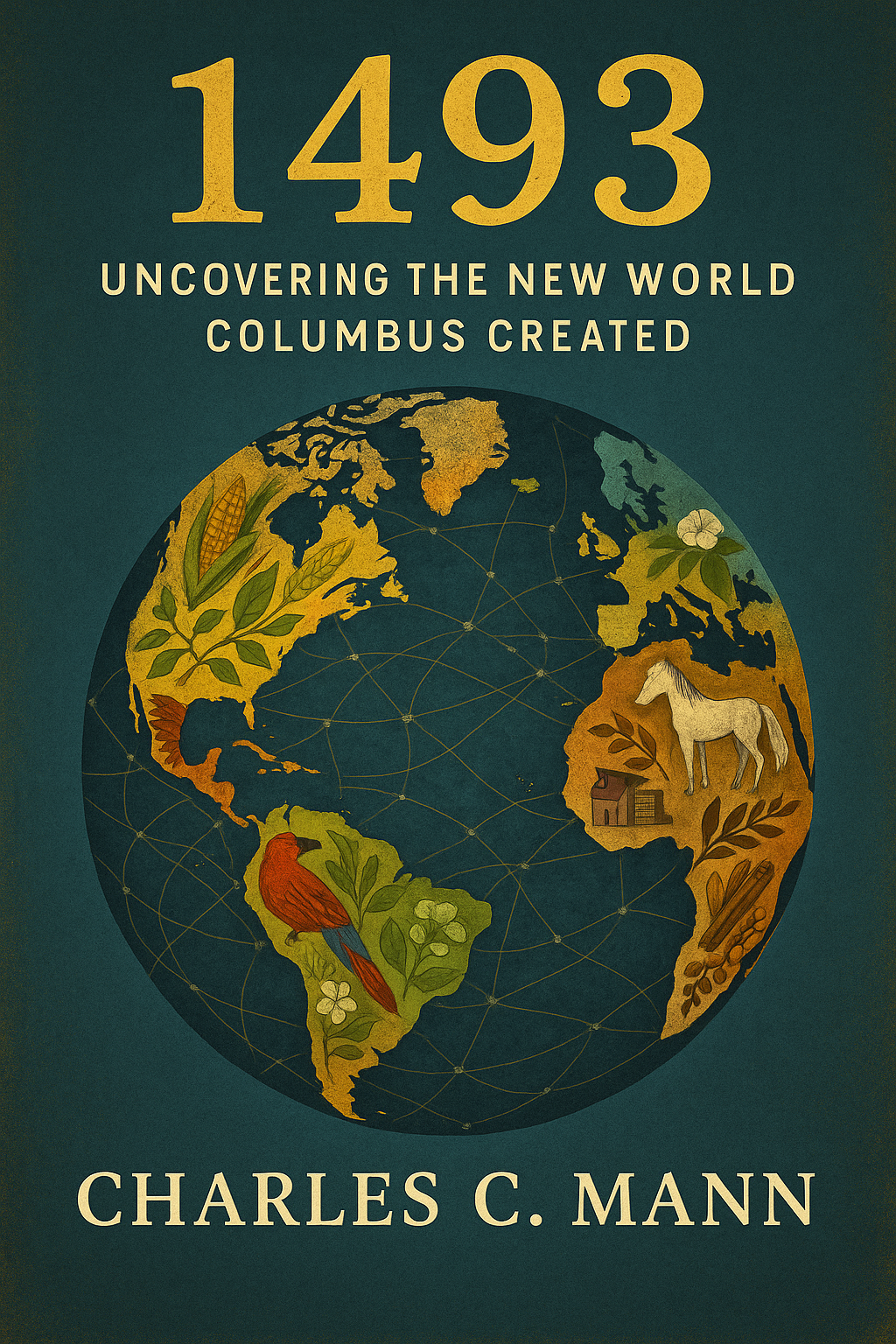
1493: Uncovering the New World Columbus Created
Chapter Summaries
What's Here for You
Prepare to have your understanding of history, and indeed the modern world, fundamentally reshaped. In '1493: Uncovering the New World Columbus Created,' Charles Mann and Chenjin invite you on a breathtaking intellectual journey that transcends the familiar narratives of exploration and conquest. Forget the isolated tales of European powers; this book reveals the astonishing, interconnected reality forged in the wake of Columbus's voyages – a reality that continues to shape our lives today. You will gain a profound appreciation for the vast, often invisible, forces that have molded our planet and its peoples. We'll delve into the unexpected ecological transformations, from the humble earthworm's impact on Jamestown to the global dominance of the potato and the rubber tree. You'll witness how seemingly small exchanges – plants, animals, and even diseases – ignited massive societal and economic shifts, creating what the authors term the 'Agro-Industrial Complex' and sparking 'Shiploads of Money' across continents. More than just a chronicle of biological exchange, '1493' unearths the human stories woven into this global tapestry. You'll encounter the resilience and agency of those often relegated to footnotes, like Juan Garrido, an African who carved a life in New Spain, and the 'fugitives' who built new societies in the 'Forest of Fugitives.' You'll explore how traditions and even the very concept of 'home,' as seen in the Philippines, have been profoundly transformed by this relentless global exchange. The tone is one of intellectual curiosity and revelatory discovery. Mann's meticulous research, combined with Chenjin's insights, brings to life a complex, interconnected world with vivid detail and a sense of wonder. You'll feel the thrill of uncovering hidden connections, the intellectual satisfaction of seeing the familiar in a new light, and a deeper understanding of the 'crazy soup' of cultures, economies, and ecologies that defines our modern era. This is not just history; it's the story of how we became who we are.
Two Monuments
We stand at the ghostly ruins of La Isabela, Christopher Columbus's first permanent settlement in the Americas, a place now largely forgotten, much like the man himself is increasingly perceived. Charles Mann, through meticulous research, guides us not just through the physical remnants of this failed colony, but through the seismic shifts it unknowingly initiated. The author explains that while Columbus was a flawed figure—a cruel, deluded man who stumbled upon the New World—his arrival marked the true dawn of a new era, inaugurating a global exchange of unprecedented scale. This wasn't just an economic transformation, but a biological one: the reknitting of Pangaea's ancient seams. As European vessels, carrying not just people but a veritable Noah's ark of plants, animals, and microbes, traversed the oceans, the world's ecosystems collided and mixed, creating the diverse global diet we know today – tomatoes in Italy, chili peppers in Thailand, coffee in Africa. This Columbian Exchange, however, was also a biological catastrophe, decimating indigenous populations through novel diseases against which they had no immunity, a stark reminder of the devastating human cost. Yet, the narrative expands beyond the initial encounter, moving to Manila and the subsequent establishment of the galleon trade, a testament to Spain's relentless pursuit of China. This monumental undertaking, driven by the insatiable demand for silver from the Americas, forged the first truly global economic system, binding continents in a complex web of exchange. The author reveals that this era, which he terms the Homogenocene, was not merely about trade routes and riches, but a profound ecological and demographic upheaval. The influx of American silver fueled European wars and inflation, while American crops like maize and sweet potatoes reshaped Asian agriculture, destabilizing dynasties. The chapter culminates in the stark contrast between the decaying grandeur of the Columbus Lighthouse in Santo Domingo, a monument to a controversial figure, and a humble statue in Manila honoring Legazpi and Urdaneta, pioneers of the Pacific silver trade. Both monuments, in their own way, represent the unintended consequences of ambition and the birth of a globally interconnected world, a world grappling with the immense, often paradoxical, legacies of these early exchanges.
The Tobacco Coast
Charles Mann, in 'The Tobacco Coast,' unveils the profound ecological and societal transformations wrought by the nascent English settlement at Jamestown, a story far removed from romanticized notions of colonial arrival. He reveals how seemingly minor introductions, like the earthworm inadvertently carried in ballast or plant roots, initiated a planetary ecological upheaval, marking the dawn of the Homogenocene in North America. John Rolfe's pivotal role, not just in marrying Pocahontas but in cultivating Nicotiana tabacum, transformed Virginia into the 'Tobacco Coast,' a commercial engine fueled by an addictive global craze that reshaped landscapes and economies. The author meticulously details the stark contrast between the European and indigenous land management practices: the Powhatan people cultivated diverse, intermingled crops in cleared woodlands managed by fire, a stark departure from the European model of vast, single-crop fields cleared and tilled with draft animals, a difference that fueled misunderstandings and conflict. Mann highlights the initial struggles of Jamestown, beset by disease, starvation, and conflict with the Powhatan empire under leaders like Powhatan and later Opechancanough, underscoring that the colony's survival, and its eventual success, hinged less on military might and more on the complex web of the Columbian Exchange and the introduction of new species, including the devastating Plasmodium parasites that accompanied European arrival. The narrative navigates the economic desperation driving the Virginia Company, a joint-stock enterprise pooling resources to fund colonization, which despite immense losses, relentlessly pursued profit through tobacco, inadvertently laying the groundwork for both representative democracy and chattel slavery. The author paints a vivid picture of Tsenacomoco, not as a pristine wilderness, but as a managed landscape shaped by beaver dams and indigenous fire practices, a 'working landscape' transformed by European ambitions, leading to the exhaustion of soil, displacement of native peoples, and the relentless expansion of monoculture farming. The story culminates in the understanding that while John Rolfe's tobacco revolutionized global trade and ingrained new institutions, the true, lasting impact was the profound and often destructive ecological integration, a testament to how unintended consequences can reshape continents and cultures.
Evil Air
Charles Mann, in his illuminating work '1493: Uncovering the New World Columbus Created,' delves into the unseen, yet profoundly impactful, forces that reshaped the Americas and the world. The chapter, 'Evil Air,' begins with a curious detail found in newly discovered letters of Cristbal Coln: his men fell gravely ill with what he called 'iiones' upon arriving at La Isabela, a sickness that historians and translators have largely interpreted as malaria. This seemingly minor point unlocks a cascade of understanding about the Columbian Exchange, revealing how the introduction of Old World diseases to the New World was not a sudden epidemic, but a slow, insidious endemic presence that fundamentally altered landscapes and societies. Mann illustrates how malaria, unlike diseases like smallpox that swept through and faded, became a persistent, debilitating force, rendering previously populous regions inhospitable and forcing devastating demographic shifts. The author masterfully navigates the scientific intricacies of malaria transmission, from the Plasmodium parasite to the Anopheles mosquito, drawing parallels between the historical accounts of suffering, such as Samuel Jeake's meticulous diary entries, and the biological mechanisms of the disease. He posits that the very survival advantage of certain African populations against malaria, due to inherited immunities like Duffy negativity, ironically became a grim catalyst for their enslavement, as they were biologically better equipped to withstand the 'evil air' that decimated European colonists. This biological predisposition, coupled with economic incentives and the search for labor, forged the brutal institution of chattel slavery, a stark consequence of ecological introductions shaping economic and political destinies. Mann further explores how the prevalence of malaria and yellow fever in tropical and subtropical regions led to the establishment of 'extractive states,' where colonial powers focused on resource extraction rather than sustainable development, leaving a lasting legacy of economic disparity. The narrative then shifts to the American Revolution and the Civil War, demonstrating how malaria, experienced differently by seasoned colonists and unseasoned newcomers, played a critical role in military outcomes, perhaps even influencing the timing of the Emancipation Proclamation and certainly contributing to the eventual victory of the American colonies. Ultimately, 'Evil Air' reveals that the history of disease is inextricably linked to human history, shaping not only populations and economies but also the very course of empires and nations, a stark reminder of the interconnectedness of our world.
Shiploads of Money
Charles and Chenjin’s chapter, "Shiploads of Money," unveils a fascinating paradox in Chinese history, beginning with the breathtaking maritime expeditions of Admiral Zheng He in the early 15th century. These were not mere voyages; they were colossal displays of power, with ships longer than any wooden vessel ever built, dwarfing even the later Spanish Armada. Yet, this astonishing feat of engineering and ambition, funded by the Yongle Emperor, was abruptly halted. The authors explain that this cessation wasn't a sign of inherent Chinese insularity or lack of curiosity, as some historians have posited, but rather a complex interplay of political infighting and economic realities. The subsequent suppression of records and retreat from the seas, however, set China on a different course, one that would eventually draw it into a global economic network it had initially shunned. This pivot was dramatically driven by severe monetary woes; China’s inability to control its own coinage, particularly the scarcity of copper for bronze coins and the rampant inflation of paper currency, led to a desperate need for silver. The Ming dynasty’s attempts to control and then ban private trade backfired, leading to widespread smuggling and the rise of figures like the wokou, who blurred the lines between merchant and pirate. This internal chaos, coupled with a dysfunctional currency system that fluctuated wildly with each new emperor, created an environment where silver, primarily from the Americas, became the de facto currency. The chapter then vividly details the discovery and exploitation of the Potosí silver mines in the Andes, a place of unimaginable wealth and brutal human cost, where mercury poisoning and brutal labor conditions were rampant. This influx of silver, however, didn't primarily benefit Europe; instead, a disproportionate amount flowed to Asia, particularly to Chinese ports like Yuegang. The demand for silver, driven by China's tax system and its lack of domestic mines, created a voracious appetite that fueled the galleon trade across the Pacific. This global network, established through the forced exchange of Chinese goods like silk and porcelain for American silver, ultimately propped up the Ming economy but also contributed to its eventual collapse. The narrative culminates in the turbulent relationship between Chinese merchants and Spanish authorities in Manila, highlighting how the pursuit of silver and commodities created complex, often violent, interdependencies. The authors reveal that trade, far from being a simple economic exchange, was deeply intertwined with statecraft, power, and the often-brutal enforcement of national ambitions, demonstrating that the "treasure of the world" came at a profound human and economic cost, reshaping global dynamics in ways that continue to echo.
Lovesick Grass, Foreign Tubers, and Jade Rice
Charles Mann, in "Lovesick Grass, Foreign Tubers, and Jade Rice," unveils a world transformed not just by silver and conquest, but by the quiet, persistent march of new plants and habits across the Pacific. We witness the astonishing speed with which tobacco, initially a novelty, became 'lovesick grass' and 'goldenthread smoke' in China, embraced by soldiers for its protective aura against malaria and by the fashionable elite for its ostentatious display, even leading to poetic odes and elaborate rituals of consumption, much like the contemporaneous snuff craze in England, where dandy Beau Brummell famously curated a snuffbox for every day of the year. This addiction, however, was more than a cultural quirk; it was a symptom of a deeper ecological and demographic shift, as China, a land with a vast population and limited arable land, found itself profoundly altered by the Columbian Exchange. The author explains that the introduction of American crops like the sweet potato, maize, and peanuts, often smuggled and initially treated as novelties, became a critical boon, especially during periods of famine and ecological stress, such as the hard cold rains of the Little Ice Age that devastated rice paddies. Chen Zhenlong's clandestine introduction of sweet potato vines, initially hidden amongst ropes, exemplifies the clandestine nature of this exchange, yet these 'foreign tubers' would eventually become a staple for the poor, a testament to their resilience and adaptability. This agricultural revolution, coupled with the Qing dynasty's efficient, albeit sometimes brutal, policies—including the forced coastal evacuation that disrupted trade and inadvertently empowered pirates like Zheng Chenggong—and later, a reversal of population control measures, fueled an unprecedented demographic surge. Mann reveals a critical insight: China's embrace of these new crops, particularly maize and sweet potatoes, allowed for cultivation in marginal lands previously unsuitable for rice and wheat, nearly tripling the nation's cultivated area between 1700 and 1850, a transformation that historians like Hong Liangji presciently warned could lead to ecological catastrophe and social dysfunction, a concept echoing Thomas Malthus's theories but with a distinctly Chinese ecological focus. The chapter details how the pursuit of profit from crops like tobacco, which demanded more labor and fertilizer than grain, led farmers to abandon rice cultivation, depleting the soil and exacerbating environmental degradation, turning fertile land into barren hillsides, a cycle of deforestation and erosion that tragically mirrored the earlier ecological struggles in the Loess Plateau, where the 'Dazhai' model of forced terracing only worsened soil erosion and flood devastation. The narrative culminates in the stark realization that while these new crops offered a lifeline, their widespread cultivation, especially in marginal lands, ultimately contributed to environmental strain and social upheaval, demonstrating how seemingly small exchanges can trigger cascading, long-term consequences for entire societies and landscapes, a stark reminder that the underpinnings of empires can be reshaped by the humble growth of a plant.
The Agro-Industrial Complex
Charles Mann, in his exploration of the 'Agro-Industrial Complex,' unveils the profound, often unseen, impact of the potato, a humble tuber from the Andes, on global history and modern agriculture. Initially, we witness the potato's astonishing journey from a mere curiosity to a staple food, its resilience and productivity allowing it to sustain burgeoning populations and, as historian William H. McNeill argues, fuel European imperial expansion. This rise coincided with the end of widespread famine in northern Europe, a stark contrast to the Malthusian trap that had long constrained populations. The narrative then delves into the intricate Andean cultivation techniques, including the use of guano, a potent fertilizer derived from seabird droppings, which, though beneficial, would later become entangled with devastating potato blights, most notably the late blight that ravaged Ireland in the 1840s, a catastrophe born from the very global exchange that introduced the potato. This period also saw the rise of industrial agriculture, a system built on improved crops, intensive fertilizers like guano, and factory-made pesticides, a direct lineage from the Columbian Exchange and the potato's unique characteristics. The chapter highlights the unintended consequences of this transformation: the creation of monocultures, the vulnerability to pests like the Colorado potato beetle, and the subsequent arms race with chemical solutions, a cycle that continues to define modern farming. The very soil, once a source of life, became a canvas for chemical warfare, a stark illustration of how the pursuit of ever-higher yields has reshaped our planet and our relationship with food, leaving us with a legacy of both unprecedented abundance and profound ecological challenges.
Black Gold
The narrative unfolds, revealing the profound and often paradoxical impact of the rubber tree, *Hevea brasiliensis*, a plant that journeyed from the Amazon to dominate Southeast Asian ecosystems and reshape global industry. Charles Mann's exploration begins in a silent, monocultural forest in China, a stark testament to rubber's ecological footprint, where every other species has been eradicated to make way for these forty-five-year-old trees, a silent, green carpet that lifts villages from destitution but silences the natural world. This transformation, Mann explains, echoes the potato's role in Europe's escape from Malthusian pressures, but rubber's influence on the Industrial Revolution is arguably more pervasive, intertwining the lives of countless individuals—slaves, engineers, merchants, scientists, and politicians—in a complex web of creation and exploitation. The story then pivots to 16th-century Seville, where Spanish ambassadors encountered the astonishing elasticity of Mesoamerican rubber balls, a material so alien to European understanding that it baffled observers like Andrea Navagero and Gonzalo Fernández de Oviedo y Valdés, who struggled to describe its 'bouncing' and 'springing' qualities. This encounter marks the introduction of an elastomer, a novel form of matter, to a world unprepared for its potential. The chapter traces rubber’s journey from indigenous Amazonian practices of latex collection and processing through boiling and smoking, to its eventual adoption in Europe and America, where its initial promise of impermeable boots and clothing dissolved into a sticky, smelly mess in fluctuating temperatures. Charles Goodyear’s obsessive, often desperate, pursuit of a stable form of rubber, leading to his accidental discovery of vulcanization through sulfur, becomes a central drama of innovation born from hardship, a tale of penury, imprisonment, and relentless experimentation, ultimately transforming rubber into a cornerstone of modern industry. Thomas Hancock’s parallel discovery and patenting of vulcanization highlight the often-complex nature of invention and intellectual property. The narrative expands to encompass the arduous, often brutal, construction of the Madeira-Mamoré Railway in the Amazon, a project that exemplified the immense logistical challenges and human cost of extracting rubber, where malaria, starvation, and exploitation were rampant, as seen through the eyes of Neville Burgoyne Craig. The sheer economic power of rubber fueled a boomtown era in cities like Belém and Manaus, creating immense wealth for a few but often at the expense of indigenous populations and laborers subjected to brutal conditions, as exemplified by the horrors of Julio César Arana's Putumayo operations. The chapter then delves into Henry Alexander Wickham's controversial act of 'biopiracy' – smuggling seventy thousand rubber seeds from Brazil to England, an act that, while reviled in Brazil, ultimately allowed Britain to establish vast rubber plantations in Asia, decimating Brazil's dominance and dramatically altering global supply chains. This strategic shift, driven by colonial ambition and industrial demand, transformed landscapes across Southeast Asia, turning regions like Xishuangbanna in China and northern Laos into vast monocultures, often displacing local populations and ecosystems. The narrative culminates with a stark ecological warning: the widespread planting of genetically uniform rubber clones, descendants of Wickham’s pilfered seeds, creates a terrifying vulnerability to diseases like South American leaf blight (*Microcyclus ulei*), threatening a global economic calamity that could cripple industries from transportation to healthcare. The interconnectedness of the modern world, symbolized by new highways linking Southeast Asia, means that a single pathogen could now traverse continents, potentially wiping out the world’s rubber supply and completing a cycle of exchange that began with the Columbian Exchange, reminding us that the very materials that built our industrial civilization carry inherent risks.
Crazy Soup
The narrative unfolds through the life of Juan Garrido, a man of West African origin who arrived in the Americas not as a conqueror, but as a slave, only to carve out a remarkable existence as a soldier, farmer, and builder in the nascent Spanish Mexico City. His journey, from his self-given moniker 'Johnny Goodlooking' to his pivotal role in cultivating wheat, illustrates a profound human element within the vast, often brutal, Columbian Exchange. Charles Mann reveals how this exchange was not merely about the movement of plants and animals, but a convulsive reshuffling of humanity itself, akin to dice flung across a gaming table. Garrido's story, however, is one of resilience and agency, a testament to an individual refusing to be defined by the chains of his past, ultimately contributing to the very fabric of the new world. The chapter then pivots to the insatiable human appetite for sweetness, tracing the history of sugar from its ancient origins to its role in fueling the plantation system, a system that would come to rely on the forced migration of millions of Africans. The stark contrast between the ecological transformation of Madeira, which adapted its sugar economy, and the disease-ridden, exploitative model of São Tomé and Príncipe, sets a grim stage for understanding the systemic nature of the new world's nascent economy. We witness how the pursuit of profit, unmoored from ethical considerations, led to the horrific development of plantation slavery, a dark engine that powered the burgeoning colonial enterprise. This grim reality is further complicated by the emergence of a complex, multi-ethnic society in Mexico City, a place teeming with people from Africa, Asia, Europe, and the Americas. The chapter explores the intricate family trees and social strata that emerged, a tapestry woven from conquest, coercion, and surprising accommodation, highlighting how the very concept of race was fluid and contested, a far cry from the rigid categories that would later define societies. Ultimately, the story of Mexico City, a 'shook-up city,' serves as a microcosm of this new world, a place of dazzling cultural fusion and stark social stratification, a precursor to the globalized urban centers of today, grappling with environmental challenges and the enduring legacy of its complex origins.
Forest of Fugitives
Charles and chenjin's chapter, 'Forest of Fugitives,' unveils a hidden history of resilience and self-creation, moving beyond the simplistic narrative of European conquest to reveal the profound agency of Africans and Indigenous peoples in the Americas. We are introduced to the clandestine world of quilombos, fugitive communities born from the ashes of slavery, like Calabar near Salvador da Bahia, a city that swelled to twenty thousand inhabitants, a testament to the enduring human spirit's quest for freedom. These settlements, often formed through alliances between escaped slaves and Indigenous peoples, became bastions of liberty, protected by formidable natural defenses and ingenious human ingenuity. The author explains that the common perception of Africans as mere pawns in the transatlantic slave trade is a profound misrepresentation; in reality, Africans themselves controlled the supply of slaves, engaging in complex negotiations with European buyers, driven by economic systems where labor, rather than land, was the primary form of property and status. This dynamic fueled the growth of the trade, yet it also laid the groundwork for resistance, as seen in the legendary Palmares, a maroon state that thrived for decades, centered around the Serra da Barriga, and commanded by figures like Aqualtune and her son Ganga Zumba, demonstrating that the desire for freedom was not a passive hope but an active, organized force. The narrative then shifts to the Isthmus of Panama, where Vasco Núñez de Balboa's quest for gold inadvertently revealed the presence of escaped African slaves, potentially the first to see the Pacific from the American side, highlighting how the pursuit of wealth often intersected with the creation of free domains. The chapter emphasizes that these struggles were not confined to isolated incidents; they were a pervasive force across the hemisphere, from the successful wars waged by the Bush Negroes in Suriname to the creation of an independent Haiti, a revolution that sent shockwaves across slave-holding societies. In Florida, maroon-Indian alliances secured liberty, and in Mexico, Gaspar Yanga's revolt led to the establishment of San Lorenzo de los Negros, the Americas first sunset town. Even in the United States, communities like those in the Great Dismal Swamp carved out existence, while the Seminole War saw a powerful Afro-Indian alliance challenge U.S. forces. The story of Dona Rosario and her family in the Amazon, working to reclaim and cultivate the land, illustrates the ongoing legacy of these maroon communities, who, through clever adaptation and deep connection to the land, continue to forge their own destiny, transforming what outsiders see as an impenetrable forest into a vibrant, managed garden, a living testament to centuries of struggle for self-determination. The core tension lies in the clash between the brutal realities of slavery and the indomitable will to freedom, a struggle that forged new societies and redefined liberty itself, often in the shadows, away from European eyes.
In Bulalacao
The author, Charles C. Mann, invites us on a journey to the Philippines, revealing how the very concept of 'home' and 'tradition' has been profoundly reshaped by global exchange. He begins in the Philippines, where a beloved folk song, 'Bahay Kubo,' extols the virtues of a traditional garden filled with plants that, surprisingly, are all introduced species from Africa, the Americas, and East Asia. This 'fractured cerebration,' as Mann terms it, highlights how deeply ingrained these 'foreign' elements have become, symbolizing a cosmopolitan present disguised as an ancient past. This paradox extends to the stunning rice terraces of Ifugao, long believed to be millennia old, but which archaeological evidence suggests were largely a creation of the Spanish colonial era, built by refugees fleeing the demands of empire. The very trees that built these terraces, Philippine mahogany, or lauan, spurred by demand from the United States and Japan, ironically paved the way for invasive earthworms that now threaten their existence, a direct consequence, Mann notes, of his own grandfather's desire for a new breakfast table. This narrative tension between the allure of global commerce and the preservation of local heritage becomes starkly evident in Bulalacao, a remote town on Mindoro island. Here, amidst the lingering presence of a communist insurgency and the ecological scars left by logging, a local official envisions a future flooded with international investors eager to develop resorts and golf courses, promising a globalized prosperity. Yet, even here, the author finds a poignant counterpoint in a family tending a garden of maize and squash – plants born of the Columbian Exchange, but cultivated with an intimate, personal connection that makes them feel like home, a testament to how people adapt and make the global their own. Mann thus illustrates that the 'great exchange' that once brought invasive species and ecological damage also brought the very elements that now define Filipino gardens and, in a complex, often contradictory way, the very terraces that are seen as a symbol of enduring tradition. The chapter concludes by pondering the distribution of globalization's costs and benefits: gains are diffuse and global, while pain is intense and local, leaving communities like Bulalacao to grapple with the desire for modern goods and services against the backdrop of environmental degradation and cultural fragmentation, a constant negotiation between unity and division, between embracing the world and holding onto what remains uniquely theirs.
Conclusion
Charles Mann and Chenjin's "1493" leaves us with a profound and complex understanding of the world that emerged after Columbus's voyages, an era they aptly label the Homogenocene. The core takeaway is that globalization, far from being solely an economic or political construct, is fundamentally a biological phenomenon. The Columbian Exchange, a vast, often unintentional, reshuffling of species, diseases, and peoples, irrevocably altered ecosystems, diets, and demographics across continents. We learn that the pursuit of wealth, particularly silver, fueled an interconnected global economy, but at immense human cost, exemplified by the brutal exploitation in the Potosí mines. The book masterfully illustrates how seemingly small biological introductions—an earthworm, a new tobacco species, or the humble potato—could trigger cascading, transformative effects on landscapes, economies, and societies, from China's demographic surge to Europe's population boom. Emotionally, "1493" evokes a sense of awe at the sheer scale of these interconnected changes, coupled with a deep somberness regarding the devastating consequences for indigenous populations and the perpetuation of brutal systems like slavery, often driven by economic imperatives and exacerbated by disease ecology. The narrative highlights the complex interplay between human actions and planetary systems, revealing how environmental shifts were often a direct consequence of human-induced demographic collapses or agricultural practices. Practically, the book urges a nuanced perspective: to recognize that progress and suffering are often inextricably linked, that unintended consequences are a hallmark of global interaction, and that the forces of economic demand, cultural adaptation, and ecological vulnerability continue to shape our world. It underscores the enduring agency of marginalized peoples, from the maroon communities forging freedom to individuals like Juan Garrido, demonstrating that even within oppressive systems, resilience and self-determination are potent forces. Ultimately, "1493" serves as a powerful reminder of our interconnectedness, the long shadow of history, and the critical need to understand the biological, economic, and social forces that have shaped, and continue to shape, our shared planet.
Key Takeaways
The accidental founding of La Isabela, despite its failure, initiated the first permanent European presence in the Americas, thereby triggering the era of globalization and the Columbian Exchange.
Globalization, as established by Columbus's voyages, is fundamentally a biological phenomenon, involving the mixing of previously isolated ecosystems, leading to both widespread dietary enrichment and devastating demographic collapse.
The pursuit of wealth, particularly silver from the Americas, drove the creation of a global economic system that linked continents, fueled European expansion and conflict, and fundamentally altered Asian economies and societies.
The Homogenocene, a term for the era ushered in by the Columbian Exchange, signifies a period of unprecedented ecological and economic homogenization, where previously distinct global regions became interconnected and interdependent.
The legacy of Columbus and the subsequent global exchanges are complex, marked by both monumental achievements in global connectivity and profound human suffering, necessitating a nuanced understanding beyond simplistic veneration or condemnation.
Environmental shifts, such as the Little Ice Age, were significantly influenced by the demographic collapse of indigenous populations and their cessation of traditional land management practices, demonstrating the deep interconnectedness of human actions and planetary systems.
Recognize that ecological shifts, like the introduction of earthworms, can have profound, long-term consequences, fundamentally altering landscapes and ecosystems.
Understand that economic drivers, such as the demand for tobacco, can lead to unintended but transformative societal and environmental changes, including the rise of new institutions and global trade patterns.
Appreciate the deep interconnectedness between human actions, land management practices, and ecological outcomes, as demonstrated by the clash between indigenous and European agricultural methods.
Acknowledge that colonization is driven by complex economic motives, where the pursuit of profit can overshadow human cost and lead to the establishment of institutions like slavery, even amidst widespread failure.
Grasp that the Columbian Exchange involved not just the transfer of goods and species but also diseases and ecological pressures that fundamentally reshaped the Americas and its inhabitants.
Understand that seemingly small decisions, like John Rolfe's cultivation of a new tobacco species, can become catalysts for massive global change, impacting economies, cultures, and environments across continents.
Realize that the transformation of landscapes, driven by economic imperatives like tobacco farming, can lead to the displacement of indigenous populations and the creation of environments increasingly alien to their original inhabitants.
The introduction of Old World diseases like malaria to the Americas was not a singular event but an endemic, persistent force that fundamentally reshaped demographics and settlement patterns.
Biological immunities, such as Duffy negativity in West African populations, while protective against diseases like malaria, ironically became a factor contributing to their enslavement.
The prevalence of debilitating diseases in tropical regions fostered the development of 'extractive states,' characterized by external control and a focus on resource exploitation rather than societal development.
Disease, particularly malaria, significantly influenced military outcomes and political developments in the Americas, including the Revolutionary War and the Civil War, by disproportionately affecting unseasoned troops.
The historical trajectory of slavery in the Americas was significantly influenced by the interplay of disease ecology, labor demands, and the differential vulnerability of various populations.
Understanding the historical impact of 'evil air'—diseases—is crucial for comprehending the deep-seated economic, social, and political structures that persist in the post-Columbian world.
The cessation of China's grand maritime expeditions was not due to a lack of curiosity but a complex interplay of political factionalism and economic pragmatism, demonstrating that even immense capabilities can be curtailed by internal discord.
China's internal monetary crises, marked by inflation and currency instability, created a desperate need for silver, effectively driving its re-engagement with global trade despite previous restrictive policies.
The lines between merchants and pirates blurred significantly in Ming China due to trade bans, illustrating how attempts to control commerce can inadvertently empower illicit actors and create volatile economic landscapes.
The discovery and exploitation of the Potosí silver mines represent a profound tension between immense wealth generation and extreme human suffering, underscoring the ethical costs often embedded in resource extraction.
The flow of American silver to Asia, particularly China, was not merely an economic transaction but a critical factor in global power dynamics, fueling empires and influencing internal stability.
Trade operates on dual roles: facilitating mutually beneficial exchange (economics) and serving as a tool for state power and aggrandizement (political philosophy), a conflict that shapes international relations and often leads to exploitation.
The Ming dynasty's reliance on foreign silver for its economy and defense, coupled with a tax system unindexed for inflation, created a critical vulnerability that contributed to its eventual downfall.
The introduction of American crops like tobacco, maize, and sweet potatoes fundamentally reshaped China's agricultural landscape and demographics, enabling population growth in marginal lands previously unsuitable for traditional staples.
Economic incentives, driven by both addiction (tobacco) and the need for sustenance (sweet potatoes), led farmers to prioritize cash crops over staple grains, resulting in soil depletion and ecological degradation.
Government policies, whether through trade disruptions, population management, or agricultural mandates, profoundly influenced the adoption and impact of new crops, shaping societal and environmental outcomes.
The pursuit of short-term economic gain, exemplified by the widespread cultivation of tobacco and the 'Dazhai' model of aggressive land conversion, can lead to long-term ecological catastrophe and social instability.
Environmental crises, such as deforestation and soil erosion driven by agricultural practices, can undermine even the most sophisticated hydraulic infrastructure and contribute to dynastic decline.
The Columbian Exchange acted as a catalyst, interacting with existing socio-political conditions in China to create a demographic surge and environmental challenges that fundamentally altered the nation's trajectory.
The potato's high productivity and nutritional value fundamentally altered European demographics and enabled imperial expansion by overcoming historical Malthusian constraints on population growth.
The development of modern agriculture, the 'agro-industrial complex,' is inextricably linked to the Columbian Exchange, particularly the introduction of the potato and intensive fertilization methods like guano.
The global spread of the potato and agricultural innovations, while solving famine, created vulnerabilities, such as monocultures susceptible to pests and diseases like the potato blight, leading to devastating historical events.
The reliance on external inputs like guano and later synthetic pesticides, driven by the need for higher yields, established a dependence on chemical solutions that continues to characterize industrial agriculture, with significant ecological and health implications.
The transformation from diverse, locally adapted Andean potato cultivation to European monocultures represents a critical shift from biological resilience to technological dependence, with far-reaching consequences for global food systems.
The pursuit of economic progress through monoculture, exemplified by rubber plantations, often leads to profound ecological fragility and the silencing of biodiversity.
The history of rubber reveals how scientific discovery, driven by both obsession and accident, can fundamentally alter industrial capabilities and human living standards.
Exploitation and innovation are often intertwined; the immense wealth generated by rubber was built upon systems of forced labor and the disregard for indigenous rights and environmental consequences.
The global spread of species, a hallmark of the Columbian Exchange, can yield immense benefits for humanity but also carries the inherent risk of introducing devastating pests and diseases across interconnected ecosystems.
Technological advancements and industrial demand can create geopolitical scrambles for resources, leading to conflicts and the concentration of power in the hands of those who control vital raw materials.
The vulnerability of a globalized industrial system to the failure of a single critical resource, such as natural rubber, underscores the need for resilience and sustainable practices in resource management.
The drive for profit and national economic security can override ethical considerations and environmental stewardship, as seen in the historical and contemporary expansion of rubber cultivation.
The Columbian Exchange was a profound reshuffling of humanity, not just goods, fundamentally altering global demographics and societal structures.
Individual agency and resilience, exemplified by figures like Juan Garrido, can transcend oppressive circumstances and shape historical outcomes.
The insatiable human desire for commodities like sugar, coupled with the pursuit of profit, can drive the creation and perpetuation of brutal systems like plantation slavery.
The early colonial societies were far more fluid and complex in their ethnic and racial compositions than later, more rigid systems would suggest, with categories of identity being contested and negotiated.
The development of colonial economies and social structures often involved a paradoxical interplay of exploitation and adaptation, as seen in the differing fates of Madeira and São Tomé.
The creation of new urban centers like Mexico City, characterized by their diverse populations and cultural fusion, foreshadowed the modern globalized metropolis, complete with its inherent tensions and inequalities.
The existence of quilombos and other maroon communities reveals that enslaved Africans and Indigenous peoples were not passive victims but active agents who forged their own free domains through strategic alliances, resistance, and the invention of liberty.
The economic systems of West Africa, where labor was the primary form of property, played a crucial role in the development and scale of the transatlantic slave trade, but also provided a foundation for enslaved individuals to exert agency.
Maroon communities across the Americas, from Palmares in Brazil to the Miskitu kingdom in Nicaragua, successfully negotiated or fought for autonomy, creating independent or semi-independent societies that challenged colonial powers for centuries.
The history of maroons demonstrates a complex interplay between Africans and Indigenous peoples, forged both in the crucible of slavery and in shared uprisings against it, creating hybrid cultures and societies that are a hidden but vital part of American history.
The enduring legacy of maroons is evident today in their ongoing struggles for land rights and recognition, as seen in contemporary Amazonian communities, highlighting that the fight for self-determination continues.
The narrative of conquest often overlooks the agency of the colonized; maroons actively shaped their environments and societies, creating vibrant cultural and spiritual practices that blended African, Indigenous, and sometimes European traditions.
The concept of 'tradition' and 'home' is often a dynamic synthesis of introduced elements, illustrating how globalization has fundamentally reshaped cultural identity.
Ecological and cultural changes, even those that appear ancient, can be the direct result of relatively recent global economic demands and colonial histories.
The benefits of global commerce, while offering jobs and goods, are often distributed widely, while the intensive local costs, such as environmental damage and cultural displacement, are borne by specific communities.
Individuals often experience 'fractured cerebration,' simultaneously embracing global products and lamenting the loss of local distinctiveness, reflecting a deep-seated human desire for both connection and rootedness.
The adaptation of introduced species and technologies into local practices, as seen in gardens and modified traditions, demonstrates human resilience and the capacity to create personal meaning within globalized systems.
The tension between global economic integration and local preservation is a defining characteristic of the modern world, leading to fragmentation and conflict as communities seek to define their own unique spaces.
Action Plan
Consider the unintended consequences of major historical events and technological innovations.
Seek out diverse perspectives on historical figures and their impact, moving beyond singular narratives.
Reflect on how global trade and exchange have shaped your own diet and daily life.
Analyze the complex interplay between economic ambitions, cultural exchanges, and ecological consequences.
Evaluate the construction and symbolism of historical monuments, considering whose stories they truly tell.
Recognize the interconnectedness of global systems, from finance and trade to climate and disease.
Engage with criticisms and controversies surrounding historical figures to foster a more nuanced understanding.
Reflect on how seemingly small introductions or changes in your own environment might have unforeseen long-term consequences.
Analyze a current economic trend or innovation to identify potential unintended ecological or social impacts.
Research the historical land use practices of your local region and compare them to contemporary methods.
Consider the historical context of a popular product or habit, examining its global spread and its effects.
Evaluate the motivations behind a significant historical or business decision, considering both intended and unintended outcomes.
Identify instances where economic pressure has led to environmental degradation or societal shifts.
Explore the concept of ecological interdependence by examining how introduced species affect native ecosystems.
Investigate the historical prevalence of diseases in regions where significant historical events occurred and consider their potential impact on outcomes.
Recognize how biological factors, such as inherited immunities, can intersect with social and economic forces to create profound historical consequences.
Analyze how environmental factors and ecological introductions, like disease vectors, have shaped the development of societies and economic systems.
Consider the long-term impact of 'extractive' versus 'institutional' models of development in historical and contemporary contexts.
Seek to understand the complex relationship between health, labor, and economic structures throughout history.
Reflect on how seemingly small biological details, like mosquito-borne parasites, can have massive historical repercussions.
Evaluate how factors like differential disease resistance may have influenced patterns of migration, settlement, and labor exploitation.
Consider how internal political divisions or economic pressures might limit even highly capable endeavors, and seek to foster alignment and clear objectives.
Analyze the unintended consequences of regulations or bans on trade and commerce, recognizing how they can create opportunities for illicit markets.
Investigate the true human and environmental costs associated with the extraction of valuable resources, moving beyond simple economic metrics.
Examine the dual nature of trade—as a private economic activity and a tool of state power—and how this tension influences global interactions.
Reflect on how a nation's monetary system and fiscal policies can create vulnerabilities, especially when disconnected from market realities or global economic shifts.
Seek to understand historical events not just as a series of actions, but as the result of complex, often contradictory, economic and political forces.
Evaluate the long-term impacts of relying on external sources for critical commodities, whether for economic stability or national defense.
Research the history of staple crops in your own region to understand their origins and impact.
Consider the long-term environmental consequences before adopting new practices for short-term gain.
Investigate how historical government policies have shaped local agriculture and land use.
Reflect on the seductive nature of new technologies or substances and their potential for unintended consequences.
Seek out diverse perspectives on environmental challenges, recognizing that solutions often involve complex trade-offs.
Examine how seemingly isolated events, like the introduction of a new plant, can trigger cascading effects across societies and ecosystems.
Investigate the origins of staple foods in your diet to understand their historical and global impact.
Consider the environmental footprint of your food choices, particularly regarding fertilizers and pesticides.
Support or explore local and diverse agricultural systems that prioritize biodiversity over monoculture.
Research the history of agricultural innovations to understand their long-term benefits and drawbacks.
Seek out diverse potato varieties at local markets or from specialty growers to appreciate the richness of this crop beyond standardized commercial types.
Investigate the origins of common materials in your daily life to understand their global impact.
Consider the ecological footprint of monoculture farming and its long-term consequences.
Seek out diverse perspectives when evaluating technological or industrial advancements, considering both benefits and drawbacks.
Support businesses and practices that prioritize sustainability and ethical resource management.
Learn about the historical exploitation inherent in global supply chains to foster critical consumption.
Educate yourself on the potential risks of invasive species and diseases in a globalized world.
Reflect on the balance between immediate economic gains and long-term ecological and social well-being.
Seek out and learn about individuals from marginalized backgrounds whose stories have been historically overlooked, recognizing their contributions to shaping societies.
Reflect on the historical and current drivers of demand for certain commodities and consider their impact on global labor and environmental practices.
Examine the evolution of social categories and racial classifications, understanding that these are often fluid and contested rather than fixed biological realities.
Consider how historical patterns of migration and cultural exchange continue to shape contemporary urban environments and social dynamics.
Analyze how the pursuit of economic gain can lead to the exploitation of human beings and consider ethical frameworks for resisting such systems.
Seek out and engage with histories that highlight marginalized voices and perspectives, moving beyond official narratives.
Consider the complex economic and social factors that fueled the slave trade, understanding that agency existed even within oppressive systems.
Recognize and appreciate the resilience and ingenuity of communities that have historically fought for and maintained their autonomy.
Support contemporary movements advocating for the land rights and cultural preservation of descendant communities of maroons and Indigenous peoples.
Explore the rich cultural fusions—spiritual, artistic, and social—that emerged from the interactions between African, Indigenous, and European peoples in the Americas.
Reflect on the ongoing relevance of the struggle for freedom and self-determination in various parts of the world today.
Reflect on your own daily life and identify elements (foods, technologies, traditions) that are considered 'traditional' but are, in fact, introduced species or concepts.
Consider the origins of products you use daily and the global supply chains and historical exchanges that brought them to you.
When encountering narratives of 'pure' tradition, question their origins and acknowledge the potential for introduced elements to have become deeply integrated.
Examine the distribution of benefits and costs in a globalized transaction you participate in; who benefits most, and who bears the heaviest local burden?
Seek out opportunities to support local producers or initiatives that are actively working to preserve or adapt cultural heritage in the face of global pressures.
Engage with the 'fractured cerebration' by consciously appreciating the global origins of familiar items while also seeking to understand and value unique local contributions.