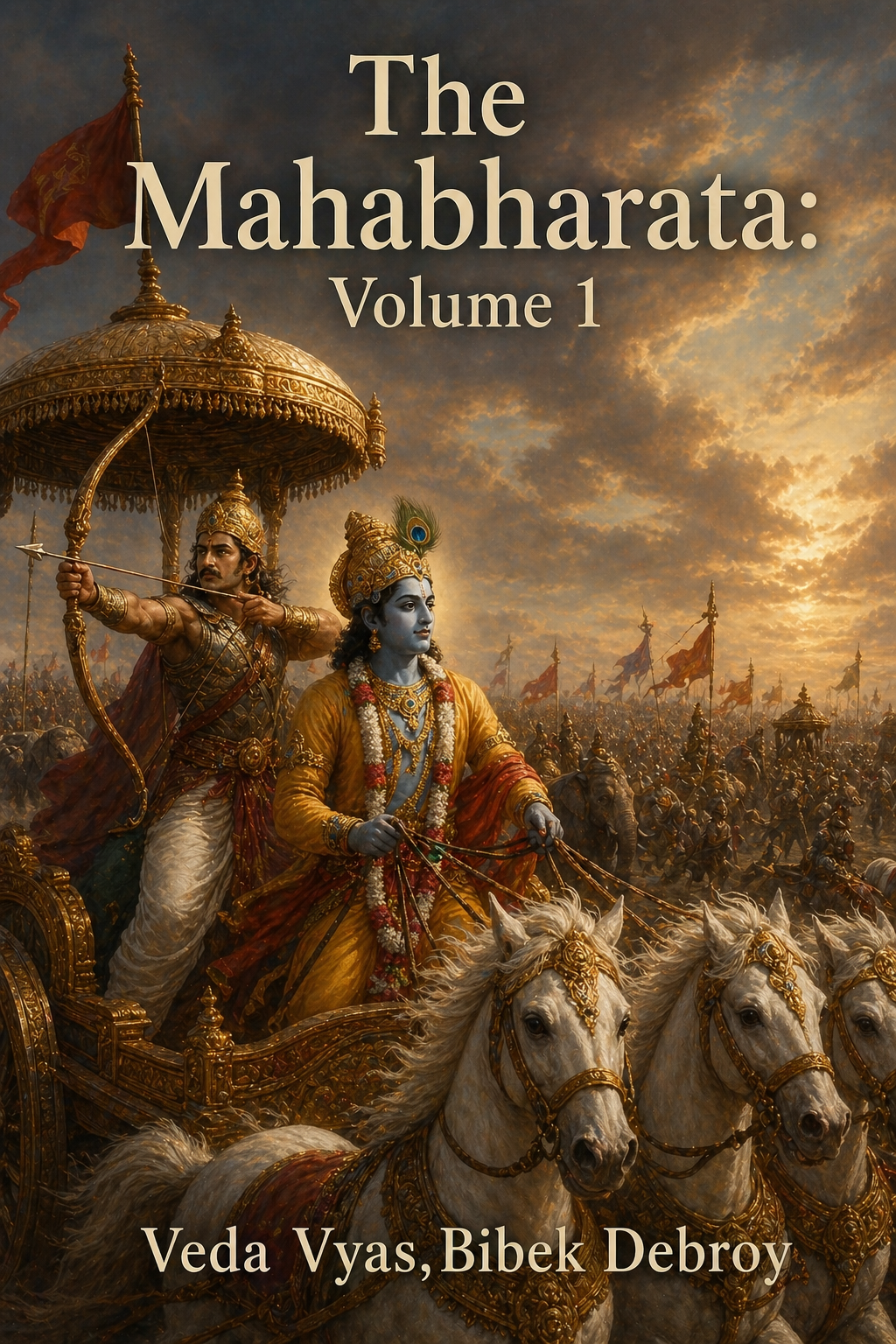
The Mahabharata: Volume 1
Chapter Summaries
What's Here for You
Embark on an epic journey into the heart of *The Mahabharata*, Volume 1. This is more than just a story; it's an exploration of dharma, destiny, and the very foundations of human existence. Through the masterful narration of Veda Vyas, retold by Bibek Debroy, you'll witness the intricate tapestry of lineage, curses, and divine intervention that sets the stage for the Kurukshetra War. Prepare to be captivated by tales of valiant warriors, cunning strategists, and powerful gods, all intertwined in a narrative brimming with tension, intrigue, and profound philosophical insights. Delve into the origins of heroes and villains, experience the Pandavas' trials and tribulations, and witness the unfolding drama of Droupadi's svayamvara. This volume promises not only a gripping narrative but also a deeper understanding of ancient wisdom, inviting you to contemplate the complexities of morality and the enduring power of storytelling.
Anukramanika Parva
In the Anukramanika Parva of the Mahabharata, Veda Vyas, as narrated by Bibek Debroy, sets the stage for the epic tale, a story within a story, framed by the sage Ugrashrava, or Souti, recounting Vaishampayana's recital to the sages at Naimisharanya. The very act of recitation becomes a sacred ritual, beginning with obeisance to Narayana, Nara, and Sarasvati, emphasizing the importance of reverence before embarking on a journey of knowledge. Souti's arrival at the hermitage is like a parched traveler finding an oasis, greeted with anticipation by hermits eager to hear ancient stories, highlighting humanity's timeless need for narratives that explain the world. The sages implore Souti to narrate the story first told by Dvaipayana, a tale revered by gods and sages alike, brimming with subtle meanings and adorned with the essence of the Vedas, revealing the epic's profound significance beyond mere entertainment. Vyasa's Mahabharata, Souti explains, is not just a story, but a comprehensive storehouse of knowledge, encompassing dharma, artha, and kama, a guide to navigating the complexities of human existence. The text acknowledges its own evolution, recognizing that poets have sung this story before, are singing it now, and will continue to do so, indicating the Mahabharata's enduring relevance and adaptability across generations. Dhritarashtra’s lamentations to Sanjaya reveal a king burdened by the consequences of his sons' actions, confessing his inability to prevent the unfolding tragedy, a stark reminder of the destructive power of unchecked desire and envy. Sanjaya reminds Dhritarashtra of the countless kings who have come and gone, each facing their own trials and tribulations, urging him to accept the inevitable nature of time and not succumb to grief. Ultimately, the study of the Bharata is presented as a purifying act, capable of destroying sins and leading to enlightenment, illustrating the transformative potential of engaging with this epic narrative. The chapter emphasizes that time is the ultimate force, creating and destroying, impartial and unconquerable, thus, wisdom lies in understanding its cyclical nature and accepting the transient nature of existence. Finally, the tale's enduring quality is underscored, as the gods themselves weighed the Vedas against the Bharata, finding the latter heavier in substance, a testament to its comprehensive exploration of the human condition.
Parvasamgraha Parva
In the *Parvasamgraha Parva* of the Mahabharata, Veda Vyas, as narrated by Souti, sets the stage by recounting the tale of Samantapanchaka, a land sanctified by Rama's act of cleansing the world of Kshatriyas and creating five lakes of blood, a stark reminder of violence and purification. The narrative then pivots to the structure of armies, defining the composition of an akshouhini with meticulous detail, highlighting the immense scale of the forces arrayed in the Kurukshetra War. Souti introduces the eighteen parvas and one hundred parva classifications of the Mahabharata, offering a roadmap through the epic's vast landscape, each parva a distinct territory in the sprawling saga, from the *Anukramanika* to the *Svargarohanika*. The *Parva* serves as a table of contents, promising accounts of love, war, dharma, and deceit. As the chapter unfolds, it reveals the essence of each parva, offering glimpses into pivotal moments: the burning of Khandava forest, the game of dice, Arjuna's celestial journey, and the climactic battles and their aftermath, providing a sensory tapestry, rich with sounds of clashing weapons and hushed whispers of conspiracy. The chapter underscores the epic's comprehensive nature, asserting that all stories find their roots within its bounds, like tributaries flowing into a mighty river. The *Parva* emphasizes the transformative power of listening to the Bharata, suggesting it surpasses ritualistic acts and inspires poets, offering purification, salvation, and dispelling sin. The chapter resolves by positioning itself as a guide, a boat to navigate the ocean of the Mahabharata, ensuring readers understand the profound meanings embedded within this supreme history.
Poushya Parva
In the Poushya Parva of the Mahabharata, Veda Vyas, as narrated by Suta, introduces us to Janamejaya's lineage and sets the stage for the snake sacrifice. The narrative unfolds with Janamejaya's brothers mistreating a dog, leading to a curse by the dog's mother, Sarama, a divine being; this act of cruelty sets a chain of events in motion, revealing how seemingly small transgressions can invite profound consequences. Seeking atonement, Janamejaya appoints Somashrava as his priest, a sage born under peculiar circumstances, highlighting the acceptance of wisdom from unconventional sources. The story then diverges to illustrate the trials of Ayoda-Dhoumya's disciples—Aruni, Upamanyu, and Veda—each facing unique tests of obedience and perseverance, mirroring the diverse paths to enlightenment. Upamanyu's tale, in particular, paints a vivid picture of extreme devotion, his hunger a gnawing reminder of the sacrifices demanded by true discipleship, culminating in his blindness and subsequent restoration by the Ashvins, divine physicians. This episode underscores that unwavering commitment to one's guru, even amidst hardship, leads to ultimate wisdom and fortune. Utanka's trials form the parva’s emotional core, his quest for earrings for his preceptor's wife becoming a gauntlet of moral and physical challenges. He confronts Poushya's unclean offering, navigates Takshaka's trickery, and receives cryptic guidance, each encounter testing his resolve and integrity. The earrings themselves become a symbol of duty and the obstacles one faces in fulfilling it. Ultimately, Utanka’s journey underscores that true knowledge and success are earned through perseverance, moral rectitude, and unwavering devotion to one's guru, transforming challenges into stepping stones towards enlightenment and revenge.
Pouloma Parva
In the Pouloma Parva of the Mahabharata, Bibek Debroy, translating Veda Vyas, sets the stage for the epic's unfolding drama, not with immediate conflict, but with the deep roots of lineage, specifically that of the Bhargavas, descendants of the sage Bhrigu. The narrative begins with Ugrashrava, a learned suta, addressing sages at a sacrifice, offering to share ancient tales, a moment that mirrors the very act of storytelling the Mahabharata embodies. Shounaka, a revered Kulapati, expresses his eagerness to hear the Bhrigu lineage, thus initiating the parva’s central theme. Bhrigu's line, including Chyavana, Pramati, and Ruru, becomes a conduit to explore dharma, destiny, and the consequences of actions. The story of Chyavana’s birth reveals a moral quandary: Agni, the god of fire, is forced to choose between truth and loyalty, leading to Bhrigu’s curse that he would become an omnivore. This curse, seemingly a punishment, becomes a catalyst for understanding the nature of purity and consumption; Agni's subsequent withdrawal plunges the world into misery, highlighting the interconnectedness of all beings and the necessity of balance. Brahma's intervention offers resolution, clarifying that Agni's flames purify all they consume, transforming the curse into a paradoxical blessing. The narrative then shifts to Ruru, whose love for Pramadvara is tested when she dies from a snake bite. Ruru’s willingness to sacrifice half his life to revive her underscores the profound depths of love and the acceptance of consequences. His subsequent vow to kill all snakes, born from grief and rage, leads him to an encounter with a transformed rishi, Sahasrapata, now a dundubha (a type of snake). Sahasrapata's tale serves as a lesson: violence begets violence, and Brahmanas should adhere to non-violence. He recounts his own curse, a consequence of a cruel prank, and emphasizes the importance of differentiating between right and wrong. The parva concludes with Ruru learning about Janamejaya’s snake sacrifice, setting the stage for future narratives and the exploration of larger themes of revenge, redemption, and the cyclical nature of karma, a reminder that every action, like ripples in a pond, creates far-reaching effects.
Astika Parva
In the *Astika Parva* of *The Mahabharata*, Veda Vyas and Bibek Debroy set the stage for a sweeping tale of revenge, sacrifice, and ultimate redemption. Souti, a skilled narrator, recounts the story of King Janamejaya's snake-sacrifice to Shounaka, framing the entire Mahabharata narrative. At the heart of this parva lies the curse inflicted upon the snakes by their own mother, Kadru, for their deceitful act against Vinata, setting in motion a chain of events that threatens their very existence. Jaratkaru, a sage of immense austerity, embodies the initial tension: his commitment to celibacy clashes with his ancestors' desperate need for a descendant to continue their lineage; he is a lone strand fraying in the winds of time. This internal conflict resolves when Jaratkaru, bound by strict conditions, marries Vasuki's sister, also named Jaratkaru, thus setting the stage for the birth of Astika. The narrative then dramatically shifts to the churning of the ocean, a vivid sensory scene where gods and demons wrestle for ambrosia, revealing the origins of Ucchaihshrava, the divine horse, and Lakshmi, the goddess of prosperity; this cosmic event underscores the theme that cooperation and conflict are intertwined in the pursuit of immortality and power. Kadru's deceit leads to Vinata's enslavement, highlighting how short-sighted actions can lead to long-term consequences. Garuda's birth and his quest for amrita to free his mother introduce themes of duty, sacrifice, and the complex relationship between freedom and obligation, illustrating how true freedom often requires overcoming immense obstacles, symbolized by Garuda's battles with the gods. Elapatra's prophecy offers a glimmer of hope, revealing that Astika will be the one to save the snakes from annihilation, and this hints at the idea that even the most dire prophecies can be averted through wisdom and compassion. Finally, Astika's intervention at the snake-sacrifice demonstrates the power of dharma and the importance of balancing justice with mercy, concluding the parva with the pivotal lesson that true victory lies not in destruction, but in the preservation of life and the restoration of balance.
Adi-vamshavatarana Parva
In the *Adi-vamshavatarana Parva* of *The Mahabharata*, Veda Vyas, through the narration of Vaishampayana, sets the stage for the epic tale by recounting the lineage and partial incarnations that lead to the Kuru dynasty's conflict. Janamejaya's curiosity about the Kurus and Pandavas' great deeds prompts Vaishampayana to narrate the ancient quarrel, emphasizing destiny's role in their actions. The narrative introduces Uparichara Vasu, a righteous king blessed by Indra, whose story highlights the importance of upholding dharma to maintain cosmic order; Indra's gifts, like the crystal chariot and unfading garland, symbolize divine favor for those who protect virtue. The tale then meanders into the unusual birth of Vyasa from Parashara and Satyavati, illustrating how extraordinary beings emerge from unconventional circumstances to fulfill higher purposes—Vyasa's division of the Vedas underscores the idea that knowledge must be adapted to changing times. The chapter confronts the moral complexities of the characters, such as Animandavya's unjust punishment and Dharma's subsequent curse, revealing that even the righteous are subject to flawed judgment and karmic consequences. The incarnations of gods and demons as key figures in the Kuru lineage—Vishnu's avatar in Devaki and the asuras' birth in royal dynasties—heightens the stakes, suggesting that earthly conflicts are reflections of cosmic battles. The narrative tension peaks with the earth's plea to Brahma, overwhelmed by the burden of these powerful beings, leading to the gods' descent in partial forms, setting the stage for the grand saga of duty, destiny, and dharma. The essence of the chapter lies not just in the lineage but in the moral ambiguities and divine interventions that shape human destiny, a theme Vyasa masterfully plants as a seed for the epic to come, where every character, like pieces on a cosmic chessboard, plays a role in the unfolding drama.
Sambhava Parva
In the Sambhava Parva of the Mahabharata, Veda Vyas, as narrated by Vaishampayana to Janamejaya, unveils the origins of gods, demons, and humanity, setting the stage for the epic tale. The narrative begins with Narayana and Indra's agreement to descend to earth, embodying a cosmic strategy to restore balance. Brahma's mind-born sons and Daksha's illustrious daughters become the vessels through which divine and demonic lineages unfold, illustrating that creation arises from both intention and circumstance. As the lineages are established, a tension emerges between fate and free will, demonstrated in the curse upon the vasus and the choices of key figures like Yayati. Yayati's story serves as a potent reminder that even righteous individuals are subject to the laws of karma, and his curse highlights how desire, when unchecked, can lead to downfall, his willingness to transfer his old age to his son Puru shows the power of devotion. Kacha's quest to learn the Sanjivani knowledge underscores the theme that true wisdom requires sacrifice, facing the asuras again and again, and Devayani's curse on him after his refusal to marry her serves as a reminder that even in the pursuit of knowledge, relationships and respect should not be disregarded, and the episode emphasizes the consequence of unfulfilled desire. The birth of Dhrishtadyumna from Agni's part and Draupadi from a sacrificial altar is a potent reminder that even in the face of seemingly insurmountable odds, hope and justice can emerge from unexpected sources. Ultimately, the Sambhava Parva asserts that every being, divine or mortal, is part of a grand cosmic design, with each action rippling through the fabric of existence, and so, we see that our origins shape our destinies, but our choices define our paths.
Jatugriha-daha Parva
In the *Mahabharata*, Veda Vyas and Bibek Debroy present a chapter fraught with tension, as the preceptor Drona orchestrates a display of arms for the Kuru princes, a spectacle Vidura observes with growing unease. The narrative crescendos with Arjuna's dazzling skill, only to be challenged by the sudden appearance of Karna, armored and radiant, igniting a rivalry and exposing Kunti's hidden anguish. The wise instructor notes how Duryodhana, consumed by jealousy, plots with Purochana to eliminate the Pandavas, exiling them to Varanavata under the guise of a festival. Vidura, ever vigilant, subtly warns Yudhishthira of impending danger, a weapon not of iron but of deceit, urging him to discern hidden paths. The Pandavas, now walking on eggshells, arrive in Varanavata, where Purochana awaits, a spider in his meticulously crafted web of lac and inflammable materials. Yudhishthira, ever the strategist, recognizes the trap, understanding that survival hinges on appearing unsuspecting while secretly preparing an escape. Bhima, the embodiment of strength, stands ready, a bulwark against the gathering storm. The instructor then details the Pandavas' calculated deception, mirroring Purochana’s treachery, digging a hidden tunnel while outwardly embracing their gilded cage. Kunti’s act of feeding Brahmanas becomes a tragic twist, as a drunken hunter woman and her sons unknowingly become the decoys in the Pandavas’ escape. As Bhima sets fire to the house of lac, the citizens of Varanavata lament, unaware of the Pandavas' subterranean escape, believing Duryodhana’s malice has triumphed. Dhritarashtra feigns grief, a mask concealing his dark ambition, while Vidura remains stoic, privy to the truth. The Pandavas, now refugees, traverse a dense forest, their exhaustion a heavy cloak, their future uncertain. Bhima, Atlas-like, carries his mother and brothers, his strength a testament to resilience in the face of overwhelming adversity, seeking water and respite under the shade of a fig tree, a temporary haven in their perilous journey, a poignant reminder of their fall from grace.
Hidimba-vadha Parva
In the *Hidimba-vadha Parva*, Veda Vyas, as narrated by Vaishampayana and translated by Bibek Debroy, plunges us into a forest encounter that tests the Pandavas' strength and morality. Hidimba, a fearsome rakshasa, dispatches his sister Hidimbaa to lure the sleeping Pandavas into a trap, hungry for human flesh. However, upon seeing Bhimasena, Hidimbaa is struck by his beauty and strength, experiencing a conflict between loyalty to her brother and a newfound desire, a stark representation of how even monstrous beings are swayed by love and attraction. This sets the stage for the chapter's central tension: the clash between duty and desire, between the monstrous and the humane. Hidimba's fury at his sister's betrayal ignites a fierce battle with Bhimasena, a raw display of power that shakes the very forest they inhabit. As the brothers awaken, the narrative emphasizes Arjuna's counsel to Bhima, highlighting the importance of timely action and strategic thinking amidst chaos, especially when facing foes who draw strength from the shadows of 'roudra' moments. Bhimasena ultimately slays Hidimba, but the encounter leaves a moral question: can violence be justified in the name of protection? Yudhishthira grapples with this, questioning the killing of a woman, even in anger, emphasizing that dharma transcends mere survival. The resolution comes through Hidimbaa's plea to Kunti, seeking union with Bhimasena, illustrating how love and unexpected alliances can emerge from conflict. Yudhishthira grants this union under the condition that Bhimasena returns each night, a compromise that balances desire with duty. From this union springs Ghatotkacha, a powerful rakshasa, born to serve the Pandavas, a potent symbol of how even seemingly monstrous origins can lead to unwavering loyalty and purpose. Before departing, Vyasa appears, reassuring the Pandavas and guiding them towards Ekachakra, a haven where they can regroup and await their destiny, reinforcing the theme that even in exile and disguise, dharma and destiny continue to unfold.
Baka-vadha Parva
In the Baka-vadha Parva of the Mahabharata, Vaishampayana recounts to Janamejaya the events following the Pandavas' arrival in Ekachakra, painting a vivid picture of their lives as mendicants, dependent on alms and residing in a Brahmana's home. The tension rises when Kunti overhears the Brahmana's family lamenting their impending doom—a sacrifice demanded by the rakshasa, Baka. This sets the stage for Kunti's intervention, a crucible where dharma and familial duty clash. She proposes that one of her sons take the Brahmana's place, a decision that sparks conflict with Yudhishthira, who questions the morality of sacrificing one's own child, even for a Brahmana. Kunti, however, stands firm, revealing her confidence in Bhima's strength, recalling his past feats of valor, like shattering a rock upon birth and escaping the house of lac. She frames her decision not as rashness, but as a calculated act of reciprocity and dharma, emphasizing the importance of honoring their host and the merit gained by a Kshatriya who aids a Brahmana. The chapter pivots as Bhima, with characteristic might, confronts Baka, turning the offering of food into a battleground. Bhima's laughter in the face of the rakshasa's threats is a stark sensory contrast to the family's earlier weeping. The forest becomes an arena, with trees uprooted and hurled, and ultimately, Bhima tears Baka in two, a visceral resolution to the family's despair. The narrative concludes with Bhima's decree to the rakshasas, demanding they cease their violence against humans, thus transforming the community's fear into peaceful coexistence. It underscores that true dharma balances compassion with decisive action, and that even in the face of monstrous demands, courage and strength can restore harmony and offer protection to those in need.
Chaitraratha Parva
In the tapestry of the Mahabharata, the narrator Vaishampayana recounts the Chaitraratha Parva, a chapter brimming with tales of destiny, friendship, and the eternal quest for vengeance. It begins with the Pandavas' sojourn after slaying the demon Baka, their lives intertwined with a Brahmana's hospitality and stories of distant lands, most notably the svayamvara of Yajnasena's daughter. The Brahmana's detailed narration of Dhrishtadyumna and Krishna’s miraculous births ignites a spark of curiosity and perhaps, a flicker of hope within the Pandavas, hinting at a predetermined course set in motion by fate. Drona’s story emerges as a central thread, a man of immense learning and skill, yet haunted by the sting of Drupada's rejection, a wound that festers into a quest for retribution. Drupada, in turn, becomes consumed by his own desire for revenge against Drona, leading him to seek divine intervention for a son capable of slaying his nemesis; his desperation is almost palpable, a king brought low by pride and humiliation. The births of Dhrishtadyumna and Krishna from the sacrificial fire are not merely miraculous events, but omens, prophecies woven into the fabric of their existence. Kunti, ever vigilant, senses a shift in the winds, proposing a journey to Panchala, a move orchestrated by destiny itself. As the Pandavas travel, their encounter with the gandharva Angaraparna reveals deeper truths about dharma, strength, and the cyclical nature of knowledge. Angaraparna's defeat by Arjuna leads not to annihilation, but to an exchange of wisdom, a reminder that even in conflict, there is an opportunity for growth. The tale of Tapati, interwoven into Arjuna’s lineage, underscores the power of devotion and the enduring legacy of choices made generations ago. Finally, the intertwined destinies of Vashishtha and Vishvamitra illustrate the destructive potential of unchecked anger and the redemptive power of forgiveness, their conflict a stark reminder that even the most righteous can be consumed by vengeance. The chapter culminates with a sense of foreboding and anticipation, the Pandavas poised on the brink of a new chapter, their lives inextricably linked to the unfolding drama in Panchala. The stage is set, the players are moving, and destiny, like a skilled puppeteer, pulls the strings.
Droupadi-svayamvara Parva
In the Droupadi-svayamvara Parva of the Mahabharata, Veda Vyas and Bibek Debroy set the stage for a pivotal moment: Droupadi's choice of husband. The narrative begins with the Pandavas, disguised as Brahmanas, seeking a priest, Dhoumya, signaling their intent to re-establish themselves. As they journey to Panchala, a svayamvara is announced, a trial of strength where the victor wins Droupadi's hand. Drupada, harboring a secret desire for Arjuna to win his daughter, sets an impossible task: string a bow and shoot a target no one else can. The tension mounts as kings and princes, fueled by desire and ego, fail spectacularly, their arrogance laid bare as the bow throws them to the ground. Arjuna steps forward, a Brahmana amidst kings, and succeeds, an act that ignites fury and disbelief among the rejected suitors. The kings, feeling insulted, threaten Drupada, but Arjuna and Bhima stand against them, showcasing their hidden might. Krishna recognizes the Pandavas, understanding their disguise. As the Pandavas return home with Droupadi, Kunti unknowingly creates a dilemma by instructing her sons to share the alms equally, leading to the complex and ethically challenging decision to have Droupadi marry all five brothers. Yudhishthira, guided by a prophecy and fearing fraternal conflict, decrees this unconventional union. The arrival of Krishna and Balarama further solidifies the Pandavas' position, even as Dhrishtadyumna spies on them, trying to understand the situation. Ultimately, this chapter reveals that true strength lies not in royal lineage but in dharma, skill, and unity, and that sometimes, unconventional paths must be tread to maintain harmony. The narrative illustrates how fate and divine intervention orchestrate events, guiding the protagonists toward their intertwined destinies. The chapter underlines the idea that appearances can be deceptive, and that hidden identities often conceal extraordinary potential, as the Pandavas' disguise allows them to navigate and ultimately alter their destiny.
Vaivahika Parva
In the Vaivahika Parva of the Mahabharata, Veda Vyas and Bibek Debroy present a narrative steeped in dharma and destiny, centered around Droupadi's marriage. The scene opens with King Drupada preparing a feast, a vibrant backdrop to the unfolding drama where the Pandavas, disguised, arrive, their true identities initially veiled in mystery, prompting Drupada to question their lineage—are they Kshatriyas, Brahmanas, Vaishyas, or Shudras? Yudhishthira's honest declaration of their Kshatriya heritage brings relief and joy to Drupada, setting the stage for Droupadi's marriage to Arjuna, who won her at the swayamvara. However, a dilemma arises: Kunti’s earlier command that the brothers share whatever they receive equally leads to the proposition that Droupadi become the wife of all five Pandavas, a concept that challenges societal norms and raises questions about dharma itself. Drupada voices his concern, highlighting the unprecedented nature of polyandry, questioning whether such an arrangement aligns with the Vedas and established practices, creating a palpable tension. Vyasa arrives, a figure of immense wisdom, to shed light on this complex situation, revealing Droupadi’s past life and a boon from Shankara that preordained her marriage to five husbands, thus framing the polyandry not as an aberration, but as a fulfillment of destiny. This divine intervention serves to resolve the ethical conflict, illustrating how adherence to dharma sometimes requires transcending conventional understanding. The narrative then transitions to the wedding ceremony itself, rich with detail—the preparations, the rituals, the gifts—painting a picture of abundance and celebration. The chapter culminates with Kunti’s blessings to Droupadi, solidifying her place within the Kuru lineage and emphasizing her virtues, her capacity for service, and her potential for motherhood, resolving any lingering doubts about the sanctity of the union. The Pandavas, now allied with Drupada, receive lavish gifts, symbolizing the strengthening of their position and the dawn of a new era, one where destiny and dharma intertwine to shape their future.
Viduragamana Parva
In the Viduragamana Parva of the Mahabharata, Veda Vyas and Bibek Debroy set the stage for political intrigue as news of Droupadi's svayamvara reaches Hastinapura, carried by trusted spies. The chapter’s central tension revolves around the Kouravas' reaction to the Pandavas' resurgence, a threat to their claim to the throne. Duryodhana, fueled by envy, sees destiny as supreme, lamenting the apparent fruitlessness of their endeavors. Vidura, however, rejoices at the news, recognizing the strategic advantage of the Kuru alliance with Drupada. Dhritarashtra, caught between familial duty and political ambition, initially feigns delight, a mask that soon slips in private council with Duryodhana and Karna. Duryodhana proposes divisive strategies—temptation, sowing discord, even assassination—revealing a willingness to embrace deceit to maintain power; his plans are like vipers in the flowerbeds of familial loyalty. Karna, ever the pragmatist, cautions against trickery, advocating instead for direct confrontation, believing the Pandavas can only be defeated through valor, while they are not strongly rooted. Bhishma and Drona, consulted for their wisdom, advise Dhritarashtra to offer the Pandavas their rightful share of the kingdom, emphasizing dharma and the importance of maintaining a good reputation. Vidura reinforces this counsel, highlighting the Pandavas' invincibility and the moral stain of Purochana's actions, and warns against listening to the poisonous words of Duryodhana, Karna, and Shakuni. Dhritarashtra, swayed by the collective wisdom, ultimately orders Vidura to bring the Pandavas and Droupadi to Hastinapura, signaling a fragile peace amidst simmering tensions. This chapter suggests that true strength lies not in deceit or brute force, but in adhering to dharma and recognizing the merit of one's rivals, even when it challenges one's own ambitions. The narrative emphasizes that a kingdom built on adharma is ultimately unsustainable, and that wisdom lies in seeking counsel from those who prioritize welfare over personal gain. It also highlights how fear can drive even the most powerful men to consider dishonorable actions, underscoring the importance of ethical leadership.
Rajya-labha Parva
In the Rajya-labha Parva, Veda Vyas and Bibek Debroy narrate the delicate dance of diplomacy and destiny as the Pandavas, having solidified their alliance with Drupada, prepare to return home, a return laden with both hope and trepidation. Drupada, ever the wise strategist, subtly suggests their departure, a suggestion echoed by Krishna, highlighting the importance of discerning the opportune moment. Yudhishthira's deference to Drupada underscores the value of seeking counsel from those who possess wisdom and understanding of the law. The air crackles with anticipation as the Kouravas are sent to receive the returning heroes, a gesture of welcome that barely conceals the simmering tensions beneath the surface. As the Pandavas enter Hastinapura, the city erupts in joyous celebration, a testament to their popularity and the people's longing for righteous leadership, their arrival is described as a symbolic return of King Pandu himself, signifying renewed hope and justice. Dhritarashtra, however, tempers this jubilation with a strategic decree: the Pandavas are to rule from Khandavaprastha, a decision designed to prevent strife, yet it plants the seeds of future conflict. This act underscores the idea that true peace requires more than just physical separation, it demands a transformation of the heart. The Pandavas, accepting their fate, transform the desolate Khandavaprastha into the magnificent Indraprastha, a symbol of their resilience and ability to create prosperity from adversity. The city becomes a beacon, drawing people from all walks of life, a testament to the power of good governance and inclusive leadership. The description of Indraprastha, teeming with life and beauty, serves as a vivid reminder that true leadership lies in fostering an environment where all can flourish. Finally, with the Pandavas settled, Krishna departs for Dvaravati, leaving them to navigate the complexities of their newfound kingdom, a poignant reminder that even the strongest leaders must eventually forge their own path.
Conclusion
Volume 1 of the Mahabharata, as presented by Vyasa and Debroy, serves as an initiation into an epic tapestry woven with timeless lessons. Reverence for knowledge, the cyclical nature of time, and the consequences of unchecked desire emerge as core themes. The narrative underscores the importance of dharma, not as a rigid set of rules, but as a dynamic principle requiring constant discernment. The emotional impact resonates through tales of loss, revenge, and sacrifice, prompting reflection on the human condition. Practically, the volume highlights the need for ethical leadership, strategic thinking, and the cultivation of inner resilience. While destiny plays a role, the narrative emphasizes the power of choice, even in the face of seemingly insurmountable odds, urging readers to strive for balance, wisdom, and compassion in their own lives. The volume is a call to action to understand that even the smallest acts have ripples across the cosmic fabric and that choices must be carefully considered.
Key Takeaways
Reverence and humility are essential prerequisites for acquiring and imparting profound knowledge.
Narratives are fundamental to the human experience, serving as vehicles for transmitting wisdom, values, and cultural understanding across generations.
True knowledge encompasses a holistic understanding of dharma (righteousness), artha (wealth), and kama (desire), guiding individuals toward a balanced and fulfilling life.
The Mahabharata's enduring relevance lies in its capacity to adapt and resonate with diverse audiences across time, offering timeless insights into the human condition.
Unchecked desires and envy can lead to devastating consequences, highlighting the importance of self-control and ethical conduct.
Accepting the cyclical nature of time and the inevitability of change is crucial for mitigating grief and finding peace in the face of loss.
Engaging with sacred texts like the Mahabharata can purify the mind, destroy sins, and lead to spiritual enlightenment, offering a path toward self-discovery and transformation.
Recognize the cyclical nature of purification and violence in the world, as exemplified by Rama's actions at Samantapanchaka, prompting reflection on the consequences of conflict.
Appreciate the immense scale and complexity of ancient warfare, understanding the composition of an akshouhini as a testament to strategic organization and resource mobilization.
Use the eighteen parvas classification as a roadmap to navigate the Mahabharata's vast narrative, gaining a structured understanding of the epic's multifaceted themes and stories.
Acknowledge the Bharata as a source of inspiration for all tales and human experiences, understanding its comprehensive nature and its capacity to offer insights into dharma, artha, kama, and moksha.
Embrace the transformative power of listening to the Mahabharata, recognizing its capacity to purify, offer salvation, and dispel sin, surpassing the need for ritualistic acts.
Small acts of cruelty can trigger significant negative consequences, emphasizing the importance of ethical behavior.
Wisdom and guidance can emerge from unexpected or unconventional sources, challenging preconceived notions.
Unwavering devotion and obedience to a guru, even in the face of extreme hardship, can lead to profound knowledge and fortune.
Perseverance and moral rectitude are essential for overcoming obstacles and achieving one's goals.
The trials one faces in fulfilling their duties can serve as transformative experiences, shaping character and deepening understanding.
True knowledge and success are earned through dedication, sacrifice, and a commitment to moral principles.
Revenge, though tempting, should be tempered with wisdom and a clear understanding of its potential ramifications.
Lineage and ancestry shape identity and destiny; understanding one's roots provides context for present actions.
Truth and loyalty can conflict, demanding difficult choices that reveal character and have wide-ranging consequences.
Curses or perceived punishments can transform into blessings, revealing the paradoxical nature of purity and consumption.
Love demands sacrifice and the acceptance of consequences, testing the limits of devotion.
Violence begets violence, emphasizing non-violence as a path to righteousness and resolution.
Actions, both virtuous and malevolent, create far-reaching effects, illustrating the interconnectedness of all beings.
Uphold lineage and legacy by balancing personal vows with familial duties.
Recognize that cooperation and conflict are intertwined in the pursuit of power and immortality.
Short-sighted actions can lead to long-term consequences; consider the full impact of your choices.
True freedom requires overcoming immense obstacles and fulfilling one's obligations.
Even the most dire prophecies can be averted through wisdom, compassion, and righteous action.
Balance justice with mercy to achieve true victory and restore harmony.
Upholding dharma is essential for maintaining cosmic order and receiving divine favor.
Extraordinary individuals often arise from unconventional circumstances to fulfill significant purposes.
Even the righteous are subject to flawed judgment and karmic consequences, highlighting the complexities of morality.
Earthly conflicts mirror cosmic battles, with divine and demonic forces influencing human affairs.
Human destiny is shaped by a combination of lineage, moral ambiguities, and divine interventions.
Creation emerges from both divine intention and earthly circumstances, shaping the destinies of beings.
Desire, when unchecked by dharma, leads to downfall, even for those on righteous paths.
True wisdom requires sacrifice and the willingness to face adversity repeatedly.
Even in the pursuit of knowledge, relationships and respect should not be disregarded.
Devotion, even in the face of difficult choices, can alter the course of destiny.
Justice and hope can arise from unexpected sources, even in the darkest of times.
Every action, intentional or not, ripples through the cosmic fabric, influencing the course of events.
Recognize that outward displays of goodwill can conceal treacherous intentions; cultivate discernment to see beyond superficial appearances.
In the face of adversity, maintain composure and strategic thinking; avoid impulsive reactions that could reveal your true intentions to adversaries.
Cultivate inner resilience and resourcefulness; prepare alternative paths and hidden strengths to navigate unforeseen dangers.
Even in moments of despair, acts of kindness and compassion can have unintended consequences; be mindful of the ripple effects of your actions.
Understand that those in positions of power may feign grief or ignorance to mask their true complicity in harmful actions; seek allies who possess true wisdom and foresight.
In times of exile and uncertainty, rely on inner strength and familial bonds; prioritize the well-being of loved ones and persevere through hardship together.
Desire can unexpectedly override duty, even in the most monstrous of beings.
Timely and strategic action is crucial when facing powerful adversaries.
True dharma balances the need for protection with the avoidance of unnecessary violence.
Unexpected alliances and love can emerge from conflict and transform initial enmities.
Compromise is sometimes necessary to reconcile conflicting desires and duties.
One's origins do not necessarily define one's destiny; loyalty and purpose can arise from unexpected sources.
Even in exile and disguise, destiny and dharma continue to unfold, guiding one towards their ultimate purpose.
Dharma is not passive; it requires decisive action to protect the vulnerable and uphold moral principles.
Reciprocity and gratitude are essential virtues, compelling one to repay kindness even at great personal risk.
True strength lies not only in physical prowess but also in the conviction to act according to one's dharma.
The protection of Brahmanas, as teachers and upholders of dharma, is a paramount duty for Kshatriyas.
Courage in the face of seemingly insurmountable threats can transform fear into peaceful coexistence and harmony.
A balance must be struck between upholding dharma and protecting one's own family, requiring difficult choices and sacrifices.
Perceived slights can fester into consuming quests for revenge, distorting one's purpose and actions.
True strength lies not only in physical prowess but also in wisdom, dharma, and the ability to forgive.
Destiny and free will intertwine, shaping individual paths and influencing the course of events.
Even in conflict, opportunities for growth and exchange of wisdom can emerge, fostering understanding.
Unchecked anger can lead to destruction, while forgiveness offers a path to redemption and healing.
The choices of ancestors echo through generations, shaping the destinies of their descendants.
True strength is defined not by social status or lineage, but by skill, unity, and adherence to dharma, challenging conventional hierarchies.
Fate and divine intervention can steer individuals toward intertwined destinies, emphasizing the role of unseen forces in shaping human lives.
Appearances can be deceptive, and hidden identities often conceal extraordinary potential, allowing individuals to navigate and alter their destinies.
Ego and arrogance can lead to downfall, as demonstrated by the kings who failed to string the bow due to their inflated self-perception.
Unconventional solutions may be necessary to maintain harmony and prevent conflict, even if they challenge societal norms and ethical boundaries.
Maintaining unity and preventing conflict within a group may sometimes require unconventional and ethically challenging decisions, as seen in the resolution to have Droupadi marry all five brothers.
Embrace honesty and truthfulness as cornerstones of integrity; like Yudhishthira's declaration, clarity dispels doubt and builds trust.
Question conventional norms when they conflict with deeper values; Drupada’s initial resistance prompts a re-evaluation of dharma.
Recognize that destiny and past actions can shape present circumstances; Droupadi’s preordained fate offers a framework for understanding.
Understand that dharma is not always straightforward and may require transcending conventional understanding; Vyasa's intervention highlights this.
Seek wisdom from knowledgeable sources when facing complex ethical dilemmas; Vyasa's guidance resolves the conflict surrounding Droupadi's marriage.
Recognize that true strength lies in adhering to dharma, not in deceit or brute force.
Seek counsel from those who prioritize welfare over personal gain to avoid being misled by self-serving advice.
Understand that a kingdom or any structure built on adharma is ultimately unsustainable.
Acknowledge the merit and potential threat of one's rivals, even when it challenges personal ambitions.
Be aware of how fear can drive even the most powerful individuals to consider dishonorable actions, and actively resist such impulses.
Maintaining a good reputation is crucial, as it serves as a source of strength and longevity.
Ethical leadership requires balancing familial duty with political realities, always prioritizing dharma.
Strategic alliances are crucial, but discerning the right timing for action is paramount for success.
Seeking counsel from wise and experienced individuals is essential for making sound decisions, especially in complex situations.
True peace requires more than just physical separation; it demands addressing the underlying causes of conflict and fostering genuine reconciliation.
Effective leadership involves transforming adversity into opportunity and creating an environment where all members of society can thrive.
Good governance attracts prosperity and fosters a sense of belonging, drawing people together to build a flourishing community.
Resilience and the ability to create something beautiful from desolation are key attributes of transformative leadership.
Action Plan
Begin each day with a moment of reverence or gratitude, acknowledging the sources of wisdom and inspiration in your life.
Seek out narratives that offer profound insights into the human condition and ethical dilemmas, such as the Mahabharata.
Reflect on your own understanding of dharma, artha, and kama, and strive for a balanced approach to these aspects of life.
Practice self-awareness and ethical decision-making, recognizing the potential consequences of your choices.
Cultivate acceptance of change and the impermanence of life, finding peace in the face of loss and adversity.
Engage with sacred texts or spiritual practices that resonate with you, seeking purification and enlightenment.
Study the cyclical nature of time and creation, understanding that destruction is often a precursor to renewal.
Study the eighteen parvas classification of the Mahabharata to gain a structured understanding of its vast narrative.
Reflect on the cyclical nature of violence and purification in your own life, seeking ways to break negative patterns.
Explore the philosophical and spiritual teachings of the Mahabharata, applying them to your own life.
Consider the Bharata as a source of inspiration for your own creative endeavors.
Share the transformative power of the Mahabharata with others, encouraging them to explore its wisdom.
Reflect on your actions and consider the potential consequences, both intended and unintended.
Be open to learning from diverse sources and challenge your preconceptions about who can offer valuable insights.
Identify a mentor or guide who can provide wisdom and support on your journey.
Cultivate perseverance and resilience in the face of obstacles, viewing challenges as opportunities for growth.
Examine your motivations and ensure that your actions are guided by ethical principles and a commitment to integrity.
Practice gratitude for the knowledge and wisdom you receive, and find ways to give back to others.
Consider the potential ramifications of seeking revenge and whether it aligns with your values and long-term goals.
Reflect on your own lineage and how it shapes your identity and actions.
Consider a time when you faced a conflict between truth and loyalty, and how you resolved it.
Identify a perceived curse or punishment in your life and explore how it might transform into a blessing.
Examine your own capacity for sacrifice in relationships and the acceptance of consequences.
Commit to practicing non-violence in your interactions with others.
Become aware of the impact of your actions on the world around you.
Explore the philosophical underpinnings of dharma, karma, and destiny.
Reflect on how personal vows might conflict with familial duties and identify potential compromises.
Consider the long-term consequences of your actions and strive for decisions that promote harmony.
Identify obstacles hindering your freedom and develop a plan to overcome them through sacrifice and dedication.
Seek out opportunities to balance justice with mercy in your interactions and decisions.
Practice compassion and understanding towards those who have wronged you, seeking resolution over revenge.
Study ancient wisdom traditions to gain insights into navigating complex ethical dilemmas.
Reflect on how your actions align with dharma and consider ways to strengthen your commitment to virtue.
Examine unconventional aspects of your own origins and identify potential strengths derived from them.
Consider the potential for cosmic forces to be at play in your own life.
Identify your own flawed judgements and karmic consequences and implement strategies to mitigate them.
Seek to understand the interplay of divine and human forces.
Reflect on your own origins and how they have shaped your values and beliefs.
Identify a desire that may be leading you astray and create a plan to check it.
Consider what sacrifices you are willing to make in pursuit of knowledge and wisdom.
Examine the relationships in your life and ensure that you are treating others with respect and consideration.
Contemplate the role of fate and free will in your own life and how you can balance the two.
Identify a situation where you can bring hope and justice to a dark situation.
Be mindful of the ripple effects of your actions and strive to make choices that promote balance and harmony.
Cultivate awareness of your surroundings, noting potential dangers and hidden agendas.
Develop a strategic mindset; anticipate potential threats and formulate contingency plans.
Strengthen your inner circle; build relationships with trustworthy individuals who offer honest counsel.
Practice emotional regulation; maintain composure and avoid revealing your true feelings to adversaries.
Prioritize self-care and physical well-being; cultivate strength and resilience to face challenges effectively.
Seek wisdom from trusted sources; heed the advice of those with experience and foresight.
In times of adversity, focus on protecting loved ones and maintaining familial bonds.
When faced with injustice, find strength in your values and strive to uphold ethical principles.
Reflect on a time when your desires conflicted with your duties, and consider how you can find a more balanced resolution.
In a challenging situation, pause to assess the situation strategically before reacting impulsively.
When faced with a moral dilemma, consider the potential consequences of your actions on all parties involved.
Be open to forming unexpected alliances with those who may initially seem like adversaries.
Seek compromises that honor both your desires and your responsibilities.
Remember that your origins do not define your destiny, and strive to create your own path based on your values.
Trust that even in difficult times, there is a larger purpose at play, and maintain faith in your ability to overcome challenges.
Reflect on the acts of kindness you've received and identify a way to reciprocate them.
Identify a situation where you can act decisively to protect someone vulnerable or uphold a moral principle.
Consider how you can balance your duties to your family with your broader ethical responsibilities.
Cultivate courage by confronting small fears, building confidence to face larger challenges.
Seek to understand the values and principles that guide your actions, ensuring they align with your dharma.
Practice gratitude daily, appreciating the blessings in your life and the kindness of others.
Reflect on any past grievances and consider how they might be influencing your current actions and decisions.
Identify a situation where you can practice forgiveness, even if it seems difficult, to break the cycle of vengeance.
Cultivate inner strength through wisdom, dharma, and self-control, rather than relying solely on external power.
Seek opportunities for growth and learning in every conflict, even with those you consider enemies.
Acknowledge the influence of your ancestors' choices on your life and strive to create a positive legacy for future generations.
Prioritize dharma and ethical behavior in all your actions, even when faced with difficult choices.
Practice empathy and compassion towards others, even those who have wronged you, to foster understanding and reconciliation.
Reflect on situations where appearances may be deceiving and consider the hidden potential in yourself and others.
Evaluate your own ego and arrogance, and identify ways to cultivate humility and a more realistic self-perception.
Consider unconventional solutions to maintain harmony in your relationships and prevent conflict.
Identify a personal or professional challenge where applying skill, unity, and adherence to ethical principles might lead to a better outcome.
Examine your belief in fate or divine intervention and consider how it influences your decision-making process.
Reflect on personal values and identify core principles that guide decision-making.
When faced with a moral dilemma, seek advice from trusted and knowledgeable sources.
Consider the potential influence of past actions or circumstances on present situations.
Question conventional norms and societal expectations when they conflict with personal values.
Embrace honesty and transparency in communication to build trust and understanding.
Analyze situations from multiple perspectives to gain a more comprehensive understanding.
Seek to understand the deeper meaning and purpose behind actions and decisions.
Practice empathy and compassion when interacting with others, especially in challenging situations.
Prioritize ethical actions over immediate gains, even when facing political pressure.
Actively seek counsel from advisors who prioritize the collective welfare over personal ambition.
Evaluate decisions based on long-term sustainability and dharma, not just short-term advantages.
Recognize the strengths of rivals and adapt strategies accordingly.
Cultivate inner resilience to resist fear-based decision-making.
Actively work to maintain a good reputation through ethical conduct.
Balance familial duties with ethical leadership responsibilities.
Seek counsel from trusted advisors before making significant decisions.
Assess the timing and circumstances before initiating any major action.
Focus on creating environments where all individuals can thrive and contribute.
Transform challenges into opportunities for growth and development.
Strive to build harmonious communities based on justice and fairness.
Cultivate resilience by finding ways to create beauty and prosperity even in desolate situations.