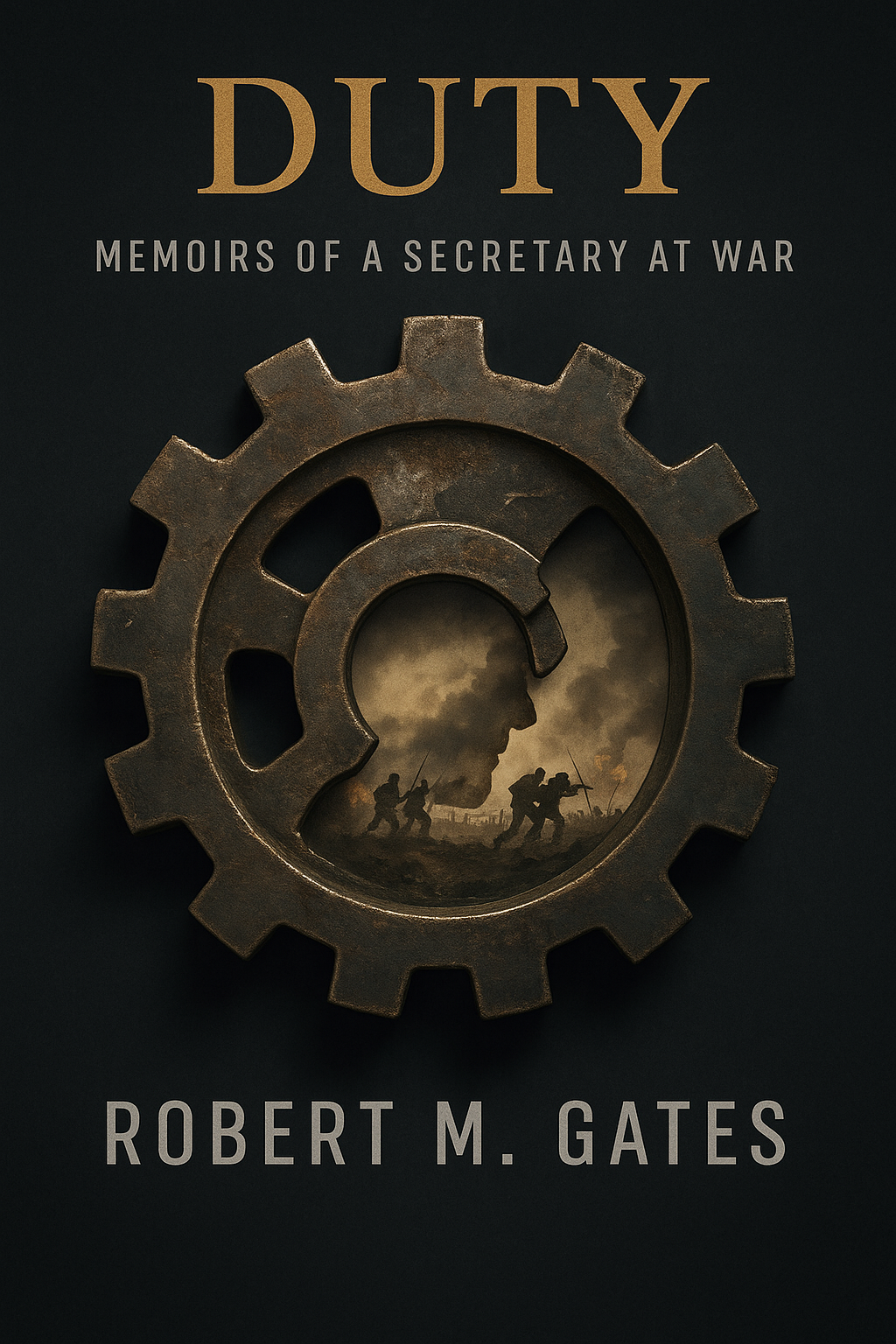
Duty: Memoirs of a Secretary at War
Chapter Summaries
What's Here for You
Step into the high-stakes world of national security and witness a remarkable journey through one of the most turbulent periods in modern American history. Robert M. Gates, a man who traded academic tranquility for the crucible of the Pentagon, invites you to experience the raw, unvarnished reality of leading the Department of Defense during two protracted wars and a world in constant flux. "Duty: Memoirs of a Secretary at War" is more than just a historical account; it's an intimate look at the immense pressures, difficult choices, and profound personal sacrifices demanded by public service at the highest level. Within these pages, you will gain an unparalleled understanding of the complexities of modern warfare, from the intricate political maneuvering in Washington to the brutal realities on the ground in Iraq and Afghanistan. Discover how a leader grappled with bureaucratic inertia, navigated fractured alliances, and confronted adversaries both foreign and domestic. You'll witness firsthand the strategic challenges, the ethical dilemmas, and the sheer exhaustion that defined this era. Gates doesn't shy away from the personal toll, revealing the weight of sending young men and women into harm's way and the internal battles fought to uphold his oath. Prepare for an intellectually stimulating and emotionally resonant experience. The tone is one of measured candor, unwavering resolve, and a deep sense of responsibility. You'll find yourself immersed in the strategic thinking, the political chess matches, and the moments of profound human connection and conflict. This memoir offers a rare window into the mind of a public servant dedicated to duty, providing critical insights into leadership, resilience, and the enduring challenges of protecting a nation in a complicated world. It's an opportunity to learn from a seasoned statesman who served with integrity, even when the path was fraught with 'one damn thing after another.'
Summoned to Duty
The narrative unfolds as Robert M. Gates, then president of Texas A&M University, finds his contented tenure abruptly interrupted by a summons that would irrevocably alter his life's trajectory. What began as a routine week in October 2006, punctuated by meetings and a speech in Des Moines, Iowa, soon pivots when an urgent call from National Security Advisor Steve Hadley lands in his inbox, hinting at a matter of national significance. Gates, a seasoned veteran of White House service, initially defers the call, a decision that belies the impending gravity of the situation. Earlier, he had declined President Bush's offer to become the first Director of National Intelligence, a testament to his desire to remain at Texas A&M, a decision solidified by his wife Becky's supportive, yet unburdening, response to his internal struggle. This prior refusal, however, was merely a prelude. The true summons arrives on a Saturday morning, a direct question from Hadley: would Gates accept the position of Secretary of Defense if asked by the President? His immediate, unhesitating answer, 'It's my duty,' echoes the profound sense of obligation that has guided his career, a stark contrast to his earlier reluctance to re-enter government service. This acceptance, made with a mix of resolve and dawning terror, sets in motion a clandestine process, including a secret meeting at the Bush ranch, where President Bush outlines the dire situation in Iraq and Afghanistan, seeking Gates's candid counsel. Gates, despite feeling an outsider to the President's inner circle, brings his unique perspective, offering sharp insights on troop surges, the neglect of Afghanistan, the strain on military branches, and the need for modernizing Pentagon acquisitions. The subsequent announcement and confirmation process reveal a Washington deeply divided and weary of war, yet eager for change, with both parties looking to Gates, a member of the Iraq Study Group, to steer a new course. His confirmation hearing becomes a crucible, marked by stark admissions, such as his candid 'No, sir' when asked if the U.S. was winning in Iraq, a statement that resonated with a public and a Senate hungry for honesty. This moment, as much as his upbringing instilling values of integrity and duty, shapes his approach to leading the vast Pentagon bureaucracy amidst two consuming wars. Ultimately, Robert M. Gates accepts the call to serve, driven by a profound sense of duty, stepping into a role fraught with immense challenges, a testament to a life dedicated to country, even when it meant leaving behind the personal contentment he had found.
Iraq, Iraq, and Iraq
Robert M. Gates, stepping into the role of Secretary of Defense, found himself confronting a nation embroiled in a war that demanded his full attention, a conflict where the rising tide of violence, dysfunctional politics, and a faltering military strategy in Iraq cast a long shadow over his tenure. He recounts his deep involvement in the planning of the 1991 Gulf War, reflecting on the strategic missteps, such as not forcing Saddam Hussein’s personal surrender, and the unintended consequences of the U.S. administration’s communications, which inadvertently encouraged uprisings that were then brutally suppressed. The chapter delves into the lingering aftermath of that war, the evasion of sanctions by Saddam, and the growing international consensus by 2003 that Iraq had resumed its weapons programs, a belief that ultimately led to the invasion. Gates expresses his stunned reaction to the post-invasion blunders—the looting, the disbanding of the Iraqi army, and the ill-conceived de-Baathification policy—likening the situation to a dog catching a car, now faced with the immense challenge of what to do next. This realization of Iraq’s profound brokenness—economically, socially, culturally, and politically—after decades of oppressive rule, war, and sanctions, became a central dilemma. The narrative then shifts to the formation of the Iraq Study Group, a bipartisan effort co-chaired by James Baker and Lee Hamilton, where Gates, despite initial reluctance, joined a group of distinguished individuals to forge a new strategy. Their journey to Baghdad, a stark contrast of seasoned statesmen in blazers amidst hardened soldiers, provided a visceral understanding of the grim realities on the ground, revealing the complex interplay of sectarian divisions, the need for basic security, and the crucial importance of Iraqi leadership stepping up, even as the U.S. military commanders emphasized the necessity of protecting the population and providing essential services to counterinsurgency. Gates illuminates the critical tension between the Washington clock, driven by media and congressional impatience, and the Baghdad clock, where genuine progress required time and sustained effort, a dynamic that shaped his strategy to buy time for the surge to take hold. He candidly details the internal debates, particularly the military's initial resistance to a troop increase, and his own evolving perspective, culminating in the momentous decision to implement a surge of U.S. forces, a strategy he believed was essential to avert a catastrophic defeat, a decision that mirrored President Bush’s own trust in his judgment over professional military advice. The chapter concludes with Gates navigating the treacherous political landscape of Washington, facing intense congressional scrutiny and criticism, while simultaneously working to sustain the surge and lay the groundwork for a long-term U.S. presence, underscoring the profound difficulty of turning the tide in a deeply fractured nation and the personal toll such decisions exacted, as seen in his agonizing extension of troop deployment tours.
Mending Fences, Finding Allies
Robert M. Gates steps into the crucible of the Pentagon as Secretary of Defense, inheriting a landscape fractured by political and bureaucratic rivalries, a stark contrast to the quiet halls of Texas A&M. His initial months are a whirlwind of ceaseless meetings, a constant battle against the 'death by PowerPoint' culture, and the daunting task of rebuilding trust with Congress, the media, and the military brass, all while two wars rage. Gates understands that implementing strategy in Iraq is impossible without first mending these fractured relationships; he must become an advocate for the troops, a steady hand in Washington's storm. He begins by establishing a clear ethos with his leadership team: transparency, candor, and a unified voice, emphasizing that while disagreements should be sharpened for decision-making, once a decision is made, the department must speak with one voice. A core insight emerges: the immense power of the Secretary of Defense, second only to the President, carries an equally immense responsibility for life-and-death decisions, demanding not just strength but a profound respect for the chain of command and the expertise of advisors. Gates navigates this complex web with a deliberate strategy of respect and engagement, traveling to military headquarters and meeting regularly with the Joint Chiefs in their own space, a symbolic gesture that yields substantive results, reducing leaks and 'end runs' to Capitol Hill. He learns that while appearances can be deceiving, as with the often-posturing members of Congress, understanding their local interests, their 'wallet lists,' is key to building bridges. His approach to the media, hiring a former journalist as a spokesman and engaging directly, fosters a rare 'honeymoon' period, demonstrating that a non-hostile stance, however painful, is ultimately more effective. The most profound emotional arc, however, is forged in the crucible of caring for the wounded. Witnessing firsthand the squalid conditions at Walter Reed Army Medical Center, Gates is moved to decisive, even ruthless, action, demanding accountability and prioritizing the well-being of soldiers over bureaucratic inertia. This visceral experience, alongside the solemn duty of writing condolence letters, transforms him, revealing the true, often unseen, cost of war and solidifying his commitment to those who serve. Ultimately, Gates’ narrative reveals that effective leadership in such a high-stakes environment hinges not just on strategic acumen, but on emotional intelligence, a willingness to listen, to build trust, and to confront systemic failures with unwavering resolve, transforming the perception of the Pentagon from a place of internal battles to a unified force dedicated to its mission and its people.
Waging War on the Pentagon
Robert M. Gates, stepping into the role of Secretary of Defense in January 2007, discovered a Department of Defense that was, staggeringly, operating with a profound lack of urgency, despite the nation being mired in two unwinnable wars. He found a Pentagon where 'business as usual' prevailed, a stark contrast to the grim reality on the ground in Iraq and Afghanistan, where initial flawed assumptions of short wars and quick handoffs to local forces had proven disastrous. Gates recognized that the department's very structure, designed for planning and preparation, was ill-suited for the speed and agility demanded by current combat operations, leading to a ponderous bureaucracy that often swallowed urgent needs in a 'Pentagon black hole.' This realization ignited his central mission: to become the principal advocate for commanders and troops, a fight that would require him to bypass established procedures and run efforts directly from his office, often bypassing the labyrinthine system. A pivotal moment arrived with the discovery of the Mine-Resistant, Ambush-Protected (MRAP) vehicle, a life-saving technology that had languished for years due to a lack of funding and a peacetime mindset within the services, unwilling to divert resources from long-term programs. Gates's intervention, declaring 'Every delay of a single day costs one or more of our kids his limbs or his life,' initiated a crash program, bypassing bureaucracy and securing congressional support to rapidly field these vital vehicles, a testament to his resolve to act decisively. Similarly, he confronted the persistent 'damnable peacetime mindset' in the Pentagon regarding Intelligence, Surveillance, and Reconnaissance (ISR) capabilities, battling turf wars and a lack of urgency, particularly within the Air Force, to ensure troops had the critical battlefield information they desperately needed. His efforts to reform the care of wounded warriors, spurred by the Walter Reed scandal, revealed another deep-seated bureaucratic inertia, where differentiating the needs of combat-injured soldiers from others proved a formidable challenge, a fight for 'platinum treatment' that highlighted the systemic resistance to prioritizing those who had made the ultimate sacrifice. Ultimately, Gates's tenure became a relentless campaign against institutional inertia, a 'war with the Pentagon' itself, aimed at rebalancing priorities from future conventional warfare to the messy realities of current conflicts and ensuring that the military could adapt with speed and innovation, a stark reminder that you 'go to war with the army you have, but you damn well should move as fast as possible to get the army you need.'
Beyond Iraq: A Complicated World
Robert M. Gates, in his memoir 'Duty,' unveils a world far more intricate than the singular focus on wartime often suggests. He explains that even during the intense pressures of two major wars, President Bush navigated a complex global landscape fraught with challenges from Russia, Syria, Iran, China, and beyond, issues that demanded as much, if not more, presidential attention than the conflicts themselves. The author recounts how the post-Cold War unipolar moment, characterized by American dominance, sowed seeds of resentment, particularly in Russia and China, who felt diminished and sought to reassert their own power. This growing animosity, he notes, was amplified by post-9/11 strategies and controversial wartime actions, though relationships with some allies began to mend as leadership changed. Gates vividly describes the stark reality of the White House Situation Room – a far cry from cinematic portrayals, often a cramped space where the "least bad solution" was the best attainable outcome, a testament to the agonizing nature of high-stakes decision-making. He then transports us to the E4B, the National Airborne Operations Center, a flying command post where ceaseless work, long flights across continents, and utilitarian quarters became the backdrop for his global diplomacy, a utilitarian space where, for a time, the menu was dictated by his own rather unhealthy preferences, earning the plane the nickname 'The Big Brisket.' A pivotal moment emerges at the 2007 Munich Security Conference, where Vladimir Putin's fiery anti-American speech aimed to fracture transatlantic ties. Gates, however, chose a path of measured response, using wit to acknowledge the changed world and extend an invitation to dialogue, a strategic pivot that diffused tension and demonstrated his understanding of the deep-seated Russian resentment stemming from the Cold War's end and the Soviet Union's collapse. This experience underscores a core insight: underestimating the psychological impact of perceived humiliation on a global power breeds long-term bitterness, a lesson learned as Gates grappled with Russia's objections to NATO expansion and missile defense deployments, a complex dance where cooperation was offered but U.S. resolve remained firm. The narrative then pivots to the tense standoff over Syria's covert nuclear reactor, a situation where Israeli intelligence provided compelling evidence, yet the U.S. intelligence apparatus had, surprisingly, missed the advanced stage of construction, highlighting a critical failure in detection and raising questions about the reliability of threat assessments. This dilemma forced a difficult choice between immediate military action, advocated by figures like Dick Cheney, and a diplomatic approach, championed by Gates, who argued against preemptive strikes and the risk of igniting wider regional conflicts, a debate that foreshadowed similar arguments concerning Iran. He reveals the immense pressure from Israel, particularly Prime Minister Olmert, to act decisively against Syria, a pressure that tested U.S. resolve and risked entangling America in another conflict, ultimately leading to an Israeli strike that, while successful in destroying the reactor, left Gates frustrated by the lack of broader diplomatic leverage. Turning to Iran, Gates chronicles decades of failed attempts at engagement, recalling his own early experience with Zbigniew Brzezinski in 1979, where a demand for the Shah's return ended any hope of dialogue. He details the complex balancing act of deterring Iran's nuclear ambitions while avoiding a new war, a tightrope walk made more precarious by an intelligence estimate that unexpectedly suggested Iran had halted its nuclear weapons program, a finding that undermined U.S. diplomatic efforts and fueled speculation about the administration's intentions. The chapter culminates in the tense standoffs with Iran in the Persian Gulf and the internal debates over military options, underscoring Gates's consistent advocacy for restraint and his belief in the strength of U.S. diplomacy, even as he acknowledged the very real threat posed by Iran's nuclear aspirations and its regional destabilization efforts. Throughout, Gates emphasizes the importance of understanding adversaries' perspectives, managing relationships based on interests rather than trust, and the profound weight of decisions made in high-pressure environments, whether in the sterile confines of the Situation Room or aboard a flying command post, a journey through a complicated world where strategic patience and clear-eyed assessment were paramount.
Good War, Bad War
Robert M. Gates, in his memoir 'Duty,' illuminates the complex and often frustrating realities of the wars in Afghanistan and Iraq during 2007, a period where the 'bad war,' Iraq, was improving while the 'good war,' Afghanistan, was deteriorating, much to President Bush's chagrin. Gates reveals a critical early insight: the underestimation of the Taliban's resilience and determination, which allowed them to reconstitute in Pakistan while the U.S. was preoccupied with Iraq. He recounts the brutal ambush of Navy SEALs in 2005 as a stark wake-up call, a turning point where the enemy's resurgence became undeniable, further enabled by Pakistan's ineffective border policies. Upon becoming Secretary of Defense, Gates found himself navigating a landscape of strategic confusion and resource strain, realizing the immense challenge of supporting both theaters simultaneously, a tension that would define his tenure. He observes that the international community, particularly NATO allies, often approached Afghanistan with a different mindset, favoring nation-building over the urgent need for counterinsurgency, a divergence that created persistent friction. Gates's first-hand experiences, like visiting remote Forward Operating Bases and meeting with President Karzai, underscored the deep complexities of Afghan politics and the critical need for listening to local leaders, even amidst frustration. He highlights the vital, yet often overlooked, importance of understanding Afghan culture and sensitivities, noting Karzai’s deep awareness of his people and his concerns about foreign actions undermining sovereignty. The narrative then delves into the systemic issues plaguing the war effort: the convoluted military command structure, the fragmented civilian assistance efforts, and the pervasive corruption within the Afghan government itself, all of which hampered progress. Gates reflects on the difficulty of assessing progress, caught between the often-pessimistic intelligence assessments in Washington and the more optimistic views from the field, a recurring dilemma in his career. He describes the emotional toll of these wars, the weight of visiting troops facing immense danger, and the quiet competence of soldiers like Captain Scott Horrigan standing in stark contrast to the political infighting back home. The chapter underscores a central tension: the gap between the sacrifices of those on the ground and the self-serving actions of politicians, a disparity that fueled Gates's growing impatience. As the Bush administration neared its end, Gates advocated for a long-term strategy, emphasizing security first and acknowledging the necessity of a continued U.S. presence, even as the incoming administration would face a deteriorating situation in Afghanistan while Iraq showed signs of stabilization. Ultimately, Gates conveys that success, particularly in complex conflicts like Afghanistan, requires a nuanced understanding of local dynamics, sustained commitment, and a clear, unified strategy, lessons learned through arduous experience and profound personal reflection.
One Damn Thing After Another
Robert M. Gates, in his memoir "Duty," recounts the relentless tide of challenges that defined his tenure as Secretary of Defense, a period marked by two major wars and an unending stream of institutional crises, famously encapsulated by his own description: "One Damn Thing After Another." He details the significant headaches emanating from the Air Force, particularly concerning its stewardship of nuclear weapons. The chapter opens with the startling revelation of a B-52 bomber incident in 2007, where nuclear warheads were mistakenly loaded onto a plane and left unsecured, a "monumental screw-up" that exposed an "erosion of adherence to weapon-handling standards." This event, alongside a later discovery of ICBM nose cones mis-shipped to Taiwan, underscored a deeper malaise: a gradual devaluation of the nuclear mission and a lack of effective oversight within the Air Force, a problem Gates admits he didn't initially address with sufficient force. He vividly describes the political firestorm that ensued, the delicate diplomacy with China, and his decision to launch independent investigations, ultimately leading to the dismissal of both the Secretary of the Air Force, Michael Wynne, and Air Force Chief of Staff, General Mike Moseley, a move that stunned Washington but was, for Gates, a necessary reckoning with systemic failure. The narrative then shifts to other critical, often unexpected, challenges: the politically explosive competition for a new tanker aircraft, a procurement process so fraught with corruption allegations and congressional pressure that Gates punted the decision to his successor; the sensitive and solemn responsibility of handling the remains of fallen servicemen, highlighted by a deeply troubling contract with a pet crematorium for military remains at Dover Air Force Base, a lapse that necessitated immediate, transparent action; the successful, high-stakes operation to shoot down a falling toxic satellite, "Burnt Frost"; and the persistent, complex struggle to close the detention facility at Guantanamo Bay, a challenge mired in legal, political, and ethical quagmires, ultimately left unresolved for the next administration. Gates also touches upon the international issue of cluster munitions, navigating a difficult public relations stance, and the growing menace of piracy, a problem that evoked historical echoes of Thomas Jefferson. Finally, he recounts the arduous confirmation battles for key figures like Lieutenant General Stan McChrystal, a brilliant warrior facing scrutiny over past controversies, and the posthumous recommendation for the Medal of Honor for Sergeant Rafael Peralta, a case that tested the boundaries of heroism and meticulous investigation. Each episode, from the nuclear weapon mishaps to the sensitive personnel decisions and complex international issues, paints a portrait of leadership under immense pressure, where every decision, however mundane or dramatic, carried profound weight and often demanded a difficult balance between operational necessity, political reality, and moral integrity, all while striving to maintain the trust and safety of the nation.
Transition
Robert M. Gates, in his memoir "Duty," recounts the profound personal toll of his tenure as Secretary of Defense, a role he admits he did not enjoy. The weight of "rocks in his rucksack"—foreign wars, congressional battles, departmental strife, and above all, the burden of sending young men and women into harm's way—was immense. He found solace and purpose in his deep affection for the troops, referring to them as his own "sons and daughters," and dedicating significant effort to resolving even the smallest issues they faced, hoping to set an example for others in authority. This deep sense of responsibility, coupled with a conviction that success in the ongoing wars was paramount, led him to consider staying on if asked by a new president, a decision he wrestled with throughout the turbulent presidential transition of 2008. He meticulously planned for this handover, determined to prevent any "dropped baton" during a wartime election, even as he publicly and privately expressed his desire to return home. The narrative unfolds with the tension of this impending change, revealing Gates's strategic efforts to manage speculation about his future, exemplified by his constant consultation of a countdown clock to his departure. The chapter vividly illustrates the complex dance of power and duty, as Gates navigates the political minefield of a presidential election while simultaneously preparing for the continuity of national security. He describes the bizarre episode of a call from Senate Majority Leader Harry Reid, who, with an almost surreal seriousness, probed Gates about his views on abortion and party affiliation, hinting at a potential, albeit improbable, vice-presidential consideration. This moment underscores the often-unseen currents and personal dramas swirling beneath the surface of high-stakes politics. As the election drew closer, Gates's resolve to leave clashed with the pragmatic needs of a nation at war, prompting discussions with figures like Zbigniew Brzezinski and even leading to a moment of candor with an old friend, Rich Armitage, where he admitted, "The best part of the job... is the same as at Texas A&M the kids. They blow me away. They make me cry. They are so awesome. Only they could get me to stay." This human element, the profound connection to the soldiers, becomes the emotional anchor amidst the strategic maneuvers. The chapter culminates in a clandestine meeting with President-elect Obama in a seemingly ordinary firehouse, a scene charged with the unspoken gravity of the moment. Here, Gates presents Obama with a list of carefully crafted questions, a bold move designed to ensure mutual understanding and candor, a testament to his commitment to duty over personal preference. He reveals his core dilemma: how to fulfill his obligation to the nation and its service members while yearning for the respite of home. The resolution begins to form as Gates, recognizing the unprecedented nature of his potential continued service, agrees to stay on, driven by a sense of responsibility that transcends political allegiance. This decision, made with a clear understanding of the challenges ahead, sets the stage for a unique period of dual service, where a single individual navigates the transition between two presidencies, embodying the enduring principle that duty, in its most profound sense, often asks us to set aside personal desires for the greater good.
New Team, New Agenda, Old Secretary
As Robert M. Gates stepped into his third year as Secretary of Defense, he found himself an outsider once more, navigating the nascent Obama administration with its own intricate web of relationships and a generational divide that cast him as 'Yoda' among the younger, ideologically driven White House staff. This chapter unfolds like a complex geopolitical chess match, revealing Gates's immediate challenge: integrating into a new team while upholding his established agenda. He recounts his initial, sometimes awkward, interactions with key figures like Vice President Biden, whom he found personally likable but often strategically misguided, and Secretary of State Hillary Clinton, with whom he unexpectedly forged a strong, independent working relationship, identifying them as an 'unfired' power center. A significant tension arose with the unconventional appointment of Jim Steinberg as Deputy Secretary of State, granting State two voices at the Principals Committee, a bureaucratic complication Gates deftly navigated. The narrative then dives into the internal struggles of the National Security Council, particularly the isolation of National Security Adviser Jim Jones, caught between the president and ambitious staffers like Mark Lippert and Denis McDonough, a situation Gates helped de-escalate, preventing a potential resignation. He also details the fraught relationship between CIA Director Leon Panetta and DNI Dennis Blair, a clash over authority that underscored the intelligence community's inherent bureaucratic friction. Gates then pivots to his own proactive agenda, focusing on critical defense reforms: ensuring troops and families were cared for, rebalancing military capabilities for future conflicts beyond the immediate wars, streamlining the defense acquisition process plagued by over-budget programs, and enhancing efforts in Afghanistan. This involved a 'war on the Pentagon' itself, pushing for crucial improvements like faster medevac in Afghanistan and a more suitable MRAP vehicle, and navigating congressional resistance, as exemplified by the battle over the F-22 fighter jet and the controversial cancellation of the VH-71 presidential helicopter. He candidly admits to being 'naive' about how quickly political realities could derail well-intentioned reforms, particularly concerning the defense budget, leading to a significant, albeit temporary, setback. Gates emphasizes the importance of a deliberate, 'strategy-driven' approach to budget cuts, a principle he championed in his dealings with President Obama, whom he found to be a pragmatic, 'deliberative' leader who, while lacking overt passion for the wars, deeply cared for the troops. The chapter culminates with Gates reflecting on the profound emotional toll of his duties, particularly after witnessing the dignified transfer of fallen service members at Dover Air Force Base, a moment that solidified his resolve to honor their sacrifice, and his successful, albeit hard-fought, efforts to reform defense spending and priorities, demonstrating that even in a new administration, an 'old secretary' could still drive significant change.
Afghanistan: A House Divided
Robert M. Gates, in his memoir "Duty," recounts the complex, often fraught, journey through the quagmire of Afghanistan, revealing a profound lack of understanding that plagued American strategy for decades. From his early days as Deputy Director of the CIA in 1986, observing a staged mujahideen training camp and realizing Pakistan's ISI dictated weapons distribution to fundamentalist groups, Gates recognized a critical disconnect between American intentions and Afghan realities. This foundational insight, the deep chasm between perception and reality, echoes throughout his narrative. Twenty years later, as Secretary of Defense, he grappled with the persistent American tendency to replace regimes without a clear vision for what should follow, a lesson learned from both Afghanistan and Iraq, leading to the conviction that imposing a Western-style democracy was a fantasy. The central tension, then, becomes the struggle to define realistic goals in a profoundly alien cultural and political landscape. Gates articulates a core dilemma: how to degrade extremist capabilities and build local security forces without repeating the Soviet mistake of becoming occupiers, a fear that haunted him, visualizing the specter of 120,000 Soviet troops and 15,000 dead soldiers. He details the internal White House debates under President Obama, where political calculations and suspicion of the military often overshadowed strategic necessity, a stark contrast to the battlefield realities faced by commanders like Stanley McChrystal. This friction is palpable as Gates navigates the pressure for troop increases against the White House's political anxieties, exemplified by the internal clashes over troop numbers and the timing of decisions, a delicate dance between military needs and political viability. A crucial insight emerges: the military's operational imperatives often clashed with the civilian leadership's political constraints, creating a dangerous disconnect. Gates underscores the critical importance of civilian capacity building, lamenting the persistent shortages and the State Department's inability to provide adequate personnel, a recurring failure that crippled progress. He highlights the profound impact of civilian casualties and disrespect for Afghan culture as strategic defeats, a lesson painfully relearned, contrasting the brutal Soviet approach with American efforts, yet acknowledging our own missteps. The narrative culminates in the agonizing decision-making process for a troop surge, a testament to Gates's struggle to reconcile his historical caution with the commanders' urgent requests, ultimately leading to a surge of 30,000 troops, a decision fraught with political peril but driven by a perceived necessity to prevent Afghanistan from becoming a safe haven for terrorists, a stark reminder that understanding the 'why' behind the war was paramount, even when the 'how' remained a complex, evolving challenge.
Difficult Foes, Difficult Friends
In the intricate dance of international relations, Robert M. Gates, in his memoir 'Duty,' illuminates the complex landscape of 2009 and 2010, where Afghanistan, though a consuming issue for national security professionals, often took a backseat to more pressing global challenges like Iran, China, and Russia, all while domestic crises loomed. The author explains how Iran, a 'national security black hole,' cast a long shadow, impacting relationships with Europe, Russia, China, Israel, and Arab Gulf states, creating a delicate web where any touch reverberated with high stakes, particularly with Israel on the brink of military action against Iran's nuclear program. Gates reveals his deep-seated skepticism of Benjamin Netanyahu, whom he met years prior and found arrogant, a sentiment that contrasted sharply with his strong, evolving relationship with Israeli Defense Minister Ehud Barak, a crucial channel for defense cooperation even as political ties between the administrations grew frosty. The chapter details the frustrating failure of diplomatic engagement, specifically the October 2009 proposal for Iran to ship uranium to Russia for enrichment and return, a deal Iran abruptly abandoned, underscoring a core dilemma: how to compel a nation to abandon nuclear aspirations when diplomatic avenues seemed to close. This failure pivoted the U.S. strategy from engagement to pressure, leading to the pursuit of UN sanctions, a process Gates navigated with a keen sense of urgency, aware that 'the clock was ticking on both the progress of the Iranian nuclear program and Jerusalem’s patience.' The narrative unfolds through Gates's extensive travels, from candid discussions with Netanyahu about military options to strategic meetings with leaders in Turkey, France, Saudi Arabia, and the UAE, each encounter revealing the nuanced — and often conflicting — interests at play, particularly concerning arms sales and regional security. A vivid scene emerges from a dinner with King Abdullah of Saudi Arabia, where a television playing in the background served as a deliberate 'wily old guy's' tactic for private conversation, highlighting the subtle maneuvers of diplomacy. The chapter also delves into the complex missile defense negotiations, particularly the shift from the Bush-era plan for European interceptors to the Obama administration's 'Phased Adaptive Approach,' a decision fraught with political sensitivities, especially concerning Russia, and complicated by leaks that exacerbated tensions. Gates candidly recounts his exasperation with President Obama's cautious approach and the politicization of crucial decisions, such as the Saudi arms deal and the handling of a Russian spy case, illustrating the constant tension between strategic necessity and political expediency. He notes how even seemingly minor diplomatic gestures, like the 'reset' button with Russia, could backfire, demonstrating a keen awareness of the pitfalls of foreign policy gimmicks. The narrative culminates in a reflection on the overwhelming nature of managing multiple global crises, the exhaustion that can cloud judgment, and the enduring challenge of balancing difficult relationships with both allies and adversaries, both abroad and within Washington's own corridors of power, ultimately emphasizing the critical need for clear-eyed strategy and resilient relationships in a turbulent world.
Meanwhile, Back in Washington
Robert M. Gates, in his memoir 'Duty,' navigates the intricate and often frustrating political landscape of Washington D.C. during his tenure as Secretary of Defense, particularly through the tumultuous year of 2010. The chapter opens with Gates' visceral dislike for the performative nature of political theater, like the State of the Union address, where he felt compelled to engage in 'political deep knee bends.' A pivotal moment arises when President Obama, without adequate consultation, announces the repeal of 'Don't Ask, Don't Tell' (DADT) during the State of the Union, blindsiding Gates and Admiral Mullen. This act, while aligning with Gates' personal belief that DADT should be repealed, highlights a core tension: the need for thoughtful, deliberate policy implementation versus the president's desire for swift action, a dilemma Gates sought to resolve by advocating for legislative change and thorough preparation for the troops. He reveals that the military leadership, though often opposed to open service, continued to have reservations about the timing and implementation, underscoring the complexity of cultural change within the armed forces. Gates and Mullen, anticipating the president's determination, had already initiated preparatory work, including a comprehensive Joint Staff briefing that identified both risks and mitigating factors for policy reversal. This foresight proved crucial when, days later, they testified before the Senate Armed Services Committee, where Mullen made history with his personal endorsement of open service, a statement that visibly stunned the room. Gates emphasizes that the challenge was not *whether* to change, but *how* to prepare the force, setting up a high-level working group to develop an implementation plan, a process he stressed needed nearly a year to execute properly, given the ongoing wars. He recounts the political maneuvering and partisan divides that characterized the DADT debate, noting the predictable reactions from advocates and opponents alike. A significant insight emerges as Gates details the painstaking process of the Pentagon's DADT review, involving extensive surveys of service members and spouses, demonstrating a commitment to understanding ground truth and ensuring that policy changes were informed by those most affected—a stark contrast to top-down directives. Yet, the narrative tension escalates when courts begin to intervene, with a federal judge ruling DADT unconstitutional, forcing the administration into a difficult dance between respecting judicial rulings and managing the practical implications for the military, leading to a profound disagreement between Gates and President Obama over suspending separations. Gates’ steadfast insistence on enforcing the law until changed, even when facing presidential pressure, underscores his commitment to institutional integrity and reasoned process. The chapter then pivots to address the critical challenges of equipping troops in combat, particularly the escalating threat of Improvised Explosive Devices (IEDs) in Afghanistan. Gates describes the heart-wrenching reality of severe casualties, the bureaucratic inertia slowing the deployment of vital counter-IED technologies, and his frustration with a Pentagon that struggled to adapt to a rapidly evolving battlefield. This leads to another core insight: the necessity of creating agile, responsive acquisition processes, exemplified by the formation of the CounterIED Task Force, to bypass bureaucratic logjams and deliver urgently needed materiel. He recounts his urgent appeals to organizations like JIEDDO, demanding a renewed sense of urgency and resources, and his vision for a decentralized system of counter-IED equipment warehousing to meet diverse mission needs. The narrative reveals Gates' ongoing struggle to reform the Pentagon's acquisition system, advocating for institutionalizing 'express lanes' for urgent needs and ensuring funding mechanisms that bypass service-level budget constraints, a challenge he recognized would persist beyond his tenure. The chapter also delves into the nascent and complex domain of cybersecurity, highlighting governmental paralysis and deep divisions over responsibility and approach. Gates recounts the establishment of Cyber Command, driven by the need to organize defense operations and protect military networks, and his innovative, albeit politically risky, collaboration with Secretary Janet Napolitano to leverage the NSA's capabilities for domestic cyber defense, a testament to pragmatic problem-solving under pressure. He further details efforts to bring execution orders (EXORDs) into alignment with presidential notification practices, ensuring greater transparency in the use of military force, and addresses a near-disastrous loss of communication with nuclear-tipped missiles, which prompted new, stringent notification protocols, reinforcing the imperative of accountability at the highest levels. The budget battles of 2010 form another significant thread, with Gates clashing with Congress over its dysfunctional appropriations process and with the White House over proposed cuts to the defense budget. He frames this as a fight for a versatile military capable of meeting diverse future threats, advocating for reinvestment of savings from overhead reductions into critical capabilities, a stark contrast to the political expediency that often dictated congressional actions and White House budget guidance. Gates’ narrative reveals a profound tension between the need for sustained defense investment and the pressures of deficit reduction, culminating in a hard-won, albeit compromised, budget agreement. His 'efficiencies initiative' emerges as a crucial strategy to combat bureaucratic bloat and reallocate resources, an effort he championed with an Eisenhower-esque call for tough choices and disciplined execution. The chapter concludes with Gates reflecting on the profound personal rewards of connecting with troops, from distributing frozen candy bars to exhausted Rangers to witnessing the graduation of new Marines and aspiring SEALs, finding solace and renewed purpose in their resilience and dedication amidst the relentless demands of his office. He shares his heartfelt message to aspiring officers, urging them to embrace innovation, challenge orthodoxy, and lead with courage and integrity, a final testament to his unwavering commitment to the men and women he served and to the future of the nation's defense.
War, War … and Revolution
Robert M. Gates, in this chronicle of his tenure as Secretary of War, navigates the treacherous currents of late 2009 and early 2010, a period marked by the complex realities of the surges in Afghanistan and the winding down of operations in Iraq, all while a seismic shift, the Arab Revolution, began to ripple across the Middle East. As the United States grappled with its strategic commitments, Gates recounts the intense political fallout from President Obama’s decision to surge troops into Afghanistan, facing criticism from both Republicans and Democrats, and enduring the sharp barbs of congressional committees, a stark contrast to the ground truth he sought in conversations with soldiers. He captures a pivotal moment on a plane to Afghanistan where, for the first and only time, he declared, 'We're in it to win it,' a departure from his usual measured language, driven by a deep need to convey purpose to the troops. His diplomatic efforts in Afghanistan, particularly with President Karzai, reveal the delicate dance of ego and strategy, often undermined by public pronouncements that blindsided even the Secretary. Similarly, in Iraq, amidst the intricate planning for troop withdrawal and the transition to advisory roles, Gates experienced the frustration of canceled meetings and the pervasive political maneuvering, highlighting the deep-seated challenges of forging stability. The chapter powerfully illustrates the chasm between the White House and the Pentagon, a persistent tension over strategy, communication, and trust, particularly evident in the Afghanistan debate where suspicion seemed to fuel every interaction. The dramatic dismissal of General McChrystal, triggered by a damaging Rolling Stone article, serves as a potent example of this friction, revealing the President's need to assert command and the tragic consequences of missteps in the political minefield. Simultaneously, the Arab Spring, ignited by a Tunisian street vendor's desperate act for dignity, unfolded with breathtaking speed, catching the administration off guard and sparking intense internal debate over how to respond, a debate often fractured by the allure of rhetoric versus the sober assessment of historical precedent. Gates powerfully conveys the administration’s struggle to reconcile democratic aspirations with regional realities, noting the cautionary tale of revolutions often yielding to more organized, ruthless elements, a pattern he observed from Tunisia to Egypt and the burgeoning conflict in Libya. His firsthand accounts of diplomatic engagements, from tense meetings with Karzai and Maliki to candid exchanges with soldiers on the front lines, underscore a recurring theme: the immense human cost of war, the complexities of international alliances, and the enduring struggle to translate policy into effective action on the ground, all while navigating a world in flux. The chapter culminates in the early stages of the Arab Revolutions, revealing a stark tension between the administration's espoused values and the pragmatic, often messy, realities of foreign policy, a dilemma Gates faced with a weary but resolute commitment to serving the troops and the nation.
At War to the Last Day
Robert M. Gates, in the final months of his tenure as Secretary of Defense, found himself navigating a relentless series of crises, a stark contrast to any notion of a quiet departure. The chapter opens with Gates flying back from Christmas vacation, immediately confronted by the daunting prospect of Arab revolutions and military operations against Libya, but this was merely the prelude to a grueling sprint. He details the complex diplomatic dance with China, emphasizing the critical need for a stable military-to-military relationship to mitigate miscalculation, even as the People's Liberation Army provocatively unveiled its new J-20 stealth fighter just before a meeting with President Hu Jintao—a move Gates cleverly turned into an opportunity to embarrass the PLA by questioning President Hu directly about it. His interactions with Russian leaders, particularly President Medvedev, reveal deep-seated concerns over NATO missile defense and lingering distrust following the intervention in Libya, illustrating how historical grievances can poison present-day cooperation. In Israel, Gates sought to reassure allies amidst regional upheaval, urging bold steps towards peace while acknowledging the escalating security threats from Iran and Gaza. His meetings with Prime Minister Netanyahu and Palestinian Authority Prime Minister Salam Fayyad underscored the region's volatility and the stalled peace process. A significant tension arose from Saudi Arabia's King Abdullah expressing profound disappointment over the U.S. perceived abandonment of Mubarak, highlighting the delicate balance between promoting reform and maintaining long-standing alliances. The narrative then shifts to the immense responsibility of military succession, detailing Gates's strategic recommendations for the Joint Chiefs of Staff, culminating in the nomination of Marty Dempsey, and his own successor, Leon Panetta, revealing the intricate process of leadership transition amidst geopolitical uncertainty. The chapter culminates with the dramatic account of the hunt for Osama bin Laden, a mission fraught with risk and requiring immense courage from President Obama, whom Gates ultimately supported after initial skepticism, recognizing the strategic implications of failure. Gates underscores that this success, achieved through painstaking intelligence analysis and a daring raid, was built on decades of prior investment and lessons learned from past failures, like the Iran hostage rescue attempt. Finally, he confronts the immense challenge of defense budget cuts, decrying the 'math, not strategy' approach that threatened to hollow out the military and endanger national security, a stark reminder that the final days of service were defined by critical, high-stakes decisions on multiple fronts, from diplomacy and war to leadership and fiscal responsibility, all while grappling with the human cost of protracted conflicts in Iraq and Afghanistan, where the fate of troop drawdowns and the very definition of success hung precariously in the balance.
Reflections
Robert M. Gates, reflecting on his four and a half years as Secretary of Defense, navigates the turbulent waters of two wars and the labyrinthine complexities of Washington. Despite experiencing consistent trust and generosity from Presidents Bush and Obama, and a general respect from Congress and the press, Gates found himself in a state of perpetual conflict, driven by the sheer difficulty of achieving meaningful progress amidst bureaucratic inertia, partisan divides, and the White House's centralizing tendencies. He recounts being tasked with salvaging the wars in Iraq and Afghanistan, conflicts already long and deeply entrenched, noting that winning had become a rare commodity in modern warfare. His goals, while modest—stabilizing Iraq to avoid strategic defeat and building an Afghan government capable of preventing the Taliban's return—seemed almost unattainable. Gates candidly addresses the Iraq invasion, acknowledging the monumental costs and the flawed premise of WMDs, while recognizing that hindsight offers only speculation on what might have been. He highlights the diversion of resources from Afghanistan due to the Iraq war and the historically naive ambition of U.S. goals there, contrasting them with meager commitments. The narrative then delves into the Obama administration's complex approach to Afghanistan, where political preferences clashed with military advice and on-the-ground realities, leading to a debated troop surge and ultimately a narrowing of objectives. Gates emphasizes the critical, often tense, civilian-military relationship, noting how both presidents, though different in their approach to military advice, grappled with generals speaking out publicly, a trend he believes has become increasingly problematic. He details the immense challenge of running the Department of Defense, the world's largest organization, stressing the need for a focused agenda, meticulous oversight, and the indispensable role of civilian staff. His relationship with Congress was a paradox: abstract respect for its constitutional role versus daily, up-close frustration with its parochial self-interest, hypocrisy, and failure to pass timely appropriations, creating an environment he likens to a "kangaroo court." Gates describes how this paralysis, fueled by partisan redistricting and a decline in bipartisan bridge-building, hinders national security. He contrasts the leadership styles of Bush and Obama, noting Obama's more centralized White House control over national security and their shared, though differently expressed, resentment of Congress. The author underscores the profound, often tragic, unpredictability of war, the inherent ignorance with which nations often begin military engagements, and the slow, peacetime-oriented machinery of the Pentagon failing to adapt. He advocates for humility in predicting future conflicts and warns against the seductive allure of technology that can mask war's grim realities, quoting Sherman that "every attempt to make war easy and safe will result in humiliation and disaster." Ultimately, Gates's reflections are deeply personal, shaped by an overwhelming sense of duty and an profound emotional bond with the troops, whose sacrifice became his driving force and the reason he stayed the course, even as the emotional toll threatened his objectivity, leading him to recognize it was time to step down, leaving behind a legacy of profound admiration for those who served.
Conclusion
Robert M. Gates' "Duty: Memoirs of a Secretary at War" offers a profound and often sobering reflection on the immense weight of public service, particularly during times of conflict. The core takeaway is that true leadership transcends personal contentment and prior reluctance, demanding an unwavering commitment to duty, even when the path is fraught with immense personal cost. Gates consistently emphasizes the critical importance of candid self-assessment and honest communication, underscoring that admitting when "we are not winning" is not a sign of weakness, but a prerequisite for effective strategy and trust-building. His narrative vividly illustrates that leading complex organizations, especially those engaged in wartime, hinges on a deep understanding of the human element, prioritizing the welfare and lives of service members above all else. This requires a willingness to listen to diverse perspectives, foster an environment of candor, and navigate intense political pressure with integrity, all while recognizing that a leader's foundational values are their compass. The emotional lessons are equally potent. Gates grapples with the agonizing burden of decisions that directly impact lives, highlighting the immense personal toll of wartime leadership. This is not a detached, clinical account; it is infused with empathy born from encounters with sacrifice. The memoir underscores the need to acknowledge and integrate this emotional and psychological impact into decision-making, recognizing that personal connection to the human cost can be a catalyst for deeper understanding and resolve. The practical wisdom gleaned from "Duty" is extensive. It lies in the ability to bridge the gap between strategic goals and flawed execution, to adapt to past mistakes, and to navigate the conflicting tempos of battlefield realities and political impatience. Gates champions proactive relationship mending, coalition building, and direct, honest engagement with stakeholders, including the media. He powerfully argues for dismantling bureaucratic inertia and peacetime mindsets that impede wartime effectiveness, advocating for decisive action to prioritize operational needs and champion critical but overlooked needs, even against significant internal opposition. Ultimately, "Duty" serves as a vital testament to the complex interplay of strategy, humanity, and unwavering responsibility required to lead in the face of profound national challenges.
Key Takeaways
The profound weight of duty can compel individuals to embrace demanding public service, even when personal contentment and prior reluctance suggest otherwise.
Candid self-assessment and honest communication, particularly admitting when 'we are not winning,' are crucial for navigating complex national security challenges and building trust.
Leading large, complex organizations, especially during wartime, requires a deep understanding of the human element, prioritizing the welfare of those in uniform above all else.
Effective leadership necessitates a willingness to listen, value diverse perspectives, and foster an environment of candor, even when facing intense political pressure and partisan division.
The transition into significant leadership roles often involves navigating clandestine processes and clandestine meetings, highlighting the sensitive nature of high-stakes national security decisions.
A leader's background and core values, forged through upbringing and past experiences, provide the essential framework for making difficult decisions and maintaining integrity under pressure.
The profound gap between strategic goals and post-invasion execution requires constant adaptation and learning from past mistakes, as evidenced by the initial blunders in Iraq.
Effective leadership in complex geopolitical crises necessitates navigating the conflicting tempos of battlefield realities and political impatience, demanding a strategy to 'buy time' for progress.
True strategic success in foreign interventions requires not just military might but also a deep understanding of a nation's intricate social, economic, and political fabric, acknowledging its pre-existing brokenness.
The 'surge' strategy, though controversial, represented a critical decision point to avert catastrophic failure, highlighting the leader's burden to trust their judgment amidst professional dissent.
Sustaining long-term commitment in challenging environments requires careful management of domestic political pressures and a clear communication strategy that bridges the gap between the battlefield and the public.
The personal cost of leadership in wartime is immense, involving agonizing decisions that directly impact the lives of service members and their families, demanding empathy alongside strategic resolve.
Effective leadership in complex organizations requires proactively mending fractured relationships and building broad coalitions of allies, rather than solely focusing on strategic initiatives.
The immense power vested in a leadership role necessitates a corresponding commitment to profound responsibility, demanding rigorous decision-making informed by candor and expertise, and a deep respect for those impacted.
Symbolic gestures of respect and engagement, such as meeting military leaders in their own spaces and traveling to their headquarters, can yield significant substantive benefits in fostering trust and reducing internal conflict.
Navigating political landscapes requires understanding and acknowledging the diverse interests and motivations of stakeholders, even when those interests appear parochial, to build bridges and foster cooperation.
Direct, honest, and non-antagonistic engagement with the media, rather than adversarial posturing, can lead to a more productive and less contentious relationship, fostering transparency and mutual understanding.
Addressing systemic failures impacting personnel, particularly those on the front lines or recovering from injury, demands decisive and sometimes ruthless action, prioritizing human well-being over bureaucratic comfort or political expediency.
The emotional and psychological toll of leadership, especially during wartime, must be acknowledged and integrated into decision-making, as personal encounters with sacrifice can be profound catalysts for change and deeper empathy.
Bureaucratic inertia and a peacetime mindset within defense organizations can critically impede wartime effectiveness, necessitating direct, top-down intervention to prioritize immediate operational needs over long-term planning.
The failure to adapt procurement and resource allocation to the realities of current conflicts, exemplified by the MRAP vehicle's delayed fielding, demonstrates how institutional resistance to change can directly endanger lives.
Effective leadership in complex organizations requires a willingness to challenge established norms and champion critical but overlooked needs, even when facing significant internal opposition from various stakeholders.
The 'business as usual' approach in defense procurement and operations, driven by organizational silos and a focus on future threats, must be actively dismantled to ensure timely support for troops in ongoing conflicts.
Reforming systems for wounded warrior care demands a fundamental shift in bureaucratic priorities, advocating for 'platinum treatment' and differentiating their unique needs from general healthcare populations.
Balancing preparation for future high-end conflicts with the urgent demands of current asymmetric warfare requires a deliberate and cultural shift in defense planning, budgeting, and training.
Recognize that global challenges rarely exist in isolation; wartime leadership requires managing a complex web of interconnected international issues.
Understand that perceived national humiliation and diminished status can fuel long-term resentment and geopolitical friction, necessitating empathetic engagement.
Prioritize strategic patience and diplomatic solutions over preemptive military action, especially when facing complex threats and limited intelligence.
Effective leadership involves navigating conflicting advice and personal relationships, making decisions based on national interests and hard realities, not just trust.
The perception of U.S. actions, particularly regarding military intervention and perceived arrogance, significantly shapes international relations and breeds resentment.
Intelligence assessments, even when flawed, can profoundly impact diplomatic strategy and international perceptions, requiring careful management and communication.
Underestimating an adversary's resilience, as seen with the Taliban's resurgence, can lead to prolonged conflict and strategic missteps.
Effective counterinsurgency requires a clear understanding of local culture, politics, and the critical need to align with local leadership, rather than imposing external solutions.
Complex, fragmented command structures and uncoordinated civilian efforts significantly undermine military effectiveness and hinder strategic progress.
Accurately assessing the progress of a war is exceptionally difficult due to conflicting intelligence and differing perspectives between field commanders and Washington analysts, demanding careful adjudication.
Sustained success in complex conflicts hinges on a long-term commitment, prioritizing security as the foundation for all other progress, even when facing domestic political pressures.
The emotional and psychological toll of war on leaders is profound, demanding resilience and a steady focus on the sacrifices of those in uniform amidst political complexities.
International alliances, while valuable, can be hampered by differing strategic objectives and public tolerance for casualties, requiring persistent diplomacy and clear communication of shared interests.
Systemic failures in critical areas, like nuclear weapons stewardship, often stem from a gradual erosion of standards and a lack of focused leadership, necessitating decisive and often painful interventions.
Complex procurements are highly susceptible to political pressure and corruption, requiring rigorous oversight and a willingness to pause or restart processes to ensure fairness and integrity, even at the cost of deferring decisions.
The handling of sensitive responsibilities, such as the dignified care of fallen service members' remains, demands absolute adherence to policy and transparency, as lapses can cause profound public outcry and erode trust.
Strategic decision-making in national security often involves managing a cascade of interconnected crises, requiring the ability to prioritize, delegate, and act decisively under pressure, even when faced with incomplete information or political opposition.
The pursuit of justice and accountability must be balanced with a thorough and impartial investigation process, especially when dealing with high honors or disciplinary actions, ensuring that decisions are based on verifiable facts.
Effective leadership involves not only making difficult decisions but also communicating them transparently and facing those affected, demonstrating respect and fostering understanding even amidst controversy.
The challenges of closing detention facilities like Guantanamo Bay are deeply entrenched in legal, political, and security dilemmas, often proving intractable and requiring sustained, bipartisan effort that transcends political cycles.
The profound emotional and psychological toll of leadership in wartime requires a deep personal connection to those serving, often manifesting as a paternal or maternal sense of responsibility.
Navigating significant political transitions, especially during wartime, demands meticulous planning and a proactive approach to ensure continuity of national security operations.
Publicly stated intentions, even those rooted in personal desire, can be overridden by a sense of duty when the stakes are sufficiently high and the need is perceived.
Effective leadership during transitions involves candid communication and the establishment of clear expectations, even if it requires unconventional methods like presenting a list of questions to a president-elect.
The burden of command, particularly the responsibility for sending individuals into combat and writing condolence letters, is a heavy one that can shape decisions about continuing service.
Maintaining personal integrity and candor is crucial, even when serving under different administrations, by offering honest advice and remaining loyal to the ultimate mission.
The personal cost of high-stakes leadership, such as the physical injury sustained by Gates, highlights the physical and emotional demands placed upon individuals in critical roles.
Navigating a new administration requires understanding its unique political dynamics and power structures, even when feeling like an outsider.
Genuine collaboration and mutual respect can forge unexpected alliances, even between individuals with differing backgrounds and initial perceptions.
Effective leadership involves proactively addressing bureaucratic inertia and systemic inefficiencies, often requiring a willingness to engage in 'war on the Pentagon' or Congress.
Budgetary decisions must be strategy-driven rather than solely accountant-driven to ensure national security priorities are met effectively.
The emotional toll of leadership, particularly in times of conflict, can be profound, necessitating personal resilience and a commitment to honoring sacrifice.
Balancing the need for decisive action with thorough deliberation is crucial for effective decision-making, especially in complex national security matters.
The practice of 'stop-loss' represents a breach of faith with service members and should be eliminated as soon as conditions permit.
American strategic objectives in complex foreign environments must be grounded in a deep, nuanced understanding of local culture, tribal politics, and power brokers, rather than relying on idealized Western models.
Effective military strategy requires a clear-eyed assessment of achievable goals, balancing the need to degrade threats with the imperative to avoid alienating the local population and becoming perceived as occupiers.
The tension between military operational necessity and political calculation is a persistent challenge, demanding careful navigation to ensure strategic decisions are not dictated solely by domestic political considerations.
Sustained success in counterinsurgency and counterterrorism operations hinges on robust civilian capacity building and interagency coordination, areas that often suffer from underresourcing and bureaucratic inertia.
Civilian casualties and a lack of cultural respect are not mere tactical setbacks but strategic defeats that erode local support and fuel the insurgency, demanding constant vigilance and adaptation.
The perception of American will and staying power is crucial, influencing regional stability and the global fight against extremism, necessitating clear communication of achievable goals and a commitment to seeing them through.
Effective leadership in wartime requires the courage to make difficult decisions, even when politically unpopular, balancing the advice of military commanders with the broader national interest and potential consequences.
The interconnectedness of global issues requires a holistic strategic approach, as actions in one domain, like Iran's nuclear program, inevitably create ripple effects across multiple international relationships and potential conflicts.
Effective diplomatic engagement can paradoxically pave the way for more robust pressure tactics by revealing a counterpart's intransigence and solidifying international resolve.
Maintaining strong defense and security relationships with allies, even amidst political disagreements, is crucial for managing shared threats and ensuring regional stability.
Strategic decisions, particularly those involving military action or arms sales, must carefully balance national interests with the qualitative military edge of allies and the broader geopolitical consequences.
The management of international crises demands constant vigilance and preparedness for immediate military response, necessitating proactive planning for contingencies that may arise with little to no warning.
Technological advancements and evolving threat assessments necessitate adaptive strategies in defense planning, requiring a willingness to pivot from established policies to more agile and effective solutions.
Navigating complex international relations involves managing both overt adversaries and difficult allies, demanding skillful diplomacy, clear communication, and a pragmatic understanding of each party's motivations and constraints.
Effective policy implementation requires deliberate preparation and engagement with affected stakeholders, rather than purely directive action, to ensure buy-in and minimize disruption.
Navigating complex organizational change, particularly within large institutions like the military, necessitates a balance between top-down imperatives and bottom-up understanding, often requiring novel approaches to bypass bureaucratic inertia.
Technological and strategic adaptations in warfare demand agile acquisition processes that can rapidly deliver critical capabilities to the front lines, necessitating a willingness to challenge established procedures and secure necessary resources.
Addressing complex national security challenges, such as cybersecurity, requires overcoming interagency and inter-branch paralysis through pragmatic, often politically risky, collaborations and clear lines of operational responsibility.
Maintaining a robust defense requires disciplined fiscal management and strategic reinvestment of savings into critical capabilities, necessitating a willingness to confront entrenched interests and advocate for long-term security over short-term political expediency.
True leadership involves fostering a culture of accountability and continuous improvement, demanding tough choices, unwavering integrity, and a deep personal commitment to the welfare and success of those under one's command, even when facing immense pressure.
The inherent tension between political rhetoric and the practical realities of military operations requires clear communication and trust between civilian leadership and military commanders to avoid strategic missteps.
Revolutions, while often sparked by a desire for dignity and freedom, carry the inherent risk of empowering more organized and ruthless factions, a historical pattern that demands cautious and nuanced foreign policy.
Effective leadership in times of war and political upheaval necessitates navigating deep-seated institutional distrust and differing strategic visions, demanding a pragmatic approach that balances ideals with operational necessities.
The perception of American commitment and strength on the global stage is profoundly impacted by the outcomes of protracted conflicts and the perceived ability to manage complex international crises.
Diplomatic engagement, even with challenging allies, is crucial for maintaining strategic positioning and supply lines, though it requires a clear-eyed understanding of their limitations as true partners.
The desire for dignity and the frustration with corruption can be powerful catalysts for revolution, but the transition to stable governance is fraught with uncertainty and historical precedent often points to difficult outcomes.
Effective leadership in times of crisis requires a disciplined approach to managing complex international relationships, balancing the pursuit of strategic goals with the imperative to avoid miscalculation and maintain open lines of communication, as demonstrated in Gates's interactions with China.
The perception of U.S. actions by long-standing allies, particularly in the context of regional instability and political change, can profoundly impact strategic partnerships, necessitating careful diplomacy to reassure friends and manage differing interests, as seen in Saudi Arabia's concerns.
Crucial military and diplomatic decisions, such as personnel succession and major operational planning, are often made under immense time pressure and with incomplete information, demanding a leader's ability to weigh risks, trust their judgment, and make difficult choices for the greater good, exemplified by the Bin Laden raid and leadership transitions.
Budgetary decisions, especially significant defense cuts, must be grounded in strategic policy and a clear understanding of their consequences, rather than purely mathematical considerations, to avoid undermining national security and military readiness, as Gates argued against 'math, not strategy'.
The success of high-risk military operations, like the Bin Laden raid, is often the culmination of decades of investment in intelligence, training, and technology, built upon lessons learned from past failures, highlighting the long-term impact of strategic foresight.
Navigating protracted conflicts requires a nuanced approach to troop presence and withdrawal, balancing the need to achieve strategic objectives with domestic political pressures and the realities on the ground, a tension Gates grappled with extensively in both Iraq and Afghanistan.
Achieving significant progress in complex organizations like the Pentagon requires a highly focused agenda, unwavering determination, and meticulous oversight, rather than broad exhortations.
The inherent tension in the civilian-military relationship is managed by ensuring candid advice is given and heard, but also by maintaining disciplined obedience to presidential decisions, even when disagreed upon.
Washington's political dysfunction, characterized by partisan polarization and parochial self-interest, significantly impedes effective governance and national security, demanding a return to civility and compromise.
War is fundamentally unpredictable, often initiated with insufficient knowledge of adversaries and the operating environment, leading to prolonged conflicts that strain national will and resources.
The seductive nature of modern technology can create a bloodless, detached perception of warfare, masking its inherent tragedy, inefficiency, and uncertainty, necessitating a deep, often painful, emotional connection to those on the front lines.
Effective leadership in wartime requires a delicate balance between maintaining team spirit and professional distance, fostering accountability, and being willing to make difficult decisions, even at significant personal emotional cost.
Action Plan
Reflect on personal definitions of 'duty' and how they might influence future life choices.
Practice candid communication, even when delivering difficult or unpopular information.
Seek to understand the perspectives of those directly impacted by major decisions, especially military personnel and their families.
Prioritize learning and listening when stepping into a new leadership role, rather than assuming immediate mastery.
Identify and cultivate trusted advisors who can offer honest counsel and help navigate complex organizational structures.
Consider the long-term implications of decisions, recognizing their potential to shape future geopolitical landscapes.
Embrace opportunities for service, even when they require significant personal sacrifice and disrupt personal contentment.
When facing a complex problem, analyze past strategic missteps and their consequences to inform current decisions.
Develop a 'Plan B' and consider potential failure points for any strategy, even when advocating for a primary course of action.
Seek diverse perspectives, including those of field commanders and political advisors, to gain a comprehensive understanding of a situation.
Recognize the tension between short-term political pressures and the long-term needs of a strategy, and actively work to bridge that gap.
Communicate candidly but strategically, acknowledging legitimate concerns while steadfastly advocating for the chosen path.
Remember the human element in all decisions, particularly those impacting military personnel and their families, by considering the real-life consequences of policy.
Proactively identify and reach out to key stakeholders with whom relationships need mending, initiating dialogue with transparency and respect.
When making critical decisions, actively seek out dissenting opinions and potential 'land mines' from your team before committing to a course of action.
Practice symbolic gestures of respect and engagement with your team or partners, meeting them in their own environments and showing genuine interest in their work.
Develop a deep understanding of the local or specific interests of those you work with, using this knowledge to build common ground and foster cooperation.
Engage with the media and external critics in a direct, honest, and non-antagonistic manner, focusing on substance rather than personal attacks.
When systemic failures negatively impact individuals under your charge, take decisive and swift action to address the root causes and hold responsible parties accountable.
Make time for personal reflection and connection with those directly affected by your decisions, especially in high-stakes or conflict situations, to maintain perspective and empathy.
Identify and challenge 'business as usual' practices within your own organization that hinder immediate effectiveness.
Champion innovative solutions, like the MRAP vehicle, even when they face bureaucratic resistance, by clearly articulating the human cost of delay.
Actively seek to understand and address the unmet needs of those on the front lines, whether in a military or civilian context.
Advocate for clear prioritization of current, pressing issues alongside long-term strategic planning, ensuring a balanced approach.
When leading or influencing a system, strive to create a culture where candid feedback and urgent needs are heard and acted upon swiftly.
Recognize and fight against organizational silos that prevent collaboration and timely decision-making, especially in critical situations.
Prioritize the well-being and support of individuals directly impacted by crises, ensuring they receive specialized attention and resources.
When faced with multiple pressing issues, consciously map out the interconnectedness of each challenge to inform strategic prioritization.
Actively seek to understand the historical grievances and perspectives of other nations, particularly those with whom relations are strained.
Before resorting to forceful action, thoroughly explore diplomatic channels and consider the long-term consequences of preemptive strikes.
When making critical decisions, rely on a clear assessment of national interests and geopolitical realities, rather than personal trust or sentiment.
Critically evaluate intelligence reports for potential biases or limitations, and consider how their public release might affect diplomatic efforts.
Cultivate a habit of strategic patience, recognizing that complex international problems often require sustained effort and time to resolve.
Cultivate a deep understanding of local cultural contexts and political dynamics before implementing strategic decisions in foreign environments.
Establish clear lines of command and robust coordination mechanisms for both military and civilian efforts to avoid strategic drift and inefficiency.
Develop robust methods for triangulating and assessing intelligence from diverse sources, acknowledging the inherent biases and limitations of both field and analytical perspectives.
Prioritize building local capacity and fostering genuine partnership with local leadership, recognizing that long-term success depends on their ownership of the mission.
Practice active listening and empathy when engaging with leaders and troops in challenging situations, acknowledging their perspectives and sacrifices.
Recognize and mitigate the systemic issues of corruption and incompetence within partner governments, while simultaneously working to strengthen their institutions.
Advocate for clear, achievable objectives and a long-term strategic vision, rather than succumbing to short-term political pressures or a purely tactical focus.
When confronted with a systemic issue, initiate independent and thorough investigations to uncover root causes, rather than solely addressing surface-level symptoms.
In high-stakes procurement processes, remain vigilant against political interference and corruption, and be prepared to halt or re-evaluate bids if fairness is compromised.
Prioritize transparency and swift corrective action when errors occur in sensitive areas, such as the handling of military remains, to mitigate public outcry and rebuild trust.
Develop contingency plans for complex, intractable problems, such as closing detention facilities, to ensure readiness for future administrations or evolving circumstances.
When considering individuals for high-level positions, conduct rigorous vetting that addresses all past controversies, and be prepared to defend your choices with factual evidence.
Establish clear, high standards for critical missions, such as nuclear weapons stewardship or awarding valor awards, and ensure consistent enforcement and oversight.
After making difficult or controversial decisions, proactively engage with those affected to explain the rationale and demonstrate respect, even when facing dissent.
Identify and articulate the core emotional drivers behind your professional responsibilities, particularly your care for those you lead.
Proactively plan for potential transitions in your professional life, anticipating challenges and seeking to ensure continuity.
Practice candid and direct communication, even when it involves difficult subjects or potential personal discomfort.
Reflect on the personal sacrifices required by your commitments and consider how to balance them with your sense of duty.
Develop a framework for evaluating critical decisions by asking probing questions, similar to Gates's approach with President-elect Obama.
Seek to understand the perspectives of those you lead, recognizing that personal connection can be a powerful motivator and source of strength.
When facing a significant transition, seek counsel from trusted advisors and prepare for potential awkwardness with grace and professionalism.
Actively seek to understand the political landscape and relationships within any new organization, even if it feels like being an outsider.
Build bridges with colleagues from diverse backgrounds and perspectives, recognizing that unexpected alliances can be powerful.
Proactively identify and address systemic inefficiencies or bureaucratic hurdles within your sphere of influence, even if it means challenging established norms.
When making budget or resource decisions, prioritize strategic goals over mere financial accounting or political expediency.
Acknowledge and process the emotional weight of challenging responsibilities, seeking moments of reflection and honoring the sacrifices of others.
Strive for a balanced approach to decision-making, combining thorough deliberation with the capacity for timely action when necessary.
Uphold a commitment to fairness and integrity in all dealings, particularly concerning those who serve under your leadership.
Prioritize deep cultural and political understanding before defining strategic goals in complex foreign environments.
Define realistic, achievable military objectives, focusing on degrading threats without alienating the local population.
Actively seek to bridge the gap between military operational needs and political considerations, fostering open dialogue.
Champion robust civilian capacity building and interagency coordination, addressing resource shortfalls proactively.
Recognize and mitigate the strategic damage caused by civilian casualties and cultural insensitivity.
Communicate strategic intent clearly and consistently to build confidence and manage expectations.
Continuously evaluate and adapt strategies based on ground realities, not just political expediency.
Foster trust and collaboration between military leaders and civilian authorities, even amidst disagreement.
Analyze the interconnectedness of your own professional or personal challenges, recognizing how addressing one issue might impact others.
Seek opportunities to build bridges with those holding differing viewpoints, understanding that dialogue, even if it leads to pressure, can clarify intentions.
Prioritize maintaining strong relationships with key partners, even during times of political disagreement, by focusing on shared security interests.
When making significant decisions, consider not only immediate needs but also the long-term impact on alliances and the broader strategic balance.
Develop contingency plans for potential crises, anticipating that critical situations may require rapid, decisive action with limited information.
Be prepared to adapt strategies as new information emerges or circumstances change, rather than rigidly adhering to outdated plans.
Practice nuanced communication by understanding the differing motivations of allies and adversaries, and tailor your approach accordingly.
When faced with significant policy changes, advocate for thorough preparation and consultation with all affected parties to ensure successful implementation.
Challenge bureaucratic inertia by seeking innovative solutions and creating 'express lanes' for urgent operational needs, bypassing traditional bottlenecks.
Prioritize the acquisition and deployment of critical technologies and equipment to the front lines, especially in dynamic combat environments.
Foster collaboration across departments and agencies to address complex national security threats like cyber warfare, even when faced with political division.
Champion disciplined fiscal management by identifying and reinvesting savings from overhead reductions into essential military capabilities.
Cultivate a culture of accountability within your sphere of influence by demanding tough choices, promoting transparency, and taking personal responsibility for outcomes.
Seek opportunities to connect with and understand the needs of those on the ground, drawing inspiration and renewed purpose from their resilience and dedication.
When faced with complex strategic decisions, seek to understand and bridge the gap between political objectives and operational realities by fostering open communication with those on the ground.
Recognize that historical patterns in revolutions often lead to unintended consequences, urging a cautious approach that prioritizes stability and avoids premature pronouncements.
Cultivate trust and transparency with allies, even challenging ones, while maintaining a realistic assessment of their motivations and limitations.
When navigating internal disagreements on strategy, focus on the mission and the well-being of those executing it, rather than allowing personal or institutional friction to derail progress.
Understand that public perception of leadership is shaped by consistent action and clear communication, especially during times of crisis.
When faced with calls for military intervention, rigorously assess vital national interests and the potential for unintended consequences before committing resources.
Prioritize clear, direct communication with those in your command structure, especially when making critical decisions that impact lives and national security.
When engaging with international counterparts, prioritize clear communication and sustained relationships to minimize misunderstandings and miscalculations, especially on sensitive military and security matters.
When facing complex decisions with significant consequences, meticulously gather intelligence and expert opinions, but also critically assess the underlying assumptions and potential biases driving the available information.
In leadership transitions, proactively plan for succession, considering not only individual capabilities but also the broader team dynamics and the strategic needs of the organization.
When confronting budget pressures, advocate for decisions rooted in strategic priorities and a clear understanding of the impact on capabilities and personnel, rather than accepting arbitrary cuts.
Recognize that major operational successes are often the result of long-term investments and lessons learned; therefore, champion consistent support for intelligence, training, and technological development.
When managing protracted engagements, carefully balance the pace of withdrawal with the achievement of strategic objectives, considering the impact on troops, allies, and regional stability.
In diplomatic engagements, be prepared to reassure allies and address their concerns, even amidst regional turmoil, to maintain essential partnerships.
Cultivate a focused agenda with specific, measurable goals when tackling complex tasks, rather than relying on general directives.
Practice active listening and seek diverse perspectives, especially from those with different backgrounds or roles, to navigate difficult decisions.
Recognize the inherent unpredictability of challenging endeavors and build resilience to adapt to unforeseen circumstances.
Strive for clarity and honesty in communication, particularly when articulating the rationale behind difficult decisions, acknowledging both successes and failures.
Develop a deep appreciation for the sacrifices of others, especially those on the front lines, allowing their commitment to inform and motivate your own sense of duty.
Maintain a critical perspective on simplified or 'video game' perceptions of conflict or complex problems, seeking to understand the full, often messy, human reality.