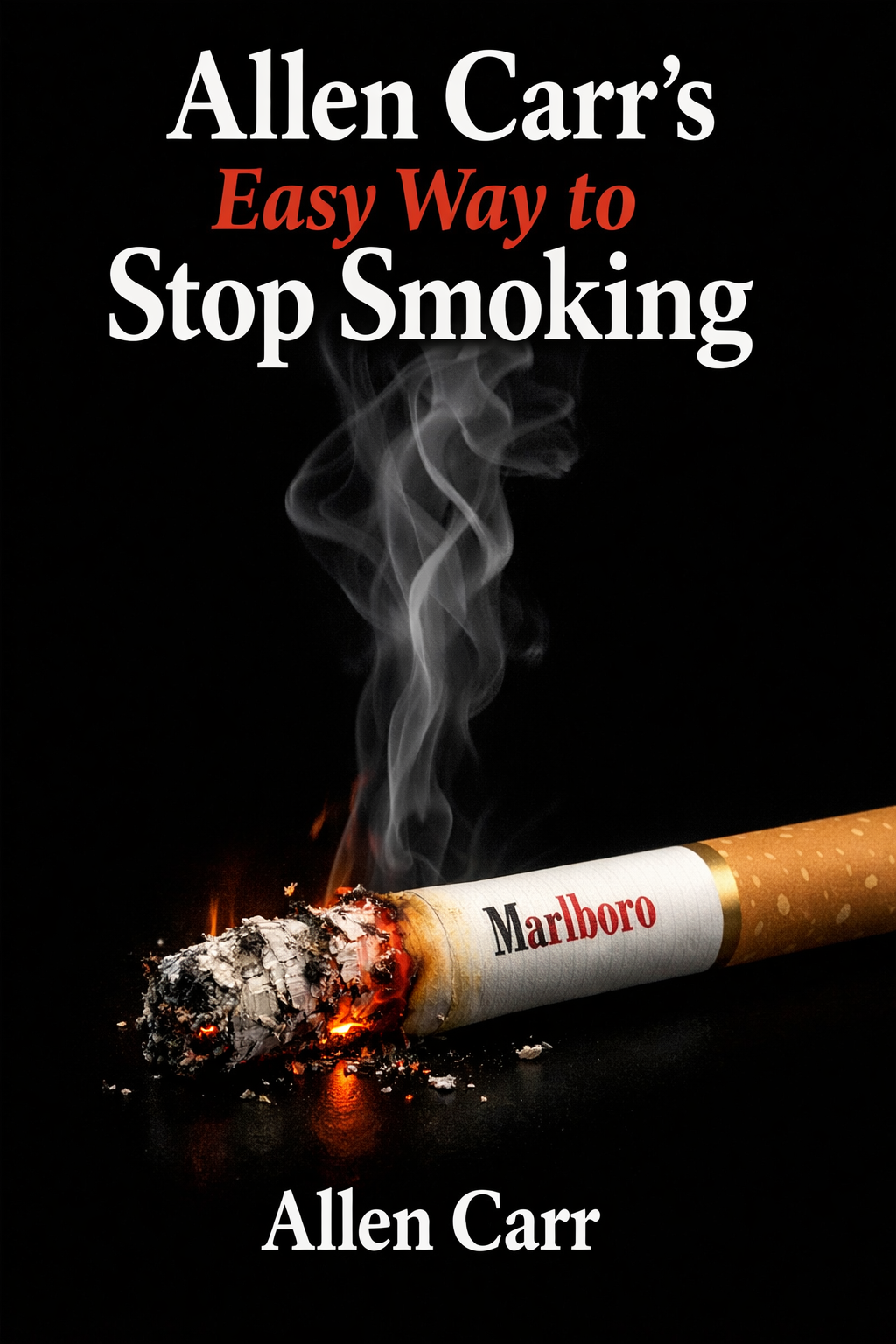
Allen Carr's Easy Way to Stop Smoking
Chapter Summaries
What's Here for You
Ready to escape the sinister trap of smoking? Allen Carr's *Easy Way to Stop Smoking* isn't another lecture on health risks. It's a liberating journey led by a former hundred-a-day addict who understands the smoker's mind like no other. Prepare to dismantle the illusions that keep you hooked – the myth of relaxation, the crutch of concentration, the phantom pleasure. This book offers a revolutionary approach, challenging the brainwashing that fuels your addiction. You'll gain a profound understanding of why you smoke, what you're *really* giving up (spoiler: it's not what you think!), and how to break free without willpower or substitutes. Expect a direct, no-nonsense tone, filled with relatable insights and a liberating sense of empowerment. Get ready to extinguish your last cigarette with excitement, not dread, and step into a smoke-free future with ease and confidence.
The Worst Nicotine Addict I Have Yet to Meet
Allen Carr opens by establishing his authority not as a medical professional, but as a former smoker of extreme proportions, a man who once consumed a hundred cigarettes a day. He paints a vivid picture of his past addiction, the constant headache, the throbbing vein, the genuine belief that his next cigarette would be his last. Yet, even staring into the abyss of his own mortality, he couldn't quit. Carr reveals that, unlike some smokers, he harbored no illusions of enjoyment; he detested the taste and smell, clinging to the belief that cigarettes offered relaxation, courage, and confidence. He recounts his skeptical visit to a hypnotherapist, an experience he initially deemed a waste of time, yet one that miraculously broke the chains of addiction. Carr emphasizes that hypnotherapy is merely a means of communication, its effectiveness hinging on the message conveyed. He underscores that he is not a mystical figure, but a pragmatic individual who sought to understand the seeming magic of his transformation. Carr shares that the key was realizing that the difficulty in quitting lies not in terrible withdrawal pangs, which he found to be largely mental, but in the fear of life without cigarettes. Carr asserts that there is no such thing as a confirmed smoker, and that fear is the primary obstacle. He cautions against two potential pitfalls: failure to follow instructions, particularly regarding cutting down or using substitutes, and failure to understand the underlying principles. He urges readers to question their own views and societal norms surrounding smoking. Carr frames the smoker's dilemma: why is it so hard to break a habit that tastes awful, costs a fortune, and kills us? Why do smokers panic when they don't have a cigarette, while other, infinitely more enjoyable things can be taken or left? Carr leaves us on a note of hope, stating that anyone can stop smoking, even the reader, provided they approach the book with an open mind, understanding that life without cigarettes is not only just as enjoyable but infinitely more so.
The Easy Method
Allen Carr begins by setting an unconventional stage: readers must continue smoking until they finish the book, a seeming contradiction designed to disarm the fear that grips smokers. Carr recounts the frustration he felt when friends, given his book, hesitated to complete it, revealing the profound fear smoking instills, a fear so potent it can overshadow even close friendships. The central tension lies in the smoker's belief that cigarettes offer genuine support, a prop in life's theater. Carr challenges this directly, urging readers to question what cigarettes truly provide, suggesting the advantages are illusory. He dismantles the common rationalizations smokers use, like a magician exposing cheap tricks, revealing that there is nothing of value to give up. The Easy Method, Carr explains, flips the conventional approach: instead of dwelling on the reasons to quit, it focuses on dismantling the perceived benefits of smoking. It's about recognizing that life without cigarettes isn't just bearable but infinitely more enjoyable, a life where one pities smokers rather than envying them. This shift in perspective eradicates the feeling of deprivation, allowing smokers to reconsider the health and financial benefits with newfound clarity. Carr reframes the quitting process not as a sacrifice, but as a liberation, urging readers to realize the positive gains of becoming a non-smoker, transforming the journey from climbing Mount Everest to escaping a terrible disease. He emphasizes that the reasons people think they smoke are not the real reasons, and that uncovering these fallacies is the key to freedom. The ultimate resolution is the realization that smoking offers no advantages at all, a revelation that empowers smokers to break free from their addiction and embrace a healthier, happier life.
Why is it Difficult to Stop?
Allen Carr begins by drawing upon his personal experience, setting the stage for understanding the perplexing difficulty of quitting smoking. He highlights a universal truth: every smoker, deep down, wishes they had never started, a sentiment that underscores the inherent conflict within the addiction. Carr points out the smoker's lament, the feeling of being possessed by something evil, leading to a cycle of procrastination and eventual resignation, where they either blame their lack of willpower or attribute some essential quality to the cigarette itself. The enigma deepens as Carr questions why anyone starts smoking, given that it's a habit universally regretted, a waste of resources, and a systematic assault on one's own health. He paints a vivid picture of the smoker's existence: a life of social ostracism, self-contempt, and the constant craving for something that provides absolutely nothing of value. Carr dismantles the common excuses smokers use to justify their habit, such as enjoyment, relaxation, or boredom relief, revealing them as mere illusions. He challenges the notion that smoking is simply a habit, illustrating how easily we break other habits when necessary. The central tension, Carr argues, is not the difficulty of quitting but the misunderstanding of the addiction itself. He reveals the core issue: smoking is not a habit; it is nicotine addiction, a truth obscured by the smoker's belief that they derive genuine pleasure or benefit from it. Carr resolves this tension by asserting that understanding nicotine addiction is the key to unlocking the chains of smoking, promising that once this understanding is achieved, quitting becomes not a struggle but a liberation, transforming the former smoker into an advocate for a smoke-free life, finally understanding how nice it is to be a non-smoker.
The Sinister Trap
Allen Carr, in "The Sinister Trap," unveils smoking as a uniquely insidious snare, one where society itself, through the actions of other smokers, becomes the bait. He highlights the perplexing fact that the first cigarette tastes awful, a perverse reassurance that one will never become addicted, which is the trap's first deception. Carr notes how the initial motivations—appearing tough for boys or sophisticated for girls—quickly morph into a lifelong struggle, a maze where the mind becomes clouded. The central tension arises from the fact that individuals often attempt to quit during times of stress, precisely when they crave the perceived relief smoking offers, leading to a cycle of relapse. Carr argues that this perception of smoking as a stress reliever is a dangerous illusion; in reality, nicotine increases anxiety and tension. He suggests that the difficulty in quitting isn't due to a lack of willpower but a misunderstanding of why smokers continue to smoke. The author contends that the fear of withdrawal and the perceived loss of a coping mechanism create a mental block, trapping smokers in a cycle of dependence. Carr likens the experience to being lost in a giant maze, where escape seems impossible, yet he offers hope by stating that understanding the true nature of the trap is the key to unlocking freedom. He emphasizes that scare tactics and knowledge of health risks are insufficient; the real question is why smokers find it so hard to quit, and the answer lies in understanding the psychological reasons behind the addiction, which Carr promises to reveal, to lead the reader out of the maze.
Why Do We Carry on Smoking?
Allen Carr delves into the perplexing question of why smokers persist despite knowing the risks. He observes that while people start smoking for trivial reasons, the continuation stems from a deeper, often unacknowledged, conflict. Carr points out that no smoker truly knows why they continue, and if they did, they would likely stop immediately. He humorously, yet poignantly, notes that smokers are aware they are being foolish, trapped in a cycle that began with an unpleasant first cigarette. The author emphasizes that smokers aren't ignorant; they recognize the health hazards and financial burden, leading them to seek rationalizations for their behavior. It's a subtle blend of nicotine addiction and, crucially, brainwashing that keeps the cycle going, a mental fog that obscures the simple truth. Carr frames the smoker's mind as a battlefield between logic and addiction, where the need to justify outweighs the obvious downsides. He suggests that smokers sense the freedom non-smokers possess, a freedom they themselves forfeited. The central tension lies in the smoker's awareness of their predicament versus their inability to break free, trapped by both physical dependence and psychological justification, like a fly caught in a web of its own making. Ultimately, the author sets the stage for exploring these twin forces—nicotine addiction and brainwashing—as the core drivers behind the continuation of smoking.
Nicotine Addiction
In this chapter, Allen Carr masterfully dissects the insidious nature of nicotine addiction, revealing it as a trap far more psychological than physical. He begins by defining nicotine as a rapidly addictive drug, delivering its impact to the brain faster than heroin, a chilling comparison that underscores the severity often downplayed. Carr exposes the first core tension: smokers believe withdrawal pangs are intense trauma, but he clarifies they are primarily mental, a feeling of deprivation masking a subtle physical craving. He paints a vivid picture of this craving as an 'empty, restless feeling,' a subtle discomfort easily mistaken for normal stress or hunger. The author reveals how this confusion perpetuates the cycle. Carr then illuminates the central paradox: smokers seek the 'pleasure' of a cigarette to regain the peace they possessed before addiction, like wearing tight shoes only to enjoy taking them off. He emphasizes that the brainwashing we experience from birth normalizes smoking, further obscuring the reality. Carr then highlights the core deception: the cigarette appears to relieve nervousness or stress, but it is merely alleviating the withdrawal symptoms it created in the first place, a backwards mechanism that keeps smokers hooked. He draws a stark parallel to a heroin addict's desperation, questioning how smokers can find pleasure in something so inherently harmful. Allen Carr underscores that smoking is not a habit but a drug addiction, a crucial distinction that reframes the challenge. He explains the body develops tolerance, requiring more nicotine to achieve the same fleeting relief, trapping the smoker in a vicious cycle. Carr exposes the illusion that smoking relieves boredom, stress, or enhances concentration and relaxation, revealing it as pure brainwashing, a false association masking the underlying addiction. Despite nicotine's potency as a poison, Carr offers hope. He emphasizes that the chemical addiction is surprisingly easy to overcome; the real battle lies in dismantling the mental conditioning. Carr reassures the reader that the body possesses incredible powers of recovery, capable of healing rapidly once the addiction is broken. He concludes with an empowering message: it is never too late to stop, and the further one is dragged down by the habit, the greater the relief upon breaking free.
Brainwashing and the Sleeping Partner
Allen Carr delves into the murky waters of why individuals begin smoking, spotlighting the subconscious mind, or what he cleverly terms the 'sleeping partner,' as the primary culprit. He argues that we often overestimate our conscious control, while our subconscious, molded by societal influences and clever marketing, dictates far more than we realize. Carr illustrates how advertising subtly plants the idea that cigarettes offer relaxation, confidence, and even act as a final comfort, embedding these notions deeply within us. A potent image of a condemned man's last request for a cigarette etches itself into the subconscious, equating smoking with something supremely valuable. Even blatant health warnings become twisted, the fear they induce associating itself with the very product meant to deter. The author stresses that smokers aren't necessarily weak-willed; rather, they're often strong individuals who mistakenly believe smoking alleviates stress or boredom, a notion Carr vehemently dispels. He highlights the societal hypocrisy, where nicotine addiction, a leading killer, is often downplayed compared to other drug addictions. To combat this pervasive brainwashing, Carr urges readers to adopt a skeptical mindset, questioning the glossy facade and recognizing the poison beneath. He recounts his personal journey, a stark reminder that even those acutely aware of smoking's dangers can fall prey to its allure. Carr's experience with switching to a pipe, enduring months of discomfort, underscores the irrationality of addiction—a willingness to suffer for a perceived benefit that simply isn't there. Ultimately, Carr reframes the narrative, urging readers to see quitting not as a sacrifice but as an escape, shedding the illusion of deprivation. He challenges the notion that smokers are enjoying something others are missing, revealing that they are, in fact, forfeiting health, freedom, and peace of mind for absolutely nothing, trapped in a cycle of chasing a tranquility that non-smokers possess naturally. He implores the reader to recognize that the only thing that persuades us to smoke is all the other people doing it; a powerful form of social brainwashing. It is not the non-smoker who is being deprived, but the poor smoker who is forfeiting a lifetime of health, energy, and peace of mind.
Relieving Withdrawal Pangs
In this chapter of "Allen Carr's Easy Way to Stop Smoking," Allen Carr dismantles the smoker's illusion, revealing that cigarettes aren't about enjoyment or relaxation, but about alleviating the very withdrawal pangs they create. He illustrates how the habit begins subtly, a seemingly harmless social prop that gradually forges a chain, linking cigarettes to pleasure in the subconscious. The author emphasizes that as dependence grows, the need to quell withdrawal intensifies, deepening the smoker's false belief in the cigarette's benefits, a deception that unfolds so gradually it often goes unnoticed. Carr highlights the common denial among smokers, even when faced with the reality of their addiction, recounting conversations with teenagers who insist they smoke for enjoyment, dismissing the notion of dependence. He notes the smoker's tendency to reach for a cigarette during moments of stress, boredom, concentration, or relaxation, each puff reinforcing the cycle. The core tension lies in the smoker's misinterpretation of relief as genuine pleasure, a mirage that Carr seeks to dispel by exposing the true nature of nicotine addiction.
Stress
In Allen Carr's exploration of stress and its entanglement with smoking, he illuminates how even minor daily stresses, like a simple phone call, can trigger the urge to light up. Carr points out that smokers often reach for a cigarette during stressful moments, not realizing they're already battling the underlying aggravation of nicotine withdrawal. The momentary relief a smoker experiences is not genuine relaxation, but a reduction of compounded stress—the external trigger plus the internal craving. Carr emphasizes that this cycle is deceptive; each cigarette, instead of calming nerves, actually erodes them further, like a slow leak in a tire. To illustrate the insidious nature of this addiction, Carr presents a stark image: a person warned of potential amputation who continues to smoke, a scenario he once dismissed as extreme, yet now recognizes as the tragic reality of nicotine's grip. He underscores that smoking progressively diminishes courage and self-assurance, fostering a false belief that cigarettes provide strength. The panic smokers feel when facing a cigarette shortage is a manufactured anxiety, absent in non-smokers, a clear sign that cigarettes create the very problems they claim to solve. Carr resolves by stating freedom from smoking brings a return of confidence and self-esteem, a reclaiming of one's natural resilience, and the realization that the calming effect of cigarettes is an illusion, a mirage in the desert of addiction.
Boredom
Allen Carr delves into the illusion that cigarettes alleviate boredom, a deceptive veil masking nicotine addiction. He explains that boredom itself is a state of mind, not a condition cured by smoking. The act of smoking, especially for habitual smokers, often becomes a subconscious ritual, a phantom limb scratching an itch they barely notice. Carr illuminates how nicotine withdrawal creates a void, a 'missing' sensation that boredom amplifies, leading smokers to light up merely to feed the 'monster' of addiction. He argues that cigarettes, rather than relieving boredom, indirectly exacerbate it by inducing lethargy, trapping smokers in a cycle of inactivity and withdrawal pangs. The author underscores the importance of dismantling this brainwashing, this deeply ingrained belief that smoking offers solace from monotony. Carr draws a parallel to the misconception that chewing gum aids relaxation, suggesting it merely provides a socially acceptable outlet for nervous tension, much like smoking masks underlying anxieties. He urges us to observe smokers closely, to see through the facade and recognize that the cigarette does not, in fact, banish boredom. As a former chain smoker, Allen Carr assures his readers that there are few activities as monotonous as the endless cycle of lighting one cigarette after another, a hollow ritual that stretches into years, proving that the true relief lies not in the act, but in breaking free from the chains of addiction.
Concentration
Allen Carr delves into the illusion that cigarettes aid concentration, a mirage that he argues actually worsens the ability to focus. He explains how smokers, already battling the craving of the nicotine monster, light up instinctively when faced with a task requiring concentration, momentarily relieving the craving but perpetuating the cycle. Carr illuminates that the relief is fleeting; withdrawal pangs persist even while smoking, leading to increased consumption and further impairment. He draws a stark image of arteries and veins gradually clogging with poisons, starving the brain of vital oxygen. Carr recounts his own past reliance on cigarettes during accountancy exams, a time when he was convinced he couldn't concentrate without them, yet he passed the exams, realizing the dependence was more psychological than physical. He highlights that smokers often attribute mental blocks to the absence of cigarettes, a convenient scapegoat, whereas non-smokers simply tackle the blocks head-on. The author emphasizes that it's the doubt, the incessant questioning of the decision to quit, that truly disrupts concentration, not the physical withdrawal itself. Carr paints a before-and-after picture: before quitting, everything is blamed on external factors; after quitting, the blame shifts to the act of quitting itself, a subtle but powerful form of self-sabotage. He resolves this tension by reminding the reader that non-smokers don't experience these withdrawal-induced concentration lapses, and the moment he extinguished his last cigarette, his concentration improved, proving the initial fear unfounded.
Relaxation
Allen Carr delves into the pervasive myth that cigarettes offer relaxation, a notion he vehemently challenges. He begins by dismantling the illusion, revealing nicotine as a stimulant that elevates pulse rates, contrary to the smoker's perceived calming effect. Carr highlights the post-meal cigarette, often seen as the pinnacle of satisfaction, but argues it's merely the 'little monster' demanding its fix, trapping the smoker in a cycle of dependency. The author illustrates how nicotine addiction intensifies over time, contrasting relaxed non-smokers with the perpetually tense, chain-smoking executives, whose cigarettes barely alleviate the very symptoms they cause. Drawing from personal experience, Carr recalls his own irritability as a young, smoking accountant, attributing his disproportionate anger not to inherent flaws but to the demanding nicotine monster. He paints a vivid picture of smokers unconsciously fidgeting, tapping, and clenching, behaviors betraying their underlying tension. Carr uses the metaphor of a fly caught in a pitcher plant, initially lured by nectar, only to be consumed, urging smokers to recognize their predicament and escape. The core insight here is that smoking doesn't relieve stress; it manufactures it, creating a false need and perpetuating a cycle of dependence. Ultimately, Carr suggests that true relaxation lies in breaking free from this addiction, rediscovering the genuine calm that smokers have forgotten.
Combination Cigarettes
Allen Carr delves into the phenomenon of the 'combination cigarette,' those smokes intertwined with specific occasions that amplify their perceived importance. He clarifies that a combination cigarette isn't about smoking multiple cigarettes simultaneously—a habit that often highlights the futility of the addiction—but rather, it's the act of smoking during events that merge stress and relaxation, such as social gatherings, parties, or even driving after a stressful appointment. Carr illuminates how these situations create a heightened need to alleviate withdrawal pangs, leading smokers to believe these cigarettes are particularly special, when in reality, it's the context that amplifies the perceived relief. Driving, for instance, can be both relaxing after a tense situation and stressful due to concentration and potential danger, factors often lurking beneath conscious awareness. Similarly, card games can blend concentration, financial stress, boredom, and leisure, creating a perfect storm for chain-smoking, filling ashtrays and minds with a hazy sense of false comfort. Carr underscores that the perceived enjoyment derived from these cigarettes is a mirage; they merely offer temporary respite from nicotine withdrawal, a cycle that perpetuates the addiction. Once the illusion is shattered—once the need for nicotine is removed—these occasions can be experienced more fully and stressful situations navigated with greater ease, a promise Carr intends to explore further. He suggests that the power lies not in the cigarette itself, but in reclaiming the occasions from the clutches of nicotine dependence, transforming moments of stress and leisure into opportunities for genuine enjoyment and relaxation.
What am I Giving up?
In this chapter of 'Allen Carr's Easy Way to Stop Smoking,' Allen Carr confronts the central fear that traps smokers: the illusion of sacrifice. Carr argues that smokers aren't giving up anything of value; instead, they are liberating themselves from a cleverly constructed prison. The core of the addiction, he asserts, lies in the brainwashing that convinces smokers they need cigarettes to fill a void, a void that cigarettes themselves create. Carr dismantles this illusion by highlighting the body's innate perfection, questioning why, if smoking were natural, we would lack a built-in filtration system and instead receive warning signals like coughs and dizziness. He paints a vivid picture of the smoker's plight—enslaved, not enjoying meals, and ostracized, forever caught between the misery of abstinence and the guilt of social offense. Carr uses the metaphor of a cold sore and a seemingly miraculous ointment to illustrate how addiction works; the ointment, like cigarettes, only masks and exacerbates the underlying problem, creating a dependency where none existed before. The true loss, Carr emphasizes, isn't quitting smoking but the constant fear and self-despisal that accompany the habit. He reframes quitting not as deprivation but as a return to confidence, courage, and freedom from slavery, where life becomes infinitely more enjoyable, not just healthier or wealthier. It’s a liberation from the panic, the 'sore' that makes smokers ignore the obvious harms, revealing that the greatest gain is freedom from the fear itself. Carr invites smokers to see the lifting of this 'mist' as a revelation, recognizing that the desire for a cigarette is not an inherent weakness but a manufactured need, perpetuated by the very thing it claims to soothe. It’s not about willpower; it’s about understanding the illusion.
Self-imposed Slavery
In this chapter of *Allen Carr's Easy Way to Stop Smoking*, Carr shines a light on the smoker's paradoxical existence, a "self-imposed slavery" where freedom is both yearned for and rejected with each cigarette. He notes how society fought to abolish slavery, yet the smoker willingly chains himself to nicotine, often oblivious to the desire for liberation that simmers beneath the surface. Carr points out that smokers often only truly 'enjoy' cigarettes when deprived of them, such as during attempts to quit or in smoke-free environments, a cruel trick of addiction that amplifies the perceived value of the very thing that enslaves them. A vivid image emerges: the smoker, once welcomed, now furtively searches for an ashtray, a pariah in a world increasingly hostile to their habit. Carr uses personal anecdotes, recalling the ordeal of attending church or even his own daughter's wedding, his mind consumed by the next cigarette rather than the present moment, to illustrate how smoking robs one of life's simple joys. He notes the irony of smokers huddling together, trading cigarettes like precious commodities, falsely congratulating themselves on their "reward," while the non-smoker experiences a natural state of peace and contentment without artificial aids. The author underscores the illusion that smoking provides peace or confidence, emotions that are the birthright of every non-smoker. Carr recounts his own pathetic behavior, sneaking away from a game of bowls under the guise of a weak bladder, a chartered accountant reduced to the level of a furtive schoolboy, highlighting the depths of this addiction. Ultimately, Carr asserts that the greatest joy of becoming a non-smoker is liberation from this mental and physical servitude, the ability to fully experience life without the constant craving and the subsequent regret. He concludes by reminding smokers that it is not the non-smoker who deprives them, but the "little monster" of addiction that dictates their every move.
I’ll Save £x a Week
In this chapter of *Allen Carr's Easy Way to Stop Smoking*, Carr dismantles the financial justifications smokers often use to rationalize their habit, revealing the deep-seated brainwashing at play. He recounts his debates with 'confirmed smokers,' those who claim to afford and enjoy their smoking, illustrating how they avoid confronting the lifetime cost. Carr presents a provocative offer—free cigarettes for life in exchange for a fraction of the total expense—an offer never accepted, spotlighting the irrationality at the heart of addiction. The author argues that unlike other life decisions, smoking defies logical cost-benefit analysis; the overwhelming evidence screams 'stop,' yet the addiction persists because smokers believe they *cannot* stop. Carr paints a vivid picture: smokers are not enjoying a pleasure but are trapped in a chain reaction, a chain for life. The true cost of smoking, Carr emphasizes, extends far beyond the weekly expense; it's a lifetime mortgage on disease and slavery. He urges readers to confront the staggering sum they will spend if they continue, framing the decision to quit as receiving a substantial bonus, a reward for breaking free. Every cigarette is not just a momentary indulgence, but a step closer to lighting 40,000 pounds on fire. Carr leaves the reader with a powerful image: resisting that final cigarette is not deprivation, but a monumental financial victory, a dance of delight anticipating the freedom and wealth regained.
Health
In "Allen Carr's Easy Way to Stop Smoking," Allen Carr confronts the profound brainwashing that obscures smokers' perception of health risks, arguing they are far more severe than commonly acknowledged, even to those who believe they've accepted the consequences. Carr illustrates this with stark imagery, asking if a smoker would light a cigarette knowing it would trigger immediate, fatal consequences, highlighting the lengths smokers go to avoid acknowledging the danger, burying their heads in the sand, as it were. He points out the ineffectiveness of shock tactics in anti-smoking campaigns, noting that smokers often rationalize their habit by citing exceptions, like the apocryphal Uncle Fred who lived to eighty despite heavy smoking, ignoring the overwhelming statistical evidence. Carr challenges the common myth of the smoker's cough, explaining it's not a sign of health but nature's attempt to expel toxins, a process suppressed by shallow breathing, further endangering the smoker. He urges smokers to reframe their understanding of health, not as an abstract concept, but as the very vehicle carrying them through life, a vehicle systematically destroyed by smoking. Carr implores readers to confront the reality of the habit, envisioning the devastating impact of smoking-induced illness on their lives and loved ones, breaking through the brainwashing that perpetuates the addiction. He dismantles the illusion of smoking as a tug-of-war between pleasure and fear, revealing that the perceived 'pleasure' is merely the alleviation of nicotine withdrawal, a misery created by the very addiction it purports to solve. Carr uses the analogy of inhaling car exhaust to illustrate the absurdity of deliberately poisoning one's lungs, emphasizing that smoking is an active choice to inflict harm. He explains that the fear of quitting is often immediate, overshadowing the distant fear of disease, a cognitive distortion that keeps smokers trapped. Carr shifts from fear-based tactics to a more empowering message, highlighting the enhanced quality of life awaiting those who quit, recounting his own experiences with improved circulation, the disappearance of liver spots, and the alleviation of restless leg syndrome. He underscores the insidious nature of smoking, not just as a direct cause of disease, but as a destroyer of the immune system, likening it to a form of self-inflicted AIDS. Carr contends that smoking diminishes courage and joie de vivre, replacing a fear of death with a fear of truly living, and that only in freedom from nicotine can one fully embrace life's precious moments. He concludes by addressing often-overlooked benefits, such as the cessation of nightmares and the improvement of sexual function, revealing the habit's far-reaching impact on well-being. Carr asserts that the dangers of smoking are often understated, citing its contribution to fires and accidents, and urges smokers to recognize the habit as a continuous chain, each cigarette bringing them closer to an unknown but inevitable catastrophe, a bomb with a fuse of indeterminate length.
Energy
Allen Carr delves into the insidious way smoking gradually diminishes one's energy levels, a decline so subtle it often goes unnoticed, much like the slow creep of unhealthy eating habits that lead to weight gain. He paints a stark contrast: imagine waking up overnight, transformed from a fit individual to someone overweight and lethargic, the shock would be immense, yet the gradual decline due to smoking is equally damaging. Carr emphasizes that the trap lies in the imperceptible nature of the deterioration. He posits that if he could transport the reader three weeks into a smoke-free future, the sheer contrast in well-being—increased energy, confidence, and concentration—would be the ultimate persuasion. The author shares his personal transformation, recalling his teenage vitality versus the perpetual fatigue he endured as a smoker, a state he mistakenly believed was normal for adults. He recounts how quitting not only alleviated congestion and respiratory issues but also unlocked a resurgence of energy, enabling him to embrace physical activities he had long abandoned. This newfound vigor made him feel alive again. Carr acknowledges that the return of health is also gradual, unlike the immediate shock of overnight transformation, and can be overshadowed by the struggle of quitting through willpower alone. He urges the reader to tap into their imagination, to envision the positive changes awaiting them, emphasizing that belief in this potential is key to breaking free from the smoking trap. He underscores the importance of recognizing the slow burn of smoking's impact and visualizing the vibrant energy that awaits on the other side, a future where one feels truly alive and engaged.
It Relaxes Me and Gives Me Confidence
In this pivotal chapter, Allen Carr dismantles the illusion that cigarettes offer relaxation or confidence, arguing instead that they are the very source of the smoker's underlying insecurity. He suggests that the craving experienced when running low on cigarettes isn't a natural anxiety but a manufactured one, a phantom limb created by nicotine addiction. Carr reflects on his own avoidance of medical check-ups, a fear rooted in the perceived consequences of his smoking, a dark cloud hanging over his future. He shares how quitting smoking felt like awakening from a nightmare, a lifting of a veil that had obscured his perspective for decades. The author emphasizes that while life inevitably presents challenges, the freedom from nicotine's grip provides the health, energy, and confidence needed to face them head-on, amplifying the enjoyment of life's positive moments. Carr underscores that the true benefit of quitting isn't just physical health, but a profound shift in mental and emotional well-being, a reclaiming of personal power from the clutches of addiction. Ultimately, he urges smokers to recognize that the confidence they seek isn't found in a cigarette, but in their own innate ability to live without it, stepping into a brighter, more secure future.
Those Sinister Black Shadows
Allen Carr shines a light on the often-unacknowledged psychological burden that smoking places on individuals, describing it as being haunted by 'sinister black shadows.' He begins by acknowledging the smoker's awareness of their own folly, a constant undercurrent of guilt and knowledge of the health risks, financial waste, and inherent stupidity of the habit. Yet, the fear of quitting, fueled by unsuccessful attempts using willpower, consumes their imagination, driving them to concoct flimsy excuses to continue smoking. Carr points out the irony: the smoker's most ingenious thoughts are often deployed not in living, but in rationalizing their self-destructive behavior. He marvels at how, during his smoking years, he blocked out the even greater advantages of quitting, beyond the obvious health and financial gains. Carr emphasizes the joy of reclaiming one's life from the slavery of addiction, the constant craving when allowed to smoke versus the misery of deprivation when restricted. The greatest freedom, however, lies in the banishment of those 'sinister black shadows' – the feelings of being despised by non-smokers, the constant need to apologize, and, most importantly, the self-loathing. Carr challenges the perception of smokers as weak-willed, recounting his own experience of self-disgust at being controlled by a substance he knew was ruining his life. Free from addiction, he now views other smokers not with envy, but with pity, a stark reminder of the insidious weed that once held him captive. It's a transformation from self-despair to self-respect, like emerging from a long, dark tunnel into the brilliant light of day. While acknowledging the need for a balanced perspective, Carr teases the next chapter, which will ironically explore the 'advantages' of being a smoker, setting the stage for a deeper deconstruction of the smoker's mindset.
The Willpower Method of Stopping
Allen Carr, in dissecting the 'Willpower Method' of smoking cessation, illuminates why it so often fails. He begins by challenging the widely held belief that stopping smoking is inherently difficult, suggesting instead that smokers themselves create this difficulty. Carr defines the Willpower Method as any approach where the smoker feels a sense of sacrifice, a constant battle against a perceived loss. He notes that people don't consciously decide to become smokers; it's a gradual slide, often starting in social situations, until smoking becomes intertwined with daily life, a crutch for stress and social ease. The central tension arises when smokers, attempting to quit, feel deprived, triggering a mental craving that amplifies stress, the very thing they once believed cigarettes relieved. Carr explains how this deprivation mindset leads to rationalizations and eventual relapse, fueled by the illusion that life is somehow less enjoyable without cigarettes; it's as if the smoker is trapped in a hall of mirrors, each reflection distorting the reality of their addiction. He emphasizes that the agony isn't primarily physical withdrawal, which is mild, but the mental anguish of doubt and uncertainty. The smoker is waiting for an external sign, a moment of enlightenment, rather than recognizing that the act of stopping is the achievement itself. Carr reveals that while the physical addiction to nicotine fades in about three weeks, the psychological brainwashing persists, leading many to return to smoking even after significant periods of abstinence. Ultimately, Carr suggests that true freedom from smoking comes not from white-knuckled willpower, but from dismantling the illusions that make cigarettes seem desirable in the first place; it requires purging both the 'little monster' of physical addiction and the 'big monster' of mental dependence.
Beware of Cutting Down
In "Allen Carr's Easy Way to Stop Smoking," Allen Carr confronts the common yet treacherous strategy of cutting down on cigarettes, revealing it as a deceptive path that prolongs the smoker's torment. Carr argues that cutting down, often seen as a stepping stone, becomes a stumbling block, trapping smokers in a cycle of craving and dissatisfaction. The author illuminates how, after failed attempts to quit, smokers often rationalize reducing their intake, only to find themselves in a worse predicament, constantly anticipating the next cigarette. Carr emphasizes that the enjoyment smokers derive isn't from the cigarette itself, but from the relief of withdrawal pangs, a cycle exacerbated by cutting down. He dismantles the illusion that smoking provides genuine pleasure, highlighting that the most 'enjoyable' cigarettes are often those that break periods of abstinence, driven by the body's desperate need for nicotine. Carr points out the hypocrisy of smokers who can abstain in certain situations—like in new cars or public places—yet feel enslaved at other times, showcasing that the addiction is more mental than physical. He urges readers to recognize that cutting down reinforces the false belief that cigarettes are a precious reward, thus intensifying the psychological dependence. Carr likens the smoker trying to cut down to someone banging their head against a brick wall to make the relief feel nice. He challenges the notion of occasional smoking, portraying it as a chain reaction that perpetuates the addiction. Carr implores smokers to confront the illusion of taste and enjoyment, urging them to smoke consciously and question what they truly savor. Ultimately, Carr advocates for a complete cessation, asserting that cutting down is a form of self-imposed torture, an exercise in futility that only strengthens the chains of addiction, while stopping is easier and less painful, offering true freedom.
Just One Cigarette
Allen Carr, in his straightforward manner, tackles the pervasive myth of 'just one cigarette,' a siren song that lures many back into the depths of addiction. He argues that this single cigarette isn't an isolated incident but the beginning of a chain reaction, a lifetime of dependence masked as an innocent indulgence. The author emphasizes that the trap often springs from the allure of a 'special' cigarette, whether it's the first one in the morning or the one after a meal, creating a false sense of comfort. Carr urges the reader to confront the reality that there is no such thing as just one, painting a stark picture of a lifetime enslaved to nicotine, a 'filthy lifetime' of self-destruction both mentally and physically. He poses a powerful question: if smokers could return to the time before addiction, would they choose to start? The answer, invariably, is a resounding no, highlighting the fear that underpins the addiction—the fear of not being able to stop, the fear that life will be diminished without it. Carr dismantles this fear, asserting that anyone can stop, that it is 'ridiculously easy' once certain fundamentals are grasped. He reinforces three key principles: that quitting isn't about giving up something, but gaining everything; that the 'odd' cigarette is a dangerous fantasy; and that there is nothing inherently different about those who struggle to quit. Carr addresses the common belief in an 'addictive personality,' dismissing it as a fallacy created by the drug itself, a form of brainwashing that must be undone to break free. In essence, Carr's message is clear: to escape the trap, one must reject the illusion of the occasional cigarette and embrace the reality of a lifetime of freedom.
Casual Smokers, Teenagers, Non-smokers
Allen Carr delves into the deceptive world of casual smoking, revealing that no smoker truly enjoys the habit, regardless of how infrequently they light up; he exposes the lies smokers tell themselves to justify their addiction, highlighting the irony of bragging about smoking less, when the real victory is not smoking at all. Carr illuminates how casual smokers, often envied by heavy smokers, are in some ways more trapped because the illusion of pleasure is greater and the incentive to quit seems less pressing. He introduces the concept of the 'little nicotine monster,' a permanent itch that smokers perpetually scratch, and the factors like money, health, and discipline that prevent chain-smoking. The author dissects various categories of casual smokers—the five-a-day smoker, the morning-only smoker, the six-months-on, six-months-off smoker—exposing the self-deception inherent in each. Carr argues that cutting down is the worst torture, a constant battle that keeps the addiction alive. He paints a vivid picture of the 'I only smoke on special occasions' smoker, whose occasions mysteriously multiply, and the 'I have stopped but I have an occasional cigarette' smoker, forever on a slippery slope. The chapter crescendos with the tragic tale of a five-a-day man ravaged by throat cancer, a stark warning against the delusion of control. Carr shifts his focus to teenagers, cautioning parents against complacency and the false security of government scare campaigns. He underscores that children initially detest smoking, and societal influences can easily lead them into the trap. Carr passionately advocates for protecting youngsters from the nicotine trap, emphasizing its role as a gateway to heavier drug use. Ultimately, the chapter serves as a potent reminder that smoking is a drug addiction, not a habit, and the only true victory lies in stopping completely and breaking free from the illusion.
The Secret Smoker
In "The Secret Smoker," Allen Carr delves into the insidious nature of hiding one's smoking habit, a behavior often more damaging than casual smoking due to its impact on relationships and self-esteem. Carr recounts his own experience of concealing his smoking from his wife after a failed attempt to quit, triggered by her heartfelt concern. He notes how this secrecy, born from a desire to avoid disappointing loved ones, ironically fueled his addiction. The deception became a wedge, causing arguments and isolation as he orchestrated scenarios to indulge his cravings undetected. Carr draws a parallel to the TV detective Columbo, where the perpetrator's initial confidence crumbles under scrutiny, mirroring the smoker's mounting anxiety and shame. The act of secret smoking, Carr argues, reinforces the smoker's false belief in deprivation, while simultaneously eroding their integrity. Each furtive puff, each hidden cigarette, becomes a symbol of this internal conflict, a desperate act to reconcile the irreconcilable. The fear of discovery looms large, casting a shadow over every stolen moment, and Carr emphasizes that the eventual exposure brings humiliation and a swift return to heavier smoking. Ultimately, Carr exposes secret smoking not as a means of control, but as a trap, one that perpetuates both the addiction and the smoker's sense of powerlessness, a vicious cycle where the relief is fleeting, and the shame lingers, turning the smoker into a fugitive in their own home. This behavior supports the illusion of deprivation and causes a major loss of self-respect, turning an otherwise honest person into a deceiver of family and friends.
A Social Habit?
Allen Carr, in examining the social dimensions of smoking, notes that the decline in smoking's prevalence since the 1960s stems from a social revolution, even more so than health concerns. While health and financial reasons to quit have always existed, the initial allure of smoking was its perceived social acceptability. Carr highlights a stark shift: once a symbol of strength and sophistication, smoking is now viewed as antisocial, a sign of weakness or fear. He vividly illustrates this transformation by recalling a time when smoke filled every pub, a visible cloud of social acceptance, contrasting it with modern-day smokers hiding their habit out of embarrassment, like flicking ashes into their pockets to avoid judgment. The core tension Carr identifies is the smoker's growing awareness of their pariah status. The author emphasizes that the days of the cigarette as a 'proud badge' are gone forever, replaced by the understanding that people smoke either because they can't stop or are afraid to try. As smokers witness others abandoning the habit, a fear of being the last one intensifies, urging them to reconsider their choices. Carr's message is clear: don't be left behind on the 'sinking ship' of smoking.
Timing
Allen Carr delves into the crucial aspect of timing when embarking on the journey to quit smoking, challenging the flippant societal view of smoking as a mere distasteful habit, framing it instead as a formidable drug addiction and society's leading killer. Carr underscores that the timing of the attempt to quit is paramount, urging smokers to identify those moments when cigarettes seem indispensable, suggesting a strategic approach: if stress triggers smoking, choose a relaxed period like a holiday to quit, and vice versa, thereby addressing the illusion that cigarettes provide relief. He cautions against gradual reduction, as it reinforces the perceived enjoyment of cigarettes, instead advocating for a conscious awareness of the cigarette's foul taste and smell as one smokes their last, building anticipation for the freedom to come. Carr illuminates the paradox that while nicotine addiction fuels the habit, the true shackle is the brainwashing that perpetuates it, a confidence trick that intelligent individuals can overcome once recognized. The author reflects on feedback received over the years, reaffirming his initial philosophy while acknowledging the challenge of communicating the ease and enjoyment of quitting to every smoker, further complicating the matter by exploring the smoker's fear of losing their 'crutch' during difficult times. Carr then grapples with the advice of continuing to smoke until the book is finished, understanding that some might delay or avoid quitting altogether. He draws an analogy to diving into cold water, advocating for immediate action—diving straight in—but recognizing that this approach might deter some from even attempting to quit. Ultimately, Carr confronts the smoker's tendency to postpone quitting, trapped in the belief that tomorrow will be easier, revealing that the most stressful periods are often behind us, and the slavery to nicotine is the true burden. He concludes by urging smokers to seize the moment, recognizing that quitting is a process they must eventually face, and with each passing day, the addiction only tightens its grip, so the most effective timing is now, or as close to it as possible, to enjoy a life unburdened by the ever-present shadow of addiction, with the promise of not just ease, but enjoyment in the journey to freedom.
Will I Miss the Cigarette?
In this crucial chapter of *Allen Carr's Easy Way to Stop Smoking*, Allen Carr addresses a central anxiety for those attempting to quit: the fear of missing cigarettes. Carr dismantles this fear by exposing the illusion that smoking provides any genuine pleasure or benefit. He points out the irony that while every non-smoker is content being smoke-free, even smokers wish they had never started, highlighting the pervasive regret underlying the addiction. The crux of the issue, Carr argues, lies in the ex-smoker's tendency to envy smokers, particularly in social settings, a phenomenon he attributes to lingering brainwashing and the deceptive allure of the 'one cigarette' fantasy. Carr urges readers to recognize this 'one cigarette' as a myth, a gateway back into the full-blown addiction, and instead, to observe smokers objectively. He paints a vivid picture: the smoker's relentless need to light up, the unconscious act of smoking, and the smoker's envy of the non-smoker's freedom. He reminds us that smokers aren't enjoying a pleasure; they are trapped in a cycle of dependency, facing a future of health problems, financial burden, and constant craving. Carr encourages the reader to shift their perspective, understanding that it is the smoker, not the non-smoker, who is truly deprived – deprived of health, energy, money, confidence, and peace of mind. Carr implores us to see smokers not with envy, but with pity, recognizing the misery and pathetic nature of their addiction, a state he intimately knew as a former 'world's worst' smoker. He draws a powerful analogy: nicotine addiction, responsible for a staggering number of deaths annually, far surpassing even heroin, is a relentless force that only worsens with time. Carr concludes with a call to action: don't envy smokers; pity them, for they deserve it, emphasizing that the illusion of enjoyment diminishes with each passing day, replaced by a growing sense of entrapment and despair.
Will I Put on Weight?
Allen Carr addresses the common fear of weight gain when quitting smoking, debunking it as a myth perpetuated by those using the Willpower Method and substituting food for nicotine. He elucidates that nicotine withdrawal pangs mimic hunger pangs, leading to confusion and overeating, a void never truly filled by food. Carr points out that the body builds immunity to nicotine, so cigarettes never fully satisfy withdrawal, leaving smokers in a state of perpetual craving. He notes the correlation between smokers and alcoholics, questioning if smoking is the root problem. Carr recalls his own experience of substituting nicotine for food during the day and vice versa in the evening, resulting in weight gain. He emphasizes that once free from nicotine, the insecurity fades, replaced by confidence and self-respect, empowering individuals to control their lives, including eating habits. The weight gain myth, Carr argues, stems from using substitutes during withdrawal, which paradoxically makes quitting harder, a point elaborated further in chapter 37. He assures readers that following his instructions should prevent weight gain, and recommends his book EASYWEIGH for those with existing weight issues or who find weight becoming a problem, applying the same principles as EASYWAY to make weight control enjoyable. It's as if the addiction creates a phantom hunger, a bottomless pit that only freedom can truly fill, allowing one to step out of the shadows and into the light of self-control.
Avoid False Incentives
In this chapter, Allen Carr delves into the pitfalls of using false incentives as motivation to quit smoking, a common but ultimately flawed strategy within the Willpower Method. Carr observes that smokers often try to bolster their resolve by focusing on external rewards, painting vivid pictures of future holidays or better cars funded by their abstinence. However, Carr points out the inherent flaw: a smoker, deep down, would often choose the immediate gratification of cigarettes over delayed rewards, making the perceived sacrifice even greater, like a mirage that vanishes upon approach. He cautions against office or family pacts, which, while seemingly supportive, can backfire by creating additional pressure and a sense of deprivation. The 'Rotten Apple' principle emerges, where one person's failure becomes an excuse for others to relapse, highlighting the danger of relying on external willpower. Carr introduces the counter-intuitive idea that sharing the credit in group efforts diminishes individual achievement and the crucial boost that comes from personal acclaim. Bribes, too, are dismissed as ineffective; if the staggering financial cost and health risks of smoking aren't enough to deter, a token reward won't tip the balance. Instead, Carr urges a shift in focus, away from what one is giving up and toward what one is gaining—freedom from addiction. He emphasizes the futility of smoking, stripping away any illusion of benefit and revealing it as a self-imposed punishment. Ultimately, the chapter serves as a stark reminder that true motivation stems not from external carrots, but from a deep understanding of the emptiness at the core of the smoking habit, a realization that empowers smokers to break free.
The Easy Way to Stop
Allen Carr, in this pivotal chapter, unveils the core of his method: the 'Easy Way' to stop smoking. He contends that the difficulty in quitting isn't primarily the chemical addiction, but the pervasive brainwashing that fuels the habit, a sinister trap that keeps smokers ensnared. Carr argues that the key lies not in struggling to quit, but in making a firm, unwavering decision to never smoke again, and, crucially, to rejoice in that decision rather than moping about a perceived loss. He recounts his own journey, marked by failed attempts and black depression, until he realized the power of absolute certainty. The author emphasizes that previous attempts were mired in the hope of eventually losing the urge, a passive waiting game that only intensified cravings. Carr highlights the importance of understanding the enemy—the myths and delusions surrounding smoking—to effectively dismantle its power. He urges readers to analyze their feelings while smoking, as he did, to recognize the inherent disgust and lack of enjoyment. Carr challenges the perception of non-smokers as weak or unsociable, portraying them instead as stronger, more relaxed individuals. The author recounts his conversations with ex-smokers, which shattered the myth of perpetual longing and revealed the joy of freedom. He insists that recognizing smoking as a drug addiction, not a mere habit, is crucial for breaking free. Carr underscores that the 'withdrawal pangs' are largely psychological, fueled by doubt and uncertainty, and that the key to ease is unwavering certainty and finality. Like escaping a prison, the initial decision to quit should be met with excitement and a sense of liberation, a shift in mindset that transforms the experience from a dreaded ordeal to a celebrated triumph. He cautions against delaying the final cigarette until the book is finished, and against viewing the withdrawal period as a sentence to be endured, but rather as a transition to be embraced. For Allen Carr, the path to quitting is not a torturous battle of willpower, but a celebration of freedom, a joyous reclaiming of one's life from the clutches of nicotine. The withdrawal period, often dreaded, is demystified as a period of transformation, not suffering, as long as the mind is set on unwavering freedom.
The Withdrawal Period
In "Allen Carr's Easy Way to Stop Smoking," Allen Carr delves into the nuances of the withdrawal period, a time fraught with both physical and psychological challenges for those attempting to quit. Carr explains that withdrawal pangs consist of two distinct elements: the physical craving for nicotine and the psychological triggers associated with certain events or habits. He illuminates how the failure to differentiate between these two factors often leads to relapse, especially when relying on willpower alone. The author draws a parallel between nicotine cravings and hunger, noting that while neither causes physical pain, both can induce significant irritability; however, unlike food, the body doesn't actually *need* nicotine, making the craving surmountable with the right mindset. Carr emphasizes that the psychological triggers, born from habitual associations, are often the trickier aspect to overcome, like instinctively reaching for the windshield wipers in a new car when intending to signal a turn. He cautions against viewing cigarettes as a placebo or a sugar pill, as they create the very symptoms they temporarily alleviate, painting a stark picture of cigarettes as the instigators of disease rather than remedies. Carr urges readers to counter the brainwashing from the outset, understanding that cigarettes offer no genuine benefit and that craving is merely a temporary discomfort; picture it as a 'nicotine monster' that must be starved, and each resisted craving is a victory. The author reframes the withdrawal period not as a torturous ordeal but as an exciting game, a chance to purge the body of an awful disease, transforming moments of craving into moments of pleasure, savoring the freedom from nicotine's grip. Finally, Carr underscores the importance of maintaining unwavering resolve, reminding oneself of the compelling reasons for quitting and recognizing that each moment of resistance brings one closer to a smoke-free life; the ultimate goal isn't to trick oneself into not needing cigarettes, but to internalize the profound truth that one genuinely does not need them.
Just One Puff
Allen Carr illuminates a treacherous pitfall for smokers attempting to quit via willpower: the deceptive allure of 'just one puff.' He warns that this seemingly insignificant act can unravel days of hard-won progress. Carr dismantles the illusion that a puff might satisfy or diminish cravings, revealing instead its devastating impact on morale. He reminds us that cigarettes were never truly enjoyable; that sensation is a fallacy perpetuated by nicotine addiction. The author paints a vivid picture: imagine starving the 'little monster' of addiction for days, only to offer it a single, precious morsel. While the conscious mind might register the puff as unpleasant, the subconscious receives a potent signal, undermining resolve. Like a tiny ember, that single puff reignites the craving, whispering insidious desires and perpetuating the cycle. Allen Carr emphasizes that this seemingly minor lapse keeps both the physical and psychological addiction alive, making the next cigarette all the more inevitable, because 'just one' is how the addiction began in the first place. The author underscores the critical importance of complete abstinence, not as deprivation, but as liberation from the chains of nicotine.
Will it be Harder for Me?
In this chapter, Allen Carr addresses a common anxiety among those seeking to quit smoking: the fear that their individual circumstances might make the process unduly difficult. He acknowledges the infinite combinations of personal factors—character, profession, timing—that shape each smoker's experience. Carr observes that certain professions, like medicine, present unique challenges. The doctor, constantly aware of health risks, lives in a state of fear, ironically fueling the need for nicotine to relieve withdrawal. The relentless stress of the job, coupled with the guilt of not setting a better example, amplifies the sense of deprivation. The author paints a vivid picture: the doctor's hard-earned breaks, meant for respite, become a stage for the cigarette to take center stage, falsely credited with relieving stress. He extends this observation to other situations marked by forced abstinence, such as drivers or stay-at-home parents battling boredom and stress. Carr notes that the Willpower Method often exacerbates the problem, as smokers fixate on their perceived loss, deepening their depression. However, he offers a transformative shift: by first dismantling the brainwashing that equates cigarettes with relief, one can begin to enjoy breaks and simple pleasures even as the body craves nicotine. The key, Carr emphasizes, lies in a positive frame of mind. Instead of dwelling on the absence of cigarettes, smokers should celebrate their liberation from this "evil monster." In essence, Carr reassures us that any smoker, regardless of their background, can find it easy and enjoyable to quit, provided they adhere to the instructions and embrace a mindset of empowerment.
The Main Reasons for Failure
In Allen Carr's exploration of why individuals falter in their journey to quit smoking, he pinpoints two primary culprits, each a formidable challenge in its own right. The first, the influence of other smokers, casts a long shadow, particularly during moments of weakness or social gatherings where the allure of a cigarette seems almost irresistible. Carr urges us to reframe these instances not as temptations but as opportunities to celebrate our liberation, to recognize that there is no such thing as 'just one cigarette,' and to pity the smoker still trapped in the cycle. He paints a scene: the wafting smoke, a siren song, but instead of succumbing, envision the smoker's envy, a silent acknowledgment of your newfound freedom. The second reason, perhaps even more insidious, is the inevitable arrival of a bad day. Carr underscores the universality of this experience, reminding us that life, whether as a smoker or a non-smoker, is a tapestry of ups and downs. The critical distinction lies in how one copes. While the Willpower Method amplifies the misery of a bad day by fixating on the craving for a cigarette, Carr's Easy Way equips us with the mental fortitude to weather the storm. He encourages us to acknowledge the difficulty, to remind ourselves that bad days were present even during our smoking days, and to focus on the 'marvellous bonus' of freedom from addiction. It's about shifting perspective: instead of viewing the absence of cigarettes as a deprivation, recognize it as a triumph. When the car breaks down, the urge to light up might surface, but Carr challenges us to remember that the cigarette was never a solution, merely an illusory crutch. To succumb is to punish oneself for a correct decision. A positive mental approach, he insists, is not merely helpful but essential, a guiding star in the journey to lasting freedom.
Substitutes
In this chapter, Allen Carr dismantles the illusion of substitutes in the quest to stop smoking, arguing that they hinder rather than help the process. Carr asserts that using substitutes like nicotine gum, sweets, or herbal cigarettes only prolongs the craving, akin to negotiating with a hijacker—it simply perpetuates the cycle. He emphasizes a crucial point: there is no substitute for nicotine because the body doesn't actually *need* nicotine; it's a poison, not sustenance. The perceived need is merely a creation of the addiction itself, a phantom void that cigarettes manufacture, not fill. Carr criticizes nicotine replacement therapy (NRT), suggesting that while some smokers may succeed using it, they do so despite, not because of, the nicotine substitutes. The real battle, he contends, is against the brainwashing, the psychological dependence, and NRT only prolongs the life of the "little nicotine monster" and, consequently, the "big monster" of the mind. He draws a stark analogy: how can one cure an addict by recommending the very drug they're addicted to? Carr urges readers to resist the urge to fill the void with anything, be it gum or food, as this only reinforces the belief that a sacrifice is being made. Instead, he advocates for recognizing that cigarettes were never a genuine reward, but rather like wearing tight shoes just to experience the relief of taking them off. He encourages readers to embrace the discomfort of withdrawal as the death throes of the addiction, a sign of liberation rather than deprivation. Ultimately, Carr’s message is about retraining the mind to understand that no substitute is needed, that the cravings are temporary and the freedom from addiction is the true reward, allowing one to pity those still trapped in the cycle.
Should I Avoid Temptation Situations?
In this chapter of *Allen Carr's Easy Way to Stop Smoking*, Allen Carr grapples with a central dilemma: whether to avoid temptation during the crucial withdrawal period, acknowledging that the answer isn't one-size-fits-all, but rather a personal decision, while offering guidance. Carr underscores that fear, a two-phased monster, is the true jailer of smokers. The first fear is immediate—the sheer panic of running out of cigarettes, a psychological dependency amplified in stressful moments, like the diver frozen at the edge, the board feeling impossibly high. Carr urges, it's essential to recognize this panic as psychological, not physical, and to launch oneself into freedom, trusting the process. The second fear is long-term: the anxiety that future joys or crises will be unmanageable without a cigarette crutch. Carr confronts the question of keeping cigarettes available as a safety net, cautioning that this often backfires, signaling a lack of full commitment. Like a half-hearted attempt to escape a maze while leaving the door ajar, it makes relapse too easy. Certainty, he emphasizes, is paramount; one must embrace the joyous declaration: "Isn't it marvelous that I do not need to smoke anymore?" Carr then navigates the social minefield of quitting, advising avoidance of undue stress while encouraging immediate engagement in social activities. Imagine attending a party, not chained to the smoking corner, but liberated, breathing freely, a testament to life's enhanced quality without cigarettes. He champions embracing the present, proving that life is better without cigarettes, even amidst nicotine's lingering grip, and anticipating the ultimate victory when the addiction is fully vanquished. Allen Carr reframes the challenge: not as deprivation, but as liberation, a courageous leap into a brighter, smoke-free future.
The Moment of Revelation
Allen Carr, in his exploration of the journey to becoming a non-smoker, elucidates the elusive “moment of revelation,” a turning point often experienced weeks after quitting, where the allure of cigarettes vanishes, replaced by a sense of liberation. Carr highlights that this experience is less common with the Willpower Method, where a sense of sacrifice lingers. He emphasizes the profound joy this revelation brings, a joy so potent it can serve as a lifelong source of strength, a reminder of freedom from addiction's grasp. Initially, Carr placed this moment around three weeks post-cessation, but later, through feedback, he discovered it often occurs much sooner, sometimes even before the last cigarette is extinguished. This variability, however, presents a challenge: setting expectations can lead to disappointment if the anticipated epiphany doesn't align with individual experiences, potentially undermining confidence. Yet, providing no guidance leaves ex-smokers perpetually waiting. Carr navigates this tension by acknowledging the five-day mark, when smoking ceases to dominate thoughts, and the three-week point, a common period for relapse, driven by the desire to test one's freedom, a test that often reignites the addiction. The key, Carr argues, lies not in passively awaiting revelation but in actively embracing life as a non-smoker from the outset. Each day smoke-free is a step further into freedom. It’s like planting a seed: nurturing it with positive action ensures it blossoms into true liberation. The chapter underscores that the moment of revelation isn't a magical event but a natural consequence of severing nicotine's hold and engaging fully with life, proving that true freedom comes not from waiting, but from living. He encourages readers to embrace their new lives immediately, understanding that the cessation of nicotine supply is the pivotal act, and that actively engaging with life as a non-smoker accelerates the arrival of that liberating moment.
The Final Cigarette
Allen Carr, in this pivotal chapter, prepares the reader for their final cigarette, emphasizing the crucial mindset needed for success. He stresses that before lighting up, one must be certain of their decision, replacing any feelings of dread with excitement for the freedom to come. Carr reminds us that no one chooses to become addicted, it’s a trap, and escaping requires a firm, positive decision to make that last cigarette truly the last. The author challenges the reader to make a solemn vow, understanding that while past attempts might have failed, this time, armed with the EASYWAY, it can be different. Carr urges the smoker to consciously inhale the final cigarette, asking themselves where the pleasure lies, and upon extinguishing it, to feel joy and liberation rather than deprivation. He acknowledges the presence of a 'little nicotine saboteur'—that feeling of wanting a cigarette—but clarifies that it is the brain, not the body, that craves nicotine. The choice, Carr explains, lies in interpreting that craving as a sign of freedom rather than succumbing to it, a distinction that separates the EASYWAY from the willpower method, where smokers spend their lives wanting what they deny themselves. Allen Carr underscores the importance of never doubting the decision to quit; doubt leads to misery, whether one succumbs to the craving or resists it. The ultimate goal, he asserts, isn't just to abstain from smoking but to become a true non-smoker, one who feels no need or desire for cigarettes. Carr insists that this transformation happens the moment the final cigarette is extinguished, provided the decision is unwavering. He cautions against waiting to become a non-smoker, as that only creates a phobia, and advises against using substitutes or envying other smokers. Carr paints a vivid picture: the ex-smoker has not given up anything but has, in fact, escaped a terrible prison and cured themselves of a disease. As health improves, the highs will feel higher and the lows less low. The chapter culminates with a powerful affirmation: whenever the thought of smoking arises, the ex-smoker should declare, 'YIPPEE, IM A NON-SMOKER!'
A Final Warning
In this crucial juncture of Allen Carr's work, a cautionary tale unfolds, serving as a stark reminder that the battle against nicotine addiction extends far beyond the act of quitting. Carr emphasizes that no smoker, given the wisdom of hindsight, would willingly choose to begin the habit, a sentiment echoed by many who seek his guidance, convinced that freedom from smoking equates to eternal liberation. Yet, Carr warns, complacency is a treacherous foe; the ease with which one abandons cigarettes can mirror the ease of relapse, a cycle he urges readers to avoid at all costs. He paints a vivid picture: even after years of abstinence, a single cigarette can reignite the dormant addiction, a spark in the tinderbox of the mind. Therefore, Carr implores, establish an unbreakable rule: never smoke, regardless of circumstance. Resist the relentless allure of tobacco advertising, a siren song masking a deadly poison. He draws a potent analogy: just as one would shun heroin, so too should cigarettes be avoided, for their death toll far surpasses that of the former. The initial cigarette, Carr cautions, offers no solace, no relief from withdrawal; instead, it serves as a Trojan horse, introducing nicotine and planting the seed of renewed craving. The smoker then faces a pivotal choice: endure temporary discomfort or plunge back into the throes of addiction, a poignant moment of truth where vigilance is the ultimate weapon.
Feedback
In this reflective chapter, Allen Carr examines the extensive feedback received over two decades since publishing "Allen Carr's Easy Way to Stop Smoking," revealing a blend of triumphs and frustrations. Initially met with skepticism from experts, the EASYWAY method has now garnered global recognition, with medical professionals increasingly attending Carr's clinics, a testament to its effectiveness. Carr isn't driven by altruism but by the genuine pleasure derived from witnessing smokers break free from the nicotine trap, a sentiment amplified by thousands of grateful letters. Yet, frustration arises from two primary sources: smokers who easily quit but relapse, and those paralyzed by the fear of quitting or who struggle immensely. Carr recounts the story of a man who, desperate to quit for even a week, succeeded easily only to return to smoking after a year, highlighting the critical need to never smoke again, a lesson often unheeded. The author likens this to rescuing someone from a bog, only to watch them willingly return. He underscores that stopping is easy, but controlling addiction is impossible; the key is resolute abstinence. For those daunted by fear, Carr urges embracing failure as a possibility, reminding readers that the worst outcome is no different from their current state, while success offers immeasurable benefits. Panic and misery, often feared, are transient and pale in comparison to the lifelong distress of smoking, thus deep breathing and emotional expression become allies in this battle. The chapter distills common misunderstandings, such as obsessing over smoking or misinterpreting withdrawal symptoms, emphasizing that freedom lies in a mindset shift toward celebrating non-smoker status. Carr dismantles the illusion of deprivation, asserting that life, meals, and social occasions are enhanced, not diminished, by quitting. Ultimately, Carr provides a checklist of instructions, including a solemn vow of abstinence, recognizing the absence of genuine pleasure in smoking, and understanding that doubt is a form of self-torture. The path to becoming a happy non-smoker begins the moment one embraces that identity, equipped with the understanding and mindset to sustain it.
Help the Smoker Left on the Sinking Ship
In this chapter, Allen Carr shines a light on the smoker's plight amidst societal shifts, painting a picture of individuals left on a 'sinking ship' as smoking becomes increasingly antisocial. Carr observes that smokers, aware of the changing tides and the exodus of their peers, find themselves in a state of panic, clinging to a habit they can no longer rationally defend; they are trapped in a cycle of justifying their addiction, both to themselves and others, by advertising illusory advantages. The author underscores how the 'Willpower Method' often backfires, leaving ex-smokers feeling deprived and, at times, turning them into unwitting advocates for the habit they've supposedly kicked. Instead, Carr advocates for empathy, urging us to remove the smoker's fears by highlighting the joys of a smoke-free life, the simple pleasure of waking up without wheezing, the liberation from addiction's chains, suggesting that true help lies not in belittling smokers but in addressing the underlying fears that keep them tethered to the habit. He notes that societal pressure, while intended to curb smoking, paradoxically intensifies the smoker's dilemma; bans and restrictions only serve to amplify the perceived value of cigarettes, ingraining the smoker's dependence. Carr then directs our attention to the insidious effects of such pressure on vulnerable groups, particularly pregnant women, who, blackmailed by health concerns, often relapse post-pregnancy due to the deeply ingrained brainwashing. Ultimately, Carr argues for a compassionate approach, urging society to view smokers not as pariahs, but as individuals deserving of pity and understanding, akin to heroin addicts, trapped in a cycle of perceived need and mental and physical torture, and that offering them empathy is more productive than condemnation, fostering an environment where they can confront their fears and break free from addiction.
Advice to Non-smokers
Allen Carr, in addressing non-smokers, unveils a crucial understanding of the smoker's psyche, emphasizing that smokers are not driven by enjoyment but by a perceived dependence, a mirage of relaxation and confidence. The initial advice centers on empathy rather than confrontation; Carr cautions against forcing a smoker to quit through health warnings or financial arguments, as this only intensifies their feeling of entrapment, potentially driving them to secret smoking—each forbidden cigarette becoming a symbol of rebellion and comfort. Instead, Carr suggests a strategy of influence through positive reinforcement, advocating for exposing smokers to the narratives of ex-smokers who once felt equally ensnared, highlighting the improved quality of life post-cessation. This plants the seed of possibility, preparing the smoker’s mind to be receptive. Carr underscores the importance of understanding withdrawal pangs as a delusion, a manipulation by the addiction itself, which strips away confidence and fosters irritability, the very antithesis of the cigarette's false promise. For those supporting an ex-smoker, Carr stresses the significance of consistent praise and acknowledgment, recognizing that the initial euphoria of quitting can fade, leaving the individual vulnerable. He paints a picture of the ex-smoker navigating a minefield of triggers and cravings, where external validation acts as a shield against relapse. Carr warns against minimizing the ex-smoker's struggle, suggesting instead to amplify their achievements, noticing their improved appearance, sweeter scent, and easier breathing, creating a positive feedback loop. He also alerts supporters to the potential manipulation tactics employed by those struggling to quit, where feigned distress is used as a ploy to elicit permission to smoke, a trap to be avoided by reinforcing the benefits of freedom and the courage to quit. The chapter serves as a guide for non-smokers, transforming them from potential antagonists into allies in the smoker's journey to freedom.
Conclusion
Allen Carr's work dismantles the illusions propping up smoking. It's not about willpower, but understanding the trap. Fear of deprivation is the core obstacle, masking the reality that smoking offers *nothing*. Freedom comes from recognizing this, shifting from sacrifice to liberation. The 'easy way' addresses the psychological addiction, brainwashing from society and the smoker's own rationalizations. Quitting isn't a battle, but an escape.
Key Takeaways
Authority comes from experience: Understanding a problem intimately can be more valuable than academic knowledge in offering solutions.
The illusion of benefit sustains addiction: Smokers often cling to false beliefs about cigarettes providing relaxation or confidence, masking the underlying addiction.
Hypnosis is a tool, not a magic cure: Its effectiveness depends on the message communicated, highlighting the importance of understanding the root cause of addiction.
Fear, not physical withdrawal, is the biggest obstacle: The fear of losing enjoyment in life without cigarettes is often more potent than the physical symptoms of withdrawal.
Question assumptions to break free: Challenging societal norms and personal beliefs about smoking is crucial for overcoming addiction.
Complete commitment is essential for success: Half-measures like cutting down or using substitutes often perpetuate the addiction cycle.
Continue smoking until the book is finished to dismantle the fear associated with quitting.
Acknowledge and confront the perceived benefits of smoking to expose them as illusions.
Recognize that there are no genuine advantages to smoking, only disadvantages.
Shift the focus from the sacrifices of quitting to the positive gains of being a non-smoker.
Understand that the reasons for smoking are often rationalizations rather than true needs.
Approach quitting not as a deprivation but as a liberation from slavery to nicotine.
All smokers, at their core, wish they had never started, revealing an inherent dissatisfaction with the habit.
The perceived difficulty in quitting stems not from the habit itself but from a misunderstanding of the underlying nicotine addiction.
Smokers often attribute benefits to cigarettes, such as relaxation or enjoyment, which are in fact illusions masking the addiction.
The belief that smoking is merely a habit is a fallacy; it's a powerful addiction that requires a deeper understanding to overcome.
Understanding the true nature of nicotine addiction is the key to breaking free from smoking, transforming the perceived sacrifice into a liberation.
The initial awful taste of the first cigarette falsely reassures individuals that they won't become addicted.
Smoking is often initiated to fulfill social desires, such as appearing tough or sophisticated, which masks its addictive nature.
Smokers often attempt to quit during stressful times, mistakenly believing cigarettes relieve stress, thus reinforcing the habit.
The perception of smoking as a stress reliever is an illusion; nicotine actually increases stress and anxiety.
The difficulty in quitting smoking stems from psychological dependence and fear of withdrawal, not a lack of willpower.
Understanding the psychological reasons behind smoking is crucial to breaking free from the addiction cycle.
Smokers continue smoking not out of enjoyment, but due to a combination of nicotine addiction and psychological brainwashing.
The initial reasons for starting smoking are often trivial, but the reasons for continuing are complex and deeply rooted in justification.
A core tension for smokers is the awareness of the health and financial risks versus the perceived need to continue smoking.
Smokers often create rational explanations to justify their behavior, masking the underlying addiction.
Breaking free from smoking requires addressing both the physical addiction to nicotine and the mental brainwashing that perpetuates the habit.
Nicotine addiction is more psychological than physical; withdrawal pangs are subtle, creating a false perception of intense trauma.
Smokers mistakenly seek cigarettes to regain a pre-addicted state of peace, trapped in a cycle of self-induced discomfort and fleeting relief.
The brainwashing from society normalizes smoking, obscuring its true nature as a harmful addiction.
Cigarettes appear to relieve stress, but they only alleviate withdrawal symptoms they created, perpetuating the addiction.
Smoking is not a habit but a drug addiction, requiring a shift in perspective to break free.
The chemical addiction is relatively easy to overcome; the primary challenge lies in dismantling mental conditioning.
The body has a remarkable capacity for recovery; it is never too late to quit smoking and experience significant health benefits.
The subconscious mind, heavily influenced by societal conditioning and advertising, plays a significant role in initiating and perpetuating smoking habits.
Smokers often mistakenly believe that smoking relieves stress and boredom, illusions reinforced by the addictive nature of nicotine and societal norms.
Health warnings and anti-smoking campaigns, while logically sound, often fail to deter smokers because the subconscious associates the fear with the act of smoking itself.
The perception of quitting smoking as a sacrifice is a form of brainwashing; reframing it as an escape from addiction is crucial for successful cessation.
Nicotine addiction is often downplayed in society compared to other drug addictions, despite being a leading cause of preventable deaths.
Questioning the motivations behind smoking and recognizing the lack of genuine benefits is essential to breaking free from the addiction's mental grip.
Smokers mistakenly attribute smoking to enjoyment or relaxation, when it primarily serves to relieve withdrawal symptoms caused by nicotine addiction.
The addiction process is gradual and subtle, leading smokers to unconsciously associate cigarettes with pleasure and relief.
Denial is a common defense mechanism among smokers, preventing them from acknowledging their dependence on nicotine.
Smokers often relieve withdrawal pangs during stress, boredom, concentration, or relaxation, reinforcing the habit in various situations.
Smokers often mistake relief from nicotine withdrawal for stress reduction, reinforcing the addiction cycle.
Cigarettes do not calm nerves; they progressively destroy them, leading to increased anxiety and dependence.
The fear of running out of cigarettes is a manufactured anxiety caused by the addiction itself, not an inherent stress.
Quitting smoking leads to a genuine return of confidence and self-assurance, breaking the illusion of reliance.
The perceived calming effect of cigarettes is merely the temporary alleviation of withdrawal symptoms, not true relaxation.
Boredom is a mental state, not a condition that cigarettes relieve; smoking merely distracts from the underlying feeling of emptiness caused by nicotine withdrawal.
Nicotine addiction creates a 'missing' feeling, which is amplified during boredom, driving smokers to light up to alleviate withdrawal symptoms rather than genuinely combating boredom.
Smoking indirectly increases boredom by causing lethargy, leading to inactivity and a greater focus on withdrawal pangs.
The belief that smoking relieves boredom is a form of brainwashing, perpetuated since childhood, preventing individuals from questioning its validity.
Smoking is a subconscious ritual for habitual smokers, often performed without conscious awareness or enjoyment, highlighting the depth of the addiction.
The act of smoking is inherently monotonous, offering no true relief from boredom and instead reinforcing a cycle of addiction and inactivity.
Cigarettes do not enhance concentration; they create a cycle of dependence that ultimately impairs it.
The belief that smoking aids concentration is a psychological crutch, not a physiological benefit.
Withdrawal pangs are often less disruptive to concentration than the anxiety and doubt surrounding the decision to quit.
Smokers tend to externalize blame, attributing concentration problems to the absence of cigarettes rather than addressing the underlying issue.
True concentration is improved when the body is free from nicotine addiction and the brain receives adequate oxygen.
Overcoming the psychological dependence on cigarettes is key to unlocking improved concentration after quitting.
The fear of losing concentration without cigarettes is often a self-fulfilling prophecy, fueled by doubt and anxiety.
Nicotine is a stimulant, not a relaxant, and it increases stress levels rather than reducing them.
The craving for a cigarette is often mistaken for a need to relax, creating a false association between smoking and stress relief.
Nicotine addiction worsens over time, leading to increased irritability and a decreased ability to relax without a cigarette.
Smokers exhibit physical signs of tension and restlessness when they are unable to smoke, revealing their underlying anxiety.
True relaxation is only possible when free from nicotine addiction, allowing smokers to rediscover genuine calm.
Breaking free from nicotine addiction is akin to escaping a trap, such as a fly leaving a pitcher plant, where initial allure leads to eventual consumption.
The perceived enjoyment of 'combination cigarettes' stems from the specific context amplifying the need to alleviate nicotine withdrawal, not from any inherent special quality of the cigarette itself.
Situations that blend stress and relaxation, like social gatherings or driving, trigger increased smoking as individuals subconsciously seek relief from withdrawal pangs amidst conflicting emotional states.
Chain-smoking during activities such as card games illustrates how multiple factors—concentration, stress, boredom, and leisure—can converge to intensify nicotine cravings and dependence.
The belief that certain cigarettes are indispensable for enjoyment or stress relief is an illusion perpetuated by nicotine addiction, masking the underlying cycle of withdrawal and temporary satisfaction.
Breaking free from nicotine dependence allows individuals to experience social events and manage stressful situations more effectively, unburdened by the need for constant relief from withdrawal pangs.
The fear of deprivation is the primary obstacle to quitting smoking, fueled by the illusion that cigarettes provide genuine pleasure or support.
Cigarettes do not fill a void; they create it, exploiting the body's natural aversion to toxins and manipulating the mind into believing they are essential.
The smoker's dilemma is a constant state of misery, torn between the discomfort of abstaining and the guilt of offending others, highlighting the true nature of addiction.
The belief that cigarettes enhance social situations is a fallacy; they actually detract from enjoyment by causing anxiety, distraction, and self-consciousness.
Quitting smoking is not about giving up something valuable but gaining freedom from physical and psychological slavery, leading to increased confidence and happiness.
The 'sore and ointment' analogy reveals that addiction is a self-perpetuating cycle, where the solution (cigarettes) is actually the cause of the problem (cravings).
The greatest benefit of quitting smoking is the liberation from the constant fear and panic associated with nicotine withdrawal, allowing for a clearer and more enjoyable life.
Smokers exist in a state of self-imposed slavery, yearning for freedom from addiction while simultaneously indulging in it.
The perceived enjoyment of cigarettes is often an illusion, amplified by deprivation and social restrictions.
Smoking robs individuals of the ability to fully experience and appreciate life's simple moments and joys.
The feeling of peace and confidence that smokers seek through cigarettes is the natural state of non-smokers.
Addiction reduces individuals to pathetic behaviors, driven by craving and a constant need for the next cigarette.
True freedom lies in liberation from the mental and physical chains of nicotine addiction.
Smokers often rationalize their habit with short-term affordability, ignoring the staggering lifetime financial burden.
The refusal to accept an offer of 'free cigarettes for life' reveals the smoker's subconscious awareness of the habit's destructiveness.
Addiction overrides logical decision-making; smokers continue not because they want to, but because they believe they cannot stop.
Quitting smoking is akin to receiving a substantial financial bonus, representing the money saved over a lifetime.
Resisting even one cigarette is a monumental victory, preventing the chain reaction of lifelong addiction.
Acknowledge that the perceived health risks of smoking are often underestimated due to brainwashing and denial.
Recognize that the smoker's cough is not a sign of health but an attempt by the body to expel toxins, indicating existing damage.
Reframe health as the essential vehicle for life, actively being destroyed by the choice to smoke.
Confront the reality of smoking-related diseases and their impact on personal life and loved ones to break through denial.
Understand that the 'pleasure' of smoking is merely the temporary relief from nicotine withdrawal, not a genuine benefit.
Prioritize the immediate fear of quitting against the longer-term fear of disease, recognizing the power of the present moment.
See smoking not just as a direct cause of specific diseases, but as a systemic destroyer of the immune system.
The detrimental effects of smoking on energy levels are often subtle and gradual, making them easy to overlook and accept as normal.
Visualizing the positive impact of quitting, such as increased energy and improved well-being, can be a powerful motivator.
Quitting smoking can lead to a significant resurgence of physical and mental energy, enabling individuals to engage in activities they previously thought impossible.
The return of energy and vitality after quitting is a gradual process, but it is a tangible reward that reinforces the decision to quit.
Using imagination to project oneself into a smoke-free future can provide the necessary motivation to overcome the challenges of quitting.
Smoking does not provide relaxation or confidence; it creates the very insecurity it purports to alleviate.
The anxiety experienced when craving a cigarette is a direct result of nicotine addiction, not a pre-existing condition.
Quitting smoking can lead to a significant improvement in mental and emotional well-being, comparable to awakening from a nightmare.
Freedom from nicotine addiction provides the health, energy, and confidence needed to cope with life's challenges effectively.
True confidence is found in the ability to live without cigarettes, not in the temporary illusion of control they provide.
Smokers are often acutely aware of the negative impacts of their habit, including health risks and financial burdens, creating a constant underlying tension.
The fear of quitting, often amplified by unsuccessful willpower-based attempts, drives smokers to create elaborate justifications for continuing their habit.
The psychological burden of smoking includes feelings of shame, self-despair, and a sense of being judged by non-smokers, manifesting as 'sinister black shadows'.
True freedom from smoking involves not only physical liberation but also the removal of self-loathing and the regaining of self-respect.
The ability to view other smokers with pity rather than envy signifies a complete shift in perspective and a reinforcement of one's own liberation from addiction.
The perceived difficulty of quitting smoking is often self-imposed, stemming from the belief in sacrifice.
Smokers mistakenly attribute stress relief and enjoyment to cigarettes, creating a dependency mindset.
The primary struggle in quitting is psychological, rooted in doubt and the illusion of deprivation, not just physical withdrawal.
Relapse often occurs because ex-smokers maintain the belief that cigarettes offer a boost during good or bad times.
True freedom from smoking requires dismantling the brainwashing that makes cigarettes seem desirable.
Waiting for a moment when the urge to smoke disappears is futile; the act of stopping is the achievement.
The 'Willpower Method' often fails because it focuses on suppression rather than addressing the underlying beliefs driving the addiction.
Cutting down on smoking reinforces the perceived value of cigarettes, intensifying psychological dependence rather than diminishing it.
The 'enjoyment' derived from smoking is primarily the relief from withdrawal symptoms, not the inherent pleasure of the cigarette itself.
The ability to abstain from smoking in certain situations demonstrates that the addiction is largely mental, not purely physical.
The belief that specific cigarettes taste better is an illusion rooted in the relief of withdrawal after a period of abstinence.
Cutting down requires constant willpower and discipline, making it a more challenging and torturous path than quitting entirely.
Occasional smoking is a fallacy; smoking is a chain reaction that perpetuates addiction unless broken completely.
Confronting and dismantling the illusions surrounding smoking is essential for successful cessation.
The concept of 'just one cigarette' is a dangerous illusion that perpetuates the cycle of addiction, turning a fleeting moment of weakness into a lifetime of dependency.
Smokers are often driven by fear – fear of withdrawal and the false belief that life won't be enjoyable without cigarettes – which must be confronted and dismantled to achieve lasting freedom.
The idea of an 'addictive personality' is a myth perpetuated by nicotine itself, designed to keep smokers trapped by convincing them they are inherently predisposed to addiction.
Quitting smoking is not about deprivation but about gaining freedom, health, and control over one's life, transforming the perception from loss to positive achievement.
To successfully quit, it's crucial to reject the fantasy of the 'special' or occasional cigarette and instead visualize the long-term consequences of continued smoking.
All smokers, regardless of frequency, feel trapped and must rationalize their habit.
Casual smokers often face a stronger illusion of control, making quitting seem less urgent.
The perceived pleasure of smoking is merely the relief from nicotine withdrawal, an artificial cycle.
Cutting down on cigarettes can be more torturous than quitting entirely, prolonging the addiction.
The 'occasional' cigarette often leads back to regular smoking, a slippery slope fueled by self-deception.
Teenagers are particularly vulnerable to nicotine addiction due to social pressures and a belief in their future control.
Nicotine addiction can be a gateway to heavier drug use, highlighting the importance of early prevention.
Secret smoking is more detrimental than casual smoking due to its negative impact on relationships and self-esteem.
The act of hiding smoking habits often stems from a desire to avoid disappointing loved ones, but it inadvertently reinforces the addiction.
Secret smoking supports the smoker's false belief that they are being deprived, fueling the addiction cycle.
The fear of being discovered while secretly smoking amplifies anxiety and shame, undermining self-respect.
The eventual exposure of secret smoking often leads to increased smoking and a deeper sense of powerlessness.
The primary appeal of smoking was once its social acceptance, a perception that has now drastically reversed.
Smokers today often feel self-conscious and ostracized due to the increasing social stigma associated with smoking.
The fear of being the last smoker, as more people quit, can be a powerful motivator to stop smoking.
Continuing to smoke is now widely seen as a sign of weakness or an inability to break free from addiction.
Social pressure, which initially encouraged smoking, now contributes to the desire to quit.
Recognize that smoking is not merely a habit but a powerful drug addiction that requires a strategic and serious approach to overcome.
Identify personal smoking triggers and choose a quitting time that strategically counters those triggers, rather than reinforcing them.
Understand that the mental brainwashing associated with nicotine addiction is a more significant obstacle than the physical addiction itself.
Challenge the illusion that cigarettes are a crutch during stressful times, recognizing that true strength lies in facing challenges without them.
Reject the procrastination trap of believing that quitting will be easier tomorrow, understanding that addiction strengthens over time.
Acknowledge that life's genuine stresses are often manageable, and the true source of suffering is the self-imposed slavery to nicotine.
Embrace the idea that quitting can be an enjoyable process, not just a difficult one, by shifting the focus from deprivation to positive gains.
The fear of missing cigarettes is rooted in brainwashing and the illusion of smoking's benefits.
The 'one cigarette' fantasy is a dangerous trap, leading back to full-blown addiction.
Smokers often envy non-smokers, despite outward appearances, highlighting the underlying regret of addiction.
Smoking provides no genuine pleasure; it only alleviates the discomfort of nicotine withdrawal.
The non-smoker is not deprived; the smoker is deprived of health, freedom, and well-being.
Pity, not envy, is the appropriate response to smokers, recognizing their trapped state.
Nicotine addiction is a progressive and deadly force that worsens over time.
Nicotine withdrawal pangs are often mistaken for hunger, leading to unnecessary food substitution.
The body's increasing tolerance to nicotine results in a perpetual state of craving that can never be fully satisfied by cigarettes.
Substituting food for nicotine (or vice versa) is a common but ineffective coping mechanism that often leads to weight gain.
Quitting smoking can restore confidence and self-respect, empowering individuals to take control of their eating habits and overall well-being.
Using substitutes during nicotine withdrawal makes quitting harder, not easier.
Following Allen Carr's specific instructions minimizes the risk of weight gain after quitting smoking.
False incentives, such as future rewards, often fail because they increase the perceived sacrifice of quitting smoking, making cigarettes seem more desirable.
Group pacts to quit smoking can create additional pressure and dependency, leading to secret smoking and the 'Rotten Apple' effect where one person's failure undermines the entire group.
External bribes or bets are ineffective because they don't address the underlying psychological addiction to smoking, and the inherent motivation must come from within.
True motivation to quit smoking stems from recognizing the complete lack of benefits derived from smoking and understanding it as a form of self-punishment.
Focusing on what one gains by quitting, rather than what one is giving up, is crucial for a successful and lasting change in behavior.
The primary obstacle to quitting smoking is psychological brainwashing, not just nicotine addiction.
A firm, joyful decision to never smoke again is more effective than passively 'trying' to quit.
Understanding and dismantling the myths surrounding smoking weakens its psychological hold.
Recognizing smoking as a drug addiction, not a habit, is crucial for successful cessation.
Withdrawal symptoms are largely psychological, fueled by doubt and uncertainty.
Adopting a mindset of excitement and liberation, rather than dread, eases the quitting process.
Differentiate between physical nicotine cravings and psychological triggers to effectively combat withdrawal symptoms.
Reframe nicotine withdrawal as a temporary purging process rather than a torturous deprivation.
Recognize that cigarettes create the symptoms they claim to relieve, dispelling the illusion of them being a beneficial aid.
Counteract brainwashing by understanding that cigarettes offer no genuine benefit and cravings are merely temporary.
Maintain unwavering resolve by constantly reminding yourself of the compelling reasons you quit.
Transform moments of craving into moments of pleasure, savoring the freedom from nicotine's grip.
Internalize the truth that you genuinely do not need cigarettes, rather than trying to trick yourself into not needing them.
A single puff after quitting can severely undermine morale and reactivate cravings, even if consciously perceived as unpleasant.
The perceived 'enjoyment' of smoking is an illusion created by nicotine addiction, not genuine pleasure.
Giving in to 'just one puff' reinforces both the physical and psychological addiction, making future abstinence more difficult.
Complete abstinence, though challenging, is essential to breaking free from the cycle of nicotine addiction.
The subconscious mind plays a crucial role in addiction; even a small dose of nicotine can reignite cravings despite conscious efforts.
Individual circumstances influence the difficulty of quitting, but mindset is paramount.
Professions with high stress and guilt, like medicine, pose unique challenges to quitting.
The Willpower Method can backfire by reinforcing the perceived loss and deprivation.
Reframing withdrawal pangs as moments of liberation can transform the quitting experience.
Breaking the brainwashing that equates cigarettes with relief is crucial for success.
A positive frame of mind is essential for overcoming the challenges of quitting.
The influence of other smokers is a primary trigger for relapse; reframe these moments to reinforce your choice to quit and pity those still addicted.
Bad days are inevitable, regardless of smoking status; focus on the benefits of being a non-smoker to cope effectively.
Craving a cigarette during a bad day is a form of self-punishment; remember that smoking never solved problems, it only masked them.
A positive mental approach is crucial for long-term success in quitting smoking; actively cultivate a mindset of freedom and triumph.
Using substitutes to quit smoking prolongs cravings and reinforces the psychological dependence on nicotine.
Nicotine is a poison, not a necessary substance, and the craving is a manufactured need, not a genuine one.
Nicotine replacement therapy (NRT) may appear logical but ultimately extends the addiction by keeping the 'nicotine monster' alive.
The true battle in quitting smoking is against the brainwashing, the psychological dependence, not just the physical addiction.
Cigarettes provide no genuine reward; the perceived benefit is merely the relief from the discomfort they create.
Withdrawal pangs should be viewed as the death of the addiction, a sign of progress and liberation, not deprivation.
Retraining the mind to understand that no substitute is needed is crucial for breaking free from the cycle of addiction.
The fear of not having a cigarette is primarily psychological panic, not physical withdrawal.
Keeping cigarettes available as a 'safety net' often indicates a lack of full commitment to quitting.
Avoiding undue stress during the initial withdrawal period can improve success.
Engaging in social activities immediately after quitting can reinforce the benefits of being smoke-free.
Certainty and a positive mindset are crucial for successfully quitting smoking.
The 'moment of revelation' is a powerful shift in mindset where the desire to smoke disappears, replaced by a sense of liberation, marking the true end of addiction.
Setting rigid expectations for when the 'moment of revelation' should occur can be counterproductive, potentially leading to disappointment and undermining confidence if it doesn't align with individual experiences.
The key to achieving lasting freedom from smoking lies not in passively waiting for a revelation but in actively embracing life as a non-smoker from the moment the last cigarette is extinguished.
The three-week mark is a critical period where many attempts to quit smoking fail due to the temptation to test one's freedom, which can quickly lead to relapse.
The cessation of nicotine supply is the fundamental act of quitting; no external force can prevent freedom unless one dwells on the craving or waits passively for a revelation.
Success in quitting smoking hinges on a mindset of excitement and liberation, not dread or deprivation.
The craving for nicotine is primarily a mental addiction, not a physical need, and can be reinterpreted as a sign of freedom.
True liberation from smoking involves becoming a non-smoker who feels no desire for cigarettes, not just an abstaining smoker.
Doubt undermines the quitting process, leading to a no-win situation of either succumbing to cravings or feeling deprived.
The moment one extinguishes their final cigarette with a firm decision, they are already a non-smoker, provided they maintain that conviction.
Using substitutes or envying smokers perpetuates the feeling of sacrifice, hindering the journey to becoming a true non-smoker.
Relapse is often easier than the initial quitting process; vigilance is key even after years of abstinence.
Never make exceptions: even one cigarette can reignite the addiction.
Tobacco companies use powerful marketing to promote a deadly product; resist the temptation.
The first cigarette after quitting offers no benefit and immediately restarts the cycle of addiction.
Quitting smoking is not a one-time event, but an ongoing commitment to avoid relapse triggers and maintain vigilance.
Relapse often stems not from craving, but from a loss of fear of smoking, necessitating a firm commitment to never smoke again.
Fear of failure is more detrimental than failure itself; attempting to quit, regardless of the outcome, is superior to resigning oneself to smoking.
Panic and misery during quitting are temporary and self-inflicted; shifting one's mindset to celebrate freedom accelerates the process.
Effective quitting hinges on understanding that there is no genuine pleasure or crutch in smoking, only an illusion.
Becoming a non-smoker requires a fundamental identity shift, embracing the mindset of a happy non-smoker from the outset.
Misunderstanding withdrawal symptoms, such as interpreting normal hunger or stress as cravings, can sabotage quitting attempts.
Smokers rationalize their habit due to societal pressures and internal conflict, needing to believe in illusory advantages to maintain self-respect.
The 'Willpower Method' of quitting smoking often fails because it leaves ex-smokers feeling deprived, inadvertently reinforcing the perceived benefits of smoking to others.
Societal pressure and smoking bans, while intended to reduce smoking, can paradoxically increase smokers' dependence by making cigarettes seem more precious during enforced abstinence.
Pregnant women face immense pressure to quit, often relapsing due to stress and the re-triggering of ingrained habits after childbirth.
Empathy and understanding are more effective than condemnation in helping smokers quit, addressing the underlying fears that perpetuate their addiction.
Smoking is primarily driven by fear and perceived need, not genuine enjoyment, and recognizing this illusion is crucial for breaking free.
Empathy is more effective than confrontation when helping a smoker quit; avoid pressure tactics that increase feelings of entrapment.
Highlighting the positive experiences of ex-smokers can instill belief and open the smoker's mind to the possibility of quitting.
Withdrawal pangs are a manipulative delusion created by addiction, not a genuine need for a cigarette.
Consistent praise and acknowledgment are crucial for supporting an ex-smoker, especially as initial euphoria fades.
Do not minimize the ex-smoker's struggle; instead, amplify their achievements and positive changes.
Recognize and resist manipulation tactics used by those struggling to quit, reinforcing the benefits of freedom from addiction.
Action Plan
Identify your personal illusions about smoking: What benefits do you falsely believe cigarettes provide?
Question your beliefs about withdrawal: Are you truly experiencing physical pain, or is it primarily psychological discomfort and fear?
Commit to following the instructions completely: Avoid cutting down or using substitutes, as these can reinforce the addiction.
Challenge societal norms about smoking: Recognize that society often perpetuates false beliefs about smoking and addiction.
Confront your fear of life without cigarettes: Visualize and plan for enjoyable activities that do not involve smoking.
Approach quitting with an open mind: Be willing to reconsider your preconceived notions about smoking and addiction.
Reflect on why you started smoking: Understanding the initial reasons can help you address the underlying needs or desires that fueled the addiction.
Continue smoking while reading the book to reduce the anxiety associated with quitting.
Actively question the perceived benefits of smoking and identify the illusions.
Make a list of the positive gains you will experience as a non-smoker.
Challenge your rationalizations for smoking and identify the underlying fears.
Focus on the freedom and liberation that comes with quitting, rather than the sacrifices.
Reframe your thinking about smoking from a pleasure to an addiction.
Reflect on how smoking affects your relationships and overall well-being.
Acknowledge and accept that you, like all smokers, likely wish you had never started.
Challenge your perceived benefits of smoking (relaxation, enjoyment) and identify them as illusions.
Reframe smoking not as a habit, but as a nicotine addiction.
Seek to deeply understand the nature of nicotine addiction and its effects on your mind and body.
Prepare to break free from smoking with the understanding that it is a liberation, not a sacrifice.
Imagine how nice it is to be a non-smoker.
Reflect on your initial reasons for starting to smoke and how those motivations have changed over time.
Identify the specific situations in which you feel the strongest urge to smoke.
Challenge the belief that smoking relieves stress by examining how it affects your anxiety levels.
Recognize that the fear of withdrawal is a psychological barrier that can be overcome with the right mindset.
Focus on understanding the true reasons why you continue to smoke, rather than solely relying on willpower.
Prepare for the quitting process by acknowledging that it may be challenging but ultimately achievable.
Reflect on the reasons you started smoking and identify the triggers that make you want to smoke.
Acknowledge the health and financial risks associated with smoking and write them down.
Challenge the rationalizations you use to justify your smoking habit.
Recognize that you are not missing out on anything by not smoking; instead, you are gaining freedom.
Prepare to address both the physical addiction to nicotine and the psychological brainwashing that perpetuates the habit by reading further.
Acknowledge that smoking is a drug addiction, not merely a habit.
Recognize that withdrawal pangs are primarily mental, not physical.
Challenge the brainwashing that normalizes or glamorizes smoking.
Understand that cigarettes provide no genuine pleasure or crutch.
Focus on dismantling the mental conditioning that perpetuates the addiction.
Visualize the body's capacity for recovery and healing after quitting.
Identify the specific situations or triggers that lead to smoking.
Replace smoking with alternative coping mechanisms for stress, boredom, or concentration.
Seek support from others who have successfully quit smoking.
Celebrate each milestone achieved in the journey to becoming smoke-free.
Actively question the perceived benefits of smoking, challenging the notion that it provides stress relief or enjoyment.
Recognize and counteract the influence of advertising and social conditioning that promotes smoking.
Reframe the act of quitting as an escape from addiction rather than a sacrifice.
Build a resistance to the brainwashing by critically evaluating the glossy image of smoking and acknowledging its harmful effects.
Identify personal triggers for smoking and develop alternative coping mechanisms.
Visualize the positive outcomes of quitting, focusing on the health, freedom, and peace of mind gained.
Seek support from friends, family, or support groups to reinforce the commitment to quitting.
Recognize that smoking is primarily driven by the need to relieve nicotine withdrawal, not for enjoyment or relaxation.
Reflect on the gradual nature of nicotine addiction and how it has subtly influenced your perception of smoking.
Challenge any denial you may have about your dependence on nicotine and acknowledge the reality of your addiction.
Identify the specific situations (stress, boredom, etc.) where you typically reach for a cigarette and become aware of the association.
Understand that the relief experienced from smoking is temporary and reinforces the addictive cycle, rather than providing genuine pleasure.
Recognize that the urge to smoke during stress is often a symptom of nicotine withdrawal, not a genuine need for relaxation.
Identify specific stressors that trigger smoking and develop alternative coping mechanisms, such as deep breathing or exercise.
Challenge the belief that cigarettes calm nerves by consciously observing how smoking affects your anxiety levels in the long term.
Visualize the long-term consequences of smoking, such as health problems and loss of self-assurance, to reinforce your commitment to quitting.
Practice mindfulness techniques to become more aware of the physical and emotional sensations associated with nicotine cravings.
Seek support from a therapist or support group to address underlying stress and anxiety issues without relying on cigarettes.
Celebrate small victories in your journey to quit smoking to build confidence and reinforce positive habits.
Recognize and challenge the belief that smoking relieves boredom by consciously observing your state of mind before and after smoking.
Identify alternative activities to engage in when feeling bored, proactively planning diversions to replace smoking.
Reflect on the subconscious nature of your smoking habit by attempting to recall each cigarette smoked during the day, increasing awareness.
Acknowledge that nicotine withdrawal exacerbates feelings of boredom and address the addiction directly rather than masking it with cigarettes.
Engage in physical activity to combat lethargy and reduce feelings of boredom, breaking the cycle of inactivity associated with smoking.
Next time you feel bored, actively resist the urge to smoke and instead, engage in a stimulating activity that genuinely occupies your mind.
Recognize and challenge the belief that cigarettes enhance concentration.
Identify alternative strategies for managing mental blocks, such as taking a short break or practicing mindfulness.
Focus on the positive benefits of quitting smoking, such as improved brain function and overall health.
Practice self-compassion and avoid self-blame when experiencing concentration difficulties after quitting.
Engage in activities that promote brain health, such as exercise, healthy eating, and adequate sleep.
Visualize yourself successfully concentrating without cigarettes to build confidence and reduce anxiety.
Replace the habit of smoking with a healthier coping mechanism, such as deep breathing or meditation.
Monitor your pulse before and after smoking to recognize nicotine's stimulant effect.
Observe smokers in situations where they cannot smoke to identify signs of restlessness and tension.
Identify activities and routines that you associate with smoking and find alternative ways to relax during those times.
Challenge the belief that cigarettes help you relax by consciously focusing on the physical and emotional sensations of smoking.
Visualize yourself escaping the 'pitcher plant' of addiction and reclaiming your freedom from nicotine.
Practice mindfulness and relaxation techniques to manage stress and cravings without relying on cigarettes.
List the specific ways that smoking makes you *less* relaxed, focusing on the physical and emotional downsides.
Identify specific situations where you tend to smoke 'combination cigarettes' (e.g., parties, driving).
Before engaging in those situations, consciously acknowledge that the urge to smoke is driven by withdrawal, not genuine need or enjoyment.
Develop alternative coping mechanisms for managing stress or boredom in those situations (e.g., deep breathing, engaging in conversation, chewing gum).
Visualize yourself enjoying these activities without smoking, focusing on the benefits of being nicotine-free.
After the event, reflect on how you felt without smoking and reinforce the positive aspects of your smoke-free experience.
Identify and challenge the specific fears and anxieties you associate with quitting smoking.
Recognize that the desire for a cigarette is a created need, not a genuine craving or weakness.
Observe smokers in social situations and notice how their smoking detracts from their enjoyment.
Focus on the psychological benefits of quitting, such as increased confidence and freedom from slavery.
Visualize the 'sore and ointment' analogy to understand how cigarettes perpetuate the cycle of addiction.
List all the ways smoking negatively impacts your life, beyond just the obvious health concerns.
Remind yourself that you are not giving up anything of value by quitting; you are gaining everything.
Prepare for the initial withdrawal symptoms by understanding they are temporary and a sign of healing.
Celebrate each day you remain smoke-free as a victory over addiction and a step towards greater freedom.
Reflect on the moments when you feel most compelled to smoke and identify the underlying triggers.
Observe other smokers and recognize the patterns of behavior that highlight their addiction.
Acknowledge the ways in which smoking has limited your freedom and ability to enjoy life.
Visualize yourself as a non-smoker and focus on the positive emotions and experiences that will come with liberation.
Challenge the illusion that cigarettes provide genuine pleasure or relief.
Recognize that cravings are temporary and can be overcome with willpower and determination.
Seek support from friends, family, or a support group to help you stay motivated and accountable.
Focus on the benefits of quitting, such as improved health, increased energy, and greater financial freedom.
Calculate the total amount you expect to spend on cigarettes for the rest of your life.
Whenever you crave a cigarette, remind yourself of the total financial cost of continuing to smoke.
Visualize the 'bonus' you will receive by quitting, focusing on what you could do with the saved money.
If you are tempted to smoke 'just one' cigarette, remember that it could cost you tens of thousands of pounds.
Share Allen Carr's 'free cigarettes for life' offer with smokers and observe their reactions.
Reframe quitting as a financial victory rather than a deprivation.
List all the things you could do with the money you save by not smoking.
Honestly assess your own level of denial regarding the health risks of smoking.
Pay attention to your body's signals, such as coughing or shortness of breath, and acknowledge them as signs of damage.
Imagine the impact of smoking-related illness on your loved ones and use that as motivation to quit.
Challenge the illusion of smoking's 'pleasure' by recognizing it as the relief of withdrawal symptoms.
Visualize your body as a precious vehicle and commit to protecting it from further damage.
List the specific benefits you expect to experience once you quit smoking.
Recognize each cigarette as a step closer to potential health catastrophe.
Focus on the immediate benefits of quitting, such as improved breathing and energy levels.
Reflect on how smoking has gradually affected your energy levels and overall well-being.
Visualize yourself three weeks after quitting, experiencing increased energy, confidence, and concentration.
List the physical activities you would like to pursue if you had more energy and vitality.
Imagine the positive impact quitting will have on your mental clarity and focus.
Use your imagination daily to reinforce your commitment to quitting and visualize a healthier, more energetic future.
Recognize that the feeling of needing a cigarette is caused by the cigarette itself.
Reflect on specific situations where you believe smoking provides confidence or relaxation and identify alternative coping mechanisms.
Imagine waking up from a bad dream to visualize the mental clarity and freedom that quitting smoking can bring.
List the health, energy, and confidence benefits you anticipate experiencing after quitting smoking.
Challenge the belief that cigarettes provide genuine stress relief by exploring healthier stress-management techniques.
Acknowledge and confront the 'sinister black shadows' – the feelings of guilt, shame, and self-despair associated with smoking.
Identify the specific excuses you use to justify continuing to smoke and challenge their validity.
Focus on the positive aspects of quitting, such as improved self-respect and freedom from addiction, rather than dwelling on the perceived sacrifices.
Visualize yourself as a non-smoker and cultivate feelings of pity rather than envy towards other smokers.
Recognize that quitting smoking is not just a physical challenge but also a psychological one, requiring a shift in mindset and self-perception.
Identify and challenge the specific beliefs you hold about the benefits of smoking (e.g., stress relief, social ease).
Recognize that the feeling of deprivation is a mental construct, not a physical necessity.
Focus on the positive aspects of quitting (e.g., improved health, more money) rather than dwelling on the perceived loss.
Prepare for the psychological cravings by developing coping mechanisms and strategies for managing stress.
Avoid waiting for a perfect moment to quit; commit to stopping now and view each smoke-free day as a success.
Remind yourself that the physical addiction to nicotine is temporary and that the mental addiction is the primary challenge.
Question the assumption that cigarettes enhance enjoyment; observe smokers at social functions and notice their discomfort.
Visualize yourself as a non-smoker and focus on the long-term benefits of a smoke-free life.
Recognize that cutting down is a form of self-torture that reinforces addiction.
Challenge the illusion that cigarettes provide genuine pleasure by consciously smoking and questioning what you enjoy.
Identify situations where you abstain from smoking without difficulty to prove the addiction is largely mental.
Focus on dismantling the brainwashing that makes you believe cigarettes are a prop or reward.
Commit to quitting entirely rather than attempting to cut down.
Acknowledge that the 'enjoyment' from smoking is merely the relief from withdrawal symptoms.
Break the chain reaction by refusing to have even one 'occasional' cigarette.
Prepare for complete cessation by identifying and addressing the underlying psychological triggers.
Replace the perceived benefits of smoking with healthy coping mechanisms for stress and anxiety.
Identify and dismantle the specific 'special cigarette' scenarios (e.g., after meals, during stress) that trigger cravings.
Whenever the urge for 'just one cigarette' arises, vividly imagine the long-term consequences of smoking on your health, finances, and freedom.
Challenge the belief that you have an 'addictive personality' by recognizing nicotine's manipulative tactics.
Focus on the positive gains of quitting – improved health, increased energy, greater financial freedom – rather than dwelling on perceived sacrifices.
Create a list of personal affirmations that reinforce your ability to quit and maintain a smoke-free life.
Visualize a future free from nicotine addiction, focusing on the benefits and positive changes in your life.
Seek support from friends, family, or support groups to reinforce your commitment and stay accountable.
Acknowledge that any level of smoking indicates addiction, not control.
Reflect on the specific lies you tell yourself to justify smoking.
Recognize that the 'pleasure' of smoking is simply the relief of withdrawal symptoms.
If attempting to quit, consider quitting entirely rather than cutting down.
Identify and avoid social situations or triggers that lead to 'occasional' smoking.
Educate children about the dangers of nicotine addiction and its link to other drug use.
Seek support from smoking cessation programs or therapists.
Challenge the belief that smoking provides a genuine crutch or pleasure.
Visualize a smoke-free life and the benefits it offers.
Replace smoking with healthier coping mechanisms for stress and cravings.
Acknowledge and confront the habit of secret smoking to begin addressing the underlying issues.
Communicate openly with loved ones about smoking habits and struggles with quitting.
Identify the triggers and situations that lead to secret smoking and develop strategies to avoid or manage them.
Focus on breaking the cycle of shame and guilt associated with secret smoking by practicing self-compassion.
Seek support from friends, family, or support groups to stay accountable and motivated in quitting.
Replace the act of secret smoking with healthier coping mechanisms, such as exercise or mindfulness.
Reframe the perception of deprivation by focusing on the benefits of quitting smoking.
Visualize the long-term positive impact of quitting on relationships and self-esteem to stay committed.
Track smoking habits, including instances of secret smoking, to gain awareness and identify patterns.
Celebrate small victories in reducing or eliminating secret smoking to build confidence and momentum.
Reflect on how social perceptions of smoking have changed in your lifetime.
Identify specific social situations where you feel most self-conscious about smoking.
Consider the message you are sending to others by continuing to smoke.
Seek support from ex-smokers and understand their motivations for quitting.
Visualize yourself as a non-smoker and the positive social interactions that will follow.
Actively notice and appreciate the increasing number of smoke-free environments.
Challenge the outdated belief that smoking is a sign of strength or sophistication.
Recognize the fear of being the last smoker as a valid reason to quit now.
Identify the specific times and situations when you feel the strongest urge to smoke.
Challenge the belief that cigarettes provide genuine stress relief or enhance social situations.
Recognize and confront the mental brainwashing that perpetuates your smoking habit.
Choose a specific date and time to quit smoking, treating it as a crucial appointment.
Instead of gradually cutting down, smoke consciously, paying attention to the negative aspects of each cigarette.
Prepare for potential withdrawal symptoms by learning about coping strategies in advance.
List the positive gains you will experience by quitting smoking, focusing on the benefits to your health, finances, and well-being.
When the urge to smoke arises, remind yourself that it is a temporary craving that will pass.
After extinguishing your final cigarette, actively celebrate your newfound freedom and non-smoker status.
Recognize and reject the 'one cigarette' fantasy as a gateway back to addiction.
Actively observe smokers in social situations, noticing their discomfort and dependence.
Remind yourself of the health, financial, and emotional benefits of being a non-smoker.
Replace envy with pity when you see someone smoking, understanding their trapped state.
Visualize the long-term consequences of smoking, including health problems and financial burden.
Create a list of personal reasons for quitting and review it regularly.
Seek support from friends, family, or support groups during challenging times.
Practice mindful breathing or other relaxation techniques to manage cravings.
Celebrate milestones in your journey to reinforce positive behavior.
Remember that each day smoke-free is a victory, and the future is brighter without nicotine.
Recognize that nicotine withdrawal pangs are distinct from hunger pangs.
Avoid substituting food for cigarettes when experiencing withdrawal symptoms.
Focus on addressing the root cause of the addiction rather than relying on substitutes.
Follow Allen Carr's instructions carefully to minimize withdrawal symptoms and cravings.
If weight gain becomes a concern, explore Allen Carr's EASYWEIGH method for weight control.
Cultivate self-awareness and self-respect to reinforce your commitment to quitting.
Visualize the freedom and control you will gain over your life once free from nicotine addiction.
Identify and list all the false incentives you've used in the past to try to quit smoking, and recognize why they were ineffective.
Shift your focus from what you believe you are giving up by quitting to all the benefits you will gain in terms of health, freedom, and well-being.
Challenge the illusion that smoking provides any genuine pleasure or benefit, and recognize it as a form of self-punishment.
Avoid relying on group pacts or external support as the primary motivation to quit; focus on your own internal reasons and desires.
Whenever you feel the urge to smoke, consciously remind yourself of the futility of the habit and the freedom you will gain by breaking free.
Make a firm decision to never smoke again and consciously rejoice in that decision.
Analyze your feelings while smoking to recognize the lack of enjoyment and inherent disgust.
Challenge the myths and delusions surrounding smoking by educating yourself about its effects.
Reframe smoking as a drug addiction, not a mere habit, to understand its true nature.
Focus on the positive gains of quitting, such as improved health and increased freedom.
Replace moping about quitting with excitement and anticipation for a smoke-free life.
View the withdrawal period as a transition to be embraced, not a sentence to be endured.
Delay extinguishing your last cigarette until you have fully absorbed the book's teachings.
Identify and differentiate between physical nicotine cravings and psychological triggers.
Reframe withdrawal pangs as a sign of your body purging itself of a harmful substance.
Whenever you experience a craving, remind yourself of the health and financial benefits of quitting.
Visualize the 'nicotine monster' inside you and celebrate each craving you resist as a victory.
Practice savoring the moments when you think about smoking, reminding yourself of your newfound freedom.
When offered a cigarette, confidently state that you no longer need them.
Replace smoking-related triggers with healthier habits, such as exercise or spending time with loved ones.
Write down a list of all the reasons you want to quit smoking and review it daily.
Seek support from friends, family, or a support group to help you stay motivated during the withdrawal period.
Commit to complete abstinence from nicotine, understanding that even a single puff can reignite the addiction.
Recognize that cravings are temporary and will subside with continued abstinence.
Challenge the illusion of enjoyment associated with smoking by acknowledging it as a need to feed the addiction.
Visualize the 'little monster' of addiction and reinforce your resolve to starve it.
Develop coping mechanisms for cravings, such as deep breathing, exercise, or engaging in enjoyable activities.
Remind yourself of the reasons why you want to quit smoking whenever you experience a craving.
Seek support from friends, family, or a support group to stay accountable and motivated.
Avoid situations or triggers that might tempt you to smoke, especially in the early stages of quitting.
Replace the habit of smoking with positive, healthy habits that promote well-being.
Celebrate your progress and acknowledge each day of abstinence as a victory.
Identify and challenge the brainwashing that links cigarettes to stress relief or pleasure.
Reframe moments of craving as opportunities to celebrate freedom from addiction.
During breaks, focus on enjoying the present moment rather than dwelling on the absence of cigarettes.
Practice positive self-talk to reinforce the benefits of quitting.
Develop alternative coping mechanisms for stress and boredom.
Seek support from others who have successfully quit smoking.
Follow all instructions of the Easy Way method diligently.
When faced with other smokers, consciously remind yourself of the benefits of being a non-smoker.
During a bad day, actively list the positive aspects of your smoke-free life.
Challenge the thought that a cigarette will solve your problems; identify alternative coping strategies.
Cultivate a daily practice of positive self-talk to reinforce your commitment to quitting.
Visualize your success as a non-smoker and the freedom it brings.
Immediately discard all nicotine substitutes (gum, patches, etc.) to avoid prolonging the addiction.
Recognize cravings as a sign of the addiction dying and not as a need that must be satisfied.
Challenge the belief that cigarettes provide a genuine reward by acknowledging the discomfort they cause.
Refrain from using any substitutes, such as sweets or gum, to avoid reinforcing the idea of sacrifice.
Focus on retraining your mind to understand that you do not need nicotine and that the cravings are temporary.
Embrace the discomfort of withdrawal as a positive step towards freedom from addiction.
Remind yourself that smokers suffer withdrawal, not non-smokers, to shift your perspective.
Visualize the addiction as a 'monster' that is dying with each craving you resist.
Avoid falling into the trap of substituting one addiction for another; address the root cause of the problem.
Focus on the mental aspect of quitting, understanding that the brainwashing is the primary obstacle to overcome.
Recognize and challenge the psychological fears associated with quitting smoking.
Commit fully to quitting by discarding all cigarettes and smoking paraphernalia.
Avoid stressful situations during the initial withdrawal period.
Attend social events soon after quitting to experience the benefits of being smoke-free.
Repeat the mantra: "Isn't it marvellous that I do not need to smoke anymore?" to reinforce a positive mindset.
Re-read the book if you feel the need to keep cigarettes available, as it indicates a lack of understanding.
From the moment you extinguish your last cigarette, consciously embrace your new identity as a non-smoker.
Actively engage in activities and situations you previously associated with smoking, proving to yourself that you can enjoy them without cigarettes.
Avoid testing your freedom by lighting another cigarette, as this can quickly lead to relapse.
Focus on the positive aspects of being a non-smoker, such as improved health and freedom from addiction, to reinforce your commitment.
When cravings arise, remind yourself that you have already cut off the nicotine supply and that the craving will pass.
Seek support from friends, family, or support groups to help you stay motivated and overcome challenges during the quitting process.
Understand that the 'moment of revelation' is a natural consequence of your efforts and will likely occur as you continue to live your life as a non-smoker.
Before smoking your final cigarette, reaffirm your decision to quit and focus on the positive aspects of becoming a non-smoker.
Smoke your final cigarette consciously, paying attention to the lack of pleasure and the harmful effects.
When you extinguish your final cigarette, declare to yourself, 'I am free! I am a non-smoker!'
Whenever you experience a craving, recognize it as a mental trick and reaffirm your identity as a non-smoker.
Avoid using nicotine substitutes, as they perpetuate the feeling of sacrifice and reinforce the addiction.
Whenever you see someone smoking, pity them rather than envying them, recognizing their enslavement to nicotine.
Do not change your life or habits just because you've quit smoking; continue to enjoy your life as before, but without cigarettes.
When thoughts of smoking arise, immediately replace them with the affirmation, 'YIPPEE, IM A NON-SMOKER!'
Commit to a zero-tolerance policy: never smoke, under any circumstances.
Actively resist tobacco advertising by recognizing its manipulative tactics.
Remind yourself regularly of the dangers of smoking and the benefits of quitting.
Visualize the consequences of relapse and the positive outcomes of staying smoke-free.
Create a support system of friends, family, or support groups to help you stay accountable.
Develop alternative coping mechanisms for stress or triggers that might lead to smoking.
If tempted to smoke, remember the feeling of withdrawal and the desire to quit in the first place.
Make a solemn vow to never consume nicotine again in any form.
Recognize and internalize that there is absolutely nothing of value being given up by quitting.
When thoughts of smoking arise, consciously reframe them with a positive affirmation like, 'Yippee! I'm a non-smoker!'
Avoid all nicotine substitutes to prevent perpetuating the addiction cycle.
Actively challenge the belief that meals, social events, or any aspect of life are diminished without cigarettes.
When experiencing panic or anxiety, practice deep breathing exercises to alleviate tension.
Identify and address any misunderstandings of the EASYWAY instructions to ensure correct application.
View the quitting process as a boxing match against the addiction, anticipating inevitable victory.
Avoid isolating oneself from social situations involving smokers; instead, embrace the opportunity to be a positive example.
Express emotions openly rather than suppressing them, allowing for natural tension release.
Identify and challenge the 'illusory advantages' you associate with smoking.
Focus on the positive aspects of quitting, such as improved health and freedom from addiction, rather than dwelling on feelings of deprivation.
Seek support from empathetic individuals who understand the challenges of quitting.
Avoid situations where you feel pressured to smoke, and create a smoke-free environment.
Practice self-compassion and avoid self-blame if you relapse, viewing it as a learning opportunity.
Educate yourself about the psychological and physiological mechanisms of nicotine addiction.
When interacting with smokers, offer encouragement and understanding rather than judgment or criticism.
Share stories of successful ex-smokers with your smoking friends or relatives.
Offer consistent praise and encouragement to someone who is trying to quit smoking.
Avoid criticizing or pressuring a smoker to quit; instead, focus on positive support.
Anticipate irritability during the withdrawal period and offer extra understanding and patience.
Help relieve pressures and create enjoyable distractions for someone who is quitting.
If the ex-smoker tries to manipulate you into allowing them to smoke, gently reinforce their strength and freedom from cigarettes.