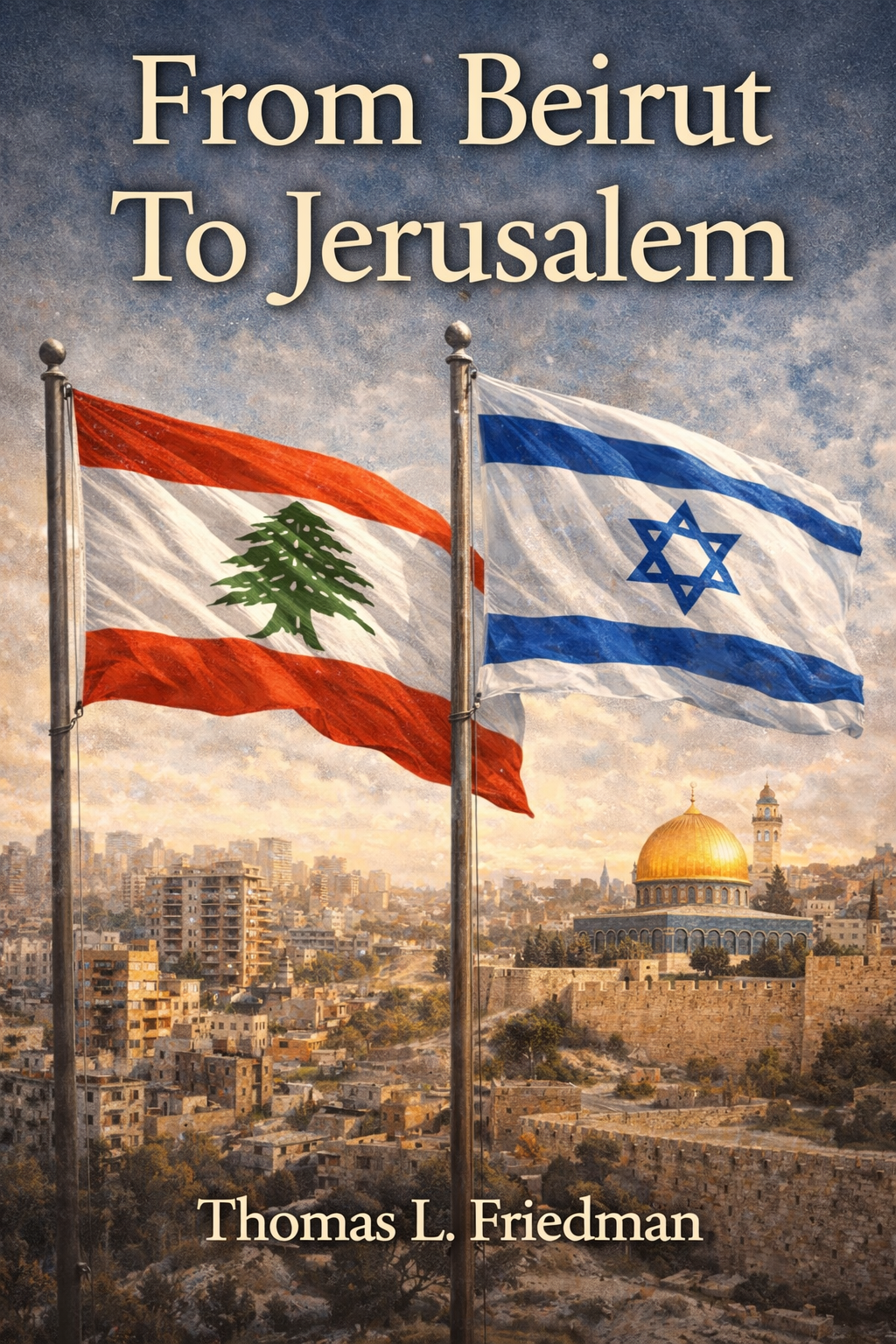
From Beirut To Jerusalem
Chapter Summaries
What's Here for You
Embark on an unforgettable journey from the heart of civil war to the complex soul of a nation, guided by Thomas L. Friedman's unflinching gaze. 'From Beirut to Jerusalem' isn't just a chronicle of conflict; it's an invitation to understand the human experience amidst chaos and transformation. You'll plunge into the 'Beirut-style poker' of shifting alliances, witness the resilience of a city under siege, and confront the 'Hama Rules' that echo in the silence after tragedy. This book promises to dismantle your preconceptions, revealing the intricate dance of worldviews – the sharp logic of Zionism against the ambiguous rhythms of the Arab world – that shape the Middle East. You'll gain a profound insight into the enigmatic figures like Yasir Arafat, the 'Teflon Guerrilla,' and understand the cultural dissonances that lead to profound misunderstandings, as vividly illustrated in 'Betty Crocker in Dante’s Inferno.' Experience the 'Earthquake' of rising anger and the identity crises that grip nations, exploring the deep spiritual and political fault lines that define Israel. Beyond the headlines, you'll uncover the complex relationship between Israel and American Jews, and grasp why this region remains perpetually 'Under the Spotlight.' Friedman’s narrative is a powerful blend of sharp reporting and empathetic observation, offering not just facts, but a visceral understanding of the human cost of conflict and the enduring spirit of those who live through it. Prepare to have your perspective reshaped, your intellect challenged, and your heart moved by a story that is as relevant today as it was when it was first told.
From Minneapolis to Beirut
Thomas L. Friedman begins his nearly ten-year immersion in the Middle East not with quiet observation, but with a jolt of the unexpected, boarding a flight to Beirut in 1979, a journey that would fundamentally reshape his understanding of the world. His childhood in Minneapolis, a far cry from the geopolitical complexities he was soon to confront, offered little preparation for the vibrant, often perilous realities he would encounter. A pivotal trip to Israel at fifteen, however, ignited a profound fascination with the region, a spark that grew into an all-consuming passion, drawing him to its history, its people, and its conflicts with an intensity that made him feel more Middle Eastern than Midwestern. This early, almost visceral connection, fueled by extensive reading, active engagement through organizations like the Jewish Agency, and immersive summers on an Israeli kibbutz, transformed him from a curious teenager into an ardent 'Israel expert-in-training.' His formal education, from Arabic language studies at Brandeis to advanced degrees at Oxford, provided intellectual rigor, but it was the crucible of diverse interactions at St. Antony's College, where he navigated the complex dynamics between Arab and Israeli students amidst the simmering Lebanese civil war, that offered a more nuanced, human perspective. Friedman learned that the Middle East was far more than the binary of Arab versus Jew, understanding that true insight demanded a deep, empathetic listening, even as he recognized the inherent loneliness of a Jew deeply invested in the Arab world, and vice versa. His nascent journalism career, beginning with an Op Ed on American politics that surprisingly found its footing in Middle Eastern affairs, led him to a reporter position at UPI, a baptism by fire that quickly thrust him into covering major global events like the Iranian revolution. The true test, however, arrived with the offer to become UPI's Beirut correspondent, a move met with apprehension by friends and family, yet embraced by Friedman as his 'moment of truth'—a necessary leap into the heart of the region he had studied for so long. Arriving in Beirut in 1979, he found not the postcard image of the 'Switzerland of the Middle East,' but a city fractured by civil war, a place where vibrant commerce coexisted with constant threat, a 'bizarre city, caught between a Mercedes and a Kalashnikov.' This initial immersion, marked by the sounds of distant shootouts and the stark reality of bullet-scarred terminals, was the beginning of his confronting a world for which nothing in his life had truly prepared him, a world far removed from the logical, antiseptic descriptions of textbooks. Friedman’s journey underscored a profound realization: that the Middle East, and particularly societies like Lebanon and Israel, are locked in a perpetual struggle between the allure of new possibilities and the unyielding grip of ancient feuds and identities, a tension that would define his decade-long exploration. He learned that to truly understand the region, one must embrace its inherent complexities and the deeply human, often contradictory, forces shaping its destiny, recognizing that a Jew reporting from Jerusalem or an American from Beirut faces unique challenges of perception and acceptance. The historical roots of conflict, from the sectarian divisions within Lebanon established by French colonial policy to the enduring Arab-Israeli dispute stemming from competing nationalisms and territorial claims, provided the backdrop for the personal narrative that unfolded, revealing how historical grievances and demographic shifts fueled the descent into civil war and shaped the very fabric of societies caught between past and future.
Would You Like to Eat Now or Wait for the Cease-fire?
Thomas L. Friedman, in "Would You Like to Eat Now or Wait for the Cease-fire?", plunges us into the heart of Beirut, a city where the veneer of civilization is perilously thin, revealing the extraordinary resilience and bizarre coping mechanisms forged in the crucible of prolonged civil strife. He begins by recounting a chilling eyewitness account of a kidnapping, a stark reminder of the everyday terror that permeated Beirut, illustrating how survival there demanded a "wild imagination" to process the unimaginable. This necessity for imagination is further underscored by the harrowing tale of Israeli Major General Amnon Shahak, who, upon arriving in command, was confronted with a scene of dismembered bodies, a brutal display of conflict so alien it shattered his soldier's hardened worldview, teaching him the profound limits of his understanding in this complex landscape. Friedman masterfully weaves personal anecdotes with broader observations, detailing the devastating bombing of his own apartment building, a tragedy that claimed the lives of his maid and Mohammed Kasrawi's wife and daughters, highlighting the senselessness and random nature of death in Beirut, where lives were extinguished without record or echo. This pervasive randomness, he explains, pushed Beirutis to develop extraordinary psychological defenses, akin to an "emotional bulletproof vest," as they navigated a reality where life and death were daily gambles. He introduces the concept of Beirut as a "Hobbesian state of nature," a place where societal collapse meant the law of the jungle reigned, yet paradoxically, this chaos fostered a profound human drive for community and comfort, leading to peculiar adaptations like the Summerland Hotel, a fortified resort offering an escape into fantasy, or the everyday defiance of shopkeepers reopening immediately after an explosion. The chapter explores the psychological toll, noting how the constant stress, unlike singular disasters, eroded normal coping mechanisms, forcing residents to invent their own 'mind games,' such as calculating odds of survival or developing elaborate conspiracy theories to impose order on chaos, a coping strategy that became both their cure and their disease. Ultimately, Friedman posits that the Lebanese, conditioned by years of conflict, became masters of "selective viewing," learning to tune out immediate dangers to maintain a semblance of normalcy, a skill so ingrained it could dull protective instincts, much like the frog that adjusts to boiling water. Yet, amidst this pervasive fear and adaptation, a deeper truth emerged: the instinct to create community, to draw together in "microsocieties" when the larger government failed, providing structure, support, and a shared humanity that even the chaos could not entirely extinguish. The author concludes by reflecting on his own transition to Jerusalem, where a minor taxi driver dispute, once a source of terror, became a moment of shared laughter with his wife, a testament to how deeply the "boiling abyss" of Beirut had reshaped their perception of the world, leaving them with a profound understanding of the fragility of civilization and the enduring strength of the human spirit.
Beirut: City of Versions
Thomas L. Friedman, in his chapter 'Beirut: City of Versions,' plunges us into the heart of a city where truth itself is a fractured mirror, reflecting countless realities. He artfully recounts his early days as a reporter in Beirut, a place where the absence of a central authority meant news wasn't discovered, but pieced together like a mosaic, each fragment a 'version' broadcast by the city's many fiefdoms and private armies. Friedman emphasizes that navigating this landscape required not just journalistic skill, but a profound sense of humor, a crucial tool for survival and understanding amidst the absurdity, as illustrated by the infamous 'Who Shot J.R.?' encounter. He reveals that true reporting in Beirut was an act of constant negotiation, a delicate dance between gaining intimate access to sources and maintaining critical distance, a balance made perilous by the ever-present threat of physical intimidation. The author learned that in a city where official channels were nonexistent, the real story often lay not in the cacophony of spokesmen and radio stations, but in the pregnant silences, a lesson learned through the chilling rise of kidnappings. Friedman also shares his personal struggle as an American Jewish reporter, constantly aware of his identity in a place where it could be both a point of curiosity and potential danger, yet finding unexpected camaraderie and acceptance. The Commodore Hotel emerges as a microcosm of Beirut itself—an island of insanity where journalists could find not luxury, but the vital lifeline of functioning communications, a place where the king was always dead and a new one, no matter how dubious, was always ready to reign. Ultimately, Friedman imparts a hard-won wisdom: the most important figures, the true movers and shakers, are often those who refuse to speak to the press, the protagonists who remain in the shadows, a profound insight into the nature of power and truth in conflict zones.
Hama Rules
Thomas L. Friedman, in "From Beirut To Jerusalem," transports us to the silenced city of Hama, Syria, in the aftermath of a brutal massacre. He describes a town scarred, its waterwheels broken, its streets echoing not with the cries of muezzins, but with the grief of widows and orphans. The author recounts arriving in Hama, a place of profound devastation, where neighborhoods lay crushed, a testament to the Syrian regime's unforgiving response to dissent. Friedman seeks to understand if this destruction was an aberration or a symptom of deeper political currents. He delves into Hama's identity as a pious Sunni Muslim town, a historical hotbed of fundamentalist opposition to the secular, Alawite-dominated government of Hafez al-Assad. The narrative then traces the escalating conflict between Assad's regime and the Muslim Brotherhood, a campaign marked by assassinations, bombings, and retaliatory state-sanctioned violence, including the notorious Tadmur prison massacre. Friedman posits that the Hama massacre was not merely a crackdown but an embodiment of 'Hama Rules' – a brutal logic rooted in the region's three intertwined political traditions: tribalisim, authoritarianism, and the imposed modernity of the nation-state. He explains how these traditions, especially the primal solidarity of tribalism and the absolute power of authoritarianism, create a political landscape where perceived threats are met with overwhelming, often devastating force, a tactic exemplified by Rifaat al-Assad's ruthless campaign to level neighborhoods. The author vividly contrasts this with the fragile, externally imposed nation-state structure, noting that leaders like Assad and Saddam Hussein masterfully navigate these layers, wielding tribal loyalties and authoritarian power under the guise of modern governance. The visceral image of flattened neighborhoods, described as plowing up a cornfield and flattening the rubble like parking lots, underscores the scale of destruction. Friedman concludes that the genius of leaders like Assad lies in their ability to fluidly switch between these roles—tribal chieftain, brutal autocrat, and modernizing president—playing a complex, three-dimensional game to maintain power, a stark reality far removed from simplistic Western notions of politics. The lesson is stark: in this arena, it is often a choice between ruling and dying, a principle that defines the enduring, often terrifying, politics of the Middle East.
The Teflon Guerrilla
Thomas L. Friedman, in 'The Teflon Guerrilla,' delves into the enigmatic figure of Yasir Arafat, portraying him not merely as a political leader, but as a master of perception and a symbol of Palestinian resilience, whose very survival atop the PLO defied conventional political logic. Friedman recounts an arresting scene in Beirut, shortly after an Israeli bombing, where a grieving mother, amidst the rubble, embraces Arafat with a profound, almost primal, devotion, offering her remaining children to his cause – a visceral testament to the deep connection he forged with his people. This 'Teflon' quality, as the author explains, wasn't born of charisma or military prowess; Arafat was physically unremarkable, even a public relations challenge, and his military record more akin to Custer than Patton. Instead, his enduring power stemmed from a profound historical achievement: he resurrected a forgotten people from obscurity, transforming refugees into a globally recognized nation demanding sovereignty. He meticulously built the PLO into an independent, unified, relevant, and theatrically potent organization. Yet, paradoxically, the very skills that elevated the Palestinian cause also became the chains that bound it. Arafat, born into a merchant family and shaped by the political crucible of the post-WWI era, navigated a complex landscape, learning early the art of survival and the necessity of political maneuvering. His early life, marked by a deep immersion in Palestinian nationalism and a near-abandonment of the cause after the 1948 defeat, led him to Kuwait, where he built a business empire before rededicating himself to the struggle. The 1967 Arab-Israeli War proved a pivotal moment, creating a leadership vacuum that Arafat, through his group al-Fatah, masterfully filled, consolidating power within the PLO and establishing it as the first truly independent Palestinian national movement. His genius lay in his ability to maintain this independence through shrewd diplomacy, playing Arab regimes against each other, and positioning the PLO as a crucial player in Arab and Third World politics, earning him the status of an 'Arab Pope.' Crucially, Arafat fostered unity by embracing all Palestinian factions, speaking with many voices to appease diverse interests, a tactic that, while unifying, would later hinder his credibility with Israelis. He maintained his base by reflecting the aspirations of the refugee population, who dreamed of returning to their original homes, thereby solidifying a maximalist political stance. The PLO's relevance was amplified by the rise of OPEC, enabling Arafat to leverage Arab oil wealth for international recognition and support, making the Palestinian cause impossible to ignore. Furthermore, Arafat employed theatricality as a strategic tool, offering his people illusions and hope through various personae – the Traveler, the General, the Revolutionary, Mr. Universe – keeping the dream of Palestine alive. Beirut, a city of illusions and spectacle, became both a sanctuary and a snare for Arafat and the PLO. It provided a base for operations, enhanced their international relevance through media attention, and fostered unity among disparate factions. However, this 'substitute homeland' also fostered a dangerous complacency, a 'treading water' mentality where the allure of power, wealth, and a vibrant lifestyle in Beirut overshadowed the urgent need for political concessions and tangible progress towards statehood. The PLO, once an ascetic guerrilla force, became a bloated, corrupt entity, mistaking media attention for real power and theatrical gestures for genuine military or political advancement. This immersion in the theater of Beirut, a city where 'I have a checkpoint, therefore I exist' was the law, ultimately led to a strategic paralysis. Arafat was caught in an untenable position: unable to achieve statehood through war, yet unwilling to make the concessions necessary for peace, a dilemma exacerbated by the seductive illusions of Beirut, which made waiting for a resolution seem more appealing than actively pursuing it. The chapter concludes by highlighting this fundamental tension: the very elements that made Arafat a legendary figure and revived the Palestinian cause also entrenched a political deadlock, leaving the dream of Palestine tantalizingly close yet perpetually out of reach.
Inside the Kaleidoscope: The Israeli Invasion of Lebanon
Thomas L. Friedman, in 'From Beirut To Jerusalem,' unpacks the complex Israeli invasion of Lebanon, revealing a core tension between two fundamentally different worldviews: the sharp-edged, purpose-driven logic of European Zionism and the ambiguous, compromising rhythms of the Arab world. Friedman explains that the European Jews who forged Israel, emerging from cultures of 'sharp edges and right angles,' possessed a 'singlemindedness of purpose' born from a history of exclusion, viewing the world in stark terms of 'Jews and the goyim.' This contrasted sharply with the 'ambiguous semicircles' of Arab societies, where 'todays enemy could be tomorrows friend,' exemplified by Friedman's landlord, Fast Eddy Ghanoum, who always offered coffee, a gesture of negotiation and compromise. Ariel Sharon, a figure embodying the 'ruthless singlemindedness of the European Zionists,' never played games; he 'killed them,' a stark departure from the Arab tendency to 'bend more life.' Sharon's secret visit to East Beirut before the invasion, observing the Phalangists' ability to conduct business amidst war, highlighted this difference, leading him to conclude, 'The question is, can we, the Jews, live here with a compromise, and I think the answer is no.' The invasion itself, launched under the banner of 'Peace for Galilee' but driven by deeper myths, revealed a profound Israeli ignorance of Lebanon's true nature. Friedman illustrates this with the myth that Lebanon was a fundamentally Christian country, overlooking the deep divisions between its Christian and Muslim communities, a misunderstanding that led Israel to ally with figures like Bashir Gemayel, who were more akin to 'mafia-like dons' than fellow beacons of Western civilization. The author shows how this mythologizing extended to the Palestinians, who were often seen not as a legitimate nation but as an undifferentiated 'cloud that hung over Israel's head,' a problem to be 'swept away.' This narrative of 'us' versus 'them' fueled the invasion, yet the reality on the ground was far more complex, a 'kaleidoscope that keeps changing.' The initial Israeli perception of a triumphant tour, filled with 'shopping sprees' and postcard-perfect scenery, soon soured as the invasion dragged on, exposing the limits of military power and the flawed premises upon which it was built. The chapter concludes with the bitter realization for both Israelis and Palestinians that the invasion, while a demonstration of Israeli power, ultimately failed to resolve the underlying political complexities, leaving behind a legacy of shattered illusions and a profound sense of loss, particularly for the Palestinians who felt abandoned not only by the world but by their own Arab brethren, a sentiment captured in the poignant message, 'Tell your children what the Arabs have done.' The narrative arc thus moves from the forceful, decisive actions of leaders like Sharon, driven by deeply ingrained myths and a particular worldview, to the chaotic, multi-faceted reality of Lebanon, and finally to the poignant disillusionment of those caught in the crossfire, highlighting the tragic consequences of acting solely on myth rather than a nuanced understanding of complex human and political landscapes.
Poker, Beirut-Style
Thomas L. Friedman, in his chapter "Poker, Beirut-Style," unfurls a narrative of shifting fortunes and brutal consequences following Israel's perceived victory after the PLO's withdrawal from Beirut. The author explains how Israel, under Begin and Sharon, saw an opportunity to secure peace by backing Bashir Gemayel, the newly elected President of Lebanon, believing he would consolidate Israeli gains and stabilize the region. This optimism, however, was a precarious hand in a game where Syrian President Hafez Assad played by 'Hama Rules—no rules at all.' The central tension arises with the assassination of Bashir Gemayel, a meticulously planned act by Syrian intelligence, which shattered Israel's strategic gamble. This event forced Israel's hand, leading them to invade West Beirut, not just to eliminate the PLO but to seize the Palestinian Research Center's archives, a symbolic act of capturing Palestinian heritage. Friedman masterfully pivots to the horrific Sabra and Shatila massacres, detailing how Israel, under orders not to enter the camps, allowed Phalangist militias to carry out brutal retribution. The author paints a visceral scene of the aftermath, a stark contrast to Israel's self-perception of 'purity of arms.' He reveals a profound insight: the dehumanization of Palestinians in the Israeli psyche, fueled by years of rhetoric, blurred the lines between combatants and civilians, enabling inaction in the face of atrocity. The Kahan Commission's investigation, while initiated, yielded punishments that Friedman critiques as 'moral double bookkeeping,' highlighting a pattern of hypocrisy where public pronouncements masked ruthless actions. This chapter serves as a critical juncture, marking not only the unraveling of Israeli strategic illusions but also a personal crisis for Friedman, forcing him to confront an Israel that played by 'Hama Rules.' The narrative then shifts to the broader political fallout: the PLO's survival under Yasser Arafat, not through strategic brilliance but symbolic resilience, and the eventual withdrawal of Israeli troops from Lebanon, a consequence of the intractable conflict and the loss of their chosen strongman. Menachem Begin, driven by the war's harsh realities, retreats into silence, a poignant testament to the clash between myth and consequence. The chapter concludes with the Shiite insurgency in South Lebanon, a brutal guerrilla war born from resentment, demonstrating how Israel's presence, intended to secure its borders, instead ignited a new, intractable conflict. The author's reflection on the war's lessons, or lack thereof, underscores the difficulty of confronting painful truths, especially when collective guilt is pervasive, leaving a lingering sense of a nation grappling with its own reflection in the shattered mirror of Lebanon.
Betty Crocker in Dante’s Inferno
Thomas L. Friedman, in his chapter 'Betty Crocker in Dante’s Inferno' from 'From Beirut to Jerusalem,' masterfully dissects the American misunderstanding of the Lebanese quagmire, presenting a narrative that is both a stark historical account and a profound exploration of cultural dissonance. The author explains how the arrival of the U.S. Marines in Beirut in 1982, intended as peacekeepers, was akin to innocent figures stepping into a centuries-old inferno, a land where ancient feuds and deep-seated hatreds simmered beneath a thin veneer of order. Friedman draws a powerful parallel to Tadeusz Borowski's account of concentration camp survivors and a Nazi guard, illustrating how the prisoners' pent-up rage, momentarily subdued by the arrival of American soldiers, erupted the moment the 'law' departed, a chilling premonition of the Marines' own fate. The initial American optimism, symbolized by the overwhelming influx of care packages—cookies, cakes, and even a surreal airlift of burritos that melted in the heat—contrasts sharply with the brutal reality on the ground, leading Friedman to reflect on this as nibbling Betty Crocker brownies in Dante's Inferno, a potent micro-metaphor for the jarring disconnect between American innocence and Lebanese passion. The author reveals a core tension: the American tendency to view complex geopolitical conflicts through the lens of their own political culture, believing that strengthening institutions would suffice, while overlooking the deeply ingrained tribal logic and historical animosities that truly governed Lebanon. This naive optimism, rooted in a 'can-do' spirit, led to critical missteps, such as the Marines being drawn into training the Lebanese army, inadvertently making them complicit in President Amin Gemayel's sectarian agenda. The narrative builds tension as the Marines, initially welcomed as protectors, become increasingly viewed as partisans, facing stone-throwing and taunts, a far cry from the 'peacekeeping' they were sent for. The devastating suicide bombing of the Marine headquarters on October 23, 1983, serves as a brutal climax, an event that Friedman frames not merely as a security failure, but as a political and cultural one, a consequence of American arrogance and ignorance of the 'democratization of the means of destruction' where small powers and militias could wield immense destructive force. The author concludes that America, accustomed to overwhelming military might, was ill-equipped for the nuanced, cunning, and often unconventional warfare prevalent in the Third World, a lesson learned the hard way, leaving the Marines with the grim understanding that they had supported a center in a country devoid of one, only factions. This chapter is a poignant reminder that true understanding requires not just power, but a profound appreciation for the intricate tapestry of history, culture, and human emotion that defines a land and its people.
The End of Something
Thomas L. Friedman, in 'The End of Something,' opens a window onto the soul-crushing despair that gripped Beirut in the early 1980s, a mood starkly captured by a man's public suicide outside his apartment, a grim symbol of dashed hopes. The author explains that the arrival of the Marines, intended to bring stability, ultimately highlighted the fragility of peace as intercommunal war raged, revealing that the deep-seated tribal passions had merely been dormant, not extinguished. Friedman illustrates this with the poignant story of Riyad Hijal, a window-glass seller whose business fortunes mirrored Beirut's political climate; when business was good, people were optimistic and replaced shattered windows, but when it was bad, they covered them with plastic, signifying a profound lack of confidence. He posits that Beirut, once an idea symbolizing coexistence and tolerance – the Levantine spirit of melding diverse identities – had become a city where this very spirit was being systematically destroyed. This spirit, born from centuries of diverse communities interacting in the bustling city center, was shattered by the Lebanese civil war, particularly the devastating Shouf conflict, which pitted neighbor against neighbor, igniting a 'war of all against all.' Friedman vividly recounts the collapse of national institutions and the desperate, often brutal, actions taken by individuals and militias, like the symbolic lowering of the American flag as the Marines evacuated, leaving behind a palpable sense of abandonment. The chapter delves into the profound loss experienced by those who cherished the cosmopolitan Beirut, a city that was a 'false bottom' hiding a deep well of tribal wrath, particularly among the Shiites who felt excluded and sought to reclaim the city. Yet, amidst the ruins, Friedman observes the emergence of a nascent 'peace society' born from shared suffering and a visceral hatred for the 'war society' that profited from chaos, exemplified by a spontaneous peace march that, though brutally suppressed, signaled a yearning for life over conflict. He concludes with a poignant observation from a Lebanese friend, Nawaf Salam, who, despite the devastation, believes that the *idea* of Beirut persists, like a weed pushing through rubble, suggesting that while the old Lebanon is gone, a new form might yet emerge from the enduring human spirit and the persistent hope for a unified future.
Time to Go
On a rain-lashed April night in 1984, Thomas Friedman, the New York Times correspondent in Beirut, found himself jolted awake not by thunder, but by the chilling whistle of incoming mortars. Hiding in his windowless bathroom, the familiar sounds of war, once the adrenaline-fueled backdrop to his reporting, now felt like a personal assault. He realized with a stark clarity that a shelling that had been routine for nine years, affecting countless others, was not news when it hit his own doorstep. This moment, amidst the wailing of neighbors and the shaking of his apartment, was the turning point, the internal signal that it was time to leave Beirut, even if the physical departure would take months. Friedman reveals how the allure of Beirut, a city caught in the throes of civil war, was a potent, almost addictive force for reporters, a siren call that drew them in with the promise of front-page stories and the intoxicating rush of adrenaline. Yet, he confesses, what truly lingered, what offered a deeper understanding of humanity, were not the explosions or the headlines, but the profound human encounters witnessed in the crucible of conflict. He shares the surreal image of a BBC correspondent, Gerald Butt, walking across the Green Line amidst shelling and sniper fire, only to be joined by a Lebanese man leading a white racehorse, seeking cover to escape the city. This moment, absurd and tragic, encapsulates the complex reality of Beirut – a place where survival, ingenuity, and brutality coexisted, and where a reporter's professional duty often blurred with personal danger. Friedman also recounts the poignant scene of the PLO's evacuation in August 1982, a moment he felt compelled to witness as the culmination of a long and difficult story. As the last trucks departed, leaving the port carpeted in spent shell casings, he found himself in a conversation with young Palestinians, only to discover the street emptied save for Arthur Blessit, the 'Sunset Boulevard Preacher,' and his son, carrying wooden crosses. Blessit’s simple declaration, "Well, Joshua, I guess we saw the peace we came for. It’s time to go home," echoed Friedman’s own sentiment. Yet, his attempt to file his story about this historic departure was thwarted by a complete communications blackout, a twenty-four-hour silence that left his meticulously crafted report—the "farewell to the PLO and the Sunset Boulevard Preacher"—unsendable, a souvenir of a story lost to the ether. This experience cemented his understanding that while headlines fade, the profound moments, the raw human experiences, are the true treasures a reporter carries. He likens the inexplicable pull of Beirut to Woody Allen's tale of a brother who thinks he's a chicken; the reporter, like the man who needs the eggs, stays because there's an essential, albeit irrational, reward in the experience, a need to witness and understand the depths of the human condition, even at personal risk.
Crosswinds
Thomas L. Friedman, in his chapter 'Crosswinds,' embarks on a poignant journey from Beirut to Jerusalem, a transition marked by profound personal grief and a stark encounter with political paralysis. As he navigates the checkpoints and cultural curiosities of war-torn Lebanon, symbolized by his golf clubs mistaken for weapons, he arrives in Israel, only to be met by a road sign warning of 'Crosswinds'—a meteorological caution that quickly reveals itself as a profound political diagnosis. Friedman elucidates that both Israel and Lebanon, despite their vastly different styles of governance, grapple with the same fundamental question: 'What kind of state do we want to have?' For Lebanon, this question fractured society internally, leading to anarchy; for Israel, it led to a political gridlock born from an agreement to fudge differences and maintain the status quo, a state where the Cabinet represented everyone and thus no one. The author traces Israel's existential dilemma back to its founding objectives: a Jewish state, a democratic state, and a state in its historical homeland. The UN partition plan forced a compromise, leading to a state that was Jewish and democratic but not in all of the historical land. The 1967 Six-Day War shattered this equilibrium, presenting Israel with an impossible choice: retain all the land and compromise democracy, annex all the land and sacrifice its Jewish character, or relinquish territory to remain both Jewish and democratic. Instead of choosing, Israel’s major parties, Labor and Likud, engaged in a sustained avoidance, a pragmatic compromise that Friedman likens to Israelis on surfboards, gliding over painful choices. He observed how politicians like Shimon Peres and Yitzhak Shamir, despite their differing rhetoric, avoided confronting the core issue of the occupied territories, often using biblical names for the West Bank and Gaza, thereby claiming ownership. This paralysis, Friedman argues, was exacerbated by a collective Israeli psyche deeply shaped by the Holocaust, fostering a sense of perpetual victimhood and a reluctance to take bold initiatives. Even figures like Yitzhak Rabin, who ordered the denial of burial for a moderate former mayor, or the Labor Party’s complicity in West Bank settlements, reveal how historical memory and a perceived existential threat trumped compassion and clear-eyed policy. The chapter powerfully illustrates how this deep-seated fatalism, a re-emergence of the 'ghetto mentality,' led to a nation more reactive than proactive, more focused on survival and remembrance than on shaping its future. The profound irony, Friedman notes, is that Israel, a nation born of bold Zionist initiative, now finds itself paralyzed by the very history it sought to escape, a nation that, despite its immense power, often only treads water when faced with the critical choices about its identity and its place in the region.
Whose Country Is This, Anyway?
Thomas L. Friedman, in 'Whose Country Is This, Anyway?', unveils the profound spiritual and identity crisis at the heart of Israel, a nation grappling with its very definition. He paints a vivid picture of this internal struggle, starting with a simple bus encounter in Jerusalem—a microcosm of the larger societal divide between the ultra-Orthodox Haredi Jew and a secular Israeli woman, each asserting their distinct vision of life. This tension, Friedman explains, is not an anomaly but a symptom of a deeper national debate. The author reveals how Israelis themselves are divided into four main camps regarding what it means to be a Jew and what kind of Jewish state Israel should be: the secular Zionists who see modernity and nationalism as their Judaism; the religious Zionists who integrate faith and state; the messianic Zionists who view the state as a prelude to divine redemption; and the non-Zionist Haredim, who seek to recreate the isolated piety of Eastern European ghettos. Friedman masterfully illustrates this fractured identity through the chaotic 1988 election campaign, where parties employed religious blessings and warnings to sway voters, and later through the contrasting worlds of a rock music school symbolizing secular freedom and the insular ultra-Orthodox neighborhood of Bnei Brak, where a newsstand owner is forced out for selling secular papers. He delves into the philosophical underpinnings of these divisions, exploring the secular desire for normalcy and assimilation-free Jewish life, as exemplified by Zeev Chafets and the Rimon School, where Elvis Presley meets Theodor Herzl, and the tribal sense of solidarity that binds Israelis, a feeling akin to being 'off the plantation.' Conversely, he presents the Haredi perspective through Rabbi Nota Schiller of Ohr Somayach, who argues that their lifestyle is the bedrock of Jewish survival, a debt owed by secular Jews, and the spiritual 'cargo' of Jewish history that must be respected, even if it means challenging the secular state’s authority or military service. Further complicating the landscape, Rabbi Eliezer Waldman of the settler movement articulates a messianic vision rooted in Abraham Isaac Kook's teachings, asserting that settling all of the land is crucial for national and universal redemption, a view that contrasts sharply with the Haredi focus on Torah over territory and the secular Zionist aspiration for a modern, 'normal' nation. The narrative culminates with Rabbi David Hartman's call for religious pluralism and a 'present-day' Judaism that integrates Western values with tradition, critiquing both the secular void left by Labor Zionism and the regressive or fantastical approaches of the Haredim and Gush Emunim. Ultimately, Friedman shows that Israel, far from forging a singular new Jewish identity, has become a living museum of Jewish history, where every spiritual option from the past three thousand years coexists, creating a dynamic, often exhausting, but undeniably vibrant national experiment.
The Fault Line
Thomas L. Friedman, in his chapter 'The Fault Line' from 'From Beirut To Jerusalem,' invites us to look beyond the carefully ordered facade of Israeli society, revealing a deeper, more complex reality simmering beneath the surface. Upon entering Israel from Lebanon, one is struck by an almost jarring sense of straight lines and symmetry—perfectly aligned groves, orderly kibbutz homes, and pristine roads, a stark contrast to the perceived chaos of its neighbor. This initial impression, Friedman explains, is a carefully constructed illusion, masking a singular, potent fault line that divides Israeli Jews and Palestinian Arabs, a division far more volatile than Lebanon's seventeen sectarian divides. While Israel's government, stronger than Lebanon's, managed to absorb the tremors of this divide for two decades after the 1967 war, effectively making the fault line invisible to many, Friedman, drawing on his sensitivity honed in Beirut, felt its persistent vibrations. He recounts how Israelis bristled at comparisons to Lebanon, dismissing his observations as the product of too much time spent amidst civil strife, yet the evidence of an inexorable melding between the two peoples began to surface in unexpected ways—a Palestinian restaurateur seeking a kosher certificate, Israelis buying homes in West Bank settlements, and Palestinians increasingly integrating into the Israeli economic and social fabric through work, trade, and even the adoption of Israeli products and systems. This integration, however, was not a simple absorption; it was a co-optation, as Palestinian philosopher Sari Nusseibeh observed, where Palestinian economic well-being became parasitic on their assimilation into Israel, a survival strategy that allowed them to maintain their claim to independence while living by Israeli rules. This created a profound identity bind, where Palestinian bodies were immersed in the Israeli system—working Israeli jobs, paying Israeli taxes, using Israeli infrastructure—while their minds clung fiercely to their distinct Palestinian identity, a tension manifested in hidden T-shirts and secret symbols of resistance. The chapter powerfully illustrates this paradox: Israel's occupation, intended to assert control, paradoxically fostered a stronger Palestinian national identity, particularly among the younger generation who knew no other reality, transforming them from passively 'Jordanized' or 'Egyptianized' individuals into a distinct, self-aware people. Yet, this burgeoning identity was forged in a crucible of daily humiliation and a pervasive sense of not belonging, even in their own homes, symbolized by Hebrew road signs and the constant need to produce Israeli identity cards. This simmering rage, often expressed through spontaneous acts of defiance rather than organized resistance, was met by Israeli security forces with a system designed to maintain order legally, even if it meant bending the rules, as seen in the Shin Bet's practices and the military courts' operations, creating a 'twilight war' where the lines between civilian and soldier, neighbor and enemy, blurred. Ultimately, Friedman reveals that the Israeli system, while seemingly ordered, rested on a foundation where Palestinian acquiescence and Israeli control intertwined, creating a deeply unstable equilibrium where the constant pressure of this imposed proximity and profound inequality was bound to fracture, leading not to a harmonious marriage, as one Palestinian intellectual predicted, but to a desperate demand for divorce, a demand that would soon erupt into the First Intifada, shattering the illusion of straight lines and revealing the jagged fault line beneath.
The Earthquake
Thomas L. Friedman’s chapter, ‘The Earthquake,’ plunges us into the crucible of late 1987, a period simmering with an anger that was about to erupt, fundamentally reshaping the Palestinian-Israeli conflict. The narrative begins with Yasir Arafat, adrift and increasingly marginalized, his frustrations laid bare in a tense interview following an Arab summit where the Palestine question was sidelined by the threat of Iran. Arafat’s fury over a seemingly minor omission in a communiqué—the phrase ‘sole and legitimate representative’—reveals the profound insecurity of a leader whose power, once substantial, now seemed to reside only in symbols and perceived slights, a world shrunk to the size of a cartoonist’s lampoon. This personal drama, however, serves as a prelude to the seismic shift about to occur. Friedman masterfully connects the political impotence felt by Arafat and the PLO with the pent-up rage of Palestinians in Gaza and the West Bank, a rage fueled by two decades of occupation and a growing sense of global and Arab abandonment. The spark ignites with seemingly random acts of violence: a stabbing in Gaza, a fatal traffic accident involving an Israeli truck driver and Palestinian workers, and finally, the shooting of seventeen-year-old Hatem Abu Sisi by Israeli soldiers. These incidents, amplified by rumor and escalating confrontation, coalesce into the spontaneous uprising known as the intifada. Friedman paints a visceral picture of this eruption, not as a calculated political move, but as a primal scream of raw emotion. He captures the unedited exchanges between young Israelis and Palestinians, a torrent of vulgarity and defiance that speaks not of political manifestos but of elemental fury. A core insight here is that the intifada was born not from strategic planning, but from twenty years of accumulated humiliation and a desperate need to assert existence. The author emphasizes that this was an uprising 'made in Israel,' forged by the very conditions of occupation. The choice of the word 'intifada' itself, meaning 'shaking off,' rather than 'revolt,' signifies a desire to purify themselves of Israeli influence rather than merely overthrow it. The narrative then delves into the profound psychological and social transformation this uprising brought. It wasn't just about throwing stones; it was about reclaiming identity, about West Bankers and Gazans asserting to Israelis, 'I am not part of you.' This was a community, previously seen as disparate individuals, demonstrating a shared past and destiny, a collective identity forged in shared bitterness. The author presents a poignant scene of an Israeli doctor’s fear that his Palestinian patient would blame him for a nurse’s car being burned, only for the patient to immediately, in Hebrew, declare his innocence—a stark illustration of the deep entanglement and mutual suspicion. This shared experience, the author argues, transformed Palestinians under occupation into a nation, a crucial turning point that gave them dignity and self-worth. The intifada, therefore, becomes an earthquake, opening a chasm between ruler and ruled, but also a catalyst for Palestinians to redefine themselves, moving from 'Jordanized' and 'Egyptianized' to a distinct Palestinian people. The emotional arc culminates in the understanding that this uprising, while born of rage, evolved into a unique liberation strategy, a testament to the resilience and emergent agency of a people finally demanding to be seen not as objects, but as subjects of their own history.
Under the Spotlight
Thomas L. Friedman, in 'Under the Spotlight,' unveils the intricate reasons behind Israel's disproportionate presence in Western media, moving beyond mere geopolitical significance to explore the profound influence of deeply ingrained cultural narratives. He illustrates this with the vivid scene of Major General Amram Mitzna, a commander in the occupied West Bank, finding himself surrounded by more journalists than soldiers, an absurdity that underscores a larger truth: Israel's story is not just a contemporary event but a continuation of an ancient, foundational 'super story' for Western civilization. This biblical narrative, with its familiar characters, geography, and themes, renders news from modern Israel inherently more digestible and resonant for Western audiences than events from other, less mythologically charged regions. Friedman explains that this 'super story' acts as a powerful lens, shaping how reality is perceived, and for the West, the biblical narrative of the Jews is the oldest and most pervasive. Consequently, the existence of modern Israel, its actions, and its struggles are not viewed in isolation but as unfolding chapters in a drama that began millennia ago, imbued with theological and historical weight. This perspective explains why incidents in Israel, even those of seemingly minor scale, can provoke outsized reactions and analysis, often compared to pivotal moments in Western history, such as the Holocaust, a comparison Friedman argues is often misplaced and driven by a complex mix of fascination, guilt, and expectation. The chapter reveals a dual dynamic: the West's historical and psychological predisposition to focus on Israel, and Israel's own deliberate cultivation of this attention, stemming from a deep-seated insecurity and a need for global validation. This intense spotlight, while providing Palestinians with a global platform, also distorts the reality of the conflict, often magnifying isolated clashes while obscuring the everyday lives of ordinary people on both sides. For Israelis, the constant scrutiny forces a performance, an explanation of actions that can overshadow the addressing of root causes, leading to a preoccupation with image management over substantive change. Ultimately, Friedman suggests that this unique position, a 'story' that is both ancient and modern, sacred and secular, ensures Israel’s continued prominence in the global narrative, a prominence that shapes not only how the world sees Israel but also, in a curious way, how the West sees itself and its own historical trajectory.
Israel and American Jews: Who Is Dreaming about Whom?
Thomas L. Friedman, in "Israel and American Jews: Who Is Dreaming about Whom?" from 'From Beirut To Jerusalem,' embarks on a profound exploration of the evolving, often complex, relationship between Israeli Jews and American Jews, a connection fundamentally reshaped by the Six-Day War of 1967. Initially, Friedman recounts his own awakening to Israel's significance on June 6, 1967, a moment that transformed a distant concept into a personal obsession, mirroring the experience of many American Jews swept up in the heroic narrative of a victorious Israel. This victory, however, sparked a significant shift: for American Jews, Israel transformed from a distant haven for 'refugee Jews,' a place for sending used clothing, into a powerful symbol of Jewish pride and identity, a 'bomb shelter' for the soul in an era of diminishing religious adherence. This newfound pride galvanized American Jewish communities, fueling philanthropy and creating a more organized, politically influential diaspora, capable of leveraging support for Israel into tangible political clout in America. Yet, as Friedman illustrates, this romanticized 'affair' began to unravel in the mid-1970s. Israelis, in turn, developed a profound fascination with America's material bounty and opportunities, a stark contrast to their own nation's struggles, leading to a reverse flow of aspiration—Israelis dreaming of making it in America, even seeking Green Cards. The author vividly portrays this dawning mutual discovery through anecdotes, like the jarring tennis court confrontation revealing simmering Israeli resentment towards American Jews, and the Pollard espionage affair, which embarrassed American Jewish leaders and exposed a deep misunderstanding of their own secure position in America. He details how the Israeli perception of supremacy waned as the constant struggle for survival became apparent, and how American Jews, confronted with the realities of Israeli actions in Lebanon, the West Bank, and Gaza, began to question the heroic image they had embraced. This disillusionment is amplified by the stark differences in religious observance, as seen in the struggle of Reform Judaism to establish itself in Israel, highlighting a fundamental chasm in understanding Jewish identity and practice between the two communities. The narrative culminates in the realization that this once-powerful bond, fueled by pride and fear, now faces the challenge of authenticity, as both Israelis and American Jews must confront the imperfections of their respective realities and each other, moving beyond superficial romance towards a more mature, grounded relationship, lest the connection fracture entirely.
From Beirut to Jerusalem to Washington
Thomas L. Friedman, reflecting on his years reporting from the Middle East, finds his grand, almost mythical impressions of the region — much like Mark Twain's youthful visions of the River Jordan — shrinking with experience, replaced by a far more complex and often harsh reality. As he prepares to move his family from Jerusalem to Washington in late 1987, a terrifying incident underscores this shift: a young Palestinian throws a stone that shatters their car's windshield, a stark, personal encounter with the conflict after years of witnessing large-scale violence. Friedman posits that the region, which had seemed a grand stage of bold colors and extralarge actions in the 1970s – with massive tank battles, oil wealth, and even peace treaties packaged for television – had, by the late 1980s, devolved into a primal, tribal struggle. Modernization and Westernization had blurred identities, leading many to retreat into ancient boundaries, wielding sticks and stones anew. This regression, he observes, mirrored the shift from large armies and sophisticated weaponry to a conflict reduced to eye-level confrontations, driven by identity cards and license plates, a deeply personal and often brutal exchange. Upon arriving in Washington, Friedman finds a public psyche increasingly wary of the Middle East, viewing it as untamable after a series of terrorist attacks and the stark images of the Intifada. Yet, he refuses this fatalistic view, believing America still has much to offer. He proposes a multifaceted diplomatic approach, urging America to act as an obstetrician, carefully assessing the readiness of the parties for peace, behaving as a friend offering optimism and truth, bargaining like a grocer by establishing clear prices for actions, and, when necessary, acting like a sonofabitch to impose consequences. This intricate dance, he suggests, is crucial for fostering genuine peace, acknowledging that while the parties must desire peace themselves, America can facilitate by understanding the deeply ingrained merchant culture of the region and by being prepared to confront those who exploit ideologies for political gain, much like the pro-Iranian militia Hizbullah engaged in 'diplomacy by other means.' Ultimately, Friedman invokes the biblical story of Moses, suggesting America's role is to help the peoples of the Middle East see that while their past is essential, it need not exhaust their future, offering hope and asking the right questions to keep the possibility of change alive, reminding them that tomorrow can indeed be different from yesterday.
Conclusion
Thomas L. Friedman's "From Beirut To Jerusalem" is a profound testament to the transformative power of firsthand experience, demonstrating that true understanding of complex, volatile regions like the Middle East transcends academic theory, demanding instead an immersive, often perilous, engagement with lived realities. The book underscores how personal fascination, even if idiosyncratic, can ignite a lifelong dedication to unraveling intricate geopolitical puzzles. Friedman masterfully illustrates the tightrope walk of navigating diverse identities, where one's own background can be both a bridge and a barrier. He reveals the enduring tension between modernization and tradition that characterizes the region, emphasizing the critical role of historical context, particularly colonial legacies and competing nationalisms, in shaping contemporary conflicts. The pursuit of knowledge in such deeply divided societies is portrayed as a solitary endeavor, requiring the resilience to maintain perspective across seemingly irreconcilable divides. Friedman argues that profound insight emerges not from sterile analysis, but from direct engagement with the unpredictable and paradoxical experiences of people. Emotionally, the narrative is steeped in the psychological toll of prolonged exposure to random violence, leading to the development of "mind games" that serve as both survival mechanisms and potential blunting agents to normal empathy. The book explores the paradox of societal collapse fostering stronger micro-communities and the immense human capacity for adaptation, enabling individuals to "thrive" under inhumane conditions by developing selective perception and redefining normalcy. The emotional landscape is further colored by the realization that while primal ties like family and religion can foster community in crisis, they can also hinder national unity. True resilience, the book suggests, lies in actively creating meaning and purpose, even amidst bleakness. Practically, Friedman dissects the brutal "Hama Rules" – the intersection of tribalism, authoritarianism, and imposed nation-states, where overwhelming force is used to maintain power. He examines the artful, often deceptive, leadership of figures like Yasir Arafat, whose "Teflon" persona masked a strategic paralysis fueled by theatricality and illusion. The PLO's transformation from a guerrilla force to a bureaucratic entity, swayed by Beirut's seductive allure, highlights the dangers of mistaking media attention for tangible progress. Friedman also sheds light on how external factors like oil wealth can influence liberation movements and how myths and assumptions, rather than objective reality, often drive political and military actions, leading to miscalculation. The book is a stark reminder that perceiving enemies as existential threats oversimplifies problems, and alliances based on animosity are fragile. It emphasizes that a society's economic interdependence shapes its political choices and that while myths can initiate movements, reality must eventually temper them for sustainable outcomes. The aftermath of events like Sabra and Shatila reveals the "moral double bookkeeping" where ruthless actions are masked by public righteousness, and symbolic resilience can supersede strategic success. American foreign policy is critiqued for imposing its frameworks without grasping local logic, and for its naive optimism. The democratization of destructive power necessitates nuanced diplomacy, and supporting factions without addressing root causes leads to external entanglement. Ultimately, Friedman conveys that true understanding demands an appreciation for history, culture, and emotion, warning against the hubris of assuming omnipotence in foreign interventions. The book concludes by highlighting that while external forces can facilitate peace, the genuine desire and readiness of the parties involved are paramount, and that confronting deeply ingrained narratives with a mirror of reality is crucial for fostering a belief in a different future, with America's own blend of optimism and pragmatism offering a potential, albeit carefully applied, bridge.
Key Takeaways
Genuine understanding of complex regions requires moving beyond academic descriptions to firsthand, immersive experience, confronting the messy realities that textbooks often omit.
Deep personal fascination, even if seemingly idiosyncratic, can serve as a powerful catalyst for lifelong learning and professional dedication in challenging fields.
Navigating geopolitical landscapes often involves a personal tightrope walk, where one's identity can be both a bridge and a barrier to acceptance and understanding among different groups.
The Middle East, like many societies, is characterized by a fundamental tension between the drive for modernization and future-building and the persistent pull of ancient traditions, identities, and conflicts.
Historical context, particularly the legacy of colonial policies and competing nationalisms, is crucial for comprehending contemporary regional conflicts and societal divisions.
The pursuit of knowledge in deeply divided societies can be a lonely endeavor, demanding a capacity to maintain relationships and perspectives across seemingly irreconcilable divides.
True insight into human affairs often emerges not from sterile analysis, but from direct engagement with the unpredictable, often paradoxical, lived experiences of people.
Survival in environments of extreme, persistent violence requires a "wild imagination" to process the unimaginable and adapt to unpredictable realities.
Prolonged exposure to random, senseless violence can lead individuals to develop profound psychological defenses and "mind games" as coping mechanisms, which, while essential for survival, can also become a "cure and a disease" by dulling normal protective instincts.
Societal collapse and the breakdown of law and order can paradoxically foster a stronger instinct for community and "microsocieties," where people draw together for support and structure when larger governmental institutions fail.
The human capacity for adaptation is immense, allowing individuals to function and even "thrive" under seemingly inhuman conditions by developing selective perception and by focusing on controllable immediate environments.
The experience of living through profound chaos can fundamentally alter one's perception of normalcy and danger, rendering previously terrifying situations manageable through resilience and a redefined sense of what constitutes a "normal" threat.
The very forces that bind communities together in times of crisis, such as strong family and religious ties, can also inhibit the development of a cohesive national identity and a strong, overarching government.
True resilience is not just about enduring hardship but about the active creation of meaning and purpose, even in the bleakest circumstances, by choosing to be a "helper" or by maintaining daily routines that provide structure.
In environments devoid of central authority, truth becomes fragmented into competing 'versions,' requiring reporters to synthesize multiple perspectives rather than seek a single, objective reality.
Journalistic objectivity in volatile regions necessitates a precarious balance between intimate access to sources and detached critical assessment, a balance threatened by physical intimidation.
The most significant narratives in conflict zones are often found not in the pronouncements of official spokesmen, but in the deliberate silences and the absence of communication from key actors.
Personal identity, particularly religious or ethnic background, can become a complex factor in reporting from deeply divided societies, requiring careful navigation to ensure the focus remains on the work itself.
Resilience in the face of extreme chaos and danger is cultivated through humor and adaptability, transforming perilous situations into opportunities for deeper understanding.
True journalistic understanding requires acknowledging and respecting the limitations of one's access, recognizing that the most influential individuals are often those who remain inaccessible to the media.
The 'Hama Rules' represent a brutal political logic in the Middle East, born from the intersection of tribalism, authoritarianism, and the imposed nation-state, where perceived threats are met with overwhelming, devastating force to maintain power.
Leaders in the Middle East often masterfully navigate a complex political landscape by fluidly shifting between tribal chieftain, brutal autocrat, and modernizing president, leveraging deep-seated loyalties and absolute power under a veneer of statehood.
The imposition of modern nation-state structures onto societies with strong primordial identities (tribal, sectarian) creates inherent instability, leading to rulers prioritizing the suppression of 'alien' groups over national unity.
In environments dominated by tribalism and authoritarianism, politics often reduces to a stark 'rule or die' dynamic, where preemptive, overwhelming displays of force are employed to signal strength and deter future challenges.
The destructive events in Hama are not isolated aberrations but rather manifestations of deeply ingrained political traditions that prioritize the survival and dominance of a ruling group through extreme measures, often justified by a need to prevent greater chaos.
Yasir Arafat's enduring leadership, termed 'Teflon,' was not derived from personal charisma or military success, but from his profound ability to resurrect a forgotten people and forge a unified, internationally recognized national movement from the ashes of obscurity.
The strategic use of theatricality and illusion, embodied by Arafat's diverse public personas and the seductive environment of Beirut, served as a powerful tool to sustain Palestinian hope and national identity, but ultimately masked a growing political paralysis and avoidance of necessary concessions.
The PLO's transformation from an ascetic guerrilla organization into a powerful, bureaucratic entity, heavily influenced by the corrupting allure and illusionary nature of Beirut, led to a dangerous conflation of media attention and theatrical gestures with actual political and military power, hindering tangible progress towards statehood.
Arafat's genius lay in cultivating PLO independence and unity by embracing all Palestinian factions and skillfully navigating Arab politics, yet this fluid approach to ideology and diplomacy, while effective for survival, ultimately damaged his credibility and precluded serious negotiation with Israel.
The rise of OPEC and the Arab oil wealth in the 1970s were critical external factors that Arafat adeptly leveraged to enhance the PLO's international relevance and secure recognition, demonstrating how geopolitical and economic shifts can dramatically impact liberation movements.
The very qualities that made Arafat a legendary leader and revitalized the Palestinian cause—independence, unity, relevance, and theatricality—also created a strategic deadlock, trapping the PLO in a cycle of illusion and inaction where the pursuit of a 'substitute homeland' in Beirut overshadowed the goal of actual Palestinian statehood.
Recognize that deeply ingrained cultural worldviews, shaped by historical experiences like the European Jewish diaspora, can lead to a 'singlemindedness of purpose' that struggles with the nuanced, compromising nature of other societies, potentially fueling conflict.
Understand that political and military actions are often driven by powerful myths and assumptions, rather than objective reality, and that these myths, if unchecked, can lead to strategic miscalculations and unintended tragic consequences.
Acknowledge that perceiving an enemy as an existential threat to be eliminated, rather than a legitimate national community with claims, simplifies complex geopolitical problems into solvable equations, often leading to overreach and failure.
Appreciate that alliances formed on the basis of shared animosity, rather than genuine mutual understanding and shared values, are often fragile and can be exploited, leading to disillusionment and further conflict.
Grasp that the perception of victimhood, while historically grounded, can be a dangerous motivator that blinds leaders to the moral implications of their actions and the suffering they inflict on others.
Understand that a society's economic interdependence and its role as a mediator between different worlds (e.g., Lebanon as an entrept) fundamentally shape its political choices, making it unlikely to alienate its primary partners for ideological reasons.
Internalize the lesson that while myths can be necessary to initiate transformative movements, they must eventually be tempered with reality to achieve sustainable and just outcomes.
The illusion of a decisive victory can mask strategic vulnerabilities, leading to overconfidence and unforeseen consequences, as seen in Israel's initial optimism after the PLO's withdrawal from Beirut.
Dehumanizing rhetoric can create a psychological distance that enables inaction in the face of atrocities, blurring the moral lines between combatants and civilians.
Political strategies built on installing 'strongmen' without addressing the root causes of instability are inherently fragile and prone to collapse, particularly in complex geopolitical landscapes.
The pursuit of political objectives can lead to a form of 'moral double bookkeeping,' where public declarations of righteousness mask ruthless actions, a pattern evident in the aftermath of the Sabra and Shatila massacres.
Symbolic resilience, rather than strategic success, can be a powerful tool for political survival, allowing leaders like Yasser Arafat to endure despite significant setbacks.
The failure to learn from past conflicts, often due to pervasive guilt and political expediency, can lead to the repetition of strategic errors and a prolonged cycle of violence.
American foreign policy often imposes its own political and cultural frameworks onto complex, deeply entrenched local conflicts, failing to grasp the underlying tribal logic and historical animosities.
Naive optimism and a belief in the universal applicability of American ideals can blind policymakers to the unique, often brutal, realities of foreign contexts, leading to unintended complicity and tragic outcomes.
The democratization of destructive power means that conventional military might is increasingly challenged by unconventional tactics, necessitating a more nuanced and cunning approach to diplomacy and intervention.
Supporting a 'center' in a fractured society without addressing the underlying factionalism and historical grievances will inevitably entangle external powers as participants in the local conflict.
True understanding of a foreign land requires more than military power or institutional reform; it demands a deep appreciation for its intricate history, culture, and the emotional landscape of its people.
When external powers take sides in internal conflicts, they become targets, and the consequences can be devastating, serving as a stark warning against the hubris of assuming omnipotence.
The enduring spirit of a city or nation can persist as an idea even after its physical and social structures are destroyed, offering a foundation for future rebuilding.
Intercommunal conflict, fueled by dormant tribal passions and exacerbated by external interventions, can lead to a complete breakdown of social order, turning a cosmopolitan ideal into a 'war of all against all.'
Economic indicators, such as the business of a window seller, can serve as powerful barometers of a society's hope and confidence in its political future.
The 'Levantine spirit,' characterized by tolerance and coexistence among diverse groups, is fragile and can be systematically dismantled by nationalist fervor and sectarian conflict.
The emergence of a 'peace society,' united by shared suffering and a desire to reclaim normalcy from a 'war society' that profits from chaos, represents a crucial, albeit often suppressed, force for potential change.
The younger generation, having known only conflict, may develop a warped sense of normalcy, where survival skills are learned through immersion in violence, leading to a profound sense of lost youth and nationhood.
The profound realization that personal danger, when it becomes routine, shifts from 'news' to a normalized, albeit terrifying, aspect of survival, prompting a reevaluation of one's role and location.
The addictive nature of conflict reporting, fueled by adrenaline and the pursuit of headlines, can overshadow the deeper, more meaningful lessons about human resilience and compassion learned through direct observation.
True understanding of the human condition is often found not in grand events, but in surreal, poignant moments of coexistence between absurdity and tragedy, illustrating the complex tapestry of survival.
The pursuit of a story's climax, a reporter's desire to see a narrative through to its end, can override rational judgment, leading to a deep personal investment in unfolding events.
The ultimate value of reporting lies not in published articles or accolades, but in the indelible memories of human encounters and the hard-won wisdom gained from witnessing life's extremes.
The inexplicable, almost irrational pull to dangerous and chaotic environments for some individuals stems from a deep-seated need to witness and understand fundamental aspects of human nature, akin to needing 'the eggs' despite the absurdity of the situation.
Political paralysis can manifest differently: Lebanon's anarchy through confronting differences, Israel's through avoiding them, both leading to gridlock.
Israel's founding Zionist objectives (Jewish, democratic, historical homeland) became irreconcilable after 1967, forcing an existential choice that was consistently deferred through pragmatic compromise.
The collective Israeli psyche, deeply influenced by Holocaust trauma, fosters a 'victim mentality' that hinders bold initiative and shapes political rhetoric around survival rather than proactive self-determination.
Political leaders often prioritize maintaining the status quo and managing public perception over confronting intractable existential dilemmas, leading to a 'consensus' that avoids individual belief.
The deep emotional and historical connection to the land, coupled with a pervasive sense of vulnerability, has driven settlement policy and hindered territorial compromise, even within parties ideologically opposed to it.
A nation's historical memory, particularly one as profound as the Holocaust, can become so dominant that it overshadows present realities and future possibilities, leading to a reactive rather than proactive stance.
Israel's core tension lies in its inability to reconcile diverse Jewish identities—secular, religious, messianic, and ultra-Orthodox—into a singular national definition, creating a 'living museum' of Jewish history rather than a unified modern state.
Secular Zionism, while foundational in building the state, created a 'Judaism without land' that substituted national identity and modern achievements for religious observance, leaving a spiritual void that both traditional and messianic interpretations seek to fill.
The ultra-Orthodox Haredi community, despite its non-Zionist stance, views itself as the custodian of Jewish continuity, carrying the historical and spiritual 'cargo' of tradition that the secular state relies upon, even as it challenges the state's authority.
Messianic Zionism, particularly the Gush Emunim movement, interprets the establishment of Israel as a divine imperative to settle all the land, seeing territorial expansion as a catalyst for universal redemption, a vision starkly at odds with pragmatic political concerns.
Rabbi David Hartman advocates for religious pluralism and a 'present-day' Judaism, arguing that spiritual diversity is permanent in Israel and that a relevant Judaism must integrate modern political values like freedom of conscience and democracy with classical tradition, rather than retreating into the past or a messianic future.
The fundamental choice facing Israelis is whether to define Jewishness through a shared national experience and political destiny (Egypt) or through a specific religious covenant and interpretation of law (Sinai), highlighting that a people's identity is forged before its specific doctrines.
True Jewish survival and vitality depend not on mystical redemption or territorial conquest, but on the human actions of building community, expanding ethics, and fostering coexistence in the present, making the holiness of the people paramount over the holiness of the land itself.
The visible order and straight lines of a society can mask a deep, underlying 'fault line' of division and tension that, if unaddressed, can lead to societal upheaval.
Economic integration and co-optation can create a profound identity bind, where individuals or communities participate in a system they outwardly reject as a means of survival.
External pressure, particularly occupation, can paradoxically catalyze the crystallization and strengthening of a distinct national identity, especially among younger generations.
A pervasive sense of humiliation and a lack of belonging, even within one's own home, can fuel a simmering rage that may manifest in spontaneous acts of resistance, even amidst economic integration.
Legal systems and security apparatuses, even when operating under a veneer of legality, can become tools for managing societal tension through methods that bypass due process, fostering a 'twilight war' dynamic.
The blurring of lines between civilian and soldier, neighbor and enemy, within a prolonged conflict creates a pervasive atmosphere of fear and suspicion, making genuine peace elusive.
The denial of a people's distinct identity and sense of home can lead to a desperate demand for separation and self-determination, challenging the status quo with unexpected force.
The intifada was an organic eruption of pent-up rage born from two decades of occupation and a sense of abandonment, rather than a pre-planned political strategy.
The uprising served as a profound act of self-definition for Palestinians, asserting their distinct identity and shaking off Israeli influence rather than simply seeking to overthrow it.
The shared experience of occupation and resistance, embodied by the intifada, forged a sense of national unity and collective identity among Palestinians, transforming them from disparate individuals into a cohesive community.
The intifada’s core strategy of mass, non-lethal civil disobedience became a powerful tool for Palestinians to exert pressure on Israel by making their population 'indigestible' within the Israeli system.
The uprising forced a painful reckoning for Israelis, confronting them with the humanity of the Palestinians they occupied and shattering their sense of unchallenged dominance and belonging.
The intifada highlighted the deep-seated differences in objectives between Palestinians living under occupation (seeking an end to occupation) and those in refugee camps (seeking return to pre-1967 Israel), complicating the path to a unified Palestinian political voice and resolution.
Western media's intense focus on Israel is driven less by its geopolitical size and more by its deep integration into the Western 'super story,' primarily the Judeo-Christian biblical narrative, making its events resonate familiarly and with profound historical and theological weight.
Israel's prominence in Western consciousness is a result of both the West's historical and psychological predisposition to view its story through biblical lenses and Israel's own strategic efforts to cultivate and leverage this attention due to deep-seated insecurities.
The intense media spotlight on Israel, while providing visibility for Palestinians, often distorts the conflict's reality by magnifying isolated incidents and obscuring the everyday lives of those involved, leading to exaggerated Western expectations and perceptions.
Israel's leaders, under constant global scrutiny, can become more preoccupied with managing their public image and explaining their actions than with addressing the underlying political causes of conflict, a phenomenon akin to an actor too focused on performance to self-reflect.
The Western fascination with Israel stems from a complex interplay of biblical resonance, theological expectations, and historical guilt (particularly in Europe), leading to a disproportionate emotional investment and a tendency to judge Israel by a unique, often self-imposed, moral standard.
While Palestinians gain attention due to their conflict with Israel, their experiences are often filtered through the Western emotional response to Jewish history, leading to a situation where the world may 'talk about' them but 'feel for' the Jews, creating profound frustration.
The Six-Day War of 1967 served as a pivotal catalyst, transforming Israel from a distant haven for American Jews into a potent symbol of collective pride and identity, thereby revitalizing and politically energizing diaspora communities.
The idealized 'romance' between American Jews and Israel began to fray as Israelis increasingly viewed America as a land of opportunity, while American Jews confronted the complex, often unheroic realities of Israeli society and politics, leading to a crisis of identity and disillusionment.
Cultural and religious differences, particularly regarding the role of observant Judaism and the perceived 'authenticity' of diaspora life, create a significant chasm in understanding between Israeli and American Jews, challenging the notion of a singular Jewish identity or destiny.
The shift in American Jewish engagement from passive pride to active political influence, spurred by support for Israel, paradoxically deepened their sense of belonging and power within American society, questioning the necessity of emigration.
Israel's strategic importance and the electoral clout of American Jews became intertwined, creating a complex interdependence where American aid was partly contingent on a vibrant, engaged, and non-emigrating American Jewish community.
The mutual discovery process, marked by confrontations and critical questioning, revealed that the bond between Israelis and American Jews was often superficial, lacking the deep understanding and acceptance of flaws necessary for a lasting, authentic relationship.
The grand, idealized perceptions of complex regions like the Middle East often dissolve into a more nuanced and challenging reality upon closer, personal experience, demanding a shift from abstract understanding to grounded observation.
Rapid modernization and Westernization can paradoxically lead to a resurgence of tribalism and identity politics as people struggle to reconcile blurred boundaries and maintain a sense of self.
Effective diplomacy requires a multifaceted approach, balancing the nurturing of readiness (obstetrician), the provision of hope and truth (friend), the art of negotiation (grocer), and the imposition of consequences (sonofabitch) to address deeply entrenched conflicts.
True peace requires the parties' genuine desire and readiness to reconcile, as external intervention cannot 'artificially inseminate' a settlement; it can only facilitate what the parties themselves are willing to build.
Understanding the underlying 'merchant' culture of negotiation and bargaining is crucial for dealing with Middle Eastern politics, moving beyond ideological rhetoric to the practicalities of exchange and price.
Confronting the deep-seated historical narratives and tribal loyalties of a region necessitates holding up a mirror of reality, challenging fantasies of mutual annihilation or external salvation, and fostering a belief in a different future.
America's unique blend of optimism and pragmatism, if applied judiciously, can serve as a vital bridge, encouraging dialogue and offering the hope that 'tomorrow can be different from yesterday,' even when facing daunting challenges.
Action Plan
Seek out firsthand experiences in areas of interest, even when feeling unprepared, recognizing that immersion is key to true understanding.
Cultivate a deep curiosity and dedicate oneself to learning about subjects that ignite personal passion, regardless of conventional paths.
Actively engage with diverse perspectives, even those that challenge one's own, to build a more nuanced worldview.
Practice empathetic listening and strive to understand the historical and cultural underpinnings of conflicts, even when they seem intractable.
Acknowledge the inherent complexities and contradictions within societies and individuals, rather than seeking oversimplified explanations.
Be prepared for the personal challenges and potential isolation that can come with deeply engaging with controversial or complex regions and issues.
Recognize the interplay between personal identity and one's ability to connect with and report on different cultures and communities.
Cultivate a "wild imagination" by actively seeking to understand and process events that challenge your perception of normalcy.
Develop "mind games" or mental exercises to manage anxiety and impose a sense of order on chaotic or uncontrollable situations, focusing on what you *can* influence.
Seek out and strengthen "microsocieties" – your immediate community, family, or close friendships – to build support structures during times of larger societal instability or personal crisis.
Practice "selective viewing" by learning to focus on immediate, controllable tasks and environments, rather than becoming overwhelmed by larger, unmanageable dangers.
Recognize and reframe your personal "boiling abyss" – the deeply unsettling experiences that have fundamentally altered your worldview – and use them as a source of inner fortitude.
When faced with overwhelming circumstances, choose to be a "helper" by engaging in purposeful activities that provide structure and meaning, rather than succumbing to passive despair.
Acknowledge the thin veneer of civilization and consciously work to reinforce the social ties that bind you to others, even when it feels easier to withdraw or become isolated.
Cultivate a sense of humor as a coping mechanism and a tool for understanding complex or absurd situations.
Actively seek out and synthesize multiple perspectives when evaluating information, recognizing that a single narrative is rarely the complete truth.
Practice maintaining a balance between building rapport with sources and preserving critical detachment in your interactions.
Pay attention to what is *not* being said or reported, as silences can often reveal as much as direct statements.
Be mindful of your own identity and how it might be perceived, but strive to ensure your work is judged on its merit rather than preconceived notions.
Develop adaptability and resourcefulness in navigating challenging environments, finding creative ways to overcome obstacles to information gathering.
Seek to understand the historical and cultural roots of political conflicts, recognizing that surface events often mask deeper traditions.
Analyze how leaders leverage different forms of identity—tribal, sectarian, national—to consolidate and maintain power.
Be critical of simplistic narratives about international affairs, recognizing the complex interplay of power dynamics and local realities.
When observing political events, consider the underlying logic and historical precedents, rather than just immediate actions.
Reflect on the concept of 'Hama Rules' to understand the extreme measures leaders might take to ensure survival and dominance.
Recognize that the modern nation-state in many regions is a superimposed structure, and underlying traditional affiliations often hold significant sway.
Analyze the sources of your own 'Teflon' quality: identify the core strengths and achievements that have enabled your resilience in challenging situations.
Examine the role of 'theatricality' in your own life or work: how do you present yourself and your ideas, and where might this performance mask or enhance reality?
Reflect on the seductive nature of 'substitute homelands' or distractions that may divert you from your primary goals, whether in personal aspirations or professional endeavors.
Seek to build unity by understanding and accommodating diverse perspectives, even if it requires speaking with multiple voices, while being mindful of maintaining personal credibility.
Evaluate how external geopolitical or economic shifts might create opportunities or challenges for your own objectives, and plan accordingly.
Recognize when media attention or perceived power might become a substitute for tangible action or meaningful progress, and recalibrate your focus.
Understand the fine line between sustaining hope through vision and perpetuating illusions that prevent necessary change or action.
Actively seek out and engage with perspectives that challenge your own deeply held assumptions about 'enemies' and 'friends,' particularly those from cultures or backgrounds different from your own.
Before undertaking significant actions, especially those with high stakes, rigorously examine the underlying myths and assumptions that inform your strategy and decision-making.
Cultivate a habit of understanding the complex internal dynamics of societies or groups you interact with, rather than relying on simplistic stereotypes or perceived commonalities.
When forming alliances, look beyond shared animosities and assess the true alignment of values and long-term interests, recognizing that superficial agreements can mask deeper divisions.
Practice self-reflection to identify personal narratives of victimhood and critically evaluate how they might be influencing your judgment and limiting your moral considerations.
Recognize that true understanding often requires moving beyond initial perceptions and engaging with the 'kaleidoscope' of reality, even when it is uncomfortable or complex.
When faced with conflict, prioritize de-escalation and negotiation by seeking common ground and acknowledging the legitimacy of others' claims, even if compromise is difficult.
Critically examine the narratives presented by all sides in a conflict, looking for evidence of 'Hama Rules' or the absence of established ethical frameworks.
Be vigilant against the dehumanization of any group, recognizing how such rhetoric can enable inaction and justify atrocities.
When evaluating leadership, look beyond promises of decisive action and assess whether underlying societal issues are being addressed.
Question official investigations and pronouncements, seeking to understand the gap between public statements and actual consequences, a practice akin to 'moral double bookkeeping.'
Recognize that symbolic representation can sustain a movement or leader, even in the absence of tangible progress or strategic victories.
Actively seek to learn from past failures, both personal and collective, rather than dismissing them or assigning blame to external factors.
When faced with complex conflicts, consider the long-term implications of military actions and the potential for unintended consequences, such as igniting new insurgencies.
Cultivate a deep appreciation for the historical and cultural context of any foreign engagement before intervening.
Question and challenge the assumption that external political models can be directly applied to diverse societies.
Recognize the limitations of military power and conventional strategies when confronting unconventional threats.
Seek diverse perspectives, especially from those within the conflict zone, to gain a more accurate understanding of ground realities.
Be vigilant against projecting one's own cultural assumptions and biases onto foreign peoples and situations.
Understand that 'taking sides' in internal conflicts makes one a target, necessitating careful consideration of the long-term consequences.
Advocate for clear communication of objectives and limitations to all parties involved in international operations.
Reflect on how symbols of societal well-being (like a window seller's business) can indicate underlying confidence or despair.
Identify and articulate the core 'idea' or shared value that defines a community or nation, and consider how it might be threatened or sustained.
Examine the roots of conflict by looking beyond immediate events to understand dormant tribal or sectarian passions.
Recognize the signs of a 'war society' that profits from chaos and contrast it with the needs and desires of a 'peace society' yearning for normalcy.
Consider how personal memories and cultural artifacts can serve as anchors to a lost past and inspire efforts to rebuild or preserve a sense of identity.
Cultivate hope by looking for signs of resilience and renewal, even in seemingly desolate circumstances, like weeds growing through rubble.
Reflect on personal 'Beirut' moments in your life—situations where danger or stress became normalized—and identify any internal signals that suggest a need for change or departure.
Differentiate between the 'adrenaline rush' of intense activity and the deeper, more lasting insights gained from meaningful human connections, prioritizing the latter in your professional and personal life.
Seek out and cherish 'surreal moments' that reveal profound truths about human nature, even amidst chaos or absurdity, recognizing their unique value for personal growth.
When faced with the drive to see a challenging endeavor through to its end, pause to assess the personal cost and ensure your commitment is balanced with self-preservation.
Cultivate a practice of savoring and retaining meaningful moments, understanding that these experiences, rather than external achievements, form the most valuable parts of your life's narrative.
If you find yourself drawn to challenging or 'crazy' situations, explore the underlying needs and motivations driving this attraction, seeking to fulfill them in healthier, more sustainable ways.
Actively seek out diverse perspectives on complex geopolitical issues, moving beyond simplistic narratives.
Examine how historical trauma, personal or collective, influences present-day decision-making and national identity.
Recognize and challenge the tendency to avoid difficult, fundamental questions in favor of maintaining comfortable status quos.
Question political rhetoric that relies on fear and existential threats to justify policies, seeking instead leadership based on clear-eyed reality.
Reflect on the balance between national pride and the capacity for compromise and concession.
Consider how deeply ingrained historical narratives can shape a society's self-perception and its willingness to embrace new possibilities.
Practice distinguishing between genuine national strength and a perceived need to constantly assert power due to underlying insecurity.
Reflect on your own definition of identity and belonging, considering how different communities shape it.
Engage with perspectives that challenge your core beliefs, seeking to understand the 'why' behind differing viewpoints.
Recognize that national identity can be built on diverse foundations, including secular achievements and spiritual traditions.
Consider the tension between historical legacy and present-day reality in your personal or professional life.
Explore how different groups within a society can coexist despite fundamental disagreements on core values.
Practice empathy by trying to understand the motivations and historical context of those with opposing views.
Evaluate the balance between tradition and modernity in your own life and community, seeking ways to integrate them meaningfully.
Actively look for the 'fault lines' of division and tension beneath the surface order in your own communities or societies.
Examine how economic dependencies might be creating identity conflicts in your own life or work.
Seek to understand and acknowledge the distinct national or group identity of those you interact with, especially those in subordinate positions.
Recognize the psychological impact of daily humiliation and lack of belonging, and consider how these feelings might drive behavior.
Question the appearance of legality and due process, especially in situations involving power imbalances and security concerns.
Reflect on how the perception of 'enemy' can blur the lines between combatants and civilians in any conflict.
Consider the long-term consequences of maintaining a status quo that relies on suppressed identity and simmering rage.
Reflect on how prolonged oppression and marginalization can fuel collective action and identity.
Consider the power of non-violent civil disobedience as a strategy for change.
Examine the psychological impact of occupation on both the occupied and the occupier.
Seek to understand the historical narratives and emotional drivers behind protracted conflicts.
Recognize that 'making oneself indigestible' through collective action can be a powerful, albeit difficult, path to asserting rights.
Practice empathy by attempting to see a conflict from multiple, deeply entrenched perspectives.
Actively question the underlying narratives and 'super stories' that shape your perception of news events, especially those involving familiar cultures or historical contexts.
Seek out diverse news sources and perspectives, particularly from regions or viewpoints that are less frequently highlighted in mainstream Western media.
Recognize that intense media focus on a conflict can distort reality; seek out information that offers a broader, more nuanced picture beyond the most dramatic or sensationalized elements.
When encountering news about Israel or other religiously or historically charged regions, be mindful of the potential for dual interpretations—the literal event versus its symbolic resonance within larger cultural narratives.
Consider how national narratives and historical traumas influence a country's foreign policy and its relationship with global media, understanding that insecurity can drive image management.
Challenge your own emotional responses to news stories by asking whether they are driven by the event itself or by pre-existing cultural or religious frameworks.
Support media literacy by critically evaluating news coverage and understanding the economic and cultural factors that influence what stories are told and how.
Engage with the complexities of a relationship, moving beyond idealized symbols to understand the real person or entity, acknowledging both strengths and flaws.
Critically examine personal or communal identity, questioning how external symbols or affiliations shape self-perception.
Seek out diverse perspectives and narratives, especially those that challenge comfortable myths or assumptions about a cherished cause or nation.
Recognize the potential for disillusionment when idealized perceptions of a group or nation collide with lived realities.
Understand that political and financial interdependence can mask deeper cultural and personal disconnects.
Foster open dialogue and mutual respect, even when confronting uncomfortable truths or disagreements about values and practices.
Challenge the notion that 'silence' or uncritical support is a neutral act; recognize that inaction can be a form of intervention.
When confronting complex situations, consciously question your initial, idealized perceptions and seek to understand the ground truth.
Recognize how rapid change can trigger a defensive retreat into familiar identities and be mindful of this in societal or personal contexts.
Adopt a multifaceted approach to problem-solving, considering different roles and perspectives needed for resolution.
Assess genuine readiness for change in yourself and others, rather than assuming external desire is sufficient for progress.
Look beyond rhetoric and ideology to understand the underlying motivations and practical considerations in negotiations.
Hold up a mirror to challenging situations or personal narratives to distinguish between fantasy and reality.
Cultivate an optimistic yet pragmatic outlook, believing in the possibility of a different future while actively engaging in the process of change.
When dealing with difficult negotiations, understand the 'price' of concessions and firm stances, and be prepared to establish and impose them.