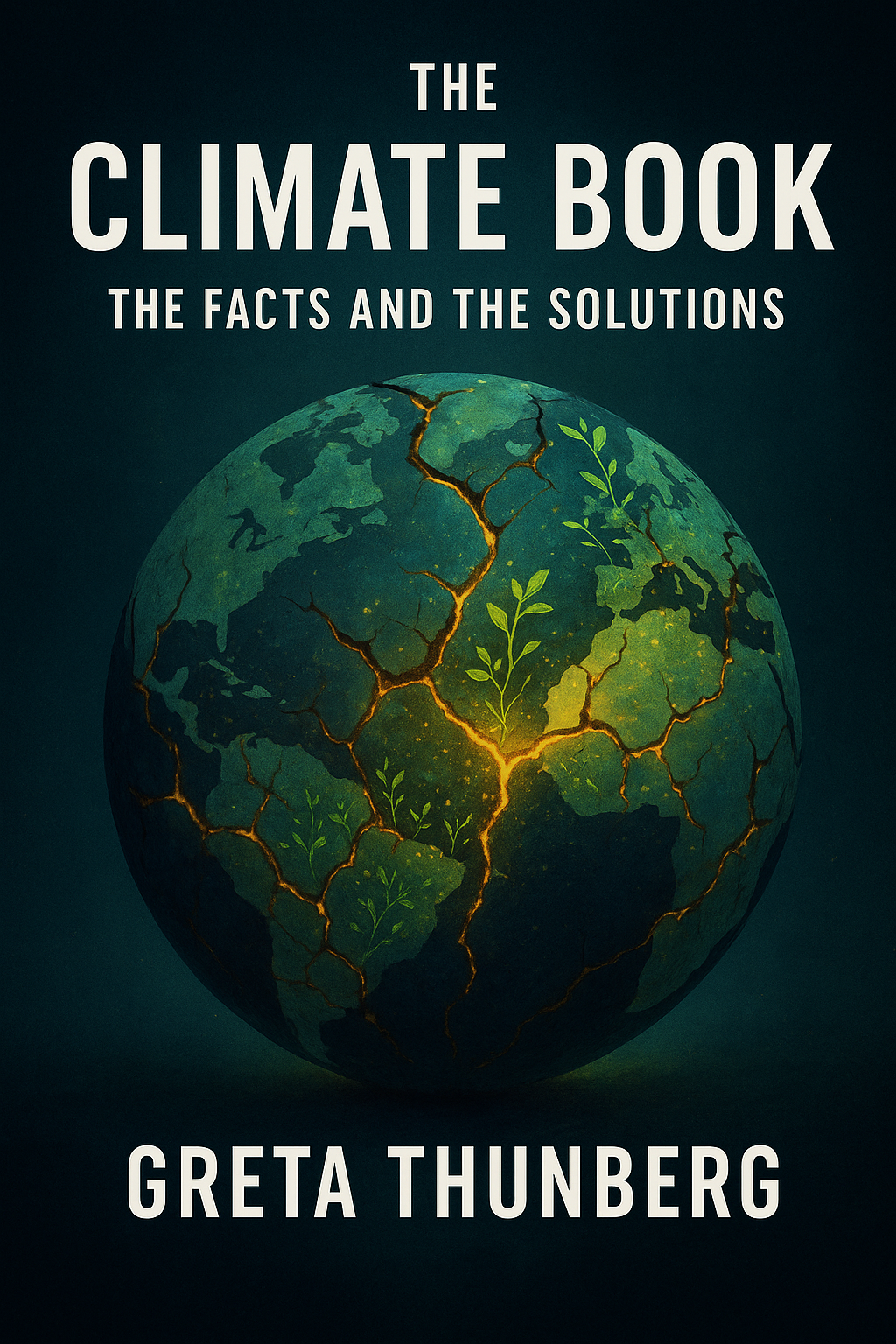
The Climate Book: The Facts and the Solutions
Chapter Summaries
What's Here for You
Are you ready to confront the most defining challenge of our time? 'The Climate Book' by Greta Thunberg, drawing on the wisdom of leading scientists, isn't just a book; it's an urgent call to action, a clear-eyed assessment, and a beacon of hope. Prepare to have your understanding of the climate and ecological crisis fundamentally reshaped. This book dives deep into the mechanics of our changing planet, revealing that the extreme weather events we witness are merely the opening act of a rapidly escalating crisis. You will gain a profound understanding of how this crisis is not just an environmental issue, but a symptom of deep-seated inequality, where a small percentage of the wealthiest disproportionately contribute to emissions. The tone is unflinching and direct, confronting the stark reality of our collective inaction and the inconvenient truth that saving our world is a voluntary act. But this is not a book of despair. Thunberg powerfully argues that while individual actions are important, they are insufficient on their own. You will discover the essential dual approach needed: the critical integration of individual commitment and sweeping systemic change. This book will equip you with the knowledge to see beyond the superficial, to understand what has truly been done (and not done) about the crisis, and crucially, what must be done now. It promises to move you from a place of passive observation to active engagement, empowering you with the clarity and conviction to demand and enact the necessary transformations for a sustainable future. It's an intellectual journey that will ignite your sense of responsibility and an emotional call to join a global movement for change.
How Climate Works
Greta Thunberg, in 'How Climate Works,' confronts us with a stark truth: the climate and ecological crisis is humanity's greatest existential threat, a defining issue for our future, yet one our societies are still largely in denial about. She argues that the pervasive culture of debate and compromise, so ingrained in our current society, is fundamentally wrong when applied to sustainability; some issues, like planetary boundaries, are indeed black and white – you are either sustainable or you are not, much like walking on thin ice that either holds or breaks. Thunberg asserts that avoiding the worst consequences requires creating a critical mass of people demanding change, which in turn necessitates a rapid spread of basic knowledge, a gap this book aims to fill by presenting current science holistically. She reveals that the climate crisis is a symptom of a larger sustainability crisis, woven from interconnected problems, and calls for a clear understanding of what we truly aim to solve: is it merely lowering emissions, or fundamentally changing our high-consumption way of life? The author highlights a critical insight: the richest 1% are responsible for more than double the carbon pollution of the poorest half of humanity, underscoring that the concept of hope is not uniform for all. She exposes how emissions are often cleverly managed through statistics, such as outsourcing production, leading to a deceptive picture of progress, and illustrates that to meet climate targets, per capita emissions must drastically decrease, a feat requiring systemic transformation, not naive optimism. Beth Shapiro and Elizabeth Kolbert contribute by tracing humanity’s evolutionary impact, from the extinction of megafauna to the transformation of landscapes through agriculture, demonstrating how Homo sapiens have consistently been an evolutionary force shaping other species' fates. Kolbert further details how the Industrial Revolution, amplified by 'late capitalism' and the 'Great Acceleration,' exponentially increased human impact, leading to widespread habitat destruction and the current trajectory towards the Sixth Extinction, uniquely caused by us. Michael Oppenheimer and Naomi Oreskes delve into the history of climate science and the deliberate obfuscation by the fossil fuel industry, explaining how decades of scientific consensus were met with misinformation campaigns, designed to create doubt and delay action, often mirroring tactics from the tobacco industry. Oreskes stresses that the crisis is not just an environmental issue but a manifestation of a broken economic system, where the pursuit of profit by a few has led to the suffering of many and the potential destruction of the planet. Thunberg concludes by emphasizing that while technology and laws are insufficient, a fundamental shift in public opinion, driven by morality, empathy, science, media, and democracy, is essential. She argues against dictatorship, asserting that justice and equal rights are paramount, and that an informed citizenry is democracy’s best defense against manipulation. The science, she insists, is unequivocal; the challenge lies in how we frame and communicate this urgent story, acknowledging historical emissions and equity, and embracing our collective responsibility to act now, for the crisis cannot be fixed later or by anyone else, demanding that we all learn to tell it like it is, without exaggeration or sugarcoating, before it is too late.
How Our Planet Is Changing
The narrative begins with a stark pronouncement: the seemingly extreme weather events we witness—wildfires, hurricanes, heatwaves—are not the 'new normal' but merely the prologue to a rapidly escalating climate crisis. Greta Thunberg, through the collected voices of scientists, reveals that Earth's natural systems, once a buffer, are nearing their limits, and we are entering an era of unprecedented change. This crisis, far from being a distant threat, is unfolding here and now. The author explains that human emissions of greenhouse gases have trapped heat, leading to what is often called 'global warming,' but experienced as 'global weirding'—weather patterns that feel increasingly unnatural and extreme. Katharine Hayhoe illustrates this with heatwaves, noting that events once rare are becoming common, and even 'double sevens' on the dice of weather are appearing, with climate change doubling the risk of such events and, in extreme cases like the 2021 Canadian heatwave, making them 150 times more likely. This intensified heat stresses ecosystems, leading to marine heatwaves, coral bleaching, and mass die-offs on land, while also threatening human health, infrastructure, and exacerbating inequalities, as the most vulnerable bear the brunt. Zeke Hausfather then shifts focus to the array of greenhouse gases beyond carbon dioxide, highlighting methane's potent, albeit shorter-lived, warming effect. He uses the analogy of cows versus a power plant to distinguish methane's emission-rate dependency from CO2's cumulative impact, emphasizing that reducing methane offers a quicker path to temperature stabilization, though both are critical. Bjrn H. Samset introduces the complex role of aerosols—tiny particles from combustion—which, while hazardous to health, currently mask a significant portion of greenhouse gas warming by reflecting sunlight. As we clean our air, this cooling effect will diminish, potentially accelerating warming in the short term. Paulo Ceppi delves into the intricate role of clouds, which possess a dual nature: reflecting sunlight (cooling) and trapping heat (warming). Despite their complexity and the uncertainties they introduce into climate models, current evidence suggests clouds are amplifying global warming, not suppressing it, a sobering insight that underscores the urgency to cut emissions. Jennifer Francis connects Arctic amplification—the rapid warming of the polar region—to a destabilized jet stream, leading to more persistent and extreme weather patterns across the Northern Hemisphere, a phenomenon that explains the seemingly erratic and devastating weather events of recent years. Friederike Otto emphasizes the power of attribution science, which now quantifies the human contribution to specific extreme events, like Hurricane Harvey's increased rainfall, highlighting that human-induced climate change is a direct cause of immense suffering and economic damage, often disproportionately affecting the most vulnerable. Stefan Rahmstorf details the ocean's role as a heat sink, absorbing over 90% of excess heat, leading to thermal expansion and rising sea levels, a process that will continue for centuries even if emissions cease, and warns of the potential collapse of the Atlantic Meridional Overturning Circulation (AMOC), a critical heat-transporting system. HansOtto Prtner and Ricarda Winkelmann address the dual threat of ocean acidification, which harms marine life by reducing calcification, and the alarming melting of ice sheets in Greenland and Antarctica, potentially triggering irreversible tipping points with meters of sea-level rise. The chapter then expands to terrestrial impacts: Kate Marvel explains how a warmer atmosphere holds more water, intensifying both droughts and floods, while Jolle Gergis details how climate change fuels megafires, transforming landscapes and releasing vast carbon stores. Carlos A. Nobre et al. highlight the Amazon's critical role as a climate regulator, now threatened by deforestation and warming, pushing it towards a 'savannization' tipping point. Beverly E. Law discusses the dual role of boreal and temperate forests, vital carbon sinks increasingly threatened by warming, wildfires, and logging, while Adriana De Palma and Andy Purvis underscore the broader crisis of biodiversity loss, driven by habitat destruction and climate change, which weakens ecosystems' ability to mitigate and adapt. Dave Goulson paints a grim picture of insect decline, essential for ecosystems and agriculture, driven by habitat loss, pesticides, and climate change, and Keith W. Larson explains how phenology—the timing of natural events—is disrupted, creating mismatches that threaten species survival and food webs. Finally, Jennifer L. Soong and rjan Gustafsson reveal the immense threat posed by thawing permafrost, a vast carbon store that could accelerate warming through positive feedback loops, especially in the Arctic, while Tamsin Edwards projects the starkly different realities awaiting us at 1.5C, 2C, and 4C of warming, emphasizing that every fraction of a degree avoided is critical for averting catastrophic, irreversible changes.
How It Affects Us
The world, Greta Thunberg explains, has a fever, a symptom of a deeper sustainability crisis born not from rising temperatures themselves, but from a system of profound inequality where a mere ten percent of the wealthiest cause half of all CO2 emissions, a stark illustration of how social and economic structures, driven by the illusion of infinite growth on a finite planet, push us toward an ecological precipice. This crisis, she reveals, was not created by humankind as a whole, but by those in power who knowingly sacrificed priceless values for unimaginable wealth, a system that mirrors the unforeseen consequences of pandemics, like COVID-19, which emerged from our destruction of natural habitats, laying the groundwork for future epidemics, as Tedros Adhanom Ghebreyesus of the WHO starkly warns that we are creating conditions where epidemics flourish, forcing migration and chasing economic growth that has become a malignancy, writing checks that civilization cannot cash. The chapter powerfully details how climate change directly impacts human health, with Ana Maria Vicedo-Cabrera highlighting that 37 percent of heat-related deaths are already attributable to climate change, and Drew Shindell underscores that roughly ten million deaths annually from air pollution stem from the same fossil fuel sources driving climate change, suggesting that cleaner air and a stable climate are achievable through shared solutions like ending fossil fuel burning and promoting plant-based diets, which offer immediate health benefits that far outweigh the costs. Felipe J. Coln-Gonzlez further elaborates on the spread of vector-borne diseases like malaria and dengue, noting how rising temperatures create ideal conditions for transmission, expanding their reach into previously unaffected regions, while John Brownstein, Derek MacFadden, Sarah McGough, and Mauricio Santillana raise concerns about the intertwined threat of antibiotic resistance, which may also be exacerbated by a warming climate, potentially leading to millions of deaths and trillions in economic losses by mid-century if unchecked. Samuel S. Myers reveals a more insidious impact: rising CO2 levels are making staple crops less nutritious, diminishing vital elements like iron, zinc, and protein, potentially pushing hundreds of millions into deficiency and exacerbating existing global health crises, a stark reminder that our disruption of planetary systems returns to haunt us through our very sustenance. Jacqueline Patterson draws a direct line from historical white supremacy and exploitation to modern environmental racism, where sacrifice zones, disproportionately populated by low-income communities and people of color, bear the brunt of pollution and extreme weather, illustrating how the extractive economy continues to oppress, while Abrahm Lustgarten and Taikan Oki paint a chilling picture of climate migration, with millions displaced by droughts, floods, and uninhabitable heat, driven by a changing climate that threatens to destabilize global security and exacerbate resource conflicts, a stark reality for vulnerable communities who have contributed least to the crisis. Michael Taylor emphasizes that for small island nations, sea-level rise is not a future threat but a present-day existential crisis, eroding beaches, livelihoods, and entire communities, a fate disproportionately borne by those who have contributed the least to global emissions, a sentiment echoed by Hindou Oumarou Ibrahim from the Sahel, where traditional knowledge offers resilience against devastating floods and droughts that have shrunk Lake Chad and intensified resource conflicts, and Elin Anna Labba, who describes the heartbreaking struggle of the Sámi people as changing snow patterns decimate their reindeer herds, a tangible manifestation of a world where history and present-day colonialism repeat, leaving Indigenous peoples at the mercy of forces they did not create. The chapter concludes with a profound call to action, asserting that while the challenges are immense, with figures like 1.2 billion people potentially displaced by 2050, as Taikan Oki notes, hope lies not in adaptation but in truth, in collective action, and in recognizing that democracy, solidarity, and a fundamental shift away from fossil fuels are our only viable paths forward, as Marshall Burke highlights how climate change acts as a threat multiplier, amplifying existing conflicts, and Eugene Linden warns that the true cost of inaction, with potential civilization collapse and trillions in economic damage, far outweighs any price we might pay for immediate, transformative change, underscoring that our current trajectory is not merely unsustainable, but an existential threat to humanity.
What We’ve Done About It
The author, Greta Thunberg, confronts a stark reality: our collective failure to address the climate crisis stems not from a lack of information, but from a profound unwillingness to admit our failures and fundamentally change. She argues that saving the world is voluntary, a fact underscored by the absence of laws compelling action, and that true leadership is not in the hands of politicians or corporations driven by profit, but requires honesty, integrity, and courage. The chapter reveals a pervasive 'new denialism,' as highlighted by Kevin Anderson and Alexandra Urisman Otto, where official climate targets often exclude vast portions of actual emissions, creating a misleading narrative of progress. This deliberate obfuscation, coupled with a reliance on speculative technological fixes like carbon capture and storage (as detailed by Rob Jackson and Ketan Joshi) and unsustainable practices like BECCS, serves to maintain the status quo. Bill McKibben and Glen Peters underscore the persistent dominance of fossil fuels, even as renewables become cheaper, while Sonja Vermeulen and Michael Clark expose how our food systems, driven by demand for meat and dairy, are a colossal driver of environmental degradation, occupying vast lands and consuming immense resources. The interconnectedness of industrial production, consumption, and waste, as explored by John Barrett, Alice Garvey, and Silpa Kaza, reveals how offshoring emissions and the myth of recycling allow developed nations to appear proactive while perpetuating global inequities. Mike Berners-Lee and Annie Lowrey further dissect the insidious nature of consumerism, fueled by marketing and a culture that values excess, urging a pause before purchasing and a critical evaluation of our desires. The chapter emphasizes that true solutions, as articulated by Jason Hickel and Sunita Narain, lie not in technological silver bullets or endless economic growth, but in degrowth, systemic change, and a radical redefinition of progress that prioritizes equity and wellbeing. Amitav Ghosh’s poignant example of Ternates dying clove trees illustrates how historical injustices and geopolitical disparities fuel a perception gap, where the Global South feels it is their 'turn' to develop, even at environmental cost, while rich nations cling to their privileged lifestyles. Ultimately, the author asserts that the greatest obstacle is not a lack of awareness, but the failure to acknowledge our ignorance and the deeply ingrained systemic inertia that perpetuates a dangerous disconnect between our words and actions, leaving us light-years away from meaningful climate action. The core tension lies in the chasm between scientific urgency and political/societal inaction, a gap that can only be bridged by confronting uncomfortable truths and demanding a fundamental societal transformation, a 'whole new way of thinking.'
What We Must Do Now
Greta Thunberg, in 'What We Must Do Now,' asserts that confronting the climate crisis demands a dual approach: individual action and systemic change, for one cannot succeed without the other. She illuminates the pervasive societal tendency to focus on minor individual gestures, like reducing plastic use or offsetting flights, while leaders often engage in 'saying one thing while doing the exact opposite,' exemplified by nations expanding fossil fuel infrastructure while claiming climate leadership. The author introduces the Swedish concept of 'folkbildning'—broad, free public education—as a crucial, yet often overlooked, tool, contrasting it with the more publicized 'flygskam' or flight shame. Thunberg argues that understanding the full picture of the crisis, rather than getting lost in divisive 'culture wars' over specific issues, is paramount. She critiques the deflection tactics of the fossil fuel industry, which shifted focus to individual carbon footprints, and the counter-argument that only a few companies are responsible, both leading to inaction. The chapter emphasizes that individual action, when amplified through activism and by using one's voice to hold power accountable, can indeed spark larger social transformations, a concept echoed by Stuart Capstick and Lorraine Whitmarsh who detail how social influence and behavioral contagion can shift norms and expectations. Kate Raworth's contribution highlights the deeply ingrained consumerist lifestyles driven by 20th-century economic theories and advertising, arguing for a radical rebalancing of consumption and ambitious government action like 'choice editing' to phase out harmful options and provide universal basic services. The psychological barriers to climate action, the 'Five Ds' of Distancing, Doom, Dissonance, Denial, and iDentity, are explored by Per Espen Stoknes, who proposes framing climate action as Social, Simple, Supportive, with Stories and Signals. Gidon Eshel points to diet, particularly reducing beef consumption, as a powerful lever for environmental amelioration, while Ayana Elizabeth Johnson reminds us of the ocean's crucial, yet often forgotten, role in climate regulation and its potential as a source of 'salty climate solutions.' George Monbiot and Rebecca Wrigley advocate for 'rewilding'—the mass restoration of damaged ecosystems—as a vital strategy for both planetary and psychic survival, stressing that Indigenous land stewardship is key. Michael E. Mann describes the 'new climate war' waged by inactivists using division, despair-mongering, and deflection, urging a focus on accountability and collective action, a sentiment amplified by Seth Klein's call for genuine emergency responses marked by significant spending, new economic institutions, mandatory measures, and truthful communication. David Wallace Wells draws parallels between the pandemic response and climate action, highlighting the potential for ambitious, whole-society mobilization, while Lucas Chancel and Thomas Piketty underscore the necessity of redistribution alongside decarbonization, noting that the wealthiest 10 percent are responsible for half of all emissions. Olf mi O. Tw connects climate justice to racial justice, framing it as 'worldmaking' that requires dismantling colonial structures and implementing reparations, a sentiment echoed by Laura Vernica Muoz, Ina Maria Shikongo, Ayisha Siddiqa, Mitzi Jonelle Tan, and Wanjira Mathai, who each, from their unique perspectives, emphasize the interconnectedness of social and ecological crises and the urgent need for collective, justice-centered action. Robin Wall Kimmerer beautifully illustrates the wisdom of Indigenous land stewardship through the 'One Bowl, One Spoon' philosophy, contrasting it with the destructive 'warehouse' worldview and advocating for a spiritual shift towards reciprocity and love for the Earth. Ultimately, Thunberg concludes by stating that hope is not passively received but actively earned through action, urging readers to 'tell it like it is' and take the helm in creating the future, for the time for incremental change is long past and only bold, collective action can avert catastrophe.
What Next?
The author, Greta Thunberg, confronts the stark reality that incremental changes and individual consumption choices, while seemingly important, are insufficient to avert the climate crisis. She argues that focusing solely on switching light bulbs or recycling, though not without merit, risks creating a false sense of security, suggesting that our current systems can accommodate these adjustments. The narrative pivots to the colossal scale of global consumption, exemplified by the Ever Given container ship incident, illustrating how cheap, dirty bunker fuel powers a system that ships goods across the globe, only for much of the 'recycled' waste to end up polluting distant lands. This cycle of production, consumption, and disposal, often disguised by statistics that exclude crucial emissions like international shipping, reveals a fundamental unsustainability. Thunberg stresses that exceeding planetary boundaries, even through seemingly unavoidable actions like paying taxes that subsidize fossil fuels, has dire consequences, particularly for those least responsible and most vulnerable. The chapter then shifts to a call for radical honesty and systemic change, asserting that technological fixes alone are no longer viable given the late stage of the crisis. Instead, it proposes a redefinition of hope and progress, emphasizing that solutions can also mean stopping harmful activities. The author outlines a multi-layered approach, requiring structural, systemic, and cultural transformations, and highlights that while individual actions matter, they must be part of a larger movement. She underscores the urgency, stating that our leaders have failed, turning a changing climate into an unavoidable crisis, and that now is the time to transform rage into action. The core tension is the inadequacy of current systems and individualistic solutions against the existential threat, resolved by a demand for systemic overhaul and collective responsibility. The narrative emphasizes that while the worst consequences can still be avoided, it requires treating the crisis as the emergency it is, admitting past failures, and demanding justice and reparations from those most accountable. The author implores readers to recognize that this is not merely an environmental issue but a crisis of inequality and injustice, and that a just transition requires acknowledging historical wrongs and ensuring that solutions benefit everyone, especially the most affected populations. The chapter concludes with a powerful plea for collective action, urging a shift from a consumer mindset to a citizen's role in demanding fundamental societal change, as only through such transformation can true hope and a sustainable future be realized.
Conclusion
Greta Thunberg's "The Climate Book" delivers a powerful, urgent synthesis of the climate and ecological crisis, emphasizing its existential nature and the profound societal inertia hindering effective action. The book dismantles the illusion of incremental change, revealing that our current systems, driven by historical injustices and a relentless pursuit of infinite growth, are fundamentally misaligned with planetary survival. The core takeaway is that the crisis is not merely an environmental issue but a symptom of systemic inequality, demanding a radical redefinition of our economic and social structures. Thunberg underscores that scientific consensus has been deliberately obscured by disinformation, creating a public "miasma of falsehoods" that necessitates a collective awakening driven by morality, empathy, and honest communication, rather than solely relying on technological fixes or political compromise. The emotional lesson is one of sober realism mixed with a call to unyielding courage; while the scale of the challenge can evoke despair, the book champions a reframing of hope, moving away from passive waiting towards active, voluntary, and collective engagement. It highlights the disproportionality of impact, reminding us that the most vulnerable, who contribute least, suffer the most, thus intertwining climate action with social justice and reparations. The practical wisdom lies in recognizing the interdependence of individual and systemic change, while critically assessing the limitations of individual choices within unsustainable frameworks. Thunberg advocates for a "folkbildning" – a deep public education – to foster genuine understanding and a shared commitment to truth. She stresses the need for governments to act with wartime urgency, implementing mandatory measures and binding carbon budgets, mirroring the scale of the emergency. Ultimately, the book urges a profound shift from a culture of denial and superficial solutions to one of honesty, integrity, and a willingness to admit systemic failure, embrace the cessation of harmful activities, and actively restore natural systems through methods like Indigenous land stewardship. The true cost of inaction, including potential civilizational collapse, far outweighs the investment required for transformative, equitable change, making immediate, bold action not just a necessity, but an ethical imperative.
Key Takeaways
The climate and ecological crisis is an existential threat that requires a fundamental shift from societal compromise to recognizing planetary boundaries as non-negotiable, akin to walking on thin ice where only survival or failure exists.
The current crisis is a symptom of a larger sustainability crisis, driven by systemic issues rooted in historical injustices like colonialism and fueled by a minority whose consumption patterns disproportionately harm the planet and its inhabitants.
Humanity's evolutionary path has consistently demonstrated our capacity to be a dominant ecological force, transforming landscapes and species' fates, a power now amplified by industrialization and capitalism to a potentially catastrophic degree, leading towards a human-caused mass extinction.
Decades of scientific consensus on climate change have been deliberately undermined by the fossil fuel industry and its allies through sophisticated disinformation campaigns, creating a 'public miasma of falsehoods' that hinders necessary action and masks the crisis as a broken economic system rather than mere environmental degradation.
Effective solutions require a fundamental change in public opinion, driven by morality, empathy, science, media, and democracy, rather than solely relying on technology or laws, and must acknowledge historical emissions and equity to be truly effective.
The science of climate change is unequivocally clear, and while communication tactics can be debated, the core message must be delivered honestly and without delay, recognizing that this crisis is cumulative, irreversible, and demands immediate, collective action from informed citizens.
The escalating frequency and intensity of extreme weather events are not anomalies but early indicators of a destabilizing climate system, driven by human greenhouse gas emissions, demanding immediate recognition and action.
While CO2 drives long-term warming, other greenhouse gases like methane offer opportunities for rapid temperature reduction, highlighting the need for a diversified mitigation strategy.
The Earth's natural systems, including aerosols and clouds, have historically masked some warming but are complex and unpredictable, and their diminishing buffering capacity underscores the urgency of emission cuts.
Arctic amplification is a critical driver of global weather pattern disruption, weakening the jet stream and leading to more persistent extreme weather across the Northern Hemisphere.
The science of extreme event attribution now clearly links specific weather disasters to human-induced climate change, quantifying the damage and reinforcing the ethical imperative to act.
The interconnected impacts of warming oceans, melting ice sheets, acidification, and terrestrial ecosystem degradation (forests, soils, permafrost) create a complex web of feedback loops that accelerate climate change and threaten biodiversity and human well-being.
The rate of climate change is outpacing the adaptive capacity of many species and ecosystems, leading to range shifts, phenological mismatches, and biodiversity loss, with severe consequences for planetary stability and human survival.
The climate crisis is a symptom of a deeper systemic inequality driven by the pursuit of infinite growth on a finite planet, necessitating a fundamental shift in our economic and social structures.
Climate change directly exacerbates human health risks, from increased heat-related deaths and air pollution to the spread of infectious and vector-borne diseases, and even the nutritional quality of our food.
The impacts of climate change are disproportionately felt by the most vulnerable populations, highlighting environmental racism and global injustice, where those who contribute least suffer the most.
Climate change is a significant driver of mass migration and potential conflict, as resource scarcity and uninhabitable conditions force displacement and destabilize societies.
Indigenous knowledge and traditional practices offer vital, time-tested solutions for climate adaptation and mitigation, demonstrating sustainable ways of living in harmony with nature.
The true cost of climate change, including potential civilization collapse and trillions in economic damage, far outweighs the cost of taking immediate, transformative action.
The climate crisis is perpetuated by a 'new denialism' where official emissions targets intentionally exclude significant portions of actual emissions, creating a false sense of progress.
True climate action is voluntary and requires honesty, integrity, and courage, as current political and corporate systems are fundamentally misaligned with planetary survival due to profit motives and short-term thinking.
Consumerism, amplified by pervasive marketing and a culture of excess, drives unsustainable demand, with affluent nations bearing disproportionate responsibility and needing to drastically reduce consumption rather than relying on superficial 'green' alternatives.
The global food system is a major driver of environmental degradation, and transitioning to plant-based diets is a critical, impactful step for mitigating climate change and improving health.
Industrial production and waste management are deeply intertwined with consumption, and offshoring emissions, coupled with the myth of widespread recycling, allows developed nations to maintain unsustainable lifestyles while perpetuating global inequities.
Technological solutions alone, such as carbon capture and storage or geoengineering, are insufficient and often serve as distractions, masking the urgent need for systemic societal change, reduced consumption, and a shift away from fossil fuels.
Historical injustices and geopolitical disparities create a perception gap, where nations that contributed least to the crisis suffer most, making climate equity and a fair distribution of the remaining carbon budget essential for global cooperation and genuine climate action.
Systemic change and individual action are interdependent and both are essential for addressing the climate crisis.
Effective climate action requires a deep understanding of the crisis's full scope, moving beyond divisive debates to embrace 'folkbildning' (public education) and collective awareness.
Psychological barriers like 'distancing' and 'doom-mongering' hinder action; reframing climate issues as social, simple, supportive, and story-driven can foster engagement.
True climate solutions must integrate social justice, recognizing that historical inequalities and exploitation are deeply intertwined with ecological breakdown, necessitating 'just transitions' and reparations.
The mass restoration of ecosystems, particularly through Indigenous land stewardship, offers powerful natural climate solutions and a path to reconnect with the Earth.
Governments must shift from voluntary measures to mandatory actions, significant spending, and the creation of new economic institutions, mirroring wartime mobilization, to treat the climate crisis as the existential emergency it is.
Individual action, when amplified through collective movements and by holding power accountable, can create social tipping points and redefine what is politically possible.
Focusing on individual consumption choices and small-scale actions within existing unsustainable systems creates a dangerous illusion of progress, diverting attention from the urgent need for fundamental systemic change.
The global economic system, particularly through industries like shipping and waste management, externalizes environmental and social costs, often masking true emissions and perpetuating a cycle of pollution and exploitation, especially in the Global South.
Admitting systemic failure—across politics, economics, and societal norms—is a necessary precursor to learning from mistakes and implementing effective, transformative solutions rather than incremental adjustments.
True climate solutions require a radical redefinition of hope and progress, shifting from notions of endless growth and technological fixes to embracing the cessation of harmful activities and the restoration of natural systems.
Addressing the climate crisis is inextricably linked to social justice, requiring historical reparations and accountability from high-emitting nations and corporations, as those least responsible suffer the most.
The urgency of the climate crisis demands treating it as an emergency, necessitating binding carbon budgets, comprehensive emissions accounting, and a transition to a just, equitable, and sustainable global society.
Action Plan
Educate yourself on the fundamental science of the climate and ecological crisis, understanding it as a complex, interconnected system.
Challenge the notion that all issues are subject to endless debate and compromise by identifying and advocating for non-negotiable planetary boundaries.
Critically examine consumption habits and question the assumption of perpetual economic growth on a finite planet, considering personal and societal impacts.
Seek out and share information from credible scientific sources, actively combating misinformation and understanding the tactics used to obscure the truth.
Engage in public discourse and democratic processes, demanding transparency and accountability from leaders and corporations regarding climate action and historical emissions.
Support systemic change by advocating for policies that address equity and historical responsibility, rather than focusing solely on individual carbon footprints.
Practice 'telling it like it is' in personal conversations and public forums, using morality, empathy, and science to communicate the urgency of the crisis without exaggeration or despair.
Educate yourself and others about the interconnected nature of climate change impacts across different Earth systems.
Advocate for and support policies that drastically reduce greenhouse gas emissions, focusing on both CO2 and short-lived climate forcers like methane.
Recognize that individual actions, while important, must be amplified by systemic changes in energy, agriculture, and land use.
Support conservation and restoration efforts for critical ecosystems like forests, oceans, and soils, which play a vital role in carbon sequestration and biodiversity.
Engage in public discourse and demand accountability from leaders regarding climate pledges and actions, challenging narratives that downplay the crisis.
Understand and communicate the disproportionate impact of climate change on vulnerable communities, advocating for equitable solutions.
Prepare for and adapt to the increasing frequency and intensity of extreme weather events by supporting resilient infrastructure and community preparedness.
Educate yourself and others about the systemic drivers of the climate crisis, focusing on inequality and unsustainable growth models.
Advocate for policies that prioritize public health and environmental justice, particularly for the most vulnerable communities.
Support and amplify the voices and knowledge of Indigenous peoples and frontline communities who are developing innovative climate solutions.
Examine and challenge the pursuit of 'infinite growth' in economic and personal spheres, seeking instead sustainable and equitable alternatives.
Demand transparency and accountability from governments and corporations regarding emissions data and climate policies.
Recognize that climate change is a threat multiplier that exacerbates existing conflicts and injustices, and advocate for peace and resource sharing.
Engage in collective action and political organizing to influence leaders and drive systemic change, rather than relying solely on individual lifestyle adjustments.
Critically evaluate all media messages and advertising, questioning who is influencing you and the values they promote.
Practice a 'pause before purchase' routine, asking 'Why do I need this?' and considering if the urge to buy stems from a deeper need or external influence.
Prioritize repairing, sharing, or borrowing items over buying new ones to reduce resource consumption and support a circular economy.
When purchasing new items, research brands and their supply chains, opting for durable, repairable products and avoiding companies with unsustainable practices.
Shift towards plant-based diets, reducing consumption of meat and dairy, and minimizing food waste by eating all purchased food.
Advocate for systemic change by supporting policies that hold corporations accountable for their emissions and promote circular economy principles.
Educate yourself on your own consumption patterns and their environmental footprint, understanding how your choices connect to global industrial and waste systems.
Challenge the narrative of 'business as usual' by questioning claims of sustainability and demanding transparency and accountability from leaders and industries.
Educate yourself and others about the full scope of the climate and ecological crisis, moving beyond isolated issues to understand the interconnected systems.
Amplify your voice by engaging in activism, holding leaders accountable, and using any platform you have to communicate the urgency of the situation.
Support and participate in movements that advocate for systemic change, recognizing that collective action is the engine of transformation.
Actively seek out and support 'folkbildning' (public education) initiatives that provide accessible, fact-based information about the climate crisis.
Practice 'choice editing' by supporting policies that phase out harmful consumption options and promote universal basic services, while also examining your own consumption patterns.
Engage with nature through practices like rewilding or supporting Indigenous land stewardship, fostering a reciprocal relationship with the Earth.
Demand that governments and institutions treat the climate crisis as the existential emergency it is, by spending what it takes, implementing mandatory measures, and communicating truthfully about the severity of the situation.
Support initiatives that promote climate justice and reparations, recognizing that ecological breakdown is deeply linked to historical and ongoing social injustices.
Treat the climate and ecological crisis as the emergency it is, demanding immediate and radical systemic change.
Admit the failure of current political and economic systems in addressing the crisis and learn from these mistakes.
Advocate for and support policies that establish binding, science-based annual carbon budgets, including all emissions.
Demand accountability and reparations from high-income nations and corporations for historical and ongoing climate damage.
Educate yourself and others about the full scope of the crisis, including systemic issues and interconnected injustices.
Engage in activism, using your voice and actions to speed up democratic processes, shift social norms, and demand justice.
Amplify the voices of those on the front lines of the climate crisis (MAPA) and support their narratives.
Shift personal consumption habits as a form of activism and moral choice, focusing on reducing overall resource usage and demanding systemic change.
Support and invest in renewable energy, nature restoration, and carbon sequestration methods, while divesting from fossil fuels.