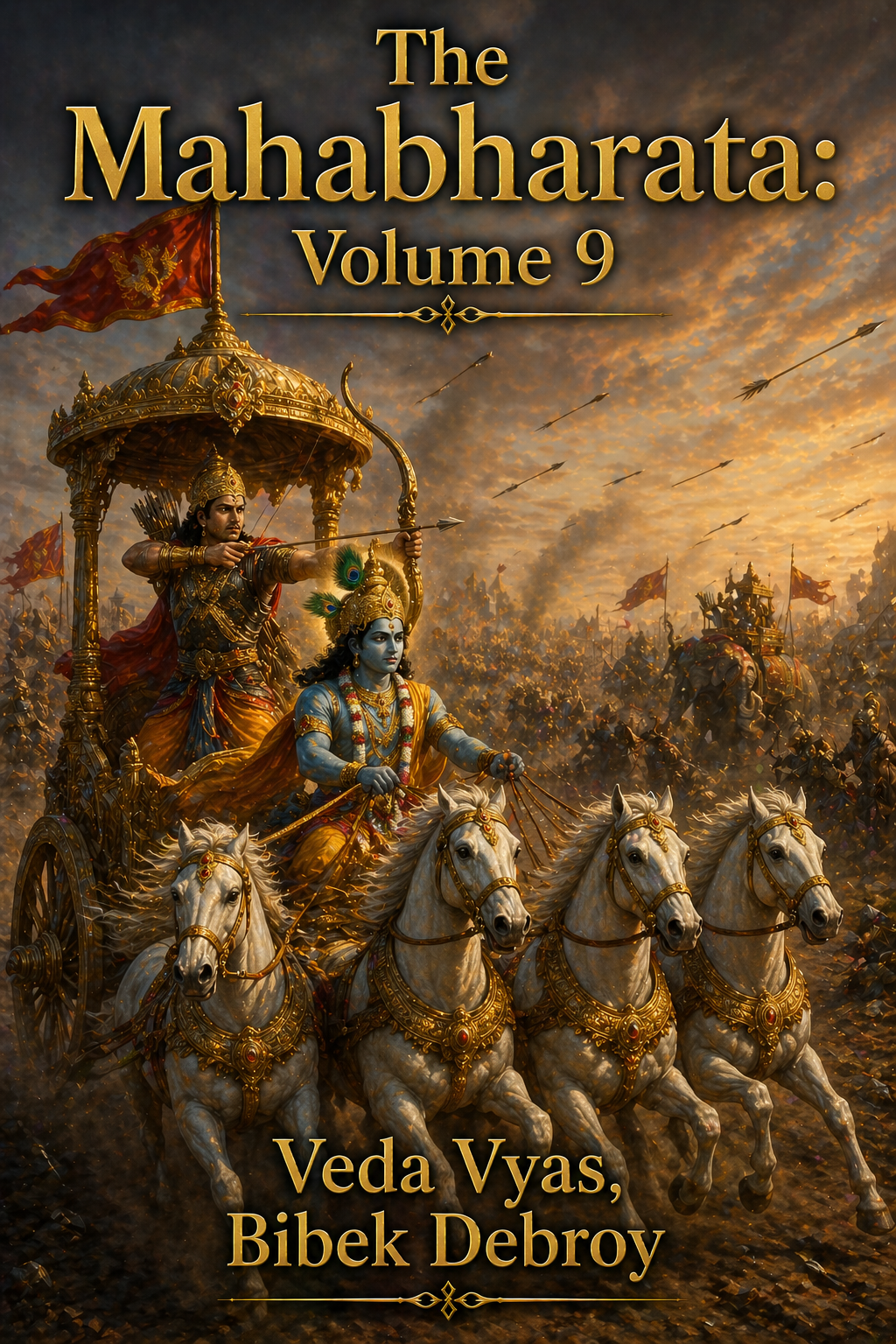
The Mahabharata: Volume 9
Chapter Summaries
What's Here for You
Embark on a journey of profound wisdom and solace within the pages of The Mahabharata: Volume 9. Prepare to delve into timeless teachings on dharma and liberation from the venerable Bhishma, as he imparts invaluable lessons to a guilt-ridden Yudhishthira. Through ancient tales and insightful discourses, you'll explore the path to moksha, uncovering the nature of Vishnu as the uncreated creator, and discover how to navigate suffering with resilience. This volume promises not just knowledge, but a transformative experience, offering a path towards inner peace and a deeper understanding of life's profound questions, echoing with ancient wisdom and compassionate guidance.
Moksha Dharma parva
Part 1: In the Moksha Dharma Parva, Bhishma, the wise elder, embarks on a profound discourse on liberation, or moksha, at Yudhishthira's request, revealing ancient wisdom sourced from figures like Rama, Narada, and Vyasa himself; he paints Vishnu as the uncreated creator, the origin and destination of all beings, setting the stage for understanding the divine's pervasive role. Bhishma recounts the creation myth, where Vishnu, in his Purushottama form, gives rise to wind, energy, and the earth, then rests upon the waters, a lotus sprouting from his navel from which Brahma emerges, highlighting the cyclical nature of creation and destruction. The narrative tension arises from Yudhishthira's quest to understand Krishna's true nature, with Bhishma emphasizing that Krishna is not merely a man but an eternal, inconceivable being. Bhishma then shifts to the lineage of Prajapatis, detailing their roles in populating the world, and emphasizes Vishnu's incarnation as a boar to slay the danavas, demonstrating divine intervention to restore cosmic order; like a tapestry woven with threads of dharma, artha, and kama, the chapter intricately details the cosmic hierarchy and the eternal play of good and evil. A key insight emerges: true liberation requires understanding the self's connection to the divine and transcending the cycle of birth and death, but the path is fraught with challenges, as highlighted by the tale of the danavas and Vishnu's boar avatar. Bhishma then shares a conversation between a preceptor and disciple, exploring the nature of Brahman and the illusion of separateness, emphasizing that Vasudeva is everything in the universe. The preceptor elucidates the roles of prakriti and purusha, the interplay of senses and qualities, guiding the disciple towards realizing the atman within the body, a spark of the divine waiting to be recognized. The path to moksha, it is revealed, involves detaching from worldly desires, controlling the senses, and cultivating virtues like truthfulness, purity, and non-violence, as these are the tools to burn the seeds of karma and prevent rebirth. Finally, the chapter presents dialogues between Indra and figures like Prahlada, Bali, and Namuchi, each grappling with loss and adversity, yet finding wisdom in understanding the transient nature of existence and the power of destiny, resolving to remain steadfast in virtue despite their circumstances. As Bhishma concludes, the emphasis remains on self-control, wisdom, and devotion as the means to navigate life's trials and ultimately attain liberation.
Dana Dharma parva
In the Dana Dharma parva of the Mahabharata, Bhishma, wounded and lying on a bed of arrows, imparts profound lessons on dharma to Yudhishthira, who is burdened by guilt and seeks solace. Bhishma begins by recounting the ancient tale of Goutami, a hunter, and a serpent to illustrate that suffering arises from one's own deeds and the subtle grasp of causality. He then narrates the story of Sudarshana and Oghavati, where Sudarshana’s unwavering commitment to honoring a guest, even at the cost of his wife's virtue, leads to a divine revelation and conquering of death, thus highlighting the paramount importance of hospitality. The narrative further explores the complex journey of Vishvamitra, a kshatriya who attained brahminhood through immense austerities, demonstrating the possibility of transcending one's birthright through perseverance. Bhishma delves into the debate between destiny and human endeavor, ultimately concluding that while destiny plays a role, human action is crucial for achieving success and prosperity, like a field requiring both seed and cultivation. A sensory scene emerges as the story of a parrot refusing to abandon its withered tree, illustrating the power of devotion and non-violence, prompting Shakra to revive the tree as a boon. Krishna then reveals the qualities in individuals where Shri, the goddess of fortune, resides, and those she avoids, emphasizing virtues like truthfulness, generosity, and devotion to dharma. Finally, the chapter addresses the question of pleasure during intercourse, recounted through the story of Bhangashvana, illustrating that women derive greater pleasure than men. Throughout, Bhishma navigates Yudhishthira's doubts, illuminating the path to dharma amidst life's complexities and moral ambiguities.
Conclusion
The Mahabharata, through Bhishma's teachings, illuminates the path to moksha, emphasizing self-awareness, dharma, and detachment. Suffering arises from actions, not external blame, demanding introspection. While destiny exists, effort shapes our future. True devotion involves selfless dedication. The goddess Shri favors ethical conduct. Ultimately, understanding diverse perspectives is key to dharma and spiritual growth, enabling transcendence.
Key Takeaways
True liberation (moksha) requires understanding the self's connection to the divine and transcending the cycle of birth and death.
The path to moksha involves detaching from worldly desires, controlling the senses, and cultivating virtues like truthfulness and non-violence.
Recognizing the transient nature of existence and the power of destiny is essential for maintaining inner peace amidst life's adversities.
Wisdom and self-control are paramount for navigating life's trials and ultimately achieving liberation.
The interplay of prakriti (nature) and purusha (consciousness) shapes the universe, and understanding this dynamic is key to enlightenment.
Suffering is a consequence of one's own actions, not solely the actions of others, demanding introspection rather than blame.
Unwavering commitment to dharma, such as hospitality, can lead to divine intervention and the transcendence of limitations.
Social roles are not fixed; one can elevate oneself through dedicated effort and spiritual growth, regardless of birth.
While destiny influences events, human effort is indispensable for achieving desired outcomes and shaping one's future.
True devotion involves selfless dedication, even when faced with difficult choices, demonstrating the power of unwavering faith.
The goddess Shri resides in individuals who embody virtues like truthfulness, generosity, and service, highlighting the importance of ethical conduct.
True dharma requires understanding and respecting the inherent qualities and experiences of others, recognizing diverse perspectives.
Action Plan
Reflect daily on your connection to the divine and the interconnectedness of all beings.
Practice detachment from worldly desires by consciously identifying and letting go of attachments.
Cultivate virtues like truthfulness, purity, and non-violence in your daily interactions.
Develop self-control by consciously monitoring and regulating your senses and impulses.
Contemplate the transient nature of existence and accept the inevitability of change.
Seek wisdom through the study of sacred texts and engagement with spiritual teachers.
Practice mindfulness to cultivate inner peace and resilience in the face of adversity.
Reflect on your own actions and identify any patterns of behavior that may be contributing to your suffering.
Commit to honoring guests and offering hospitality, even when it requires personal sacrifice.
Identify a skill or quality you admire and dedicate yourself to developing it through consistent effort.
Examine your beliefs about destiny and identify areas where you can take more control of your life.
Practice non-violence and compassion in your interactions with others, even when it is difficult.
Cultivate virtues like truthfulness, generosity, and service in your daily life.
Seek to understand the perspectives of others, even when they differ from your own.