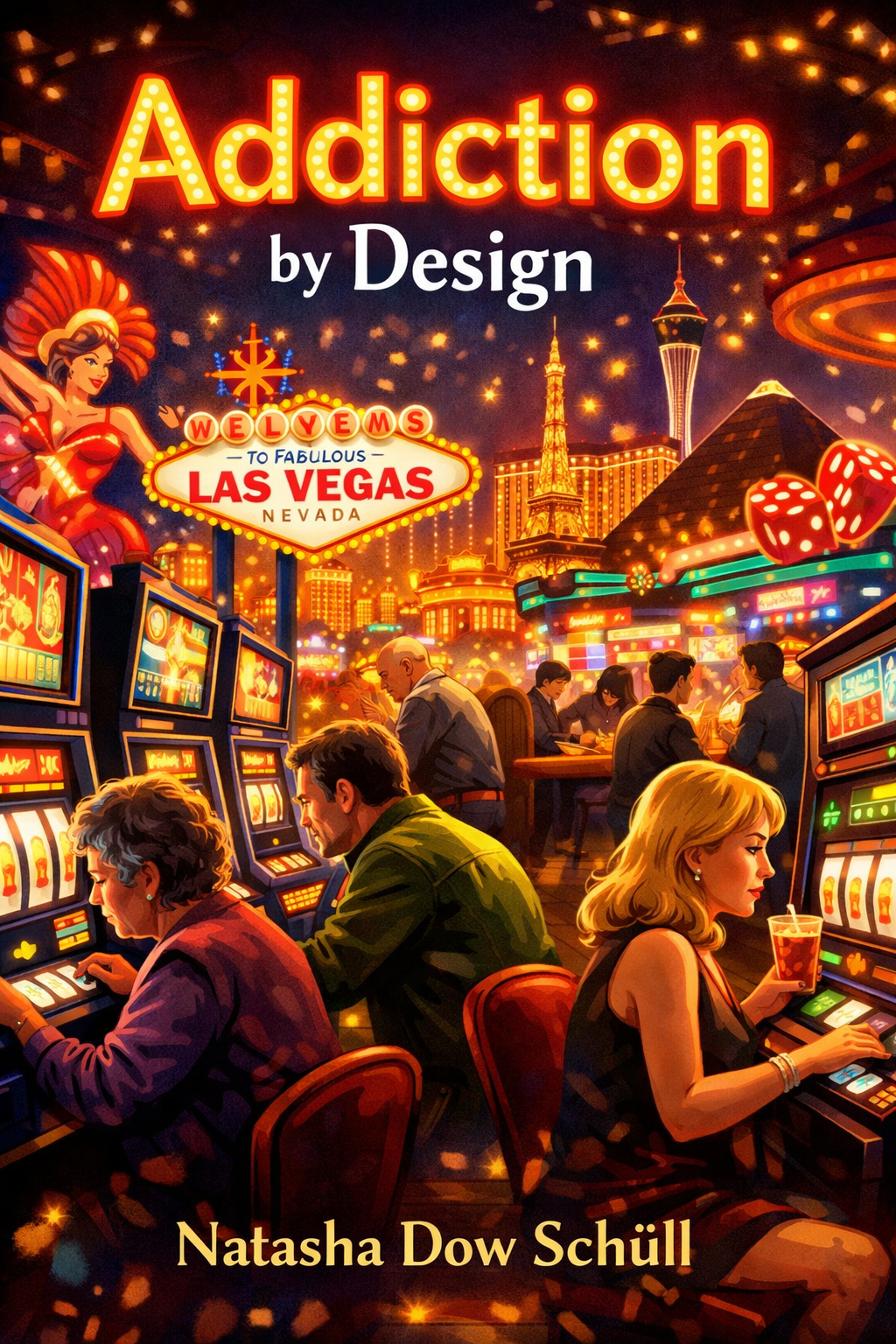
Addiction by Design
Chapter Summaries
What's Here for You
Prepare to enter the captivating and unsettling world of machine gambling. "Addiction by Design" offers an unprecedented look into the intricate relationship between technology, psychology, and the gambling industry. This book promises to dissect the seductive power of slot machines, revealing how casinos are meticulously engineered to capture and hold players in a state of near-hypnotic engagement. You'll gain a deep understanding of the architecture, algorithms, and data-driven strategies that fuel addiction, exploring the ethical dilemmas and societal consequences of this high-stakes game. Expect a thought-provoking and at times disturbing exploration, challenging your assumptions about free will, personal responsibility, and the very nature of pleasure and compulsion. Be prepared to confront the human cost of an industry built on the pursuit of the 'zone', where the line between entertainment and oblivion blurs.
INTERIOR DESIGN FOR INTERIOR STATES: Architecture, Ambience, and Affect
In "Addiction by Design," Natasha Dow Schüll delves into the intricate relationship between casino environments and the psychology of machine gambling, focusing on how interior design shapes the gambler's experience. Schüll begins by painting a stark scene: gamblers so engrossed they remain oblivious to emergencies, highlighting the zone's immersive power. Daniel's reflection reveals that the journey into the zone begins well before the casino floor, intensified by the architecture and atmosphere itself. Referencing "Learning from Las Vegas," Schüll contrasts modernist architecture with casinos' deliberate disorientation, designed for escapism rather than social ideals. The chapter pivots to Bill Friedman, the maverick casino design guru, whose maze-like layouts aim to lure and hold players, not through aesthetic appeal, but through applied behaviorism. Friedman's design principles prioritize the elimination of space, creating secluded playing worlds where gamblers feel insulated from the outside hubbub. Like a sensory deprivation chamber, casinos shrink space to expand the gambler's focus, using canopies and alcoves to offer perceptual shelter. Schüll explains that Friedman uses convolution, cues, and curvature to maintain gamblers' attention, guiding them deeper into the maze, and modulate affect through carefully controlled sensory atmospherics. The author emphasizes that, as Friedman advises, atmospheric elements operate most effectively when they remain subliminal, adjusting temperature, light, color, and sound to create an emotionally resonant environment that encourages longer play. Ultimately, Schüll argues that the architecture and ambiance of casinos work in concert with the gambling technology to create and maintain an otherworldly zone, where the line between intention and environmental influence blurs, and the appeal becomes palpably clear even to those trying to resist it.
ENGINEERING EXPERIENCE: The Productive Economy of Player-Centric Design
In "Addiction by Design," Natasha Dow Schüll unveils the intricate engineering behind the gambling experience, particularly how player-centric design aims to maximize continuous gaming productivity. Schüll begins by highlighting Leslie Cummings's breakdown of expediting play: accelerating speed, extending duration, and increasing spending. The industry's shift towards experience engineering, epitomized by WMS Gaming's "What Players Want" campaign, reveals a broader trend of mining consumer experiences for value, moving from goods and services to orchestrated experiences. The chapter explores how speed, a critical element of the zone, is technologically enhanced through push-buttons, touchscreens, and streamlined money handling, drawing parallels to the temporal discipline of factories where moments are the element of profit. Schüll masterfully paints a picture of gamblers suspended in time, seeking refuge in the predictable rhythms of mechanically mediated play. The narrative tension rises as the chapter delves into the industry's relentless pursuit of extending time-on-device, creating comfortable cocoons with personalized services and sensory environments, illustrated by Bally's Privacy Zone cabinets and WMS's emotive lighting. It’s a delicate dance of ambient intensities, balancing color, light, sound, and space to maintain the zone. The chapter crescendos as Schüll examines intensifying financial flow, detailing how innovations like TITO and mobile ATMs shrink the space between impulse and action, turning real money into the currency of the zone, a disconnection that gamblers like Nancy attest led to financial ruin. Schüll concludes by noting the asymmetric collusion between player and machine, where the gambler seeks an autotelic zone while the industry aims for complete depletion, a pursuit Sylvie Linard succinctly describes as playing to extinction, revealing a stark contrast between the gambler's suspension of value and the industry's relentless extraction of it, leaving individuals like Katrina in debt, not just financially, but to a system designed to capitalize on their desires.
PROGRAMMING CHANCE: The Calculation of Enchantment
In "Addiction by Design," Natasha Dow Schüll delves into the captivating world of gambling machines, revealing how these devices blend disenchantment and enchantment to keep players engaged. She begins with Rose, a slot machine mechanic, whose attempt to demystify the machines by learning their inner workings ironically deepened their allure, pinpointing the elusive 'mystery chip' as the heart of the game's inscrutability. Schüll draws on Max Weber's concept of disenchantment, noting how gambling machines, while scientifically calibrated for profit, paradoxically create a sense of wonder and incalculability. The industry thrives on this manufactured incalculability, obscuring the odds to heighten the thrill, as one Nevada regulator admits. As the chapter unfolds, Schüll traces the evolution from mechanical to digital slots, highlighting how digital technology enhances the illusion of control, even as it distances players from the actual mechanisms determining outcomes. The random number generator (RNG) becomes the 'Really New God,' an unpredictable force that captivates players, and virtual reel mapping further distorts perceptions, promising greater chances of payoff than reality. This distortion extends to near-miss effects, carefully engineered to encourage continued play, while legal loopholes permit these perceptual manipulations. Schüll introduces us to Roger Horbay, who designed software to demystify the machines, yet even he acknowledges that compulsive gamblers often bypass reason in pursuit of the 'zone.' Ultimately, Schüll reveals an asymmetric collusion: designers marshal technology to delude, while gamblers willingly suspend disbelief to chase the elusive enchantment, creating a gap between calculative rationality and intuitive play, where the industry profits and players seek the zone—a potent blend of hope and illusion.
MATCHING THE MARKET: Innovation, Intensification, Habituation
In "Addiction by Design," Natasha Dow Schüll delves into the intricate relationship between gambling machine design and player behavior, revealing a carefully calibrated system where technology and human tolerance co-evolve. Schüll introduces us to Mollie, a gambler whose escalating need for intensity mirrors the increasing complexity of the machines she plays, highlighting the concept of 'tolerance' as both an addictive and adaptive phenomenon. The industry, Schüll argues, doesn't just cater to existing preferences; it actively shapes them through payout schedules, the mathematical scripts that dictate reward frequency. Like Skinner's experiments, these schedules reinforce behavior, keeping gamblers engaged even as they lose. Designers, like Nicholas Koenig, see math as both the 'hook' and the 'hold,' gently persuading players to trust an invisible structure with their money. This leads to a demographic operation, matching player types—action players seeking big wins and escape players craving time-on-device—with specific game designs. Schüll vividly paints a picture of casinos, especially those catering to locals, as spaces designed for habit, not enchantment, filled with video poker machines that offer a semblance of skill and choice. The industry recognized that players valued time-on-device, engineering video poker to provide twice the play for the same investment, thus creating a lucrative formula. As video poker evolved, so did player strategies, shifting from jackpot chasing to more frequent, moderate wins, a change the industry subtly encouraged with billboard campaigns. This dynamic of responsive adjustment, where the industry picks up on player desires and recalibrates machines accordingly, has led to a shift in the gambling addiction profile, with more women becoming addicted to video poker's continuous rewards. Schüll then pivots to Australian-style video slots, which intensify hit frequency through multiple paylines, creating an illusion of constant winning even as players steadily lose. These machines offer a 'smoother ride,' masking losses and reinforcing play with sensory cues. Katrina, an Australian gambler, exemplifies this co-evolution, as she recalls how small changes in game design pushed her habituation to higher levels, revealing that innovation destabilizes tolerance, prompting further adjustments. Schüll underscores that gambling isn't a simple equation of supply and demand but an asymmetric interplay: gamblers seek homeostatic balance in the zone, while the industry ratchets up the intensity needed to reach it, creating a continuous loop of innovation and tolerance, a world where the machines are always matching, always upping the ante.
LIVE DATA: Tracking Players, Guiding Play
In "Addiction by Design," Natasha Dow Schüll delves into the intricate dance between the gambling industry and its patrons, focusing on how casinos gather and utilize player data to enhance profitability. It began with simple observation, as IGT's 1988 advertisement suggested, watching and listening to players. But the industry's methods have since evolved into sophisticated tracking systems. Schüll introduces us to Randy Adams, a game designer who embodies the industry's player-centric approach, emphasizing the importance of understanding what the customer wants. The chapter explores the shift from relying on intuition, the artist's touch, to embracing data-driven analysis, a world where, as Gary Loveman puts it, "intuition and hunch" are replaced with "science." Player tracking systems, like Harrah's Total Rewards, emerged as critical tools, transforming slot machines into networked surveillance devices, recording every bet, win, and break. The surveillance is not panoptic, but rather a subtle collection of data, turning gamblers into 'dividuals,' bundles of traits and habits. Behavioral analytics software, such as Mariposa and seePOWER, visualizes this data, creating heat maps that reveal collective behaviors and preferences. A casino floor becomes a living, breathing organism under the watchful eye of algorithms. These systems enable casinos to know more about players than they know about themselves, tailoring marketing campaigns with laser precision. Schüll then explores the concept of 'touch points,' where technology allows casinos to communicate directly with players at play, offering personalized bonuses and rewards. Harrah's even calculates a player's predicted lifetime value, offering special treatment to the most profitable. Downloadable gaming represents the apex of this trend, allowing casinos to adjust game elements in real time, responding to player preferences as they emerge. The chapter culminates with a glimpse into the future of mobile gambling, where games accompany players through physical space, and marketing becomes location-sensitive. The tension lies in the asymmetric relationship between the industry's analytical prowess and the gambler's intuitive play, a dynamic where the house increasingly knows the player better than the player knows the game, or even themselves. As Deleuze noted, we now live in control societies, where an invisible web of communicating information technologies works not to discipline and punish but to incite and reward.
PERFECT CONTINGENCY: From Control to Compulsion
In "Addiction by Design," Natasha Dow Schüll navigates the paradox of control in machine gambling, revealing how the pursuit of entertainment morphs into a compulsion for immersion. She starts by referencing Mihaly Csikszentmihalyi's concept of flow, a state of absorption where the self fades, noting how machine gambling, with its clear goals, immediate feedback, and sense of control, seems perfectly designed to induce it. However, unlike the enriching flow experienced by artists or athletes, gamblers often find themselves in a depleting, entrapping loop. Schüll challenges Csikszentmihalyi's view that addiction stems solely from individual predisposition, emphasizing the role of machine design in shaping the experience. A central tension emerges: despite industry rhetoric about entertainment, players often seek uninterrupted flow and self-erasure, rejecting innovations that disrupt their zone. Here, the author paints a vivid scene: casino managers puzzled by players who prefer to disable flashy bonus features, yearning for the seamless rhythm of the game. This leads to the concept of "perfect contingency," where the gambler's actions and the machine's responses become indistinguishable, blurring the lines of control and agency. Drawing on child development theory, Schüll explains how this perfect alignment, akin to an infant's seamless connection with its mother, can become a trap, hindering the development of tolerance for unpredictability. The modern gambling machine, with its stripped-down circuitry and carefully calibrated payout schedules, becomes a vehicle for retreat into this functional autism. Lola's words echo in the reader's mind, "I’m almost hypnotized into being that machine," encapsulating the gambler’s absorption. Schüll then explores how, over time, gamblers require less interaction to enter the zone, with some even turning to autoplay features that minimize agency. This challenges designers’ assumptions about the importance of choice and skill, highlighting the allure of pure chance and the rhythmic continuity of the zone. As Randy Adams confesses, compulsive gamblers seek modes of play that allow them to more perfectly and quickly enter the zone. Finally, Schüll considers Donna Haraway’s cyborg manifesto, questioning whether the gambler's relationship with the machine is one of symbiotic union or self-liquidation. The longer a gambler perseveres, the greater the odds of depletion, both financially and physically, with bodies left unattended, a stark reminder of the technology’s role in facilitating excess. The chapter closes with a chilling vision: a futuristic casino designed to keep gamblers chained to their machines, a dystopia made all the more disturbing by its player-centric attentiveness.
GAMBLED AWAY: Liquidating Life
In "Addiction by Design," Natasha Dow Schüll delves into the phenomenon of machine gambling, particularly video poker, through the experiences of individuals like Patsy, whose life becomes consumed by the zone, a state where the boundaries between play and reality blur. Schüll, acting as a seasoned guide, explains how this all-consuming machine life suspends elements of contemporary life, such as market-based exchange and monetary value. The author highlights the paradox of choice, where the pressure to make endless decisions in modern capitalist societies leads individuals to seek refuge in the simplified contingencies of gambling machines, with one micro-scene showing a gambler meticulously placing coin cups to ward off human interaction, emphasizing the desire for isolation. Schüll elucidates how machine gambling suspends social exchange, offering a reprieve from the emotional labor demanded by service-oriented jobs, isolating individuals in a digital cocoon where human contact is minimized. The narrative tension escalates as Schüll reveals that money loses its conventional value, becoming merely a token to prolong the zone experience, a currency of disconnection rather than social exchange, where time itself is bent and distorted. A vivid image emerges of gamblers economizing on essentials to fuel their addiction, pennies pinched in the real world funneled into the insatiable machines. Finally, Schüll resolves that clock time is suspended as gamblers enter an event-driven temporality, seeking to extend their play by any means necessary, even as the real world encroaches. The central tension is that gambling, rather than being an escape, is an intensification of late capitalism's discontents, a mutation where the actuarial imperative is both embraced and undermined, leaving individuals trapped in a cycle of compulsion and isolation, craving certainty in a world of chance.
OVERDRIVE: Chasing Loss, Playing to Extinction
In "Addiction by Design," Natasha Dow Schüll delves into the paradoxical relationship gamblers have with control, revealing how they simultaneously seek and surrender it within the immersive world of machine gambling. She introduces us to individuals like Isabella, whose life story is marked by damaging losses of control and a yearning for safety, finding solace in the predictable, almost mechanical dynamics of slot machines. Schüll illuminates how gamblers often convert accidental, unwilled losses into willed losses, actively participating in their own financial downfall as a means of exerting control over the inevitable. Alexandra's experience, grappling with the uncontrollable grief of her son's death, highlights how machine play becomes a refuge, a space where she paradoxically feels in control of her losses, a stark contrast to life's unpredictable blows. Maria's analogy to abusive relationships further underscores this dynamic, choosing the terms of her own loss rather than waiting for it to be imposed upon her. Sharon's story presents a different angle: her addiction stems not from a lack of control, but an excess of it, a confrontation with the limits of her self-maximizing ambition, leading her to high-performance destruction as a way to neutralize the pain of loss. Schüll draws on Freud's theory of repetition compulsion, suggesting that gamblers, like Ernst with his spool, replay their losses through wagering, seeking to master the absolute losses they have experienced. The gambling machine, then, becomes a digitized spool, offering a sense of control over things valued being gone, a way to dampen, undo, or otherwise master experienced losses, recalibrating wagers and modulating pace to influence play's end. Ultimately, the author argues, the drive to zero out tension runs deeper than the drive to tame loss, underwritten by a wish to move past the need for control altogether, where financial losses become not collateral damage, but the aim itself, revealing the often-unacknowledged intolerability of wins, as gamblers seek release from life's perturbing contingencies and uncertainties, aiming for self-dissolution and a state of oneness within the zone, short-circuiting life's detours for a more direct route to destiny. It's a world, as the author paints, where the spinning reels and flashing lights become a siren song, luring players into a state where the only certainty is the eventual zero.
BALANCING ACTS: The Double Bind of Therapeutics
In Natasha Dow Schüll's exploration of addiction in Las Vegas, she turns our attention to the paradoxical relationship between gambling and therapy. Schüll introduces us to a world where the very infrastructure designed to enable addiction is intertwined with a network of therapeutic interventions. The chapter opens with vivid scenes from Gamblers Anonymous, painting a picture of individuals caught in a landscape saturated with temptation, a constant negotiation between risk and recovery. The author highlights the shared traits between the gambling and recovery industries, noting that both aim to modify behavior through external modulation and achieve a state of affective balance. We see that the gambler's pursuit of a homeostatic state in recovery mirrors the tensionless state sought in the zone of addiction, blurring the lines between self-loss and self-recovery. Julian Taber's Consumer Lifestyle Index reveals the expansive definition of addiction, suggesting that anything, even self-help, can become problematic in excess. Schüll emphasizes that recovery, much like gambling, becomes a form of self-management, a continuous inspection and modification of behavior, resonating with neoliberal demands for individual responsibility. The daily craving scales used in therapy, like financial balance sheets, quantify the addicts' risk, pushing them to aim for a zero state. Herein lies the central tension: the equilibrium sought in therapy eerily resembles the zone of machine play, implicating each in the other. Gamblers often describe both their machine play and therapeutic practices as forms of self-medication, blurring the line between self-destructive escape and self-attentive recovery. The author shares stories of individuals like Mollie, Janet, Patsy and Amy assembling arsenals of tools and techniques to bring themselves into balance, but the author reveals that these therapies can inadvertently pave a route back to the zone. Maria's fear of medication and meditation highlights the risk of associating recovery tools with addictive behaviors. The chapter culminates in the poignant image of Terry, caught between pharmacies that double as casinos and casinos that double as pharmacies, illustrating the double bind of the recovering gambling-machine addict. Schüll argues that gambling addicts, in their constant recalibration and adjustment, embody contemporary actuarial selfhood, navigating a world where potentially addicting elements are tactical components of self-care, and palliative elements can be potentially addicting.
FIX UPON FIX: Recipes for Regulating Risk
In "Addiction by Design," Natasha Dow Schüll delves into the complex world of gambling addiction, specifically focusing on how society attempts to regulate the risks associated with slot machines. Schüll begins by highlighting the tension between the gambling industry's desire for profit and growing concerns about the harm its products inflict, setting the stage with an anecdote about an Australian gambling executive's warning regarding restrictive measures being considered in his country. The initial insight is that the responsibility for managing gambling risks is a hotly debated issue, with different stakeholders advocating for technological remedies, informational remedies, or self-governance approaches. The author then navigates the American Gaming Association's (AGA) strategic positioning, particularly Frank Fahrenkopf's recognition of problem gambling as the industry's "Achilles heel," noting how the industry subtly shifts blame from the machines to individual vulnerabilities, reminiscent of the tobacco industry's tactics. Here, Schüll reveals a second insight: the gambling industry often frames addiction as a personal failing to deflect attention from the addictive potential inherent in their products, a carefully constructed narrative that guides research funding and shapes public perception. Like moths to a flickering screen, gamblers are drawn into a world meticulously designed to hold their attention, and their money. Schüll then dissects the consumer protection approach, examining how informational remedies, such as displaying odds and costs, are proposed to empower gamblers to make rational choices. However, she notes a divide between those who see distorted cognition as the problem and those who see the machines' deceptive design as the culprit. This leads to a third insight: even well-intentioned efforts to inform consumers can be undermined by the inherent design of gambling machines, which are engineered to bypass rational decision-making. The author moves on to technological remedies, exploring modifications to machine design aimed at reducing the speed, duration, and magnitude of wagering, while acknowledging the industry's resistance to such changes, fearing unintended consequences. Schüll offers a fourth insight: technological fixes are often a compromise, attempting to mitigate harm without fundamentally altering the addictive core of machine gambling. The narrative then introduces the Responsible Gaming Device (RGD), a tool designed to empower players to self-regulate through budget management and self-exclusion, but Schüll reveals a paradox: problem gamblers often use these tools to enhance their play experience rather than control it. A fifth insight emerges: tools intended for self-regulation can ironically become part of the addiction cycle, blurring the line between responsible gaming and compulsive behavior. Finally, Schüll examines the latest approach: player tracking software that monitors live play data to identify problematic patterns, delegating the task of risk management to algorithms and trained employees. She concludes with a sixth insight: the gambling industry's embrace of risk-tracking measures is often driven by a desire to mitigate legal liability rather than a genuine concern for player welfare. The chapter closes by emphasizing that, despite differing narratives of accountability, all remedies ultimately follow a logic of risk management, targeting individual consumer behavior while leaving the core modes of machine use largely unchallenged.
Raising the Stakes
In "Addiction by Design," Natasha Dow Schüll turns her ethnographic lens to the complex relationship between the gambling industry, its technologies, and the individuals caught in its pull, focusing here on the ethical fault lines exposed when revenue maximization clashes with responsible gambling. Schüll begins by setting the scene at a National Center for Responsible Gambling meeting, where industry representatives, researchers, and government officials gather, a microcosm of the conflicting interests at play. A core tension emerges: can the gambling industry maximize profit while minimizing harm? This question hangs heavy as industry insiders like IGT's Connie Jones disavow any focus on addiction, instead prioritizing competition and revenue, while others, like casino operator Denis, attempt to filter out the 'compulsives,' seeing them as separate from those 'there to have a good time.' Yet, as Richard Mirman from Harrah's grapples with the ethics of incentivizing gambling, a troubling picture arises of VIP customers deeply enmeshed in the casino's ecosystem, their habits enabled and encouraged. Randy Adams, a game designer, offers a contrasting approach, attending Gamblers Anonymous meetings to understand and avoid creating 'addictive stuff,' though his explanations reveal the slipperiness of accountability, shifting between person, product, and intention. Nicholas Koenig stands out for his stark admission: 'I admit that the games I build are addictive,' a rare moment of industry self-awareness. Richard Schuetz, a former casino CEO and addict, offers a stinging self-indictment, acknowledging that revenue-seeking often overrides ethical concerns, and the industry employs defense mechanisms like minimization and denial. The pursuit of Corporate Social Responsibility becomes a focal point, yet the debate circles around regulation versus incentives, with some clinging to Milton Friedman's doctrine of profit maximization above all else. Schüll then exposes the industry's relentless search for new markets, driven by economic pressures and a desire to establish 'player habits' globally, even adapting games to suit cultural preferences, and electronic table games emerge as a bridge, drawing traditional table players into the world of machines, while the industry eyes the youth market, importing video game elements into slots. The chapter crescendos with Schüll's reflection on the broader implications, contrasting Goffman's view of gambling as a social drama with the modern machine gambler's retreat into a 'smooth, insulated zone,' a space of controlled affect and perfect contingency, which reflects anxieties around precarious economic and social circumstances. Ultimately, the industry seeks to 'game' chance itself, attempting to manage risk through technology, yet this masks deep asymmetries between the gambler's quest for equilibrium and the industry's drive to 'up the ante,' creating a cycle of escalating investment and dependence. Schüll concludes by emphasizing the need to understand the dynamic linkages between experience and design in our increasingly technologically mediated lives, revealing how the 'gaming of chance' reshapes both individual behavior and broader cultural values.
Conclusion
Natasha Dow Schüll's "Addiction by Design" paints a chilling portrait of the symbiotic relationship between gambling machine design and human vulnerability. The core takeaway is the deliberate engineering of addiction through carefully calibrated sensory environments, technological advancements, and data-driven manipulation. Casinos aren't simply providing entertainment; they are actively shaping and intensifying player desires, prioritizing 'time-on-device' over monetary wins, and profiting from the relentless pursuit of the 'zone.' The emotional lesson lies in recognizing the illusion of control inherent in machine gambling. Players seek escape and a sense of mastery, yet the industry exploits these desires, transforming real money into abstract tokens and fostering a disconnection from reality. The practical wisdom gained is a call for critical awareness. We must understand how technology can subtly influence behavior, blurring the lines between self-care and compulsion. The book urges a reevaluation of responsibility, demanding transparency and ethical conduct from the gambling industry, regulators, and individuals alike. Ultimately, "Addiction by Design" serves as a cautionary tale, highlighting the potential for technology to amplify pre-existing human vulnerabilities and the importance of safeguarding against the allure of engineered enchantment.
Key Takeaways
Casino design strategically manipulates the environment to foster a sense of isolation and immersion, drawing players deeper into the gambling experience.
Effective casino design prioritizes the elimination of excess space, creating intimate, sheltered areas that enhance focus and minimize distractions.
Casinos use mazes and convoluted layouts to rivet attention on gambling equipment, guiding movement and evoking a propensity to play.
Sensory atmospherics, such as lighting, sound, and scent, are carefully calibrated to modulate affect and encourage longer play by operating below the threshold of conscious awareness.
The ultimate goal of casino design is to create a desubjectified state of uninterrupted motion, allowing the casino to galvanize, channel, and profit from experiential affect.
Increase gaming productivity by accelerating play through technological advancements and intuitive interfaces.
Extend gamblers' time-on-device by creating comfortable, personalized, and sensory-rich gaming environments.
Streamline financial flow to minimize pauses between play and replenishing funds, reducing opportunities for reflection.
Recognize the asymmetric collusion between players and the gambling industry, where the industry profits from players' pursuit of the 'zone'.
Balance sensory stimuli to avoid overstimulation, ensuring players remain comfortable and engaged.
Adapt machine design to fit the human form, enhancing comfort and reducing physical fatigue to extend play sessions.
Acknowledge that technology can induce a disconnection from reality, subtly morphing real money into play money.
The allure of gambling machines lies in their ability to blend scientific precision with manufactured mystery, creating a sense of wonder that overrides rational calculation.
Digital technology enhances the illusion of control in gambling, even as it distances players from the actual mechanisms determining outcomes.
Virtual reel mapping distorts players' perceptions of odds, promising greater chances of payoff than actually exist, and contributing to continued play.
Near-miss effects are carefully engineered to exploit psychological tendencies, encouraging players to persist by recasting losses as potential wins.
Even when the inner workings of gambling machines are understood, the drive to enter the 'zone' can override rational knowledge, leading to compulsive play.
An asymmetric collusion exists between designers and gamblers, where technology is used to delude, and players willingly suspend disbelief to chase the elusive enchantment.
Games are designed not just to match existing player preferences but to actively shape and intensify them through carefully calibrated reward schedules.
The industry profits from understanding different player motivations—'action players' versus 'escape players'—and tailoring games to exploit these desires.
Casinos, especially those targeting locals, are strategically designed to foster habit and convenience, prioritizing direct access to machines over spatial disorientation.
The value of gambling has shifted from singular monetary wins to temporal duration, with games engineered to maximize 'time-on-device' rather than jackpot size.
Technological innovations in gambling machines destabilize player tolerance, pushing them to adapt and seek new levels of intensity and stimulation.
Addiction in gambling emerges from a continuous process of human-machine adaptation, where the industry's designs match and spur on the changing needs of players.
The industry uses both negative and positive feedback loops to keep players engaged, with gamblers continuously adjusting their actions to maintain the zone, while the industry ratchets up the intensity required to achieve it.
Transition from Intuition to Analysis: The gambling industry has shifted from relying on instinct and guesswork in game design to embracing data-driven analysis and technological assistance to understand player behavior.
Player Tracking as Surveillance: Player tracking systems have transformed gambling machines into networked surveillance devices, collecting vast amounts of data on player behavior, turning gamblers into 'dividuals' for targeted marketing.
Data Visualization for Actionable Intelligence: Behavioral analytic software visualizes player data, revealing patterns and preferences that inform strategic modifications to casino games, layouts, and marketing campaigns.
Relationship Management as Strategic Exchange: Customer tracking technologies enable bonding by gathering information to customize appeals to gamblers, incentivizing loyalty through personalized bonuses and rewards.
Flexible Control through Downloadable Gaming: Downloadable gaming allows casinos to adjust game elements in real time, responding to player preferences and creating a dynamically responsive gaming environment.
Asymmetric Knowledge and Control: A profound imbalance exists between the gambling industry's ability to analyze player behavior and the player's ability to understand the odds and strategic implications of their play.
Mobile Gambling and Continuous Productivity: Wireless gambling could turn every square foot of a casino into an incremental revenue driver, making the continuous productivity of the gambler mobile.
Machine gambling induces a unique flow state, differing from life-affirming activities by becoming depleting and entrapping due to its design.
The gambling industry's focus on entertainment often clashes with players' deeper desire for uninterrupted flow, immersion, and self-erasure.
Perfect contingency, where the gambler's actions and the machine's responses become indistinguishable, blurs the lines of control and agency, leading to a state of absorptive automaticity.
Over time, gamblers require less interaction to enter the zone, sometimes preferring autoplay features that minimize agency and maximize rhythmic continuity.
The gambler's relationship with the machine can devolve into self-liquidation rather than self-actualization due to the machine's design for continuous wagering.
The design and structural characteristics of gambling machine technology facilitate and amplify excessive gambling behavior, leading to physical and financial depletion.
The modern pressure to make endless choices can paradoxically lead to a desire for the simplified contingencies offered by gambling machines.
Machine gambling provides a temporary escape from the emotional labor and social demands of service-oriented jobs, fostering isolation.
Within the gambling zone, money's conventional value diminishes, transforming into a mere token to prolong play and disconnect from real-world concerns.
Gambling suspends clock time, creating an event-driven temporality where the goal is to extend the zone experience, often at the expense of real-world responsibilities.
The act of gambling, rather than being a true escape, intensifies the anxieties and contradictions inherent in late capitalism.
Addiction to machine gambling represents a mutation of the actuarial imperative, where self-enterprise tools are perverted to continue play, undermining self-maximizing behavior.
Gamblers seek certainty and control through the structured outcomes of machine gambling, providing an illusion of safety from the volatility of real life.
Gamblers paradoxically seek both control and the relinquishment of control in their interactions with gambling machines.
Machine gambling provides a means for converting passive, unwilled losses into active, willed losses, offering a sense of mastery over inevitable negative outcomes.
Addiction can be understood as a pathological intensification of the death drive, seeking release from life's contingencies and a suspension of self.
The intolerability of wins reveals a deeper drive to zero out tension and dissolve the self, rather than simply master loss.
Gambling machines serve as external mechanisms that resonate with and amplify pre-existing internal drives toward self-liquidation and escape from existential anxieties.
The efficacy of machine design lies in its ability to draw out and channel inclinations already present in gamblers, creating a partnership between the industry's aim for player extinction and the player's own push toward self-extinction.
Anything, even self-help, can become an addiction when practiced in excess, demanding a vigilant approach to seemingly positive habits.
Addiction recovery, like gambling itself, often becomes a form of self-management, requiring continuous monitoring and adjustment of one's behavior.
The equilibrium sought in therapeutic practices can paradoxically resemble the 'zone' of addiction, blurring the lines between self-recovery and self-loss.
Therapies, while intended to lead individuals out of addiction, can inadvertently provide a path back to it, especially when they operate on the same principles as addictive behaviors.
Gambling addicts often engage in self-medication, using both machine play and therapeutic practices to modulate their inner state, making it difficult to distinguish between escape and recovery.
Effective recovery requires recognizing and addressing the unexpected interdependencies that form between affect-regulating properties of drugs and machines, short-circuiting distinctions between self-care and compulsion.
The debate over gambling addiction is fraught with tension, as stakeholders clash over who should bear responsibility for managing the risks: the individual, the industry, or the regulators.
The gambling industry often deflects blame for addiction by framing it as a personal failing, thereby shifting attention away from the addictive potential inherent in their products.
Even well-intentioned efforts to inform consumers about the risks of gambling can be undermined by the inherent design of gambling machines, which are engineered to bypass rational decision-making.
Technological fixes for gambling addiction are often a compromise, attempting to mitigate harm without fundamentally altering the addictive core of machine gambling.
Tools intended for self-regulation in gambling can ironically become part of the addiction cycle, blurring the line between responsible gaming and compulsive behavior.
The gambling industry's embrace of risk-tracking measures is often driven by a desire to mitigate legal liability rather than a genuine concern for player welfare.
Acknowledge that the pursuit of profit can overshadow ethical considerations, especially when dealing with potentially addictive products.
Recognize the importance of self-awareness and accountability within industries that can negatively impact consumers.
Seek to balance innovation and revenue generation with consumer well-being and responsible practices.
Understand the role of technology in shaping human behavior and adapt business strategies to mitigate potential harms.
Consider the broader social and economic contexts that drive both individual behavior and industry practices.
Cultivate critical thinking around the marketing and design techniques used to influence consumer choices.
Promote transparency and collaboration between industry stakeholders, regulators, and researchers to foster ethical conduct.
Action Plan
Analyze your own environment (home, office, etc.) for potential distractions and eliminate excess space to create more focused areas.
Pay attention to the sensory atmospherics in places you frequent (lighting, sound, scent) and note how they affect your mood and behavior.
When designing a space, consider the psychological impact of each element and how it contributes to the overall experience.
If struggling with addictive behaviors, become aware of the environmental triggers that may be exacerbating the problem and create strategies to avoid or mitigate them.
Practice mindfulness in environments designed to be immersive, observing the cues and atmospherics without getting drawn in.
Critically evaluate the design of commercial spaces, questioning the motivations behind the layout and sensory elements.
Use the principles of space elimination and attention-focusing to optimize workspaces and learning environments for productivity and engagement.
Reflect on the role of speed in your own engagement with technology and entertainment.
Assess the sensory elements in your environment and how they influence your focus and mood.
Consider the potential for asymmetric relationships in your interactions with commercial entities.
Set clear financial limits before engaging in gambling or other potentially addictive activities.
Pay attention to the ergonomic design of your workspace and make adjustments for greater comfort.
Examine how cashless payment systems might affect your spending habits.
Be mindful of the potential for technology to disconnect you from the value of real money.
Reflect on the balance between seeking enjoyment and avoiding exploitation in leisure activities.
Analyze the design of your favorite games or apps and how they encourage continued use.
Reflect on your own relationship with games of chance and identify any potential illusions of control you may be experiencing.
Educate yourself about the inner workings of gambling machines and the role of random number generators.
Be aware of the potential for virtual reel mapping to distort your perception of odds.
Recognize and challenge the psychological effects of near-miss experiences.
If you gamble, set strict limits on your time and money and stick to them.
If you are struggling with compulsive gambling, seek professional help.
Consider the ethical implications of designing games that exploit cognitive biases.
Advocate for greater transparency and regulation in the gambling industry.
Reflect on your own tolerance levels with respect to technology, identifying patterns of increasing intensity and potential habituation.
Analyze the reward schedules in games or apps you use, recognizing how they might be designed to keep you engaged.
If you gamble, set strict time and budget limits, and be mindful of the subtle ways machines encourage you to play longer.
Become aware of the sensory cues associated with winning in gambling games, and how they might be masking actual losses.
If you're struggling with gambling addiction, seek professional help and support from others.
Advocate for stricter regulations on gambling machine design and marketing practices.
Support research into the psychological effects of gambling and other addictive technologies.
Educate yourself and others about the persuasive techniques used in gambling and other forms of entertainment.
Examine your motivations for playing games, distinguishing between enjoyment and escapism.
Before engaging with any potentially addictive technology, set clear intentions and boundaries to protect your well-being.
Analyze player data to identify patterns and preferences that can inform game design and marketing strategies.
Implement player tracking systems to gather data on player behavior and personalize the gaming experience.
Utilize data visualization tools to identify trends and anomalies in player behavior.
Develop targeted marketing campaigns based on player segmentation and preferences.
Evaluate the ethical implications of data collection and surveillance in the gambling industry.
Empower players with choices to configure their own games, fostering a sense of control and engagement.
Monitor player affect and intervene with personalized rewards to enhance their experience.
Explore the potential of mobile gambling to extend the gaming experience beyond the casino floor.
Continuously adapt and adjust game offerings based on player feedback and data analysis.
Reflect on activities in your own life that induce a flow state and assess whether they are life-affirming or potentially depleting.
Examine the design of digital products you use regularly and identify features that promote uninterrupted flow versus those that encourage conscious engagement.
Pay attention to moments when your actions and a machine's responses become indistinguishable, and consider the implications for your sense of control and agency.
If you engage in gambling, be mindful of the point at which you require less interaction to enter the zone, and consider setting limits to prevent compulsive behavior.
Assess whether your relationship with technology is one of symbiotic union or self-liquidation, and take steps to cultivate a more balanced and sustainable approach.
Notice and record for a week the amount of time you spend on activities such as gambling and note how you feel before, during, and after doing them. Look for patterns.
Set time limits for any gambling activity.
Reflect on the areas of your life where you feel pressured to make endless choices and consider strategies for simplifying your decision-making process.
Identify sources of emotional exhaustion in your work or personal life and actively seek healthy ways to detach and recharge.
Examine your relationship with money and consider whether it has become a source of stress or anxiety, taking steps to re-evaluate its role in your life.
Monitor your time spent on potentially addictive activities and set healthy boundaries to prevent them from consuming your life.
Explore alternative coping mechanisms for dealing with stress and anxiety, such as mindfulness, exercise, or creative expression.
Practice mindful decision-making, focusing on the present moment and avoiding the trap of chasing certainty or control.
Seek professional help if you suspect you may be developing an addiction or compulsive behavior.
Reflect on personal experiences where you've sought control in unhealthy ways, identifying the underlying emotions driving those behaviors.
Examine your relationship with technology, particularly any devices or apps that offer a sense of escape or control, and assess their impact on your well-being.
Practice mindful awareness of your impulses and cravings, especially when feeling stressed or overwhelmed, to interrupt the cycle of seeking external solutions.
Explore alternative coping mechanisms for dealing with loss and trauma, such as therapy, support groups, or creative expression.
Identify and challenge any beliefs that equate self-worth with control or achievement, fostering self-compassion and acceptance.
Set clear boundaries around technology use, including time limits and designated device-free zones, to promote healthier habits.
Engage in activities that promote a sense of presence and connection, such as spending time in nature, practicing meditation, or engaging in meaningful conversations.
Seek professional help if you suspect you have a gambling problem or other addiction, recognizing that recovery is possible with support and guidance.
Critically evaluate your self-care routines to ensure they are not becoming compulsive or escapist behaviors.
Maintain a detailed record of medications and therapies, noting both positive and negative effects on your addictive tendencies.
Seek professional guidance to identify and address the underlying emotional needs that drive addictive behaviors.
Explore alternative coping mechanisms that do not involve technological self-modulation or pharmaceutical interventions.
Cultivate self-awareness to recognize the subtle ways in which therapeutic practices can inadvertently reinforce addictive patterns.
Actively seek support from others in recovery to navigate the challenges of balancing therapeutic interventions with the risk of relapse.
Advocate for greater transparency in the gambling industry, including the clear display of odds and costs on all machines.
Support research into the design of gambling machines and their impact on addictive behavior.
Promote policies that prioritize player welfare over industry profits, such as limiting bet sizes and implementing mandatory time-outs.
Encourage the development and implementation of effective self-regulation tools, but be aware of their potential to be co-opted by the addiction cycle.
Hold the gambling industry accountable for its role in promoting responsible gaming and mitigating the harms of addiction.
Support the implementation of risk-tracking systems that prioritize player welfare over marketing opportunities.
Educate yourself and others about the risks of gambling addiction and the strategies used by the industry to deflect blame.
If you or someone you know is struggling with gambling addiction, seek professional help and support.
If working in the gambling industry, critically assess the potential for harm in your products and practices.
Advocate for ethical standards and regulations within your industry to protect consumers.
Support research on the psychological and social impacts of gambling.
Educate yourself and others about the risks of addiction and responsible gambling practices.
Consider the long-term consequences of short-term profit maximization.
If struggling with gambling, seek professional help and support.
Promote open and honest conversations about the ethical dilemmas within the industry.
Evaluate the design and marketing of gambling products through an ethical lens.
Support policies that prioritize public health and consumer protection over revenue generation.
Examine your own relationship with technology and its potential impact on your behavior.