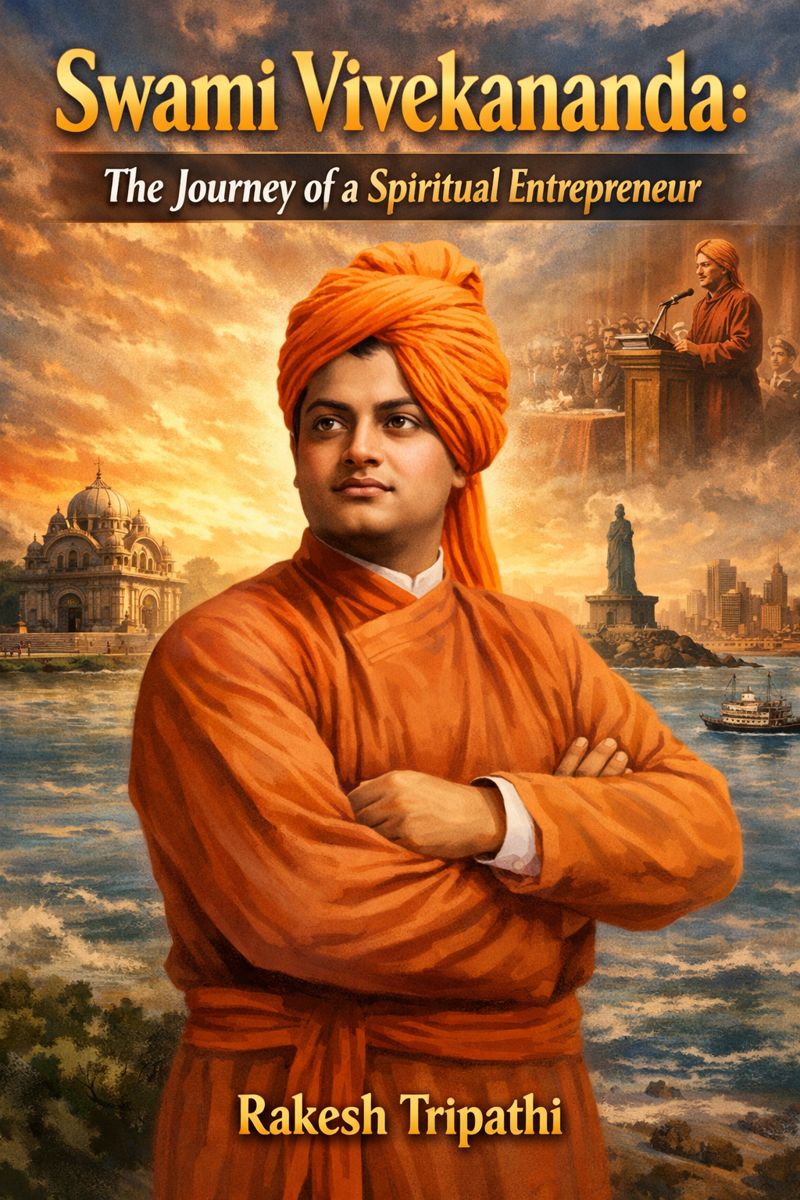
Swami Vivekananda: The Journey of a Spiritual Entrepreneur
Chapter Summaries
What's Here for You
Embark on a transformative journey with Swami Vivekananda, a spiritual entrepreneur who bridged ancient wisdom with modern needs. This book unveils the compelling narrative of Narendranath Dutta, from his humble beginnings in 19th-century Calcutta to his evolution into a global spiritual icon. You'll discover the profound impact of his meeting with Sri Ramakrishna, the foundational moments of the Ramakrishna Order, and the intrepid wanderings that shaped his worldview. Witness his groundbreaking appearance at the Parliament of Religions, a pivotal moment that introduced Vedanta to the West and challenged prevailing notions of spirituality. Explore his extensive global outreach, his strategic engagement with Western thinkers and societies, and the visionary establishment of the Ramakrishna Math and Mission – organizations dedicated to selfless service and the dissemination of noble ideas. The narrative continues through his subsequent journeys to Europe and America, offering deeper insights into his mission and personal reflections. Beyond his life and travels, this exploration delves into the linguistic brilliance and philosophical depth of his discourses, revealing how he masterfully mapped Hinduism's core tenets to inspire nation-building and address contemporary challenges. You will gain a profound understanding of a visionary leader who was not just a monk, but a dynamic force for cultural and spiritual regeneration. The tone is one of intellectual curiosity, spiritual reverence, and inspirational admiration, inviting you to connect with Vivekananda's enduring legacy and apply his principles to your own life and the world around you. Prepare to be enlightened, challenged, and inspired by the multifaceted genius of a true spiritual entrepreneur.
VIVEKANANDA’S CHILDHOOD AND EARLY LIFE
The story of Swami Vivekananda, born Narendranath Dutta, begins not with a roar, but with the quiet potential of a child in 19th-century Calcutta, a world away from the spiritual titan he would become. Tripathi unveils a young Naren, the sixth of ten children, born into an affluent family steeped in philanthropy and intellectual curiosity. His mother, Bhuvaneswari Devi, a woman of deep faith and grace, saw him as a gift from Shiva, naming him Vireswara at birth. This upbringing, rich with the epics of the Ramayana and Mahabharata, provided a foundational understanding of duty and devotion, even as his father, Vishwanath Dutta, a respected lawyer, exposed him to diverse intellectual currents through his own broad interests in poetry, scripture, and a generous, if sometimes exploited, hospitality. We see a child brimming with restless energy, drawn to the enigmatic figures of wandering monks, a fascination that hinted at the spiritual path ahead. This duality, the pull between the material world of his father's successful law practice and the spiritual yearnings sparked by his mother and the ascetics he encountered, formed the early tension in his life. Narendra’s parents, though influential, were not without their quirks; his father, an agnostic who often mocked societal norms, was nonetheless a kind provider, while his mother, embodying traditional Hindu womanhood, navigated domestic duties with serene detachment. The initial stages of his education were marked by a rebellious streak, a quick mind that chafed against rote learning, leading to a brief stint with a private tutor who instilled a grounding in Sanskrit and English. By age eight, at the Metropolitan Institution, his exceptional intelligence began to shine, forging lifelong friendships with future spiritual companions like Rakhal and Baburam. Even then, a profound sense of purity and a disciplined, ascetic inclination were evident, coupled with a fearlessness that demanded empirical proof before acceptance – a trait that would define his later philosophical inquiries. The stark reality of social discrimination, the sight of separate tobacco pipes for different castes in his father's office, deeply troubled the young Naren, planting seeds of protest against injustice. As adolescence dawned, his intellect deepened, drawing him into newspapers, history, philosophy, and a growing passion for music and public discourse. His higher education at Presidency and then Scottish Church College became a crucible, where he delved into Western philosophies—Aristotle, Spencer, Kant, Comte—and the works of John Stuart Mill, relentlessly applying reason and logic to ancient doctrines. This rigorous intellectual pursuit, however, was not divorced from his spiritual inclinations; the very sight of wandering monks, ascetics, and beggars stirred something profound within him, a longing for a life beyond material concerns. A pivotal moment arrived during a lecture by Professor William Hastie at Scottish Church College, where the concept of 'trance' was discussed, and the principal pointed to Sri Ramakrishna of Dakshineswar as the sole exemplar of such an exalted state. This introduction, this whisper of a realized soul, would prove to be the turning point, setting young Narendranath on a path that would ultimately lead him to become the globally revered Swami Vivekananda, forever bridging the realms of profound spirituality and practical human service.
MEETING SRI RAMAKRISHNA
In a land steeped in spiritual tradition yet burdened by societal decay, where the priestly class had supplanted profound philosophy with ritual and the masses were left materially and spiritually impoverished, a young man named Narendra felt an unquenched thirst for truth. The winds of change, carried by British education, awakened a generation to the shortcomings of their society, prompting a search for new forms of Hinduism. Narendra, a beacon of this intellectual awakening, first found himself drawn to the Brahmo Samaj, a reformist movement that championed reason and broke from orthodox practices, yet it could not quench his deep yearning for direct spiritual experience. He sought not just intellectual assent but the tangible realization of God, a quest that led him to question many, including the learned Devendranath Tagore, only to be met with answers that offered no solace. His mind, a crucible of rational inquiry and spiritual longing, wrestled with the existence of God, finding himself on the precipice of agnosticism, a state amplified by his family's pressing concerns about his marriage and future. It was a relative, Ramchandra Datta, himself a follower of Sri Ramakrishna, who pointed Narendra towards Dakshineswar, suggesting a visit to the saint. This pivotal encounter, which began with Narendra's soul-stirring devotional songs at the home of Surendranath Mitra, offered a radical departure from his previous disappointments. When Narendra finally posed his persistent question, "Sir, have you seen God?" to Sri Ramakrishna, the answer was not one of abstract theology, but a profound, direct affirmation: "Yes, I have seen God. I see Him as I see you here, only more clearly." This declaration, echoing with the resonance of undeniable inner experience, struck Narendra like a divine utterance, leaving him in a state of bewildered peace. Sri Ramakrishna, himself born into poverty and eschewing formal education for a life of intense spiritual pursuit, had embarked on a similar journey, dedicating himself to the worship of the Divine Mother Kali at Dakshineswar, his devotion so profound it consumed his physical needs. His own spiritual odyssey, marked by deep communion and the realization of oneness with Brahman through various paths, including Islam and Christianity, had convinced him of the universal truth that all religions lead to the same God. This profound conviction, born not from scripture alone but from direct, lived experience, was what set him apart. Narendra, meanwhile, grappled with a personal crisis: the death of his father had plunged his family into destitution, forcing him to confront the stark reality of providing for them while his spirit yearned for renunciation. When Sri Ramakrishna asked him to pray for material wealth, Narendra experienced a powerful vision of Mother Kali, a moment that redefined his understanding of God, revealing the divine not as an distant creator, but as an immanent presence within all existence. Under Sri Ramakrishna's guidance, Narendra’s sharp intellect, which initially mocked visions and demanded proof, was tempered by the guru’s profound wisdom, enabling him to grasp the limitations of pure reason when confronting ultimate truths. Sri Ramakrishna re-educated him in the essence of Hinduism, not as dogma, but as an inner experience of unity in diversity, teaching him the value of service and the recognition of the divine in all beings. This profound training, steeped in the philosophy of Advaita Vedanta, gradually transformed Narendra’s skepticism into a deep understanding of the oneness of existence, preparing him to carry forward a vision of religion as a tangible, experiential reality accessible to all, a realization that brought a profound resolution to his inner conflict.
THE BEGINNINGS OF THE RAMAKRISHNA ORDER
As Sri Ramakrishna's earthly journey neared its end in December 1885, diagnosed with an incurable oral cancer, his devoted disciples found themselves adrift in a sea of uncertainty. Shifted from Dakshineswar to Shyampukur and then to the serene Cossipore Garden House, he spent his final days surrounded by his consort, Maa Sarada, and his young disciples, entrusting them to Narendra. His mahasamadhi on August 16, 1886, left a void, not just of spiritual guidance, but of structure; until then, it was a handful of individuals seeking enlightenment, not an organized order. The immediate crisis was stark: the Garden House lease was expiring, financial support vanished as devotees, who had funded Sri Ramakrishna's stay, refused to support the monks, urging them back to their homes. This was a profound disappointment, yet, as the author Rakesh Tripathi explains, adversity forged a stronger bond among the young disciples. Undeterred, Narendra held fast to his promise to the Master, rallying the disciples to propagate his ideas, understanding that hardship was an inevitable forge for true success. However, a significant tension arose between the young monks and the householder devotees over the permanent placement of Sri Ramakrishna's ashes and relics. Ramchandra Datta proposed interring the ashes at his Kankurgachi retreat while the disciples would disperse, a suggestion that deeply upset Narendra and his companions who envisioned a Ganga-side memorial as per the Master's wish. Narendra, embodying wisdom and foresight, appealed for reason, urging them to embody the Master's teachings, stating, "If we are true to his ideals, if we live up to them, we shall have done more than merely worship the relics." This plea resonated, and they agreed to temporarily house the ashes at the Garden House. In a deeply symbolic act, Narendra and the disciples swallowed a portion of the ashes, renewing their resolve in meditation, while another urn was sent for worship. The ashes were eventually interred at Kankurgachi on Janmashtami, but the future of the young monks, now initiated into sanyasa, remained precarious, with families pushing for a return to worldly life. Narendra, however, was resolute in his vision of renunciation, facing lamentable resistance from householders who saw brighter material prospects for the boys. Recalling this time in a letter, Vivekananda wrote, "You remember, I suppose, how, after the Masters passing away, all forsook us as so many worthless, ragged boys." Adding to the chaos, interpretations of Sri Ramakrishna's teachings diverged wildly, with some householders denying the need for monasticism or a dedicated math. It was Narendra, understanding the eternal, Vedic roots of the Master's message, who revitalized their purpose, proposing that serving humanity with a spirit of worship was the path to God-realization, a vision he believed would create a new current of thought uniting humanity. The tide began to turn when Surendranath Mitra, moved by a vision of the Master, offered to fund a rented house for the monks. This led to the establishment of the first math, the Baranagar Math, in a dilapidated, cheap, and purportedly haunted old building, which, despite its grim appearance, became an ideal retreat for spiritual pursuit. Within six weeks of the Master's passing, on December 9, 1886, the Baranagar Math was a reality, a sanctuary where, under Narendra's guidance, the monks rediscovered their resolve for a life of renunciation. Narendra's role evolved into that of a friend, philosopher, and guide, his personality becoming synonymous with the mission, his every thought echoing Sri Ramakrishna's philosophy, earning him deep reverence. The brotherhood deepened through shared meditation and devotional practices, and despite facing poverty – subsisting on simple boiled leaves and rice, with common property for clothes – their resolve remained unshakeable, their existence fueled by intellectual discourse and spiritual exploration. They debated Kant, Hegel, and even materialists, comparing Vedanta with Buddhist philosophy, and engaging Christian missionaries in intellectual sparring, all while Narendra, bound by a legal dispute over his ancestral home, steadily guided the Order's formation. The transformation from Narendra to Swami Vivekananda was a gradual alchemy, blending monk, patriot, prophet, warrior, and teacher, his soul perpetually connected to the Divine, viewing humanity as its manifestation. His relentless passion, working "twenty-four hours at a time, almost like a lunatic," was driven by a profound realization: personal God-realization was insufficient; true peace lay in unifying humanity through selfless service.
THE PARIVRAJAKA’S TRAIL
The journey of Swami Vivekananda, the spiritual entrepreneur, is deeply etched in the solitary wanderings of a monk, a tradition as ancient as flowing water, believed to remain pure through constant movement. During his formative years, Narendra, as he was then known, meticulously trained his brother-monks at the Cossipore Garden House and Baranagar monastery, imparting knowledge of scriptures, Sanskrit grammar, and yoga, laying the groundwork for their self-realization. Yet, he too felt the pull of solitude, embarking on his own excursions, testing his strength and independence, and crucially, fostering self-reliance in his disciples. For nearly a third of his short life, nearly 18 years, Swami Vivekananda embraced the path of the Parivrajaka, the wanderer, venturing into the vast, unmapped terrains of India, often incognito, armed with little more than a staff and a begging bowl. These journeys, though sparsely documented by others, became the crucible for his profound understanding of India’s soul. He witnessed firsthand the deep chasm between the sacred scriptures and the lived reality of the common man, recognizing that the distortion and ignorance surrounding the Vedas, Upanishads, and Bhagavad Gita had plunged the masses into a state of moral and ethical decay. This realization ignited a powerful conviction: the sublime truths of Vedanta, the divinity of the soul, and the unity of existence, needed to be brought out of secluded caves and scholarly circles to empower the struggling masses, offering them dignity and renewed confidence. His encounters with people from all walks of life—from princes to paupers—cultivated in him a deep empathy, transforming him into a true lover of humanity, devoted to the welfare of all beings. The plight of the impoverished and ignorant villagers, trapped by social injustice and lacking basic necessities like clean water and healthy living conditions, became a constant echo in his mind, a poignant call to action that drowned out even the bliss of samadhi. He saw the ancient wisdom of the Vedas as the potent instrument to revive India’s lost glory. This experiential learning, a deep communion with the spirit of India, shaped his future message, guiding him from a potential religious recluse to a divine channel for humanity's service. His extensive travels, spanning seven years and covering almost the entire subcontinent, were marked by hardship and profound insight. In Varanasi, a spiritual anchor, and Ghazipur, where he trained under Pavhari Baba in Hatha Yoga, he deepened his spiritual practice. His journey westward led him to Alwar and Mount Abu, forging a pivotal connection with Maharaja Ajit Singh of Khetri, a patron who supported his spiritual and intellectual pursuits, including a renewed study of Sanskrit grammar. Gujarat and Maharashtra offered further exposure, familiarizing him with Jainism and Buddhism and sparking conversations with figures like Bal Gangadhar Tilak. A pivotal moment occurred in Limbdi, where the progressive Thakore Sahib inspired the idea of carrying India's message to the West. This nascent idea gained momentum in Hyderabad, where, in a powerful public address at Mahboob College, Vivekananda eloquently articulated his mission to reveal the glory of the Vedas and Vedanta to the world, a declaration that marked his first public exposition of his Western mission. The Maharaja of Mysore, a devout follower, offered financial support for this ambitious journey, though Vivekananda, ever guided by a higher purpose and the Master's silent behest, eventually accepted the necessary assistance, embarking on his transformative voyage to America from Bombay on May 31, 1893, aboard the SS Peninsular. On this journey, he met Jamsetji Nusserwanji Tata, a kindred spirit with whom he shared a vision for India’s development through science and technology, an encounter that would foster the establishment of institutions like the Indian Institute of Science, Bangalore, underscoring Vivekananda’s holistic approach to national regeneration through both spiritual enlightenment and material progress.
THE PARLIAMENT OF RELIGIONS
The journey of Swami Vivekananda to America, a spiritual entrepreneur on a mission, began aboard the SS Peninsular, a voyage that exposed him to the unfamiliar customs and landscapes of Colombo, Penang, Singapore, Hong Kong, and Japan. In China, he observed a practical approach to life, venturing into monasteries at personal risk, and in Japan, he was struck by the nation's fervent embrace of modernization and development, a spirit he found lacking in his own countrymen. This observation fueled a passionate letter to his disciples in Madras, urging them to shed their inertia. The voyage continued, and a less comfortable passage across the Northern Pacific, unprepared for the chill, brought him to Vancouver, then by train to Chicago in late July 1893. America, at the turn of the century, was a land dominated by materialism, a belief in human capability to conquer nature, yet it was also fertile ground for philosophical ferment, thanks to thinkers like Emerson and Whitman who had already paved the way for an appreciation of Vedanta. Vivekananda’s initial days in Chicago were marked by disorientation and a sense of isolation amidst the grandeur of the World's Fair, his unique attire drawing curiosity and the attention of the press. The realization that the Parliament of Religions was still weeks away and that he lacked the required credentials left him shattered, a predicament exacerbated by dwindling finances. A chance encounter with Kate Sanborne proved pivotal, leading him to Boston and introductions to influential figures like Professor John Henry Wright of Harvard. Wright, recognizing Vivekananda's profound intellect, became instrumental in securing his admission to the Parliament, famously exclaiming that asking Vivekananda for credentials was like asking the sun for its right to shine, and even provided the fare to Chicago. Before heading to the Parliament, Vivekananda delivered his first public lecture in Annisquam, advocating for industrial education in India, and continued to lecture in Salem and New York, addressing topics of contemporary relevance. Upon reaching Chicago for the Parliament, a series of unfortunate events – losing his papers and being unable to communicate his need for lodging – led him to spend a night sleeping in an empty rail wagon. The next morning, hungry and disheveled, his attempt to beg for food was met with disdain, until a kind woman, George W. Hale, recognized his purpose and offered him hospitality and assistance. This experience, a testament to divine providence, culminated in his arrival at the Parliament of Religions, held as part of the World's Columbian Exposition. Walking into the grand hall, amidst delegates from various faiths, Vivekananda, with his commanding presence, was called upon to speak. His opening words, a simple yet powerful "Sisters and Brothers of America," instantly forged a connection, setting the stage for his groundbreaking address on September 11, 1893. He spoke not with dogma, but with humility, emphasizing the unity of religions and the personal, experiential nature of Hinduism, presenting it as a continuous revelation rather than a closed book. Vivekananda's message, delivered with a commanding yet persuasive tone, transcended mere theory, advocating for realization through action and service, and his revolutionary ideas, focused on ending sectarian violence and promoting spiritual oneness, laid the foundation for the modern interfaith movement, a legacy that continues to resonate today.
EXPLORING THE WEST
As Swami Vivekananda embarked on his mission in the West, the bustling landscape of America, particularly Chicago during the World's Fair, became a crucible for his ideas, bringing him into contact with eminent figures like John D. Rockefeller and Robert Ingersoll. Though he encountered lingering fanaticism and bigotry, these did not deter his resolve, marking the true beginning of his work abroad. His mind, however, remained tethered to India's problems, a deep concern evident in his letters, even as fame and adulation swirled around him; as a sanyasi, these accolades held little sway, his heart yearning for quiet contemplation. Initially seeking funds for his Indian projects, Vivekananda soon abandoned this pursuit, recognizing the unsuitability of the Western climate for such appeals, and shifted his focus to his lectures, a decision solidified by a letter to Professor Wright in October 1893. He embraced a life of constant travel, organized by the Slayton Lyceum Lecture Bureau, traversing cities like Des Moines, Detroit, and Boston, aiming to disseminate his Master's philosophy and correct Western misconceptions about India. The journey was arduous; unaccustomed to the harsh winters, he often fell ill, and the profound ignorance about Hinduism he encountered, often met with irritable questions and even tests of self-realization, proved a significant challenge. Racial discrimination, though surprising, did not offend him, as he remained focused on his mission. His patriotic undertones, evident in his use of phrases like "my country, my people," painted him not just as a monk, but as an ambassador of India and, ultimately, a global citizen. The sheer volume of his work—delivering twelve to fourteen lectures weekly—led to immense physical and mental strain. While a guest of Senator Thomas W. Palmer in Detroit, he continued to advocate for the universal acceptance of all religions, his constant movement leaving him without a fixed abode. His intellectual curiosity led him to explore Western art and culture, visiting museums and galleries, overwhelmed by a vision he longed to see mirrored in India, yet never losing sight of his original purpose: to bridge the material and spiritual worlds. In early 1894, facing criticism from some Christian clergy for his teachings on "The Divinity of Man" and "The Harmony of Religions," Vivekananda remained undeterred, his lectures offering a "kaleidoscopic experience" to his listeners. A significant turning point arrived when he discovered his organizers were defrauding him, leading him, with Senator Palmer's assistance, to terminate the contract and lecture independently, a move that amplified his popularity. He began to select smaller, more intellectually mature audiences, earning the title "militant mystic" for his unwavering dedication. His influence grew, and he even contributed some of his earnings to American charities, such as the Tyler Street Day Nursery, with proceeds from a lecture on "The Religions of India." He also offered sharp criticism of misrepresentations of women's status in India and even pointed out societal flaws in American customs. Before departing for England, he trained and initiated disciples at Thousand Island Park, returning to New York on August 8, 1895. Invitations from figures like Henrietta Muller and Edward T. Sturdy, who recognized his spiritual significance, paved the way for his journey to Paris and then England. In Paris, he absorbed French culture, and upon arriving in England, despite initial apprehensions about being a representative of a "subject race," he found a sense of belonging. He assisted Sturdy with translating the Narada Bhakti Sutras and, after a period of acclimatization, delivered a successful lecture on "Self-Knowledge" in London, articulating his mission to "organize no sect" but to offer a universal outline of Vedanta. It was during this time in London that he met Margaret Noble, the future Sister Nivedita. Though his disciples in America urged his return due to the expanding work there, Vivekananda, after arranging for Swami Saradananda to continue his work in London, sailed back to the USA on November 27, 1895. Upon his return, he resumed lectures with renewed vigor, seeking larger venues and, crucially, finding Josiah J. Goodwin, a dedicated stenographer whose tireless efforts ensured that much of Vivekananda's teachings would be preserved for posterity, a feat that saved countless hours of wisdom from being lost. He took a holiday break with the Leggetts before resuming lectures that combined deep insights into Indian philosophy with "extraordinary outbursts of devotion." The American mind, described as a "hotbed of all kinds of religious and irreligious monstrosities," presented a formidable challenge, yet Vivekananda appeared as a beacon of Vedic religion and Vedanta philosophy, initiating the Brahmavadin magazine in India with his disciples' help. His second American visit saw him hailed as the "lightning orator," filling Madison Square Garden with captivated audiences, many seeking initiation. He reorganized the Vedanta Society, establishing an executive committee to manage its affairs and foster an "interchange of ideals and ideas between the East and the West," creating open doors for mutual understanding.
SWAMI VIVEKANANDA’S GLOBAL OUTREACH
The narrative unfolds as Swami Vivekananda embarks on a profound mission of spiritual and cultural exchange, extending his influence far beyond India's shores. Initially, his vision was a reciprocal flow: Indian monks sharing Vedanta in the West, while American disciples would bring practical teachings of science, industry, and cooperation to India, aiming to bridge the perceived divide between East and West. This grand ambition necessitated meticulous preparation, as Vivekananda carefully trained his Western disciples like Sister Haridasi Sara Ellen Waldo and Swami Kripananda, impressing even Harvard professors with his philosophy's blend of logic, spirituality, and a focus on self-realization. His prolonged stay in America led him to recognize the need for systematic organization of Hindu thought, planning to classify Upanishadic concepts to foster Western understanding. Yet, the relentless pace took a toll; by April 1896, Vivekananda was physically exhausted, his nerves shattered, prompting a journey to England for further teaching. Amidst this strenuous schedule, he found solace in moments of childlike delight, reading comics or enjoying cooking, supported by the thoughtful care of his Western followers who offered him respite. The American press lauded him as the 'Lordly Monk,' captivated by his intellect, and academic institutions like Columbia University even offered him a professorship, which he respectfully declined as a sanyasi. Arriving in England, he reconnected with Swami Saradananda, sharing ambitious plans for the Ramakrishna Math, plans that amazed Saradananda with Vivekananda's indefatigable energy. He meticulously instructed his Indian brethren on organizational lines, emphasizing that 'Organization is strength and obedience is its hidden secret.' His vision for a global reach was clear, aiming to awaken humanity's inherent godhood, drawing intellectuals and distinguished figures into his movement, individuals like Henrietta Muller and Edward Sturdy who would become instrumental. As his work in London solidified, he recognized the need for a permanent presence, arranging for Swami Saradananda to go to America while Swami Abhedananda joined him in England. This period also saw the arrival of his brother, Mahendranath, whom Vivekananda steered away from revolutionary activities towards electrical engineering, believing such skills would empower India's modernization. He articulated a universalist view of Vedanta, stating it 'will become the universal religion, convert it into universal treasure,' not a closed preserve. His tireless activity was fueled by the motive to free humanity from ignorance, inspiring many to join his cause. The chapter highlights a pivotal European tour, a nine-week respite in Switzerland and Germany, where he found tranquility by Lake Leman and was recognized as a spiritual genius by Professor Paul Deussen. Upon returning to London, revitalized, he continued his work, joined by Swami Abhedananda and Goodwin, and began training his brother-monks. He understood the profound impact of his Western work on India, asserting, 'One blow struck outside India is equal to a hundred thousand struck within.' The success of Swami Abhedananda's lectures and the demand for his published works, like 'Raj Yoga,' marked significant progress. Simultaneously, he nurtured the spiritual regeneration of India, inspiring the creation of magazines like 'Prabuddha Bharata' to reach the masses. He also empowered Western women like Sister Haridasi to teach Vedanta. As his return to India loomed, he declined a substantial offer for establishing a permanent headquarters, preferring a modest start in India. News of a devastating famine in India spurred him to action, organizing relief efforts from afar. His global vision was expansive, encompassing Russia, Japan, and China. He planned educational institutions for women in India, inspired by Henrietta Muller and Margaret Noble. Even as he prepared to depart for India in mid-December 1896, leaving Swami Abhedananda to carry the torch in England, he reflected on the 'roaring success' of his London work, noting the English capacity for 'slow' but 'sure and abiding' assimilation. His journey to India, via Italy where he observed the organizational genius of Christianity, brought him back to Asian shores with a profound sense of mixed identity and renewed purpose, ready to unite India under a banner of spiritual strength, a national hero welcomed with unprecedented fervor.
THE HOMECOMING
Swami Vivekananda's return to India, a spiritual entrepreneur charting a new course, was met with an outpouring of national anticipation, a collective yearning for a prophet of rejuvenation and a harbinger of a new era after his triumphant dissemination of Hinduism to the West. The author, Rakesh Tripathi, illuminates how Vivekananda’s success in America, eclipsing established organizations, had ignited a new consciousness across India, a profound recognition of its spiritual heritage, even as a curious disunity persisted among his countrymen in fully embracing his global representation of Hinduism. This lack of organized recognition, Vivekananda discerned, stemmed not from a failure to appreciate his efforts, but from a long subjugation that had eroded the capacity for collective action, a challenge he immediately sought to address by urging his brother-monks to orchestrate grand meetings and galvanize the nation's spirit. His journey from Colombo to Almora unfolded as a series of profound encounters and addresses, from the sacred grounds of Rameswaram where he urged the worship of the divine in the suffering masses, to the vibrant city of Madras where he delivered pivotal lectures like 'My Plan of Campaign' and 'The Future of India,' laying bare his vision for a nation reborn through spiritual revival, not mere social reform. He spoke of combining Western materialism with Eastern spiritualism, emphasizing that India's strength lay in its religion, a beacon for the world, and that its regeneration required an 'upheaval in religion,' a diffusion of its scriptural truths to all. This homecoming was not merely a personal triumph but a strategic endeavor to infuse national life with spiritual vigor, a 'national ship' that needed mending, not cursing. In Calcutta, his homeland, the reception was immense, a testament to his deep connection with his roots, yet even amidst the adulation and the formation of the Ramakrishna Mission, his health faltered, prompting a retreat to the serene Himalayas of Almora, a place that quieted his mind and turned his thoughts toward renunciation, though his work never ceased, guiding disciples and planning new ventures. His return was a powerful assertion of India's spiritual legacy, a call to action for its people to embrace their heritage, build character, and serve humanity, reminding them that 'the secret of life is give and take,' and that 'India must conquer the world' not through conquest, but through the universal truths of its spirituality, a mission that would define his remaining years and shape the future of a nation.
THE RAMAKRISHNA MATH AND THE RAMAKRISHNA MISSION
The story of the Ramakrishna Math and Mission is one of profound vision and tireless execution, born from Swami Vivekananda's ambition to set in motion a 'machinery which will bring noble ideas to the door of everybody.' He envisioned an organization, rooted in the selfless service he learned from Sri Ramakrishna, that would translate spiritual teachings into tangible good for humanity. This grand idea began to take concrete shape with the establishment of the Baranagar Math, but Vivekananda yearned for a dedicated Mission to embody his Master's philanthropic and spiritual ideals. On May 1, 1897, a pivotal meeting at the home of Balaram Bose brought together monks and devotees, leading to the unanimous decision to form a new organization. Just days later, on May 5, the aims and objectives were formalized: the Ramakrishna Mission would preach and help others practice Sri Ramakrishna's truths for temporal, mental, and spiritual advancement, fostering fellowship among different religions as expressions of one eternal truth. Its methods were clear: train individuals for the welfare of the masses, encourage arts and industries, and spread Vedantic ideas as exemplified by Sri Ramakrishna. The Indian Work Department focused on establishing mathas and ashrams for training, while the Foreign Department aimed to foster better understanding between India and the world. Crucially, the Mission declared itself apolitical, open to anyone who believed in Sri Ramakrishna's mission. Almost immediately, the nascent Mission was called upon to address the Bengal famine of 1896-97, and then the devastating Assam earthquake of 1897, which severely damaged the Alambazar Math, necessitating a move. This crisis, however, became an impetus for securing a permanent home. Supported by disciples and devotees, land was acquired on the banks of the Ganges, and the Belur Math began to take shape, with Swami Vijnanananda and Swami Advaitananda overseeing its construction. The relocation and rebuilding were monumental tasks, requiring significant contributions and meticulous planning, culminating in the establishment of the Belur Math as the spiritual heart, a beacon guiding future activities. Even the annual birth anniversary celebrations of Sri Ramakrishna, a vital occasion for fostering unity across social divides, had to be carefully managed post-relocation, showcasing the organization's evolving operational capacity. Initially, the Ramakrishna Mission Association operated more as a forum for religious discussions, with the monks bearing the brunt of the work, but as the Belur Math became the central seat, the philanthropic and charitable activities were increasingly absorbed by the monastic order. Vivekananda, a keen strategist, understood the need for robust governance to protect the organization from future complications, especially concerning property. This led to the creation of the Debottar Trust Deed in 1901, vesting Belur Math properties in a board of trustees composed of Sri Ramakrishna's direct disciples, a deliberate move to safeguard against legal entanglements. By stepping down from leadership in favor of Swami Brahmananda, Vivekananda demonstrated his commitment to institutional stability over personal authority. The Mission's emblem, designed by Vivekananda himself, with its motto 'Atmano Mokshartham Jagat Hitaya Cha' (For one's highest freedom and for the good of the world), encapsulated its dual purpose of spiritual realization and global welfare. From these foundational efforts, a vast network of institutions emerged, dedicated to education, healthcare, rural development, and spiritual guidance, all driven by the core ideal of 'Sivajnane Jivaseva'—serving humanity as the Divine. Today, the Ramakrishna Math and Mission stand as a testament to this enduring vision, with over 171 centers worldwide, continuing their silent work of spiritual regeneration and holistic human development, a living legacy of selfless service and universal brotherhood.
ACROSS EUROPE AND AMERICA AGAIN
The narrative unfolds as Swami Vivekananda embarks on his second major journey to the West in 1899, a voyage marked by a different spirit and purpose. This time, sailing aboard the SS Golconda, he documents his experiences in a travelogue named 'Parivrajaka,' offering a more personal chronicle than his previous, more public-facing missions. The journey, passing through familiar ports like Naples and Marseilles before reaching London, carried an undercurrent of melancholy. Unlike the triumphant reception of his first visit, London presented a muted welcome, shadowed by the painful dissociation of trusted friends and a decline in Vivekananda's own health. He found solace and a period of recuperation with Sister Nivedita's family in Wimbledon, deeply connecting with the Noble family who were impressed by his profound spiritual insights. Despite these personal challenges, invitations from America beckoned. Resuming his travels on the SS Numidian, Vivekananda, accompanied by Swami Turiyananda and American disciples, arrived in New York on August 28, 1899, finding the off-season atmosphere surprisingly conducive to his spirit. A significant development awaited him: the establishment of the first permanent quarters for the Vedanta Society of New York in October 1899, a testament to Swami Abhedananda's diligent leadership. This marked a crucial milestone, solidifying Vedanta's presence in the American intellectual and religious landscape. Yet, amidst this professional triumph, Vivekananda's health remained fragile, a somber premonition of his declining days, a sentiment he confided to Swami Abhedananda. Consequently, his activities were limited to rest and occasional, intimate engagements, a stark contrast to his earlier vigorous public speaking. Heading west to Los Angeles, his seven-month stay was characterized by a similar constraint on his energy, though he still delivered occasional lectures that drew significant crowds. He observed a subtle shift in the American audience, a reluctance to invest financially in lectures, which led him to confide a sense of lost zest for work to Christine. However, the spirit of his mission remained, and an invitation to speak at the Congress of Religions in Oakland presented a new avenue. Vivekananda, however, sought to transcend the confines of formal lectures, aiming for independent work. His arrival in San Francisco on February 23, 1900, marked the delivery of a powerful lecture, 'The Ideal of a Universal Religion,' which underscored themes of self-reliance, realizing one's inner divinity, and the essential unity of humanity, echoing with a consistency and depth that defined his enduring message.
THE MAHASAMADHI
The final days of Swami Vivekananda's life, as chronicled by Rakesh Tripathi, unfold not as a fading light, but as a deliberate, profound preparation for a transition, a spiritual entrepreneur consciously orchestrating his departure. After a period of intense activity, Vivekananda began a subtle withdrawal, a conscious relinquishing of the reins of the Math, not out of weariness, but to empower his trained disciples, allowing them to realize their full potential without his perceived interference. This withdrawal, a shedding of outer concerns much like a snake sheds its skin, signaled a profound inner shift, a turning inward toward deeper spiritual communion, a preparation for death that echoed the prophecies of his master, Sri Ramakrishna. His interactions in these last weeks, though tinged with his characteristic energy, carried a deep resonance of finality. He met with Sister Nivedita, not just to bless her ambitious vision of a university for women, but to ensure all worldly affairs, even a long-standing family property dispute, were settled, leaving everything in order, a testament to his pragmatic approach even in the face of the ethereal. He spoke of a 'great tapasya' coming over him, and pointed out a spot by the Ganga where his body should be cremated, a quiet instruction that now houses a temple. The day of his Mahasamadhi itself was marked by deliberate, meaningful actions: a three-hour solitary meditation in the chapel, a whispered self-reflection that only a fellow Vivekananda could understand, and a rare communal meal with his monastic brothers, relishing the food as if for the last time. He expressed a desire for Kali Puja, a final act of devotion, and then, with a characteristic blend of wit and wisdom, taught Sanskrit grammar to the brahmacharis, his mind perhaps already on other planes, discussing the potential of a Vedic college to 'kill out superstitions.' As evening deepened, his mind grew more withdrawn, and he retired to his room to meditate facing the Ganga. The actual passing, described with poignant detail by his disciples, was not a struggle but a serene surrender. One account tells of him requesting to be fanned, then lying down, his hands trembling slightly before a deep, final breath, his eyes fixed, his face assuming a divine expression. Another speaks of a deep breath, a cry like a baby in a dream, and then stillness. The doctors' pronouncements of heart failure or apoplexy were secondary to the monks' unshakable conviction: Vivekananda had voluntarily cast off his body in samadhi, a conscious departure as predicted by Sri Ramakrishna. Sister Nivedita, present in his final days, captured the essence of this great departure, seeing it as a 'great death,' the body laid down like a 'worn-out garment.' Though grief-stricken, the disciples found peace in their faith, knowing his inspiration would continue to permeate the world, a vision that remains imperishable, a rare instance of a visionary transforming potential into eternal reality, even before reaching the age of forty.**
LINGUISTIC ASPECTS IN SWAMI VIVEKANANDA’S DISCOURSES
The profound influence of Swami Vivekananda, a spiritual entrepreneur, resonated through his speeches and writings, serving as conduits for his teachings to the masses. These were not mere recitations but deeply informed by his study of ancient scriptures and his own lived spiritual journey as a parivrajaka. His words, as noted by Nehru, possess a timeless appeal, guiding humanity toward realizing its full potential, a legacy initiated with his pivotal Chicago lecture. Vivekananda's discourse was fundamentally anchored in a deep concern for India's destiny and its people's struggles, addressing issues like materialism, poverty, and irrationality, all viewed through the lens of their impact on India's future. A distinct strain of mysticism, inherent in Hindu traditions, colored his lectures, letters, and dialogues, whether with his devoted followers in Calcutta, visionary patrons like the Maharaja of Khetri, industrialist Jamsetji Tata, or key disciples such as Alasinga and Shashi. His most representative works delved into the Vedas and Upanishads, highlighting the consequences of ignorance regarding these texts—namely, inequitable development, caste discrimination, and moral decay. Vivekananda's letters, penned while abroad, maintained vital connections, each addressed with a nuanced understanding of the recipient's status and his relationship with them. His conversations and dialogues, often originally in Bengali as 'Swami-Shishya Samvada,' later translated as 'The Diary of a Disciple,' reveal his profound engagement with his fraternity and seekers on topics of spiritualism, renunciation, fearlessness, self-realization, and selfless work. The chapter then turns to the ancient linguistic traditions of the Vedas and Upanishads, texts born from the earliest stages of human thought, containing hymns of profound sentiment and serving as the bedrock of Hindu cultural life. Despite inherent linguistic complexities and scholarly debates on their interpretation, Vivekananda possessed a remarkable ability to demystify these scriptures. His approach was shaped by the shift from oral to written transmission of these texts and the diverse audiences he addressed—from the illiterate masses of India to the English-speaking West. The historical context of these scriptures, preserved through meticulous memory transmission across generations, underscores their unique nature. Vivekananda recognized that the custodians of this tradition, the pundits, had sometimes become mere grammarians detached from the spirit of the texts, yet he also acknowledged the existence of individuals who preserved entire Vedic branches through memory, preserving intonations with remarkable accuracy. He understood that the interpretation of these ancient texts had been contested from their inception, with differing views on whether the mantras held inherent meaning or were primarily ritualistic utterances. The 'shruti' tradition, emphasizing the word as sound and the purity of reception, where knowledge is 'heard' through an unbroken flow from guru to disciple, formed a crucial part of his understanding. While contemporary scholars suggest the Sanskrit of these texts was a distinct, archaic spoken language, Vivekananda's grasp extended beyond literal translation, recognizing the inseparable link between sound and meaning, and the vibrational effect of words. He saw the interpretation of these texts as 'amorphous,' inviting global perspectives, and understood that meaning was inseparable from intention and context, necessitating a linguistic analysis through frameworks like Halliday's Systemic Functional approach. Vivekananda's own journey, marked by intense study and a profound connection with Sri Ramakrishna, honed his ability to link textual understanding with tradition, even mastering Panini's grammar to overcome linguistic hurdles. He astutely observed that Vedic grammar often consisted of exceptions, granting significant liberty in interpretation, with Yaska's dictionary serving as a crucial safeguard. He acknowledged the limitations of literal translation and the subjective interpretations of commentators like Sayanacharya, recognizing that a deeper understanding required looking beyond the surface, acknowledging the 'Adhikarabheda' or the principle of varying eligibility for different levels of understanding. Vivekananda's approach to translation and interpretation was thus a dynamic blend, seeking to convey the essence of the scriptures to diverse audiences. He often paraphrased mantras rather than offering literal translations, especially for Western audiences, recognizing their lack of traditional background. He cautioned against the subjective biases of orientalists and even great Indian commentators like Shankaracharya, Ramanujacharya, and Madhvacharya, who he felt sometimes twisted texts to fit their specific philosophical schools, obscuring the Upanishads' underlying theme of unity in diversity, which he saw as a progression of steps rather than a singular doctrine. Vivekananda advocated for a return to the 'shrutis,' emphasizing that true understanding came from those who 'know the meaning' and possess realisations, not mere 'bookworms' or grammarians. He introduced concepts like 'soul of our souls' and 'work for work's sake' to bridge conceptual gaps, illustrating his unique approach to rendering complex ideas accessible. Gayatriprana's research further validates Vivekananda's methods, confirming his tendency to create his own translations, often extemporaneous, simpler, and more direct, modifying them for different audiences and tracing his linguistic evolution. Her analysis highlights Vivekananda's techniques: paraphrasing mantras, commenting without direct quotation, and referencing passages with unique keywords, all organized through principles of established facts, reformulation from a Neo-Vedantic standpoint, general yoga methods, and descriptions of yogic transformations. Ultimately, Vivekananda emerges as a unique synthesis—a linguist, philosopher, grammarian, and historian—who navigated the tension between tradition and philology, bridging the gap between ancient wisdom and modern understanding, ensuring the timeless message of the scriptures continued to resonate.
MAPPING HINDUISM IN SWAMI VIVEKANANDA’S DISCOURSES
The author Rakesh Tripathi guides us through Swami Vivekananda's profound engagement with Hinduism, revealing how the spiritual leader masterfully wove its core tenets into his discourses to address the challenges of his time and inspire nation-building. Vivekananda, a 'spiritual entrepreneur,' didn't merely present ancient scriptures; he dynamically adapted them, employing a style that was at once persuasive, fiery, and deeply personal, cutting across social, religious, and racial divides to connect with a universal humanity. He saw Hinduism not as a rigid dogma, but as a vibrant 'way of life,' demystifying its complex philosophy through scriptural verses and relatable narratives, much like a skilled craftsman shaping raw material into an accessible form. For instance, his explanation of 'Sat' or Truth, referencing the Rig Veda's 'Ekam Sat Vipra Bahudha Vadanti' (Truth is one, sages call it by different names) and the Upanishadic 'Satyameva Jayate' (Truth alone triumphs), served to dissolve the divisive tendency of seeing truth through a singular, often ethnocentric, lens. He also addressed the practice of 'Pratika' or symbolism, acknowledging its role as an aid for those at the base level of spiritual understanding, while recognizing its temporal limitations, a nuanced approach that bridged the gap between rational thought and devotional practice. Nature ('Prakriti') was explored through the poetic negation of the Nasadiya Sukta, hinting at the profound mystery of creation. Vivekananda championed 'Bhakti' or devotion, not as blind faith born of fear, but as a 'deathless love' and 'one-pointed devotion' ('Ekgranishth'), urging a shift from fear-based worship to reverential connection. Similarly, 'Jnana' or knowledge was presented not as mere intellectual accumulation, but as the pathway to the ultimate truth, exemplified by the story of Svetaketu's limited understanding, reminding us that true wisdom transcends conceit. He powerfully advocated for 'Tyaga' or renunciation as the key to fearlessness, a stark contrast to the pervasive anxieties of life. The chapter highlights Vivekananda's vision for 'Samajik Samata' or Social Equity, championing the equal partnership of women in humanity's progress, a revolutionary stance for his era, and sadly, still a pressing concern today. He saw 'Karma' or Action and 'Sewa' or Service to Humanity as inseparable from self-realization, urging the awakening of masses through selfless action, echoing the Bhagavad Gita's call to 'Arise, Awake, and stop not until the goal is reached.' The concept of 'Sthayi Aacharan' or Steadfast Human Behaviour was promoted as crucial for societal well-being, emphasizing consistency and righteousness. His exploration of 'Shrishti' or Creation, using the Nasadiya Sukta and the Sandhya Mantra, delved into the manifest and unmanifest, posing questions about the divine role. Crucially, he illuminated the concept of 'Atman' and 'Brahma,' the ultimate self, contrasting the Indian philosophical primacy of Atman with Western materialism, and reiterating the non-dualistic truth that 'Thou art That.' The narrative then pivots to the 'Present State of Hinduism,' lamenting its transformation into a more politicized, commercialized, and ritualistic faith, a far cry from Vivekananda's vision of tolerance and universal brotherhood, a situation exacerbated by the erosion of ethical values and the rise of divisive tendencies. The chapter concludes by outlining 'The Challenges before Hinduism,' underscoring that despite societal progress, the root-and-branch change Vivekananda envisioned remains elusive, calling for a return to his discourses to re-infuse dharma into governance and society, and to revive the spirit of selfless service and ethical conduct in a world often blinded by materialistic pursuits.
SWAMI VIVEKANANDA IN CONTEMPORARY INDIAN MEDIA
The author reveals how contemporary Indian media, particularly in the years 2011-2013, began to reflect a societal yearning for deeper meaning and solutions to pressing issues, mirroring Swami Vivekananda's enduring message. Early in 2011, Doordarshan's series interviewing religious figures highlighted a common lament: religion, intended as a guide, had become a source of division, pulling humanity away from its true purpose. This was followed by CNN IBN's "Youth and Vivekananda," which sought answers to modern problems within the Swami's ideology. The narrative then shifts to 2012, a year marked by Aamir Khan's "Satyamev Jayate." This groundbreaking show, intentionally aired on Doordarshan for maximum reach, tackled deeply ingrained social ills like female foeticide, child abuse, and dowry, achieving record viewership and prompting swift governmental action. The show's immense catharsis underscored a collective hunger for confronting uncomfortable truths. Coinciding with this was Dr. Chandra Prakash Dwivedi's "Upanishad Ganga," a fifty-two episode serial that brought the timeless wisdom of the Vedas and Upanishads to bear on contemporary challenges, presenting each concept through a problem-solution narrative, much like Vivekananda himself drew from these ancient texts. The author emphasizes that this media engagement, both electronic and print, continues to feature Vivekananda, yet a critical insight emerges: despite these efforts, the fundamental challenge of awakening the masses persists, a familiar echo of Vivekananda's own call to action over a century ago. The chapter then pivots to the enduring relevance of Vivekananda's vision, suggesting that safeguarding Hinduism lies in remembering its core lessons—righteousness, non-violence, and universal tolerance—as embodied in its stories and images. This is underscored by the Indian government's significant investment in the Swami Vivekananda Values Education Project, a testament to his continuing influence. The author posits that reshaping India requires integrating Vivekananda's teachings, creating a nation that honors its past values while judiciously embracing modern demands. Just as Vivekananda carried the spiritual message of India to the West, seeking balance between material progress and spiritual awakening, the contemporary need is to reiterate and disseminate his message across all societal strata. The narrative concludes with a powerful call to action: to continuously work towards nation-building, especially for the youth, fostering a consciousness and pride that can lead India to fulfill its potential. The revolution Vivekananda ignited a century ago, the author suggests, is an ongoing force, urging us to define ethical governance and evolve a just social order, truly embodying the India Vivekananda envisioned.
Conclusion
Rakesh Tripathi's "Swami Vivekananda: The Journey of a Spiritual Entrepreneur" offers a profound exploration of a life dedicated to bridging ancient wisdom with modern needs. The core takeaway is the transformative power of a well-grounded moral and intellectual foundation, cultivated through diverse experiences and a relentless pursuit of truth. Vivekananda's journey underscores that genuine spiritual realization transcends mere intellectual understanding, demanding experiential encounter and a deep empathy for human suffering. His life serves as a testament to the idea that true spirituality is not about dogma, but about an inner experience of unity and service, accessible to all. The book highlights the emotional lessons of confronting societal decay and superficiality, finding authenticity in deeper faith, and navigating the inherent tension between material comfort and spiritual aspiration. It reveals how adversity and scarcity can forge inner strength and create unbreakable bonds, transforming individuals into a cohesive force for good. Practically, Tripathi illustrates the art of spiritual entrepreneurship: building lasting organizations not in comfort, but in shared adversity, and prioritizing the embodiment of core teachings over mere relics. Vivekananda's strategic approach to global outreach, adapting his message to diverse cultural contexts, and his emphasis on empowering women and establishing educational institutions, offer a blueprint for societal regeneration. The narrative powerfully argues that national progress hinges on spiritual revival and the diffusion of ethical principles, advocating for a synthesis of Eastern spiritual ideals with Western practical methodologies. Ultimately, Vivekananda's legacy is that of a visionary who empowered humanity by revealing its inherent divinity, urging a shift from fear-based worship to love, from passive knowledge to active realization, and from self-concern to selfless service ('Sivajnane Jivaseva'). His life's work, from demystifying ancient scriptures through linguistic mastery to establishing robust institutions like the Ramakrishna Mission, demonstrates that true leadership lies in translating personal spiritual realization into a universal mission for the welfare of all ('Jagat Hitaya Cha'). The book concludes by emphasizing that the enduring relevance of his message of spiritual awakening and balanced progress requires continuous dissemination, serving as a crucial guide for individual and collective growth in a complex world.
Key Takeaways
A strong moral and cultural foundation from parents, even with differing beliefs, cultivates eclectic interests and the ability to recognize human suffering.
Early exposure to diverse intellectual traditions and social inequalities can spark a lifelong quest for truth and a rejection of unreasonable customs.
A combination of discipline, saintliness, and innate curiosity, nurtured through varied educational experiences, shapes a personality capable of profound spiritual and intellectual depth.
The fascination with spiritual figures and asceticism in youth, coupled with a demand for reasoned proof, foreshadows a unique blend of mysticism and critical inquiry.
Encountering individuals who embody profound spiritual states can serve as a catalyst, directing intellectual curiosity toward a deeper, personal realization.
The tension between material comforts and spiritual aspirations can be a powerful engine for self-discovery and the pursuit of higher truths.
True spiritual realization transcends intellectual understanding and requires direct, experiential encounter with the divine, a principle exemplified by Sri Ramakrishna's confident assertion of having 'seen God'.
Societal decay and the superficiality of ritualistic religion can create a spiritual vacuum, prompting a search for deeper, more authentic forms of faith, as seen in the context of 19th-century India.
A profound spiritual quest often involves a tension between rational inquiry and the acceptance of truths that lie beyond empirical proof, a conflict embodied in Narendra's journey.
The divine is not an abstract, distant entity but an immanent presence within all creation, a realization that reframes one's understanding of suffering and the nature of God.
Genuine spiritual guidance involves respecting the disciple's intellect and journey, allowing them to arrive at truth through their own experience rather than through blind adherence.
Religion, at its core, is not a set of dogmas but an inner, deeply personal experience of unity and connection, capable of encompassing all paths and all realizations.
True organizational foundations are forged not in comfort but in the crucible of shared adversity and unwavering commitment to a founder's vision.
When faced with conflicting interpretations of a leader's legacy, prioritizing the embodiment of their core teachings over material relics offers a more profound path to spiritual continuity.
The strength of a nascent movement lies in the leader's ability to inspire collective resolve and provide a unifying vision, especially when external support wanes and internal doubts arise.
Adversity and scarcity can paradoxically amplify inner strength and deepen bonds, transforming a group of individuals into a cohesive spiritual brotherhood.
Leadership's ultimate test lies in translating personal spiritual realization into a mission that serves and unifies humanity, rather than remaining a solitary experience.
The establishment of a spiritual order requires not only devotion but also strategic planning, resourcefulness, and the courage to defy societal expectations and familial pressures.
The transformative power of solitary wanderings lies not just in self-discovery, but in fostering self-reliance in others and gaining a ground-level understanding of societal needs.
True spiritual wisdom transcends academic circles and must be accessible to the masses to combat ignorance and elevate human dignity.
Empathy for the suffering of humanity can serve as a potent catalyst for a life dedicated to service, shifting focus from personal salvation to collective upliftment.
Experiential learning through diverse interactions is crucial for shaping a comprehensive worldview and refining one's mission.
The essence of ancient scriptures, when understood holistically and applied practically, can serve as a powerful tool for national regeneration and individual empowerment.
A spiritual leader's journey is often shaped by divine guidance and the practical needs of their people, blending inner realization with outward action.
The journey to a significant destination often involves unexpected trials and a stripping away of worldly comforts, revealing inner strength and reliance on providence.
True spiritual understanding is not about dogmatic assertion but personal realization and experience, which can be shared with humility and openness.
Connecting with an audience requires establishing common ground and recognizing shared humanity, transcending superficial differences.
Modernization and development require a spirit of active engagement and potential realization, a quality that can be a catalyst for societal change when observed and internalized.
The foundation of religious harmony lies in recognizing the shared core of human thought and the continuous, unfolding nature of divine revelation.
Spiritual leadership involves not just intellectual articulation but the courage to embody one's message, even in the face of adversity and doubt.
Even amidst immense personal success and adulation, a true spiritual leader remains anchored to their core mission and concerns for their homeland.
Effective spiritual or philosophical dissemination requires adapting one's approach to the prevailing cultural and intellectual climate of the audience, even when facing significant ignorance and prejudice.
The journey of a spiritual entrepreneur involves navigating challenges like exploitation by organizers and societal resistance, demanding resilience and the strategic shift to independent action.
Preserving and disseminating profound teachings requires not only the speaker's insight but also the dedication of others, highlighting the collaborative nature of legacy.
A balanced perspective that integrates material progress with spiritual understanding allows for a holistic view of the world and fosters connection between different cultures.
The ultimate aim of spiritual teaching is not to establish new sects, but to empower individuals by revealing their inherent divinity and fostering universal acceptance.
The necessity of adapting spiritual and philosophical teachings to diverse cultural contexts is crucial for global outreach and understanding.
Effective leadership involves meticulous planning, training of successors, and fostering a sense of shared purpose to ensure the sustainability of a movement.
Balancing intense dedication to a mission with personal well-being is essential for long-term effectiveness, requiring moments of rest and childlike joy.
The impact of work done abroad can profoundly influence and strengthen efforts at home, serving as a catalyst for national rejuvenation.
A truly universal message transcends religious boundaries and should be shared widely, becoming a 'universal treasure' accessible to all.
Empowering women and establishing educational institutions are vital components for societal progress and the holistic development of a nation.
The ability to integrate diverse experiences and identities is key to navigating a complex global landscape and fulfilling a universal mission.
The impact of foreign domination can erode a nation's capacity for organized collective action, necessitating conscious efforts to rebuild this capability.
True national regeneration hinges on spiritual revival and the diffusion of core scriptural truths, rather than solely on political or social reforms.
The synthesis of Eastern spiritual ideals with Western practical methodologies offers a path to holistic human progress and service.
Spiritual leaders must not only inspire but also strategically organize their followers to translate vision into lasting institutional impact.
The highest form of worship and service involves recognizing and attending to the divine presence in the poor, the weak, and the suffering.
Personal character, built on courage, self-respect, and sacrifice, is the fundamental strength upon which a nation's future is built.
Visionary leadership requires establishing robust organizational structures (like the Math and Mission) to translate grand ideals into sustained, practical action.
Selfless service ('Sivajnane Jivaseva') is not merely an act of charity but a profound spiritual practice of recognizing the Divine in all beings, demanding personal sacrifice.
Effective organizations must anticipate and mitigate future challenges, such as legal complexities, through strategic governance and trust-based frameworks.
The dual aim of personal spiritual liberation ('Atmano Mokshartham') and universal welfare ('Jagat Hitaya Cha') provides a powerful, integrated framework for meaningful contribution.
Organizational growth, even when driven by spiritual ideals, necessitates adaptability and the development of clear operational rules and training for its members.
The strength of an organization lies not just in its initial vision but in the enduring commitment and sacrifice of its successive generations of workers.
Spiritual work often requires resilience in the face of personal setbacks and declining health, demanding a focus on inner strength when external circumstances are challenging.
The establishment of permanent institutions, like the Vedanta Society's first quarters, signifies a crucial turning point in the dissemination of spiritual philosophies, moving from transient teachings to lasting foundations.
True spiritual leadership involves adapting to evolving societal dynamics, recognizing shifts in audience engagement (like the willingness to pay for lectures), and finding new ways to convey timeless wisdom.
The core of spiritual teaching lies in empowering individuals to recognize their inherent divinity and potential, fostering self-reliance and a universal understanding of humanity.
Even amidst personal health struggles and disillusionment, the commitment to conveying profound spiritual truths can inspire lasting impact and leave a legacy of empowering thought.
True leadership involves a conscious withdrawal to empower others, allowing disciples to achieve their full potential without constant oversight.
Spiritual preparation for death is an active process of inward turning and settling worldly affairs, demonstrating a profound acceptance and control over one's destiny.
The final acts of a realized soul often blend profound spiritual communion with deliberate engagement in worldly duties and teaching, showing a mastery over both realms.
A voluntary departure from the physical body, or Mahasamadhi, is a conscious act of surrender rooted in spiritual realization, not an end but a transition.
The legacy of a spiritual visionary extends beyond their physical form, continuing to inspire and guide humanity through their teachings and realized truth.
Vivekananda's mastery of linguistic nuances in ancient scriptures, particularly the Vedas and Upanishads, allowed him to bridge the gap between complex traditional texts and diverse modern audiences, demystifying profound spiritual concepts.
The interpretation of ancient scriptures is an evolving process, fraught with linguistic challenges and subjective commentaries, necessitating an approach that transcends literal translation to embrace context, tradition, and the speaker's intent.
Vivekananda's translation and interpretation techniques, including paraphrasing and conceptual coinages, were adaptive strategies designed to make timeless spiritual truths accessible to audiences with differing cultural and intellectual backgrounds.
True understanding of spiritual texts arises not from rote memorization or grammatical mastery alone, but from lived experience, realization, and an intuitive grasp of the underlying principles, as exemplified by Vivekananda's emphasis on 'knowing the meaning'.
The tension between philology (the scientific study of language) and tradition (lived, inherited knowledge) was a central challenge in interpreting ancient scriptures, a dichotomy Vivekananda navigated by integrating both scholarly rigor and spiritual insight.
Vivekananda's approach to scripture highlights the importance of 'Adhikarabheda,' the principle that understanding and interpretation are contingent on the receiver's preparedness and eligibility, allowing for layered meanings and progressive spiritual growth.
The inherent nature of Vedic Sanskrit, with its grammatical complexities and potential for multiple interpretations, provided Vivekananda with the flexibility to convey overarching spiritual unity while acknowledging diverse philosophical schools.
Swami Vivekananda's discourses reveal Hinduism as a dynamic 'way of life' rather than a rigid dogma, emphasizing its adaptability and universal relevance across diverse audiences.
Vivekananda's approach to scripture involved demystifying complex concepts like 'Sat' (Truth) and 'Pratika' (Symbolism) through relatable narratives and scriptural references, bridging ancient wisdom with contemporary understanding.
The core principles of Hinduism, as articulated by Vivekananda, advocate for a profound shift from fear-based worship to devotion rooted in love ('Bhakti') and from passive knowledge to active realization ('Jnana') and selfless action ('Karma', 'Sewa').
Vivekananda championed social equity, particularly the empowerment of women, and the necessity of 'Tyaga' (Renunciation) for fearlessness, presenting these as integral to spiritual progress and societal upliftment.
The contemporary state of Hinduism, characterized by politicization and commercialization, starkly contrasts with Vivekananda's vision of tolerance and universal brotherhood, highlighting a critical need to return to the ethical and spiritual foundations he espoused.
The challenges facing modern Hinduism stem from a loss of its ethical core and a materialistic worldview, necessitating a revival of 'Dharma' in governance and personal conduct, as envisioned by Vivekananda.
Vivekananda's teachings on 'Atman' and 'Brahma' offer a philosophical counterpoint to materialism, emphasizing the primacy of the inner self and the non-dualistic nature of reality, urging a focus on spiritual realization over external pursuits.
Contemporary media's engagement with societal issues reflects a recurring need for foundational wisdom, echoing Swami Vivekananda's historical call to awaken the populace.
The enduring relevance of ancient scriptures like the Vedas and Upanishads, when presented through relatable narratives, offers potent solutions to modern social maladies.
Safeguarding cultural and spiritual heritage involves actively remembering and applying its core tenets of righteousness, non-violence, and universal tolerance.
Nation-building necessitates a synthesis of traditional values and modern adaptability, discerning essential global influences while rejecting harmful ones.
Vivekananda's message of spiritual awakening and balanced progress remains a crucial guide for individual and collective growth, requiring continuous dissemination.
Ethical governance, rooted in Swamiji's teachings, is essential for fostering a just and equitable society that fulfills national aspirations.
Action Plan
Reflect on the role of your parents and early education in shaping your interests and values.
Identify figures or concepts that have inspired your spiritual or intellectual journey.
Examine societal norms or inequalities that you find troubling and consider how they might inform your search for truth.
Engage with diverse philosophical or spiritual texts to broaden your intellectual horizons.
Practice applying reason and logic to your own beliefs and assumptions.
Seek out individuals or communities that foster intellectual and spiritual growth.
Cultivate a practice of questioning and seeking empirical evidence for accepted truths.
Engage with your deepest spiritual questions, acknowledging both your rational mind and your intuitive yearnings.
Seek out mentors or guides who embody their wisdom through lived experience, not just intellectual knowledge.
When faced with societal or personal crises, look for the underlying spiritual truths that can offer solace and perspective.
Practice recognizing the divine presence not only in moments of spiritual fervor but also in the mundane realities of everyday life.
Cultivate an inner dialogue that balances critical inquiry with an openness to experiences that transcend logical explanation.
Understand that true spiritual growth often involves reconciling seemingly contradictory aspects of existence, such as suffering and divine goodness.
Explore the core principles of diverse spiritual traditions, seeking the common threads of realization rather than focusing on superficial differences.
When facing the dissolution of a familiar structure, focus on reaffirming the core principles and vision that once bound the group together.
Instead of clinging to external symbols of a leader or past, strive to embody their fundamental teachings in your daily actions.
Cultivate resilience by viewing challenges not as insurmountable obstacles, but as opportunities to reveal and strengthen your inner resolve.
Seek to build community by actively supporting and unifying others, especially during times of transition or scarcity.
Prioritize service to humanity as a vital extension of personal spiritual growth, recognizing that true fulfillment often lies in collective upliftment.
When establishing a mission or organization, be prepared to navigate financial constraints and societal skepticism with strategic planning and unwavering conviction.
Engage in rigorous intellectual and spiritual exploration, debating ideas and seeking knowledge from diverse sources to deepen understanding and refine purpose.
Embark on personal journeys of observation and learning, seeking to understand the realities faced by those different from yourself.
Actively seek out and share profound spiritual or philosophical truths in accessible ways with your community.
Cultivate empathy by engaging with the struggles of the less fortunate and consider how you can contribute to their well-being.
Re-examine foundational scriptures or core principles in your field of interest, looking for deeper, practical applications.
Identify a societal problem you care about and explore how knowledge, science, or wisdom can be leveraged to address it.
Seek guidance from mentors or spiritual teachers, but also trust your inner compass and the 'higher purpose' that emerges from your experiences.
Connect with like-minded individuals to foster shared visions for personal and collective development.
Consider how your unique skills and insights can contribute to the regeneration and upliftment of your nation or community.
Embrace unfamiliar situations with curiosity, looking for opportunities to learn and grow, even amidst discomfort.
When facing obstacles to a goal, explore alternative paths and seek connections with those who can offer support and mentorship.
Practice connecting with others by focusing on shared values and common humanity, especially when discussing diverse or sensitive topics.
Observe and reflect on societal progress and innovation, considering how these principles can be applied to address challenges in your own context.
Approach sharing your beliefs with humility, acknowledging the personal nature of understanding and the possibility of continuous revelation.
Cultivate resilience by maintaining faith in a guiding principle or purpose, even during periods of uncertainty and hardship.
Actively seek to understand and articulate the common threads that bind different traditions and perspectives together.
Identify your core mission and remain anchored to it, even when external success or distractions arise.
Research and understand the prevailing cultural context before attempting to share your ideas or knowledge.
Develop resilience to navigate challenges such as financial exploitation or resistance from established systems.
Seek out dedicated individuals who can help preserve and disseminate your work.
Cultivate a balanced perspective that honors both material realities and spiritual insights.
Focus on empowering individuals by revealing their inherent strengths and potential, rather than creating exclusive groups.
Actively work to foster understanding and open communication between different cultures or belief systems.
Identify opportunities to share your unique skills or knowledge with diverse communities, seeking reciprocal learning.
Prioritize training and empowering others within your sphere of influence to ensure the continuity of your work.
Schedule regular periods of rest and engage in activities that bring you simple, childlike joy to prevent burnout.
Reflect on how external experiences or influences can strengthen and inform your efforts in your primary mission or community.
Articulate the universal principles underlying your beliefs or work, making them accessible and valuable to a wider audience.
Consider how to support or establish initiatives that empower marginalized groups, particularly women, for societal advancement.
Embrace and integrate diverse influences and experiences to broaden your perspective and enhance your mission's reach.
Identify areas where collective action has been hindered and brainstorm strategies to foster organized effort.
Explore the core spiritual principles of your tradition and consider how they can be broadly disseminated to enrich society.
Seek opportunities to integrate spiritual wisdom with practical problem-solving in your daily life and work.
Practice recognizing and serving the divine in those who are suffering or in need, extending compassion and aid.
Focus on building personal character by cultivating courage, self-respect, and a spirit of sacrifice for the greater good.
Engage in continuous learning and self-reflection to understand and articulate the foundational truths of your heritage.
Consider how to 'expand' your influence and share valuable insights, rather than remaining solely receptive.
Reflect on a personal ambition and consider what 'machinery' or organizational structure could help bring it to fruition for others.
Identify opportunities in your daily life to practice 'serving humanity as the Divine,' even in small, sacrificial ways.
Evaluate the governance and long-term stability of any organization you are part of, considering potential future challenges.
Consider how to balance personal spiritual growth with meaningful service to the wider community in your own life.
Seek out or create opportunities for training and development that align with a larger purpose, whether personal or collective.
Recognize and appreciate the foundational efforts and sacrifices of those who built institutions you benefit from today.
Document your own significant journeys or periods of growth, whether through writing, art, or other creative means, to capture evolving insights.
When faced with the departure of trusted colleagues or friends, acknowledge the pain but seek supportive environments for rest and rejuvenation.
Identify and support leaders within your community or organization who are diligently working to establish lasting foundations for shared values or goals.
If experiencing health limitations, focus on the most impactful ways you can contribute, even if it means adjusting the scope of your activities.
Reflect on the core message of self-reliance and inner divinity, and consciously practice recognizing and utilizing your own potential.
Seek out opportunities to share your wisdom through mediums that feel authentic and sustainable, even if they differ from past methods.
When engaging with spiritual or philosophical ideas, consider how they empower individuals to take ownership of their own spiritual journey.
Identify areas in your life or work where your presence might be hindering the growth of others, and consider a strategic withdrawal to empower them.
Reflect on your own preparedness for life's transitions, both worldly and spiritual, and take steps to settle outstanding matters with intention.
Practice mindful engagement in your daily activities, recognizing the profound in the ordinary, as Vivekananda did even in teaching grammar.
Cultivate a deeper understanding of your own spiritual path and the concept of voluntary surrender, seeking wisdom from realized beings.
Consider your legacy not just in terms of accomplishments, but in the enduring inspiration you can offer to others.
Engage with foundational spiritual texts by seeking to understand their historical and linguistic context, not just their literal meaning.
When communicating complex ideas, consider paraphrasing and using analogies to make them accessible to diverse audiences.
Recognize that interpretation is often influenced by tradition and personal belief; approach texts with an awareness of potential biases, both in yourself and in commentaries.
Cultivate a practice of deep listening and receptive understanding, acknowledging that the mode of reception is as important as the message itself.
Explore the concept of 'Adhikarabheda' in your own learning, understanding that knowledge and insight unfold progressively based on one's readiness.
When encountering difficult or ambiguous texts, look for the underlying intention and context, rather than getting lost in purely grammatical or literal interpretations.
Seek to connect intellectual study with lived experience, understanding that true wisdom often arises from realization, not just from book knowledge.
Explore the scriptural verses referenced by Swami Vivekananda, such as 'Ekam Sat Vipra Bahudha Vadanti' and 'Satyameva Jayate,' to deepen understanding of truth.
Reflect on the concept of 'Pratika' (symbolism) in spiritual practice, considering its role as an aid rather than an end in itself.
Cultivate 'Bhakti' (devotion) by focusing on love and reverence towards the divine, rather than worship born of fear.
Engage in 'Karma' (action) and 'Sewa' (service to humanity) as integral parts of one's spiritual journey, embodying Vivekananda's call to selfless action.
Consider the principle of 'Tyaga' (renunciation) in daily life, identifying areas where letting go can lead to greater freedom and fearlessness.
Champion social equity by actively supporting the equal status and progress of women in all spheres of life.
Examine personal adherence to core Hindu values like tolerance and universal brotherhood, contrasting them with contemporary societal trends.
Seek to understand the concept of 'Atman' and 'Brahma' by contemplating the inner self and its connection to the ultimate reality, moving beyond materialistic preoccupations.
Actively seek out and engage with media that thoughtfully addresses societal issues through the lens of wisdom traditions.
Reflect on the core principles of righteousness, non-violence, and tolerance within your own cultural or spiritual heritage.
Consider how ancient wisdom can offer solutions to contemporary personal or community challenges.
Engage in discussions about how to balance tradition and modernity in your own life and community.
Share Swami Vivekananda's messages of service and spiritual awakening with younger generations.
Support or participate in initiatives that promote values-based education and ethical governance.