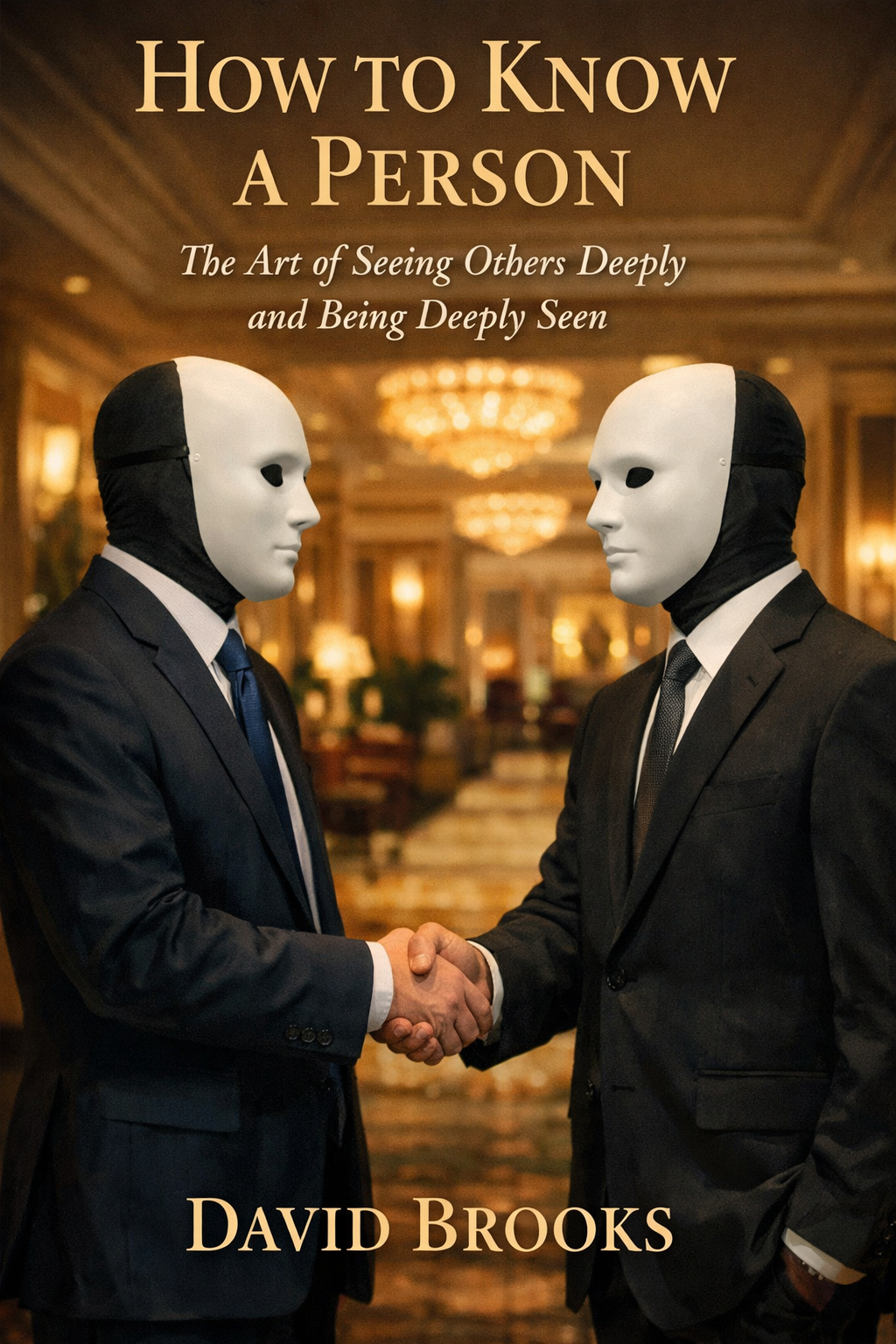
How to Know a Person: The Art of Seeing Others Deeply and Being Deeply Seen
Chapter Summaries
What's Here for You
In a world often characterized by hurried judgments and superficial connections, David Brooks' "How to Know a Person" offers a profound and timely invitation to a deeper way of seeing and being seen. This isn't just a book about social skills; it's a journey into the very heart of human connection, promising to equip you with the tools to understand others with genuine depth and to cultivate the courage to be truly understood yourself. Brooks masterfully navigates the complexities of human interaction, revealing how easily we fall into the trap of 'diminishing' others and ourselves through quick, often inaccurate, assessments. Yet, he illuminates a powerful alternative: the art of 'illumination' through active, moral attention, and the profound practice of 'accompaniment,' moving beyond observation to shared experience. You will gain a richer understanding of what it truly means to be a person – not just a recipient of events, but an architect of your own reality. The book champions the transformative power of 'good talks' and 'the right questions,' demonstrating that true knowing arises not from interrogation, but from a mutual expedition toward understanding. You'll confront the 'epidemic of blindness' that plagues our society, leading to isolation and a crisis of connection, and learn how to navigate even the most 'hard conversations' with grace and insight. Brooks explores the fundamental human quest for recognition, the shaping power of suffering, and the unique energy each person brings into a room, urging you to become a 'sommelier of people.' This book promises an intellectual awakening and an emotional recalibration. It's a guide to understanding the intricate dance of human personality, the dynamic journey of life tasks, and the deep yearning to share our 'life stories.' You'll discover how your ancestors shape your present and what true wisdom looks like – a relational, embodied understanding. Prepare to be challenged, moved, and ultimately, transformed. The tone is one of compassionate wisdom, intellectual curiosity, and a deep, abiding hope for the possibility of genuine human connection. You will leave with a renewed sense of purpose in how you engage with the world, equipped to foster deeper empathy, build stronger relationships, and experience the profound fulfillment of truly knowing and being known.
The Power of Being Seen
David Brooks, in "The Power of Being Seen," reflects on his own journey from a detached, intellectually driven childhood, where feelings were suppressed and social cues were often missed, to a more emotionally open and connected way of being. He recounts a formative experience at a New York Public Theater panel discussion, a stark contrast to the reserved environments he was accustomed to, where spontaneous emotional expression and camaraderie were not only accepted but celebrated. This event, alongside the natural tenderizing effects of life's challenges—fatherhood, personal failures, aging—began to thaw his 'emotional ice age.' Brooks argues that living in detachment is a withdrawal from life itself, a self-imposed estrangement. He shares how consciously altering his life by becoming more vulnerable and expressive, and by writing about emotion and spiritual growth, gradually led to novel experiences of feeling and changed his life goals from mere knowledge to wisdom. A profound realization emerged: while being openhearted is crucial, it's insufficient without social skills – the concrete actions of listening, disagreeing respectfully, offering forgiveness, and sitting with suffering. He posits that in an age of increasing isolation and digital superficiality, where stimulation replaces intimacy and understanding is scarce, mastering these interpersonal skills is paramount. The core of human need, Brooks explains, is to be deeply seen and understood; it's as vital as food and water, and its absence is a profound cruelty. He illustrates this through the contrast between 'Diminishers,' who make others feel small and unseen, and 'Illuminators,' who foster growth and respect through genuine curiosity and attentive listening, citing examples like Harry Nyquist of Bell Labs. Brooks acknowledges our inherent social ignorance, noting that even close friends and family often misread each other, a tendency that can worsen over time. The chapter champions the art of seeing others deeply, not as a set of techniques but as a way of life that yields the deepest pleasures, culminating in a poignant personal moment of 'beholding' his wife, recognizing her entire being in a flash of profound connection. This ability to see the richness of another's consciousness, to understand their unique experience of the world, is presented as the ultimate gift and the foundation for resilient individuals, strong relationships, and a healthy society, especially in our increasingly pluralistic world.
How Not to See a Person
David Brooks, in "How Not to See a Person," invites us into a Washington D.C. bar, not just as an observer, but as a participant in the pervasive human tendency to 'diminish' others, even ourselves. He recounts his own penchant for the 'size-up,' a quick, often judgmental assessment based on superficial cues—a bartender's tattoos, a man's attire, a couple's phone-gazing—revealing a broader societal epidemic of open eyes that fail to truly see. This inability to perceive others deeply, Brooks explains, stems from several inherent 'diminisher' tricks: egocentrism, where self-absorption blinds us to others' perspectives; anxiety, the internal noise that drowns out external realities; naive realism, the stubborn belief that our own view is the only objective truth; the 'lesser minds problem,' where we perceive ourselves as more complex than others; objectivism, the detached analysis that misses the rich inner life of individuals; essentialism, the reliance on stereotypes and generalizations that flatten unique human beings; and the static mindset, where outdated perceptions prevent us from seeing how people have evolved. Brooks uses the poignant, decades-long relationship between Vivian Gornick and her mother, Bess, as a stark illustration of this profound disconnect. Despite intense, often combative communication, they remain locked in separate worlds, each unable to truly grasp the other's subjective experience—Vivian seeing her mother primarily through the lens of her own hurt and dependency, and Bess trapped in her own overwhelming grief and identity as a widow. Their story, etched in "Fierce Attachments," demonstrates that even deep devotion and constant interaction can foster 'intimacy without togetherness,' a state where 'you can be loved by a person yet not be known by them.' The author emphasizes that seeing another person 'in all their fullness' is not an innate talent but a cultivated craft, a skill akin to learning a complex trade, requiring deliberate practice and a willingness to move beyond our ingrained limitations. This chapter serves as a critical examination of our default modes of interaction, urging a shift from superficial judgment to a deeper, more empathetic understanding, acknowledging that truly seeing another is perhaps the most challenging, yet most rewarding, human endeavor.
Illumination
David Brooks, in his chapter 'Illumination,' invites us to consider the profound power of attention, not merely as observation, but as an active, moral force that shapes both ourselves and those we encounter. He illustrates this with a vivid encounter in Waco, Texas, where he met LaRue Dorsey, a ninety-three-year-old former teacher. Initially, Mrs. Dorsey presented a stern, disciplinarian facade to Brooks, a journalist who approaches interviews as a student, seeking to be taught. However, the dynamic shifted dramatically when a mutual friend, Jimmy Dorrell, a pastor known for his deep empathy and community work, greeted her. Jimmy's boisterous, loving embrace, a gesture of profound affection, instantly transformed Mrs. Dorsey, revealing a joyous, childlike spirit beneath the stern exterior. This moment, Brooks explains, is the essence of illumination: the capacity to call forth a different, often truer, version of a person through the quality of our attention. He posits that each of us carries a characteristic way of showing up in the world, a posture toward others that can either find beauty and warmth or threats and stiffness. The core insight here is that attention is not passive; it is a moral act that brings aspects of things into being, suggesting that the quality of our lives is intrinsically linked to the quality of attention we project. Brooks contrasts his own student-like approach with Jimmy’s pastor-like gaze, which stems from seeing every person as a creature made in the image of God, possessing infinite value and dignity. This perspective, whether rooted in faith or a belief in the soul, fosters a posture of respect and reverence, a precondition for seeing people well. To be an 'Illuminator' means offering a gaze that conveys, 'I want to get to know you and be known by you,' an unconscious answer to the fundamental human question, 'Am I a priority to you?' This gaze radiates respect, acknowledging the uniqueness and inherent superiority of every individual, not as a puzzle to be solved, but as a mystery to be honored. Brooks distills the characteristics of this illuminating gaze into five key elements: tenderness, a deep emotional concern that perceives our shared bonds; receptivity, the openness to another’s experience without projecting one’s own viewpoint; active curiosity, an explorer’s heart eager to understand different lives and beliefs; affection, recognizing that true knowing is a whole-body, heartfelt experience, not just an intellectual exercise; and generosity, a spirit that redefines limitations and sees inherent worth, as exemplified by Dr. Ludwig Guttmann’s work with paraplegics. Finally, he introduces a holistic attitude, resisting the urge to simplify individuals into mere labels or single traits, understanding that, like rivers, humans are complex, ever-changing beings. Brooks emphasizes that this is an ethical ideal, a way of living that shapes our character; as Parker J. Palmer suggests, 'Every epistemology becomes an ethic.' He draws upon Iris Murdoch’s philosophy, which posits that morality is less about abstract principles and more about the continuous, everyday act of paying attention to others. The essential immoral act, Murdoch argues, is the inability to see people correctly, leading to self-serving representations, stereotyping, and dehumanization. Conversely, the essential moral act is casting a just and loving attention, a form of knowledge that involves patient, discerning regard and resisting self-centeredness. This profound attention, exemplified by therapist Mary Pipher's approach of 'no tricks' and genuine engagement, transforms interactions from problem-solving to a pure form of love, fostering empathy by inhabiting each person's point of view and recognizing their efforts to do their best. Ultimately, Brooks reveals that by striving to illuminate others with a tender, receptive, curious, affectionate, generous, and holistic gaze, we not only see them more deeply but also become better versions of ourselves, finding greatness in the small, close-at-hand acts of consideration.
Accompaniment
David Brooks, in his chapter 'Accompaniment,' invites us to consider a profound shift in how we approach knowing others, moving beyond mere observation to a deeper, shared experience. He begins with the evocative story of Loren Eiseley, the naturalist who found himself immersed in the shallow Platte River, not just observing it, but 'accompanying' it, feeling its flow from glacial springs to the Gulf, dissolving the boundaries between himself and the vast watershed. This experience, Brooks suggests, is a powerful metaphor for the next crucial step in truly knowing a person: accompaniment. It’s about moving side-by-side, not face-to-face, engaging in the mundane rhythms of life together—small talk at the supermarket, dropping kids at school—allowing our unconscious minds to attune to each other's energy and temperament. This gentle, unhurried process, characterized by patience and a willingness to decelerate social life, builds the comfort and trust necessary for deeper connection. Brooks emphasizes that this isn't about leading or directing, but about being a faithful, other-centered presence, riding alongside another's journey with relaxed awareness. He highlights the quality of playfulness, noting that shared activities, from casual games to dog training, can forge deep bonds by allowing people to relax, be themselves, and experience spontaneous communication and laughter, creating a sense of shared understanding and recognition. Ultimately, accompaniment involves a surrender of ego and power, akin to a musician supporting a singer, where the goal is to embellish the beauty of another's unique journey. Brooks illustrates this with his own misstep in coaching youth baseball, where his desire to 'help' inadvertently threatened the coach's authority. True accompaniment, he reveals, means meeting people where they are, respecting their timetable, tolerating mistakes, and offering a quiet, unwavering presence, particularly during times of hardship. This art of presence, of simply showing up, as seen in the profound gesture of former students returning to support a grieving professor, or friends silently surrounding a colleague at a wedding, underscores the deep connection forged through witnessing and believing in another's journey, even for a brief span, on paths impossible to walk alone.
What Is a Person?
David Brooks, in 'What Is a Person?', invites us to peer beyond the surface of existence, revealing that each individual is not merely a recipient of events, but a profound architect of their own reality. He masterfully uses the harrowing account of Emmanuel Carrre's experience during the 2004 Sri Lankan tsunami to illustrate this central thesis. Carrre, initially trapped in a self-absorbed pessimism, finds his world irrevocably altered not just by the cataclysm itself, but by his immersion in the deeply personal experiences of others. We witness Jrme's singular focus on saving his wife, Delphine, after their daughter Juliette's death, a stark manifestation of love transformed into a life-or-death mission. We see Delphine's silent, profound grief, a world model shattered and in need of painstaking reformation. We observe Hlne, Carrre's girlfriend, emerge as a heroine, her actions driven by a powerful, other-centered purpose. Brooks reveals that the tsunami, a shared objective event, was experienced as radically different subjective realities, colored by individual histories and immediate tasks. This divergence underscores a core insight: experience isn't what happens to us, but what we *do* with what happens. The author draws on cognitive science and neuroscience to explain that our perception is not a passive recording, but an active, predictive construction. Our brains, locked away in the skull, take limited sensory data and weave it into a rich, coherent narrative, a 'high-definition movie' built from our existing knowledge and expectations. Brooks illustrates this with the famous 'invisible gorilla' experiment, where a predicted event is simply not seen, and the football game study, where fans of opposing teams construct entirely different objective realities from the same objective footage. This constructionism, the understanding that we actively create our perception of reality, is fundamental to understanding others. Brooks posits that a person is, at their core, a 'point of view,' a creative artist who integrates memories, beliefs, traumas, and loves into a unique way of seeing. To truly know another, then, is not to categorize them, but to engage with their perspective, to ask how they see things and what enduring energies shape their world. Carrre's own transformation, from a self-absorbed man to one capable of deep affection and other-awareness, serves as a powerful testament to this principle. His journey, mirrored in the profound shifts experienced by Delphine and others, demonstrates how even in the face of unimaginable loss, the human mind can reform its models, adjust its perspective, and ultimately, create a richer, more humane existence. The chapter concludes with a call to become 'Illuminators' – individuals who seek to understand the world through the eyes of others, recognizing that true connection and wisdom emerge from this empathetic engagement. The raw, visceral impact of the tsunami narrative serves as the crucible for these profound insights, forging a path from individual suffering to collective understanding and personal transformation.
Good Talks
In the realm of human connection, David Brooks illuminates the profound art of conversation, moving beyond mere dialogue to what he terms 'good talks' – a mutual expedition toward understanding. The author posits that knowing another person is less about seeing and more about the intricate dance of talking and listening, a skill often overlooked and underdeveloped. He challenges the common misconception of a good conversationalist as a witty storyteller or a sharp lecturer, instead defining them as masters of fostering a two-way exchange, capable of drawing out the best in others, much like statesman Arthur Balfour, who could transform a hesitant remark into a contribution to human wisdom. A good talk, Brooks explains, is not a series of pronouncements but a collaborative exploration where half-formed ideas are nurtured, expanded, and returned, sparking novel thoughts and leading participants on an unexpected journey. The central tension lies in our inherent mediocrity as conversationalists, often falling prey to 'bore bombs' or assuming our own transparency. To counter this, Brooks offers crucial insights: treat attention as an on-off switch, fully present rather than passively dimmed; become a 'loud listener,' reacting with palpable engagement, mirroring Oprah Winfrey's vibrant empathy or Andy Crouch's enthusiastic affirmations, creating an atmosphere of hospitable expression. He reveals the counterintuitive power of familiarity, suggesting people connect more readily with shared experiences than novel ones, and advocates for making others 'authors' of their stories by probing for specific details and emotional nuances, understanding not just what happened, but how it was felt and what lessons were learned. Brooks wisely advises against fearing the pause; these moments of silence, like those embraced in Japanese culture, are vital for reflection, allowing deeper listening rather than premature response, much like an improv comedian who waits to build upon a scene. He introduces the concept of 'looping' – repeating what’s heard to ensure accurate understanding, a technique that, while sometimes feeling artificial, forces greater clarity and focus. The 'midwife model' is presented for conversations requiring deep support, where the listener assists the speaker’s own unfolding insights without imposing their own, gently prodding for deeper honesty, as seen in Parker J. Palmer's clearness committee experience. Crucially, Brooks emphasizes keeping the 'gem statement' – the underlying truth of shared values – at the center of disagreements, and exploring the 'disagreement under the disagreement' to uncover deeper moral or philosophical roots, turning arguments into mutual exploration. Finally, he cautions against 'topping' – shifting the focus to one's own experiences – and instead encourages sitting with another’s reality, recognizing the profound rarity of being truly heard, and aiming to make that experience less exceptional. The journey from superficial chatter to deep understanding is arduous but transformative, a continuous act of co-creation.
The Right Questions
David Brooks, in 'The Right Questions,' reveals the profound power of inquiry, not as a means to extract answers, but as a gateway to deeper self-understanding and connection. He recounts the transformative experience of his friend David Bradley, who used carefully crafted index cards born from incisive questions to help people gain perspective on their lives, a practice so impactful that individuals still cherish those cards years later. Brooks posits that many people, unlike the naturally inquisitive child, lose this vital skill, often due to societal pressures that discourage vulnerability and emotional expression, leading to conversations dominated by self-presentation rather than genuine exchange. The author draws upon his own journalistic journey, from initially daunting assignments to becoming a seasoned questioner, illustrating how even simple, broad inquiries can unlock profound narratives, as seen in his interview with Valentina Kosieva in Moscow, whose life story, marked by immense Russian historical trauma, unfolded through persistent, open-ended questions like 'And then what happened?'. Brooks underscores that effective questioning is a moral practice, a posture of humility that acknowledges our inherent inability to fully know another's inner world, shifting the focus from untrustworthy 'perspective-taking' to the more reliable 'perspective-receiving.' He contrasts judgmental, closed, or vague questions with humble, open-ended ones that invite the other person to lead the conversation, sharing an anecdote where a moderator's 'Tell me about...' question allowed a shy woman to reveal a deeply personal, yet joyful, reason for late-night grocery shopping, showcasing how such questions can illuminate a person's pleasures and wider life. Brooks argues that even in casual settings, probing for commonalities, like asking 'Where did you grow up?', can forge unexpected connections, while at more intimate gatherings, 'big questions'—such as 'What should I do with the rest of my life?'—can interrupt routine and prompt significant life reevaluations, transforming pleasant evenings into memorable explorations of values and purpose. Ultimately, Brooks concludes that people are not as private or resistant to deep conversation as we might fear; rather, they often long to be asked questions that allow them to share their authentic selves, a need so powerful that studies show people derive more pleasure from self-disclosure than financial reward, reinforcing the idea that embracing a life lived in the form of a question is the most profound way to navigate the mysteries of human experience.
The Epidemic of Blindness
David Brooks, in 'The Epidemic of Blindness,' paints a stark portrait of a society adrift, caught in a crisis of connection that leaves individuals feeling unseen, unheard, and increasingly isolated. He describes a cultural landscape fractured by political animosity, digital dehumanization, and a pervasive social breakdown, leading to surging rates of depression, anxiety, and loneliness. The statistics are chilling: the percentage of Americans with no close friends has quadrupled, and many report feeling lonely frequently, spending drastically less time with others than in previous decades. This isn't just about a lack of companionship; Brooks reveals how this disconnection warps the mind, fostering suspicion, self-loathing, and a hardening into solitude, making us vulnerable to rejection and insecurity. He likens loneliness to a deceiving filter, obscuring our true selves and leading to a profound sense of invisibility. This void, he explains, often fuels a desperate search for recognition, which has tragically found an outlet in the divisive, shame-driven politics of our time. Instead of fostering genuine community, this 'politics of recognition' amplifies resentment and offers a shallow sense of belonging, ultimately failing to humanize or heal. The author emphasizes that this crisis is fundamentally moral, stemming from a societal failure to cultivate the skills and inclinations for kindness, generosity, and respect. For generations, the focus in education and culture has shifted away from character development towards self-interest and career success, leaving individuals without the tools to truly see and connect with others. This absence of moral formation, Brooks argues, has metastasized into the social breakdown we witness, manifesting as cruelty, distrust, and even violence, as seen in the tragic stories of young men who, feeling invisible, seek a perverse form of recognition through horrific acts. He brings this to life with the poignant anecdote of a young man caught before a mass shooting, who confessed he simply 'wanted attention' and would have abandoned his plan if someone had offered acceptance. The author concludes that this epidemic of blindness is a civilization-wide failure, born from a deficiency in teaching basic social and emotional skills, and a neglect of moral formation—the very foundations needed to truly know another person and be known in return.
Hard Conversations
David Brooks, in his chapter 'Hard Conversations,' invites us into the increasingly fractured landscape of contemporary society, a place where his work of understanding others has led him through encounters fraught with tension and deep-seated emotion. He recounts experiences with an elderly Black woman simmering with fury over the hardships faced by young girls in her former neighborhood, an ardent Trump supporter who screamed obscenities at him, and a Native American matriarch whose simmering rage at historical injustices finally erupted. These encounters, he explains, are not merely personal clashes but are deeply shaped by the societal currents of disconnection, distrust, and the ingrained legacies of historical power imbalances—slavery, elitism, sexism, prejudice, and economic domination. Brooks posits that truly knowing another person requires seeing them not just as an individual, but also as a member of their group and within their social location, a complex, graduate-level task. He reveals that the essence of a hard conversation lies not just in the words spoken—the official conversation—but in the underlying currents of emotion, respect, and intention that flow beneath the surface, the actual conversation. Brooks emphasizes the critical importance of understanding the 'frame' of a conversation, recognizing that differing perspectives on the culture war, for instance, stem from fundamentally different lived realities and social positions. He shares his own struggle on a panel discussion where his attempt to offer a detached analysis clashed with a Black intellectual's lived experience of systemic injustice, leaving him feeling both powerless and acutely aware of his own societal privilege. This experience underscores a core insight: 'How you see a situation depends on what you are capable of doing in a situation,' a concept illuminated by research on perception and 'affordances,' where our physical, intellectual, social, and economic capacities shape our view of the world. Brooks learned that successful navigation of these difficult exchanges requires moving beyond simply stating one's own position to actively entering the other person's 'ken,' their frame of reference, showing genuine curiosity and respect. He stresses that when conversations devolve into 'us vs. them' dynamics and labeling, the possibility for understanding evaporates, turning a potential for connection into a battle of perceived wrongs. To redeem such moments, Brooks suggests stepping back, clarifying intentions by stating what they are *not* and then what they *are*, and re-establishing a mutual purpose, acknowledging that ruptures can, paradoxically, create opportunities for deeper bonds. Ultimately, he concludes, while we can never fully inhabit another's reality, cultivating the skills to see and hear others, even across vast differences rooted in our unique life experiences, allows us to transform distrust into trust and build a foundation of shared humanity, echoing the ancient wisdom: 'I am human, and nothing human is alien to me.'
How Do You Serve a Friend Who Is in Despair?
David Brooks, in his chapter 'How Do You Serve a Friend Who Is in Despair?', navigates the profound and often agonizing terrain of accompanying a loved one through deep suffering, particularly depression, drawing from the searing experience of his oldest friend, Peter Marks. The author begins by acknowledging a societal shift: as public life grows more acrimonious, private lives are increasingly marked by sadness, leading to more frequent encounters with individuals grappling with depression, grief, and struggle. Brooks posits that while we may not always be able to cure these afflictions, we can offer the profound gift of making those suffering feel deeply known. He recounts the devastating descent of his friend Pete, a man characterized by a rare blend of the ordinary and the extraordinary—a devoted father, husband, and friend, whose outward life of joy and success masked a profound childhood trauma that eventually manifested as severe depression. Brooks confesses his initial unpreparedness for this reality, his own tendency towards optimism blinding him to the true depth of Pete's pain. He learned, through agonizing years, that depression is not merely sorrow but a distorted state of consciousness, a cold, black, and empty landscape that defies extrapolation from one's own periods of sadness. Early attempts to offer advice or positive reframing proved futile, even counterproductive, as they often signaled a lack of understanding to the sufferer. The central lesson for Brooks became clear: the true role of a friend in despair is not to cheer them up, but to acknowledge the reality of their suffering, to hear them, respect them, love them, and crucially, to demonstrate that one has not given up on them. He shares Pete's struggle with the fear of losing his identity as a healer and the internal battle against 'lying voices' that whispered he was a burden. Brooks highlights the profound impotence words can feel in the face of such darkness, yet emphasizes the power of simply being present, of maintaining the easygoing friendship that existed before the illness, hoping to alleviate isolation. A pivotal moment of connection came through a video of Mike Gerson's sermon, which validated Pete's experience of internal torment and offered a glimpse of hope for eventual healing. Brooks reflects on the importance of small, consistent gestures—like sending postcards—that signify unwavering presence without demanding a response. He underscores that depression can warp a person's reality into a 'nightmarish Salvador Dalí world,' one that defies logic and is difficult to articulate. The author's narrative arc moves from the tension of helplessness and loss, particularly after Pete's suicide, towards the insight that true service lies in humble, flexible presence and the offering of being seen. He concludes with the poignant recognition that while he feels sorrow for not having done more, guilt is unwarranted, given the immense support Pete received and the sheer magnitude of the illness itself, a 'beast' that was ultimately larger than human intervention. The enduring lesson is the profound satisfaction, vulnerability, and obligation that true friendship entails, and the quiet dignity of offering comfort through shared presence in the face of unfathomable pain.
The Art of Empathy
David Brooks, in 'How to Know a Person,' delves into the profound human quest for recognition, a journey that begins in infancy. He reveals how the absence of being seen, as demonstrated in the stark 'still face' experiments, can inflict deep, lasting wounds, shaping our fundamental beliefs about safety, love, and worthiness. These early experiences, often unconsciously carried, echo through generations, influencing our adult relationships and defenses. Brooks illustrates this with the striking findings of the Grant Study, which unequivocally linked the warmth of one's childhood home to lifelong success and well-being, cautioning that a bleak childhood acts as a poor cushion against life's inevitable difficulties. He then unpacks the 'defensive architecture' people construct, like avoidance, deprivation, overreactivity, and passive aggression, explaining how these survival mechanisms, though once adaptive, can become 'sacred flaws' that limit our ability to connect and perceive reality accurately. This conceptual blindness, where outdated models dictate present behavior, can lead to catastrophic errors, much like the generals of World War I. The path to repairing these deeply ingrained models, Brooks argues, lies not in introspection, which is often overrated and too close to the self, but in genuine communication and empathy. He defines empathy not as a mere feeling, but as a set of trainable skills: mirroring, the ability to accurately catch and embody another's emotions; mentalizing, the capacity to understand the 'why' behind those emotions by projecting our own experiences; and caring, the crucial act of stepping outside our own perspective to meet another's unique needs. This journey toward empathy is often ignited by crisis, a moment when our defenses crumble, revealing the limitations of our internal maps. It's in these vulnerable spaces, Brooks suggests, that we need others to offer not just understanding, but the embodied experience of being truly seen and supported, a process he likens to 'getting down on the ground' with someone. This requires a physical and emotional attunement, a co-regulation that calms the nervous system and reshapes how we perceive the world. Ultimately, Brooks posits that our deepest wounds can become our greatest sources of power, enabling us to connect with others from a place of shared humanity, transforming suffering into a profound capacity for love and understanding.
How Were You Shaped by Your Sufferings?
David Brooks, in his chapter 'How Were You Shaped by Your Sufferings?', invites us to consider the profound, often transformative, impact of hardship on the human spirit. He illustrates this through the poignant story of Barbara Lazear Ascher, whose husband's terminal illness and subsequent death, while devastating, stripped their life down to its essentials, revealing a profound intimacy and a sense of being blessed even in the face of mortality. Yet, the journey did not end with death; Lazear Ascher's grief was a raw, disorienting process, marked by an "emptiness of my hollowed self," a stark reminder that suffering shatters our comfortable assumptions about a benevolent and controllable world. Brooks then introduces the crucial distinction between assimilation and accommodation in the face of trauma: those who assimilate try to fit the experience into their existing models, often saying, "I survived and will keep on chugging," while those who accommodate, like the cancer survivor who declares, "This changes who I am," actively remake their internal models. This act of remaking, Brooks explains, involves confronting existential truths and asking fundamental questions about safety, desert, identity, and one's place in the world—a difficult journey not all navigate successfully, as evidenced by surveys showing a significant percentage of trauma survivors viewing life for the worse, while a comparable number see it for the better. The author draws parallels with Frederick Buechner's experience of his father's suicide, a trauma that, though deeply buried for decades, eventually compelled a decades-long "journey down into the depths of what it means to be human." Buechner's realization that "excavation is not a solitary activity" underscores a central insight: true healing and self-knowledge emerge through sharing our griefs, transforming raw pain into a catalyst for deeper connection and understanding. Brooks suggests practical ways to facilitate this excavation, including family-history exercises, partner-based life reviews, chronological life mapping, and expressive writing, all aimed at helping individuals reintegrate their experiences and create new mental models. He posits that the "Illuminator ideal" of character development, unlike the "warrior-statesman model" focused on self-mastery, emphasizes social connection and the daily acts of building relationships—the gaze of respect, the question of curiosity, the conversation of solidarity. This social model, Brooks argues, cultivates good character not through solitary willpower, but through skillful, humble, and warm engagement with others, recognizing both their pain and their strength. Ultimately, the chapter reveals that while suffering can shatter us, it also holds the potential to reshape us, forging resilience and a deeper capacity for empathy, urging us to see our "full humanness" and be known in that truth, for it is in "sharing our griefs with others" that we truly overcome fear and know each other at the deepest level.
Personality: What Energy Do You Bring into the Room?
David Brooks, in his chapter 'Personality: What Energy Do You Bring into the Room?', invites us to become 'sommeliers of people,' urging us to look beyond superficial impressions and understand the fundamental energies individuals bring into any space. He contrasts the flamboyant extroversion of George W. Bush, whose magnetic, albeit sometimes rigid, presence could disarm and captivate, with a noted lack of intellectual curiosity, a trait that, Brooks suggests, may have influenced significant decisions. This anecdote serves as a launchpad into the author's core argument: that a healthy society thrives on a diverse spectrum of personality types, each offering unique gifts, much like a rich ecosystem depends on varied flora and fauna. Brooks critiques the unscientific nature of popular assessments like the Myers-Briggs Type Indicator, which relies on false binaries, and champions the empirically validated 'Big Five' personality traits—extroversion, conscientiousness, neuroticism, agreeableness, and openness—as a more robust framework for understanding human nature. He explains how extroverts, driven by the pursuit of positive emotions and rewards, can be both exhilarating and risk-prone, while those low in extroversion find depth in quieter pursuits. Conscientiousness, he reveals, offers discipline and focus, essential for organization but potentially leading to rigidity, as seen in the extreme routines of 'Ronald.' Neuroticism, characterized by heightened sensitivity to negative emotions, can foster a vital awareness of danger and pain, even as it presents challenges. Agreeableness, the capacity for kindness and social understanding, fosters strong relationships but may not always lead to conventional career success, while openness fuels innovation and new experiences, a drive that can make the mundane unbearable. Brooks posits that these traits are not fixed destinies but dispositional signatures, gifts that shape our interactions and can be cultivated over a lifetime, much like fine wine improves with age. Understanding these fundamental energies, he concludes, is not just an academic exercise but a crucial skill for navigating relationships, fostering empathy, and building a more compassionate and effective society.
Life Tasks
David Brooks, in his chapter 'Life Tasks,' invites us to view human development not as a static series of stages, but as a dynamic journey through a succession of common life tasks, each demanding a unique evolution of consciousness. He reveals that from the very moment of birth, a baby's primary task is bonding, their vision sharply focused on the nurturing face before them, a world of 'Rembrandt portraits.' This expands as they develop a 'lantern consciousness,' absorbing the world with boundless curiosity, a stark contrast to the adult's 'spotlight consciousness.' The narrative then traces the emergence of the toddler's drive for self-identity, the dramatic 'No No No' of establishing personhood. Brooks explains that understanding individuals deeply requires recognizing the specific life task they are currently navigating. He outlines several key tasks: the 'Imperial Task,' where the drive for agency and competence can lead to an all-consuming, self-centered 'imperial consciousness' focused on winning and external validation, a mindset that can tragically persist into adulthood, turning relationships into contests. Following this is the 'Interpersonal Task,' a shift towards social identity, where the consciousness becomes attuned to psychological traits and the desire to 'fit in,' leading to idealism and a profound dependence on external approval, where a breakup can feel like the loss of self. Then comes 'Career Consolidation,' the pursuit of mastery and making a difference, often marked by an 'individualistic mindset' and a focus on achievement, which can lead to a sealing off of emotions and relationships in the relentless pursuit of a vocation. Brooks paints a vivid picture of Lyndon Johnson's ambition as a physical manifestation of this drive. However, he notes that this intense focus can eventually lead to a spiritual hunger, a realization that external success is insufficient. This often precipitates the 'Generative Task,' a profound shift towards service, fostering and guiding the next generation, adopting a 'gift logic' that replaces the meritocratic drive, transforming leaders into guardians who steward institutions and pass on values. The remarkable transformation of Adam Newman, from a self-centered, aloof individual to a compassionate servant of the world, exemplifies this crucial transition. Finally, Brooks touches upon Erik Erikson's final task, the struggle for 'Integrity versus Despair,' where wisdom emerges from the ability to hold contradictions and see life's connections, finding peace in acceptance and the deep satisfaction of everyday moments and meaningful connections, a stark contrast to the regret of a life unlived. Brooks concludes by reminding us that we are all 'works in progress,' often unaware of our own ongoing evolution, and that embracing these life tasks with a renovated consciousness is the key to truly knowing ourselves and others.
Life Stories
David Brooks, in his chapter 'Life Stories,' unveils a profound truth: beneath the surface of our busy lives, people possess a deep, often unmet, yearning to share their narratives and to be truly seen. He recounts the research of Nicholas Epley, who discovered that we consistently underestimate the pleasure others derive from conversation, leading us to avoid the very interactions that could bring happiness and connection. This reluctance, Brooks suggests, stems not just from busyness or social anxiety, but from a faulty prediction of enjoyment. The author emphasizes that human beings are fundamentally narrative creatures, and our ability to construct and understand life stories is crucial for a meaningful existence. He contrasts the 'paradigmatic mode' of analytical, data-driven thinking, prevalent in our professional lives, with the 'narrative mode,' which is essential for grasping the unique complexity of an individual. Brooks illustrates this with an anecdote about an elderly gentleman on a plane, whose life story, filled with immigration, entrepreneurial spirit, and surprising turns, offered a richer understanding than any superficial conversation. He then delves into the intricate landscape of the inner voice, exploring how it shapes our self-perception and narrative tone, revealing our fundamental attitudes towards the world. This inner monologue, he notes, can be a source of guidance or torment, with some individuals experiencing it as a constant stream of characters and conversations, while others find periods of silence. Brooks introduces the concept of the 'imago,' an idealized self-image that guides our aspirations, using Viola Davis's powerful story of overcoming adversity as an example of a clearly defined heroic identity. He further explores James Marcia's stages of identity creation, from diffusion to achievement, highlighting the importance of settling on a stable, authentic heroic identity. The chapter also touches upon the common narrative plots we adopt, such as 'Overcoming the Monster' or 'Rags to Riches,' and how these shape our understanding of our own lives, particularly the American tendency towards redemption stories. Brooks cautions against unreliable narrators, those who distort their stories to the point of self-deception, and celebrates narrative flexibility, the ability to revise our life stories as we age and gain wisdom. He posits that therapists act as 'story editors,' helping individuals reconstruct their lives into more accurate and empowering narratives. Ultimately, Brooks reveals that listening to someone's life story is not a passive act; it's a co-creative process, where our affirmation and attention help others solidify their identity and grow, reminding us that our sense of self is deeply intertwined with the acknowledgment of others.
How Do Your Ancestors Show Up in Your Life?
David Brooks, in 'How to Know a Person,' delves into the profound influence of our ancestral heritage, illustrating how the past shapes our present identity and perception of others, much like the vibrant tapestry of Zora Neale Hurston's life. Born prematurely and facing a father who never fully accepted her, Hurston was nurtured by a mother who encouraged her to 'jump at the sun.' Her formative years in the all-Black town of Eatonville, Florida, exposed her to a raw, unfiltered community where emotions were naked and language was a playground for bold insults and rich folklore. This immersion in the 'small dramatic panorama' of her childhood, a place 'sacred' and never quite left, provided the raw material for her literary genius, teaching her both individualism and community. Brooks emphasizes that this phenomenon is not unique to Hurston; he recounts his own Manhattan roots, where five generations have left their imprint, creating a 'semiconscious prejudice' that New York, and by extension, where one comes from, is the ultimate measure of life. He posits that we live our childhoods twice: first with wonder, and later with understanding, a journey often undertaken by artists returning to their origins for spiritual nourishment. Hurston's own precognitive visions of an orphaned future, and the haunting failure to heed her dying mother's wishes, underscore the deep emotional currents that bind us to our past, even as they propel us forward. Her subsequent wanderings and eventual return to Florida to study anthropology under Franz Boas reveal a deliberate act of reconnecting with her roots, an endeavor to 'get inside Negro art and lore' and bring it to the world. Brooks highlights this ancestral connection as a 'weapon of resistance' against those who diminish Black life and southern Black culture. He draws on Edmund Burke's wisdom, suggesting that we cannot look forward without looking back, for each person is a 'long movement, a transmission from one generation to another.' This ancestral influence isn't merely passive inheritance; it's a dynamic interplay where individuals embrace, reject, and transform cultural legacies. Brooks uses the example of diplomats' parking ticket habits to illustrate how differing cultural tolerances for rule-breaking, shaped by ancestral experiences with colonialism or oppression, manifest in distinct behaviors. He introduces Michele Gelfand's 'tight' and 'loose' cultures, and Joseph Henrich's research on WEIRD (Western, Educated, Industrialized, Rich, Democratic) societies, revealing how historical conditions—like agricultural practices or settlement patterns—sculpt deeply ingrained societal norms regarding gender roles, interdependence, and individualism. The enduring legacy of early English settlements in America, as detailed by David Hackett Fischer, is shown to still shape regional attitudes on morality, social order, and even voting patterns centuries later. Ultimately, Brooks argues that to truly know a person, we must adopt a 'double vision': appreciating the powerful force of group culture while simultaneously perceiving the unique, individual journey of self-creation, often in defiance of that culture. This requires holding complexity, recognizing that culture is neither everything nor nothing, and seeing individuals as both 'culture inheritors and as culture creators.' The author concludes by reflecting on his own Jewish heritage, not as a religious adherent, but as a fiber of his being, a source of reverence for the word, a drive for achievement, and an audacious conviction in life as a moral journey, prompting the profound question: How do the dead show up in your life, and how do we, in turn, see others in their entirety, beyond shallow stereotypes, as a 'summing-up of all the other lives that are simultaneous with yours'?
What Is Wisdom?
David Brooks, in his chapter 'What Is Wisdom?', invites us to reconsider our very definition of wisdom, moving beyond the image of a solitary sage dispensing pronouncements to embrace a more relational and embodied understanding. He begins by illustrating moments where one person truly *sees* another: a teacher recognizing a quiet student's thoughtful nature, a teacher calling out a student's reliance on glibness, a father offering comfort instead of punishment to a drunken daughter, or even Franklin Roosevelt's astute observation of a young Lyndon Johnson. These glimpses, Brooks suggests, are the seeds of wisdom – not the accumulation of facts, but the profound art of knowing people. He contrasts the conventional view of wisdom, epitomized by figures like Yoda or Solomon, with his evolving perspective: wise people don't simply tell us what to do; they first bear witness to our stories, accepting our struggles and guiding us to process our own thoughts and emotions. They create a 'safe space' for navigating life's inherent ambiguities, like the tension between intimacy and independence, receptivity being their essential gift. Brooks then weaves in compelling narratives to illuminate this concept: the profound connection between writer Tracy Kidder and the Burundian immigrant Deo, where shared vulnerability, particularly the fear of judgmental eyes, becomes a bridge across vastly different experiences, demonstrating that deep knowing is possible even across cultural chasms. He also recounts therapist Lori Gottlieb's work with John, a man whose narcissistic facade masked deep trauma and loneliness, showing how compassionate confrontation and patient witnessing can help someone uncover buried truths, like the death of his son, leading to a more integrated self. The cinematic scene from 'Good Will Hunting' further underscores this, as Robin Williams' character doesn't offer solutions but bravely confronts Will with his own hidden fears and vulnerabilities, pushing him toward a deeper, more personal way of knowing. Brooks emphasizes that wisdom is not an individual trait but a social practice, cultivated in 'communities of truth' where minds intermingle and perspectives are shared, leading to a collective awareness that transcends individual intellect. He concludes with a personal reflection, admitting his own ongoing struggle with ego and diffidence, yet highlighting his progress in seeking deeper connection and understanding, especially through embracing 'critique with care' – naming what we almost know ourselves, within a context of unconditional regard. Ultimately, Brooks posits that true wisdom lies in the everyday acts of encounter, in the capacity to make another person feel truly seen and understood, a skill that enriches not only the receiver but also the giver, fostering a moral way of being in the world characterized by generous, loving attention.
Conclusion
David Brooks' "How to Know a Person" offers a profound and urgent call to re-cultivate the lost art of seeing and being seen, a skill he argues is fundamental to personal fulfillment, robust relationships, and societal cohesion. The book dismantles the pervasive modern tendency towards detached observation and superficial "size-ups," revealing them as forms of cruelty that deny our deepest human need for recognition and understanding. Brooks masterfully illustrates that true connection hinges not on intellectual prowess or strategic interaction, but on a deliberate, moral act of attention—characterized by tenderness, receptivity, and genuine curiosity. He emphasizes that individuals are not static entities to be categorized, but complex, evolving "points of view" whose subjective realities are shaped by unique life stories, ancestral legacies, and personal traumas. The emotional core of the book lies in the recognition of our profound vulnerability and the deep-seated wounds that arise from being unseen or misunderstood. Brooks argues that empathy is not an innate trait but a trainable craft, cultivated through active listening, "good talks," and the courage to engage in "hard conversations" by stepping into another's frame of reference. He offers practical wisdom through concepts like "accompaniment," which suggests a gentle, side-by-side approach to knowing, and the power of asking "the right questions" that foster self-reflection rather than providing answers. The book underscores that our personalities, life tasks, and even our suffering shape how we perceive the world and others, urging us to appreciate these "dispositional signatures" with the nuance of a sommelier. Ultimately, "How to Know a Person" is a compelling testament to the transformative power of genuine human connection. Brooks posits that wisdom is not about accumulated knowledge, but about the capacity to witness another's story with unconditional regard, creating hospitable spaces for vulnerability and self-discovery. In an era marked by digital isolation and societal blindness, his work serves as a vital roadmap for rebuilding trust, fostering empathy, and rediscovering the profound joy and moral imperative of truly knowing one another. The journey towards seeing others deeply is, in essence, the journey towards becoming more fully human.
Key Takeaways
Living in a detached state is a withdrawal from life, leading to estrangement from oneself and others, necessitating a conscious journey toward emotional openness and connection.
While vulnerability is essential for deep connection, it is insufficient without the practical social skills needed to navigate relationships with consideration and understanding.
The fundamental human need to be deeply seen, heard, and understood is as vital as basic sustenance, and its denial constitutes a profound form of cruelty.
Individuals can be categorized as 'Diminishers,' who make others feel small and unseen, or 'Illuminators,' who foster growth and respect through genuine curiosity and attentive listening.
Accurate perception of others' thoughts and feelings is often overestimated, even among close relationships, highlighting a pervasive social ignorance that requires deliberate cultivation of empathy.
The ability to deeply understand and connect with others is not merely a set of techniques but a way of life, essential for personal fulfillment, strong relationships, and societal cohesion in a pluralistic world.
The pervasive human tendency to 'diminish' others through superficial judgments and generalizations ('size-ups') prevents genuine connection and understanding.
Inherent psychological barriers such as egocentrism, anxiety, naive realism, and the 'lesser minds problem' actively hinder our ability to perceive others accurately.
Reliance on objectivism and essentialism, while useful for group analysis, fails to capture the unique subjectivity and inner world of an individual.
A static mindset, where perceptions of others are not updated as they evolve, leads to profound misunderstandings and relational blindness.
Even in intense, lifelong relationships, a lack of true sight can result in 'intimacy without togetherness,' where individuals are known but not deeply understood.
Seeing another person fully is not an automatic process but a learned craft requiring intentional skill development and a commitment to empathy.
The quality of our attention is a moral act that actively shapes how we perceive and interact with others, influencing their revealed selves.
Seeing others with respect and reverence, recognizing their inherent dignity and infinite value, is a prerequisite for truly understanding them.
Illumination is achieved through a specific posture of attention characterized by tenderness, receptivity, active curiosity, affection, generosity, and a holistic view.
Morality is fundamentally rooted in the continuous, attentive act of seeing others accurately and with just, loving regard, rather than abstract principles alone.
The ability to overcome self-centeredness and prejudice to truly see another person leads to moral growth and the cultivation of deeper, more meaningful connections.
Human beings are complex, multifaceted beings whose true nature is revealed not through simplification but through a sustained, holistic, and empathetic gaze.
Accompaniment is a gentle, side-by-side approach to knowing others, distinct from intense, direct inquiry, fostering connection through shared mundane experiences.
Patience and 'negative effort,' or the ability to hold back and respect another's timetable, are crucial for building trust and allowing relationships to deepen organically.
Playfulness, engaged in shared activities, is a powerful catalyst for human connection, fostering relaxation, spontaneity, and a sense of shared understanding.
Other-centeredness, characterized by humility and a supportive role, is essential in accompaniment, allowing individuals to shine and navigate their own journeys without forceful direction.
The art of presence, particularly showing up during difficult times without needing to offer solutions, is a profound act of compassion and connection, offering silent witness and support.
True connection is built not through improvement or advice, but through the privilege of being seen and the act of witnessing another's essence, accompanying them on their unique journey.
A person is fundamentally a 'point of view,' actively constructing their reality based on unique life experiences, beliefs, and emotions.
Objective events are experienced subjectively; understanding how an individual interprets an event is more crucial than the event itself.
Human perception is not passive reception but an active, predictive, and creative construction, akin to a brain weaving a movie from limited data.
True understanding of others requires moving beyond categorization to engage with their perspective and learn how they construct their world.
Traumatic events can act as catalysts, radically transforming an individual's worldview and fostering deeper empathy and connection.
Becoming an 'Illuminator' involves actively seeking to see the world through another's eyes, fostering greater wisdom, humanity, and grace.
Effective conversation is a collaborative exploration, not a performance, requiring active listening and mutual contribution to foster understanding.
Treating attention as an 'on-off switch' and employing methods like 'SLANT' (sit up, lean forward, ask questions, nod, track) ensures full presence, making the other person feel deeply valued and heard.
Embracing pauses and employing 'looping' (repeating what's heard) enhances comprehension and encourages deeper self-expression from the speaker, moving beyond superficial exchanges.
Facilitating deeper self-discovery in others, akin to a 'midwife,' involves asking probing questions and creating a safe space for honest reflection rather than offering unsolicited advice or insights.
Identifying the 'gem statement' and the 'disagreement under the disagreement' transforms conflict into an opportunity for profound mutual exploration by uncovering shared values and root causes.
Avoiding the conversational trap of 'topping' and instead focusing on deeply understanding the other person's experience is essential for building genuine connection.
The most transformative questions are not those seeking specific answers, but those that create analytical frames for self-reflection and perspective.
Societal pressures often stifle natural childhood curiosity, leading adults to prioritize self-presentation over genuine inquiry and connection.
Effective questioning is a moral act rooted in humility, acknowledging the limits of one's own understanding and prioritizing the reception of another's perspective.
Open-ended, humble questions, often starting with 'How,' 'What,' or 'Tell me about,' empower individuals to share their authentic selves and deeper life experiences.
Probing for commonalities and asking 'big questions' can foster unexpected connections and prompt significant life reevaluations, moving beyond superficial conversation.
Humans possess a profound, often unacknowledged, desire to be asked questions about themselves, finding deep satisfaction in self-disclosure and being truly heard.
Societal disconnection, exacerbated by political polarization and digital isolation, has created a profound crisis of loneliness and mental distress, characterized by declining social connections and rising rates of sadness and anxiety.
Loneliness acts as a distorting lens, fostering suspicion, self-doubt, and a heightened vulnerability to rejection, leading individuals to withdraw and create defensive internal worlds.
The modern 'politics of recognition' offers a superficial substitute for genuine connection, fueling resentment and division by prioritizing identity affirmation over community building and mutual understanding.
A core cause of societal breakdown is the decline in moral formation, with a societal shift away from teaching kindness, generosity, and respect, leaving individuals ill-equipped for deep interpersonal connection.
The failure to cultivate basic social and emotional skills in individuals has metastasized into widespread distrust, cruelty, and a pervasive sense of alienation, impacting everything from daily interactions to political discourse.
The desperate craving for recognition, amplified by feelings of invisibility, can tragically manifest in destructive ways, including acts of violence, as individuals seek to be seen, even if through infamy.
Rebuilding connection requires a conscious effort to re-emphasize moral formation, focusing on cultivating empathy, restraint of selfishness, and the practical skills needed to treat others with dignity and kindness.
Understanding another person requires perceiving them simultaneously as an individual, a group member, and within their social location, a complex skill that transcends basic interpersonal interaction.
Hard conversations operate on two interwoven levels: the surface-level 'official conversation' and the deeper 'actual conversation' driven by emotions, intentions, and the transmission of respect or threat.
The 'frame' of a conversation, dictated by individual perspectives shaped by lived experiences and social position, must be acknowledged and entered by participants, rather than imposing one's own frame, to foster genuine understanding.
Perception is not objective but is profoundly shaped by our capabilities and limitations, meaning individuals literally 'see' different worlds based on their physical, social, and economic circumstances ('affordances').
Navigating difficult dialogues demands active curiosity and a willingness to step into another's 'ken' (frame of reference) to demonstrate respect and build a shared pool of knowledge, rather than retreating into entrenched positions.
Conversations that devolve into labeling and 'us vs. them' dynamics destroy understanding; redemption lies in pausing, clarifying intentions, and re-establishing a mutual purpose that encompasses both parties.
Despite vast differences in lived experience, the capacity to listen with respect and curiosity can transform distrust into trust, fostering connection by acknowledging shared human struggles and joys.
When accompanying a friend in despair, the most profound service is not to offer solutions or cheerfulness, but to acknowledge and validate their suffering, demonstrating unwavering presence and love.
Depression is not merely sadness but a distorted state of consciousness that alters perception of reality, making it an 'unimaginable abyss' that cannot be understood by extrapolating from normal periods of distress.
Attempts to 'positive reframe' or offer advice to someone in deep depression can be counterproductive, potentially making them feel worse for their inability to feel better and signaling a lack of understanding.
True friendship in times of suffering requires immense humility, flexibility, and a willingness to enter, as much as possible, the friend's altered reality, even when it defies logic.
Small, consistent gestures of presence, like notes or emails, can be powerful affirmations of connection, offering comfort without the burden of response, signifying 'I am with you.'
The struggle of depression often involves battling internal 'lying voices' and a profound sense of isolation, even when surrounded by love, underscoring the need for external validation of their experience.
The fundamental human need for recognition, unmet in early life, creates deep psychological wounds that shape adult defenses and relationships.
Early childhood experiences, particularly the quality of familial relationships, are powerful predictors of adult well-being and success, acting as a crucial 'inoculation' against future pain.
Defensive mechanisms, developed in childhood to cope with trauma, can become 'sacred flaws' that distort perception and hinder genuine connection, leading to 'conceptual blindness' in adulthood.
True empathy is a set of trainable skills—mirroring, mentalizing, and caring—rather than a passive emotion, requiring active engagement with another's internal world.
Repairing outdated internal models and overcoming childhood wounds is best achieved through communicative connection and empathetic support, rather than solitary introspection.
Empathy is a fundamentally embodied process, involving physical co-regulation and shared experience, which can physically alter our perception of the world and foster deeper human connection.
Wounds, when processed and integrated, can transform into sources of profound strength and understanding, enabling individuals to offer unique wisdom and service to others.
Suffering acts as a crucible, shattering our fundamental assumptions about the world and forcing a re-evaluation of our core beliefs and identity.
Individuals respond to trauma by either assimilating the experience into their existing worldview or accommodating it by actively remaking their internal models, leading to different paths of growth or damage.
The process of confronting and integrating loss and trauma is often a protracted journey, a 'night sea journey,' requiring the excavation of buried emotions and the willingness to face disavowed parts of the self.
True healing and deeper self-knowledge emerge not from solitary endurance, but from the courageous act of sharing grief and experiences with others, fostering connection and mutual understanding.
Character is not solely built through self-mastery and willpower, but is profoundly shaped through skillful, humble, and warm social interactions and the daily acts of building connection with others.
By actively engaging with our past suffering, sharing its meaning, and creating new narratives, we can transform ourselves and construct a more resilient and meaningful future from the ruins of what was lost.
A society's strength and functionality are deeply rooted in the diversity of its citizens' personality traits, with each disposition offering unique contributions and serving valuable social roles.
Popular personality assessments like Myers-Briggs lack scientific validity due to their reliance on simplistic, false binaries, whereas the 'Big Five' traits provide a more nuanced and empirically supported framework for understanding personality.
Each of the 'Big Five' personality traits—extroversion, conscientiousness, neuroticism, agreeableness, and openness—presents a distinct 'energy' or way of interacting with the world, offering both inherent advantages and potential drawbacks.
Personality traits are not immutable destinies but 'dispositional signatures' that can be understood, appreciated, and even gently cultivated or modulated over time, influencing our interactions and life outcomes.
Developing an informed understanding of personality traits, akin to a sommelier's expertise with wine, allows for deeper perception of others and more appropriate, empathetic ways of relating to them.
Human development is a continuous process of navigating distinct 'life tasks,' each requiring a specific evolution of consciousness, rather than a fixed set of stages.
The 'Imperial Task,' driven by the need for agency, can foster a self-centered consciousness fixated on external validation and winning, which, if unchecked, can hinder deep relationships.
The 'Interpersonal Task' shifts focus to social identity and belonging, leading to a consciousness highly attuned to others' opinions, making individuals vulnerable to isolation and the devastation of loss.
Career consolidation involves a drive for mastery and making a difference, often fostering an individualistic mindset that can lead to emotional detachment and a sealing off from deeper connection.
The 'Generative Task' represents a profound shift towards service and nurturing the next generation, characterized by a 'gift logic' and a guardian's stewardship, moving beyond self-interest.
Achieving 'Integrity' in the face of death involves accepting one's life, holding contradictions, and finding wisdom in connection, contrasting with the regret of 'Despair' over a life unfulfilled.
Individuals are 'works in progress,' and recognizing one's current life task and the necessary shift in consciousness is crucial for personal growth and understanding others.
We consistently underestimate how much others desire to connect and share their life stories, leading us to miss opportunities for deep human connection.
Understanding individuals requires shifting from a 'paradigmatic' (analytical) mode to a 'narrative' mode, which captures the unique complexity and evolution of a person's life.
Our inner voice, the internal narrator of our life story, significantly shapes our perception of the world and our sense of self-efficacy.
Developing a clear 'imago,' or idealized self-image, and a coherent life plot is essential for establishing a stable and meaningful identity.
Narrative flexibility, the ability to revise and update our life stories as we age and encounter new experiences, is vital for personal growth and resilience.
Listening to someone's life story is a co-creative act that affirms their identity and can help them see themselves in a new, more empowered light.
Our sense of self and our understanding of others are deeply interwoven with the legacies and experiences of our ancestors, a connection that is both inherited and actively shaped.
Places of origin, particularly childhood hometowns, serve as sacred anchors that imbue individuals with a unique blend of individualism and community, acting as a continuous source of identity and inspiration.
True understanding of a person requires a 'double vision' that simultaneously acknowledges the influence of their cultural heritage and their unique journey of self-creation, often in defiance of group norms.
Cultural norms and behaviors, from attitudes towards rules to family structures, are not arbitrary but are often deeply rooted in the historical circumstances and survival strategies of ancestral groups.
Individuals are not passive recipients of culture but active 'cultural cocreators,' selectively embracing, rejecting, and transforming the traditions passed down to them.
Recognizing the presence of the past in ourselves and others allows for a deeper, more nuanced connection, moving beyond superficial stereotypes to see the whole person shaped by history.
The tension between embracing one's cultural inheritance and asserting individual identity is a fundamental aspect of human experience, requiring the conscious effort to hold both perspectives.
True wisdom is not about possessing knowledge, but about the profound ability to see and understand other people deeply, acting as a 'witness' to their stories rather than a dispenser of advice.
Wise individuals create a hospitable environment where vulnerability is safe, allowing others to explore life's ambiguities and contradictions, fostering self-discovery rather than imposing solutions.
Deep connection and understanding, even across vast differences, are forged through shared vulnerability and the courage to confront difficult truths, acting as a bridge between disparate experiences.
Wisdom is fundamentally a social skill, practiced and amplified within 'communities of truth' where shared perspectives and attentive listening lead to collective insight and a richer understanding of ourselves and others.
Critiquing with care, which involves naming unspoken truths within a framework of unconditional regard, is a crucial aspect of wisdom that facilitates personal growth and self-awareness.
The ongoing practice of seeking to deeply understand others, even when imperfect, cultivates a moral way of being in the world, characterized by compassionate awareness and loving attention.
Action Plan
Consciously practice making meaningful eye contact and engaging fully when someone is sharing something personal.
Identify and practice one small, concrete social action each day, such as offering a genuine compliment or actively listening without interrupting.
Seek opportunities to be genuinely curious about someone else's perspective, asking thoughtful questions to understand their experience.
Reflect on personal interactions and identify moments where you might have been a 'Diminisher' and consider how to shift towards being an 'Illuminator.'
When interacting with others, especially those with different backgrounds or viewpoints, make an effort to 'begin to see' the world through their eyes.
Practice 'beholding' loved ones by paying special, focused attention to their entire being, not just isolated facts or memories.
Engage in conversations where vulnerability is appropriate, sharing a bit of your own authentic self at a measured pace.
Consciously practice pausing before making judgments about others, especially based on initial impressions.
Actively challenge your own assumptions by asking clarifying questions and seeking alternative perspectives.
Dedicate specific moments to quiet internal anxieties to better attune to the person in front of you.
When observing others, consciously look for the unique inner world—their imagination, sentiments, and desires—rather than just outward behavior.
Regularly update your perception of people in your life, recognizing that they, like you, are constantly evolving.
Engage in active listening, focusing not just on what is said, but on the emotions and underlying needs being communicated.
When reflecting on relationships, consider what you might be missing about the other person's subjective experience, rather than solely focusing on your own.
Seek out opportunities to learn about others' backgrounds and experiences to counter essentialist tendencies and stereotypes.
Practice approaching each new person with the intention of being a student, seeking to learn from them.
Consciously adopt a posture of respect and reverence, acknowledging the inherent dignity of every individual you meet.
Cultivate tenderness by actively seeking to perceive the bonds and shared humanity that connect you to others.
Develop receptivity by resisting the urge to project your own viewpoint and instead patiently open yourself to another's experience.
Nurture active curiosity by asking open-ended questions and genuinely seeking to understand different perspectives and life experiences.
Embrace affection by recognizing that true knowing involves the heart and whole being, not just the intellect.
Practice generosity of spirit by looking for the inherent worth and positive potential in individuals, even in challenging circumstances.
Resist simplifying people into clichés or single traits; strive to see their complexity and contradictions with a holistic attitude.
Practice 'negative effort' by consciously holding back advice or judgment when someone is sharing a difficulty, offering your presence instead.
Engage in shared, low-stakes activities with acquaintances or friends, focusing on the process and shared experience rather than a specific outcome.
Observe how others interact in everyday situations, like conversations with service staff, to gain insights into their character.
When someone is struggling, resist the urge to 'fix' the problem; instead, simply show up and offer a quiet, attentive presence.
Cultivate a playful mindset in interactions by embracing spontaneity and finding joy in shared moments, even in routine tasks.
Practice 'other-centeredness' by actively listening and subtly supporting the other person's agenda or narrative, much like a musical accompanist.
Be willing to decelerate the pace of social interactions, allowing relationships to unfold naturally without pressure or urgency.
Actively seek to understand how others perceive a shared situation by asking, 'How does this look to you?'
Inquire about the experiences and beliefs that shape another person's unique worldview.
Practice empathy by consciously trying to step into another's point of view, especially during moments of conflict or misunderstanding.
Recognize that your own perception is a construction and be open to revising your understanding of events and people.
Engage in 'quality conversation' by asking open-ended questions that explore personal histories and the 'why' behind someone's reactions.
View moments of personal crisis or trauma not just as suffering, but as potential catalysts for profound shifts in perspective and increased compassion.
Practice the 'SLANT' method (sit up, lean forward, ask questions, nod, track) during your next conversation to give your full attention.
Consciously incorporate pauses after someone speaks before formulating your response, allowing time for reflection.
When someone shares something significant, try paraphrasing their statement and asking for confirmation (e.g., 'So, what I hear you saying is...').
During a disagreement, identify and articulate the 'gem statement' – the underlying truth or shared value you both agree on.
When discussing a conflict, ask yourself and the other person, 'What is the disagreement under this disagreement?' to uncover deeper roots.
Resist the urge to 'top' someone's story; instead, reflect on their experience and ask clarifying questions before sharing your own.
When someone is sharing a story, ask for specific details and how they felt during the experience to help them become the 'author' of their narrative.
Practice asking open-ended questions that begin with 'How,' 'What,' or 'Tell me about...' instead of closed or judgmental ones.
When someone shares a story, resist the urge to immediately offer advice; instead, follow up with 'And then what happened?' or similar prompts.
Make a conscious effort to ask at least one 'big question' or a question probing for commonalities in your next social interaction.
Reflect on your own conversational habits: do you tend to present yourself or inquire about others?
When interviewing or speaking with someone, adopt a posture of humility, genuinely embracing the fact that you do not know everything about them.
Try the 'take me back' technique in your own reflections or conversations, starting from an earlier point in life to gain broader perspective.
Before asking a question, consider its underlying intent: is it to judge, to limit, or to understand and receive?
Actively seek out opportunities for genuine, face-to-face interaction, prioritizing quality over quantity of social engagement.
Practice active listening and empathetic inquiry in conversations, aiming to understand the other person's perspective before responding.
Consciously work to restrain selfish impulses and actively look for ways to show kindness and generosity in daily encounters.
Reflect on personal interactions and identify moments where moral formation or social skills could have been applied more effectively.
Engage with divisive political discourse with a focus on understanding underlying needs for recognition rather than simply reacting with outrage.
Seek out resources or communities that prioritize character development and the cultivation of virtues like humility and gratitude.
Make a deliberate effort to see the humanity in those you disagree with, recognizing their inherent dignity even amidst conflict.
Commit to developing and practicing the basic social and emotional skills necessary for considerate and respectful interaction with others.
Before a difficult conversation, reflect on the social dynamics and power imbalances that might influence how each participant perceives the situation.
During a hard conversation, actively listen for the underlying emotions and intentions (the 'actual conversation') alongside the spoken words.
When faced with disagreement, make a conscious effort to stay within the other person's 'frame' or perspective for a time, asking clarifying questions to understand their reality.
Practice curiosity by asking open-ended questions like 'What am I missing here?' or 'How does this look from your point of view?'
If a conversation becomes tense, pause and ask, 'How did we get to this tense place?' to create space for reflection.
When clarifying your own intentions, use 'splitting' by stating what your motive is *not* before articulating what it *is*.
When discussing sensitive topics, try to identify and articulate a shared mutual purpose that encompasses both participants' broader goals.
Respond to critical or angry feedback with respectful curiosity, recognizing that most people desire to be heard and to connect.
Resolve to simply be present for a friend in despair, offering companionship without the pressure to fix or cheer them up.
Practice active listening, focusing on hearing and respecting your friend's reality, even if it seems illogical or difficult to grasp.
Send small, consistent notes or messages to let your friend know they are on your mind, signifying support without demanding a response.
Acknowledge the reality of your friend's suffering, using phrases that validate their experience rather than trying to minimize it.
Cultivate humility and flexibility, accepting that you may not fully understand or be able to change your friend's internal state.
If appropriate and handled with care, be willing to explicitly ask about suicidal thoughts, as the topic is often already on the person's mind.
Focus on offering comfort through being seen, creating an atmosphere where your friend feels understood and accepted as they are.
Practice 'mirroring' by consciously attuning your breathing, posture, and vocabulary to match those you are speaking with, reflecting their emotional state.
Develop 'mentalizing' by asking yourself, 'What might this person be feeling and why, based on my own similar experiences?'
Cultivate 'caring' by actively seeking to understand what another person truly needs, even if it differs from what you would want or find comfortable.
Engage with complex literature, such as character-driven novels or plays, to expand your emotional repertoire and practice understanding diverse perspectives.
Utilize tools like a 'mood meter' to pause and accurately label your own emotions, increasing your emotional granularity.
Seek out structured 'contact theory' experiences, bringing together different groups with a shared goal to foster understanding and reduce prejudice.
Observe the world with the keen eye of an actor or artist, noticing the 'minutiae' of human behavior and trying to understand the stories behind them.
When accompanying someone through suffering, resist the urge to 'fix' them; instead, offer your presence and willingness to 'get down on the floor' with them, sharing their experience.
Engage in honest conversations with trusted friends or family members about past sufferings and losses, sharing the emotional and psychological impact.
Practice expressive writing, dedicating time to write freely about emotional experiences without concern for grammar or structure, to surface unconscious thoughts and perspectives.
When confronting personal hardship, actively consider whether you are assimilating the event into your old life model or accommodating it by creating a new one, and lean towards accommodation for growth.
Seek opportunities to offer compassionate presence and active listening to others who are experiencing difficulties, recognizing that this is a core practice of developing good character.
Reflect on your own family history and upbringing, perhaps using prompts like "In our family, the one thing you must never do is..." to uncover deeply embedded values and beliefs.
Reframe past adversities not just as events endured, but as turning points that have shaped who you are today, acknowledging the lessons learned and the resilience gained.
Practice seeing others in their 'full humanness,' acknowledging both their struggles and their strengths, and extending the same grace to yourself.
Familiarize yourself with the 'Big Five' personality traits (extroversion, conscientiousness, neuroticism, agreeableness, openness) to better categorize the energies people bring into rooms.
Observe individuals closely, noting their habitual ways of reacting and interacting, to make educated guesses about their dominant personality traits.
Reflect on your own personality traits and consider how they might influence your interactions and life decisions.
When relating to others, consciously consider their likely personality traits to tailor your communication and approach for greater understanding and connection.
Practice gentle encouragement of positive opposite behaviors in yourself and others, rather than focusing on punishing negative ones, to foster personal growth.
Recognize that personality traits are not fixed but can be influenced and developed over time, encouraging a mindset of continuous self-improvement.
Identify which of the described 'life tasks' (Imperial, Interpersonal, Career Consolidation, Generative, Integrity) currently resonates most strongly with your own life.
Reflect on the 'consciousness' associated with your dominant life task and consider how it shapes your perceptions and interactions.
Recognize when your current consciousness might be hindering your growth or relationships, and consider the potential benefits of evolving to the next task.
Practice shifting from an 'imperial consciousness' to an 'interpersonal' or 'generative' one by actively seeking to understand and support others' perspectives and needs.
If you are in the 'Career Consolidation' phase, be mindful of becoming too 'sealed up' and actively seek opportunities to reconnect with emotions and relationships.
Embrace opportunities to mentor or guide younger individuals, embodying the principles of the 'Generative Task' by fostering and serving the next generation.
Engage in practices that cultivate wisdom and acceptance, such as reflecting on life's connections and appreciating everyday moments, as described in the 'Integrity' task.
Acknowledge that you are a 'work in progress' and be open to the discomfort and cost of leaving behind old ways of being to re-embed in a new, more evolved consciousness.
Initiate conversations with people you encounter by asking them to share aspects of their life story, rather than just surface-level opinions.
Consciously shift from analytical 'paradigmatic' thinking to empathetic 'narrative' thinking when trying to understand another person.
Pay attention to your own inner voice and the narrative tone it uses to describe your experiences and yourself.
Reflect on your own 'imago' or idealized self-image and the overarching plotlines that define your life story.
Practice narrative flexibility by revisiting and potentially revising past interpretations of your life events as you gain new perspectives.
When listening to others, actively affirm and acknowledge the parts of their story that resonate, helping them to feel seen and understood.
Ask questions that prompt stories, such as 'How did you come to believe that?' or 'Tell me about the person who shaped your values most.'
Identify a specific place from your childhood or ancestral past that holds significant emotional or spiritual meaning.
Reflect on a specific tradition, story, or value passed down from your family or culture and consider how you embrace or reject it.
Ask an older family member or friend about their own ancestral influences and how they perceive their heritage shaping them.
Consider how historical events or societal conditions might have influenced the ancestral groups from which you descend.
Consciously practice 'double vision' when meeting new people: look for the influence of their background while also seeking their unique individual perspective.
Journal about a time you felt either deeply understood as an individual or misunderstood as a member of a group.
Explore the folklore, art, or historical narratives of your ancestral culture to deepen your understanding of its legacy.
Identify one way you actively 'create' culture in your own life, whether through your work, relationships, or personal expression.
Practice active, attentive listening in conversations, focusing on truly hearing the other person's story without immediately formulating a response or sharing a similar anecdote.
Intentionally create space for ambiguity and complexity in conversations, asking open-ended questions that encourage deeper reflection rather than seeking quick answers.
Cultivate 'critique with care' by learning to offer gentle, honest feedback that names unspoken truths, framed within a context of genuine regard and support.
Seek opportunities to engage with people whose experiences are radically different from your own, focusing on understanding their unique perspective and emotional landscape.
When interacting with others, consciously shift from a performance-based mindset to one of genuine curiosity about their inner world and subjective experience.
Observe crucial conversational moments where vulnerability is expressed and pause to explore those moments more deeply, rather than letting them pass by.
Practice offering 'unconditional positive regard'—showing genuine interest and acceptance—even when faced with challenging or difficult behavior, looking for the underlying story.