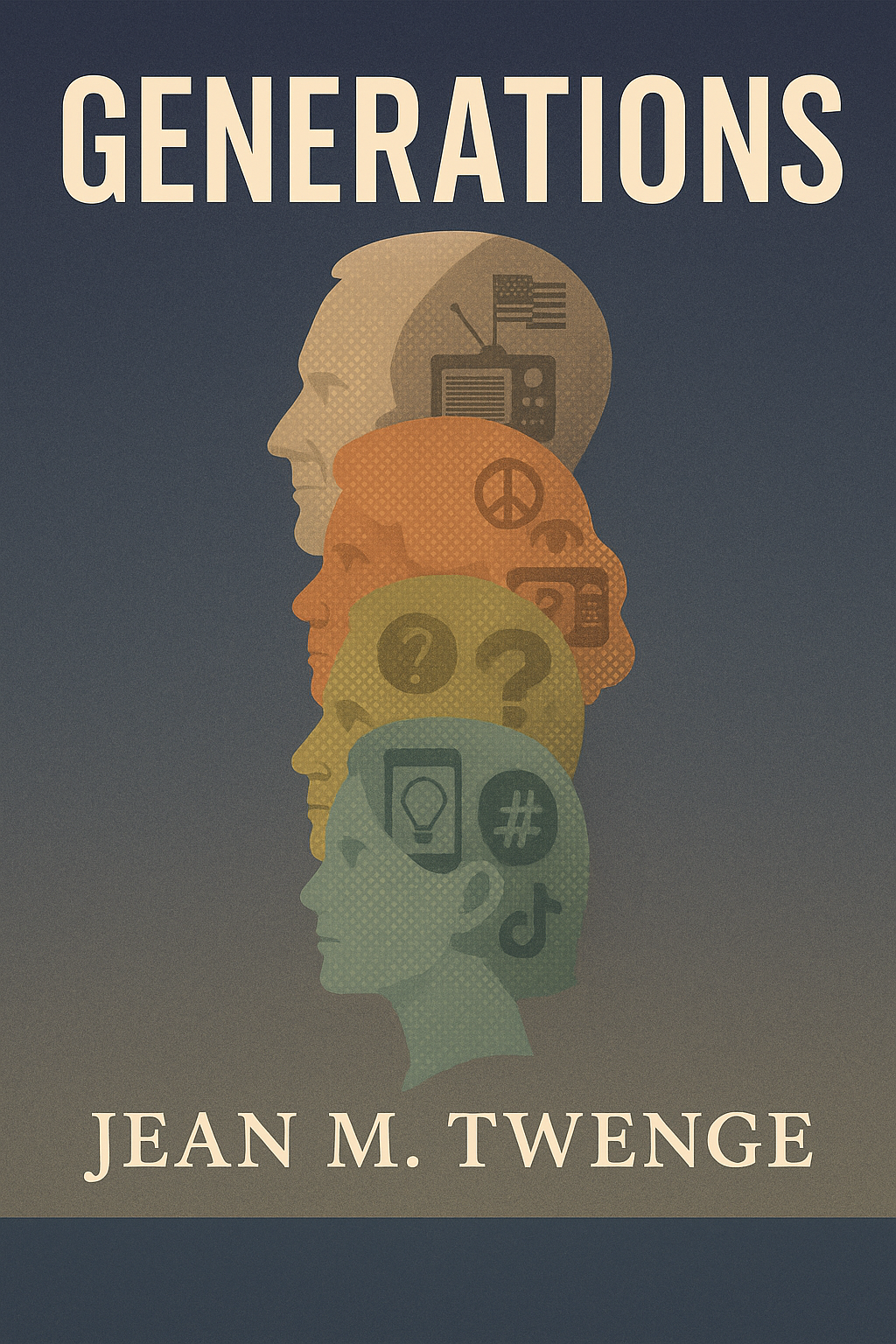
Generations: The Real Differences Between Gen Z, Millennials, Gen X, Boomers, and Silents—and What They Mean for America's Future
Chapter Summaries
What's Here for You
Ever wondered why certain generations seem to operate on a completely different wavelength? Jean M. Twenge's "Generations" doesn't just offer a peek behind the curtain; it pulls it back entirely, revealing the profound, often underestimated, forces that shape our core beliefs, attitudes, and personalities. You'll discover that the decade you were born into might hold more sway over who you are than even your upbringing. This book is your guide to understanding the real differences – the 'how' and 'why' – that distinguish the Silent Generation, Boomers, Gen X, Millennials, Gen Z, and the emerging Polars. You'll move beyond stereotypes to uncover the unique historical contexts, societal shifts, and technological revolutions that forged each cohort. Did you know the 'Silent' generation wasn't so quiet after all, but instrumental in societal change? Or how the sheer size of the Boomers created a 'bowling ball' effect on culture? You'll explore Gen X's unique position between analog and digital worlds, Millennials' journey through optimism and technological immersion, and Gen Z's existence as true digital natives, forever shaped by the smartphone. Furthermore, you'll be introduced to the 'Polars,' a generation already defined by political polarization and global challenges. Ultimately, "Generations" equips you with the intellectual tools to navigate our increasingly complex society. You'll gain a deeper understanding of yourself, your family, your colleagues, and the broader cultural landscape. This isn't just about looking back; it's about understanding the present and anticipating America's future, recognizing how these generational dynamics are not just historical footnotes but active forces shaping our collective destiny. Prepare for an enlightening, insightful, and perhaps even surprising journey into the heart of generational divides and their impact on the world to come. The tone is one of intellectual curiosity, backed by rigorous research, inviting you to see the world, and the people in it, with fresh eyes and a more profound sense of connection.
The How and Why of Generations
The author, Jean M. Twenge, invites us to consider the profound forces that shape who we are, revealing that the era of our birth exerts a greater influence on our attitudes and personalities than even our upbringing. Imagine, she suggests, a tribe on North Sentinel Island, untouched by modern technology, their lives a living echo of centuries past—a stark contrast to our rapidly evolving world. In today's society, Twenge explains, technology acts as the primary engine of change, a relentless current that reshapes culture, behavior, and values. This technological tide, in turn, fosters two key intervening forces: individualism, a deep-seated emphasis on the self, and a slower life trajectory, where milestones of adulthood are reached much later. This "Technology Model of Generations" posits that these forces, rather than just major historical events, are the true drivers of generational differences. The narrative highlights how advancements from home appliances to the internet and social media have not merely altered our daily routines but have fundamentally rewired our social interactions, expectations, and sense of self. For instance, the rise of individualism, fueled by laborsaving devices and increased leisure time, has shifted societal focus from collective duty to personal choice and expression, a transformation evident in everything from evolving dress codes to the acceptance of diverse family structures. Simultaneously, plummeting infant mortality and increased life expectancy, coupled with the demands of a knowledge-based economy, have led to a "slow life strategy," where individuals mature and age over a longer, more nurtured period. These linear, progressive changes, Twenge argues, have disrupted the older, cyclical theories of generational development, leading to a unique cultural landscape for each cohort. The author emphasizes that understanding these generational divides, supported by vast datasets encompassing millions of individuals, is not about stereotyping but about gaining crucial insights into societal dynamics, workplace interactions, and personal relationships, ultimately offering a clearer lens through which to view both the past and the unfolding future.
Silents (Born 1925–1945)
The author, Jean M. Twenge, invites us to look beyond the moniker 'Silent Generation' and discover a cohort that, far from being quiet, was instrumental in sparking some of America's most profound social transformations. Born between 1925 and 1945, these individuals navigated the Great Depression and World War II as children and adolescents, experiencing a world where prosperity and peace were not guaranteed, a stark contrast to the post-war boom they helped build and later witnessed. This foundational experience of scarcity and upheaval, followed by the dazzling technological advancements of the 1950s—jet travel, televisions, early computers—fostered a unique perspective, a generation caught between the traditions of the past and the burgeoning individualism that would fuel the societal shifts of the 1960s. Though often overshadowed by the 'Greatest Generation' and the larger 'Baby Boomer' cohort, the Silents were far from passive observers. Twenge reveals how members of this generation, like Dr. Martin Luther King Jr. and Ruth Bader Ginsburg, were at the vanguard of the Civil Rights and feminist movements, pushing for equal rights in race, gender, and sexuality. Their lived experiences, from the stark realities of segregation, as exemplified by the story of John, to the fight for equal pay and opportunities, as seen with the protest against gender-segregated job ads, underscore their crucial role in dismantling discriminatory systems. This generation, characterized by early marriages and a baby boom, also laid the groundwork for greater educational attainment, with a significant increase in high school and college degrees. Despite predictions of political marginalization, they have consistently held significant leadership positions, demonstrating a capacity for mediation and trust, bridging divides with a thoughtful, non-confrontational approach. While often perceived as conservative, their views on social issues evolved, placing them as a bridge between the traditionalism of their predecessors and the progressivism of their successors. Their resilience, forged in an era of both hardship and rapid change, is further evidenced by their comparatively lower rates of mental distress and suicide, a testament to their deep-rooted sense of stability and calm, even as they faced the unprecedented challenges of the COVID-19 pandemic. The Silent Generation, therefore, stands as a complex paradox: seemingly quiet yet profoundly impactful, traditional in some ways yet instrumental in pioneering equality and individualism, embodying a unique duality that has shaped the very fabric of modern America.
Boomers (Born 1946–1964)
The author, Jean M. Twenge, unveils the colossal impact of the Baby Boomer generation, born between 1946 and 1964, a demographic wave that reshaped America. Born in the wake of World War II, this generation's sheer size, unprecedented in modern history, created a "bowling ball" effect, influencing culture, politics, and societal norms at every life stage. Twenge explains how this generation, initially focused on collective change in the 1960s, rapidly pivoted towards radical individualism, a trait that became their defining characteristic, manifesting in everything from personal choices like drug use and premarital sex to broader societal shifts like the decline in birth rates and the rise of self-fulfillment in the 1970s, self-expression in the 1980s, and the embrace of technology. This relentless pursuit of individual choice, while driving progress in areas like gender equality and civil rights, also sowed seeds of societal division and personal distress; the chapter highlights how Boomer individualism, amplified by technology and consumer culture, correlated with increased rates of unhappiness, mental health struggles, and even 'deaths of despair,' particularly among those without college degrees, illustrating a profound tension between personal freedom and collective well-being. The narrative traces this generation's journey from the counterculture of the 1960s to their dominance in politics and business, noting their chameleon-like ability to shift ideologies, from early liberalism to a more conservative stance in later life, a transformation that mirrored the nation's own political evolution. Ultimately, Twenge posits that understanding the Boomers is crucial, as their embrace of individualism and subsequent societal changes laid the groundwork for the generations that followed, serving as the "ur-generation" that normalized many of the trends now taken for granted in contemporary American life.
Generation X (Born 1965–1979)
Jean M. Twenge's exploration of Generation X reveals a cohort often defined by what it is not, sandwiched between the societal upheavals of the Boomers and the digital natives that followed. This generation, born from 1965 to 1979, experienced a unique blend of analog childhoods and an analog-to-digital adolescence, becoming the first to truly harness the internet while remaining the last to remember a world without it. Twenge illustrates how Gen X, often overlooked as the 'middle child' of generations, developed a fierce independence, a pragmatic cynicism born from witnessing idealism crumble, and a defining trait of self-reliance, often in contrast to the perceived idealism of their predecessors. They were the first generation not drafted into military service, yet lived with the pervasive fear of nuclear war, and their upbringing in the Reagan era fostered a blend of self-confidence and material ambition, a stark contrast to media portrayals of 'slackers.' This duality is captured in their simultaneous embrace of technology, inventing foundational internet platforms, and their experience of a primarily analog youth, marked by cassette tapes and outdoor play. Gen X navigated a cultural landscape shaped by rising individualism, higher divorce rates—making it normal rather than exceptional—and the rise of the 'latchkey kid,' fostering a deep-seated resilience and adaptability. Their life trajectory was characterized by a shortened childhood and an extended adolescence, marked by an earlier start to sexual activity but a later age of marriage, reflecting a complex interplay of fast and slow life strategies. Moreover, Gen X cemented a cultural shift toward extrinsic values, prioritizing financial success and material possessions, a trend that continues with younger generations. Despite early struggles with crime rates and economic pessimism, Gen X ultimately achieved solid economic footing, often through higher education and excelling in the burgeoning tech industry, defying the 'impoverished generation' stereotype. Their mental health, while marked by higher teen suicide rates, stabilized in adulthood, showing resilience despite adolescent challenges. A defining characteristic is their deep-seated skepticism of authority and institutions, a cynicism that deepened over time and contributed to a decline in social trust. This questioning spirit, however, also fostered a growing awareness of racial inequality and a significant shift towards accepting diverse identities and relationships, most notably in the fight for same-sex marriage. Politically, Gen X displayed a notable apathy in their youth, a stark contrast to the activism of Boomers, though they later became a significant voting bloc. Their early passion for environmentalism, reviving Earth Day and driving recycling initiatives, stands as a testament to their capacity for collective action when motivated. Ultimately, Gen X embodies a generation of transition, a bridge between the analog past and the digital future, characterized by independence, adaptability, and a profound skepticism that has shaped their unique place in the American narrative.
Millennials (Born 1980–1994)
Jean M. Twenge's exploration of the Millennial generation reveals a cohort shaped by an era of unprecedented optimism and technological immersion, yet also by profound societal shifts that have led to unique challenges and evolving perspectives. Raised by mostly Boomer parents in an age of reliable birth control and legal abortion, Millennials were, as Twenge explains, the most planned and wanted generation, instilled with a relentless positivity and a paramount belief in the individual self, a cultural undercurrent amplified by the dawn of the internet. This self-confidence, initially a source of delight and occasional dismay for older generations in the workplace, met a stark reality with the 2008 recession, shifting the narrative from ambitious self-starters to those facing economic hardship. As digital natives, Millennials mastered communication through texting and instant messaging, fundamentally altering social interaction and paving the way for the social media landscape that now defines much of modern life. Their upbringing under 'helicopter' or 'hothouse' parenting, a response to perceived global competition and income inequality, fostered a generation that would later coin the term 'adulting' to describe the often-unromantic realities of grown-up responsibilities. Yet, as Twenge illuminates, Millennials are not merely defined by the trends they are often blamed for; they are the culmination of individualism and technological advancement, ratcheting these trends up a notch. A core tension emerges as the chapter delves into Millennials' self-perception versus objective reality, particularly concerning their economic standing; while narratives of being 'screwed' by the economy persist, data suggests Millennials are actually performing better financially than previous generations at the same age, a discrepancy often fueled by sky-high expectations and the pervasive influence of social media showcasing curated lives, leading to a sense of relative deprivation. Furthermore, the chapter uncovers a surprising paradox: despite the ease of digital connection, Millennials are less sexually active and marry later, delaying significant life milestones like parenthood, a 'slow-life strategy' influenced by longer lifespans and a greater emphasis on personal fulfillment. This generation, marked by high educational attainment, also grapples with immense student loan debt, a significant factor in their perceived economic struggles. The narrative arc culminates in the observation that this generation, once characterized by teen happiness and optimism, now faces rising rates of depression and 'deaths of despair' in adulthood, a stark contrast that Twenge attributes not solely to economic woes or political events, but to the erosion of traditional social structures like marriage and religious institutions, coupled with the isolating effects of pervasive technology and a culture that prioritizes the individual self, creating a complex tapestry of achievement, disillusionment, and a redefinition of adult life.
Generation Z (Born 1995–2012)
Jean M. Twenge, in her chapter on Generation Z, illuminates a cohort profoundly shaped by the advent of the smartphone and the digital age, a generation that has never known a world without the internet. The author explains that this swift technological integration has created a distinct break, marking Gen Z as the first generation to spend their entire adolescence immersed in the smartphone era, leading to a significant shift in social interaction towards the digital realm. Twenge highlights Gen Z's remarkable racial and ethnic diversity, noting they may be the last generation where any single group constitutes a majority, and their unprecedented attention to gender identity and sexual orientation, challenging older norms and language. A core tension arises as Gen Z navigates a world grappling with authenticity, free speech, and mental health, utilizing language infused with tech, gender fluidity, and anxiety, often expressing themselves through gallows humor and emojis like the skull. The narrative reveals a generation increasingly embracing fluidity, not just in gender identity, but in their approach to life, delaying traditional markers of adulthood such as marriage and childbearing, a phenomenon Twenge terms the 'slow-life strategy.' This deliberate pacing, while offering protection from certain risks, also fosters a sense of extended adolescence and, for some, a perception of missed opportunities for independence. Furthermore, Twenge explores the striking rise in political activism and voter turnout among Gen Z, a generation motivated by a desire for change and a critical lens on societal structures, often fueled by social media's rapid dissemination of information and impassioned discourse. However, a central dilemma emerges with the pervasive impact of digital media on mental health; the author posits that the increased use of smartphones and social media, particularly among girls, correlates with rising rates of depression, anxiety, self-harm, and loneliness, creating a complex interplay where technology both connects and isolates. This digital immersion, coupled with a growing pessimism about the world and their personal prospects, paints a picture of a generation navigating profound societal shifts, demanding attention as they redefine norms and push for change in a rapidly evolving America, ultimately revealing a generation that, despite facing significant mental health challenges and a perceived harshness in the world, is actively shaping its future.
Polars (Born 2013–2029)
Jean M. Twenge, in her examination of generational shifts, introduces the Polars, born roughly between 2013 and 2029, a generation whose formative years were irrevocably shaped by two defining forces: the escalating political polarization gripping the United States and the undeniable reality of global warming, symbolized by melting polar ice caps. These young individuals, also sometimes referred to as Alphas, entered a world already saturated with technology; by their earliest years, smartphones and social media were ubiquitous, a stark contrast to the digital revolutions that defined previous generations. The author notes that the very start of this generation is marked by significant technological shifts like smartphone ownership crossing 50% in the U.S. around 2013, the founding of Black Lives Matter that same year, and, crucially, the onset of the COVID-19 pandemic in early 2020, an event that for many Polars will remain a hazy, early memory, if recalled at all. Twenge highlights that Polars are poised to be the first generation with a non-White majority in the U.S., with a significant rise in multiracial individuals, a demographic shift reflected in public figures like Alexis Olympia Ohanian Jr., whose very existence challenges traditional norms. Yet, beneath this evolving social landscape, a central tension emerges: while children today are statistically safer from fatal injuries than ever before, thanks to improved safety measures, this physical security comes at a cost. The author reveals that this generation is experiencing a dramatic decline in physical activity, with a doubling of children in elementary school age reporting less than half of days with physical activity between 2012 and 2019, leading to an alarming rise in childhood obesity. This sedentary trend, fueled by an increased reliance on screens—with 8 to 12-year-olds spending over five and a half hours daily with screen media by 2021—coincides with growing concerns about mental health. The early exposure to social media, even for those under the age of 13, presents risks of encountering harmful content, mirroring the increasing rates of depression and self-harm seen in the preceding Gen Z. The pandemic, while initially showing a moderate increase in anxiety and depression among 5-7 year olds, by late 2020 saw these rates more than double, though thankfully returning to pre-pandemic levels by late 2021 as schools reopened. Ultimately, Twenge posits that while the Polars are growing up in an era of unprecedented technological immersion and significant societal challenges, their parents, often Millennials, have provided a more economically secure environment, and historical precedent, like the Silent generation's resilience during times of crisis, offers a glimmer of hope that this generation may yet rise to meet the complex future they are inheriting.
The Future
Jean M. Twenge, in 'The Future,' illuminates the seismic shifts reshaping our world, driven by technological evolution and the distinct experiences of successive generations. The author observes that predicting the future is a complex endeavor, akin to the creators of 'The Jetsons' foreseeing video calls but not the profound downstream impacts of technology on societal norms, such as Jane Jetson's potential career. As Boomers, who have long led the workforce, begin to retire in large numbers, a generational turnover is underway, ushering in new dynamics in both business and politics. One of the most significant transformations, accelerated by the COVID-19 pandemic, is the widespread adoption of remote work, a trend embraced by Gen X and Millennials for its flexibility and by Gen Z for its inherent digital convenience, fundamentally altering the traditional 'butt-in-chair' model towards a focus on results and flexibility. This shift is also giving rise to the concept of 'safe spaces' in workplaces, reflecting Gen Z's need for environments that support mental well-being, a stark contrast to the more social, activity-based break rooms favored by older generations. The author emphasizes that Gen Z is not simply a younger version of Millennials; they require reassurance rather than just praise, and their integration into the workforce demands clearer structure and expectations, though they possess a strong, practical work ethic. Furthermore, the lines between personal and professional lives have blurred for Gen Z, shaped by technology and individualism, leading to a workforce that values making a difference and helping others, often prioritizing societal contribution over traditional markers like job interest or status. In an era where 'everything is political,' Gen Z expects companies and institutions to take stances on social and moral issues, a departure from the business-as-usual approach of previous generations, creating a delicate balance for organizations navigating employee expectations and consumer relationships. The rising awareness and advocacy for mental health among younger generations are compelling businesses to prioritize holistic employee well-being, extending beyond traditional work performance to encompass their overall lives. The author also notes a 'flattening' of traditional hierarchical structures, with Gen Z challenging the necessity of leadership and valuing equality and autonomy, which influences company policies on everything from appearance to decision-making. The future is also increasingly nonbinary, with Gen Z's evolving understanding of gender identity necessitating changes in workplace norms, from gender-neutral facilities to pronoun usage, reflecting a broader cultural shift. Compounding these workplace and social changes is a dramatic decline in birth rates, with Millennials and Gen Z expressing less desire for children, impacting demographics, the economy, and social structures, leading to a future where the population is older and potentially more isolated, with pets increasingly filling familial roles. Politically, the formative years of Millennials and Gen Z, shaped by periods of low presidential approval and increasing societal division, suggest a continued lean towards the Democratic party, further complicated by evolving Republican views on social issues and a growing segment of the population identifying as Independents, all set against a backdrop of deep polarization and distrust in government. The pervasive influence of technology, particularly social media, is identified as a key driver of both connection and division, fueling misinformation, political polarization, and mental health challenges, necessitating a critical look at regulation to protect children and foster healthier online environments. Finally, in the realm of race relations, the author highlights a complex trajectory marked by calls for both greater diversity and inclusion, alongside a surprising, though sometimes voluntary, desire for separate spaces among younger generations, indicating that the ongoing reckoning with race will continue to evolve in unexpected ways, while religion continues its societal retreat. The core tension across all these domains is how we navigate the profound shifts brought about by accelerating individualism, the 'slow-life' strategy adopted by successive generations, and the ever-present, double-edged sword of technology, which offers unprecedented connection and convenience alongside isolation, division, and mental health crises, challenging us all to find common ground and foster a more cohesive future.
Conclusion
Jean Twenge's "Generations" offers a compelling data-driven narrative, revealing that the era of our birth, largely dictated by technological advancements, exerts a more profound influence on our core attitudes and life trajectories than even familial upbringing. The book meticulously unpacks how the relentless march of technology has fostered individualism and a 'slow life strategy,' characterized by delayed milestones and prolonged development, across successive generations. From the Silent Generation's resilience forged in hardship and early advocacy for change, to the Boomers' seismic impact driven by sheer numbers and a radical embrace of individualism, and Generation X's pragmatic self-reliance born from a transitional era, each cohort presents a unique response to these overarching forces. Millennials, shaped by amplified optimism and digital immersion, grapple with high expectations and the isolation of pervasive connectivity, while Gen Z, the first truly digital natives, navigate unprecedented social comparison, anxiety, and a demand for purpose and authenticity. The nascent Polar generation faces an even more polarized world, deeply intertwined with digital realities from infancy. The emotional lessons resonate deeply: the inherent human need for connection, the challenges of unmet expectations in an individualistic culture, and the quiet anxieties amplified by digital life. Practically, Twenge provides a crucial lens for understanding societal friction, workplace dynamics, and personal relationships. The wisdom lies in recognizing that generational differences are not about inherent superiority or inferiority, but about the distinct adaptations to evolving technological and societal landscapes. The book's ultimate takeaway is a call for empathy and informed dialogue, urging us to move beyond generational stereotypes and acknowledge the shared human experience within these distinct, technologically-defined epochs to collaboratively shape a more cohesive future.
Key Takeaways
The era of an individual's birth, profoundly shaped by technological advancement, is a more significant determinant of their core attitudes and personality traits than their family upbringing.
Modern generational differences are primarily driven by the relentless, linear progression of technology, which in turn fosters individualism and a slower life trajectory, rather than by cyclical historical events alone.
Individualism, amplified by technological convenience and economic shifts, encourages personal choice, self-expression, and equality, fundamentally altering social structures and personal values across generations.
A 'slow life strategy,' resulting from decreased mortality rates and extended education, means individuals now reach life milestones like marriage and career later, requiring greater parental investment and prolonged development.
Understanding generational differences, supported by large-scale data, is essential for navigating contemporary societal issues, from workplace dynamics to personal relationships, by distinguishing reality from myth.
Generational trends, even if not personally embodied by an individual, impact society and individuals through shifting cultural norms and interconnected social dynamics, requiring an awareness of group-level influences.
The Silent Generation, despite its name, was a pivotal force in driving social change, particularly in civil rights and feminism, by bridging historical traditions with emergent individualism.
Their formative experiences during the Great Depression and WWII instilled a unique blend of resilience and optimism, influencing their perspective on societal progress and personal stability.
Silents acted as crucial catalysts for equality movements, demonstrating that significant societal shifts are often initiated by those who navigate the transition between old and new paradigms.
Despite facing societal constraints, particularly for women, the Silent Generation's pursuit of education and their active participation in leadership roles highlight their lasting impact on American institutions.
The generation's relative mental stability and lower suicide rates, contrasted with surrounding generations, suggest the protective influence of historical context, strong family ties, and a more communal upbringing.
Silents embody a Janus-faced perspective, looking to the past while actively shaping a more individualistic and equality-focused future, demonstrating a capacity for both tradition and transformation.
The sheer demographic size of the Boomer generation created a 'bowling ball' effect, profoundly influencing American culture and society across all life stages.
The Boomer generation's defining characteristic was a radical shift from collective action to intense individualism, influencing personal choices and societal norms.
Boomer individualism, driven by technological advancements and evolving cultural values, led to significant societal progress in areas like equality but also contributed to increased personal distress and social division.
The Boomer generation's political ideology was highly adaptable, shifting from early liberalism to a more conservative stance as they aged and their life circumstances changed, mirroring broader national political trends.
The rise of individualism and technological acceleration during the Boomer era created high expectations for personal fulfillment, which, when unmet, contributed to increased rates of unhappiness and mental health challenges, particularly for those without higher education.
The Boomers' pursuit of individual choice and self-expression, while beneficial in challenging norms, also led to a higher incidence of divorce and a less stable family structure compared to previous generations.
The Boomer experience with income inequality and the widening happiness gap demonstrates how economic stratification can lead to profound disparities in well-being and life outcomes.
Generation X, often overlooked and defined by its transitional nature, developed a core identity of self-reliance and pragmatic cynicism, shaped by witnessing the unfulfilled promises of earlier idealism and the dawn of the digital age.
The rise of individualism, coupled with higher divorce rates and the prevalence of latchkey childhoods, fostered a unique resilience and adaptability in Generation X, enabling them to navigate a complex world with a strong sense of independence.
Generation X cemented a cultural shift towards extrinsic values, prioritizing financial security and material success, a trend that has persisted and intensified in subsequent generations, impacting career choices and life goals.
Despite facing significant societal challenges like rising crime rates and economic uncertainty in their youth, Generation X demonstrated remarkable economic resilience and achieved solid financial footing through education and technological innovation.
A pervasive skepticism towards authority and institutions became a hallmark of Generation X, leading to a decline in social trust that has continued to impact societal cohesion and political engagement across generations.
Generation X's evolving attitudes, particularly their growing acceptance of diverse identities and their early advocacy for environmental causes, highlight their capacity for change and their role as agents of social progress, even amidst their characteristic independence.
Generation X's unique position as a bridge between the analog and digital worlds has equipped them with a dual perspective, allowing them to understand both pre-digital realities and the complexities of our technologically saturated culture, influencing their approach to leadership and societal engagement.
Millennials' inflated self-confidence and high expectations, fostered by a culture of relentless positivity and 'empty self-esteem' boosting, often clash with the realities of adulthood, leading to disappointment and mental health challenges.
Despite popular narratives of economic hardship, Millennials are, on average, performing better financially than previous generations at the same age, with perceived poverty often stemming from high expectations, social comparison, and the burden of student debt rather than objective lack of success.
The 'slow-life strategy,' characterized by delayed marriage, parenthood, and career progression, is a defining feature of Millennials, driven by longer lifespans, increased educational attainment, and a cultural shift toward prioritizing individual fulfillment over traditional milestones.
Millennials' reduced engagement with traditional institutions like marriage and religion, coupled with the isolating effects of pervasive technology and social media, contributes to higher rates of loneliness and mental health struggles in adulthood, despite their optimism as adolescents.
The pervasive narrative of Millennials 'getting the shaft' economically is amplified by social media and negative news cycles, creating a sense of relative deprivation and fueling political attitudes favoring government intervention, even when objective economic data presents a more positive picture.
The pervasive integration of smartphones and digital media has fundamentally reshaped Gen Z's social interactions, cognitive patterns, and mental well-being, creating a distinct generational experience.
Gen Z's unprecedented racial and ethnic diversity and their openness to diverse gender identities and sexual orientations signal a significant shift in societal norms and future demographics.
The 'slow-life strategy,' characterized by delayed milestones like marriage and childbearing, reflects Gen Z's adaptation to a complex world, offering protection but potentially prolonging dependence.
Digital media, particularly social media, is strongly correlated with increased rates of depression, anxiety, and loneliness among Gen Z, especially girls, due to factors like social comparison and sleep deprivation.
Gen Z exhibits a pronounced tendency towards political activism and polarization, driven by a desire for systemic change and amplified by social media, marking a departure from previous generations' political engagement.
A pervasive sense of pessimism about the world and personal prospects characterizes Gen Z, potentially exacerbated by depression and a critical view of societal structures and historical narratives.
Gen Z's perception of widespread gender discrimination, even when not fully aligned with objective data on professional advancement, reflects the influence of social discourse and potential cognitive distortions tied to mental health.
The Polar generation (2013-2029) is uniquely defined by the pervasive influence of political polarization, climate change, and an early immersion in digital technology, setting a distinct developmental trajectory.
Despite significant advancements in child safety leading to historically low rates of fatal injuries, Polars face a growing dilemma of reduced physical activity and increased rates of overweight and obesity due to increased screen time.
Early and often unsupervised exposure to social media platforms poses significant mental health risks for young Polars, including potential engagement with harmful content and a continuation of trends toward anxiety and depression.
Economic security for Polar children is bolstered by financially stable Millennial parents who have fewer children later in life, potentially making them one of the most economically advantaged generations in decades.
The COVID-19 pandemic, while initially impacting the mental well-being of young Polars, ultimately demonstrated a capacity for resilience as anxiety and depression rates returned to pre-pandemic levels with the reopening of schools.
The generational shift from collectivist societies to individualism, coupled with a 'slow life' standard, is shaping Polar childhoods and delayed adult responsibilities, contrasting with earlier generations' experiences.
The pervasive influence of technology, individualism, and the 'slow-life' strategy are the primary drivers of generational differences, not just major historical events.
The workplace is undergoing a radical transformation driven by Gen Z's demand for flexibility, mental health support, and purpose, shifting focus from presenteeism to results.
Gen Z's expectation that businesses take political and social stances creates a complex dilemma, requiring companies to balance authenticity with the risk of alienating market segments.
Declining birth rates, influenced by technology, individualism, and the slow-life strategy, are reshaping the demographic landscape, impacting economies, social structures, and family definitions.
Political polarization is deepening, exacerbated by geographic and informational separation, with younger generations showing distinct political leanings and evolving views on social issues.
Social media's algorithmic amplification of negativity and misinformation poses a significant threat to democracy and mental well-being, demanding thoughtful regulation.
Navigating the future requires acknowledging that all generations are shaped by technology and influence each other, necessitating understanding and collaboration rather than blame.
Action Plan
Reflect on how specific technologies you grew up with might have shaped your core values and behaviors.
Consider the concept of "individualism" versus "collectivism" in your own social interactions and decision-making.
Analyze how a "slow life strategy" might be influencing your personal timeline for achieving major life milestones.
Seek out data-driven insights rather than relying on anecdotal evidence or stereotypes when discussing generational differences.
Engage in conversations with individuals from different generations with an open mind, focusing on understanding rather than judgment.
Recognize that while generational trends represent averages, individual experiences can vary significantly.
Reflect on how your own formative experiences, shaped by historical context, influence your current perspectives and actions.
Seek out and listen to the stories of individuals from the Silent Generation to gain firsthand insights into their lived experiences and contributions.
Recognize and appreciate the often-unseen efforts of individuals and groups who bridge societal divides and advocate for equality.
Consider the value of 'listening leadership'—cultivating the capacity to ask questions and truly hear others, as exemplified by members of the Silent Generation.
Evaluate your own level of trust in others and consider how this trust, or lack thereof, impacts your interactions and community involvement.
Explore the historical context of social movements and identify how different generations contributed to their progress and eventual outcomes.
Reflect on how the pursuit of individual choice has shaped your own life and relationships, considering both its benefits and potential drawbacks.
Analyze how cultural narratives around success and happiness, amplified by media and technology, might be influencing your expectations.
Examine your own political views and consider how they may have evolved over time, similar to the Boomer generation's trajectory.
Practice mindful consumption, questioning whether material possessions truly contribute to lasting happiness or fulfillment.
Seek out diverse perspectives and engage in open dialogue across generational lines to foster understanding and bridge potential divides.
Prioritize genuine connection and community engagement to counteract potential feelings of isolation in an increasingly individualistic society.
Evaluate your personal definition of success, moving beyond purely economic or achievement-based metrics to include well-being and meaningful relationships.
Reflect on how the rise of individualism has shaped your personal values and decision-making.
Consider the balance between independence and interdependence in your own life and relationships.
Examine your relationship with technology, acknowledging both its benefits and potential drawbacks, much like Gen X did.
Evaluate your trust in institutions (government, media, corporations) and consider how this trust has been formed.
Recognize the resilience and adaptability fostered by challenging childhood experiences, and apply these lessons to current obstacles.
Explore environmental initiatives and consider how individual actions can contribute to collective well-being.
Engage in open-minded discussions about diverse viewpoints, even when they challenge your deeply held beliefs, mirroring Gen X's evolving societal acceptance.
Cultivate a balanced self-view by grounding self-esteem in actual achievements and efforts, not just inherent worth.
Critically assess financial narratives by comparing personal economic realities with broader statistical data.
Re-evaluate personal timelines for major life milestones, recognizing that 'adulting' can be a gradual process, not a singular event.
Prioritize in-person social connections and community engagement to counteract potential isolation exacerbated by digital lifestyles.
Set realistic expectations for career and life outcomes, acknowledging the gap between idealized visions and everyday realities.
Engage with institutions that foster social connection and shared purpose, whether through marriage, community groups, or religious practice, to build a robust support system.
Reflect on your own digital media consumption: assess how much time you spend online versus in person, and consider the impact on your mood and well-being.
Engage in intentional, in-person social interactions to foster deeper connections and counteract the isolation that can stem from digital communication.
Educate yourself on the evolving language and understanding of gender identity and sexual orientation to foster more inclusive conversations.
Practice mindful self-care and seek professional support if you are experiencing increased anxiety, depression, or loneliness, recognizing these are common challenges.
Seek diverse perspectives and engage in civil discourse, even on contentious issues, to bridge generational divides and foster understanding.
Challenge ingrained assumptions about traditional life milestones and consider what a 'slow-life strategy' might offer in terms of personal fulfillment and well-being.
Critically evaluate the information consumed online, recognizing the potential for negative bias and social comparison, and actively seek out balanced viewpoints.
Prioritize physical health through regular exercise and adequate sleep, understanding their profound connection to both mental and emotional well-being.
Encourage balanced technology use by setting clear screen time limits and promoting alternative activities.
Prioritize outdoor play and physical activity to counteract sedentary trends and promote healthy weight development.
Foster open communication with children about their online experiences and educate them about navigating social media safely.
Stay informed about current events and societal challenges, discussing them with children in age-appropriate ways to build resilience.
Advocate for policies and community initiatives that support child safety, physical activity, and mental well-being.
Recognize the unique challenges and opportunities of the Polar generation, adapting parenting and educational approaches accordingly.
Actively seek to understand the unique values and communication styles of different generations in your workplace and personal life.
Embrace flexibility in work arrangements and focus on results rather than hours spent, where possible.
Prioritize mental health support and create psychologically safe environments for yourself and others.
Engage thoughtfully with political and social issues, recognizing that personal choices and company actions can have broader implications.
Critically evaluate information consumed online, especially from social media, to combat misinformation and polarization.
Be mindful of the trade-offs between individualism and community, seeking balance in your own life and interactions.
When interacting with younger generations, provide clear expectations and structure while acknowledging their desire for purpose and autonomy.
Consider the long-term demographic shifts and their potential impact on economic and social planning.