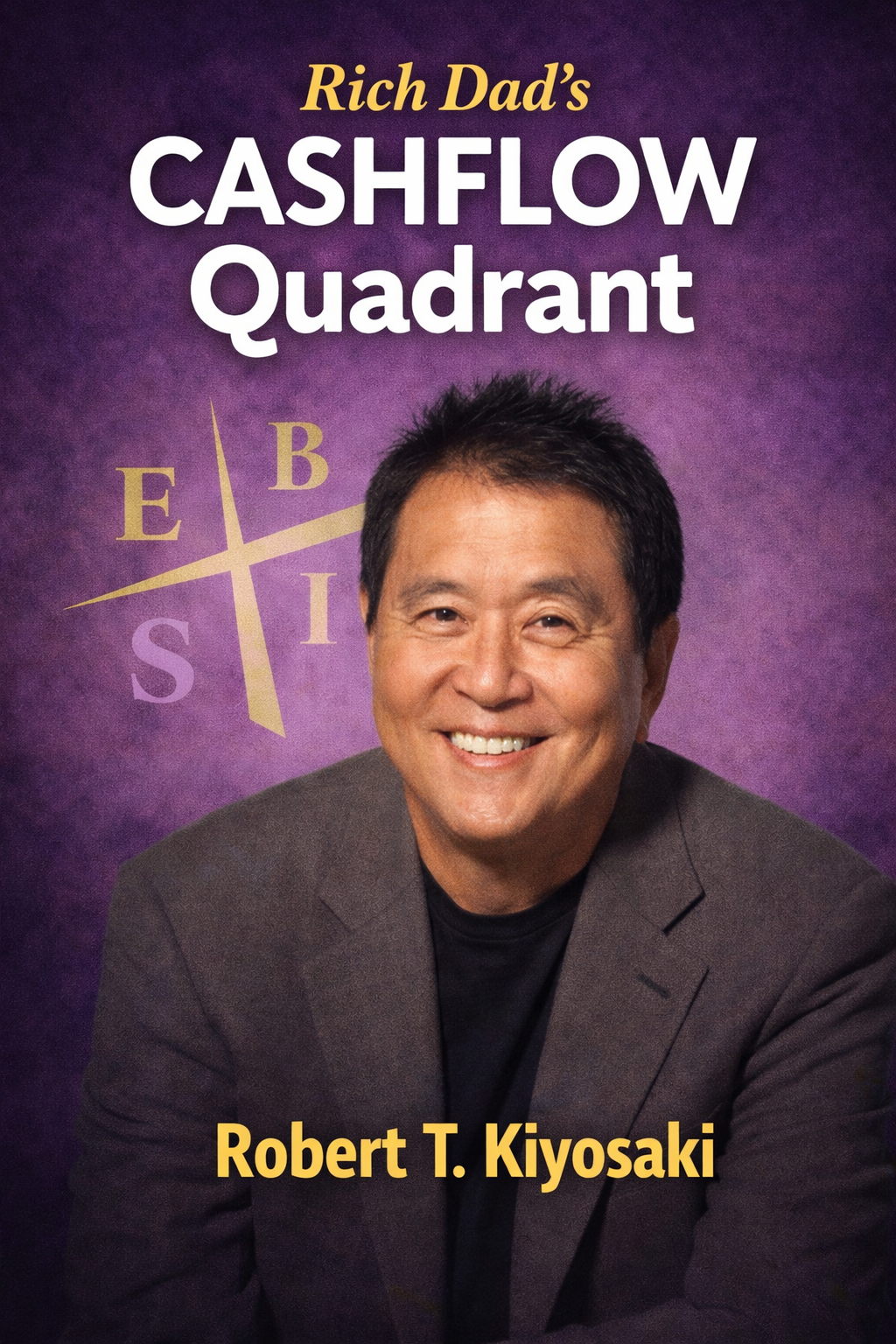
Rich Dad's CASHFLOW Quadrant
Chapter Summaries
What's Here for You
Are you tired of the rat race, trading time for money, and feeling trapped in a cycle of financial insecurity? "Rich Dad's CASHFLOW Quadrant" is your wake-up call. Robert Kiyosaki doesn't just offer financial advice; he ignites a revolution in how you perceive wealth. Prepare to challenge deeply ingrained beliefs about jobs, security, and the very nature of money. This isn't a get-rich-quick scheme; it's a roadmap for transforming your mindset, mastering cash flow, and building a business or investment portfolio that works for you, not the other way around. You'll confront your fears, learn to see opportunities where others see risk, and discover the power of mentorship. It's a journey of self-discovery, demanding courage, faith, and a willingness to step outside your comfort zone. Get ready to dismantle conventional wisdom, embrace the entrepreneurial spirit, and unlock the secrets to creating true financial freedom. This book will empower you to become the architect of your own financial destiny, moving from employee to investor, from security to freedom, one strategic step at a time.
WHY DON’T YOU GET A JOB?
In this chapter of *Rich Dad's CASHFLOW Quadrant*, Robert Kiyosaki recounts a stark period of homelessness with his wife Kim, a crucible that forged their resolve to pursue financial freedom over mere job security; he frames their experience as a direct challenge to the conventional wisdom that a job is the ultimate solution to financial woes. Kiyosaki illuminates the essence of their struggle: it wasn't about avoiding work, but about rejecting the limitations of the 'Employee' quadrant in favor of building assets. The author introduces the CASHFLOW Quadrant—E, S, B, and I—representing different avenues of income generation: Employee, Self-employed, Business Owner, and Investor. He underscores that true wealth isn't tied to formal education or initial capital, but to mindset, determination, and a willingness to learn, like a plant that finds a crack in the pavement and tenaciously grows towards the sun. Kiyosaki emphasizes that each quadrant demands a unique skill set and attracts different personalities, and while one can achieve financial success or failure in any quadrant, the B and I quadrants offer distinct advantages, particularly in tax benefits and wealth accumulation. The chapter reveals the contrasting financial philosophies of his two fathers: one valuing job security and downplaying money's importance, the other viewing money as a tool for freedom and impact. Kiyosaki shares a pivotal moment when his highly educated father's principled stand cost him his career, reinforcing the author's commitment to creating financial independence. This early exposure to the quadrants allowed Kiyosaki to recognize how seemingly small differences in financial strategies could compound into vast disparities over time. Ultimately, Kiyosaki positions the CASHFLOW Quadrant not merely as a financial model but as a framework for personal development, urging readers to consider not just what they do, but who they aspire to become, recognizing that the journey to financial freedom begins with a shift in perspective and a commitment to lifelong learning. The chapter closes with the idea that understanding these quadrants is about finding a home—a strategic place to generate income aligned with one's values and strengths.
DIFFERENT QUADRANTS, DIFFERENT PEOPLE
In *Rich Dad's CASHFLOW Quadrant*, Robert Kiyosaki illuminates how deeply our emotional responses to money shape our career paths, noting that shifting quadrants isn't just a job change, but a core transformation. He contrasts his educated dad's pursuit of security with his rich dad's embrace of freedom, revealing that fear of financial loss often drives individuals back to the familiar E or S quadrants. Kiyosaki underscores the importance of listening to people's words to discern their core values, suggesting that those in the E quadrant often prioritize security and benefits, while those in the S quadrant value independence and control, often viewing themselves as perfectionists. The B quadrant, in contrast, thrives on delegation and systems, epitomized by Henry Ford's ability to leverage the expertise of others; the true B can leave their business for a year or more and return to find it more profitable. The author cautions against fixating solely on product excellence, using the McDonald's example to highlight the power of a robust business system over a superior hamburger, emphasizing that success lies in building scalable systems and leading people, not just perfecting a product. Investors in the I quadrant, the playground of the rich, make money with money, a realm where wealth is measured in time, not dollars, and where the goal is to have assets generate passive income exceeding expenses, thus reaching true financial freedom. Finally, Kiyosaki addresses the shift from Industrial-Age pension plans to Information-Age self-reliance, urging readers to become educated investors who manage risk wisely, rather than depending on outdated notions of guaranteed security, reminding us that while financial freedom might be free, it demands a willingness to dream, desire, and overcome disappointments. Like a caterpillar transforming into a butterfly, changing quadrants requires welcoming change, a journey that profoundly alters not only oneself but also one's relationships and perspectives.
WHY PEOPLE CHOOSE SECURITY OVER FREEDOM
In this chapter from *Rich Dad's CASHFLOW Quadrant*, Robert Kiyosaki delves into the pervasive mindset that prioritizes job security over financial freedom, a deeply ingrained belief instilled from school and home. Kiyosaki contrasts his two fathers: one, highly educated, advocating for a secure job; the other, rich, championing financial independence. The author explains how this pursuit of security often leads to a life trapped by debt, a cycle perpetuated by societal norms and a lack of financial literacy. He paints a picture of the 'average educated person' ensnared by the script of school, job, and escalating expenses—a gilded cage where success paradoxically diminishes free time. Kiyosaki highlights the critical importance of financial intelligence, not just in earning money, but in managing, retaining, and leveraging it across generations. He contrasts his educated dad, whose financial decisions led to increased debt and taxes despite higher income, with his rich dad, who understood how to create and manage money effectively. The author underscores that the illusion of job security crumbles when faced with economic realities; he likens those solely focused on the left side of the CASHFLOW Quadrant to someone with only one leg, wobbling precariously with every economic gust. The author then examines common patterns: the endless job-hopping in pursuit of a mirage of freedom, and the grueling, often unsustainable path of self-employment. Kiyosaki cautions against blindly following the outdated advice of seeking only job security, especially given today's tax and debt structures. He advocates for education in both the B (Business owner) and I (Investor) quadrants to achieve true financial security and freedom. Kiyosaki reveals that those who understand how to operate on both sides of the CASHFLOW Quadrant gain confidence and resilience. Finally, the author recommends a path starting in the B quadrant to develop a solid business sense before venturing into the I quadrant, emphasizing that experience and cash flow are crucial for navigating the investment world. For Kiyosaki, the ultimate goal is to break free from the cycle of trading time for money, to reach a state where both time and money work in your favor, where one's actions in their spare time determine their future, not just their present.
THE THREE KINDS OF BUSINESS SYSTEMS
In "Rich Dad's CASHFLOW Quadrant," Robert Kiyosaki elucidates the pivotal transition from employee or self-employed (the left side of the quadrant) to business owner (B) by mastering systems, viewing them as bridges to financial freedom. Kiyosaki underscores that the B quadrant necessitates expertise in both systems and people, highlighting three primary business systems: traditional C corporations (developing your own system), franchises (buying an existing system), and network marketing (joining an existing system). Each system, with its unique strengths and weaknesses, aims to generate passive income once operational. Kiyosaki recounts his early struggles, including homelessness while building a business system—a hybrid of a C corporation and franchise—and the lessons learned from his failures. His rich dad's wisdom echoes: failure is a crucial teacher, an unavoidable part of the success journey. He shares his experience of building a company from scratch with his wife, Kim, emphasizing the dual challenge of perfecting both the system and the people within it. Kiyosaki contrasts his path with that of Mike, who inherited a system, acknowledging the inherent difficulty in creating a business from the ground up. Kiyosaki details the evolution of business, noting the shift from big corporations and mom-and-pop shops to the rise of franchises, initially viewed with suspicion but ultimately recognized as the wave of the future. He highlights the value of mentorship, recounting his apprenticeship with his rich dad, and cautions against advisors who lack practical experience. He advocates for learning leadership over management, emphasizing the importance of inspiring rather than controlling people. Kiyosaki then explores the advantages and disadvantages of each business system—creating your own, buying a franchise, or engaging in network marketing—detailing why banks prefer lending to businesses with proven systems. He stresses that success in the B quadrant requires overcoming the fear of rejection, disregarding others' opinions, and developing leadership skills. He likens network marketing to buying a personal franchise, emphasizing the importance of the educational component and mentorship within these organizations. Kiyosaki concludes by reaffirming that building a successful system, be it through creating one's own or leveraging an existing one, is the bridge to financial freedom, a journey now more accessible due to technological advancements. The choice of system is less about the product and more about the people, the system, and the education one receives.
THE FIVE LEVELS OF INVESTORS
In this chapter, Robert Kiyosaki unveils the path to financial freedom, emphasizing that investing, despite perceived risks, is crucial, contrasting his rich dad's proactive stance with his poor dad's risk-averse mindset; for Kiyosaki, true freedom blossoms only when money works for you, a lesson he learned early through Monopoly, envisioning 'four green houses, one red hotel' as a metaphor for real-world cash flow, a pipeline built to withstand financial storms and minimize taxes. However, Kiyosaki cautions against blindly trusting financial 'experts,' many of whom are mere employees or salespeople, not genuine investors; he critiques the common 401k plan as potentially detrimental due to high taxes, lack of insurance against market crashes, and benefits primarily accruing to the plan managers. Kiyosaki then categorizes investors into five levels, from the financially illiterate 'Zero-Financial-Intelligence Level' to the 'Capitalist Level,' where business owners leverage other people's money for wealth creation; the 'Savers-Are-Losers Level' highlights the danger of saving devalued currency, especially in bonds, while the 'Im-Too-Busy Level' critiques those who delegate their finances without understanding, potentially falling prey to scams like Ponzi schemes, legal or otherwise. Level Four, 'The Im-a-Professional Level,' represents the do-it-yourself investor, often lacking a comprehensive financial education, and finally, the 'Capitalist Level' embodies the richest, those who build businesses (B quadrant) and invest shrewdly (I quadrant), utilizing OPM (other people's money) and teamwork to generate wealth; Kiyosaki stresses that becoming a capitalist requires a different kind of education, one focused on real-life skills, entrepreneurship, and leveraging debt, rather than traditional degrees. He recounts his early real estate investments, financed entirely by debt, as pivotal learning experiences, leading to financial freedom by 1994, and thriving even during market crashes; the key, Kiyosaki suggests, is to assess one's current investor level, address character flaws, and continuously learn, with the ultimate goal of achieving infinite returns through financial intelligence. Kiyosaki urges readers to choose their path wisely, emphasizing that the freedom to choose is paramount, and to recognize that true ROI (Return On Investment) is a Return On Information, making financial education indispensable for navigating the complexities of the modern financial world, a world where, like a skilled chess player, one must anticipate multiple moves ahead to secure their financial future.
YOU CANNOT SEE MONEY WITH YOUR EYES
In this chapter of *Rich Dad's CASHFLOW Quadrant*, Robert Kiyosaki, through the lens of his rich dad's teachings, illuminates the critical distinction between seeing money with one's eyes versus understanding it with one's mind. He recounts an early real estate investment that appeared promising on the surface but was, in reality, a financial pitfall. The rich dad swiftly dismantled the deal, emphasizing that true wealth-building lies not in the visible asset, but in the unseen factors: the deal's structure, the market dynamics, and one's own financial literacy. Kiyosaki underscores that most people invest based on emotion or hearsay, leading to mediocre or negative returns; they're visually fixated, like moths to a flame, on the *idea* of wealth, rather than the mechanics of it. The path to financial intelligence, therefore, begins with financial literacy—understanding the language and numbers of capitalism and the ability to discern real risk from perceived risk. This involves questioning conventional wisdom, such as the notion that a house is always an asset, and recognizing whose balance sheet benefits from such arrangements. Kiyosaki challenges readers to shift their perspective, to see that money is fundamentally an idea, an instrument of debt, and that the game of capitalism revolves around understanding 'who is indebted to whom?' He advocates for taking on debt only when it generates income, and stresses the importance of differentiating between facts and opinions in financial decision-making. The rich dad's lesson culminates in the idea that profit is made when you buy, not when you sell, emphasizing the need for deals to make economic sense from the outset, irrespective of market fluctuations. Kiyosaki wants the reader to understand, in essence, that financial freedom requires a mental transformation, a shift from being a passive player to an informed strategist in the game of money.
BECOMING WHO YOU ARE
In this chapter of *Rich Dad's CASHFLOW Quadrant*, Robert Kiyosaki, through the guiding wisdom of his rich dad, explores the profound internal shifts required to transition from seeking job security to building financial freedom. The journey, Kiyosaki emphasizes, isn't merely about changing jobs or investment strategies; it's about confronting and overcoming deeply ingrained patterns and addictions, especially the addiction to earning money in a particular way. Rich dad cautions against the allure of money, likening it to a drug that can enslave individuals to familiar yet limiting quadrants. Kiyosaki recounts his own struggles with fear and self-doubt, particularly during a period of homelessness, illustrating how easily one can lose sight of their dreams amidst the pressures of survival. Like a flame flickering in the wind, passion must be actively shielded from the gales of fear. The author reflects on his initial rejection of teaching, only to later realize it was his true calling, inherited from his educated-but-poor dad, to create an educational system that empowers entrepreneurs and investors. He shares the story of his nylon wallet company, a venture that initially thrived but ultimately faltered due to foreign competition and a loss of passion, driving home the point that a business without heart is destined to decline. Kiyosaki highlights the inherent risks of seeking security solely through employment or self-employment, noting the increasing precarity of jobs and the burnout often experienced by the self-employed. He champions the right side of the CASHFLOW Quadrant—business ownership and investing—as offering greater security through systems that generate passive income. Numbers, he asserts, become the eyes through which one perceives financial reality, distinguishing facts from opinions and reducing risk. Kiyosaki concludes by emphasizing that while the path to financial freedom may be challenging, requiring both financial literacy and a willingness to confront one's deepest fears, the rewards—financial independence and the fulfillment of one's true potential—are well worth the effort; remember, there are no shortcuts, only dedicated study and learning.
HOW DO I GET RICH?
Robert Kiyosaki, in "Rich Dad's CASHFLOW Quadrant," dismantles conventional wisdom about wealth, likening the path to riches to a simple game of Monopoly: four green houses traded for a red hotel. He asserts that extraordinary wealth isn't about complex strategies, but rather a shift in mindset. Kiyosaki challenges the notion that hard work alone leads to riches, pointing out that many who toil relentlessly remain trapped in debt and unfair taxation. The core issue isn't *doing* what the rich do, but *being* the kind of person who naturally attracts wealth. He illustrates this with the BE-DO-HAVE model, emphasizing that changing one's underlying beliefs is paramount. Kiyosaki underscores that those on the left side of the CASHFLOW Quadrant often prioritize security and perfectionism, driven by fear of loss and a need for control, while those on the right side manage risk intelligently. He cautions against letting emotions dictate financial decisions, advocating for emotional neutrality towards winning and losing. Kiyosaki recounts his own leap from a secure job at Xerox into the unknown, battling self-doubt with affirmations of courage and faith. He describes the journey to financial freedom as an internal one, akin to learning to ride a bicycle—expect falls, but trust in your ability to rise again. The author emphasizes that the tension between employees and business owners, or business owners and investors, often stems from differing core values and emotional viewpoints. He urges readers to be aware of their internal dialogue, distinguishing between emotion-based and logic-based thoughts. Ultimately, Kiyosaki concludes that the crossing from the left side to the right side of the CASHFLOW Quadrant is about transforming who you are, not just what you do—a transformation that renders the game of wealth not a terrifying gamble, but a joyful pursuit.
BE THE BANK, NOT THE BANKER
In this pivotal chapter of *Rich Dad's CASHFLOW Quadrant*, Robert Kiyosaki, acting as a seasoned mentor, dissects the anatomy of wealth transfer, particularly how economic shifts disproportionately affect those tethered to the E and S quadrants. He begins with a vivid recollection of the Tax Reform Act of 1986, a legislative earthquake that triggered a seismic shift in wealth, leaving many Es and Ss financially stranded as their tax loopholes vanished. Kiyosaki illuminates how panic, a lack of specialized financial skills, and the absence of a robust cash-generating system left individuals vulnerable, while those in the B and I quadrants seized the opportunities amidst the chaos. It was like watching two boats in a storm: one capsizing from a design flaw, the other charting a course through the tempest. Kiyosaki stresses the importance of mindset, urging readers to *be* someone capable of recognizing and acting on opportunities, which will then enable them to *do*, ultimately allowing them to *have* financial success. He shares his personal experience of navigating the crisis, leveraging his business acumen and financial literacy to acquire assets at deeply discounted prices. Kiyosaki emphasizes the cyclical nature of economic history, warning against the collective amnesia that often leads Es and Ss back into debt traps, lured by the siren song of easy monthly payments and the illusion of homeownership as the ultimate investment. He challenges the notion of a grand conspiracy, framing the economic landscape instead as a game with distinct rules and perspectives for each quadrant, cautioning against witch hunts and blaming external forces for one's financial woes. The author then advocates for becoming the bank, not merely a banker, by mastering the art of creating money through strategic real estate investments and understanding the power of debt when managed wisely. He illustrates how to structure deals where others pay for the debt, effectively laying off risk, a fundamental principle in the world of finance. Kiyosaki pulls back the curtain on corporate structures, revealing how they offer asset protection and income sheltering, contrasting this with the vulnerability of employees whose earnings are taxed before they even see them. He champions the power of information and continuous learning, urging readers to study economic history and understand the laws and market forces that govern wealth creation. Ultimately, Kiyosaki presents two stark choices: security, which comes at the cost of excessive taxes and interest, or freedom, which demands financial literacy and the courage to play the game wisely. The key, he suggests, is to build businesses and buy real estate, mirroring the strategies of the wealthy to navigate the ever-shifting economic tides and secure financial independence.
TAKE BABY STEPS
In "Rich Dad's CASHFLOW Quadrant," Robert Kiyosaki advocates for a gradual approach to financial independence, likening it to eating an elephant one bite at a time. He emphasizes that the journey from the E and S quadrants to the B and I quadrants requires baby steps, cautioning against the pitfalls of attempting too much too soon, which often leads to burnout and failure. Kiyosaki observes that fear of failure paralyzes many, especially those conditioned by formal education to avoid mistakes; he champions action over inaction, asserting that even missteps offer valuable learning experiences. The author highlights a study identifying long-term vision, delayed gratification, and the power of compounding as key traits of those who escape poverty, contrasting this with the short-term thinking and immediate gratification that leads to financial ruin. Kiyosaki suggests that while goal-setting is important, an "underachiever mindset," focusing on small, consistent steps, is more effective for long-term success. He also stresses the importance of adapting to the Information Age by re-educating oneself to think like a rich person, emphasizing financial, systems, and emotional intelligence, which are not taught in traditional schools. Kiyosaki equates financial struggle to financial anxiety, suggesting that breaking free requires addressing mental and emotional loops, and advocates for financial literacy through tools like his CASHFLOW board game, which provides a safe space to learn and change one's financial habits. The game serves as a mirror, reflecting one's financial behaviors and offering a path to re-education, fostering a shift from a hard-work-and-spend mentality to an accumulation of cash-producing assets, a transformative journey from financial anxiety to control and optimism.
STEP 1: IT’S TIME TO MIND YOUR OWN BUSINESS
In this chapter, Robert T. Kiyosaki illuminates a pervasive, yet often unacknowledged, societal programming: the tendency to prioritize everyone else's financial well-being over our own. Kiyosaki argues that from an early age, individuals are subtly guided to become cogs in a machine that enriches others—employees making their bosses wealthy, debtors enriching banks, taxpayers funding the government, and consumers fueling other businesses. Kiyosaki likens this to a grand illusion, where individuals chase the mirage of financial security, only to find themselves perpetually serving external interests. He contends that the first step toward true financial freedom lies in recognizing this pattern and consciously shifting focus to one's own financial health. Like a gardener tending to a neglected plot, one must first assess the current state before cultivating future growth, thus Kiyosaki advocates for creating a personal financial statement as a baseline. The author emphasizes the importance of setting both short-term and long-term financial goals, acting as a compass guiding one's financial decisions, and transforming abstract dreams into tangible objectives. Kiyosaki urges readers to proactively manage their cash flow, seeing it not just as income and expenses, but as the lifeblood of their financial future. Ultimately, the chapter serves as a wake-up call, urging individuals to break free from the cycle of enriching others and instead, cultivate their own financial independence.
STEP 2: TAKE CONTROL OF YOUR CASH FLOW
In "Rich Dad's CASHFLOW Quadrant," Robert Kiyosaki, channeling his rich dad's wisdom, asserts that mastering cash flow is the cornerstone of financial success. He illuminates a stark reality: those who can't manage their cash flow end up working for those who can, trapped in a cycle where more money only amplifies existing financial woes. Kiyosaki stresses that financial literacy, specifically understanding cash-flow management, is often overlooked in traditional education, leading many to believe that increased income alone will solve their problems, like chasing a mirage in the desert. The author introduces the concept of two sets of books—one's own and the banker's—revealing that for every liability you hold, you are someone else's asset, a silent cog in their wealth-building machine. He distinguishes between good debt, where others pay for your assets, and bad debt, where you bleed your own resources. Kiyosaki illustrates how the financial fast track and the rat race are two sides of the same coin, connected by the flow of money between creditors and debtors; a dance where understanding the rules dictates who leads and who follows. The core message is clear: merely earning more won't solve financial problems if cash-flow management remains unaddressed. Therefore, Kiyosaki urges readers to meticulously plan their spending, minimize debt, and live within their means before attempting to expand them. The ultimate goal, he suggests, is to shift from being an employee of one's debts to an investor building assets, paving the way to financial independence. He introduces a debt reduction strategy, advocating for focused repayment on one debt at a time, snowballing the freed-up funds to tackle subsequent liabilities, ultimately freeing oneself from financial burdens and redirecting resources toward wealth creation. The chapter serves as a wake-up call, urging readers to seize control of their financial destiny through education, strategic planning, and disciplined execution.
STEP 3: KNOW THE DIFFERENCE BETWEEN RISK AND RISKY
In "Rich Dad's CASHFLOW Quadrant," Robert T. Kiyosaki dismantles the common perception of business and investing as inherently risky, arguing that the true risk lies in financial under-education. Kiyosaki paints a stark contrast: the financially literate individual, by age 45, has an asset column outweighing liabilities, embodying calculated risk, versus the majority who, lacking this knowledge, find investing perilous. The author emphasizes that financial literacy isn't just about seeing numbers, but about training the mind to discern cash flow direction, illustrating how a house can be an asset or liability based on whether it fills or drains your pocket. Kiyosaki recalls his rich dad's insistence on financial intelligence, defining it as converting cash or labor into income-generating assets, challenging the notion of endlessly working for money that vanishes just as quickly. He urges a review of the cash-flow patterns of the poor, middle class, and rich, spotlighting the rich person's focus on asset acquisition over relentless labor. The narrative crescendos with a warning against the "financial red line," where income barely covers expenses, leading to job dependency, resistance to change, and stress-induced health issues, as Kiyosaki equates relying on a secure job to the highest risk. He concludes by redefining risk: not in buying assets or minding one's business, but in purchasing liabilities disguised as assets and prioritizing others' financial gains over one's own, urging readers to actively distinguish between genuine risk and perceived risk, and to commit to ongoing financial education as a means of empowerment.
STEP 4: DECIDE WHAT KIND OF INVESTOR YOU WANT TO BE
Robert Kiyosaki, in this pivotal chapter, lays bare the soul of investment, explaining that the path to wealth isn't just about picking stocks, but about the kind of investor you choose to become. He introduces us to three archetypes: the Type-C investor, adrift and seeking only expert advice, much like a ship without a rudder in a storm; the Type-B investor, earnestly seeking answers, often overwhelmed by choices and retail investments; and the Type-A investor, the problem-solver, the one who sees opportunity where others see chaos, expecting returns that defy gravity. Kiyosaki underscores that most people struggle financially not from lack of opportunity, but from avoiding financial problems altogether. The author emphasizes that while many are forced into investing due to shifting retirement landscapes, true wealth lies in actively seeking and solving financial puzzles, a skill honed in the B and I quadrants. He shares that he operates as all three types, a Type-C investor when it comes to mutual funds, a Type-B investor when seeking professional advice, and a Type-A investor when solving problems in apartment housing. Kiyosaki argues that one should start small, learn to solve problems, and focus on a specific area, which allows you to become an expert. The author contends that the path to the financial fast track involves mastering cash flow, understanding risk, and ultimately, becoming a problem-solver. He uses examples like Bill Gates, Donald Trump and Warren Buffet who excelled by mastering a specific problem. Kiyosaki reveals a stark truth: the financial world operates on two sets of rules, one for the rich and another for everyone else, where tax laws often favor the wealthy, incentivizing them to solve societal problems like low-income housing while the middle class foots the bill. Therefore, the chapter is a call to action, urging readers to take control, mind their own business, and view every financial problem as a hidden opportunity, a chance to learn, grow, and ultimately, accelerate their journey to financial freedom, and recommends getting educated in both investing and business.
STEP 5: SEEK MENTORS
In this chapter, Robert Kiyosaki underscores the profound impact mentors have on shaping one's financial destiny, painting them as guides who illuminate the path toward financial intelligence. He contrasts the differing financial philosophies of his 'rich dad' and 'poor dad,' with the former championing passive income and asset accumulation, while the latter prioritized a high-paying job and frugality, noting that both served as strong mentors. Kiyosaki introduces the concept of 'reverse role models'—individuals whose failures provide invaluable lessons on what not to do, and how both positive and negative examples contribute to one's financial education. He delves into the spiritual dimension of money, dissecting the saying 'The love of money is the root of all evil,' explaining how his rich dad viewed temptation, greed, and financial ignorance as the true evils, rather than money itself, and how succumbing to temptation through debt and excessive spending hinders the acquisition of true assets. Kiyosaki advocates for surrounding oneself with individuals who are heading in the same financial direction, cautioning against seeking advice from those stuck in financial swamps, rather than those who have successfully navigated the terrain. He stresses the importance of having coaches and mentors, especially in the realms of business and investing, likening it to professional athletes having coaches to hone their skills. Finally, Kiyosaki urges readers to analyze the people they spend the most time with, categorizing them by their primary quadrant (E, S, B, or I) and investor level, and to evaluate whether these associations align with their desired financial future, suggesting that misalignment may necessitate changes in one's social circle to foster personal and financial growth; it is a mirror reflecting your trajectory, showing whether you are ascending towards financial freedom or drifting in place.
STEP 6: MAKE DISAPPOINTMENT YOUR STRENGTH
In "Rich Dad's CASHFLOW Quadrant," Robert Kiyosaki unveils a potent truth: within every disappointment lies a valuable lesson, a gem waiting to be discovered. He recounts his own early struggles in sales, a period riddled with rejection and self-doubt, a time when he couldn't, as he puts it, "sell a life preserver to a drowning man." Kiyosaki emphasizes that the fear of disappointment often paralyzes individuals, preventing them from pursuing new ventures. But Kiyosaki, guided by his rich dad's wisdom, learned to transform disappointment from a liability into an asset. The author stresses the importance of preparing for disappointment, not with resignation, but with a mindset ready to extract wisdom from setbacks; it's not about avoiding failure, but learning how to navigate it. Kiyosaki shares his mentor's advice: expect to be disappointed, for only fools believe everything will unfold as desired. The author highlights how impatience often fuels disappointment, leading people to abandon promising ideas prematurely. He advises cultivating the emotional fortitude to persevere through initial setbacks, understanding that significant rewards often require time and resilience. Kiyosaki champions the importance of mentors, likening them to emergency contacts for financial crises, guides who offer invaluable counsel during challenging times. The narrative illustrates this with a vivid scene: a tense real estate negotiation where Kiyosaki, on the verge of losing control, calls his mentors, averting disaster and gaining new negotiation skills. He underscores that complete knowledge is unattainable beforehand, and learning often occurs in the crucible of experience. He advocates for embracing new challenges, anticipating disappointments, and relying on mentors for guidance. The author urges readers to be kind to themselves, recognizing that self-criticism can be more damaging than external judgment, hindering future risk-taking and innovation. Kiyosaki recounts a childhood incident, breaking his sister’s tooth, to illustrate the importance of honesty in facing mistakes rather than running from them. He concludes by stating that success is measured not only by desire and dreams but also by how one handles disappointment, urging readers to develop the emotional maturity to adapt to change and transform setbacks into stepping stones. He then suggests taking small steps, learning from mistakes, and seeking advice from mentors, emphasizing the critical need to take action and learn by doing, even if it means starting small and investing a little to learn.
STEP 7: THE POWER OF FAITH
In this reflective chapter, Robert Kiyosaki explores the profound impact of self-belief on one's journey to financial freedom, framing it as an essential element within the CASHFLOW Quadrant philosophy. He recounts a pivotal moment in his youth when a high school guidance counselor, with cutting words, predicted failure for him and his friend Mike, an event that, paradoxically, fueled their determination. Kiyosaki suggests that the limitations others impose, or that we impose upon ourselves, only hold power if we allow them to, emphasizing that perceived shortcomings are self-imposed prisons. The author draws a parallel between our self-perception and reflections in a mirror, suggesting that our internal dialogue shapes our reality more powerfully than external appearances; negative self-talk becomes a self-fulfilling prophecy, dimming the potential for growth. He notes that during moments of emotional intensity, people often reveal their deepest fears and insecurities, cloaked as practical concerns or external limitations—a defense mechanism against vulnerability. Kiyosaki urges readers to confront these limiting beliefs, to recognize that statements like "I can't" or "It's not worth it" are often masks for deeper fears or a resistance to change. The author advocates for a process of introspection, urging individuals to dig beneath the surface of their doubts to uncover the hidden truths and desires that can ignite transformative change. He shares his personal journey with his wife Kim, highlighting their mutual commitment to confronting their individual doubts and inadequacies, learning to trust themselves more than they feared failure. Kiyosaki reframes the pursuit of wealth as a journey of self-trust, where financial freedom becomes a byproduct of overcoming internal obstacles; it is not merely about accumulating assets, but about cultivating an unwavering belief in one's capabilities. Ultimately, Kiyosaki champions the idea that personal growth is inextricably linked to financial success, urging readers to nurture their self-belief, confront their fears, and embrace the power of faith in their own potential, for the reward is not just financial independence, but a profound trust in oneself.
IN SUMMARY
In this concluding chapter, Robert Kiyosaki emphasizes the importance of building financial pipelines to secure one's future, drawing from his and Kim's journey from homelessness to financial freedom. He underscores that achieving financial independence requires a shift in mindset and action, urging readers to embark on this path with self-awareness and a long-term perspective. Kiyosaki advises readers to confront their spending habits, minimize debt, and live within their means as initial steps, illustrating a path to expand one's financial capabilities gradually. The author highlights the significance of having a clear, long-term financial plan, even if it starts with small, consistent investments, and warns against overcomplicating the process early on. He introduces the CASHFLOW Quadrant and different investor levels not as rigid categories, but as tools for self-discovery, encouraging readers to identify their interests and aspirations in the financial world. Kiyosaki reframes the traditional employer-employee dynamic, reminding us that while a boss provides a job, it is ultimately our responsibility to build wealth. This shift from 'hauling water buckets' to constructing 'pipelines of cash flow' represents a transition from active to passive income generation. He acknowledges that 'minding your own business' in this context can be challenging initially, requiring continuous learning and adaptation, but assures that the initial commitment is the hardest part, like pushing a boulder uphill that eventually finds its momentum. Kiyosaki frames financial education as a lifelong journey, emphasizing that once the commitment is made, the path becomes progressively easier, grounded in common sense rather than complex strategies.
Conclusion
Rich Dad's CASHFLOW Quadrant is more than just a guide to financial independence; it's a roadmap to self-discovery. Kiyosaki masterfully illustrates that true wealth isn't solely about accumulating assets, but about understanding *why* you pursue wealth and *how* your mindset shapes your financial reality. The book challenges conventional wisdom, urging readers to question ingrained beliefs about job security and traditional education. It's a journey of confronting fears, embracing calculated risks, and cultivating the emotional intelligence necessary to navigate the complexities of the financial world. The core takeaway is empowerment: financial freedom is attainable for anyone willing to learn, adapt, and, most importantly, believe in their own potential. It underscores the critical shift from being an employee to building systems and creating passive income, emphasizing that financial intelligence is less about technical knowledge and more about emotional mastery. The book's practical wisdom lies in its actionable steps, from cash flow management to seeking mentorship, empowering readers to take control of their financial destiny, one 'baby step' at a time.
Key Takeaways
Financial freedom is achievable regardless of one's initial financial state or formal education, hinging more on mindset and determination.
The CASHFLOW Quadrant (E, S, B, I) represents distinct methods of income generation, each requiring different skills and attracting different personalities.
True wealth isn't about avoiding work, but about strategically choosing how your money and time are utilized to build assets.
The B and I quadrants offer potential advantages in tax benefits and wealth accumulation compared to the E and S quadrants.
One's core values, strengths, weaknesses, and interests significantly influence which quadrant is most suitable for generating income.
Financial success or failure is possible in any of the four quadrants, highlighting that quadrant choice alone doesn't guarantee wealth.
Understanding the CASHFLOW Quadrant is about identifying a strategic 'home' for generating income that aligns with one's personal values and long-term goals.
Recognize that choosing a quadrant is deeply tied to your emotional response to money, particularly fear versus freedom.
Listen to the words people use to identify their core values and the quadrant they operate from, such as 'security' for employees or 'independence' for the self-employed.
Focus on building business systems, not just superior products, to achieve scalable and sustainable success, as exemplified by the McDonald's model.
Strive to generate passive income from assets to achieve financial freedom, where your money works for you, rather than you working for money.
Embrace risk management and continuous learning in the I quadrant to make informed investment decisions, rather than relying on outdated notions of financial security or gambling.
Understand the shift from Industrial-Age pension plans to Information-Age self-reliance and take personal responsibility for your financial future through active investing.
The pursuit of job security, while seemingly safe, can trap individuals in a cycle of debt and limit their potential for financial freedom.
Financial intelligence—understanding how to manage, retain, and leverage money—is crucial for building wealth and achieving lasting financial independence.
Success in the E (Employee) and S (Self-employed) quadrants often leads to less free time, whereas success in the B (Business owner) and I (Investor) quadrants can create more freedom.
The traditional advice of 'go to school, get a good job' is outdated and may not lead to financial security in today's economic landscape.
Operating in multiple quadrants of the CASHFLOW Quadrant provides greater financial stability and resilience in the face of economic changes.
Building a successful business (B quadrant) can provide the experience, cash flow, and knowledge necessary to become a successful investor (I quadrant).
Taxes and debt are the two biggest expenses that hinder financial freedom, and understanding how to legally minimize taxes is essential for wealth accumulation.
Building or buying into a business system is essential for transitioning to the B quadrant and achieving financial freedom.
Failure is an invaluable learning experience and an inevitable part of the entrepreneurial journey; embrace it rather than fear it.
Mastering both business systems and people management are critical for success in the B quadrant.
Mentorship from someone with direct experience is more valuable than advice from someone without.
Network marketing offers a low-cost entry point into business ownership, providing access to established systems and educational resources.
Overcoming fear of rejection and developing leadership skills are fundamental for success as a business owner.
Prioritize financial education to mitigate the risks associated with investing and to achieve true financial freedom.
Be wary of blindly trusting financial 'experts,' as their interests may not align with your own financial well-being.
Understand the potential drawbacks of common retirement plans like 401ks, considering factors like taxes and market volatility.
Assess your current investor level and identify areas for improvement to progress towards higher levels of financial sophistication.
Embrace lifelong learning and seek real-life skills in entrepreneurship and investing to become a successful capitalist.
Leverage other people's money (OPM) and build a strong team to amplify your investment potential.
Recognize that a 'Return On Information' (ROI) is more valuable than a simple 'Return On Investment,' emphasizing the importance of financial education.
Train your mind to see the unseen factors in investments, such as cash flow and market risks, rather than relying solely on surface appearances.
Prioritize financial literacy to understand the language and numbers of capitalism, enabling informed decision-making.
Question conventional financial advice and distinguish between facts and opinions to avoid being misled.
Recognize that debt can be an instrument of wealth creation if structured correctly, ensuring someone else pays for it.
Understand the fundamental game of capitalism: 'Who Is Indebted to Whom?' to position yourself as the creditor, not the debtor.
Make investment decisions based on sound economic principles that hold true in both good and bad times, not on speculation or tax incentives.
Know that your profit is made when you buy, not when you sell, meaning deals must make economic sense from day one.
Recognize and break the addiction to earning money in a specific quadrant to achieve true financial freedom.
Cultivate and protect your passion, using it as fuel to overcome fear and self-doubt on the path to entrepreneurship.
Build systems, rather than just seeking jobs, to generate passive income and achieve long-term financial security.
Develop financial literacy and the ability to interpret numbers to make informed investment decisions and reduce risk.
Understand that true security lies in creating systems on the right side of the CASHFLOW Quadrant, not in traditional employment.
Acknowledge that the journey to financial freedom requires confronting and overcoming deeply ingrained patterns and past conditioning.
Shift your mindset from prioritizing security to embracing calculated risks, recognizing that financial freedom requires a different way of thinking, not just different actions.
Focus on *being* a financially intelligent person before *doing* what you think rich people do, understanding that your core beliefs dictate your financial outcomes.
Manage your emotions, particularly the fear of losing money, by learning to view both winning and losing as integral parts of the investment game.
Recognize that financial intelligence is more about emotional IQ than technical financial knowledge, and work on controlling your emotional responses to money.
Be aware of your internal dialogue and distinguish between emotion-based thoughts (e.g., "Play it safe") and logic-based thoughts, especially when making financial decisions.
Cultivate a supportive environment and seek mentors who have already achieved financial freedom to guide you through the challenges of transitioning quadrants.
Embrace failure as a necessary step towards success, viewing mistakes as opportunities for learning and growth rather than reasons to quit.
Economic shifts create opportunities for those with the right mindset and skills, while leaving others vulnerable.
Financial literacy and specialized skills are essential for navigating economic crises and capitalizing on opportunities in the B and I quadrants.
Understanding economic history and market cycles is crucial for anticipating and adapting to future changes.
Strategic debt management involves ensuring that others pay for the debt, minimizing personal risk and maximizing potential gains.
Corporate structures offer asset protection and income sheltering advantages that are not available to employees.
Continuous learning and information gathering are vital for staying ahead of the curve and making informed financial decisions.
Choosing financial freedom requires embracing risk, developing financial intelligence, and playing the game wisely.
Achieving financial freedom requires consistent, incremental "baby steps" rather than drastic, unsustainable leaps.
Overcoming the fear of failure through action is crucial for learning and growth in the B and I quadrants.
Cultivating long-term vision, delayed gratification, and leveraging the power of compounding are essential for building wealth.
Adopting an "underachiever mindset" by setting small, attainable goals can lead to greater long-term success and reduce stress.
Success in the Information Age demands financial, systems, and emotional intelligence, which are best developed through practical experience and continuous learning.
Addressing the underlying mental and emotional patterns that cause financial anxiety is key to breaking free from the cycle of financial struggle.
Re-educating oneself to think like a rich person involves prioritizing the accumulation of cash-producing assets over a high-paying job.
Societal programming often leads individuals to prioritize the financial success of others over their own.
Achieving financial independence requires a conscious shift in focus towards managing and growing one's own assets and cash flow.
Creating a personal financial statement is crucial for understanding one's current financial position and setting a foundation for future growth.
Setting clear, attainable financial goals provides direction and motivation for taking control of one's financial future.
Proactive cash flow management is essential for achieving financial goals and breaking free from the cycle of debt and financial dependence.
Increasing income without mastering cash-flow management exacerbates financial problems, not solves them.
Understanding the concept of two sets of books—one's own and the banker's—reveals the flow of assets and liabilities.
Good debt is debt someone else pays for, while bad debt is paid for with one's own resources.
The financial fast track and the rat race are interconnected, representing the flow of money between creditors and debtors.
Taking control of cash flow requires mapping out a plan to manage spending and minimize debt.
A focused debt-reduction strategy, such as prioritizing one debt at a time, accelerates the path to financial freedom.
Building an asset column through investments is essential for long-term financial independence.
True risk lies not in business or investing, but in a lack of financial education, highlighting the importance of informed decision-making.
Financial literacy involves understanding the direction of cash flow, distinguishing between assets that generate income and liabilities that drain it.
Financial intelligence is the ability to convert labor or cash into assets that provide ongoing cash flow, shifting focus from earning to building wealth.
Relying solely on job security is a high-risk strategy, emphasizing the need for diversified income streams and adaptability in changing economic landscapes.
The key to financial stability is prioritizing asset acquisition over simply working harder, leading to financial independence.
Misunderstanding assets and liabilities leads to perceived risk in investing, underscoring the importance of financial education.
Defining risk personally and committing to continuous financial education are crucial steps toward financial freedom, empowering individuals to make informed choices.
True wealth is built by actively seeking and solving financial problems, not avoiding them.
There are three types of investors: Type A (problem-seekers), Type B (answer-seekers), and Type C (advice-seekers); becoming a Type A investor is essential for wealth creation.
Focusing on solving a specific type of financial problem allows you to become an expert and attract investment opportunities.
The financial system often favors the wealthy through tax advantages, making it crucial to understand and leverage these rules.
Becoming proficient as a business owner first provides essential skills and cash flow to excel as an investor.
Inside every financial problem lies an opportunity for growth and wealth creation.
Mentors provide critical guidance, distinguishing between what is financially important and what is not, shaping one's financial mindset and direction.
Reverse role models offer invaluable lessons by demonstrating what pitfalls to avoid on the path to financial success.
True financial freedom stems from mastering temptation and avoiding debt, rather than demonizing money itself.
Surrounding oneself with mentors and peers who share similar financial goals is crucial for staying on track and achieving those goals.
Analyzing one's social circle and categorizing individuals by their financial quadrant and investor level reveals whether those relationships support or hinder one's financial aspirations.
Investing in coaches and mentors is essential for accelerating learning and achieving mastery in business and investing, mirroring the approach of successful professionals.
Disappointment, when reframed, can be a source of invaluable learning and growth, transforming potential liabilities into assets.
Preparing for disappointment, rather than avoiding it, allows one to approach challenges with a calm and rational mindset, enabling better decision-making.
Impatience often exacerbates disappointment, leading to premature abandonment of worthwhile endeavors; perseverance and emotional fortitude are crucial for long-term success.
Mentors serve as vital support systems, offering guidance and perspective during challenging times, helping individuals navigate setbacks and acquire new skills.
Self-compassion is essential for resilience; excessive self-criticism can hinder future risk-taking and the ability to learn from mistakes.
Honesty in acknowledging and addressing mistakes is crucial for personal and financial growth, preventing the cycle of avoidance and repeated errors.
Taking action, even in small steps, is paramount for learning and growth; practical experience is more valuable than passive knowledge acquisition.
Limiting beliefs imposed by others or ourselves only hold power if we allow them to, highlighting the importance of self-belief in overcoming perceived shortcomings.
Our internal dialogue shapes our reality more powerfully than external appearances, emphasizing the need to cultivate positive self-perception.
Statements of limitation often mask deeper fears or resistance to change, urging individuals to confront these underlying emotions to unlock potential.
Personal growth is inextricably linked to financial success, reframing the pursuit of wealth as a journey of self-trust and overcoming internal obstacles.
The pursuit of wealth is not merely about accumulating assets, but about cultivating an unwavering belief in one's capabilities and trusting oneself.
Financial freedom is achieved by building passive income streams ('pipelines') rather than relying solely on active income ('hauling water buckets').
A long-term financial plan, even with small, consistent investments, is crucial for building wealth and achieving financial independence.
Self-awareness and understanding one's interests are essential for navigating the CASHFLOW Quadrant and finding a unique path to financial success.
While employers provide jobs, individuals are responsible for their own financial well-being and wealth creation.
The initial commitment to financial education and planning is the most challenging, but the process becomes easier over time with consistent effort.
Managing spending habits, minimizing debt, and living within one's means are foundational steps towards expanding financial capabilities.
Action Plan
Identify which quadrant you currently generate the majority of your income from.
Reflect on your core values, strengths, weaknesses, and interests to determine which quadrant aligns best with your personality and goals.
Research the tax advantages and disadvantages of each quadrant to make informed financial decisions.
Develop a plan to acquire the necessary skills and knowledge to transition to a different quadrant, if desired.
Seek mentorship from individuals who have achieved success in your target quadrant.
Start small by exploring investment opportunities in the 'I' quadrant, even with limited capital.
Analyze your spending habits and identify areas where you can free up resources to invest in assets.
Challenge limiting beliefs about money and embrace a mindset of abundance and financial freedom.
Educate yourself on different business models and consider starting a side hustle in the 'B' quadrant.
Define what financial freedom means to you and create a roadmap to achieve your specific goals.
Identify your primary emotional driver related to money: fear or freedom.
Analyze your current income generation quadrant (E, S, B, or I) and its alignment with your values and goals.
Practice listening to the words people use to identify their core values and motivations.
Evaluate your business model to determine if it's a job (S) or a scalable system (B).
Develop a plan to increase passive income from assets in the I quadrant.
Educate yourself about risk management and investment strategies.
Take personal responsibility for your financial future by actively managing your investments.
Cultivate the mindset of an entrepreneur by focusing on building systems and leading people.
Assess your current financial situation and identify areas where you can reduce debt and minimize taxes.
Educate yourself on the B and I quadrants by reading books, attending seminars, and seeking mentorship from successful business owners and investors.
Start a side business or invest in assets that generate passive income to diversify your income streams.
Create a financial plan that aligns with your goals and values, focusing on building long-term wealth rather than short-term gains.
Challenge the traditional notion of job security and explore alternative career paths that offer more freedom and flexibility.
Develop your financial intelligence by learning how to read financial statements and analyze investment opportunities.
Seek professional advice from a qualified financial advisor or accountant to optimize your tax strategy and investment portfolio.
Identify which business system—C corporation, franchise, or network marketing—aligns best with your skills and resources.
Seek out a mentor who has successfully built a business in your chosen system.
Develop a detailed business plan that outlines your system, marketing strategy, and financial projections.
Invest in education and training to improve your leadership and people management skills.
Confront your fear of rejection by actively seeking out sales or networking opportunities.
Evaluate network marketing opportunities based on their educational programs and mentorship, not just the product.
If buying a franchise, strictly adhere to the franchisor's system to maximize your chances of success.
Focus on building a strong team of people who can effectively operate the system you choose.
Assess your current financial literacy and identify areas where you need more education.
Evaluate your current investment portfolio and determine if it aligns with your financial goals and risk tolerance.
Research alternative investment strategies beyond traditional savings accounts and retirement plans.
Seek out mentors or coaches who have achieved financial success in the areas you are interested in.
Take a course or attend a seminar on a specific investment topic, such as real estate or stock trading.
Seek out mentors or advisors who can provide guidance and support on your financial journey.
Start small by investing a small amount of money in a diversified portfolio to gain experience.
Track your investments and regularly review your progress to identify areas for improvement.
Challenge your assumptions about money and investing, questioning conventional wisdom.
Develop a financial plan that includes clear goals, timelines, and strategies for achieving them.
Commit to lifelong learning and stay updated on the latest financial trends and strategies.
Analyze your current investments to identify hidden risks and potential cash flow leaks.
Commit to learning the basics of financial accounting and how to read financial statements.
Question the advice of financial advisors and seek out multiple perspectives before making decisions.
Restructure existing debts to generate positive cash flow or reduce interest payments.
Identify opportunities to create assets that generate passive income and increase your net worth.
Develop a long-term financial strategy based on facts and sound economic principles, not speculation.
Seek out mentors or advisors who have a proven track record of financial success.
Educate yourself on the tax implications of different investment strategies.
Practice due diligence before making any investment, verifying facts and challenging assumptions.
Identify your primary source of income and assess whether it aligns with your long-term financial goals.
Reflect on your passions and consider how you can incorporate them into a business or investment opportunity.
Commit to improving your financial literacy by studying financial statements and market trends.
Identify limiting beliefs or habits related to money and develop strategies to overcome them.
Explore opportunities to create passive income streams through business ownership or investments.
Network with successful entrepreneurs and investors to learn from their experiences and insights.
Take calculated risks and view failures as learning opportunities on the path to financial freedom.
Identify your core emotional values related to money and assess how they influence your financial decisions.
Practice emotional neutrality by observing your reactions to financial gains and losses without judgment.
Challenge limiting beliefs about money and wealth by reframing negative thoughts into positive affirmations.
Seek out mentors or join communities of financially successful individuals to learn from their experiences and perspectives.
Develop a financial plan that aligns with your long-term goals and values, rather than short-term emotional impulses.
Take small, calculated risks to build your confidence and comfort level with investing.
Analyze your internal dialogue and identify emotion-based thoughts that may be holding you back from financial success.
Create a support system of friends or family members who encourage your financial growth and hold you accountable.
Educate yourself on financial literacy and investment strategies to increase your knowledge and reduce your fear of the unknown.
Study economic history to understand market cycles and anticipate future economic shifts.
Develop financial literacy by reading books, attending seminars, and seeking advice from financial professionals.
Start a business, even on a small scale, to gain experience in the B quadrant.
Invest in real estate, focusing on deals where others pay for the debt.
Structure your business as a corporation to take advantage of asset protection and income sheltering benefits.
Seek out mentors and advisors who are already successful in the B and I quadrants.
Continuously learn and adapt to changes in laws and market forces.
Take calculated risks and embrace the challenges of building wealth and financial independence.
Analyze your current quadrant and create a plan to transition to the right side of the CASHFLOW Quadrant.
Practice seeing opportunities where others see problems.
Identify one small, manageable step you can take this week towards your financial goals.
Challenge your fear of failure by taking a calculated risk and learning from the experience.
Create a long-term financial vision and break it down into smaller, achievable milestones.
Commit to delayed gratification by making a conscious choice to save or invest instead of making an impulse purchase.
Dedicate time each week to learning about financial literacy and investment strategies.
Play the CASHFLOW board game to develop your financial intelligence and identify areas for improvement.
Track your expenses and identify areas where you can reduce spending and increase savings.
Create a personal financial statement to assess your current financial situation.
Set both short-term (one-year) and long-term (five-year) financial goals.
Identify and track your cash flow, focusing on increasing income and decreasing expenses.
Determine specific investment vehicles (e.g., real estate, stocks, businesses) to include in your asset column.
Develop a plan to decrease your debt and increase your passive income.
Review and update your financial statement regularly to monitor progress toward your goals.
Review your financial statements to understand your current financial position.
Determine which quadrant of the CASHFLOW Quadrant you currently receive your income from.
Set a goal for which quadrant you want to receive the bulk of your income from in five years.
Pay yourself first by setting aside a percentage of each paycheck into an investment savings account.
Focus on reducing personal consumer debt by using only one or two credit cards and paying off new charges in full each month.
Generate an extra $150-$200 per month to accelerate debt repayment.
Apply the additional funds to one credit card until it is paid off, then snowball the payments to the next debt.
Once debt-free, redirect the monthly payments toward investments to build your asset column.
Define personal risk to understand your comfort level and financial goals.
Commit five hours weekly to financial education through reading, news, or seminars.
Analyze personal cash flow to identify assets and liabilities, then strategize to increase assets.
Play the CASHFLOW game or join a CASHFLOW Club to improve financial intelligence.
Consider hiring a financial coach to gain personalized guidance and accelerate financial freedom.
Read the business section of your newspaper and the Wall Street Journal.
Listen to the financial news on television or radio.
Identify a specific financial problem you can focus on solving to develop expertise.
Assess your current investor type (A, B, or C) and create a plan to evolve towards a Type-A investor.
Start small by investing in your financial education through courses, books, and seminars.
Analyze local investment properties to understand cash flow, vacancy rates, and maintenance costs.
Meet with financial advisors to gain insights into trusts, wills, and insurance strategies.
Seek opportunities to partner with experienced Level-4 and Level-5 investors in their ventures.
Mind your own business by taking control of your cash flow and adding to your asset column.
Become proficient as a Level-4 investor before trying to become a Level-5 investor.
Identify individuals in the investment and business arenas who could serve as mentors.
Analyze the financial habits and mindsets of your current social circle, categorizing them by quadrant and investor level.
Seek out reverse role models and learn from their mistakes.
List the six people you spend the most time with and determine if their financial habits align with your goals.
Actively seek out investment clubs, network-marketing groups, or other business associations to find like-minded individuals.
Assess whether you are projecting your personal expectations onto others and adjust your approach accordingly.
If your current social circle does not support your financial goals, consider making changes to your relationships or seeking out new connections.
Reflect on which quadrant you want to operate from in the future and take steps to align your actions with that vision.
Identify a past disappointment and analyze the lessons learned from it.
Develop a plan for an upcoming venture, anticipating potential setbacks and outlining strategies to address them.
Cultivate a network of mentors or advisors who can provide guidance and support during challenging times.
Practice self-compassion by challenging negative self-talk and focusing on learning from mistakes.
Start small by taking incremental steps toward a larger goal, minimizing the risk of overwhelming disappointment.
Invest a small amount of money in a new venture or asset class to gain practical experience and accelerate learning.
Actively seek out opportunities to step outside your comfort zone and embrace new challenges, viewing potential failures as learning opportunities.
When faced with a setback, pause, reflect, and identify the specific lessons learned before moving forward.
Share your experiences with others to foster a supportive community and learn from their insights.
Identify a limiting belief you hold about your financial abilities and challenge its validity.
Pay attention to your self-talk and replace negative statements with positive affirmations.
Reflect on a past experience where you overcame a challenge and draw strength from that memory.
Uncover a deeper truth behind a statement of limitation, such as "I can't afford it," by exploring the underlying fear or desire.
List your strengths and talents to reinforce your belief in your potential for success.
Seek out a mentor or support group to help you stay motivated and accountable.
Take one small step each day towards your financial goals, regardless of your doubts.
Confront a fear that is holding you back from pursuing a financial opportunity.
Forgive yourself for past financial mistakes and focus on learning from them.
Visualize yourself achieving your financial goals and embrace the feeling of success.
Create a detailed budget to track income and expenses, identifying areas to reduce spending.
Develop a plan to minimize debt, prioritizing high-interest liabilities.
Calculate the amount needed to invest monthly to achieve specific financial goals, such as retirement or financial freedom.
Start investing a small amount of money regularly, even if it's just a few dollars, to build the habit and gain experience.
Research different investment options and strategies to find those that align with your interests and risk tolerance.
Educate yourself continuously about personal finance and investing through books, courses, and mentors.
Identify your strengths and interests to find a unique path to financial success within the CASHFLOW Quadrant.
Commit to building passive income streams to reduce reliance on active income from employment.