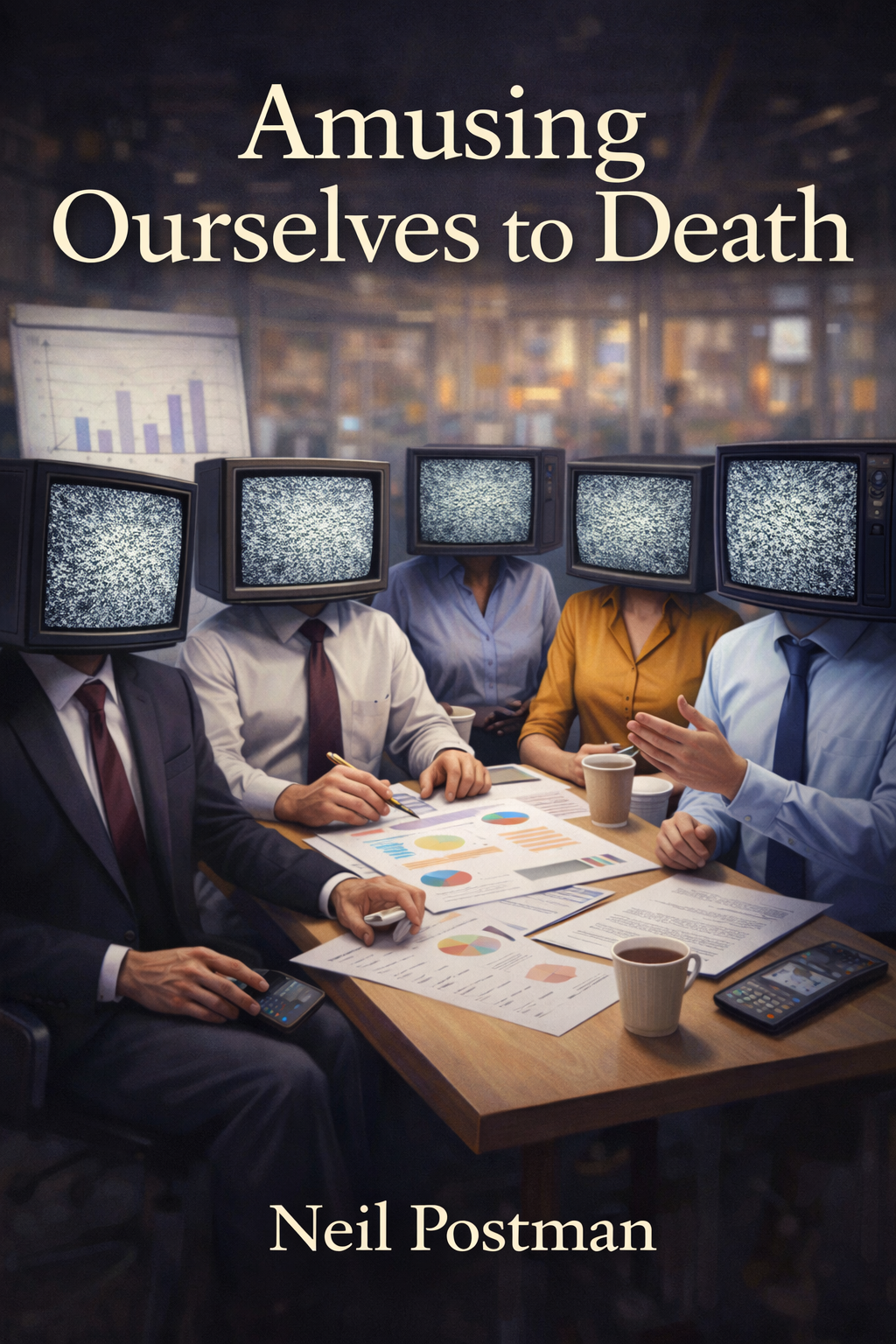
Amusing Ourselves to Death
Chapter Summaries
What's Here for You
Prepare to have your perceptions of media, culture, and even reality itself profoundly reshaped. Neil Postman's "Amusing Ourselves to Death" is not just a book; it's a wake-up call, a critical examination of how the very mediums we consume are fundamentally altering the way we think, understand, and interact with the world. Postman masterfully guides you from the era of the printed word, where discourse was serious and coherent, to the dazzling, often superficial, age of television and electronic media. You'll discover how the dominance of entertainment has infiltrated every aspect of public life – from politics and religion to education – transforming them into spectacles rather than substantive arenas of thought. This journey will equip you with the intellectual tools to deconstruct the messages bombarding you daily, to recognize the subtle ways media shapes your worldview, and to understand the profound implications of prioritizing amusement over substance. If you've ever felt a nagging sense that something is amiss in our public conversations, or wondered why complex issues are reduced to soundbites and images, this book will provide startling clarity. It's an invitation to reclaim critical thinking, to recognize the dangers of passive consumption, and to engage with information and ideas with a newfound depth and discernment. The tone is sharp, insightful, and at times, deeply unsettling, but ultimately empowering. You'll gain a vital understanding of the 'Huxleyan warning' – the subtle yet pervasive threat of distraction and triviality – and emerge with a more critical, informed, and engaged perspective on the media landscape and the culture it shapes.
The Medium Is the Metaphor
The author, Neil Postman, invites us to consider a profound shift in American culture, moving from the Age of Typography to the Age of Television, and he uses the glittering, entertainment-obsessed city of Las Vegas as a potent metaphor for our national character. He argues that, just as Boston symbolized political radicalism and New York the melting pot, Las Vegas now embodies a culture where all public discourse—politics, religion, news, education—has been transformed into a form of entertainment, largely unnoticed and unprotested. This transformation, Postman contends, is not merely a superficial change but a fundamental alteration driven by the very media we use to communicate. He draws a parallel to ancient wisdom, referencing Plato's observation that the form of our conversations dictates the ideas we can express, and importantly, the Second Commandment, which cautioned against graven images, suggesting an early understanding that visual representations could shape culture in ways that abstract thought might not. Postman expands on Marshall McLuhan's famous aphorism, "the medium is the message," clarifying that media are not merely conveyors of information but powerful metaphors that shape our perception of reality. He illustrates this with examples: smoke signals are too simple for philosophical argument, the visual nature of television makes a candidate like William Howard Taft implausible, and the telegraph created the very concept of 'the news of the day' as a commodity. Each medium, from the clock that broke time into measurable seconds, divorcing it from natural events, to the alphabet that allowed for abstract thought and critical scrutiny, fundamentally alters our way of thinking and the content of our culture. Postman suggests that eyeglasses, by implying the possibility of improving nature, and the microscope, by revealing hidden realities, also embedded powerful metaphorical ideas that influenced our understanding of ourselves and the world. Ultimately, he posits that our tools for conversation are not neutral; they are metaphors that classify, frame, and define our reality, and by understanding these mediametaphors, we can grasp how our culture is being reshaped, urging us to reflect on this shift from word-centered to image-centered discourse as we stand on the verge of 'amusing ourselves to death.'
Media as Epistemology
The author, Neil Postman, embarks on a profound exploration, positing that a seismic shift in America's dominant media metaphor has fundamentally altered public discourse, rendering much of it 'dangerous nonsense.' He contends that while the printing press fostered coherence, seriousness, and rationality, the advent of television has led to a 'shriveled and absurd' public conversation. Postman clarifies his critique isn't born of elitism or aesthetic judgment, but from a deep concern with epistemology—how we define and acquire knowledge, and crucially, how the very medium of communication shapes these definitions. Drawing a parallel with Northrop Frye's concept of 'resonance,' where a phrase or character gains universal significance beyond its original context, Postman argues that every medium possesses this metaphorical power, imprinting itself on our consciousness and social institutions, influencing our very notions of truth, piety, goodness, and beauty. He illustrates this by examining how different cultures and eras have defined truth through their dominant media: a West African tribe relying on oral proverbs, the Biblical figures using parables, and Jesus himself drawing from a rich oral tradition, contrasting this with a print-based courtroom where written law and testimony hold sway, creating a tension between the spoken and written word. Similarly, universities, steeped in print culture, privilege the written over the spoken, as evidenced by the doctoral oral where a footnote citing spoken testimony is deemed less valid than a published source, highlighting the ingrained bias that 'the published word is invested with greater prestige and authenticity than the spoken word.' This bias, he suggests, also shaped ancient Greek rhetoric, where eloquence and orderly argument were intrinsically linked to truth, a stark contrast to Socrates' seemingly unadorned defense, which may have been misinterpreted by his contemporaries. Postman then extends this to Aristotle's deductive logic and our modern obsession with quantification, suggesting that each era's 'truth' is tied to its prevailing media metaphor, whether it's myth and ritual for nature, deductive logic for science, or numbers for economics. He acknowledges that while some forms of truth-telling are indeed healthier than others, the decline of print-based epistemology and the rise of television's influence have had grave consequences, making us 'sillier by the minute.' He cautions against a simplistic view, noting that media changes are gradual and additive, like a river slowly becoming toxic, yet even in its degraded state, the river's form persists, and some uses remain, albeit with diminished value. This is the critical mass America has reached with television, which now dictates our information, ideas, and epistemology, even as print lingers as a 'residual epistemology.' Postman concludes by emphasizing that this shift primarily impacts public discourse—political, religious, informational, and commercial—while acknowledging television's potential for comfort and even social change, though he believes its impact on rational discourse is a serious concern. He reminds us that every technological shift involves trade-offs, much like the printing press fostered individuality at the cost of community and modern science at the expense of religious sensibility. Ultimately, Postman's central thesis is that as television moves to the center of our culture, the seriousness, clarity, and value of public discourse are dangerously declining, a profound warning about the unseen biases of our communication tools.
Typographic America
The author, Neil Postman, invites us to consider a profound tension in the very fabric of American culture, one that began with the colonial embrace of the printed word, a commitment so deep it shaped thought, discourse, and society itself. He begins with a curious anecdote about the Dunkers, a religious sect that, in a moment of striking intellectual humility, resisted writing down their principles, fearing it would trap them in dogma and stifle future enlightenment – a sentiment Postman likens to Plato's critique of writing, a rare instance of distrust in an era that would soon champion the very medium they eschewed. In stark contrast, the early American colonists, particularly in New England, were fervent devotees of typography, their religious sensibilities, political ideas, and social lives inextricably bound to the printed page. This wasn't mere casual reading; literacy rates soared, with the Bible as the cornerstone, but a vast array of non-religious texts also flowed into colonial life, imported in quantities that would stagger modern comparisons, demonstrating a deep-seated belief in the power and necessity of print for progress and understanding. This intense engagement with the written word was fueled by several factors: migrants from more literate regions of England, laws mandating schooling to thwart Satan and empower citizens with knowledge, and a profound epistemological shift where knowledge itself became intrinsically linked to the printed page, liberating minds from the immediate and local to a more abstract, universal understanding. America, as Postman reveals, imported a rich literary tradition, readily consuming works by English authors, which fostered a surprisingly classless reading culture where ideas and discourse could be shared widely, exemplified by the explosive success of Thomas Paine's 'Common Sense,' a phenomenon that dwarfed modern bestseller metrics and showcased the populace's readiness to engage with complex ideas. Even the emergence of native literature, particularly newspapers like Benjamin Harris's early, suppressed 'Publick Occurrences' and the later, sustained publications, signaled a growing public sphere, a space for debate and the pursuit of truth, though not without its struggles for freedom of information. As America progressed into the nineteenth century, this print-based culture intensified, with libraries, penny newspapers, and affordable books reaching every stratum of society, creating a shared intellectual landscape where even popular novels generated sensations comparable to major historical events, and public figures like Charles Dickens were treated with a level of adulation usually reserved for modern celebrities. This immersion in print, Postman argues, wasn't just about consumption; it fundamentally shaped the *form* of public discourse, transforming conversation into something akin to a public address, sermons into structured arguments, and even emotional preaching into a form that could be readily translated into the printed word, revealing that the medium itself, as Marx implicitly understood, dictates the nature of the message and its audience, forging a rational, serious public conversation that has since profoundly diverled from our current media environment.
The Typographic Mind
The author, Neil Postman, invites us to journey back to the mid-nineteenth century, a time when the printed word reigned supreme, shaping public discourse into what he terms the 'Age of Exposition.' He paints a vivid picture of the Lincoln-Douglas debates, not merely as political contests, but as grand performances for audiences accustomed to enduring hours of intricate, language-dense oratory. These were not people passively consuming soundbites; they were intellectual participants, capable of grasping complex arguments and subtle distinctions, a stark contrast to the demands of a television-centric culture. Postman argues that the very structure of print, its sequential and propositional nature, fostered a culture that valued rationality, objective analysis, and coherent thought. This typographic mind, he explains, was deeply embedded in every facet of American life, from religious discourse, where learned figures like Jonathan Edwards engaged audiences with tightly reasoned sermons, to the legal profession, where giants like John Marshall embodied detached, analytical devotion to logic. Even commerce, in its early advertising, appealed to understanding rather than passion, a testament to the era's respect for reasoned argument. This focus on exposition, on the careful construction and deconstruction of meaning through language, was the bedrock of an era that believed in the power of reason to comprehend, predict, and control the world. However, Postman notes the subtle shift occurring by the late 1800s, the first tremors of a new epistemology that would eventually give way to the 'Age of Show Business,' where images and emotional appeals would begin to overshadow the rigorous, propositional content that defined the typographic mind.
The Peek-a-Boo World
The author, Neil Postman, unveils a pivotal shift in American public discourse, tracing its origins to the mid-nineteenth century with the convergence of two transformative ideas: the decoupling of transportation and communication, and the ancient human impulse to represent reality. The first, a 'new idea,' was the practical application of electricity to communication, epitomized by Samuel Morse's telegraph. This invention, Postman explains, effectively annihilated space, collapsing regions and enabling a continent-wide conversation for the first time. However, this technological leap came at a profound cost, destroying the prevailing definition of information and ushering in the 'Age of Show Business.' Thoreau's prescient observation that we rush to connect Maine and Texas without considering if they have anything important to say, proved tragically accurate. The telegraph, Postman reveals, introduced irrelevance, impotence, and incoherence by divorcing information from its function in decision-making, transforming it into a commodity valued for novelty rather than utility. This was amplified by the rise of the penny press, which began to prioritize sensationalism over reasoned discourse. The partnership between the telegraph and the press created a deluge of 'news from nowhere, addressed to no one in particular,' making relevance itself irrelevant, much like Coleridge's metaphor of water everywhere without a drop to drink. This generated an information glut that diminished our sense of social and political potency, leaving us with opinions about global crises that we can do nothing about, trapped in a loop of impotence where news elicits opinions that become more news. Adding to this fragmentation, the author introduces the 'old idea' – the daguerreotype and its successor, photography. While seemingly a tool for 'reproducing nature,' photography, Postman argues, speaks only in particularities, lacking the syntax and abstractive power of language. It presents facts without context or argument, offering a decontextualized, atomized view of reality. The true 'assault,' as Daniel Boorstin termed the graphic revolution, came when these mechanically reproduced images, particularly photography, began to replace language as our primary means of understanding reality. The synergy between telegraphic news and photographs created an illusory sense of context, attaching faces to unknown names and making distant events seem relatable, yet ultimately leaving us with disconnected facts. This led to the invention of 'pseudocontexts' – crossword puzzles, game shows, cocktail parties – as a means to entertain ourselves with otherwise useless information, a refuge for a culture overwhelmed by irrelevance and incoherence. Postman concludes that these electronic and graphic revolutions, with telegraphy and photography as their vanguard, birthed a 'peekaboo world' – a world of broken time and attention, where events flash into view and vanish, offering endless entertainment but little coherence or sense. Television, he posits, became the command center of this new epistemology, orchestrating our communications and shaping our understanding of reality itself, making the bizarre seem natural and transforming our culture into a vast arena for show business, a culmination of Aldous Huxley's fears.
The Age of Show Business
Neil Postman, in his chapter 'The Age of Show Business,' unveils a profound shift in American public discourse, arguing that television has fundamentally altered how we perceive and engage with all forms of experience. He begins by playfully illustrating the absurd, 'quixotic' uses of a television set—as a lamp, a book holder, or an electronic bulletin board—to highlight the folly of believing new media merely amplify old ones, a concept he calls 'rearview mirror thinking.' Postman distinguishes between a technology, the physical apparatus, and a medium, the social and intellectual environment it creates, asserting that television, unlike the printing press with its bias toward linguistic culture, possesses an inherent bias toward images and entertainment. In America, this bias has been fully exploited, transforming television into the dominant cultural force. This is not merely about television being entertaining; it's about entertainment becoming the 'supraideology' for all discourse, even news, which is presented as a spectacle rather than a call to reflection. Postman illustrates this with the ABC broadcast of 'The Day After,' which, despite its serious subject matter and intellectual participants like Henry Kissinger and Elie Wiesel, devolved into a series of professional performances rather than a genuine discussion, demonstrating how the medium's demand for visual interest and rapid pacing suppresses complex thought. He contends that this 'show business' mentality has permeated every facet of American life, from religious services incorporating rock music and televised surgeries to political debates judged by style over substance. The core tension Postman identifies is the erosion of seriousness and depth in public life, replaced by the superficial allure of entertainment. The resolution, or rather the stark realization, is that how television stages the world becomes the model for how the world is staged, leading to a culture where priests, presidents, and surgeons prioritize showmanship over their disciplines. The author’s central insight is that the very nature of television compels a transformation of all content into entertainment, a phenomenon that has escaped the confines of the screen and reshaped our understanding of reality itself.
“Now ... This”
Neil Postman, in his chapter “Now ... This,” unveils a chilling transformation in American public discourse, arguing that the relentless pace and fragmented nature of electronic media, particularly television, have fundamentally altered our perception of reality and information. He introduces the phrase “Now ... this” not as a mere transition, but as a new part of speech, a verbal guillotine that severs any connection between what we've just seen or heard and what's to come, effectively declaring the world meaningless and not to be taken seriously. This discontinuity, Postman explains, is nurtured by television's structure, where every segment, often lasting around forty-five seconds, is a discrete, self-contained event designed for maximum entertainment value, not for fostering deep thought or consequence. He illustrates this with the example of television news, where the visual appeal and perceived credibility of newscasters—dubbed 'talking hairdos'—become paramount, often eclipsing the actual substance of the news itself; the teller's likability, rather than their accuracy, dictates truth. This shift from reality to verisimilitude, where a newscaster looking like a liar can undermine truth more than an actual lie, is a profound epistemological change, reducing complex issues to mere entertainment. The pervasive use of music, the brevity of stories, and the dominance of film footage all serve to create a stylized performance, akin to vaudeville, where genuine concern or terror from newscasters would be disconcerting to an audience accustomed to viewing news as a dramatic spectacle. This constant bombardment of fragmented, decontextualized information, punctuated by commercials, creates an "information environment" that Postman likens to "trivial pursuit," where facts are mere sources of amusement, leading to a culture that is highly entertained but profoundly uninformed. He observes this phenomenon extending even to print media, like USA Today, which mirrors television's format with short articles, heavy reliance on visuals, and a disregard for typographic depth, thereby reinforcing the idea that coherence and contradiction are obsolete in this new media landscape. Ultimately, Postman warns, this "Now ... this" culture, a Huxleyan world where we "dance and dream ourselves into oblivion," risks not just ignorance but a dangerous illusion of knowledge, leaving us ill-equipped to discern truth or engage with the world in a meaningful, coherent way, a stark contrast to the informed citizenry envisioned by thinkers like Walter Lippmann, who believed in the public's capacity to detect lies when presented with the means to do so. The damage, he concludes, is particularly acute for younger viewers, shaping an epistemology where even grave events are perceived as exaggerated and not to be taken seriously, a profound loss of our capacity to be truly informed.
Shuffle Off to Bethlehem
Neil Postman, in "Shuffle Off to Bethlehem," invites us to consider the profound transformation religion undergoes when filtered through the lens of television, a medium inherently biased towards entertainment. He observes how charismatic figures like Reverend Terry, Pat Robertson, and Jimmy Swaggart, while attempting to convey spiritual messages, often mimic the styles of Milton Berle, Entertainment Tonight, or even vaudeville. This shift from sacred ritual to secular spectacle is not merely a stylistic choice but a fundamental alteration of religious experience itself. Postman argues that the very nature of television, with its emphasis on visual immediacy, rapid pacing, and constant commercial breaks, strips away the essential elements of traditional religious practice: ritual, dogma, theology, and crucially, spiritual transcendence. The author reveals a core tension: the medium's inherent bias toward secularism and entertainment fundamentally clashes with the demanding, introspective, and often austere nature of authentic religious engagement. He illustrates this with the example of a woman saved from anxiety by the 700 Club, elevated first by Jesus and then by becoming a television star, leaving the reader to ponder which state is considered higher. This leads to the first critical insight: on television, religion becomes an entertainment product, with the preacher often overshadowing God, becoming the de facto star. The second insight emerges from the understanding that this isn't necessarily the fault of the preachers, many of whom are simply adapting to the demands of the medium, but rather a consequence of television's inherent limitations. As Postman explains, not all forms of discourse translate effectively across media; just as poetry loses its essence in translation, so too does the profound depth of religious experience become diluted when rendered for the small screen. He highlights the danger of 'technological naivete,' the belief that a message remains the same regardless of its delivery system. A third crucial point is that television's environment, typically a living room filled with distractions, lacks the consecrated space necessary for genuine spiritual experience. The constant awareness that a flick of a switch can summon secular amusements, coupled with the pervasive commercial interruptions, makes introspection and transcendence difficult. Postman further elaborates that the core goal of these televised religious programs, much like secular shows, is audience attraction, driving them to adopt marketing strategies and tailor messages to what people want, rather than what they need – a stark contrast to the teachings of historical religious figures. This leads to a fourth insight: television religion prioritizes popularity and affirmation over the challenging, transformative messages that define many traditional faiths. The author then addresses the counterargument that spectacle has always been part of religion, but distinguishes between religious spectacle, which aims for enchantment and access to the sacred, and television's entertainment, which creates distance from it. Finally, Postman posits that the ultimate danger is not that religion becomes content for television, but that television shows, with their focus on personality, affluence, and superficiality, may inadvertently become the content of religion itself, a phenomenon he implicitly labels as blasphemy when the televised personality eclipses the divine. The chapter resolves with a somber reflection on how mass culture, in its quest to entertain, risks trivializing and potentially destroying authentic cultural and religious experiences, leaving us to question if a televised Hamlet can truly be Hamlet.
Reach Out and Elect Someone
Neil Postman, in his chapter 'Reach Out and Elect Someone,' confronts a profound shift in American political discourse, arguing that it has devolved from a spectator sport with clear standards of excellence, like traditional athletics, into a form of show business dominated by the persuasive, image-driven logic of the television commercial. He posits that where sports offer objective measures of success, politics, when framed as entertainment, prioritizes appearance over substance, turning the pursuit of office into a matter of advertising. This transition, Postman explains, profoundly impacts capitalism itself, which, once rooted in rational exchange between informed buyers and sellers, now relies on emotional appeal and manufactured desires, echoing the very techniques of television commercials that substitute imagery for testable propositions. The author reveals that this paradigm has devastated political discourse by demanding brevity, emotional resonance, and simplistic solutions, effectively turning complex issues into easily digestible, often pseudotherapeutic, entertainment. He illustrates this with the example of Ramsey Clark’s detailed policy papers being no match for Jacob Javits’s image-centric, thirty-second commercials, a strategy that, while effective in winning elections, hollows out genuine political engagement. Postman contends that this television-age politics, driven by image managers and celebrity assimilation, fosters a 'Huxleyan' rather than 'Orwellian' threat to democracy; it doesn't ban information but drowns us in a continuous, incoherent present of superficial entertainment, rendering us unfit to remember history or engage in substantive debate. The core tension lies in the transformation of politics from a realm of reasoned debate and party-based interests to a performance of symbolic, emotional appeals, where politicians become celebrities and the electorate seeks not solutions to tangible problems, but a comforting image of themselves reflected on the screen, ultimately leading to a form of 'amusement' that pacifies rather than empowers.
Teaching as an Amusing Activity
The author, Neil Postman, turns his sharp gaze upon the evolving landscape of education, particularly through the lens of television's pervasive influence, presenting a compelling argument that the very nature of learning is being reshaped. He begins by dissecting the seemingly innocuous arrival of Sesame Street in 1969, a show embraced by children for its commercial-like entertainment, by parents seeking to assuage guilt and offload teaching responsibilities, and by educators charmed by its efficiency and novelty. Yet, Postman reveals a deeper, more unsettling truth: Sesame Street, and television in general, fundamentally undermines the traditional concept of schooling. Where classrooms foster social interaction, questioning, language development, and require attentive discipline, television offers a private, passive experience that prioritizes immediate gratification over sustained engagement. This is not a conspiracy, Postman emphasizes, but a consequence of television's inherent nature, which he argues functions as a powerful, albeit invisible, curriculum. He posits that television operates under three core commandments: 'Thou shalt have no prerequisites,' meaning learning can commence at any point without foundational knowledge; 'Thou shalt induce no perplexity,' ensuring contentment over intellectual struggle; and 'Thou shalt avoid exposition,' favoring dynamic visuals and storytelling over reasoned discourse. This philosophy, he contends, is not confined to children's programming but permeates all television, from documentaries to dramas. The tension arises as this entertainment-driven model seeps into the classroom itself, transforming education into an 'amusing activity.' Projects like 'The Voyage of the Mimi,' a multi-million dollar initiative integrating television, books, and computer games, exemplify this shift, prioritizing televisual appeal over pedagogical depth. Postman critiques this trend, citing studies that suggest television viewing, especially in a dramatic context, often hinders rather than enhances learning and critical thinking, promoting segmented, concrete understanding over inferential reasoning. The resolution offered is a stark warning: by embracing entertainment as the primary mode of learning, we risk preparing students not for rigorous intellectual engagement, but for a passive consumption of all aspects of life, from news to politics, delivered in a similarly delightful, undemanding package. The true curriculum, Postman concludes, is no longer solely within the classroom walls but is being dictated by the relentless, entertaining logic of the television screen, fundamentally altering how knowledge is acquired and what it means to be educated.
The Huxleyan Warning
Neil Postman, in his chapter 'The Huxleyan Warning,' casts a prescient shadow over our modern condition, contrasting two paths to cultural decay: the Orwellian prison of overt control and the Huxleyan burlesque of pervasive distraction. While Orwell's vision of a boot stamping on a human face is a stark, recognizable threat, Postman argues that Huxley's prophecy is the more insidious and, in America, the more actively realized danger. He explains that in a Huxleyan world, spiritual devastation doesn't arrive with a clenched fist but a smiling face, not through censorship but through an overabundance of trivial entertainment. In this landscape, Big Brother isn't watching us; we are voluntarily watching him, captivated by a ceaseless stream of amusement. Postman reveals a crucial insight: technology itself is ideology, a program for social change that reshapes our public discourse, our institutions, and our very ways of thinking, often without our conscious consent or even awareness. He laments that while we are adept at recognizing and resisting overt tyranny, we are ill-equipped to combat a culture that dissolves serious public conversation into 'babytalk' and transforms civic life into a 'vaudeville act.' The author highlights the critical dilemma: how does one fight against a 'sea of amusements' when there are no cries of anguish, no visible oppressor? He points to America's profound 'love affair with television' as the prime example of this Huxleyan experiment, where the slow, deliberate act of reading has been supplanted by the speed-of-light transmission of images, fundamentally altering our cognitive habits and cultural consciousness. Postman critiques the naive belief in technological neutrality, asserting that changes in communication technologies, like the alphabet or the printing press, have always been profound cultural revolutions, but electronic media, particularly television, accelerate this process dramatically, bypassing debate and resistance. He underscores that the true problem isn't what people watch, but simply *that* we watch, becoming an audience to our own public lives. The author offers a glimmer of hope, not in unrealistic Luddite fantasies of dismantling technology, but in a radical shift of consciousness: we must learn to ask critical questions about the nature of information and the media that deliver it. He suggests that our schools, the last bastion of a medium capable of sustained reflection – the printed word – are our only hope, though they too have largely failed to demythologize media, often treating technologies as natural phenomena rather than historically constructed ideologies. Ultimately, Postman echoes Aldous Huxley's warning that the danger lies not in laughter replacing thought, but in the populace losing the awareness of *why* they are laughing and *why* they have stopped thinking, a state where 'education' races against 'disaster.'
Conclusion
Neil Postman's "Amusing Ourselves to Death" serves as a potent, albeit disquieting, examination of how our dominant media shape not just what we know, but how we know it. The core takeaway is that the form of a medium is inseparable from its message, acting as a powerful metaphor that redefines our perception of reality, truth, and intelligence. Postman traces a cultural trajectory from the "typographic mind" of print culture, characterized by its emphasis on rationality, sequential thought, and deep engagement, to the "Age of Show Business" dominated by television. This shift, he argues, has transformed public discourse into a trivialized spectacle, where entertainment reigns supreme, eroding our capacity for critical thinking, nuanced understanding, and meaningful civic participation. The emotional lesson is one of profound loss – the loss of intellectual rigor, the diminishment of seriousness, and the erosion of genuine connection to complex issues. We are, in Postman's view, willingly sedated by a constant stream of amusing distractions, a "peekaboo world" where context is abandoned and coherence is sacrificed for fleeting spectacle. The "Now... This" epistemology, where disparate fragments of information are presented without connection or consequence, fosters an "amused ignorance" that makes us susceptible to manipulation and indifferent to truth. Practically, Postman's wisdom lies in his urgent call for "media consciousness." He implores us to recognize that technology is not neutral; it carries an inherent program that reshapes our cognitive habits and societal values. The book’s enduring relevance lies in its prescient warning against the Huxleyan threat of pervasive distraction and trivialization, a danger more insidious than Orwell's overt oppression. The practical wisdom is to actively resist the "show business" mentality that infects our institutions, from politics and religion to education. This requires a conscious effort to cultivate a "typographic mind" – one that values depth, context, and reasoned argument – even in an image-saturated world. Ultimately, Postman challenges us to become active interrogators of our media environment, understanding its biases and inherent limitations, to reclaim the integrity of our public discourse and preserve our capacity for genuine thought and informed citizenship.
Key Takeaways
The dominant media of a culture act as powerful metaphors, shaping not just how we communicate but how we perceive and understand reality itself, often in ways we fail to recognize.
The form of a medium inherently dictates the type of content it can effectively convey, meaning a shift in media (e.g., from print to television) necessitates a change in the substance and nature of public discourse.
The transformation of public discourse into entertainment, driven by visual media like television, risks trivializing important societal conversations in politics, religion, and education.
Ancient wisdom, such as the biblical prohibition against graven images, hints at a long-held understanding that visual representation can profoundly influence a culture's intellectual and spiritual direction.
Technological innovations, from the clock to the telegraph, embed metaphorical ideas that extend beyond their practical function, altering our fundamental concepts of time, news, and even the mind.
Understanding the metaphorical power of our communication tools is crucial for recognizing how our culture is being redefined and for maintaining the integrity of intellectual and civic life.
The medium through which information is conveyed fundamentally shapes our definition of truth and knowledge, not just the content itself.
Every communication medium possesses a 'resonance,' a metaphorical power that extends beyond its original context to influence culture, institutions, and concepts of truth.
Our understanding of intelligence and wisdom is inextricably linked to the dominant forms of communication prevalent in a culture.
The shift from a print-based epistemology to a television-based one has led to a dangerous decline in the seriousness and clarity of public discourse.
The perceived authenticity and validity of information are often dictated by the medium, with print historically holding more prestige than oral tradition or even spoken testimony.
While new media offer benefits, they also involve trade-offs, transforming societal values and cognitive habits, often in ways that are not immediately apparent.
The early American colonists' profound commitment to the printed word, driven by religious conviction and a societal shift towards knowledge embodied in text, established a unique typographic culture that shaped public discourse and intellectual life.
The widespread literacy and accessibility of printed materials in Colonial America, from religious texts to popular literature, fostered a remarkably classless reading culture that enabled broad public engagement with ideas.
The form of the printed word, with its linear, analytical structure, fundamentally influenced not only the content of public discourse but also the very nature of oral communication, transforming conversations into structured 'dissertations'.
The scarcity of alternative media in early America meant that print held a virtual monopoly on public discourse, serving as the primary metaphor and measure for all forms of communication and thought.
The success of figures like Thomas Paine and the widespread consumption of newspapers and pamphlets underscore the populace's capacity and desire for intellectual engagement when provided with accessible printed material.
The dominance of the printed word in the 18th and 19th centuries fostered a 'typographic mind' that prioritized rationality, sequential thought, and propositional content in public discourse.
Audiences in the Age of Exposition possessed a high capacity for sustained attention and complex aural comprehension, engaging deeply with language-based arguments.
Print culture cultivated a rigorous intellectual environment where meaning was paramount, demanding analytical engagement from both speakers and listeners, unlike the more passive consumption of modern media.
The shift from an 'Age of Exposition' (print-dominated) to an 'Age of Show Business' (image and entertainment-dominated) represents a fundamental change in how information is processed and valued by society.
The legal and religious spheres of the 18th and 19th centuries exemplified the typographic mind's emphasis on reasoned exposition, scholarship, and intellectual rigor, a stark contrast to contemporary manifestations.
The very act of reading in a print-centric era fostered habits of mind characterized by detachment, objectivity, and a tolerance for delayed response, essential for navigating complex ideas.
The telegraph, by detaching information from its functional context, transformed news into a commodity valued for novelty, leading to an "information glut" that diminished individual and collective agency.
Photography, with its focus on particularities and lack of linguistic syntax, presents a decontextualized and atomized view of reality, contributing to a loss of deeper understanding.
The partnership of telegraphy and photography created an illusory sense of context for news, leading to the development of "pseudocontexts" for entertainment rather than meaningful action.
The "peekaboo world" fostered by electronic media, characterized by fragmented attention and fleeting information, prioritizes entertainment over coherence, making complex issues seem trivial or unmanageable.
Television functions as a "metamedium" and "myth," shaping not only our knowledge of the world but also our very ways of knowing, making its biases appear natural and unquestionable.
Television's inherent bias toward visual spectacle and rapid pacing fundamentally reshapes all forms of public discourse, prioritizing entertainment over depth and reflection.
The distinction between a technology (the machine) and a medium (the social/intellectual environment it creates) is crucial for understanding how television's 'bias' dictates its cultural impact.
Entertainment has become the 'supraideology' of all television discourse, meaning all subjects, even tragedy and barbarism, are presented for amusement, diminishing their potential for serious engagement.
The 'show business' mentality, driven by television's demands, has infiltrated all major institutions, causing a shift from intellectual rigor to superficial performance in areas like politics, religion, and education.
The way television stages reality becomes the dominant model for how reality itself is perceived and conducted off-screen, leading to a culture that values image and spectacle above substance.
The concept of 'rearview mirror thinking'—viewing new media as mere extensions of old ones—prevents us from grasping the radical redefinition of public discourse brought about by television.
The phrase 'Now... This' functions as a conceptual severing device in electronic media, transforming public discourse into a series of disconnected, meaningless fragments devoid of consequence.
Television news prioritizes the 'credibility' of the presenter's appearance and perceived sincerity over factual accuracy, redefining truth as a matter of performance and likability.
The structure of television news, characterized by short segments, music, and visual dominance, inherently packages information as entertainment, eroding the capacity for serious, contextual understanding.
The constant fragmentation and decontextualization of information by electronic media lead to 'disinformation,' creating an illusion of knowledge while actively misleading audiences away from genuine understanding.
Modern media's embrace of discontinuity and entertainment over coherence and depth makes the public indifferent to factual inaccuracies and contradictions, fostering a state of amused ignorance.
The "Now... This" epistemology, where coherence and context are abandoned, renders traditional methods of detecting lies ineffective and diminishes the public's capacity to be truly informed, not just aware of events.
Television's inherent bias toward entertainment strips religion of its sacred elements, transforming profound spiritual practice into a superficial spectacle where the preacher becomes the primary focus, often overshadowing the divine.
The medium of television fundamentally alters religious messages; attempting to translate the depth of religious experience into a format designed for mass entertainment inevitably leads to a dilution and distortion of its original meaning and value.
The secularized environment of the television screen, saturated with commercialism and constant potential for distraction, actively works against the creation of the consecrated space and contemplative mindset necessary for authentic religious experience.
Televised religion prioritizes audience attraction and fulfilling viewer desires over delivering challenging spiritual needs, mirroring commercial broadcasting strategies and creating a 'user-friendly' faith that avoids demanding truths.
The spectacle presented in televised religion functions as entertainment, which distances viewers from the sacred, unlike the traditional religious spectacle of enchantment that facilitates access to it, leading to a potential inversion where television shows become the content of religion.
The television commercial has fundamentally reshaped political discourse by prioritizing image and emotional appeal over substance, clarity, and honesty, transforming politics into a branch of show business.
Modern capitalism, influenced by television advertising, has shifted from a basis of rational consumer choice to one driven by emotional manipulation and the creation of perceived psychological needs.
Political campaigns now rely on 'image politics,' where candidates present themselves as reflections of the audience's desires and anxieties, rather than offering substantive policy or ideology, making voters more like passive consumers of entertainment.
The dominant mode of television communication, characterized by brevity, spectacle, and instantaneity, erodes historical context and deep understanding, making citizens 'unfit to remember' and less capable of engaging in serious, nuanced political thought.
The primary threat to liberal democracy in the age of television is not overt censorship (Orwellian) but the overwhelming 'glut' of superficial, entertaining information that displaces substantive discourse and critical engagement (Huxleyan).
The shift from party-based political interests to symbolic, psychological interests means that voters are increasingly swayed by personality and image rather than tangible benefits or ideological alignment.
Television, through its inherent structure and programming, functions as a powerful, unregulated curriculum that fundamentally reorients learning away from traditional schooling's emphasis on critical thinking, sequence, and intellectual struggle towards passive entertainment and immediate gratification.
The core tenets of television's 'educational' philosophy—no prerequisites, no perplexity, and avoidance of exposition—are antithetical to the development of deep learning, which requires building upon prior knowledge, grappling with complexity, and engaging in reasoned discourse.
The increasing integration of television and media into the classroom, exemplified by projects like 'The Voyage of the Mimi,' risks prioritizing 'televisibility' and entertainment value over genuine educational substance, potentially leading to a superficial understanding of subjects.
Studies suggest that information presented dramatically on television often leads to less effective learning and a diminished capacity for higher-order, inferential thinking compared to learning through print media.
By making learning synonymous with entertainment, education risks preparing students to passively consume all forms of information, including news, politics, and commerce, in a similarly undemanding and undiscriminating manner.
The shift from book-centered to image-centered learning represents a profound crisis in education, akin to historical transitions from oral to alphabet cultures or the advent of the printing press, demanding a critical understanding of media's epistemological impact.
The primary threat to a culture's vitality in the technological age is not overt oppression (Orwellian) but pervasive distraction and trivialization (Huxleyan), where citizens willingly become passive audiences to their own lives.
Technology is not neutral; it carries an inherent 'program' for social and cultural change that reshapes our understanding, discourse, and institutions, often without conscious intent or public consensus.
The critical challenge lies in recognizing and resisting the subtle ideological force of media technologies, particularly television, which can transform serious public discourse into entertainment and erode critical thinking.
A culture's ability to defend itself against spiritual devastation is hindered when the threat manifests as amusement rather than overt tyranny, making it difficult to rally opposition to a 'sea of amusements.'
The solution to media saturation lies not in rejecting technology but in developing media consciousness – a deep understanding of how information forms, speeds, and contexts shape our reality and our thinking.
Education, specifically the critical examination of media's role in shaping culture and thought, is the most viable, albeit challenging, path to regaining control over our relationship with technology.
Action Plan
Actively analyze the dominant media you consume, asking how its form might be shaping your perception of reality.
Critically evaluate political, religious, and news content not just for its message, but for its presentation and entertainment value.
Seek out diverse forms of communication, including print and long-form audio, to counterbalance image-heavy media.
Reflect on how technological tools in your own life (e.g., smartphones, computers) might be influencing your thinking and worldview beyond their intended function.
Consciously question the 'entertainment' framing of public discourse and seek out sources that prioritize depth and substance over spectacle.
Engage in conversations that require abstract thought and nuanced argument, recognizing the value of word-centered discourse.
Consider the historical context of communication technologies to better understand their long-term impact on culture.
Actively question the source and medium of information, considering how it might shape the message.
Cultivate a critical awareness of the implicit biases present in different communication forms, from print to digital media.
Consciously engage with diverse forms of communication, valuing both written analysis and thoughtful oral discourse.
Seek out information that challenges your current media consumption habits and expands your epistemological framework.
Practice distinguishing between the style or 'eloquence' of a message and the logic of its argument, especially in public discourse.
Reflect on how your own preferred communication methods might be influencing your perception of truth and intelligence.
Prioritize in-depth engagement with complex topics, resisting the tendency for superficial understanding often encouraged by fast-paced media.
Reflect on how the medium through which you consume information (print, digital, audio, video) might be shaping your understanding and opinions.
Seek out diverse sources of information, particularly those that challenge your current media diet, to broaden your intellectual perspective.
Practice articulating your thoughts in a structured, clear manner, as if explaining a concept to an informed but invisible audience.
Consider the historical context of communication, recognizing that the dominant media of an era profoundly influence its culture and discourse.
Engage with longer-form printed materials, such as books and essays, to cultivate a deeper, more analytical mode of thinking.
Seek out and engage with long-form written content (books, essays, in-depth articles) to practice sustained attention and deep comprehension.
Consciously analyze the structure and propositional content of arguments encountered in media, distinguishing between reasoned claims and emotional appeals.
Practice articulating complex ideas in a clear, sequential, and logically coherent manner, mirroring the expository style of the typographic mind.
Deliberately slow down information consumption, allowing for reflection and critical evaluation rather than immediate reaction.
Engage in activities that require focused, analytical thought, such as puzzles, strategy games, or learning a complex new skill.
Reflect on how visual and auditory media shape your understanding and compare it to the analytical process fostered by reading.
Actively question the source and context of information, especially from electronic media, to discern its relevance and utility.
Seek out longer, more complex forms of communication, such as books and in-depth articles, to counter the fragmentation of "peekaboo" media.
Consciously practice connecting disparate pieces of information, looking for deeper meanings and implications rather than accepting isolated facts.
Engage in activities that require sustained attention and problem-solving, such as puzzles or strategic games, to strengthen focus and cognitive coherence.
Be mindful of the difference between knowing *of* many things and truly understanding a few, prioritizing depth over breadth in your learning.
Recognize when information is presented for entertainment rather than for action or understanding, and adjust your engagement accordingly.
Critically examine how visual media, like photographs and television, frame reality and consider what might be omitted or de-emphasized.
Actively question the presentation style of all media, distinguishing between substantive content and mere entertainment value.
Seek out and engage with media forms that prioritize depth, reflection, and complex ideas, even if they require more effort.
Be mindful of the 'show business' tendencies in your own communication and professional life, striving for authenticity and substance over performance.
Challenge the presentation of serious topics as mere entertainment, especially in news and public affairs, by seeking out more in-depth analysis.
Consciously analyze how the visual and pacing demands of television might be influencing your perception and understanding of events.
Diversify your information sources to include formats less driven by the immediate gratification of visual spectacle, such as long-form articles, books, and radio documentaries.
Actively seek out longer, more contextualized analyses of news events beyond brief television segments.
Question the superficial 'credibility' of news presenters and prioritize the verifiable accuracy of their reports.
Consciously resist the urge to move on from one news item to the next without reflection; pause to consider implications.
Diversify news sources to include print, long-form journalism, and documentaries that offer depth and coherence.
Engage in critical thinking by identifying logical connections and contradictions in information presented across different media.
Be mindful of the emotional impact of media and discern between genuine information and entertainment designed to evoke visceral responses.
Practice 'media fasting' or limiting exposure to fragmented, rapid-fire news cycles to foster deeper engagement with information.
Critically evaluate religious programming by discerning whether it aims for spiritual transcendence or mere entertainment.
Seek out and engage in religious or spiritual practices that emphasize consecrated spaces and contemplative rituals, away from media distractions.
Be mindful of the 'translation' process when consuming spiritual content through various media, recognizing what might be lost or altered.
Prioritize spiritual needs over superficial comforts when seeking religious guidance, questioning messages that solely promise prosperity or ease.
Actively seek out and engage with religious traditions that emphasize depth, challenging doctrines, and historical context, rather than purely affirmative messages.
Actively seek out and engage with long-form political analysis and historical context to counteract the superficiality of image-based media.
Critically evaluate political advertisements and media appearances, looking beyond emotional appeals and superficial charm to assess substance and policy.
Prioritize media consumption that offers depth and complexity over those that offer only brief, entertaining fragments.
Support and engage with traditional media and journalistic practices that emphasize in-depth reporting and factual accuracy over sensationalism.
Recognize that political discourse is often framed as entertainment and consciously resist the urge to be passively amused; instead, seek to be informed and engaged.
Understand that the 'image' of a politician is often a crafted persona, not a true reflection of their capabilities or intentions, and look for evidence beyond appearances.
Make a conscious effort to connect current political events to historical precedents to build a more robust understanding of societal patterns and challenges.
Critically evaluate the nature of learning presented by various television programs, identifying the underlying 'commandments' of prerequisites, perplexity, and exposition.
Actively seek out and engage with print media, recognizing its distinct capacity for fostering deeper, inferential thinking and knowledge retention.
Discuss with children and students the difference between passive media consumption and active, engaged learning, highlighting the value of intellectual struggle.
Examine current educational initiatives and media integrations for their true pedagogical goals versus their entertainment appeal.
Consciously resist the temptation to equate learning with immediate enjoyment, embracing the challenge and perseverance required for genuine understanding.
Question the curriculum design of educational media, considering whether content is driven by what is 'televisual' or by sound educational principles.
Educate oneself and others on the cognitive and social effects of media, developing critical 'equipment' for viewing television and other technologies.
Actively question the source, format, and context of information encountered, especially from electronic media, to understand its underlying message and potential effects.
Seek out and engage with slower, more deliberate forms of information consumption, such as reading books or long-form articles, to counterbalance the rapid-fire nature of digital media.
Initiate conversations with friends, family, or colleagues about the specific ways media technologies are influencing personal and public discourse.
Dedicate time to reflect on how entertainment and trivial content might be displacing more substantive public conversation in one's own life.
Support educational initiatives that prioritize media literacy and critical analysis of information technologies within schools.
Consciously identify and acknowledge the 'programs' or inherent biases embedded within the technologies used daily, rather than assuming their neutrality.
Practice mindful consumption of media, recognizing when one is passively observing versus actively engaging or learning.