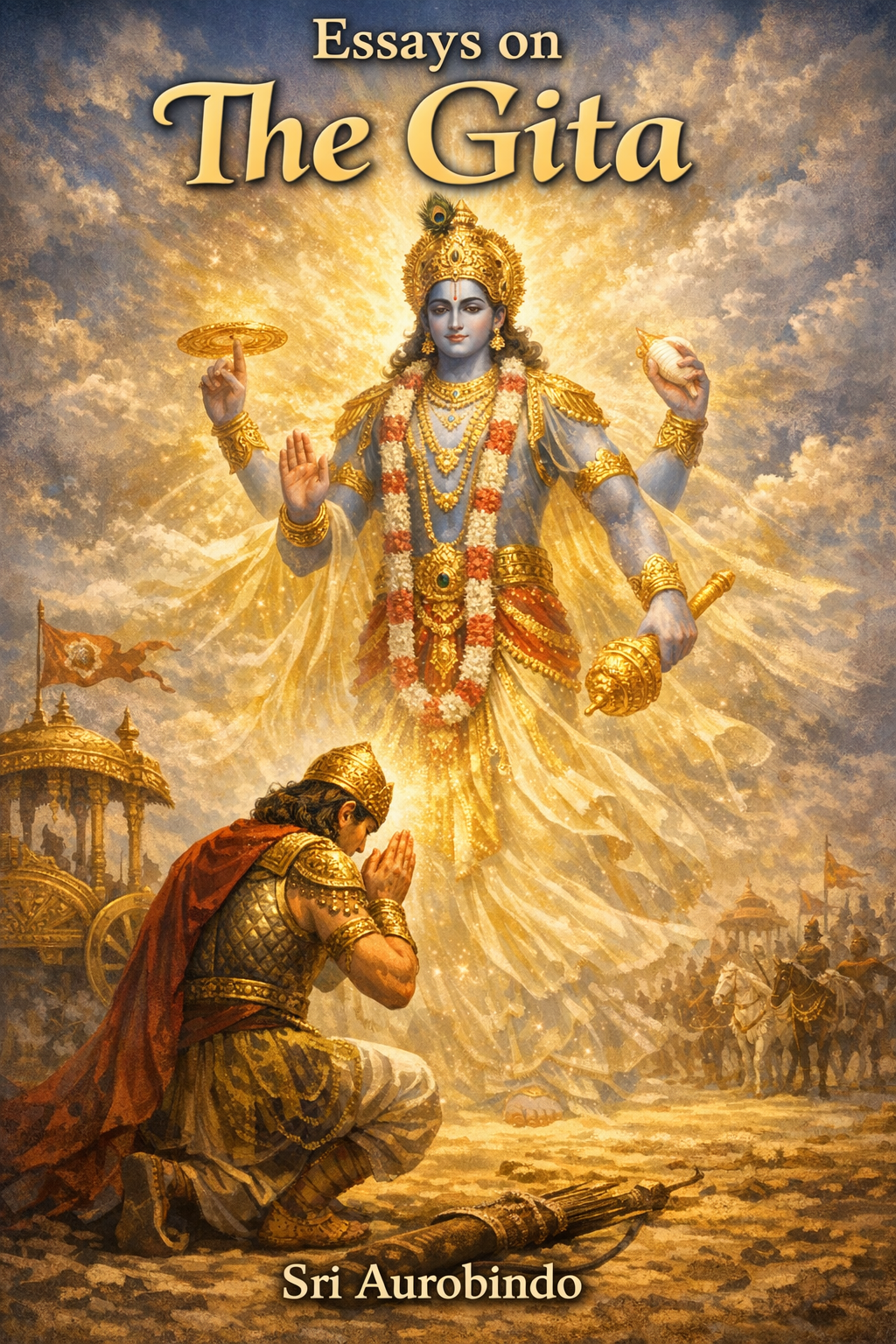
Essays on The Gita
Chapter Summaries
What's Here for You
Embark on a profound journey with Sri Aurobindo's "Essays on The Gita," an invitation to experience the Bhagavad Gita not as a dusty dogma, but as a living, breathing source of truth for the modern soul. This isn't just a commentary; it's a reawakening, a call to confront the battlefield of your own existence with clarity, courage, and an awakened will. Aurobindo urges you to move beyond one-sided interpretations and embrace the Gita's multifaceted wisdom, revealing its power not in detachment, but in the dynamic integration of action, devotion, and knowledge. You will discover how to reconcile inner peace with outward engagement, understanding the divine paradox of a world that is both a manifestation of God and a stage for our personal struggles. Prepare to explore the essence of divine works, the transformative power of sacrifice, and the profound concept of Avatarhood as a principle of divine intervention and inner evolution. This exploration will equip you with the tools to transcend the limitations of nature's modes, to understand the intricate dance of free will and destiny, and to find your true self above the Gunas. You will gain a deeper understanding of the 'intelligent will' as the rudder of your existence, learn the significance of works performed with equality and knowledge, and uncover the secret of living a divine life in the midst of worldly action. The tone is one of intellectual rigor, spiritual depth, and an unwavering belief in humanity's potential for transformation. Aurobindo's vision is expansive, offering not just philosophical insights, but a practical pathway to integrate the highest spiritual truths into the very fabric of your daily life, leading you towards a supreme secret of divine union and fulfillment. Prepare to be challenged, inspired, and ultimately, liberated.
Our Demand and Need from the Gita
Sri Aurobindo, in 'Essays on The Gita,' invites us to approach ancient scriptures not as rigid dogma, but as living sources of truth, urging a spirit of open inquiry rather than exclusive possession. He observes that while humanity has thankfully evolved beyond religious warfare, a subtler form of intellectual egoism persists, where we claim our truth as supreme and others as merely preparatory. Aurobindo posits that the eternal Truth is not confined to a single formula or text; rather, it expresses itself through time and human consciousness, necessitating a distinction between the perishable, temporal elements of a scripture and its imperishable, universal core. The challenge lies in discerning this enduring essence, for the very language, metaphysical frameworks, and historical contexts of ancient texts are subject to change, making precise historical interpretation an elusive goal, as evidenced by the divergent commentaries on the Gita itself. Thus, the true value of approaching the Gita, or any sacred text, is not in extracting its exact historical or metaphysical meaning, but in seeking the living truths it offers, transmuting them into a form vital and relevant to contemporary humanity. Aurobindo illustrates this with the concept of sacrifice, which, when detached from its ancient ritualistic form, reveals a universal principle of interchange and self-giving applicable to modern life. Similarly, concepts like the fourfold order of society or the Shastra, when understood in their underlying spirit rather than their literal, temporal manifestation, point to profound truths about human nature and societal organization. He champions the Gita not as a sectarian weapon, but as a gateway to a vast synthesis of spiritual experience, reconciling diverse paths of Knowledge, Works, and Love, and embracing a vision that transcends rigid philosophical schools like Sankhya or Vaishnava Theism. The Gita, in its expansive, synthetic approach, offers a profound harmony, a testament to India's rich spiritual heritage, and serves as a vital foundation upon which future syntheses of human thought and aspiration must be built. Our demand from the Gita, therefore, should be for this essential, living message—the principles that guide humanity towards its perfection and highest spiritual welfare, not for academic debate, but for transformative inner realization.
The Divine Teacher
Sri Aurobindo, in his 'Essays on The Gita,' invites us to look beyond the mere narrative of the Mahabharata, positing that the Bhagavad Gita is not just a philosophical treatise detached from time, but an integral part of a profound human drama. He argues that the Gita's power lies precisely in its emergence from a critical, agonizing moment in Arjuna's life – a moment of profound moral crisis on the battlefield of Kurukshetra, where he confronts the terrifying prospect of carrying out a violent, seemingly unavoidable action. Whether inserted later or woven in from the start, the author emphasizes the Gita's deliberate entanglement within the epic, a constant reminder that its teachings are not abstract ideals, but a response to a practical, existential dilemma. At the heart of this teaching, Aurobindo reveals, lie three spiritually significant elements: the divine personality of the Teacher, Krishna; his unique relationship with his disciple, Arjuna, the representative man; and the very occasion of their discourse – a violent crisis forcing a confrontation with the meaning of existence. India's deep-rooted belief in the Avatara, the divine descent, is presented not as a mere dogma, but as a logical extension of the Vedantic worldview, where all existence is a manifestation of the One Reality. While the divine can be seen in the efflorescence of its powers, the Avatara, Aurobindo explains, is the full, conscious descent, the Unborn knowing itself and acting within the framework of human birth, a concept distinct from Western theological interpretations. The Vaishnava ideal of Nara-Narayana, the human soul and the divine soul eternally companioning each other, mirrors this, with Narayana being the indwelling guide, the Lord within the heart, whose veil is withdrawn when man speaks face-to-face with God. The author then pivots to the spiritual significance of this divine manifestation, suggesting that the historicity of Krishna, much like the historicity of Christ, is secondary to the inner experience of the divine presence and guidance. The Krishna who matters is the eternal incarnation, the God within, who speaks through the Gita, illuminating life's meaning and the secret of divine action, especially in humanity's darkest hours. This internal divinity, Aurobindo posits, is the true Avatara, manifesting externally to guide humanity. He highlights that the Gita's emphasis on action, particularly its gospel of works, stems from its unique position as the culmination of a vast human action, a struggle that forces a reckoning with divine purpose. The symbolic companionship of Arjuna and Krishna, the human and divine soul, is thus not depicted in serene meditation, but on the clamorous battlefield, with Krishna as the charioteer guiding the destiny of the fight, a powerful metaphor for how the divine moves us through our own ego and ignorance, often unrecognized until the crisis demands full awareness. Ultimately, the Divine Teacher in the Gita is revealed not just as the source of knowledge, but as the secret Master of works and sacrifice, the Friend of humanity, by and for whom all struggle and progress occurs, guiding us toward an ultimate realization.
The Human Disciple
Sri Aurobindo, in 'Essays on The Gita,' unveils the profound narrative of the human disciple, Arjuna, as the quintessential soul grappling with the existential crisis that precedes divine revelation. The divine Teacher, Krishna, is presented not just as a historical figure, but as the eternal Avatar, the Lord within the heart, guiding all seeking consciousness. Arjuna, the man of action, finds himself at a precipice, his world of fixed ethical and social standards—his dharma—shattered by the horrific prospect of a fratricidal war. This isn't the detached inquiry of a philosopher, but the visceral, emotional, and moral revolt of a pragmatic man whose entire framework for action has collapsed, leaving him in a state of "all-embracing inner bankruptcy." He doesn't seek abstract truths, but a "true law, a clear rule of action," a dharma to navigate the chaos. The author emphasizes that Arjuna's crisis is born from the collision of his deeply ingrained sense of duty with the brutal reality of its consequences, awakening him through sensation and emotion to the devastating human cost of conflict. His initial recoil is a powerful, primal reaction, a rejection of the material aims of victory and rule when achieved at such a dreadful price. This leads to a profound moral awakening, a realization that the very standards he upholds—family, society, civilization—are poised for destruction. His cry, "It is more for my welfare that the sons of Dhritarashtra armed should slay me unarmed and unresisting. I will not fight," marks the nadir of his despair, a complete surrender to the overwhelming sense of sin and the potential for hellish consequences. Krishna's teaching, therefore, is not about outward rules, but about a radical inner transformation, a shift from ego-bound action to conscious living in the Divine, a path that transcends but also originates and orders all action. The narrative arc moves from Arjuna's profound tension and bewilderment to the resolution offered by the divine guidance, a path towards a higher consciousness and a divine law that liberates while empowering action in the world. The essential lesson lies in understanding that true spiritual progress often begins not with intellectual assent, but with the complete breakdown of familiar, yet insufficient, frameworks, forcing a desperate, yet ultimately fruitful, search for a higher, more encompassing truth and law of being.
The Core of the Teaching
Sri Aurobindo, in his 'Essays on The Gita,' delves into the profound teachings of the Bhagavad Gita, urging readers to grasp its central essence to avoid the pitfalls of onesided interpretation. He notes that the Gita, with its rich, multifaceted philosophy, easily lends itself to partisan readings, where intellects, unconsciously or half-consciously, twist its words to fit preconceived notions, a common human failing. Aurobindo cautions against reducing the Gita to a mere precursor for renunciation, or solely a doctrine of devotion, or even, as modern interpretations often suggest, a gospel of purely worldly action and social service. Instead, he reveals that the Gita's teaching is not about human action, but divine action, not social duty, but selfless performance of the divine will, and not social service, but action as a sacrifice offered to the Supreme. The central tension arises from the modern mind's exile of God and spirituality, favoring a practical, ethical, and social idealism that misses the Gita's core message: to live in God, in the spirit, and in the Eternal. The Gita, Aurobindo explains, does not teach the disinterested performance of duties as the ultimate law, especially when faced with a profound moral crisis like Arjuna's, where duty clashes with conscience. Such a situation cannot be resolved by merely performing a sin dispassionately; it demands a higher resolution. The Gita's true solution lies in ascending to the Brahmic consciousness, a state of inner poise and wideness that transcends the conflict between duty and conscience. This is achieved through a triune path: first, Karmayoga, the selfless sacrifice of works by the doer, recognizing actions as sacrifice to the Supreme Self; second, Jnanayoga, the realization that one is not the doer, but that nature operates through us, leading to the understanding of the Self as the inactive principle; and finally, Bhaktiyoga, the surrender of the whole being to the Supreme Purusha, the divine governor of Prakriti, transforming action into an offering and raising consciousness to dwell in divine awareness. The ultimate resolution is found in becoming 'minded' with the Lord, devoted to Him, surrendering all laws of conduct to take refuge in Him alone, attaining supreme peace and eternal status through His grace. This journey moves from human action to divine action, from the bondage of lower laws to the liberty of a higher, spiritual law, culminating in union with the divine Being and oneness with the supreme divine nature.
Kurukshetra
Before diving into the Teacher's path of will, heart, and thought, Sri Aurobindo urges us to confront the profound context from which the Gita arises: the battlefield of Kurukshetra, a potent symbol for the very nature of human life and existence itself. Arjuna's personal anguish, his inner struggle, and the ethical quandaries he faces, reveal a larger truth – the fundamental tension between living in the world as it is, with its inherent conflict, and aspiring to a spiritual life. This is the dejection Arjuna feels when the veil of ethical illusion is torn away, forcing him to see the universe not just as a place of creation, but also of destruction, a cosmic dance where Time, personified as the Divine, devours the very beings it creates. Heraclitus' ancient wisdom that 'War is the father of all things' echoes here, as the chapter asserts that existence, from the material to the mental and moral realms, is forged in struggle. Our very life, Aurobindo explains, is a continuous process of dying and being reborn, a constant consumption of one life by another, a beleaguered city of competing forces. Even seemingly noble actions, like self-sacrifice for a cause, can lead to unintended cycles of oppression, as seen in the historical examples of nations born from struggle becoming oppressors themselves, or victorious religions morphing into persecuting powers. This stark reality, this 'grim mask of death' that Nature wears, is not to be ignored or softened by sentimentalism. Instead, the chapter insists on the necessity of looking existence, and by extension God, squarely in the face with courage and honesty. It is only by acknowledging this dual aspect of the Divine – both the Terrible Destroyer and the Loving Mother, the Rudra and the Shiva – that true spiritual progress can be made. This unflinching gaze, this embrace of the universal Destroyer, is the crucial first step towards understanding the way and the goal, towards finding a resolution that transcends the inherent discords of existence and leads to a higher, immortal life.
Man and the Battle of Life
Sri Aurobindo, in his 'Essays on The Gita,' invites us to confront the inherent conflict within existence, urging us to embrace the divine paradox of a world that is both a manifestation of God and a battlefield of clashing forces. He posits that true understanding requires an intellectual acceptance of this duality, a courageous envisaging of nature's process, where the Lord of all worlds is also Time the Destroyer. This isn't an evasion, but a profound affirmation: to accept God is to accept the omnipresent, omniscient Being who orchestrates this complex reality, not as a flawed creator, but as the master of His own creative consciousness. This acceptance demands a leap of faith, a recognition that even amidst chaos, pain, and destruction, there must be an underlying solution and a reconciling knowledge, echoing the profound sentiment, 'Though Thou slay me, yet will I trust in Thee.' Aurobindo then turns to the human experience, framing life itself as a struggle, a battle that culminates in supreme crises like the Kurukshetra war. He notes that the Gita arises from a historical context where war was an inseparable part of human activity, a reality that even the ideal of universal peace has failed to erase due to humanity's spiritual and social unpreparedness. He observes the modern paradox where the pursuit of universal peace ironically leads to unprecedented global conflict, a system of political adjustments rather than fundamental human change. The Gita, therefore, addresses the fighter, the man of action, accepting this martial aspect not as an end, but as a means, a function to be harmonized with spiritual existence. It speaks to the Kshatriya, the warrior and ruler, whose role, steeped in Indian culture, involves protection, justice, and the cultivation of courage and nobility. Aurobindo contrasts this with the modern tendency to homogenize roles, forcing individuals into a collective duty that disregards natural temperament, leading to the disorganization and violation of conscience seen in total war. The ancient Indian system, by contrast, confined military duty to a specialized class, channeling destructive tendencies within ethical and chivalrous bounds, thus minimizing societal disruption and fostering spiritual development even in conflict. This was war as a limited, regulated activity, destructive to the body but constructive to the soul. The chapter then delves into the Gunas—sattva (poise, knowledge), rajas (passion, action), and tamas (ignorance, inertia)—as the forces shaping human response to life's battles. The tamasic man succumbs, seeking mere survival; the rajasic man plunges in for egoistic gain or self-development through struggle; the sattvic man seeks harmony and peace, either internally or by imposing it on the world. However, when these modes prove insufficient, humanity may recoil, seeking escape beyond the Gunas, either into voidness or into a state of mastery above them. Arjuna's initial recoil from the battlefield exemplifies this, a tamasic despair leading him to consider renunciation. Yet, the divine Teacher redirects him, not towards physical asceticism, but towards an inner renunciation—a profound transformation of action itself—teaching that true mastery lies not in escaping the battle, but in engaging with it from a place of inner detachment and spiritual clarity, transforming the turmoil of struggle into a pathway for self-perfection and serene action within the world.
The Creed of the Aryan Fighter
Sri Aurobindo, in his *Essays on The Gita*, delves into the profound 'Creed of the Aryan Fighter,' unveiling a powerful rebuke to Arjuna's despair on the battlefield. Krishna's initial response is not a gentle solace, but a sharp challenge, calling Arjuna's sorrow and hesitation a 'confusion of mind,' a 'weakness of the heart,' and an 'unmanliness' that betrays his heroic lineage and divine purpose. This isn't a Nietzschean creed of mere hardness, nor an ancient Teutonic call to arms devoid of compassion; rather, it springs from a rich Indian ethos where compassion is a divine attribute, as later enumerated by Krishna himself, alongside fearlessness and energy. The true divine compassion, Aurobindo explains, observes the human struggle with wisdom and love, seeking to heal and uplift, not to condemn. It is this noble quality that protects the weak and oppressed, but it also has the strength to confront and dismantle tyranny. Arjuna's current pity, however, is not this divine force, but a 'weak self-pity,' an egoistic recoil from personal suffering and the emptiness his actions might bring. This is a lower form of compassion, useful perhaps for those less developed, but not for the 'divine man' like Arjuna, who must ascend from strength to strength. The author highlights that Arjuna's dilemma stems from his emotional and intellectual props for righteousness being cast down, leaving him unable to accept the divine command based on his old, egoistic foundations. Krishna’s response, therefore, must first dismantle these egoistic claims. He begins by grounding his teaching in the philosophical and moral conceptions of Vedantic philosophy and the social ideals of Aryan society. Aurobindo clarifies that the sorrow for the bodily death of friends and kindred is a grief that wisdom renounces, for the enlightened know that the soul, not the body, is the eternal reality. The soul is unborn, ancient, and sempiternal, casting off old bodies as a man changes worn-out clothes; it is indestructible, untouched by weapons, fire, or water. This profound understanding reveals that life and death are merely incidents in the soul’s journey toward immortality, a transcendence of life and death, not merely survival. The true aim of human existence, Aurobindo explains through Krishna’s voice, is this arduous preparation for immortality, living as a spirit in the Spirit, beyond the transient touches of the material world. To be disturbed by sorrow, horror, or self-pity is 'un-Aryan ignorance,' a deviation from the upward path. Yet, this philosophical bedrock must also justify the bloody conflict. Aurobindo explains that this is not just inner development, but a field for external action. The Kshatriya, the warrior class, has a dharma, a duty, to battle for the right against injustice, and their virtue lies not in abstention, but in courageous action. The true happiness of a Kshatriya is not domestic comfort, but righteous battle, for which they can lay down their lives or win glory. To refuse this battle is to abandon duty, virtue, and honor, incurring disgrace and lowering the moral standard of mankind. Thus, the chapter resolves the tension: the Aryan fighter knows God, knows self, and helps humanity by protecting the Right, performing their work fearlessly. Life and death, sorrow and suffering are mere trifles to be conquered on the upward path to immortality. The warrior must look beyond personal gain or loss, focusing on the divine command and the world's need, fighting without hate or grief, recognizing the One Self in all, and seeing the body as merely dust. This is the creed: fight, conquer, and ascend.
Sankhya and Yoga
The Teacher, in the foundational text of the Gita, begins by drawing a crucial distinction between Sankhya and Yoga, not as mere philosophical schools, but as two complementary paths to spiritual liberation. While the Gita is rooted in Vedantic thought, it is deeply colored by Sankhya's analytical approach and Yoga's practical discipline, forging a unique synthetic philosophy. The Sankhya presented here is not the atheistic system of Ishwara Krishna, which posits multiple souls, but a Vedantic Sankhya affirming a single, supreme Purusha, the Lord of all. Similarly, the Yoga of the Gita transcends Patanjali's purely subjective Rajayoga, embracing a broader, more dynamic system where action, when performed selflessly, becomes a permanent foundation for spiritual ascent, not just a preliminary step. The core of Sankhya's analysis reveals a dualistic universe driven by Purusha, the passive conscious soul, and Prakriti, the active energy comprised of three gunas: sattwa (intelligence), rajas (force), and tamas (inertia). Creation arises when these gunas, initially in equilibrium, are disturbed, leading Purusha to mistakenly identify with Prakriti's actions through Buddhi (intelligence) and Ahankara (ego-sense). This delusion, where the soul attributes Prakriti's mechanical operations to itself, is the root of bondage. The traditional Sankhya explains the multiplicity of conscious beings by positing many Purushas, a logical necessity to account for diverse individual experiences. However, the Gita introduces a profound shift by affirming a single Purusha. To bridge this gap and address the problem of multiplicity, the Gita expands upon Sankhya by introducing the concept of a triple status of Purusha: the Kshara (mutable, embodied souls within Prakriti), the Akshara (immutable, silent witness detached from Prakriti), and the Uttama (the supreme Lord, Purushottama, who encompasses both). This Purushottama, the supreme Brahman, is the ultimate cause, manifesting through a higher, divine Nature, which becomes the individual soul, the Jiva. Thus, the multiplicity of souls is not an illusion but a partial manifestation of the One, capable of both bondage and liberation. This synthesis of Vedanta, Sankhya, and Yoga, reconciling knowledge, action, and devotion, offers a path where the apparent contradictions of pure Sankhya and pure Monism are resolved, allowing for the integration of action and devotion even after liberation.
Sankhya, Yoga and Vedanta
Sri Aurobindo, in his 'Essays on The Gita,' embarks on a profound synthesis, weaving together the seemingly disparate paths of Sankhya and Yoga, grounded in the expansive truth of Vedanta. He explains that the Gita's initial aim is to bridge these traditions, conventionally seen as opposed: Sankhya pursuing liberation through knowledge and the intelligence (Buddhi), while Yoga emphasizes works and the transformation of active consciousness, often through inner renunciation of desire rather than outward action. Arjuna, caught in the prevailing intellectual currents, finds himself bewildered by Krishna's seemingly contradictory teachings—urging him toward terrible action while simultaneously extolling knowledge and renunciation. The core dilemma, as Aurobindo elucidates, lies in understanding how works, purified by knowledge and offered without attachment to the fruit, can become a means of salvation, rather than leading to bondage. Krishna reveals that true renunciation is not mere inaction but an inner detachment, a recognition that Nature, not the self, performs actions. This leads to the insight that the wise see no fundamental separation between Sankhya and Yoga; integrating them yields the fruit of both. The chapter also addresses a schism within Vedanta itself, between the Karmakanda, focused on Vedic rituals for worldly and heavenly rewards, and the Jnanakanda, emphasizing Upanishadic knowledge of Brahman for true spiritual immortality. Aurobindo highlights the Gita's strong critique of the former, seeing its ritualistic focus as a tangled path binding individuals to the limitations of the three gunas, and instead champions a broader, sacrificial conception of all life's activities offered to the Divine without desire. He points out that while the Gita adopts the Vedantic emphasis on knowledge and realization of the immutable Brahman, it goes further, reintroducing the concept of Ishwara, the Lord, and ultimately positing the Purushottama as supreme, a truth that transcends even the Immutable Brahman and the mutable Prakriti. This synthesis, Aurobindo suggests, moves beyond the strict interpretations of the Vedas and Upanishads, emphasizing inner experience and direct realization over mere scriptural adherence, much like a clear spring bubbling forth its own truth, unconcerned with the dry riverbeds of dogma. The ultimate resolution lies in recognizing that true liberation is found not in outward renunciation or passive contemplation alone, but in the dynamic union of knowledge, works, and devotion, leading to an existence lived in conscious participation with the Divine, even amidst the most intense cosmic activity.
The Yoga of the Intelligent Will
Sri Aurobindo, in his exploration of The Gita, guides us through the profound concept of the 'intelligent will,' revealing it not merely as a mental faculty but as the very rudder of our existence. He begins by acknowledging the reader's potential apprehension, drawing a parallel to Arjuna's own fears, and posits that the Gita's path is a gradual unveiling, a preparation of the mind for a higher truth that transcends intellectual grasp. The core tension arises from our innate human tendency to be bound by works and their outcomes, driven by desire and fear—a state of ignorance about the true nature of action and its source. Krishna, the divine Teacher, introduces his Yoga not as a system of dogma, but as a liberation from this karmic bondage, a freedom from the paralyzing 'great fear' that besieges humanity. This liberation, he assures, is attainable through a focused, unified intelligence—a 'buddhi' that is concentrated, poised, and directed singularly towards truth, rather than the scattered, desire-driven mind that chases fleeting external rewards. Aurobindo meticulously unpacks the psychological order presented by Sankhya, illustrating how the soul, Purusha, interacts with Nature, Prakriti, to create our subjective experience. He explains that Buddhi, the discriminative and determinative power, evolves from Nature, and when this power is unified and directed inward, it becomes the intelligent will capable of mastery. Conversely, a dissipated intelligence, subject to the senses and their objects, leads to desire, attachment, and suffering—a downward spiral into ignorance and bondage. The path forward, therefore, is an upward and inward orientation of this intelligent will, drawing the senses back from their external pursuits, like a tortoise retracting its limbs, to find their source in the quiescent mind, the intelligence, and finally, the serene self-knowledge of the Purusha. This is not a call for outward asceticism, for abstaining from food or worldly contact, but an inner renunciation of desire, a mastery of the 'rasa,' the subjective liking and disliking, by seeing the supreme Soul within and fixing the will upon it. The narrative emphasizes that true self-mastery is not achieved through mere mental discipline alone, but by aligning our personal will with something higher, with the Divine, consecrating the whole self to that ultimate reality. It is in this surrender, this 'sitting firm in Yoga, wholly given up to Me,' that the senses, though in contact with objects, are no longer at their mercy, leading to a profound inner peace, 'atmaprasada,' a state of calm, desireless, griefless fixity known as Samadhi. The ultimate sign of this liberated state, Aurobindo reveals through the Gita, is not an outward spectacle, but an inner equality, a profound detachment from the dualities of life—gain and loss, success and failure—allowing for action performed in Yoga, with skill and potency, free from the fruits of labor and the fear of sin. This path leads to a reversal of earthly values, where the apparent 'day' of worldly consciousness becomes the 'night' for the liberated soul, and the perceived 'night' of divine union becomes their luminous day, culminating not in a negative annihilation, but a vast immergence into the infinite existence of Brahman.
Works and Sacrifice
Sri Aurobindo, in his profound exploration of The Gita, unravels a central paradox: how can one reconcile the pursuit of inner peace and divine knowledge with the imperative to act, especially in the face of Arjuna's daunting battlefield? The chapter begins by acknowledging the traditional Vedantic emphasis on renunciation and withdrawal, where works, driven by desire and ignorance, are seen as obstacles to the soul's serene, actionless Brahmic status. Yet, Krishna's teaching introduces a radical inconsistency—a call to action, a 'bloody strife,' a 'ruthless battle,' even as he speaks of inner calm and desireless equality. This apparent contradiction, Arjuna's complaint of a confusing doctrine, propels the Gita to develop its positive teaching of Works. Aurobindo clarifies that the true cessation of works, 'naikarmya,' is not the mere absence of physical action but the soul's rise above Prakriti's activities, remaining unaffected by them. He reveals a core insight: 'Mere renunciation of works is not a sufficient, not even quite a proper means for salvation.' The narrative then pivots, asserting that inaction is not only impossible—as 'everyone is made to do action helplessly by the modes born of Prakriti'—but also fundamentally misguided. The universe itself is an act of God; our very existence is movement. The true danger lies not in action itself, but in the 'power of her three guas, modes or qualities to confuse and misguil the intelligence and so obscure the soul.' Thus, the path forward is not outward renunciation but 'controlled action of the subjective and objective organism.' The essence of this 'action done as Yoga,' or Karmayoga, is 'nonattachment,' doing works without clinging to the objects of sense or the fruit of those works. Krishna declares, 'karma jyyo akarmaa'—action is greater than inaction. This isn't a call to abandon knowledge, but to understand that true knowledge means equality and nonattachment, a 'poise of the intelligent will in the Soul free and high-uplifted above the lower instrumentation of Prakriti.' The tension between desire and action is addressed by shifting the motive: 'By doing all works with sacrifice as the only object,' we loosen the knot of egoism, which is the 'knot of the bondage.' All action, Aurobindo explains, is by Prakriti, and its ultimate purpose is for the Divine; it proceeds from, endures by, and is directed to the Divine. By acting 'Godwards, without any thought of ego,' we move towards freedom. The chapter then broadens the concept of sacrifice beyond its Vedic ritualistic confines, illustrating how the Gita reconciles the Sankhya's emphasis on the inactive Purusha with Yoga's focus on the Ishwara, the Lord superior to Prakriti's operations. The ultimate message is a powerful synthesis: all actions, when performed with this spirit of sacrifice and nonattachment, become the very means to supreme knowledge, not an obstacle. The Gita's method, Aurobindo emphasizes, is always to widen narrow, formal notions to admit great general truths, moving from the restricted Vedic sense of sacrifice to its 'larger and universal application,' leading to liberation. This profound reorientation transforms the battlefield into a spiritual arena, where action, guided by wisdom, becomes the path to the Divine.
The Significance of Sacrifice
Sri Aurobindo, in his 'Essays on The Gita,' delves into the profound concept of sacrifice, revealing it not merely as ancient ritual but as a dynamic, evolving truth at the heart of existence. Initially, the Gita presents sacrifice, or 'yaja,' as a cornerstone of creation, a cosmic transaction where humans foster the gods, and in turn, the gods provide sustenance and desired enjoyments. This ancient Vedic view, where life is a continuous exchange, suggests that works are born of Brahman, and Brahman from the Immutable, thus establishing the all-pervading Brahman within sacrifice itself. However, Aurobindo masterfully navigates the apparent tension between this active, ritualistic ideal and the Vedantist vision of the liberated man, who, content in the Self, transcends the need for action or external gain. The secret, he explains, is not inaction but desireless action, 'karma' performed without attachment, for the sake of the world—'lokasagraha.' This transforms the very nature of sacrifice, shifting its focus from mere ceremonial offerings to a philosophical and psychological offering of one's entire being and actions. As we move from the external to the internal, the fire of sacrifice becomes the 'brahmagnni,' the fire of Brahman, or the inner 'Agni,' the priest of sacrifice, into which all our energies, physical and psychological, are poured as offerings. The true nectar of immortality, the 'amrita,' is not a physical drink but the divine ecstasy won by this inner sacrifice. The ultimate realization, Aurobindo illuminates, is that all aspects of sacrifice—the act, the energy, the materials, the giver, the receiver, the goal—are, in essence, the one Brahman. This profound understanding liberates one from the bondage of works, as actions, when performed with this divine awareness, leave no binding impressions on the soul. The journey culminates in recognizing that the Divine Being, the Purushottama, is the ultimate enjoyer of all sacrifice, and by offering our actions, our very existence, into His being, we achieve unity, peace, and the supreme good. This is the path where works done without desire lead to knowledge, and works done in self-knowledge and God-knowledge lead to liberation, turning the entire cosmic activity into a progressive offering to the one Self and Lord.
The Lord of the Sacrifice
Sri Aurobindo, in 'Essays on The Gita,' guides us through the profound concept of sacrifice as the very foundation of existence and divine connection. He reveals that the human mind often grasps only fragments of truth, yet in times of enlightenment, it yearns to synthesize its understanding of the world, God, and the self. The Gita's core teaching, rooted in Vedanta, is that all existence is Brahman, a divine movement flowing from and returning to the One. Nature, as a power of the Divine, orchestrates this cosmic dance, involving and evolving beings through phenomenal creation, ultimately leading back to conscious possession of the indwelling Soul. This cycle is sustained by Purusha, the eternal spirit, manifesting as the finite many (sarvabhtni), the cosmic powers (gods), and the immutable, infinite Self (Brahman). The ultimate secret, however, is Purushottama, the Supreme Divine, who reconciles all dualities – the finite and infinite, the personal and impersonal, the world and supracosmic peace. Aurobindo explains that all true action is a sacrifice, an offering from Prakriti to Purusha, with life itself serving as an altar where beings offer their works and their fruits according to their level of consciousness. Where willing sacrifice is absent, Nature exacts it by force; life, in its essence, is a mutual exchange, a divine will stamped upon existence. Yet, ignorance and ego blind individuals, causing them to see themselves as the sole doers and enjoyers, hoarding what Nature offers, missing the true meaning of life which is to discover and worship the Divine through ever-increasing self-offering. As one begins to perceive the self in others, universal Nature, and glimpses of the One, the ego starts to recede, paving the way for an ethical and altruistic being who recognizes a higher law. This journey leads to an understanding of sacrifice not as a mere transaction for personal gain, but as a path toward union with the Divine, moving from the finite to the Infinite. The author emphasizes that true liberation lies beyond the ego and the finite, in embracing the impersonal and infinite, which brings largeness, peace, and pure happiness, contrasting with the transient joys of the ego-bound self. The Gita, therefore, begins with the Brahmic consciousness, the impersonal life, as the first spiritual necessity. The path to transformation is twofold: knowledge, turning the understanding inward to the Self, and works, where the true renunciation is not fleeing action but slaying ego and desire by abandoning attachment to its fruits. By recognizing Nature as the agent and the soul as the silent witness, the ego is quieted, and actions are seen as Nature's movements, not our own. This leads to impersonality in being and works, a freedom found not in immobility but in action itself, with the impersonal soul remaining calm and free. However, Aurobindo posits that this impersonality is not the final destination. The true meaning of existence is a sacrifice offered to the Purusha, obscured by ego and limited personality. While impersonality corrects the ego, the ultimate truth lies in the Purushottama, the Supreme Divine who is both the Akshara (immutable) and Kshara (mutable), the impersonal and the personal. The ultimate goal, therefore, is not self-extinguishing immergence but a living, self-completing union with the Purushottama, a raising of our entire existence to the Divine, a harmonization of our nature with His perfect nature, and a life lived in accordance with His divine will, losing desire in His love and delight. This, Aurobindo concludes, is man's perfection, the highest secret, the true goal of human living, and the ultimate step in our progressive sacrifice of works, for the Lord remains eternally the master of works and the soul of sacrifice.
The Principle of Divine Works
Sri Aurobindo, in his Essays on The Gita, delves into the profound doctrine of sacrifice, revealing its ultimate significance through the lens of the Purushottama, a supreme divine presence. The core tension lies between the desire for spiritual peace through withdrawal and the imperative to engage in the world's work. Aurobindo explains that merely attaining the Brahmic condition, a state of perfect peace and equality by merging with the impersonal Self, is not the final goal. This is merely a step towards realizing the Purushottama, the supreme Personality who is both transcendent and immanent, the silent calm above Nature and the active presence within all becomings. The central insight here is that transcending our limited individual personality by seeing it as a becoming within the impersonal Being is the pathway to union with this supreme, all-encompassing Personality. Without this understanding, the retreat from the world can lead to spiritual inertia, an indifference to worldly duties. However, with it, the same withdrawal becomes a means to engage in the world's activities from a place of divine freedom and transcendence. Imagine the world, not as a prison of ego and desire, but as a vast, conquered kingdom, an 'opulent kingdom, rjya samddham,' won by slaying the tyrant ego and breaking the chains of possessiveness. This is the essence of divine works: action performed not for personal gain, but as a sacrifice, a continuation of divine will, liberating the soul into a state of spiritual royalty. Krishna himself exemplifies this, acting in the world not out of necessity, but as a standard, a guide, the very path for humanity. He acts tirelessly, not bound by desire or the fruits of action, demonstrating that true mastery lies in working without attachment, with the motive of upholding the world and guiding its progress. This isn't a call for mere social service or humanitarian effort; it's an injunction to achieve spiritual unity with the Divine and all beings within it. The author clarifies that the modern mind, often focused on intellectual or moral altruism, struggles to grasp this higher plane of spiritual realization. The Gita's vision transcends the subordination of the individual to society, advocating instead for the individual's fulfillment in God, an expansion into the consciousness of the Godhead. The ultimate aim is not a Nietzschean superman, but a divinized human being who has offered their entire personality to the transcendent Divinity, finding their greater self by losing the smaller one. This divinized individual, like Krishna, acts from a place of divine consciousness, not bound by the lower nature of the three gunas, but embodying the Purushottama's nature, which reconciles the immobile and the dynamic, the impersonal and the personal. The tension between the kinetic man, driven by action and the world's play, and the quietist, seeking refuge in inaction, is resolved in the Purushottama's nature, which embraces both. The author emphasizes that this divine action is not about renouncing the world but about transforming one's inner spirit, making actions a sacrifice for the divine in all beings, thus drawing others upward to a higher consciousness. The true resolution comes from understanding Krishna's divine birth and works, leading not to rebirth, but to union with the unborn, imperishable Divine, becoming a master of works and a participant in universal Mastery.
The Possibility and Purpose of Avatarhood
Sri Aurobindo, in his Essays on The Gita, delves into the profound concept of Avatarhood, presenting it not merely as a historical event but as a pivotal doctrine within the integral Yoga of the Bhagavad Gita. He explains that Krishna, in declaring the ancient transmission of this Yoga from the divine to sages, reveals his concealed Godhead as the Avatar, the divine birth taking possession of humanity. This Yoga, Aurobindo posits, is supreme because it unifies all paths—action, knowledge, and ecstasy—leading to divine peace and divine works, a synthesis that reconciles even contrary principles within the divine being. The central tension arises when Arjuna questions how Krishna, seemingly a contemporary, could have taught the primordial Sun-God. Krishna's response unveils the core of Avatarhood: though he is unborn and imperishable, he manifests through his own Nature and self-Maya for a specific purpose. This purpose, Aurobindo clarifies, is twofold: the descent of God into humanity and the ascent of humanity into Godhead. The Avatar's role, therefore, is not solely to uphold Dharma, or righteousness, but to serve as a bridge, a divine example, and a gate through which humanity can rise to a divine nature. Imagine the Avatar as a luminous beacon, cutting through the fog of ordinary human ignorance, not just to illuminate the path but to embody it. Aurobindo addresses the rationalist's objections—how the infinite can become finite, the unborn incarnate—by grounding the Gita's philosophy in Vedanta, where all existence is ultimately divine. The universe itself is God's self-representation, and finite forms are merely expressions of infinite being. Thus, the divine birth is not a contradiction but a natural, albeit supreme, manifestation of the Godhead's self-awareness and power. The ordinary birth, governed by Prakriti and Maya, involves a descent into limitation and ignorance, where the divine is concealed. The Avatar's birth, however, is a conscious action of self-Maya, Yogamaya, where the Divine actively manifests, not to conceal, but to enlighten and guide humanity's ascent. It is the Soul, the secret Lord within, stepping forward from behind the veil to consciously inhabit and transform human existence, offering a perfected model for mortal creatures to aspire to. This divine birth, this birth of knowledge, is the soul's conscious emergence as the self-existent Being, Lord of Nature, not entangled but free, offering a resolution to the human condition of ignorance and limitation by providing a direct manifestation of the divine possibility within us.
The Process of Avatarhood
Sri Aurobindo, in his 'Essays on The Gita,' delves into the profound mystery of divine Incarnation, presenting it not as an anomaly, but as the divine counterpart to the eternal miracle of human birth itself. He explains that each human being, in essence, is a partial consciousness of the one Divine Consciousness, a facet of the infinite Godhead temporarily veiled by ignorance and the material world, much like a precious coin minted from divine substance yet coated with worldly alloy, obscuring its true origin. The Avatar, however, is the rare instance where this divine substance shines through, the veil is lifted, and the Godhead consciously inhabits the human form, not through evolutionary ascent as ordinary humans experience, but through a direct descent, a deliberate taking up of human nature. This descent, Aurobindo clarifies, serves a crucial purpose: to exemplify the possibility of divine realization within humanity, to imbue the earth with divine influence, and to provide a spiritual mold, a dharma, for humanity’s upward striving. It is a collective work, a divine intervention to uphold the Godward law and prepare for the reign of light and perfection. Aurobindo distinguishes the Avatar from the Vibhuti, the extraordinary individual who embodies divine qualities to a supreme degree, noting that while a Vibhuti is a powerful manifestation of divine energy within human form, the Avatar is the Godhead itself consciously present and governing from within the human vessel. The author posits that the Avatar’s essence lies not merely in heightened divine qualities but in the conscious presence of the Self governing human nature. He explores the idea of a human soul calling down the divine descent, a potent channel for divine consciousness, but ultimately emphasizes the Gita's assertion of the Godhead's direct self-manifestation, using its own Prakriti to enter human form, not as a mere vessel or intermediary, but as the inherent Lord. This divine descent, he argues, is crucial for demonstrating that human limitations can become instruments for divine works, that human consciousness can be converted into a vessel for divine essence, thereby fulfilling the Avatar's purpose. Even human suffering, Aurobindo suggests, is assumed by the divine soul to reveal its redemptive power and ultimate overcome-ability, a testament to the Avatar’s role as a divine leader and exemplar, not a mere magician. The author acknowledges the intellectual difficulty of this concept, particularly the preparation of the human body and mind for the divine inhabitant, hinting at possibilities like pure heredity or even the Avatar’s own continuous evolution across ages to prepare fitting forms, as suggested by the Vishnu avatars, ultimately framing Avatarhood as a cyclical process of divine revelation and concealment, essential for humanity's spiritual evolution. This external manifestation, though perhaps less prominent in the Gita than the inner descent, is vital, for the mental and physical symbolization aids the growth of inner reality, creating a dynamic interplay between the spiritual and the material that propels humanity towards its divine potential.
The Divine Birth and Divine Works
Sri Aurobindo, in 'Essays on The Gita,' unveils the profound duality inherent in the Avatar's descent, presenting it not merely as an outward intervention but as a potent inner transformation. The Avatar's work, like their birth, possesses a double aspect: an external force shaping the world to uphold divine law and propel humanity's Godward journey against nature's cycles of relapse, and an internal force awakening the individual and collective soul to new revelations of the Divine within. It is a crucial distinction that the Avatar does not descend solely for grand external actions; the true value lies in the underlying force and the symbolic idea they embody. When humanity faces a crisis of consciousness, a fundamental shift is required, one that necessitates the manifestation of a divine consciousness. Aurobindo clarifies that purely intellectual or practical upheavals, like the Reformation or the French Revolution, might be guided by exceptional individuals, or 'vibhutis,' but a crisis with a spiritual seed demands the direct presence of the God-consciousness itself – the Avatar. The popular interpretation of the Avatar's mission, as restoring the Dharma by destroying the wicked and delivering the good, like Krishna's role in the Mahabharata, is acknowledged but deemed an insufficient, outward-facing view. Dharma, Aurobindo emphasizes, is far more than mere ethics or social justice; it encompasses the entire inner and outer law governing humanity's relationship with existence, a divine principle guiding spiritual evolution. This Dharma is not static but an evolving law of growth, a path towards divine purity, largeness, and unity, constantly in tension with its opposite, 'adharma,' the force of ignorance and darkness. It is this perpetual cosmic struggle, mirrored in the war between divine and Titanic powers, that sets the stage for the Avatar's work. The Avatar, whether manifesting as a spiritual teacher like Buddha or Christ, or as a divine personality like Rama or Krishna, brings forth a threefold gift: a new Dharma, a guiding law of self-discipline and righteous action; a Sangha, a spiritual fellowship uniting those on this path; and the Divine presence itself, the soul of the Dharma and Sangha, drawing humanity towards liberation. The Gita's teaching, in its expansive Vedantic vision, integrates all paths, viewing the entire humanity as the Sangha, and the Avatar's work as fostering 'lokasamgraha' – the welfare and spiritual growth of all beings. The ultimate fruit of the Avatar's coming is the realization of the divine nature within, a liberation from the limited ego into infinity, a transformation into divine being and consciousness, leading to a life lived in the calm and bliss of the Divine, irrespective of the specific form or name through which the Divine manifests. Ultimately, the Divine meets each seeker in the way they best accept and love, for in that acceptance, God finds His joy.
The Divine Worker
Sri Aurobindo, in his *Essays on The Gita*, unveils the profound concept of the 'Divine Worker' within the chapter titled 'The Divine Worker,' presenting a path not of outward renunciation, but of inner transformation and divine action. The central tension arises from the human soul's entanglement in the 'thick and tangled' way of works, where action and inaction are perpetually confused, leading to doubt, error, and suffering. Krishna, as the narrator reveals, teaches that release from these ills comes not through cessation from action, but through performing works from a soul in Yoga with the Divine, a state of being 'yukta ktsnakarmakt.' This is not about mere inactivity, which can be a subtler form of Nature's hold, but about realizing that even in the 'full flood of action,' the soul can be free, not the doer, and unbound by the results. The author explains that the truly rational man perceives action within inaction and inaction within action, understanding the fundamental distinction between the free, inactive soul (Purusha) and ever-active Nature (Prakriti). This insight allows the liberated individual to act universally, not in subjection to Nature, but poised in the silent calm of the soul, united with the Divine. The first sign of this divine worker is the absence of personal egoism, leading to the impossibility of desire, as it is 'starved out' for want of a support. The liberated man, though outwardly engaged in works, is free from the 'inferior concept and nether will of desire,' having abandoned attachment to the fruits of his labor. The divine will works through his active nature, not for personal gain, but as an 'impersonal instrument of the Master of works.' This leads to the second sign: freedom from desire, where actions are performed not for the fruit, but as a channel for the divine will. The narrative then introduces the third sign: spiritual impersonality. The divine worker acts not from a personal inception, but as a channel for the divine power, with the human mind and soul doing 'nothing, na kicit karoti' even as Nature acts. This impersonality is further illuminated by the concept that the divine resides in all beings, fostering universal friendliness and compassion, seeing the Divine in every individual, regardless of circumstance. This leads to the fourth sign: perfect equality, 'dvandvtta,' where the divine worker is beyond dualities like failure and success, honor and dishonor, sin and virtue. The author emphasizes that this liberation does not prevent action but transforms it; actions become waves rising and disappearing on the surface of immutable depths, performed with the divine knowledge that 'it is only the senses acting upon the objects of the senses.' The ultimate resolution lies in the understanding that the divine consciousness itself is a source of perfect inner joy and peace, 'nityatpto nirraya,' independent of external circumstances. This state is achieved through inward renunciation, 'tyga,' the true Sannyasa, where all works are 'reposed on the Brahman,' like water clinging not to a lotus leaf. The divine worker, freed from the ego, acts as a pure and silent channel for the divine power, fulfilling the divine will in the world, their actions 'rising from a free spirit and disappearing without modifying it.' This is the essence of the accomplished Karmayogin, whose works are a testament to a soul united with the Infinite.
Equality
Sri Aurobindo, in his profound exploration of 'Essays on The Gita,' unveils equality not merely as a desirable state of mind, but as the very bedrock of spiritual liberation and the free soul's interaction with the world. He explains that true equality is not an artificial balancing of external circumstances, which are inherently unequal, but an inner, spiritual oneness that mirrors the indivisible unity of Brahman. This profound insight challenges our conventional understanding: while the liberated soul's inherent qualities—knowledge, desirelessness, impersonality, bliss, and freedom from the modes of Nature—might seem self-contained, they must manifest outwardly through equality when engaging with the diverse, often chaotic, tapestry of existence. Knowledge, for instance, is the consciousness of unity, and in relation to the many, it must express itself as an equal oneness with all beings. Impersonality, the superiority of the one immutable spirit to its multiple world-personalities, demands an impartial spirit in action, regardless of varying relations or conditions. Desirelessness, the spirit's detachment from limiting attractions, translates into an equal indifference to possession or an equal, unattached delight in all. Similarly, transcending the modes of Nature (the *gunas*) requires an impartial equality towards all activities and outcomes. Aurobindo draws a vivid parallel: the warrior, though wounded or defeated, finds delight in the very act of battle, accepting its mingled weft of joy and pain as part of a larger pursuit. This delight in life, he reveals, is a secret pleasure the soul takes in the very strife and effort, even in adversity, a pleasure that makes continued existence possible. The ordinary mind, however, recoils from the unmingled bliss of the pure spirit, finding the turbid, dualistic nature of life more familiar and palpable. Yet, the path to perfection lies in ascending beyond these dualities, moving through sattwic being towards that which is beyond the three *gunas*. The movement towards equality, he cautions, can begin with sattwic, rajasic, or even tamasic tendencies—a dull insensibility, a weariness of life's pain and pleasure, or an intellectual perception of life's futility. However, tamasic equality, a mere recoiling from life, offers no true liberation unless transformed by the sattwic perception of a greater existence. The Gita, while admitting this recoil as a starting point, emphasizes a more active engagement. It calls upon the warrior spirit, as in Arjuna's case, to confront desire, to practice *titiksha*—the will and power to endure—facing the shocks of pleasure and pain without being troubled. This Stoic discipline, the mastery over one's nature, is crucial. But the Gita’s equality transcends mere intellectual discernment or stoic self-mastery; it is rooted in the Vedantic knowledge of unity. While the philosopher maintains equality through the discerning mind, the spiritual seeker finds it by realizing the Self beyond the three *gunas*. This divine birth leads not to a lonely salvation, but to a profound oneness with all beings, a sympathy that embraces their joys and sorrows without being affected. The perfect sage, the Gita teaches, is not isolated but engaged in doing good to all creatures, a universal worker for God in the world, finding Him everywhere and serving Him in all actions, his acts proceeding from the One within and directed to the One in all. This is the Gita's grand, synthetic equality, lifting all into the integrality of divine being and nature.
Equality and Knowledge
Sri Aurobindo, in his exploration of 'Equality and Knowledge' within The Gita, unveils a profound interdependence, likening Yoga and knowledge to the two wings of the soul's ascent. He explains that true union, achieved through divine works performed without desire and with an equal mind towards all beings and circumstances, is fundamentally grounded in this very desirelessness and equality, which in turn are nurtured by knowledge. As actions become more selfless and equanimous, knowledge deepens, and with this growing wisdom, the soul becomes more steadfast in its commitment to these divine principles, creating a virtuous cycle where each enhances the other, much like two eyes working in tandem to provide a richer perception of reality. The Gita asserts that this sacrifice of knowledge is superior to any material offering, capable of purifying the soul and transcending even the gravest transgressions, for knowledge, pure and potent, annihilates desire and its offspring, sin. The liberated soul, firmly rooted in self-knowledge, performs actions as a sacrifice, its works dissolving into the being of Brahman without karmic consequence, as if performed not by the individual but by the Divine through His Nature. This is the culmination of all actions, not their cessation, for the one who has destroyed doubt by knowledge and surrendered works through Yoga, dwelling in the Self, remains unbound. The Yoga of works, therefore, is presented as superior to physical renunciation, being more accessible and rapidly leading the soul to Brahman through the offering of all actions to the Lord, culminating in an inner, spiritual renunciation. This divine work is not mere intellectual pursuit but a luminous growth into being, a realization of the Truth hidden within our ignorance, like a sun concealed in darkness. Through persistent, wholehearted endeavor, by focusing the entire conscious being on this Truth, we become one with it, purifying ourselves from the suffering of the lower man. This leads to a perfect equality, the foundation for truly resting our works in Brahman, seeing all existence as one Brahman, and thus acting freely without fear of attachment or sin, transcending the dualities of good and evil. The Divine, no longer hidden by ignorance but manifest as our true Self, becomes the doer, using us as mere instruments, nimittamtram, for the world's welfare. This supreme knowledge, a self-existent, intuitive light, requires the conquest of mind and senses, a steadfast faith, and a growing realization, not mere intellectual accumulation. The soul full of doubt, lacking faith, perishes, while true knowledge, a realization of revealed truth, transcends intellectual skepticism. This ultimate knowledge is not about proving but about living, about growing into a greater reality, a truth that is self-evident when the veils of ignorance are lifted. The Gita insists on the intimate connection between knowledge and equality, where knowledge reflected in the intellect manifests as equality in temperament, leading to a profound, all-encompassing oneness that fuels liberated action in the world. This is not a passive indifference but an active, compassionate engagement, a divine sympathy that embraces all beings, recognizing the Divine in every soul, from the saint to the sinner. The ultimate resolution lies in an absolute union of the personal will with the Divine Will, a complete surrender where the individual becomes an instrument for the universal Divine purpose, working impersonally for the welfare of all existences, realizing that true freedom and mastery come not from self-rule alone, but from union with God, becoming one with the divine Master of Nature. This journey culminates in a perfect equality of self-surrender, where the instrument responds faultlessly to divine Power and Knowledge, leading to a harmonious existence where one lives in the Divine, helping humanity ascend towards this oneness, a state of being that is the secret goal of human nature and the ultimate will of existence, breaking free from the prison of division and growing into adult nature and free spirit.
The Determinism of Nature
Sri Aurobindo, in 'Essays on The Gita,' invites us to explore the complex relationship between human freedom and the seemingly deterministic forces of Nature, guiding us beyond a simplistic view of mechanical subjection. He reveals that when we align our actions with self-knowledge and the higher Self, we transcend the ordinary workings of Prakriti and its gunas, becoming masters of our nature, not slaves to the chain of Karma. The ego, a mere knot of reference in Nature's play, falsely claims ownership of our actions; true liberation arises from shifting our focus from this ego-centricity to the Divine Supersoul, acting from a unified Will rather than the unequal play of the gunas. Aurobindo cautions against interpreting the Gita's emphasis on Nature's subjection as absolute determinism, stressing the need for a holistic understanding. He posits that true freedom isn't the apparent free will of our ordinary mentality—which is often a distorted reflection of higher truths—but a complete liberation and mastery. This reconciliation is achieved by understanding the Sankhya and Vedantic doctrines of Purusha and Prakriti, recognizing different planes of consciousness where truths appear differently. Just as science shows the same vital reactions in diverse life forms, so too does our perception of freedom shift with our level of consciousness; what appears as free will to the unenlightened is seen as bondage by the Yogin who perceives the whole. The Gita, therefore, asserts the ego-soul's subjection to the gunas precisely to counter the illusion of freedom when one is still caught in the meshes of lower nature. The text distinguishes between the apparent self—the ego, which is indeed part of Nature—and the true Self, the divine and eternal Purusha. The apparent soul, or desire-soul, is mutable and determined by the gunas, while the true Purusha remains free. Liberation, then, involves shedding the desires of this desire-soul and the false self-view of the ego. Aurobindo clarifies that while Prakriti is the active principle, the Purusha is the conscious witness, and the ego arises when the Purusha identifies with Prakriti's workings. He warns against a mistaken understanding of these truths, such as a nihilistic withdrawal or an excuse for Asuric tendencies; these higher truths are only valid and livable on a higher plane of consciousness. The idea that 'a man is what his nature has made him' is true in a limited sense, but the ego must still bear the reactions of its Karma, as it possesses will and desire. The injunction to follow one's own nature (svadharma) is not a license for impulse, but a call to align with essential nature, distinguishing it from accidental wanderings and perversions. True self-mastery, sayama, involves controlling the lower self by the higher, not through suppression, but through right guidance, leading to the self delivering the self. The chapter then traces the progression of consciousness from tamas-dominated existence (atom), through rajasic life (plant), to the emerging mind in animals, culminating in man, who possesses a conscious intelligent will (buddhi) capable of referring actions to a higher law. Yet, even man's will, heavily influenced by past Karma, heredity, and environment, is a relative freedom, often a fiction. The Gita suggests that even the sattwic principle, the highest guna, binds through desire and ego. True freedom emerges not from satisfying the ego, even a virtuous one, but from transcending it by realizing the supreme Self, becoming an instrument of a supreme Will beyond the gunas. This requires climbing beyond sattwa, leaving the ego, and letting all desire drop away, even the desire for liberation itself, to truly live in the supreme consciousness.
Beyond the Modes of Nature
Sri Aurobindo, in his exploration of 'The Gita,' delves into the intricate dance between Nature's deterministic forces and the human experience of free will, revealing that our sense of agency, while powerful, is not an absolute liberty but a crucial evolutionary mechanism. He explains that the ego, from which we believe we act, is itself an instrument of Prakriti, Nature, its will shaped by past actions. Yet, this very illusion of free will, this 'error of standpoint and placement,' serves a profound purpose: it allows Nature, through our conscious identification with our actions, to become increasingly aware and to ascend through its own modes – from the inertia of Tamas to the struggle of Rajas, and finally to the light of Sattwa. This perceived self-mastery, a dominion of higher natural possibilities over lower ones, is essential for our progress, a necessary 'machinery' that would be disastrous to lose prematurely. It's not a sheer delusion, but a 'distorted and misplaced sense of the truth' that a truly free Self exists within, a divine Purusha, the Lord secret in our hearts, for whom all truly exists. The ego's self-assertion is but a broken shadow of this inner Master. As we progress, the 'Kshara Purusha' – the soul involved in Nature's constant flux and becoming – identifies with these changes, mistaking momentary actions for its entire being. However, beyond this mutable self lies the 'Akshara Purusha,' the silent, immutable, all-pervading Self, the witness untouched by Nature's play. The Gita, Sri Aurobindo clarifies, does not advocate for a cessation of action like the Sankhya philosophy, which sees the Purusha as a passive witness leading to inaction. Instead, the Gita presents a higher truth: the 'Purushottama,' the Supreme Soul, who is both the Lord of Nature and beyond it. While Nature executes the divine will, the individual soul, by identifying with the Akshara and ultimately the Purushottama, can become a 'divine instrument,' a 'nimittamtram,' no longer bound by the ego's distorted will or the gunas' limitations. This isn't about rejecting action, but transforming it, lifting it above egoistic reactions, and unifying our entire being with the Divine Will, moving from the 'traiguyamay my,' the Maya hard to overcome, to a state of 'nistraiguyo,' beyond the three modes, fulfilling the ultimate divine potential. The journey moves from the perceived bondage of natural determinism to the realization of a supreme freedom within a divinely orchestrated existence, where action becomes a pure expression of the divine.
Nirvana and Works in the World
Sri Aurobindo, in his Essays on The Gita, delves into the profound concept of Nirvana, not as a mere cessation of being, but as a transformative union with the Purushottama, the Supreme Being, a union that encompasses both the immutable Self and the dynamic play of existence. The Gita, Aurobindo explains, moves beyond a singular focus on the static, immutable Self, which might suggest an abolition of all worldly action and devotion. Instead, it presents a Yoga of the whole being, a path where knowledge, works, and love are harmonized, culminating in a state where the liberated soul experiences oneness with the Divine while still actively participating in the world. This is not the void of oblivion, but a profound peace, a 'brahmanirva' or extinction in the Brahman, where the limited ego dissolves into the infinite consciousness. Imagine the quietude of a perfectly still lake reflecting the vast sky – the water itself is not gone, but its surface turbulence has yielded to a profound, encompassing calm. The chapter highlights that this state of Nirvana is attainable not by retreating from the world, but by divinizing one’s actions within it. The sages who achieve this Nirvana are those whose inner stains are effaced, whose doubts are severed, and who dedicate themselves to the welfare of all creatures. This is the core tension: how can one achieve ultimate peace and detachment, a state seemingly antithetical to worldly engagement? The Gita’s resolution lies in understanding that the Brahman is not merely an abstract, transcendent Self, but is also immanent within all existences and activities. Therefore, living in this unifying consciousness means seeing the Divine in the world and acting for the good of all beings, a cosmic sense infused with divine love and action. Aurobindo further elaborates on the practical path, detailing the psychophysical disciplines of Rajayoga—the control of the mind, senses, and breath—as powerful aids to achieve this inner stillness. Yet, even this intense practice is not an end in itself, but a means to a greater realization. The ultimate peace, the chapter reveals, is found not in isolation, but in knowing the Divine as the enjoyer of all actions, the lord of all worlds, and the friend of all creatures. This knowledge, coupled with selfless action and devotion, leads to the highest state. The liberated soul, no longer driven by ego or desire, acts spontaneously from this divine consciousness, their actions becoming sacrifices to the Divine, their lives a reflection of cosmic well-being. The chapter concludes by emphasizing that the greatest among these Yogins is the Bhakta, the one who loves and surrenders to the Divine with their entire being, for in this divine love and union, all else is contained and transcended, leading to a life lived in the Divine, a true conquest of creation.
The Gist of the Karmayoga
Sri Aurobindo, in 'Essays on The Gita,' delves into the profound essence of Karmayoga, revealing that the initial six chapters lay a foundational, yet incomplete, groundwork for the spiritual journey. The Gita, he explains, doesn't simply offer a series of intellectual propositions; it's a living discourse designed to guide a disciple through stages of experience. The central tension, as embodied by Arjuna's dilemma on the battlefield, is the struggle between personal ethical duty and the call to uphold righteousness, a conflict that conventional human reasoning, bound by ego and the 'gunas'—the modes of nature—can only resolve pragmatically, never absolutely. Aurobindo clarifies that the Gita's true solution transcends this normal human mind, advocating for a radical shift in consciousness. This transformation involves rising above our natural being, moving from identification with the limited ego and its desires to a realization of the true, immutable Self. It's a process of inner rebirth, where action, though outwardly similar, becomes a divine instrument rather than a personal endeavor driven by desire or attachment to results. The author emphasizes that this isn't merely an intellectual exercise; it demands living the spiritual experience, a practice he calls Yoga, which leads to an upward transference of our center of being. This profound shift is akin to being reborn into the spirit, enabling one to perform 'divine works' as a passive instrument of a higher Will. Aurobindo highlights the interplay between our being and our actions: changing our being transforms our actions, and engaging in works with the right spiritual disposition alters our very nature. The core insight here is that our current existence, largely dictated by material nature and limited by our senses, mind, and reason, is not our complete reality. There exists a hidden Self, a deeper truth of our being, which can be accessed not by mere thought, but by living it. This involves mastering the senses, abandoning desire, and stilling the mind to perceive the calm, blissful Self within. As we grow into this Self, our ego dissolves, and we become one with all beings, seeing the divine Will operating through us. The Gita, therefore, proposes a dual path: understanding the nature of this supreme Being and how to align our actions with its purpose, ultimately leading to a state where personal sin and virtue dissolve into the universal divine purpose. The journey is about changing our being, becoming divine, and thus performing divine works for the upliftment of humanity, transforming action itself into the means of spiritual rebirth. This calls for a deep understanding of the relationship between the individual soul, the immutable Self, and the supreme Divinity who orchestrates cosmic play, a relationship illuminated by knowledge and divine love, or 'bhakti.' The Gita's ultimate message, Aurobindo suggests, is to become an instrument of the Divine, offering all actions as a sacrifice, thereby resolving the deepest existential conflicts not by altering external circumstances, but by transforming the very core of our being.
The Two Natures
Sri Aurobindo, in his 'Essays on The Gita,' navigates the profound metaphysical landscape presented in the Bhagavad Gita, particularly focusing on the transition from the initial teachings of works and knowledge to a deeper synthesis of knowledge and devotion, all centered around Arjuna's fundamental dilemma. The author explains that the Gita moves into a more concise, yet potentially perilous, intellectual articulation of spiritual and supracosmic truths, requiring careful interpretation. The core tension arises from the apparent contradiction between the immutable, inactive Self and the necessity of action in the world. To resolve this, the Gita introduces a crucial distinction: the two natures of the Divine. The first is the eightfold, phenomenal nature—earth, water, fire, air, ether, mind, reason, and ego—which binds the individual to the cycle of the three gunas, leading to ego-driven action and desire. This is the realm of ignorance, a "Maya, a power of illusion" that "bewilders our knowledge, creates false values, envelops us in ego, mentality, sense, physicality." However, there exists a second, higher nature: the supreme spiritual nature, 'Para Prakriti,' which is not merely a passive presence but the "integral conscious power of the Supreme Being, cit-shakti." This Para Prakriti is the true source of cosmic existence and creative energy, where Purusha and Prakriti are one. It is described as the "infinite timeless conscious power of the self-existent Being" that manifests as the Jiva, the individual spiritual existence within all forms. Aurobindo highlights that this supreme nature is the divine energy inherent in all things, the "eternal seed of all existences," not the superficial play of the gunas, but the "essential quality in its spiritual power." The narrative arc resolves this tension by revealing that the lower, phenomenal nature, though seemingly separate and often detrimental, is ultimately a divine Maya, a "divine Maya of the gunas" spun by the Godhead. The path forward lies in recognizing that the divine strength and will are the root even of these derivations, and by turning towards this higher nature, the individual can transcend the limitations of the phenomenal world, moving from the gods to the original Godhead, finding the "last sense of the gods and their works and the inmost spiritual verities of our own imperishable existence."
The Synthesis of Devotion and Knowledge
Sri Aurobindo, in his profound exploration of The Gita, guides us beyond mere philosophical discourse, illuminating a path towards practical salvation—a transformation from mortal imperfection to immortal perfection. He reveals that the Gita's metaphysical insights are not ends in themselves, but potent starting points for unifying works, knowledge, and devotion. At the heart of this synthesis lies the understanding of the Purushottama, the supreme truth of our potential, alongside the impersonal Self and the individual soul, the Jiva, all of which are divine manifestations. The challenge, Aurobindo explains, is to shift our actions from the lower nature of ignorance, driven by ego and desire, to our true spiritual personality, allowing our works to flow from the soul’s intrinsic power, becoming a pure outflowing of the Supreme’s will. This involves a conscious redirection, moving from the ego-driven passions of the lower self towards the sattwic impulse—the pursuit of knowledge and right action—governed by reason and an enlightened will, rather than by the turbulent play of the three gunas. Aurobindo cautions that even the sattwic individual can remain trapped by desires and aversions, caught in the dualities of nature; true transcendence requires moving beyond this, towards an impersonal oneness with the Immutable Self and, crucially, towards the Purushottama, the supreme Person. This is where devotion, or bhakti, emerges not as a lesser path, but as an essential complement to knowledge and works. The Gita, Aurobindo elucidates, demands this integral approach: acting from the soul, with knowledge, and with a profound, all-embracing devotion to the Divine. He distinguishes four types of devotees—those seeking refuge, those seeking worldly gifts, those seeking knowledge, and those who adore with knowledge—affirming that while all are valuable, the latter, the jnani bhakta, represents the Gita’s ultimate aim. This devotee, having purified their nature and transcended egoic sin, embraces the Divine not for personal gain but for its own sake, recognizing the Godhead in all existence and dedicating their entire being in loving surrender. It is in this complete self-offering, this union of integral knowledge and integral self-giving, that the soul finds its true spiritual personhood, becoming a channel for the Divine will and realizing its highest truth of being, a state where the soul’s cosmic existence is not merely justified but exquisitely fulfilled.
The Supreme Divine
Sri Aurobindo, in 'Essays on The Gita,' unveils a profound vision of the Supreme Divine, not as an entity to be excluded, but as a higher spiritual fulfillment of our very being. He posits that we are, in our essence, rays of this supreme Soul, veiled in mortal imperfection, yet capable of returning to our divine origin. This journey, he explains, is not about self-annulment but self-fulfillment within divine Nature. The Gita guides us, first, to the calm of an impersonal, immutable Self, a vast presence where our ego dissolves. But this is just the prelude. The fuller vision reveals a living Infinite, a divine Being from whom all proceeds and to whom all belongs. To unite with this Infinite is not to lose ourselves, but to recover our true selves, poised in its supremacy. This is achieved through a triple movement: works founded in spiritual nature, knowledge of the Divine as the All, and, most decisively, a self-giving through love and devotion to the Master of our works, the Inhabitant of our hearts. This consecration transforms our knowing into knowledge and our action into light. Krishna reveals that understanding this Purusha, in the entirety of his divine existence, is the key to liberation, a release from mortal limitations into immortality. He clarifies the cosmic framework: the immutable Brahman as the ultimate foundation, Nature (Prakriti) as the creative energy, and the Purushottama, the Supreme Divine, indwelling within all. This divine presence, the Lord of sacrifice, presides over the cosmic dance of manifestation and dissolution, a ceaseless cycle of becoming and non-becoming. Yet, for the soul seeking ultimate freedom, there exists a supracosmic unmanifest, a supreme status beyond this cosmic play. Attaining this 'parama dhma' means escaping the cycle of birth and rebirth, not through negation, but through a complete integration of knowledge, works, and love, a devoted turning to the Divine as the All-Being, Vasudeva. The Gita emphasizes the crucial role of consciousness at the moment of departure from the physical body; whatever thought or state of being is held most firmly then becomes the soul's next attainment. This is not a last-minute salvation, but the culmination of a life lived in constant aspiration and remembrance. As Aurobindo eloquently puts it, the remembrance of the Divine must become the natural condition of our activities, the very substance of consciousness, transforming our entire life into an unbroken Yoga, a constant, effortless union with the Supreme. The ultimate goal is to become one with the Divine, not merely in thought, but in the very fabric of our being, making every action, every moment, a conscious remembrance and an expression of this divine oneness.
The Secret of Secrets
Sri Aurobindo, through the voice of the divine Teacher, prepares Arjuna for a profound unveiling, a turning point in understanding the integral Divinity that underpins all existence, leading towards the awe-inspiring vision of the eleventh book. This isn't merely intellectual ascent; it's a call to inner sight, a transformation where Arjuna, and by extension the reader, becomes conscious of the Godhead as the source, sustainer, and ultimate end of all being and action, realizing oneself as existing solely within this divine power, an immortal spark of the supreme. The narrative emphasizes that true liberation from sorrow and bewilderment, the human riddle, arises not from intellectual clarity alone, but from seeing with the inner eye, acting with perfect faith, and a profound devotion to the Self that is both within and without. The chapter highlights the foundational understanding that we are not fatally bound to the ignorance of ego-driven action, and that a path exists to act from a place of divine self-knowledge, free from the dualities of virtue and sin, joy and sorrow, success and defeat. This freedom is found by recognizing the spirit within as calm, superior to the external tangle of nature's workings, an impartial witness to the play of the three Gunas. The ego, the linchpin of delusion, must be surrendered; its loss in the soul's self is the first condition of freedom, a transition from merely mind and ego to becoming spirit. This necessitates giving up desire for the fruits of our works, and ultimately, the very idea of being the sole doer, recognizing instead the universal intelligence and will at work through us. As nature is but a power of the supreme Being, our works are hers, and their fruits are part of a grander cosmic purpose. A crucial insight emerges: liberation is not solely a quietistic detachment from nature, but a foundation for divine participation, a spiritual detachment that recognizes the Supreme as more than nature and reason. This leads to a divine activism, a unified action of nature and soul in adoration and aspiration toward the One Godhead, the secret of both the static self and the dynamic cosmic action. The Teacher reveals that the apparent antinomies between the impersonal self and human personality, and between the self and nature, are dissolved by the truth of the Godhead being both impersonal and personal: an infinite being and consciousness, and a conscious power of being manifesting in multiplicity. This Being, Vasudeva, is all – the immutable self and the spiritual principle of self-becoming that expresses itself through universal action or Karma, a sacrifice of the soul in nature to the supreme Soul within. The ultimate secret, the 'king-knowledge,' is the realization of the whole Godhead, samagra mm, which cuts asunder the knot of ignorance and enables a return to spiritual existence and the supracosmic Reality. This truth, however, demands faith, an acceptance of the inner divine Purusha, and a surrender of the egoistic mind and life for transmutation, an exceeding of the lower self to become the divine self, living the truth of our spiritual existence, a journey of becoming, not annihilation.
The Divine Truth and Way
Sri Aurobindo, in his profound "Essays on The Gita," unveils the supreme and integral secret for spiritual perfection and liberation. It's a truth that resides in the mystery of a transcendent Godhead, a being so vast and other than the universe that no earthly language can truly capture its unimaginable essence. This leads to a consequent law of perfection: an adoration and surrender of our entire nature to this divine source. Our ultimate path, Aurobindo explains, is not merely an outward gesture, but a complete turning of our entire existence in the world towards the Eternal, a reverse movement of divine Yoga to transcend phenomenal limitations and recover a greater consciousness. The true, sempiternal image of the Divine is not found in matter, life, or even mind; what we perceive is merely a self-created form, not the eternal form of Divinity itself. There exists something ineffably infinite, beyond our most subtle conceptions, from which the entire universe has been spun out, founded upon an unthinkable, unmanifest self-formulation. It's a crucial insight: the universe and all its existences are *in* the Divine, drawing their truth from Him, but He is not contained *by* them; He is their Being, they are His becomings. This relationship is not bound by our limited concepts of space and time; the Divine's existence is unthinkable, timeless, and spaceless, yet through a Yoga of divine Power, He creates phenomena of Himself in a spiritual, not material, self-formulation. While pantheism sees an identity of God and universe, Aurobindo posits a more nuanced truth: the Divine is one with all that is, yet also exceeds it, and is even other than this spiritual infinity that contains the universe. He is supracosmic, yet pervades all as its self, a luminous, uninvolved presence that brings existences into manifestation by His simple presence. This leads to a core tension: the distinction between immutable Being and mutable becomings, a duality resolved in the supreme Godhead who manifests both. The path to our real relations with this being lies in union with Him in our spiritual consciousness, a truth born not of intellectual speculation but of direct spiritual experience. The author guides us through various experiences of the Divine: first, as something entirely separate and greater than ourselves and the universe, leading to a view of the Divine as extracosmic. Then, we realize we live and move in Him alone, with the universe as a phenomenon of Spirit. A farther, transcendent experience reveals our self-existence as one with His, a oneness where all is one in self, though variations exist in phenomena. Yet, Aurobindo cautions against exclusive intensity, whether in union with the self or in the exclusive seeking of the supracosmic Absolute, which can tax derivative creations with unreality. He clarifies that these forms, though derivative, are existent forms of His being, not figments. The universe and our existence within it become a constant, real form of the Divine's self-aware existence, allowing for relations of difference and cosmic dealings. He emphasizes that all these seemingly opposed spiritual experiences are reconcilable by understanding that the divine Reality is greater than universal existence, yet all universal and particular things are that Divine, significative of Him, not entirely That in appearance, but still the term and stuff of His existence. This is the truth of Vasudeva Sarvam Iti—the Godhead is all that is, all within the universe, and all that is more than the universe. The Gita, Aurobindo stresses, first affirms His supracosmic existence to guide the mind to its highest goal, then His universal existence justifying cosmic effort, then His immanence as the divine inhabitant in the human body, vital for individual existence and human relations, and finally, His manifestation in all things, founding the integral turn of being Godwards. He reveals how truths about the Divine can alter their sense depending on the context: as the supracosmic Godhead, He originates all but is above it; as the cosmic Self, He is the silent nondoer, with Nature acting; as the individual Divine, He is the secret Godhead within us. The apparent contradictions in scripture—that all existences are in Him, yet He is not in existences, and yet He has lodged Himself in the human body—are resolved when we understand these different 'poises' of being. The supracosmic Godhead is not spatially contained, but in the cosmic manifestation, He is the supporting Self, the Paramatman, the invisible spiritual foundation, the secret spirit in us bearing our thoughts and movements. This pervasion is an act of consciousness, not material. Ultimately, Aurobindo concludes that the Divine is One, yet manifests in countless ways: as the Transcendent, the Universal, and the Individual. To live and act in this whole truth—adoring Him as the Transcendent, the God in the world, and the Godhead in all—is the large and perfect way.
Works, Devotion and Knowledge
Sri Aurobindo, in his profound exploration of 'Essays on The Gita,' unveils the integral truth of the Divine, not as a distant cosmic entity, but as the immanent reality within all existence, the supreme Spirit, the Eternal Parabrahman. He explains that the individual soul, the Jiva, is a partial manifestation of this Divine, limited by the ego and ignorance that veil our true nature. Yet, our essence remains one with the Divine. The path back to this truth, this salvation, lies in turning all our faculties—mind, will, action, and emotion—Godwards. This integral turning, this *sarvabhvena*, forms the bedrock of the Gita's synthesis of knowledge, devotion, and works. To truly know God, Aurobindo emphasizes, is not merely an intellectual exercise; it is an awakening of the inner being, a profound realization that ignites an overwhelming love and adoration for the Divine, not just as an abstract unity, but as the universal Self present in every atom of creation and beyond. This knowledge, when touched by the inner being, naturally blossoms into a passionate seeking, a yearning to become one with the divine vision. This adoration, in turn, must manifest as an offering of our entire existence. All our works, our very will and nature, are to be surrendered to the Divine Lord, the Ishwara. This is the sacrifice, the *jnayajna* and *karmayoga*, where the outer ritual gives way to an inner oblation, where the Divine becomes the action, the offering, the mantra itself, the very substance of our existence. The worldly mind, however, often remains trapped, bewildered by appearances, blind to the Divinity within itself and in others, clinging to the ego's pursuit of transient, finite things. This is the trap of the Asuric and Rakshasic nature, a cycle of vain striving. But for those who open themselves to the divine nature, the veil falls, revealing the Godhead in man and the world, leading to an ever-increasing love and adoration. This integral devotion transforms life into a constant Yoga, a unification of the human spirit with the Divine. The journey is arduous, marked by the ego's resistance, yet the Gita offers a path of absolute self-giving, a *yogasana* where every action, every enjoyment, every sacrifice becomes an offering to the Supreme. In this complete surrender, the distinctions of desire and ego dissolve, freeing the soul from bondage. The Divine, as the friend, the lover, the father, and mother, embraces all equally, irrespective of past actions or social standing. The outcaste and the Brahmin, the sinner and the virtuous, all find equal access to this divine liberation through sincere self-surrender. This is not merely about seeking celestial joys, but about discovering the highest Godhead here and now, transforming our mundane existence into a divine one, where sorrow gives way to bliss, and weakness to the Eternal's strength. The ultimate resolution is a supreme unification, a merging of knowledge, works, and the heart's longing into a single, all-encompassing divine existence.
The Supreme Word of the Gita
Sri Aurobindo, in 'The Supreme Word of the Gita,' unveils the profound, synthetic vision at the heart of the Gita's teachings, moving beyond the initial step of withdrawing from the ego into the silent Self. This journey, he explains, is ultimately a seeking after the Divine, a turn towards union with the Eternal, and its depth depends on our perception of this Divine. For the human mind, approaching the Infinite requires finding a gate, a concept or power that can touch the immeasurable Truth beyond mental grasp. While abstractive philosophies seek the Eternal through negation, a process of 'neti neti' (not this, not that), which negates life and self to find an impersonal reality, this path, though profound, cannot universally satisfy the embodied soul’s yearning. Religions of love and works, while vital and active, can sometimes become too absorbed in finite divine personalities, falling short of complete absorption in the Eternal. The Gita’s genius, Aurobindo reveals, lies in its synthetic understanding of human nature, acknowledging the abstracting intellect, the yearning heart, and the active will, unifying their diverse needs for the supreme and infinite Truth, Power, and Love. This comprehensive view, rooted in the Upanishads but illuminated by later experience, recognizes the Purushottama, the supreme Divine Person, not as an abstract negation, but as an unthinkable, unimaginable positive. The Gita admits the path of negation but sanctions it only mildly, asserting that the Divine is most easily and intimately approachable not by denying relations, but *through* all relations, in 'sarvabhvena'—by all essential ways of our nature. This is the 'sukham ptum,' the easy path, requiring only the indomitable will to break through ignorance. The Ishwara, the Godhead, is revealed not merely as the immutable Self, the silent witness, but as the very Cause and Master of our inward and outward existence, the supreme and universal Spirit, the creative and directive personal side of the Divine. This Godhead is the origin of all, the Parabrahman who is Parameshwara, the supreme Lord, and his divine Nature, not Maya, is the true creatrix of the universe. All creatures are becomings of this one divine Being, and the world is his phenomenal self-extension. The Gita’s unified significance lies in seeing this supreme Godhead as the unchanging Self in all, the Godhead in man who directs our workings, and the Godhead whose divine nature is veiled by lower derivations. To awaken to this is to unify our impersonal being with it, to discover our divinity within, and to return to our essential divine nature. This is also to discover our spiritual unity with all creatures, seeing all in the Self and the Self in all, acting in accordance with this oneness. The ultimate command, the 'supreme word,' is to see and adore the One in all things, becoming one universality with the universe, fulfilling all relations as expressions of this divine unity. This knowledge, when translated into the affective, emotional, and temperamental plane, becomes a calm love and intense adoration, a profound delight that transforms all other pleasures, leading to an unbroken continuity of oneness and an ecstatic union with the absolute, all-originating Godhead, fulfilling the Eternal in the individual and exalting the individual spirit to the infinitudes of the Eternal.
God in Power of Becoming
Sri Aurobindo, in his profound exploration of The Gita, unveils a pivotal stage in the gospel of spiritual liberation, presenting the Godhead not merely as a transcendent ideal, but as the immanent, ever-becoming essence of all existence. The narrative arc begins with Arjuna's profound doubt, a central tension born from the bewildering complexity and apparent oppositions of the world. Krishna, the divine Teacher, responds by offering a synthesis that integrates Sankhya's discernment, Vedanta's unity, and Yoga's surrender, culminating in the revelation of the supreme Being as the transcendent Reality, the impersonal Self, and the indwelling Divinity in every atom of creation. This integral vision, however, presents a new challenge: how to reconcile the divine perfection with the world's imperfections, the sublime with the seemingly mundane, the saint with the sinner. The author explains that the human mind, anchored in phenomena, struggles to see the Divine in its myriad, often contradictory, manifestations. To bridge this gap, Krishna, acceding to Arjuna's plea for deeper understanding, enumerates his 'Vibhutis'—his sovereign powers of becoming. These are not merely divine attributes, but specific, preeminent manifestations across the cosmos, from the grandest cosmic forces to the subtlest qualities of human character. As Krishna reveals, 'I am Time the head of all reckoning,' and 'I am the energy of the energetic and the strength of the mighty.' This enumeration serves as a vital bridge, offering tangible points of recognition, like light catching on a prism, revealing the infinite within the finite. The core insight is that the Divine is not confined to abstract ideals but is dynamically present, woven into the very fabric of existence, from the 'radiant sun among lights' to the 'resolution and perseverance' within the human heart. This understanding resolves the tension by shifting perception from a dualistic view of good and evil to an integral one, where all beings and phenomena are seen as expressions of the One. The chapter concludes with Arjuna's acceptance, not just intellectually, but with the heart's delight and the will's submission, signifying a profound shift from seeking knowledge to embodying it, a resolution marked by the realization that 'all beings are in their own way and nature powers of the Godhead.'
The Theory of the Vibhuti
Sri Aurobindo, in 'Essays on The Gita,' unveils a profound understanding of the Bhagavad Gita, moving beyond mere spiritual detachment to reveal the gospel of the Divinity within humanity. The Gita, he explains, is not just about turning away from the world to a distant Absolute, but about the unfolding of the divine potential within each soul through an increasing union with the Godhead. This union, this divine Yoga, elevates us from the limitations of the ego and the tangled web of the three gunas—sattva, rajas, and tamas—towards a higher, divine humanity. The purpose of Krishna's divine revelation to Arjuna is to make him aware of the immense Being and Power acting through him, transforming his motives from lesser human concerns to a larger spiritual purpose, especially at this supreme moment of appointed work. The chapter illuminates the mystery of existence, revealing God's origination of the world, His immanence within it, and all existence's essential unity. Upon acquiring this new self-vision, the liberated soul sees the world not as a mere material construct, but as a manifestation of the One Divine Being, with the Self as the Inhabitant within all. Yet, it’s crucial to understand that the world, even in its infinite complexity, is but a partial manifestation of the Godhead, which remains infinitely greater, existing beyond all cosmic formulation. The liberated spirit, therefore, sees beyond the cosmos to the utter Divine, recognizing each finite as a figure of the Infinite Absolute. This spiritual seeing is not merely intellectual but a direct, intimate experience, akin to the physical mind's sensuous perception, where spirit sees spirit. The divine Shakti, the infinite power of being, is present everywhere, secretly supporting existence, but remains veiled until the light of knowledge rends the veil of Yogamaya. The individual soul, the Jiva, possesses this divine Nature but, within the inferior Prakriti of ignorance and ego, follows a principle of selection and finite determination, leading to a struggling self-expression. This struggle, dominated by tamas (inertia), rajas (action and desire), or even the limited sattwa (light and peace), obscures the true divine nature. The essential step towards perfection is transcending this tangle of ignorance, ego, and the gunas, thereby finding one's own divine nature. The liberated eye perceives not just the lower, struggling nature, but the divine Prakriti beneath, recognizing that even apparent imperfections and perversions are expressions of divine quality and energy under limiting conditions, all striving towards self-knowledge and the Absolute. The text emphasizes the upward urge of these striving powers towards Godhead, celebrating great manifestations of energy, knowledge, love, and will as signs of this ascent. The concept of Vibhuti, meaning divine manifestation or power, is thus foundational. It is the recognition of the Godhead’s power in its widest sense—might, knowledge, will, love, purity, beauty—as the dynamic omnipresence of the divine Shakti shaping herself in innumerable beings. Each being, from the lion to the Titan, the sage to the scientist, is a manifestation of this divine power, with the imperfections introduced by the gunas being a secondary aspect. Aurobindo stresses that this understanding must be grounded in the recognition of the divine self in all beings, fostering equality and compassion, seeing the Godhead not in the outward individual alone, but in the power they display. While acknowledging an ascending scale in manifestation, where man represents a higher degree than the beast, the true respect for divinity in man is heightened by recognizing the great pioneers who lead towards a potential supermanhood. Arjuna himself is presented as such a Vibhuti, a chosen instrument of the divine Will, and the revelation given to him is essential for him to consciously perform his great work, a crucial step in humanity's progress towards the kingdom of Right and Truth. This knowledge culminates in seeing Time itself as a figure of the Godhead, guiding cosmic cycles, and calling the liberated Vibhuti to do God's work in the world, rising to supreme transcendences.
The Vision of the World-Spirit; Time the Destroyer
Sri Aurobindo, in his 'Essays on The Gita,' unveils the profound significance of Arjuna's vision of the universal Purusha, a moment not merely poetic but revelatory. Arjuna, having grasped the spiritual truth that all originates from and resides within the Divine, desires to see this ultimate reality embodied, the very Spirit that governs the cosmos. He yearns to witness the imperishable soul of existence, not its formless stillness, but its active, dynamic power. Krishna, the Avatar, grants him a divine eye, enabling him to perceive the infinite, multitudinous forms of the Godhead, unifying the entire world within its cosmic body. This vision, the One in the Many and the Many in the One, is presented as the key to liberating the soul from doubt and bewilderment, reconciling all existence with an all-embracing joy and courage. Yet, within this magnificent spectacle, a terrifying aspect emerges: Time the Destroyer. Krishna reveals himself as the immeasurable force of cosmic destruction, the devouring flame that consumes the universe to pave the way for new creation. This is not a mere external force, but the very Godhead manifesting in his fierce, transformative aspect, a truth from which humanity often recoils, preferring comforting illusions over the totality of existence. Aurobindo emphasizes that this destructive power, personified by Rudra, is integral to the Divine's cosmic play, essential for progress and renewal, just as destruction is often the precursor to creation in both the individual and the collective. The narrative then addresses the central dilemma: how can one reconcile the inherent violence and suffering in the world with a loving, benevolent God? The author argues against simplistic explanations, urging readers to courageously face the reality that God is the creator, preserver, and destroyer, and that the torment of existence, the pain and evil, are also his touch. Only by embracing this complete vision, by seeing the destroyer's face as a mask for the all-blissful Godhead, can true unity and peace be found. The chapter culminates with Krishna's command to Arjuna, and by extension to all humanity, to act as an instrument of the Divine Will, fulfilling the purpose of Time the Destroyer not with egoistic attachment, but with detached dedication, recognizing that destruction is a necessary prelude to a higher order and a more glorious manifestation of existence. The ultimate call is to become a mere occasion for the inevitable working of the cosmic will, to fight for righteousness, and to find peace not in abstention, but in the acceptance of this grand, often terrifying, divine unfolding.
The Way and the Bhakta
Sri Aurobindo, in 'Essays on The Gita,' illuminates the profound evolution of Arjuna's understanding, moving beyond the limitations of ordinary human consciousness towards a divine union. The teaching, having guided Arjuna away from egoistic motives and towards an acceptance of divine action, culminates in a reconciliation of the Spirit and Nature, a solution to the antinomy that once troubled his mind. Aurobindo reveals that the Gita's path offers a more comprehensive liberation than the austere, knowledge-exclusive Vedantic tradition, which often sought absorption in an immutable, unmanifest Brahman. While knowledge remains a vital foundation, the Gita emphasizes an integral knowledge, interwoven with selfless action and, crucially, a deep, personal love and adoration for the Supreme Being, Purushottama, who is both transcendent and immanent. This Godhead, the living soul of all existence, is not a distant, silent absolute, but the active Lord of all works and universal nature. The core tension lies in Arjuna's query: which path holds greater yogic wisdom – devotion to the manifest Divine or seeking the unmanifest Immutable? Krishna's response is decisive: those who fix their minds on Him, possessed of supreme faith, seeing the Divine in all manifestations, are the most perfectly united. This path, embracing the living Godhead in all aspects, offers a swift and natural ascent. Aurobindo paints a vivid picture of this path: imagine a climber, not struggling against a harsh, indifferent mountain, but being lifted by an unseen, loving hand, bathed in a divine light. While the exclusive path of knowledge, seeking the unmanifest, can lead to the same ultimate goal, it is arduous, requiring severe austerity and a lonely effort, often involving the mortification of one's nature. The Gita's way, conversely, harnesses all aspects of being – knowledge, will, feeling – as potent wings for liberation, transforming ordinary actions into a constant inner sacrifice. The bhakta, the devoted soul, embodies a divine nature characterized by equality, desirelessness, and the absence of egoism, extending universal love and compassion. They are freed from the agitated lower nature, living in a state of peace, indifferent to outcomes, and acting as pure instruments of the Divine will. This is the swiftest, largest, and greatest way, where the soul, by resting its mind and understanding in the Purushottama, is lifted into divine love, will, and knowledge, transcending mortal existence. Even when difficulties arise, like nights of exile from the Light or moments of doubt, the persistent practice of union and remembrance gradually establishes this divine consciousness. Ultimately, the chapter concludes by highlighting the 'immortal Dharma' – the innate law of the highest spiritual divine consciousness, which requires transcending lower, ego-driven dharmas to become a unified instrument of the Eternal's power, love, and knowledge, leading to a perfect freedom.
The Field and its Knower
Sri Aurobindo, in 'Essays on The Gita,' delves into the profound revelations of the chapter 'The Field and its Knower,' building upon the foundational knowledge previously imparted. The final six chapters of the Gita, he explains, reframe and deepen the understanding of divine ascent by emphasizing the intricate relationships between the Supreme Purusha, the immutable Self, the individual soul (Jiva), and Prakriti in her dynamic action and subtle gunas. Arjuna's crucial question about the Purusha and Prakriti, the field of being and its knower, and knowledge itself, serves as the catalyst for this deeper elucidation. Aurobindo illuminates how all life and works are a cosmic transaction between the soul and Nature, a process that can culminate in spiritual liberation, transforming the mortal into the immortal. The soul, he reveals, possesses a triple reality: first, as an ego-bound individual trapped by ignorance in the outward workings of Prakriti; second, as an eternal, impersonal Self, a silent witness to Nature's play; and third, as a manifestation of an ineffable, supreme Reality—the Eternal, the Ishwara, the origin and sustainer of all. This supreme Reality manifests through two natures: a lower, derived Prakriti, bound by Maya and the three gunas, which entangles the soul in ego, limitation, and the cycle of birth and death; and a higher, divine, spiritual nature, where the soul is a free, blissful, immortal portion of the Divine. The chapter then defines the 'field' (kshetra) not merely as the physical body but as the entirety of Nature's workings—mental, vital, and physical—that constitute our experience, and the 'knower' (kshetrajna) as the consciousness that perceives this field. This cosmic field, with its inherent dualities of pleasure and pain, liking and disliking, which arise from the interaction of the spirit's delight with Nature's energies, represents our ego's transaction with the universe. True knowledge, however, begins when the knower turns inward, seeking the reality behind the appearances. This unified self-knowledge and world-knowledge, the 'ksetra-ksetrajayor jnanam,' is the ultimate illumination. The path to this wisdom is marked by detachment from worldly things, an inward-turned spirit, a steady mind, and unwavering focus on eternal truths. It requires a moral foundation of humility, purity, and self-control, a detached equanimity towards the world's vicissitudes, and a profound philosophical perception of existence. Ultimately, the chapter guides us to the realization that the Eternal, the Brahman, is both transcendent and universal, the source and substance of all being, the immutable Self supporting the mutable play of Nature. By recognizing this divine presence within all beings and all phenomena, one transcends the limitations of mortal nature, shedding ignorance and embracing immortality. This is the supreme status, the divine being, where the soul, though engaged in the world's action, remains unaffected, like the omnipresent ether, a pure, immutable essence, free from the cycles of birth and death, and fully identified with the Eternal.
Above the Gunas
Sri Aurobindo, in 'Essays on The Gita,' delves into the profound distinction between the Soul and Nature, revealing how true liberation lies not in mere survival, but in achieving 'sdharmya'—a divine likeness—by transcending the three modes of Nature, the gunas: sattva, rajas, and tamas. The chapter opens by establishing that ordinary immortality, the cyclical rebirth of the soul, is common to all embodied spirits, a persistence of form through dissolution and re-creation. However, the Gita posits a deeper, spiritual immortality, a state of being where the Spirit recognizes its eternal, unconditioned existence, untouched by the cycles of birth and death, much like the Purushottama, the Supreme Soul, who remains self-aware and eternal even as he manifests in countless forms. This divine state, Aurobindo explains, is not passively received but actively attained by aligning one's existence with the divine law, a process that requires a Godward effort of knowledge, will, and adoration. The core dilemma arises because the embodied soul, by its very nature, becomes entangled with Prakriti, Nature, identifying with the limiting conditions of mind, life, and body, thus forgetting its divine origin. To break free, one must cultivate self-knowledge and God-knowledge, moving beyond mere intellectual understanding to a direct spiritual experience. The author illuminates how the three gunas—sattva (light, knowledge, harmony), rajas (passion, desire, action), and tamas (inertia, ignorance, darkness)—though present in all, create a triple cord of bondage. Even sattva, the principle of knowledge and happiness, can bind when attached to its limited, mental forms and fleeting pleasures. The tension lies in the fact that all natural action is driven by these gunas, yet freedom requires rising above them. The Gita's solution, Aurobindo explains, is to abandon the fruits of action, detaching from the results and offering the work itself to the Divine. This act of desireless action, performed as an instrument of the Supreme Will, allows the soul to ascend. Imagine a vast, stormy sea—the gunas—and a steadfast lighthouse, the awakened Spirit, observing the tempest without being swept away. This detachment and equanimity in the face of life’s dualities—happiness and suffering, praise and blame—are the hallmarks of the liberated soul. Yet, Aurobindo reveals a final, even higher state, one that surpasses mere passive immutability. This is the realm of the Purushottama, accessed through divine love and adoration (bhakti), leading to an eternal dharma and a bliss (Ananda) that transcends the limitations of the gunas, culminating in a union of oneness and divine delight. This journey, from the bondage of Nature's modes to the supreme bliss of divine union, is the essence of spiritual perfection and immortality.
The Three Purushas
Sri Aurobindo, in his profound 'Essays on The Gita,' guides us through a central, unifying thought that underpins the entire scripture: the presence of a triple consciousness, three yet one, woven into the fabric of existence. He explains that what we perceive is not the Eternal Spirit directly, but a Nature operating through a veil of ignorance, a 'Maya,' which conceals the Divine. This is the 'Kshara,' the mutable, universal soul, the spirit in cosmic becoming, seemingly bound and suffering. Yet, hidden within this flux is the 'Akshara,' the immutable, eternal Self, the still, silent witness, untouched by action or change, the stable ground from which all movement arises. The tension arises from the apparent irreconcilability of these two: the active, ever-changing world and the unchanging, silent Self. The Gita, however, transcends this apparent duality, revealing a higher truth, the 'Purushottama,' the Supreme Person, who is both the mutable and the immutable, yet greater than either. Imagine the world as an ancient, sprawling banyan tree, its roots of desire reaching down into our lives, its leaves the Vedic hymns, its fruits the fleeting enjoyments of the three worlds. To achieve liberation, one must not merely retreat from this tree, as an ascetic might sever its roots, but understand its entirety. The Purushottama, Aurobindo reveals, is not a distant, abstract Absolute, but the Lord dwelling within the heart of every creature, the source of memory, knowledge, and reason, the very essence of life, light, and consciousness. This supreme Being is the foundation of all existence, the 'Ishwara,' the Lord of the Kshara and the Akshara, yet transcending them both. The Gita's path, therefore, is not one of mere renunciation or passive contemplation, but an integration—a divine action rooted in the stillness of the Self and infused with love and knowledge. By embracing the Purushottama in his completeness, both in the silent Self and in the dynamic manifestation of the world, the soul finds its true nature, releasing itself from the illusions of Maya and ascending into divine being. This is the Gita's ultimate wisdom: to know and embrace the Divine in his entirety, not as an abstract negation, but as a vibrant, all-encompassing Reality, the source and sustainer of all, leading to immortality and the eternal Dharma.
The Fullness of Spiritual Action
Sri Aurobindo, in 'Essays on The Gita,' delves into the profound dilemma Arjuna faces on the battlefield of Kurukshetra, a struggle not merely of arms but of the soul grappling with its nature, bound and defective, and its potential for evolution. The Gita's central teaching, as Aurobindo elucidates, is not simply about liberation but about the seamless integration of spiritual freedom with continued action in the world—the profound concept of 'muktasya karma,' the action of the liberated. Arjuna's crisis stems from the breakdown of conventional moral and social foundations; duty, once a clear path, now leads to immense suffering and sin, presenting a grim paradox where upholding justice stains the hands with blood. The customary rules of Dharma falter when faced with conflicting imperatives, leaving him dislodged, seeking a new, satisfying spiritual norm. Aurobindo reveals the Gita's solution: to act impersonally, calmly detached, as an instrument of a vaster, divine Will, not driven by the ego or personal desires. This requires a retreat from the turbulent surface of the mind and ego into the tranquil, impartial expanse of the impersonal Self, the witnessing consciousness that observes Nature’s play without being entangled. This realization, that Nature acts and not the individual ego, is the first crucial step. However, Aurobindo pushes beyond this duality of Purusha and Prakriti, introducing the Gita’s highest truth: the Purushottama, the supreme Lord who is both the impersonal Brahman and the personal Godhead, the source and sustainer of all existence. This supreme Being is not merely a distant observer but the active force behind Nature, the divine Will that impels all creation. The world, therefore, is not a mechanical play of the Gunas—sattwa, rajas, tamas—but a manifestation of the Eternal’s power. The transformation required is not merely an intellectual understanding but a profound shift in consciousness, a divine alchemy where human nature itself is transmuted. This is achieved through a right spirit of will, viewing all actions as a sacrifice to the Lord, not for personal gain or ego satisfaction, but for universal welfare. The ultimate step is the inner surrender of all actions to the Divinity within, feeling the work taken up by a supreme Presence, transforming the limited ego into a channel for infinite, divine power. This leads to a state of integral consciousness where the soul unites with the Eternal, experiencing the bliss of the Spirit not just in calm impersonality but also in the ecstatic Ananda of divine love and adoration, a state where the natural being and action become one with eternal beauty, harmony, and love. The challenge remains: how to achieve this divine nature while still in the body, how to transmute the Gunas that bind human action, for merely observing their play from a detached self is insufficient. The Gita's ultimate message, Aurobindo emphasizes, is not renunciation of works but renunciation of desire, leading to the action of the liberated, where even the instrumental nature becomes divine, pure, and untroubled, fulfilling the highest secret of spiritual action and uniting the soul with the supracosmic Purushottama through love, joy, and adoration.
Deva and Asur
Sri Aurobindo, in his 'Essays on The Gita,' delves into a profound paradox: the transition from the shackled, gunabound nature of humanity to the dynamic freedom of a spiritual being. The central dilemma lies in reconciling the Gita's assertion that the liberated soul acts beyond the influence of the three gunas—Sattwa, Rajas, and Tamas—with the apparent reality that all action in nature is inextricably bound by their interplay. How can one act without being subject to these modes, without the reactions of desire, striving, and sorrow? Aurobindo explains that the true motive power is not Prakriti's mechanism, but a divine spiritual Will, which, though it uses these inferior conditions, remains untouched by them. This divine will, a pure, infinite conscious Godhead, operates with a spontaneous Ananda, a joy not born of striving but of universal possession. The inertia of Tamas, for instance, is seen not as a void, but as an obscured calm and repose, the very foundation of the Divine's infinite energy. Similarly, Rajas, the force of kinesis, transforms from troubled striving into a divine kinetic will when infused with spiritual knowledge and bliss. Sattwa, the quality of light and happiness, acts as a mediator, its highest expression reflecting the pure spiritual light and bliss from which it derives. The liberated soul, therefore, doesn't cease action but participates in this divine will, acting not from the lower, limited mind, but from the infinite spirit, experiencing a calm that can coexist with the most intense activity, a power and delight that are inexhaustible and self-existent. This transformation, however, is not abrupt; it requires a progression. The Gita, Aurobindo reveals, finds the leverage for this change in the full development of the sattwic guna, allowing it to transcend itself and merge into its source. Rajas and Tamas, being derivations of ignorance and inertia, cannot achieve this transformation without Sattwa's intervention. Rajas must be purified by knowledge, and Tamas illuminated by divine repose. This leads to the crucial distinction the Gita makes between the Deva and the Asura, not as absolute creations, but as dominant tendencies within human nature. The Deva nature, characterized by sattwic virtues like self-control, purity, truth, and compassion, moves towards this spiritual liberation. In contrast, the Asura nature, driven by egoistic desire, wrath, greed, and arrogance, plunges deeper into bondage, mistaking desire and ego for the ultimate aims of life. The Asura’s actions, however mighty, are misdirected, leading to destruction and a descent into lower states of being. This distinction, while stark, is not a rigid predestination; even the greatest sinner can turn towards the Divine. The Asuric Prakriti, representing Rajas at its height, leads to the slavery of the soul, a threefold door to hell—desire, wrath, and greed—which ultimately fold back into Tamas, the deep darkness of ignorance. To escape this, one must shed these forces and turn to the light of Sattwa, living by truth and righteousness, embodied in Shastra, the accumulated wisdom and ethical guidance of humanity. Yet, Shastra itself is a preparatory step; the ultimate goal is to transcend even these dharmas, acting directly from the divine will in the freedom of the spirit.
The Gunas, Faith and Works
The author explains that the Gita distinguishes between actions driven by personal desire and those guided by the Shastra, which represents humanity’s collective wisdom and evolving understanding of life. Personal desire stems from an unregenerated ego, fueled by ignorance, while Shastra represents an attempt at order, an effort by the sattwic element within us to guide the rajasic and tamasic impulses. This societal law, often found outside ourselves in the wisdom of the race, is embraced through faith, or 'raddh' – a conscious assent and will to believe and realize its principles. Yet, humanity often chafes against fixed laws, seeking new truths when old ones become stale conventions or reveal their imperfections. This quest, as exemplified by figures like Buddha or Christ, is a constant search for a higher, more perfect law, an eternal Dharma. The individual, sensing a disconnect between established laws and their own deepest experience, may break away, not always out of ego, but sometimes in response to the Shastra's limitations or its degradation into mere custom. This movement, whether a revolt of the ego or a sattwic turn towards a greater ideal, is a necessary adventure into the unknown, driven by an appeal to one's inner self or a potent force within existence. The Gita reveals that this faith, this 'raddh', is the very substance of the Purusha, the soul in man; 'whatever is that will, faith or constituting belief in him, he is that and that is he.' This profound statement hints at a pragmatic truth: we create our reality through our beliefs and actions, though this is only one facet of a larger, universal existence. The Gita then delves into the practical application of these principles through the three essential elements of action: sacrifice, giving, and askesis, each capable of being performed in a tamasic, rajasic, or sattwic manner. A tamasic act is done without conscious will or proper method, lacking helpful giving and dedication; a rajasic act, though outwardly conforming, is driven by ego, ostentation, or a lust for results, essentially an Asuric action; while a sattwic act is dictated by truth, executed with a concentrated mind, and offered impersonally, moving towards a higher obligation. Even sattwic action, however, is a fixed dharma offered to divine aspects, whereas the highest culmination is a complete self-offering to the Supreme Divine, an integral action for the good of the world, transcending all fixed rules into a state of divine freedom and unity. This ultimate state is characterized by action flowing naturally from a divine will, free from personal ego and limitations, where the soul becomes an instrument of the supreme Purushottama. The chapter concludes by explaining the significance of the mantra 'OM, Tat, Sat' as a triple definition of Brahman, representing the Absolute, Existence, and the symbolic sound of the Divine, underscoring that all true action, whether sacrifice, giving, or askesis, must be rooted in faith – the 'raddh' that determines our becoming and our ultimate realization of the highest, most real, and eternal truth.
The Gunas, Mind and Works
Sri Aurobindo, in his 'Essays on The Gita,' delves into the intricate dance between action, intention, and the fundamental forces of nature known as the gunas, guiding us toward a profound spiritual transcendence. The chapter opens by addressing Arjuna's crucial question about Sannyasa and Tyaga, distinguishing them not as physical renunciation from the world, but as a profound inner detachment from desire and ego. The author explains that true Tyaga, or renunciation, is not the abandonment of action, but the renunciation of the desire for its fruits, a concept often misunderstood and leading to a confusion that elevates mere inaction over purposeful, detached engagement. This inner renunciation, this laying aside of the personal life governed by ego and desire, is the real Sannyasa, the true path to spiritual heights, whether through impersonal oneness with Brahman or union with the divine Purushottama. The Gita clarifies that while physical renunciation might be a conventional understanding, the true liberating activity is sattwic self-discipline, pervaded by a spirit of detachment from the ego's demands. As we navigate the complexities of action, the narrative highlights a central tension: the persistent influence of the three gunas – tamasic (inertia, delusion), rajasic (passion, desire), and sattwic (harmony, knowledge) – not only in our actions but even in our renunciations. A renunciation driven by attachment to inaction, for instance, is revealed as a tamasic withdrawal, while renouncing action due to weariness or pessimism is a rajasic or ego-rooted act, failing to grant true freedom. The essence of liberation, therefore, lies not in ceasing action, but in transforming the spirit behind it, moving from ego-centric doing to a selfless offering of works to the Divine. This leads to the pivotal insight that the knowledge informing our actions is paramount; tamasic knowledge is narrow and blind, rajasic is fragmented and ego-driven, while sattwic knowledge perceives existence as an indivisible whole, culminating in the realization of the one Spirit and the Divine Will as the true doer. The narrative then illuminates the five causes of action—body, doer, instruments, effort, and divine will—revealing that the ego is merely an apparent doer, a tool of nature, and true liberation comes from recognizing the universal Shakti and the Divine Will as the ultimate forces at play. This understanding liberates the individual from the consequences of action, whether outwardly auspicious or inauspicious, such as the great battle of Kurukshetra, which is presented as an extreme example of action undertaken for the world’s greater purpose, not for personal gain. The chapter emphasizes that the liberated man acts as a divine instrument, knowing that the supreme Shakti works through him, fulfilling a destiny guided by the wise, all-seeing Will of the Divine, not by blind fate. We are shown how the character of action is determined by the guna coloring the doer, the instrument, and the work itself: tamasic action is mechanical and deluded, rajasic is driven by desire and ego, and sattwic is calm, impersonal, and duty-bound, leading to a higher spiritual plane where action is dictated not by mental intelligence but by the spirit within, a divine force acting through a purified instrument. Ultimately, the narrative resolves the tension by illustrating that true happiness, a clear, pure joy of the soul, arises not from external circumstances or the fleeting pleasures of the senses—tamasic contentment in ignorance or rajasic thrill in worldly pursuits—but from the self-discipline and inner transformation that leads to the spiritual ecstasy of divine oneness, the absolute Ananda, a state of being where the soul is enshrined in light, united with the Self, the Spirit, and Godhead, transcending all limitations and karma.
Swabhava and Swadharma
Sri Aurobindo, in his 'Essays on The Gita,' guides us through a profound exploration of spiritual perfection, revealing that true liberation arises not merely from adhering to external codes, but from an inner unfolding of the soul. He posits that the ultimate aim is to transcend the limitations of the triple gunas—sattva, rajas, and tamas—moving beyond even the highest sattwic state into a supreme divine nature. This journey, he explains, transforms our loftiest ideals and dharma into a self-existent perfection, where our actions become a free expression of the divine within, rather than dictated by external rules or personal ego. The author emphasizes that while a general path exists for all, the Gita strongly advocates for understanding and following one's own nature, or *swadharma*, even if it appears imperfect compared to another's seemingly superior path. To pursue an alien nature is to act against the soul's natural evolution, like a borrowed garment that stifles true growth. This *swadharma*, rooted in *svabhava* (one's inherent nature), was historically represented by the four ancient social orders—Brahmin, Kshatriya, Vaishya, and Shudra—each embodying distinct qualities and functions. However, Aurobindo clarifies that the Gita's focus is not on the rigid, hereditary caste system that later emerged, but on the inner spiritual significance of this classification. He stresses that true *swadharma* is determined by one's innate qualities and inner calling, not by birth or external convention. Imagine a river, not forced into a rigid canal, but carving its own path, its essence dictating its course; this is the essence of following one's *swadharma*. The author reveals that any work, when performed with right knowledge, motive, and dedication as a worship of the Spirit, becomes a means to spiritual perfection, regardless of its outward appearance. The true tension lies between external societal pressures and the inner imperative of the soul; the resolution is found in aligning our actions with our deepest truth. Ultimately, Aurobindo concludes, by recognizing the divine presence within and allowing our actions to flow from this inner truth—our *svabhava*—we can transmute all aspects of life into a pathway towards spiritual liberation and unity with the Divine, moving beyond divisions to a unified, self-determined divine action.
Towards the Supreme Secret
Sri Aurobindo, in 'Essays on The Gita,' unveils the ultimate revelation of the Bhagavad Gita, moving beyond mere rules and practices to an illimitable spiritual truth. He posits that while humanity often craves fixed paths and enclosed horizons, the Gita's greatness lies in its capacity to lead us beyond all forms and systems into an infinite freedom. The core dilemma it addresses is the apparent paradox of living a full, active life in the world while simultaneously inhabiting the highest spiritual consciousness. Unlike ascetic paths that suggest renouncing life altogether, the Gita offers a superior method: reconciling the active and inner lives. This is achieved not by abandoning action, but by transforming it through inner quietism, or 'naikarmya,' a state of being untouched by desire and attachment, rooted in the silent, immutable spirit. The author explains that within us reside two selves: the lower, ego-bound nature subject to ignorance and passion, and the higher, self-possessed spiritual being, often glimpsed but not fully inhabited. The Gita’s path involves turning the intelligence away from the outward pull of desire and attachment, fostering an understanding that is detached and a soul that is self-conquered. This inner renunciation, 'tyaga,' is presented as superior to outward abandonment. The ultimate aim is not mere withdrawal into an inactive self, but a divine becoming where one acts from the Spirit's true power, 'Shakti.' Imagine a vast, silent ocean, and from its depths, a powerful, controlled current emerges to shape the world – this is the essence of the Gita's reconciliation. This state is reached by recognizing that all action is ultimately the Divine’s action, with the individual serving as an instrument, offering all works as a sacrifice. This profound surrender, this integral knowledge of the Divine within and without, leads to a state of liberated action, 'muktasya karma,' where one lives in the Purushottama, the supreme Self who is both personal and impersonal, transcendent and immanent. The chapter culminates in the understanding that this highest spiritual perfection is not an escape from life, but an integration of all existence into the Divine, a state where adoration, love, and devotion are not only possible but are the crowning experience of this ultimate union.
The Supreme Secret
Sri Aurobindo, in 'Essays on The Gita,' unveils the profound 'Supreme Secret' of the Gita's Yoga, a path transcending ordinary human consciousness and ego. He explains that this is not merely a philosophical abstraction but a living, intimate relationship with the Divine, the Purushottama, who is both the immutable Absolute and the personal Master, Friend, and Lover of our souls. The core tension arises from our inherent ego-centric existence, bound by the limitations of the lower nature and the three gunas—inertia, passion, and a limited sattwic reason—which create a cycle of ignorance and suffering. The Gita's Yoga offers a radical transition: a complete surrender of the individual soul, the Jiva, delivered from the ego's grip, into this supreme Godhead. This isn't about annihilation, but about a magnificent fulfillment, a transfiguration where our limited consciousness ascends into the divine. Imagine the vast ocean meeting a single drop; the drop doesn't cease to exist but becomes one with the boundless expanse, retaining its essence while merging into something infinitely greater. Aurobindo emphasizes that this path moves beyond a purely impersonal transcendence, acknowledging the truth of our spiritual individuality as an eternal portion of the Divine, a truth that persists beyond the dissolution of the ego. The supreme secret, the most profound message, is to become 'myminded,' a lover and adorer, a sacrificer, and to surrender all dharmas—all personal rules, virtues, and even knowledge—to the Divine alone. This complete reliance on the indwelling Lord, the Purushottama, promises deliverance from all sin and evil, leading to an ultimate peace and eternal status. It is not the austerity of knowledge alone, but the unified closeness of our entire being—mind, heart, will, and action—offered as a living sacrifice, that unlocks this integral perfection. This journey transforms our very existence, making our actions divine, our knowledge infused with spiritual light, and our love a reflection of the universal delight of being, ultimately leading to a liberated, divine life where the soul, no longer bound by ego or Maya, lives consciously in the infinite presence of the Godhead.
The Core of the Gita's Meaning
Sri Aurobindo, in 'Essays on The Gita,' delves into the enduring relevance of this ancient scripture, presenting it not as a relic of the past, but as a living, renewable source of spiritual guidance for the modern human mind. The core tension, he reveals, lies in the Gita's profound attempt to unify the inner spiritual truth with the outer actualities of human life and action, a reconciliation that transcends mere compromise or ethical rendering. The text grapples with the fundamental human dilemma: our existence is a complex tapestry of the physical-vital, the mental, and the spiritual, and we often struggle to understand their true relations and the ultimate purpose of our lives. The Gita, Aurobindo explains, doesn't dismiss any of these dimensions; it acknowledges the necessity of social duty, the ideal of non-violence (Ahinsa), and the path of ascetic renunciation, but ultimately moves beyond these disparate positions. It boldly asserts that all of life is a significant manifestation of the Divine Being, and that a complete human action can be harmonized with a complete spiritual life lived in union with the Infinite. This is the central insight: the Gita offers a path where the spiritual aspiration for absolute truth and the practical demands of life need not be in conflict. It suggests that the mind, often caught between the imperative of vital existence and the pursuit of intellectual or ethical absolutes, can find a higher law. The author highlights that the Gita's message to the man of vital and material pursuits is that this lower life, while a manifestation of the Self, is often veiled in Maya; pursuing it for its own sake leads to ignorance, and a gospel of mere power or ego leads to ruin. Instead, such individuals must embrace a dharma that trains the lower personality towards a higher law. For those focused on intellectual and ethical standards, the Gita posits that while these are necessary stages, they are not the ultimate truth; the soul must transcend these to reach a more absolute dharma rooted in spiritual and immortal nature, breaking free from ego-moulds into the impersonal spirit. And for the absolutist seekers of the Infinite who advocate for the extinction of life and action, the Gita offers a profound counterpoint: the Supreme is not solely a remote, ineffable existence, but is immanent within the universe, expressed through all beings and all things. Therefore, the true resolution, the Gita teaches, is to find the Divine not only in silent contemplation but also in the world and its activities, raising all aspects of life—intelligence, heart, will, and life itself—to an integral union. This divine-become state, this God-possession, allows one to live and act joyfully for the Divine, transforming human endeavor into a supreme, allembracing divine activity. The Gita’s ultimate message, therefore, is one of dynamic integration, a luminous ascent achievable through works, knowledge, and love, offering hope not just for the individual, but potentially for mankind’s collective turn towards perfection, provided there is sincere self-surrender and an abiding belief in the indwelling Divinity.
The Message of the Gita
Sri Aurobindo, in 'Essays on The Gita,' unveils the profound secret of action, revealing it as intrinsically linked to the very essence of life and existence. The divine Teacher posits that life is not a mere cosmic mechanism, but a continuous manifestation of the Spirit, with humanity's soul being an eternal fragment of the Godhead, and action's true purpose lies not in fleeting external rewards, but in self-discovery and self-realization. The core tension arises from the duality of human consciousness: one bound by the outer appearance of Nature, Prakriti, where the ego perceives itself as a separate, nature-bound entity, and another, the inner reality, where existence is understood as Soul and Spirit, Purusha. This inner truth, though obscured by ignorance and absorption in our physical and mental mechanisms, offers a path to transfiguration. The message calls for a radical conversion, an integral Yoga—a synthesis of knowledge, will, love, and perfection—to bridge this gap. It urges us to know our true Self as God, one with all, and to live in this divine reality, offering all actions as a sacrifice and delivering our being into the hands of the Supreme. The path involves turning away from the lower nature, slaying desire and attachment, and cultivating an absolute equality and calm indifference towards life's dualities, recognizing the Self as the inactive witness, distinct from Nature's play. This leads to a profound release, a state of being where action is no longer a struggle but a divine offering, a selfless labor for the world's good, as the Divine acts through the liberated soul. The ultimate resolution is not mere renunciation, but an active, divine engagement, where every act becomes a conscious expression of the Supreme, leading to a state of blissful union and perfection, embodying the divine will in the world. It’s about transforming our nature into a divine spiritual nature, seeing God in all, and acting as His instrument, thereby transcending the limitations of ignorance and ego to live in the full glory of our true, divine being.
Conclusion
Sri Aurobindo's 'Essays on The Gita' offers a profound and integral understanding of this ancient scripture, moving beyond literal interpretations to reveal its living, eternal truths. The core takeaway is that the Gita is not a rigid dogma but a dynamic synthesis of Works (Karmayoga), Knowledge (Jnanayoga), and Love (Bhaktiyoga), designed to guide humanity through life's inherent struggles. Aurobindo emphasizes that true spiritual wisdom lies in discerning the universal principles from the temporal context, extracting their vital essence to vitalize contemporary life. The battlefield of Kurukshetra serves as a potent metaphor for the internal and external conflicts we all face, urging us to confront the grim realities of existence, including death, with courage and equanimity. The emotional lessons are profound: facing existential crises, the collapse of conventional moral frameworks, and the 'all-embracing inner bankruptcy' are not endpoints but initiations into higher consciousness. The Gita teaches that true compassion transcends pity, and that spiritual growth often stems from a revolt against the inadequacy of current life aims. Practically, the work guides us toward self-mastery, not through suppression, but through an 'intelligent will' that aligns our being with the Divine. It redefines renunciation as an internal transformation, shedding desire and ego, rather than external abandonment of action. The divine worker is one who acts without attachment to results, recognizing Nature as the doer and becoming an instrument of the Divine Will. This involves transcending the limitations of the three 'gunas' (sattva, rajas, tamas) and realizing the Purushottama, the Supreme Divine who is both transcendent and immanent. The Avatar's role is illuminated as a conscious divine descent to guide humanity's evolution, embodying divine potential within human form. Ultimately, the Gita's message is one of integration: harmonizing action, knowledge, and devotion, transforming our entire existence into a divine sacrifice and a conscious union with the Eternal, leading to liberation not through escape, but through divinization within the world.
Key Takeaways
True liberation stems from inner sight and devotion to the divine Self, not just intellectual understanding.
Freedom from egoistic action is achieved by recognizing the universal divine will as the true doer and relinquishing the fruits of one's labor.
Approach ancient scriptures with an open spirit of inquiry, seeking living truths rather than exclusive dogma, as eternal Truth is too vast to be contained in any single formulation.
Distinguish between the temporal, perishable elements of a scripture (language, historical context) and its eternal, universal core, as the latter holds lasting value for humanity.
The true benefit of studying texts like the Gita lies in extracting and vitalizing their underlying principles into forms relevant to contemporary life, rather than adhering to literal or historical interpretations.
Spiritual texts often convey universal truths through specific historical or cultural examples; understanding the spirit behind the form is key to unlocking their enduring relevance.
The Gita represents a profound synthesis of spiritual paths—Works, Knowledge, and Love—offering a comprehensive gateway to spiritual experience rather than a rigid philosophical system or sectarian doctrine.
Future spiritual development requires building upon past syntheses, like that of the Gita, to create new, broader harmonizations of human thought and experience.
The Gita's profound spiritual teachings are inextricably linked to a specific, critical human crisis, demanding practical application rather than abstract contemplation.
The concept of the Avatara, or divine descent, is rooted in the Vedantic understanding of existence as a manifestation of the One Reality, with the Avatara representing the full, conscious embodiment of the divine within the human.
The spiritual significance of the divine teacher (Krishna) and the human disciple (Arjuna) transcends historical accuracy, focusing instead on the inner experience of divine guidance and the soul's awakening to its divine companion.
The divine operates through human ego and ignorance, guiding actions and events often unrecognized until a crisis forces an arrest before the veil of ultimate reality.
The Gita's emphasis on the gospel of works arises from its context as the culmination of a vast human action, revealing the divinity behind our actions and struggles.
The symbolic relationship between Arjuna and Krishna on the battlefield represents the human and divine souls engaged in the struggle of life, guided by an unseen divine hand.
The human disciple's crisis arises not from intellectual doubt, but from the collapse of conventional moral and social frameworks (dharma) when faced with their devastating consequences.
True spiritual guidance begins when an individual experiences an 'all-embracing inner bankruptcy,' losing faith in all familiar standards of action.
The divine Teacher's response focuses on an inner transformation and a new Law of conscious living in the Divine, rather than prescribing specific outward rules of conduct.
Arjuna's pragmatic demand for a 'clear rule of action' highlights the human tendency to seek decisive, actionable guidance, even when the path requires a profound inner shift.
The ultimate resolution involves transcending ego-bound action and embracing a higher consciousness where action originates from and is ordered by the Divine.
The narrative illustrates that profound growth often stems from a sensational, emotional, and moral revolt against the perceived inadequacy of one's current life aims and standards.
The Gita's profound teachings are easily misinterpreted by partisan intellects seeking to fit them into preconceived doctrines, necessitating a comprehensive understanding of its entire argument.
Modern interpretations often err by reducing the Gita to a gospel of worldly action or social service, neglecting its core message of divine action and living in God.
The Gita's ultimate teaching transcends human duty and ethical casuistry, guiding individuals toward Brahmic consciousness, a state of spiritual freedom and inner poise above moral conflict.
The path to divine realization involves a triune ascent: Karmayoga (selfless action as sacrifice), Jnanayoga (realizing oneself as not the doer), and Bhaktiyoga (surrender and union with the Supreme Purusha).
True spiritual freedom is found not in the disinterested performance of duty, but in abandoning all laws of conduct to take refuge in the Divine, thereby attaining liberation from sin and achieving supreme peace.
The Gita resolves the tension between human duty and inner conscience not by prioritizing one over the other, but by elevating action to a divine plane through self-surrender and identification with the Supreme Will.
The battlefield of Kurukshetra serves as a universal metaphor for the inherent struggle and destructive forces present in all existence, both external and internal.
Spiritual realization requires confronting the 'grim mask of death' in existence, rather than succumbing to optimistic illusions or sentimentalism.
The divine nature encompasses both creation and destruction; acknowledging the terrifying aspect of God (like Rudra or Kali) is essential for true spiritual understanding.
Cycles of conflict and destruction, even in seemingly positive movements like nationalism or religious expansion, demonstrate the deep-rooted nature of strife in the world.
True spiritual progress necessitates an unflinching, courageous gaze at the difficult realities of life and the cosmos, rather than evasion.
Understanding and accepting the law of 'Life by Death' is a prerequisite for finding a path towards immortal life and ultimate spiritual transcendence.
The Gita's teaching requires accepting the divine paradox of existence: God as both the benevolent Lord of all worlds and the destructive force of Time, necessitating a faith that reconciles apparent chaos with divine order.
Life is inherently a battle, and the Gita addresses this reality not by advocating for the elimination of conflict, but by providing a framework for harmonizing the fighter's function with spiritual aspiration.
The Indian civilization's emphasis on specialized roles, particularly confining the martial duty to a dedicated class, minimized societal disruption and channeled destructive energy ethically, contrasting with modern total war's disorganizing effect.
Human responses to life's struggles are shaped by the three Gunas (sattva, rajas, tamas), leading individuals to either succumb, exploit, or seek harmony, but ultimately pointing towards a need for a resolution beyond these modes.
True spiritual liberation is not found in physical renunciation of action (sannyasa) but in an inner renunciation, a transformation of one's attitude and engagement with action from a place of inner mastery and detachment.
The Kshatriya ideal represents a warrior who embodies the principle of struggle and mastery, not for destruction's sake, but to realize underlying principles of right, justice, and law, transforming conflict into a means of ethical elevation.
Arjuna's perceived pity is a self-indulgent weakness, not divine compassion; true compassion balances protecting the suffering with confronting the oppressor.
The eternal reality is the soul, not the transient body; life and death are merely phases in the soul's journey towards immortality, not causes for genuine grief.
The Aryan fighter's duty (svadharma) demands courageous action in the face of conflict, where upholding righteousness and honor is paramount, even if it involves battle.
True fulfillment for a warrior lies not in personal comfort but in righteous battle and the pursuit of a noble cause, with victory or noble sacrifice being the ultimate reward.
The ultimate aim of human existence is the ascent towards immortality, transcending the limitations of the physical body and emotional reactions through self-knowledge and spiritual realization.
Spiritual seeing is direct, intimate experience, not solely an intellectual construct, where the divine is felt and known through identity.
Facing life's challenges, including war and death, with equanimity and detachment is essential for spiritual growth, viewing them as means for the soul's progress and evolution.
The Gita's philosophy is a synthesis of Sankhya's analytical framework and Yoga's practical application, offering a more holistic path than either system alone.
The traditional Sankhya's dualism of many Purushas and one Prakriti is superseded by the Gita's monistic view of a single, supreme Purusha (Ishwara/Purushottama) as the ultimate cause.
Bondage arises from the soul's mistaken identification with the mechanical actions of Prakriti (Nature) due to the ego-sense and discriminative will, a delusion the Gita seeks to dispel.
The Gita resolves the problem of soul multiplicity by positing a triple status of Purusha: the mutable (Kshara), the immutable (Akshara), and the supreme (Uttama), where individual souls (Jivas) are partial manifestations of the One.
Unlike traditional Sankhya, the Gita elevates selfless action (Karmayoga) to a permanent foundation for spiritual liberation, integrating it with knowledge and devotion.
The concept of Purushottama, the supreme Lord, unifies the transcendent and immanent aspects of the Divine, providing a foundation for the highest forms of devotion (Bhaktiyoga).
The Gita's primary objective is to synthesize Sankhya (knowledge-based liberation) and Yoga (action-based liberation), demonstrating their ultimate unity rather than opposition.
True renunciation is internal—the shedding of desire and ego—rather than the external abandonment of action, allowing one to act without being bound by the consequences.
All of life's activities, not just ritualistic sacrifices, can and should be transformed into acts of Yoga, offered to the Divine as a path to liberation.
The Gita critiques the ritualistic focus of the Vedavadins, deeming it a lower path that binds individuals to material desires and worldly rewards, unlike the higher spiritual knowledge of Brahman.
While embracing Vedantic knowledge of Brahman and Sankhya's immutable Purusha, the Gita elevates the concept of Ishwara (the Lord) and Purushottama (the Supreme Being) as the ultimate goal, transcending passive immutability.
Spiritual liberation is not solely achieved through passive knowledge or active works, but through their integral union, complemented by devotion, allowing one to dwell in the Divine even amidst worldly action.
Authentic spiritual truth transcends literal scriptural interpretation, emphasizing direct inner experience and realization guided by the Divine within, rather than rigid adherence to dogma.
The central tension lies in the human tendency to be bound by actions and their results due to desire and fear, a state of ignorance that the Gita's Yoga seeks to resolve.
True liberation from suffering and bondage is achieved not through outward asceticism, but through the cultivation of an 'intelligent will'—a unified, inward-focused 'buddhi' that directs the mind and senses towards the inner Self.
Mastery over the senses and the mind is essential, achieved by drawing them back from external objects and desires to find their quiescent source in the Self, akin to a tortoise retracting its limbs.
The path to freedom involves an inner renunciation of desire and attachment to outcomes, by fixing one's will and consciousness upon the Supreme Self, leading to a state of equanimity and inner peace.
Self-mastery is not solely a mental effort but requires consecration of the entire being to the Divine, aligning personal will with a higher power for true liberation and potent, desireless action.
The ultimate state of Samadhi is characterized by an inner equality and peace, where desires no longer disturb the mind, and actions are performed with detached skill, leading to a profound immergence into the infinite Brahman.
The core tension arises from the perceived conflict between the pursuit of spiritual knowledge (requiring renunciation and inaction) and the necessity of action (as exemplified by Arjuna's situation), which the Gita resolves by redefining the nature of both.
'Naikarmya,' or actionlessness, is not achieved through outward cessation of activity, but by the soul's transcendence of Prakriti's actions, remaining unaffected by them.
Inaction is neither possible nor the ideal path; true liberation comes from 'controlled action' guided by wisdom, where the danger lies in the mind's confusion by the 'guas' (qualities of Nature), not in action itself.
Karmayoga, the Yoga of action, is fundamentally about 'nonattachment'—performing works without clinging to sensory objects or the results of one's actions.
Action, when motivated by 'sacrifice' (dedicating it to the Divine) rather than egoism, becomes the means to loosen the bondage of ego and achieve spiritual freedom.
The Gita expands the concept of sacrifice beyond Vedic rituals to a universal principle, integrating the inactive soul (Purusha) with the active Lord (Ishwara) and all actions towards the Divine.
True spiritual realization is not an escape from action, but the performance of all actions, even significant ones, with inner freedom and detachment, leading to supreme knowledge.
The concept of sacrifice evolves from ancient ceremonial rites to a profound psychological and spiritual offering of desireless action, emphasizing the inner transformation over external ritual.
True liberation is achieved not through inaction, but through performing actions without attachment and for the welfare of the world ('lokasagraha'), transforming work into a form of spiritual sacrifice.
The ultimate understanding of sacrifice reveals that all elements—the act, the energy, the giver, the receiver, and the goal—are manifestations of the singular Brahman, leading to a sense of unity and freedom.
By offering actions and desires to the Divine, recognizing the Purushottama as the true enjoyer, one transcends egoistic pursuits and finds contentment and liberation in unity.
The highest form of sacrifice culminates in self-knowledge and God-knowledge, where all existence is perceived within the Self and the Supreme Being, dissolving the illusion of individual doership and enjoyership.
The core of existence and all action is sacrifice, an offering from Nature to the Divine, which is obscured by ego and ignorance.
True liberation arises not from fleeing action but from slaying the ego and desire, relinquishing attachment to the fruits of one's work.
The ultimate goal transcends impersonal existence, leading to a conscious, dynamic union with the Purushottama, the Supreme Divine who embodies both the finite and the infinite.
Embracing the impersonal and infinite leads to peace and largeness, contrasting with the transient and often sorrowful nature of ego-bound finite existence.
The path to spiritual transformation involves a synthesis of knowledge (turning inward to the Self) and works (acting without attachment to results).
The ultimate spiritual goal transcends mere withdrawal into impersonal peace; it involves realizing the Purushottama, the supreme Divine Personality who is both transcendent and immanent, guiding action from a place of freedom.
Divine works are not optional duties but a liberated soul's natural expression, performed as a sacrifice to uphold the world and guide humanity, driven by the motive of divine will rather than personal desire.
True spiritual fulfillment lies in divinizing the individual self by expanding into the consciousness of the Godhead, not by subordinating the individual to collective human ideals.
The Gita's philosophy reconciles the apparent conflict between action (kinetic) and inaction (quietist) by positing the Purushottama's nature as the ultimate ideal, where divine action is performed without bondage.
The divinized individual acts as a living example, embodying divine consciousness and guiding others by consciously participating in the cosmic play of divine manifestation.
Understanding Krishna's divine birth and works provides the knowledge for liberation, enabling the soul to escape the cycle of rebirth and unite with the eternal, unborn Divine.
The Avatar's purpose extends beyond upholding Dharma to facilitating humanity's ascent into divine consciousness, acting as a divine bridge and example.
Avatarhood is understood within the Vedantic framework as a natural manifestation of the Infinite's self-representation, not a contradiction to its nature.
The divine birth is a conscious act of self-Maya (Yogamya) for enlightenment and guidance, distinct from ordinary births which involve descent into ignorance via Prakriti.
The Avatar embodies the divine nature within human form, serving as a perfected model and direct manifestation to help humanity overcome limitations and achieve self-knowledge.
The Gita's Yoga synthesizes all paths, offering a complete liberation through the unified realization of divine knowledge, action, and ecstasy.
The Gita reconciles apparent paradoxes, such as the unborn assuming birth, by positing the universe as the divine being's self-expression and the divine presence within all existence.
The divine Incarnation (Avatarhood) is not an aberration but the divine mirror to the inherent divine nature of human birth, where Godhead consciously takes human form.
The Avatar's descent is a deliberate intervention to exemplify divine potential within humanity and provide a spiritual blueprint for human evolution, rather than solely an evolutionary ascent.
While Vibhutis embody supreme divine qualities, the Avatar is distinguished by the Godhead's conscious, internal presence and governance of the human form.
The Avatar's purpose is to demonstrate that human limitations can be instruments for divine works, converting human consciousness into a vessel for divine essence.
The divine assumption of human suffering by the Avatar serves to reveal its redemptive power and ultimate overcome-ability, embodying a divine leader and exemplar.
The process of Avatarhood involves the Godhead consciously using its own nature to manifest in human form, bringing divine consciousness and power directly into the world.
External Avatarhood, though a symbol, is crucial for aiding the growth of inner spiritual reality, creating a dynamic interplay that drives humanity's divine evolution.
The Avatar's mission is fundamentally a spiritual crisis intervention, aimed at transforming human consciousness from within, rather than solely enacting external change.
Dharma is a dynamic, all-encompassing principle of divine law and evolution, encompassing ethical, social, and spiritual dimensions, not just a rigid moral code.
The Avatar's work is intrinsically linked to the cosmic struggle between divine and adharmic forces, aiming to elevate humanity by restoring the balance and furthering spiritual growth.
Avatarhood embodies a triad of divine gifts: a guiding Dharma (law), a spiritual Sangha (fellowship), and the Divine presence itself, which collectively facilitate spiritual evolution.
The Divine meets humanity on its own terms, accepting and joyfully responding to individuals in the manner they best embrace and love, signifying an inclusive and personal divine engagement.
True liberation and divine action stem not from avoiding worldly duties (inaction) but from performing them with detachment and inner union with the Divine (action in Yoga).
The divine worker transcends the ego by recognizing that Nature, not the individual self, is the true doer of actions, allowing for freedom from desire and attachment to results.
Spiritual impersonality is the understanding that the Divine resides in all beings, fostering a universal compassion and equality that transcends personal reactions and worldly judgments.
Perfect inner joy and peace are innate qualities of the divine consciousness, independent of external circumstances, achieved through inward renunciation rather than outward asceticism.
The path of the divine worker involves reposing all actions onto the Brahman, becoming a pure, silent channel for divine will, where actions are performed without egoistic inception or modification of the self.
True spiritual equality is an inner oneness with the divine, not an external balancing of unequal circumstances.
The signs of a liberated soul, such as knowledge and desirelessness, must manifest outwardly as equality in action when engaging with the world.
Life's inherent dualities of pleasure and pain are embraced by the soul for the sake of growth, a concept exemplified by the warrior's delight in battle.
While equality can be approached through various tendencies (tamasic, rajasic, sattwic), true liberation requires transcending these and realizing the Self beyond the three *gunas*.
The Gita's ideal of equality moves beyond Stoic self-mastery or philosophical indifference to a divine oneness characterized by active compassion and universal service.
The ultimate equality is found not in isolation, but in recognizing the divine in all beings and engaging in selfless action for the good of the world.
The intertwined nature of Yoga (divine works without desire) and Knowledge forms the essential two wings for the soul's spiritual ascent, each mutually reinforcing the other.
Knowledge is not merely intellectual accumulation but a luminous, intuitive realization of the Divine Truth, essential for destroying desire, sin, and attachment, thereby purifying action.
True liberation through knowledge allows actions to be performed as sacrifices to the Supreme, dissolving into Brahman without karmic consequence, as the Divine becomes the true doer.
The Gita advocates for the Yoga of works over physical renunciation, as it is a more accessible path to union with Brahman through the offering of all actions to the Divine.
Spiritual equality, born from the realization of oneness with all beings in Brahman, is the foundation for liberated action, enabling one to act impersonally for the welfare of all.
Ultimate mastery and freedom are achieved not through self-control alone, but through union with the Divine Will, transforming the individual into a faultless instrument of God's work.
True freedom lies not in the apparent free will of the ego, which is bound by Nature's gunas, but in aligning with the higher Self and becoming an instrument of Divine Will.
The ego's claim of agency is an illusion; understanding the interplay of Purusha and Prakriti reveals that actions often stem from Nature's modes, not individual volition.
The Gita's teachings on determinism must be understood holistically, recognizing different planes of consciousness where 'freedom' and 'bondage' hold varying meanings.
Liberation involves transcending the limitations of the three gunas (sattva, rajas, tamas), even the sattwic tendency to bind through desire and a nobler ego.
Self-mastery (sayama) is achieved by the higher self controlling the lower through right guidance, not suppression, leading to the self delivering the self.
The perception of free will is relative; our choices are profoundly shaped by past Karma, heredity, and environment, suggesting a deeper determinism that must be acknowledged.
Ultimate freedom is attained by realizing the supreme Self beyond the ego and Nature's gunas, acting as a pure instrument of a singular, free Divine Will.
The ego's sense of free will, while an illusion of absolute liberty, is a vital evolutionary mechanism that propels Nature's ascent through its modes (Tamas, Rajas, Sattwa).
True freedom lies not in rejecting action, as some philosophies suggest, but in transforming action by realizing the inner divine Purusha (Purushottama) as the true source and controller, making the individual a divine instrument.
The apparent conflict between determinism (Kshara Purusha, involved in Nature's flux) and freedom (Akshara Purusha, the immutable witness) is reconciled in the Purushottama, who transcends both aspects.
The ego's self-assertion and its concept of free will are distorted reflections of the true Self's mastery and freedom, serving as a necessary step towards higher consciousness.
Transcending the limitations of the three gunas (Tamas, Rajas, Sattwa) is key to moving beyond Nature's deterministic play and achieving true spiritual freedom and divine action.
The ultimate goal is not mere dissociation from Nature's action but the divinization of one's natural being, transforming it into an instrument of the Divine Will through conscious identification with the Purushottama.
Nirvana in the Gita represents not an abolition of being, but a dissolution of the limited ego into the all-encompassing consciousness of the Purushottama, enabling active participation in the world.
True spiritual liberation is achieved through the harmonization of knowledge, works, and devotion, rather than an exclusive focus on the immutable Self.
The path to spiritual peace (Nirvana) involves divinizing one's actions in the world and dedicating them to the welfare of all beings, reflecting the immanence of the Divine.
Psychophysical disciplines like Rajayoga serve as crucial aids, not ends, in stilling the restless mind and senses to facilitate entry into a higher, unifying consciousness.
The highest state of spiritual realization is embodied in the Bhakta, the divine lover who finds union with God through unconditional love and surrender, living and acting within the Divine.
The liberated soul acts spontaneously from a divine consciousness, transforming worldly actions into sacrifices and embracing all beings with love and compassion, a state of 'jita sarga' or conquered creation.
The Gita's Karmayoga transcends ordinary ethical dilemmas by advocating for a shift in consciousness beyond the ego and the 'gunas' (modes of nature) to achieve absolute spiritual resolution.
True spiritual transformation, the 'gist' of Karmayoga, involves an inner rebirth where one's being is divinized, making actions instruments of divine will rather than personal pursuits.
Mastery over the senses, eradication of desire, and stilling the mind are crucial prerequisites for realizing the calm, immutable Self within, the true source of liberation.
The Gita posits that our empirical existence is not the totality of our being; a deeper, hidden Self offers a path to freedom and fulfillment, accessible through spiritual experience (Yoga).
Actions performed in a state of selfless tranquility and impersonality, as divine workings rather than personal efforts, cease to bind and become the means of spiritual growth.
The ultimate resolution to existential conflict lies not in changing external circumstances but in transforming the core of one's being into a divine instrument for universal purpose.
The Gita's second phase synthesizes knowledge and devotion on a metaphysical foundation, moving from intellectual challenges to profound spiritual truths.
The core tension between the inactive Self and the need for action is resolved by distinguishing between the lower, phenomenal "eightfold Nature" bound by gunas and the higher, supreme spiritual Nature ('Para Prakriti').
The phenomenal world, driven by ego and desire, is characterized as a divine Maya, a "power of illusion" that obscures ultimate reality but originates from the Divine.
The supreme Nature ('Para Prakriti') is the active, conscious power of the Divine, the source of all existence, manifesting as the Jiva and the essential quality within all beings.
The true spiritual essence of things, including strength, intelligence, and desire, lies not in their superficial phenomenal manifestations (like egoistic desire or sattwic actions) but in their original divine quality and power.
Transcendence is achieved not by rejecting the world but by recognizing its divine origin and turning from the derived, phenomenal aspects to the supreme, unified spiritual Nature.
The Gita's metaphysical truths serve a practical purpose: guiding individuals from imperfection to perfection by integrating action, knowledge, and devotion.
True spiritual action originates from the soul's intrinsic power and the Supreme's will, rather than from ego-driven desires or the lower nature's impulses.
Transcendence of the three gunas, driven by ego and ignorance, is achieved by cultivating the sattwic impulse towards knowledge and right action, eventually moving beyond dualities.
Devotion (bhakti) is not a lesser path but an integral component of spiritual realization, complementing knowledge and works, culminating in an all-embracing love and surrender to the Divine.
The highest form of devotion is that of the 'jnani bhakta'—the devotee who adores the Divine with integral knowledge, recognizing the Godhead in all existence and offering their entire being.
Spiritual growth involves a progressive refinement of devotion, moving from seeking refuge or worldly boons to the ultimate realization of the Divine as the sole object of love and worship.
The path to the Supreme Divine involves not the exclusion of our cosmic nature, but its spiritual fulfillment, transforming mortal imperfection into divine perfection.
True spiritual realization encompasses both the impersonal, immutable aspect of the Self and the personal, living Infinite, a divine being from whom all originates.
An integral approach to the Divine is essential, achieved through a trinity of works, knowledge, and devoted self-giving, harmonizing our being with the Supreme.
Liberation from the cycle of birth and death is attainable through understanding the Purushottama and integrating this knowledge into one's entire life, culminating in a conscious state of union at death.
The consciousness held at the moment of physical death is decisive, shaping the soul's next attainment, underscoring the need for a life lived in consistent remembrance and aspiration towards the Divine.
The ultimate union with the Supreme is not a passive state but an active, ongoing Yoga, transforming all of life's activities, including action and struggle, into a constant remembrance of the Divine.
Spiritual detachment from nature is the foundation for divine participation, leading to a unified action of soul and nature in adoration of the Godhead.
The Godhead is both impersonal (infinite being) and personal (conscious power manifesting in multiplicity), resolving the antinomy between self and nature.
The 'king-knowledge' of the whole Godhead requires faith and surrender of the ego to become the divine self, transmuting limited nature into spiritual existence.
The Divine is simultaneously supracosmic (beyond all existence), universal (encompassing all existence), and individual (immanent within each being), and understanding these distinct yet unified 'poises' is crucial to grasping spiritual truth.
Our perception of reality is limited by our phenomenal self; true spiritual liberation requires transcending these limitations through a complete turning of our entire being towards the Eternal, not just isolated aspects.
The universe and all its forms are not independent realities but 'becomings' and 'expressive realities' of the Divine, originating from and sustained by His infinite Being, yet He is not contained by them.
Apparent contradictions in spiritual texts, such as the Divine being both everywhere and nowhere, are resolved by recognizing the different contexts (supracosmic, cosmic, individual) from which these truths are applied.
Spiritual realization involves moving beyond intellectual speculation to direct experience, progressing from seeing the Divine as separate, to immanent, to ultimately recognizing the oneness of all existence with the Divine.
The path to mastery and freedom lies not in being subject to the cycles of nature and becoming, but in returning to the divine consciousness and recognizing the indwelling Divinity within oneself and all beings.
The Divine is both transcendent and immanent, the ultimate reality that underpins all existence, and our true self is fundamentally one with this Divine.
Spiritual liberation and realization stem from an integral turning of all our faculties—knowledge, devotion, and action—towards the Divine, not merely through intellectual understanding.
True knowledge of the Divine ignites an overwhelming love and adoration, transforming the seeker's inner being and compelling a passionate pursuit of unity.
The path of works becomes a divine sacrifice when all actions, intentions, and their fruits are offered to the Supreme Lord, dissolving egoistic desire and bondage.
Absolute self-surrender to the Divine is the most direct and swift way to achieve divine oneness, transcending all social, moral, and karmic distinctions.
The ego-bound mind, fixated on transient appearances and desires, creates a cycle of struggle and suffering, while surrender to the Divine offers liberation and transformation.
The Gita's ultimate teaching synthesizes abstract knowledge, emotional devotion (bhakti), and active works, recognizing the whole of human nature in its approach to the Divine.
The Divine is not solely an impersonal, immutable Self, but also the personal Ishwara, the active Lord and conscious Cause of all existence, accessible through all relations.
True spiritual realization involves seeing the One Divine in all manifestations, transcending ego-centric separation and embracing a universal unity of being and action.
The path to the Divine is not exclusively through negation but is most easily and effectively achieved by engaging with all aspects of existence ('sarvabhvena') with a focused will and an open heart.
The Gita's 'supreme word' emphasizes both the transcendent origin of all reality and its immanent presence and governance within the cosmos, offering a complete spiritual vision.
Liberation from ignorance and suffering comes from understanding the Divine as the originating source and sustaining reality of both the manifested world and all its dualities (good/evil, pleasure/pain).
The divine is not solely transcendent but is immanent and actively 'becoming' within all aspects of existence, requiring a shift from abstract contemplation to integral perception.
Humanity's inherent difficulty in reconciling the perceived imperfections of the world with the concept of a divine perfection can be overcome by recognizing the Divine's preeminent manifestations (Vibhutis) as tangible anchors for faith.
The enumeration of the Divine's Vibhutis provides concrete, recognizable points of contact, transforming the abstract concept of God into an experienced reality woven into the fabric of everyday life and cosmic phenomena.
True spiritual realization involves not just intellectual assent but the active consent of the will and the heart's delight, moving from knowing the Divine to embodying its presence.
All beings, regardless of their perceived quality or nature, are expressions of the Divine's power and becoming, urging a holistic view that transcends dualistic judgments.
The Divine's presence is revealed through both cosmic forces and subtle human qualities, emphasizing that the infinite can be glimpsed in the highest attainments and most fundamental aspects of existence.
The Gita's message transcends mere detachment, advocating for the unfolding of divine potential through union with the Godhead within the world.
The liberated soul perceives the world as a manifestation of the One Divine Being, with the Self as the Indwelling presence in all existence.
While the cosmos is a partial manifestation, the Godhead remains infinitely transcendent, recognized through each finite as a figure of the Absolute.
The imperfections and struggles of the material world arise from the ego and the three gunas, obscuring the underlying divine Prakriti, which is the true source of all energy and quality.
The concept of Vibhuti recognizes the dynamic omnipresence of divine power in its widest sense—might, knowledge, love, beauty—manifesting in all beings and achievements.
True reverence for the divine in humanity is amplified by acknowledging the ascending scale of manifestation and the role of great pioneers leading towards higher states of being.
The vision of the World-Spirit, encompassing both creation and destruction, is essential for reconciling the apparent dualities of existence and liberating the soul from doubt.
Humanity's tendency to shy away from the destructive aspects of reality prevents a full understanding of the Divine's nature and cosmic purpose.
Destruction, embodied by Time the Destroyer, is not an antithesis to creation but an integral, necessary force for progress and renewal in the universe.
True spiritual courage lies in accepting the totality of existence, including its pain and suffering, as manifestations of the Divine, rather than seeking comfortable illusions.
The divine command to act, even in the face of overwhelming destruction, is to become an instrument of the cosmic will, detached from personal outcomes and focused on fulfilling a higher purpose.
The ultimate resolution of the tension between divine love and cosmic destruction is found in recognizing the Destroyer's face as a mask for the all-blissful Godhead, leading to inner peace and unity.
The Gita offers a comprehensive liberation by integrating knowledge, selfless action, and personal adoration of the Purushottama, transcending the limitations of exclusive paths focused solely on an impersonal Absolute.
True yogic wisdom lies not just in seeking the unmanifest Immutable, but in actively uniting with the living, manifest Divine, seeing God in all aspects of existence.
The path of devotion (Bhakti) to the Purushottama, characterized by equality, desirelessness, and universal love, provides a swift, natural, and potent means to spiritual liberation and perfection.
The 'immortal Dharma' of the Gita involves transcending lower, ego-driven laws to align one's entire being with the divine consciousness and its infinite power, love, and knowledge.
The tension between the impersonal, immutable Self and the personal, manifest Divine is resolved in the Gita's vision of Purushottama, who encompasses both transcendence and immanence, offering a holistic path to union.
The Gita's later chapters deepen the understanding of spiritual ascent by detailing the intricate relationships between the Supreme Purusha, the individual soul, and Nature, moving beyond earlier foundational knowledge.
The soul possesses a triple reality—an ego-bound personality, an eternal impersonal Self, and a manifestation of the supreme, ineffable Eternal—revealing layers of existence beyond immediate experience.
Our worldly experience, characterized by the 'field' of Nature's workings and the 'knower's' perception, is shaped by inherent dualities like pleasure and pain, which are seen as deformations of the spirit's inherent delight.
True spiritual knowledge arises not from observing the external 'field' alone, but from the 'knower' turning inward to grasp the deeper reality behind appearances, leading to a unified self and world understanding.
The path to wisdom involves cultivating inner qualities such as detachment, equanimity, self-control, and a philosophical focus on eternal truths, transforming one's engagement with the world.
The ultimate realization is that the Eternal (Brahman) is both transcendent and universal, the underlying substance of all existence, and by recognizing this, one transcends mortal limitations and embraces immortality.
Liberation comes through identifying with the eternal Self, seeing oneself as the free witness and enjoyer of Nature's actions rather than the executive doer, thus achieving freedom from the cycle of birth and death.
True spiritual immortality is not mere survival of death, but achieving 'sdharmya'—likeness with the Divine—by transcending the limitations of Nature's three modes (gunas).
The embodied soul becomes bound by identifying with the limiting qualities of Nature (sattva, rajas, tamas), forgetting its inherent divine essence and freedom.
Liberation from the gunas is achieved not by inaction, but by performing actions with detachment from their fruits, surrendering the work itself to the Divine.
Equanimity in the face of life's dualities (pleasure/pain, praise/blame) is a key sign of a soul that has risen above the gunas and is anchored in its higher consciousness.
A state beyond the immutable Brahman can be attained through divine love (bhakti), leading to a supreme bliss and oneness that represents the ultimate spiritual perfection.
The apparent duality of the active, mutable world (Kshara) and the unchanging, immutable Self (Akshara) is reconciled in the concept of the Purushottama, the Supreme Person who transcends and embodies both.
The world and Nature are not illusions to be escaped, but real manifestations of the Divine, veiled by Maya, which can be understood and transformed through spiritual insight.
Liberation is achieved not by renouncing the world (Nivritti) alone, but by integrating divine action and knowledge (Pravritti) with the stillness of the Self, embracing the Purushottama in his totality.
The Purushottama is the indwelling Lord in every creature, the eternal individual ('Jiva') who is a portion of the Divine, not separate but an essential aspect of the Supreme.
True spiritual knowledge involves recognizing the Divine not just in the immutable Self or the mutable cosmos, but as the unified, all-pervading Purushottama, the source of all existence.
The Gita proposes a path of integrated spiritual practice, combining inner stillness and equality with outward divine action, love, and knowledge, leading to a complete realization of the Divine.
The Gita proposes a path of spiritual action where liberation is not detachment from the world, but the ability to act within it with spiritual freedom and perfection.
Arjuna's dilemma highlights that conventional ethical frameworks and duties can falter under extreme circumstances, necessitating a higher, spiritual norm for action.
True spiritual action requires transcending the ego and personal will to become an instrument of a divine, universal Will, acting with detachment from results.
The Gita's ultimate realization transcends the duality of the impersonal Self and active Nature, revealing a supreme Purushottama who is the source and sustainer of both, integrating divine calm with dynamic action.
The transformation of human nature into divine nature is essential for spiritual action, achieved through viewing all actions as sacrifice and surrendering the ego's doership to the divine presence within.
The highest state involves not just impersonal knowledge and calm, but also the ecstatic union of the soul's love and adoration with the Divine, fulfilling all aspects of being.
The Gita advocates for the transmutation of one's inherent nature (the Gunas) into a divine instrument of action, rather than mere renunciation of works, enabling continuous spiritual engagement.
The core tension lies in harmonizing divine action beyond the three gunas (Sattwa, Rajas, Tamas) with the apparent inescapable influence of these gunas on all natural action.
True spiritual action originates from a divine, infinite Will, not the limited, mechanistic play of Prakriti's modes, offering a freedom untouched by worldly reactions.
The sattwic guna, when fully developed, acts as a crucial mediator, enabling the transcendence of Rajas and Tamas by reflecting the higher spiritual light and bliss.
The Deva and Asura natures represent dominant tendencies in human evolution: the Deva moves towards spiritual liberation through sattwic virtues, while the Asura succumbs to egoistic desire and bondage.
The path to liberation involves transcending the limitations of the gunas, with the development of Sattwa being a primary step, leading to a state where action is guided by divine will, not egoistic impulse.
While the Asura's path leads to bondage and a descent into ignorance, the possibility of redemption exists for all, as even the greatest sinner can turn towards the Divine.
Ethical and spiritual guidance (Shastra) serves as a preparatory stage, ultimately leading to a state of divine action in absolute spiritual freedom, transcending all external laws.
Human action is fundamentally categorized by its source: personal desire (ignorance) versus societal law or Shastra (reason and collective wisdom), with the latter being a necessary step toward self-regulation.
Faith ('raddh') is not mere belief, but the very substance of the soul's being, shaping reality through conscious will and action, embodying the pragmatic truth that we become what we believe and strive for.
The three essential elements of dynamic action – sacrifice, giving, and askesis – are imbued with the qualities of the three gunas (tamas, rajas, sattwa), determining whether they lead towards ignorance, egoism, or spiritual purification and eventual transcendence.
Sattwic action, while purified and selfless, represents a fixed dharma; the ultimate spiritual perfection lies in transcending even sattwic limitations to act as a pure instrument of the Supreme Divine.
The mantra 'OM, Tat, Sat' encapsulates the highest reality and guides all actions, signifying that true sacrifice, giving, and askesis must be offered with faith and a conscious orientation towards the Absolute.
The quality of our faith and the intensity of our will to realize its truth are the primary determinants of our spiritual progress and our ability to manifest our highest potential.
True renunciation (Tyaga) is not the abandonment of action but the inner detachment from desire and ego, a concept often confused with physical withdrawal (Sannyasa).
The influence of the three gunas (tamasic, rajasic, sattwic) shapes not only our actions but also our understanding of renunciation, with genuine liberation arising from transcending their limitations.
The knowledge that informs our actions is paramount; sattwic knowledge perceives the unity of existence and the Divine Will as the true doer, freeing us from ego-bound actions and their consequences.
Liberation from karma is achieved by recognizing oneself as an instrument of the Divine Shakti and Will, rather than the ego as the primary doer, regardless of the outward nature of the action.
The ultimate spiritual culmination transcends the pleasures of the mind and senses, leading to absolute bliss (Ananda) through union with the Self, Spirit, and Godhead.
Spiritual perfection is achieved by evolving beyond the limitations of the three gunas into a supreme divine nature, not by merely adhering to external rules.
Following one's inherent nature (*swadharma*), even if seemingly imperfect, is crucial for spiritual evolution and is superior to performing an alien nature's role, however skillfully.
The Gita's concept of *swadharma* is rooted in an individual's innate qualities and inner truth (*svabhava*), not in hereditary social structures or external conventions.
Any work, when performed with the right inner orientation—as worship and dedication to the Divine—can become a powerful means of spiritual growth and liberation.
The true path to spiritual freedom lies in expressing one's inner being and unique potential, transforming actions from external obligations into an inner, divine imperative.
Recognizing the divine essence within allows us to align our actions with our deepest truth, leading to a unified, self-determined divine expression and ultimate liberation.
The Gita's supreme secret transcends fixed doctrines, guiding individuals toward boundless spiritual freedom by reconciling active worldly life with highest spiritual consciousness.
True spiritual liberation is achieved not through ascetic renunciation of life, but through inner quietism ('naikarmya') and the transformation of action into sacrifice, recognizing the Divine as the ultimate doer.
The path to spiritual realization involves conquering the lower, ego-bound self by cultivating a detached understanding and a self-conquered soul, turning inward towards the immutable spirit.
The Gita advocates for 'tyaga' (inner renunciation) over 'sannyasa' (outward abandonment), emphasizing the transformation of one's entire being and actions into an expression of divine will.
Ultimate spiritual perfection lies in realizing the Purushottama, the supreme Self who is both personal and impersonal, leading to a state of liberated action where individual existence is an instrument of divine power.
Integral knowledge of the Divine, encompassing its presence within the individual, the universe, and in its transcendent eternity, is attained through supreme devotion ('bhakti') and leads to liberated, unbinding action.
The Gita's Yoga offers a path to transcend ego and limitations through complete surrender to the Purushottama, the supreme Divine.
True spiritual liberation involves not annihilation but a profound fulfillment and transfiguration of one's being into the divine consciousness.
The highest spiritual realization reconciles impersonal transcendence with the truth of our spiritual individuality as an eternal part of the Divine.
Surrendering all personal dharmas and relying solely on the Divine's guidance is the ultimate secret to overcoming all limitations and achieving divine perfection.
Integral perfection is achieved through the unified offering of one's entire being—mind, heart, will, and action—to the Divine.
The Gita's enduring relevance lies in its core aim to unify the inner spiritual truth with the outer realities of human life and action, offering a dynamic integration rather than a mere compromise.
Human existence is a complex interplay of the physical-vital, mental, and spiritual; the Gita provides a framework for understanding and harmonizing these dimensions, rather than prioritizing one over others.
The Gita offers distinct messages for different orientations: for the vital-material man, it calls for self-subdual and adherence to a higher law; for the intellectual-ethical man, it points beyond duty and law to a more absolute spiritual dharma.
The ultimate spiritual seeker is urged not to withdraw from the world but to find the Divine immanent within it and all beings, transforming all life activities into a divine expression through integral union.
True spiritual fulfillment is achieved by becoming Godlike, integrating divine consciousness into all aspects of life, thereby turning human endeavor into a supreme, allembracing divine activity.
The Gita's path to liberation and divine union is accessible to all, including the lowest and sinfullest, through sincere self-surrender and an unwavering faith in the indwelling Divinity.
The true purpose of action is self-realization, not external reward, stemming from the understanding that life is a divine manifestation.
Human consciousness operates on two levels: the ego-bound outer reality of Nature and the true inner reality of Spirit, and bridging this gap is key to liberation.
Desire and attachment are the primary obstacles to spiritual realization, binding us to the ego and obscuring our true divine nature.
True action is selfless and desireless, offered as a sacrifice to the Divine, where the individual acts as an instrument of a higher will.
Spiritual perfection involves an integral Yoga, harmonizing knowledge, will, and love, leading to divine action and blissful union with the Supreme.
The ultimate resolution to life's struggles lies in recognizing oneself as a divine spark, acting in accordance with the Supreme Will, and transforming one's nature into a divine expression.
Action Plan
When approaching any scripture or philosophical text, consciously distinguish between its historically contingent elements and its potentially universal, timeless truths.
Practice reinterpreting ancient concepts (like sacrifice, duty, or divine order) in a way that resonates with contemporary ethical and psychological understanding.
Seek to understand the underlying spirit and intent of a teaching, rather than rigidly adhering to its literal or formal expression.
Engage with diverse spiritual and philosophical traditions with an attitude of open inquiry, looking for common threads and complementary insights.
When studying a text, focus on how its core principles can be applied to your own life for personal growth and spiritual welfare, rather than solely on academic analysis.
Recognize that spiritual realization often involves personal experience and inner living, not just intellectual assent to doctrines or systems.
Reflect on a personal crisis where spiritual or ethical principles were tested, and consider how the Gita's context might offer new perspective.
Explore the concept of the Avatara in your own spiritual or philosophical framework, distinguishing between historical accounts and inner experience.
Identify moments in your life where you felt guided by an unseen force, even if you didn't fully understand it at the time.
Consider your own actions and their underlying motivations, questioning whether you perceive yourself as the sole doer or as an instrument of a larger purpose.
Examine the role of 'works' or action in your spiritual practice, seeking to understand the divine potential within your daily efforts.
Contemplate the relationship between your human self (Arjuna) and the divine presence within (Krishna) in navigating life's challenges.
Reflect on personal 'dharma' or guiding principles, and consider the potential consequences if these principles lead to unforeseen negative outcomes.
When facing a crisis of action, acknowledge and explore the sensational, emotional, and moral dimensions of the dilemma, rather than solely relying on intellectual analysis.
Identify moments where established standards of conduct have failed or led to conflict, and recognize these as potential catalysts for inner growth.
Practice detaching from the desire for the fruits of one's actions, focusing instead on the intention and the inner state from which action arises.
Seek to understand the divine or higher purpose behind actions, moving beyond egoistic or social motivations.
Cultivate a conscious awareness of the Divine as the source and orderer of all action, aiming to live and act from this higher consciousness.
When feeling overwhelmed by conflicting duties, articulate the core need for a 'true law' or guiding principle for action.
Commit to understanding the Gita's teachings in their entirety, resisting the urge to focus solely on isolated verses or chapters.
Examine personal motivations for action, discerning whether they stem from egoistic or altruistic human ideals versus a desire to perform divine will.
Practice observing actions as the play of universal forces (Prakriti) rather than solely personal achievements or failures.
Cultivate a sense of inner poise and wideness, even amidst conflicting duties or moral dilemmas, by seeking a connection to a higher consciousness.
Begin the practice of offering actions as a sacrifice to the Supreme, not for personal gain or recognition, but as an act of devotion and surrender.
Explore the concept of living 'minded' with the Divine, consciously aligning one's will and consciousness with a higher, spiritual reality.
Reflect on the distinction between social or ethical duties and the call of the divine, recognizing when the latter may require transcending the former.
Identify a personal 'Kurukshetra' – a situation in your life that forces you to confront difficult truths or ethical conflicts.
Practice looking directly at uncomfortable aspects of existence, rather than avoiding them, even if it causes temporary distress.
Reflect on the dual nature of forces in your life, acknowledging how creation and destruction, love and power, are often intertwined.
Challenge simplistic, sentimental views of life and spirituality by seeking out the 'grim mask of death' in your understanding.
Consider how even noble intentions or actions can, in the larger scheme, contribute to cycles of conflict or unintended consequences.
Begin to see the Divine not just as benevolent, but also as the active force behind all phenomena, including destruction, with courage.
When faced with a difficult truth, pause and ask: 'What is the core reality here, stripped of my illusions or desires?'
Reflect on your own dominant Guna (sattva, rajas, or tamas) and how it shapes your response to life's challenges.
Identify a current conflict or struggle in your life and consider how you might approach it with inner renunciation – detached engagement rather than emotional reaction.
Examine the 'battlefield' of your own life, seeking to find the underlying principles of right or justice you are striving to uphold, even in difficult circumstances.
Practice the act of faith by consciously trusting in a higher order or principle, even when faced with uncertainty or adversity.
Consider how the concept of specialized roles, as described in ancient Indian civilization, might offer a new perspective on your own work and responsibilities.
Begin to cultivate an 'inner askesis' by practicing mindfulness during demanding activities, focusing on maintaining inner calm amidst external turmoil.
Examine your own emotional reactions to difficult situations: are they rooted in genuine compassion or self-pity?
Reflect on the impermanence of the physical body and contemplate the eternal nature of the soul to gain perspective on loss and suffering.
Identify your core duties and responsibilities (your svadharma) and consider how you can act with integrity and courage in fulfilling them.
Practice viewing life's challenges – both joys and sorrows – with a sense of equanimity, as opportunities for growth rather than personal afflictions.
When faced with a difficult task, focus on the essential work to be done, detaching from personal outcomes like gain, loss, or emotional comfort.
Strive to protect what is right, even when faced with opposition or the prospect of difficult action, remembering the honor in noble effort.
Cultivate a broader perspective by looking beyond immediate personal circumstances to the larger purpose and the well-being of the world.
Analyze your own actions: discern whether they stem from a sense of ego or a detached awareness, similar to distinguishing Purusha from Prakriti.
Reflect on the 'three gunas' within your daily life: observe how sattwa, rajas, and tamas influence your thoughts, feelings, and actions.
Practice selfless action by dedicating your efforts towards a higher purpose, detaching from the fruits of your labor.
Contemplate the 'triple status of Purusha' to understand the different layers of your own consciousness – the active self, the witnessing self, and the supreme Self.
Explore the idea of a higher nature beyond the apparent mechanical processes of the mind and senses, seeking connection to a more divine aspect of yourself.
Integrate the principles of knowledge, action, and devotion in your pursuits, recognizing their interconnectedness for spiritual growth.
Examine your daily activities and identify opportunities to reframe them as acts of sacrifice or Yoga, performed with inner detachment.
Cultivate the practice of observing your actions, recognizing that underlying forces may be at play, thus reducing personal egoic attachment to outcomes.
Seek to integrate periods of reflection and knowledge-seeking with dedicated, desireless action in your life.
Question rigid adherence to external religious forms or rituals that do not foster inner growth or connection to the Divine.
Explore the concept of the Divine not just as an abstract principle, but as a personal Lord (Ishwara) to whom your actions can be offered.
Practice indifference to the results of your efforts, focusing instead on the quality and intention of the action itself.
Prioritize inner realization and direct experience of truth over blind acceptance of scriptural or traditional doctrines.
Identify the desires and fears that bind you to the results of your actions.
Practice focusing your attention and will on a single, higher purpose or truth, rather than scattering your energy.
Begin to consciously withdraw your senses from external distractions when overwhelmed, mentally returning them to their source within.
Cultivate a mindset of detachment from the fruits of your labor, focusing on the action itself with equanimity.
Dedicate your efforts and intentions towards a higher power or guiding principle, consecrating your actions.
Strive for inner equality, recognizing that true peace comes from within, independent of external circumstances, like an ocean remaining still despite incoming waters.
Identify your daily actions and reflect on their underlying motives: are they driven by ego or a sense of sacrifice/dedication?
Practice performing tasks with a focus on the action itself, rather than solely on the anticipated outcome or reward.
Cultivate nonattachment by observing your sensory experiences and desires without letting them dictate your actions.
Reframe challenging or unpleasant duties as opportunities for spiritual practice, dedicating the effort to a higher purpose.
Recognize that your mind's 'guas' (qualities like passion, inertia, or goodness) influence your actions; strive to maintain clarity and detachment from these influences.
Consciously shift your intention from personal satisfaction to serving a greater good or the Divine in your endeavors.
When faced with unavoidable action, focus on performing it with inner equanimity and a clear, detached will, rather than with emotional entanglement.
Examine your daily actions and identify opportunities to perform them with a sense of selfless service rather than personal gain.
Practice dedicating the fruits of your labor, however small, to a higher purpose or the welfare of others, cultivating the spirit of 'lokasagraha'.
Reflect on the concept of 'desireless action' and begin to detach your sense of accomplishment from external rewards.
Cultivate inner awareness by recognizing that your energies and efforts are part of a larger cosmic flow, a manifestation of the Divine.
Seek to understand your actions not as solely your own, but as expressions of a universal energy, and offer them consciously to that energy.
When faced with challenges or enjoyments, practice equanimity by seeing them as part of a larger divine play rather than personal successes or failures.
Integrate the understanding that true contentment comes from within, from self-knowledge and connection to the Supreme Self, rather than external circumstances.
Recognize your daily activities as offerings, consciously dedicating the fruits of your labor to a higher purpose.
Practice detachment from the outcomes of your actions, focusing on the quality and intention of the act itself.
Cultivate awareness of the ego's influence, observing its tendencies to claim ownership and seek personal satisfaction.
Seek moments of stillness to connect with your inner Self, perceiving the impersonal, universal essence within you.
Begin to see the divine presence not just in grand spiritual concepts, but in the everyday interactions and operations of the world.
Explore the concept of sacrifice by consciously giving time, energy, or resources without expecting a direct personal return.
Reflect on your current actions: are they driven by personal desire or a sense of higher purpose?
Begin to view worldly tasks not as burdens, but as opportunities for spiritual practice and sacrifice.
Cultivate the understanding that your individual self is a part of a greater Divine consciousness.
Practice acting with detachment, focusing on the action itself and its inherent value, rather than its outcome.
Seek to embody the principles of the Purushottama by integrating transcendence with engagement in your daily life.
Study the life and teachings of Krishna as an example of divine action performed in the world.
Consider how your actions contribute to the well-being and progress of the collective, aligning them with a divine motive.
Reflect on the dual purpose of Avatarhood: divine descent and human ascent, and consider how this applies to personal spiritual growth.
Examine the concept of 'self-Maya' as a conscious divine action and contrast it with perceived limitations of personal Maya or ignorance.
Study the Gita's synthesis of action and knowledge, seeking to integrate these principles into one's own life rather than pursuing them in isolation.
Contemplate the Vedantic idea that all existence is divine manifestation, and see if this perspective can shift your understanding of your own nature and the world.
Consider the Avatar as a divine example and explore how embodying divine qualities like selfless action and wisdom can guide your own conduct.
When facing challenges, ask if you are acting from a place of 'Prakriti's mechanism' or from a more conscious, divine-informed will.
Reflect on the inherent divine nature within your own being, recognizing it as a partial manifestation of the universal Godhead.
Contemplate how human limitations can serve as instruments for higher purposes, rather than mere obstacles.
Seek to embody divine qualities such as consciousness, love, and strength in your daily actions, acting as an exemplar of divine humanity.
Examine your own life for moments where divine presence or guidance has consciously governed your actions, even in subtle ways.
Consider the potential for a conscious 'descent' of divine will and power into your own human nature through dedicated spiritual practice.
Understand that spiritual growth is a cyclical process of concealment and revelation, and embrace both aspects in your journey.
Recognize the importance of symbolic manifestations, both internal and external, in aiding the growth of spiritual reality.
Reflect on the 'crisis of consciousness' in your own life and identify whether it requires an inner or outer, or both, form of transformation.
Examine your understanding of 'Dharma' in your life, considering its ethical, social, and spiritual dimensions beyond simple rules.
Recognize the 'adharma' or forces of ignorance and ego within and around you, and consciously align your actions with the growth of divine values.
Seek to embody the 'divine works' by practicing unegoistic, disinterested, and universal actions in your daily life.
Cultivate a sense of spiritual fellowship, recognizing the 'Sangha' not just in formal groups but in all of humanity striving towards the Divine.
Embrace the Divine in the form and name that resonates most deeply with your nature, understanding that this is a valid and accepted path to spiritual realization.
Practice taking refuge in the Divine consciousness, releasing reliance on limited human wills and the strife of personal emotions.
Recognize that true spiritual progress lies in performing actions with detachment, not in avoiding them.
Practice observing your actions and motivations, distinguishing between the ego's desires and the divine will.
Cultivate the understanding that you are a channel for divine action, rather than the sole doer, to reduce ego and attachment.
Strive for inner equality by viewing success and failure, praise and blame, with equanimity.
Develop compassion by seeing the Divine in all beings, fostering a sense of universal connection.
Commit to renouncing attachment to the fruits of your labor, focusing instead on the performance of the action itself as an offering.
Seek to repose your works upon the Brahman, treating your actions as a sacrifice to the Divine.
Embrace the concept that true freedom comes from inner transformation and self-mastery, not external circumstances or renunciation.
Cultivate inner awareness to recognize when external circumstances trigger feelings of inequality or comparison.
Practice observing life's dualities—pleasures and pains, successes and failures—with a detached yet engaged spirit, akin to the warrior accepting the conditions of battle.
Identify and acknowledge the soul's subtle pleasure in life's struggles and challenges, even when the mind recoils from them.
Begin to distinguish between mere indifference to life's events and a true spiritual equality that accepts all touches without disturbance.
Consciously practice enduring discomforts or minor adversities (e.g., unpleasant weather, minor irritations) without emotional agitation, building the will to endure (*titiksha*).
Seek opportunities to act with impartiality and kindness towards all individuals, regardless of their perceived status or relationship to you, recognizing the divine spark within each.
Reflect on how to extend one's actions and service beyond personal salvation towards the well-being of others, embodying the principle of doing good to all creatures.
Cultivate desirelessness in daily actions, focusing on the act itself rather than its fruits.
Seek to understand the underlying unity of all beings, practicing empathy and recognizing the Divine in everyone.
Offer your actions, both mundane and significant, to the Supreme, seeing yourself as an instrument rather than the doer.
Develop a practice of contemplation or meditation to deepen self-knowledge and inner wisdom.
Strive for equanimity, treating all experiences, successes, and failures with a balanced perspective.
Engage in selfless service, dedicating your efforts towards the welfare of others and the universal good.
Strengthen your faith in a higher Truth, even when intellectual doubts arise, by persisting in inner realization.
Shift your focus from ego-centric actions to actions aligned with a higher purpose or Divine Will.
Observe your motivations, distinguishing between ego-driven desires and actions aligned with a broader consciousness.
Recognize the influence of past Karma, heredity, and environment on your choices, acknowledging the relative nature of your 'free will'.
Practice self-mastery by consciously guiding your impulses and desires with a higher understanding, rather than suppressing them.
Seek to understand the interplay of Nature's modes (gunas) in your thoughts and actions, observing their influence without attachment.
Cultivate awareness of the true Self beyond the ego, even as you navigate the world of apparent duality.
Aspire to become an instrument of a supreme Will, transcending personal desires, even the desire for liberation itself.
Observe your own sense of agency: notice when you feel compelled by external circumstances versus when you feel a genuine choice, reflecting on the ego's role.
Recognize the 'error of standpoint' by questioning your ego's assumption of being the sole doer and center of action.
Cultivate awareness of Nature's modes (Tamas, Rajas, Sattwa) within yourself, noting how they influence your thoughts, feelings, and actions.
Begin to shift your identification from the mutable, ego-driven self (Kshara) to the inner witness, the immutable Self (Akshara), through moments of calm observation.
Practice seeing your actions not as solely your own, but as part of a larger divine play, thereby reducing attachment to outcomes.
Strive to align your will with what you perceive as the Divine Will, even in small, everyday decisions, by asking 'What would be the most divine action here?'
Seek to become a 'divine instrument' by offering your capacities and actions, transformed by this new perspective, to a higher purpose beyond personal gain.
Cultivate a practice of seeing the Divine not only within yourself but also in all beings and activities.
Engage in selfless actions for the welfare of others, viewing them as a form of spiritual sacrifice.
Practice mental discipline to still the restless mind and senses, drawing awareness inward.
Seek to harmonize your inner spiritual realization with your outward engagement in the world.
Develop love and faith towards the Divine, surrendering personal will and desire.
Recognize that true peace (Nirvana) is found not in withdrawal from the world, but in transforming one's consciousness within it.
Strive to act from a place of divine consciousness, where actions are spontaneous, luminous, and beneficial.
Observe your daily actions and identify the underlying motives, distinguishing between ego-driven desires and a sense of selfless duty.
Practice moments of sensory withdrawal throughout the day, consciously turning your attention inward to cultivate inner stillness.
Engage in a routine activity with full awareness, focusing on the process rather than the outcome, to detach from the fruits of your labor.
Begin a practice of meditation or quiet contemplation, aiming to become aware of the calm, immutable Self beyond the mind's fluctuations.
Reflect on the 'gunas' (modes of nature) in your experiences—tamasa (inertia), rajas (activity), and sattva (illumination)—and how they influence your reactions.
Consider how you can offer your daily tasks, even mundane ones, as a form of sacrifice or service to a higher purpose, shifting your internal orientation.
Cultivate equanimity by practicing non-reactivity to pleasant and unpleasant experiences, recognizing them as transient phenomena.
Identify instances in your life where ego and desire (lower nature) drive your actions.
Reflect on the concept of 'Para Prakriti' as the underlying conscious power of the Divine in all things.
Examine how the concept of Maya might be influencing your perception of reality and creating 'false values'.
Seek to understand the 'essential quality' of your own actions and motivations, rather than just their superficial manifestation.
Consciously shift focus from phenomenal outcomes to the underlying spiritual intention or 'divine will' in your pursuits.
Practice recognizing the Divine presence not just in moments of clarity but also within the 'Maya' of everyday experiences.
Reflect on your daily actions: do they stem from true inner impulse or from ego and desire?
Consciously cultivate the sattwic qualities of knowledge and right intention in your decision-making.
Practice redirecting your intentions in your work, viewing it as a form of sacrifice or offering.
Explore devotional practices that resonate with you, not as an end, but as a means to deepen your connection to the Divine.
Identify and question your own desires and aversions that keep you bound to the dualities of nature.
Seek to understand the Divine not just through intellectual knowledge, but through an integrated, all-embracing devotion.
Begin to see the Divine not only in abstract concepts but in all beings and situations, fostering a sense of unity.
Integrate spiritual aspiration into daily life by consciously seeking to fulfill your cosmic nature through divine principles.
Cultivate a practice of devotion and knowledge, reflecting on the Divine as both the source and the totality of existence.
Practice dedicating your actions, thoughts, and will to the Supreme Divine, viewing them as offerings rather than personal achievements.
Begin consciously remembering the Divine throughout your day, not just in moments of quiet meditation, but amidst your activities and challenges.
Reflect on your thoughts and aspirations, ensuring they are consistently aligned with your desired spiritual attainment, especially as you approach significant life transitions.
Strive to see the Divine presence in all beings and all phenomena, transforming ordinary perception into a recognition of the Godhead.
Cultivate inner sight by practicing detachment from the fruits of your actions, offering them to a higher purpose.
Recognize the universal divine will working through you and others, shifting from identifying as the sole doer to a channel of divine action.
Practice seeing the Godhead not only as an impersonal infinite but also as a personal presence in all beings and experiences.
Develop faith in the inner divine Purusha by surrendering egoistic demands and desires for transmutation.
Engage in daily reflection to discern the interplay between your mutable nature and your immutable spiritual self.
View all actions, both inner and outer, as a form of adoration and aspiration toward the supreme Godhead.
Practice turning your entire existence, not just isolated thoughts or actions, towards your highest spiritual ideal.
Contemplate the idea that the universe and its forms are 'becomings' of a greater Divine Being, rather than independent entities.
Seek to reconcile seemingly contradictory spiritual or philosophical ideas by examining the different 'poises' or contexts from which they arise.
Engage in practices that foster direct spiritual experience, moving beyond purely intellectual understanding.
Recognize and honor the indwelling Divinity within yourself and in all beings, even when veiled by apparent limitations.
Actively look for the Divine not only as a transcendent reality but also as immanent in the world and in each individual existence.
Dedicate your actions and your being to serving this unified Divine reality, both as the Transcendent and the Immanent.
Identify one daily action or thought that feels purely ego-driven and consciously reframe it as an offering to the Divine.
Dedicate a few minutes each day to reflect on the Divine not just as a concept, but as a felt presence within yourself and others.
Practice offering your efforts, rather than solely focusing on the outcome, to the Supreme Lord.
Seek opportunities to see the Divine in those you find challenging to connect with, shifting your perception from judgment to unity.
When facing difficult circumstances, consciously turn your will and aspiration towards the Divine, acknowledging its presence and guidance.
Integrate moments of silent contemplation or prayer into your routine, focusing on love and surrender rather than specific requests.
Recognize that external distinctions of status or behavior hold no ultimate spiritual weight, and extend genuine acceptance to all beings.
Cultivate the practice of seeing the Divine not only in moments of quiet contemplation but also within all your daily relationships and interactions.
Engage in a conscious effort to unify your intellectual understanding of the Divine with heartfelt devotion (bhakti) and purposeful action.
Reflect on the dual nature of the Divine as both transcendent origin and immanent presence, recognizing its role in both the grand cosmic order and your personal life.
Actively seek to identify and dismantle personal ego-centric perspectives that create a sense of separation from others and the Divine.
Practice recognizing the underlying unity in apparent dualities (e.g., joy and sorrow, success and failure) as expressions of a single, greater reality.
Dedicate a portion of your day to conscious adoration and gratitude, acknowledging the Divine as the source and sustainer of all that you are and experience.
Actively look for preeminent manifestations of divine qualities (strength, wisdom, beauty, etc.) in everyday life and in nature.
Practice recognizing the divine presence not just in idealized figures or concepts, but also in diverse and challenging aspects of existence.
Cultivate mindfulness to perceive the 'becoming' of the Divine in the continuous flow of time and action.
Engage in reflection to connect personal qualities like resolution, intelligence, or perseverance to their divine source as described by Krishna.
When faced with the world's complexities, recall the concept of Vibhutis as anchors to maintain a sense of divine immanence.
Practice integrating intellectual understanding with emotional assent and volitional surrender to deepen spiritual realization.
Meditate on the idea that all beings are unique expressions of the Divine, fostering a more inclusive and compassionate perspective.
Cultivate a practice of seeing the divine presence in all beings, regardless of their apparent nature or actions.
Reflect on the 'three gunas' (sattva, rajas, tamas) in your own actions and motivations, seeking to transcend their limitations.
Recognize your own innate divine potential and strive for 'increasing union' with that higher nature through conscious effort.
Shift your perspective to view worldly actions not as ego-driven pursuits but as opportunities for spiritual self-expression.
Seek to understand the underlying divine power or 'Vibhuti' behind great achievements and manifestations in the world.
Practice seeing imperfections and struggles not as absolute failures, but as veiled expressions of divine energy seeking its true form.
Embrace the idea that personal growth is part of a larger cosmic progression towards the unveiling of the Godhead in humanity.
Cultivate the practice of seeing the totality of existence, embracing both its joys and sorrows without judgment.
When confronted with difficult realities, actively seek to understand their place within a larger cosmic or evolutionary process.
Practice detachment by focusing on performing actions with dedication, offering the results to a higher purpose rather than personal gain.
Develop the courage to face uncomfortable truths about life, death, and change, rather than turning away from them.
Recognize that destruction, whether personal or societal, can be a necessary precursor to growth and renewal.
When experiencing hardship, consciously look for the underlying divine purpose or lesson, even amidst suffering.
Strive to act as an instrument of a greater good, aligning personal efforts with perceived universal Will, rather than solely egoistic desires.
Cultivate supreme faith by actively seeking to see the Divine in all manifestations, both personal and impersonal.
Integrate knowledge, selfless action, and personal adoration into your daily life as interconnected practices.
Practice equality by treating friends and enemies, honor and insult, pleasure and pain with equanimity.
Renounce the fruits of your actions, offering them to the Divine Will rather than seeking personal gain.
Embrace desirelessness by releasing attachment to outcomes and focusing on the action performed as an offering.
Strive to live by the 'immortal Dharma' by aligning your actions with the highest spiritual consciousness, transcending egoistic impulses.
Engage in constant remembrance of the Divine, associating every outward movement of the mind with inner spiritual truth.
Cultivate awareness of your body and mind as the 'field' of your experience, observing its sensations and thoughts without immediate judgment.
Practice turning your attention inward, away from external distractions, to explore your inner reality and the silent witness within.
Identify and acknowledge the dualities of pleasure and pain, liking and disliking in your daily life, recognizing them as transactions with Nature.
Engage in practices that foster detachment from worldly attachments, such as mindful letting go of desires and possessiveness.
Develop a consistent practice of contemplation or meditation, focusing your mind on the eternal truths and principles of existence.
Strive to see the presence of the Eternal, the universal Spirit, in all beings and phenomena, fostering a sense of interconnectedness.
Shift your self-perception from being the 'doer' of actions to being the 'witness' and free enjoyer, understanding your true role in the cosmic play.
Begin to consciously differentiate between your mutable personality and your immutable, eternal Self, anchoring yourself in the latter.
Cultivate self-awareness to discern the influence of sattva, rajas, and tamas in your thoughts, feelings, and actions.
Practice detaching from the anticipated results of your efforts, focusing instead on performing actions with dedication and integrity.
Engage in activities with a spirit of surrender, viewing yourself as an instrument of a higher will rather than the sole doer.
Develop equanimity by consciously observing and accepting life's dualities—pleasure and pain, success and failure—as transient experiences.
Incorporate devotional practices or expressions of love and adoration towards the Divine as a path to transcend limitations.
Seek knowledge and understanding not just intellectually, but as a means to spiritual illumination and inner harmony.
Contemplate the duality of stillness and action in your own life and seek a unifying principle.
Recognize the 'Maya' or veil of ignorance that may be obscuring your perception of deeper realities.
Explore the concept of the 'Purushottama' by reflecting on the Divine as both transcendent and immanent.
Practice integrating moments of inner stillness and self-awareness into your daily activities.
Consider how your actions, desires, and attachments contribute to the 'cosmic tree' and its roots.
Cultivate a sense of the Divine's presence within yourself and in all beings you encounter.
Strive to embrace the 'completeness of knowledge' by uniting wisdom, love, and action in your life.
Cultivate a practice of observing your thoughts and emotions without immediate reaction, seeking an inner calm like a quiet lake reflecting the sky.
When faced with a difficult duty, pause to consider the deeper spiritual implications and potential divine will behind the situation, rather than just the immediate ethical demands.
Identify personal desires and egoic motivations driving your actions and consciously try to reframe them as offerings to a higher purpose or the universal good.
Practice seeing the divine presence not only within yourself but also in others and in the unfolding events of the world, fostering a sense of universal connection.
Begin to consciously surrender the feeling of being the sole 'doer' of your actions, attributing the ultimate origination and outcome to a higher power or universal force.
Engage in selfless service or actions for the welfare of others, viewing them as a form of spiritual sacrifice and an expression of divine will.
When reflecting on your actions and their consequences, acknowledge the role of 'Nature' (external circumstances and inherent tendencies) while maintaining inner freedom and detachment.
Cultivate sattwic qualities such as truthfulness, calm, purity, and compassion in daily interactions.
Observe the interplay of Sattwa, Rajas, and Tamas in your own thoughts, feelings, and actions without judgment.
Practice self-control and redirect desires away from egoistic gratification towards higher aims.
Seek knowledge and wisdom (Shastra) as a guide for ethical conduct and right living.
When faced with difficult choices, consciously choose actions aligned with truth and righteousness over impulse or desire.
Recognize and challenge Asuric tendencies like wrath, greed, and arrogance within yourself.
Embrace the possibility of transformation, understanding that even past errors do not preclude a turn towards the Divine.
Reflect on your daily actions: are they driven by personal desire or a broader sense of duty and wisdom?
Identify the core beliefs ('raddh') that shape your actions and consider if they align with your aspirations for growth.
Examine your 'sacrifice, giving, and askesis' (effort) and assess whether they are performed with egoistic motives (rajasic), inertia (tamasic), or pure intention (sattwic).
Practice performing one daily action with a conscious, selfless intention, aiming for the benefit of others or a higher principle.
Meditate on the mantra 'OM, Tat, Sat' to connect with the underlying reality and purpose of your actions.
Cultivate a deeper, more conscious faith ('raddh') by actively seeking knowledge and aligning your will with what you perceive as truth and goodness.
Strive to move beyond mere adherence to rules (even sattwic ones) towards a state of spontaneous, divinely inspired action.
Reflect on your actions: Are they driven by desire for results or by a sense of duty and inner calling?
Practice detaching from the fruits of your labor, acknowledging that the outcome is not solely within your control.
Examine the 'knowledge' behind your decisions: Is it narrow and ego-centric, or does it encompass a broader perspective?
Cultivate awareness of the gunas within you: Notice when inertia, passion, or clarity influences your thoughts and actions.
Begin to mentally 'transfer' your works and their results to a higher power or universal will, even in small daily tasks.
Seek clarity and unity in your understanding by looking for underlying principles rather than just surface-level details.
Engage in actions with a sense of service, recognizing your role as an instrument rather than the sole doer.
Reflect on your innate qualities, talents, and deepest inclinations to identify your core *svabhava* (inherent nature).
Evaluate your current actions and roles to discern if they align with your inner truth or are merely external impositions.
Consider how you can infuse your present work or responsibilities with a sense of worship and dedication to a higher purpose.
Identify one area where you might be pursuing an 'alien nature' and explore how to reintegrate or shift towards your own true path.
Practice performing a daily task with full inner attention and intention, seeing it as an expression of your essential being.
Begin to view perceived imperfections in your own path not as failures, but as natural stages in your unique spiritual journey.
Cultivate a mindset that prioritizes inner alignment over external validation or comparison with others' achievements.
Cultivate inner quietism by practicing detachment from desires and attachments to worldly objects and outcomes.
Transform daily actions into a form of sacrifice, offering them with the understanding that the Divine is the ultimate doer.
Consciously turn your intelligence and will inward, away from outward-pulling desires, towards the silent, immutable spirit.
Practice 'tyaga' by consciously renouncing mental and vital likes and dislikes, striving for equanimity.
Seek to understand the Divine presence not only within yourself but also in the universe and in its transcendent eternity.
Engage in activities with the awareness that you are an instrument of a higher divine purpose, not the sole initiator of action.
Develop a practice of deep meditation to foster union with the inmost self and realize your spiritual nature.
Cultivate a daily practice of surrendering personal desires and actions to a higher power or principle.
Consciously identify and release ego-driven motivations in daily interactions and decisions.
Engage in acts of selfless service and offering, viewing them as sacrifices to the Divine.
Seek to perceive the Divine presence not only within oneself but also in all beings and the world.
Practice remembering the Divine presence throughout the day, especially during challenging moments.
Reflect on personal 'dharmas' or self-imposed rules and question their ultimate necessity in the face of complete surrender.
Reflect on the interplay between your spiritual aspirations and your daily responsibilities, seeking areas for greater integration.
Identify the 'triple web' of your existence—physical-vital, mental, and spiritual—and consider how they influence each other in your life.
Examine any tendencies to compartmentalize life into 'spiritual' and 'secular' and explore how to unify these aspects.
Practice seeing the Divine not just in moments of quiet contemplation but also in your interactions, work, and the world around you.
Commit to transforming at least one daily activity, no matter how mundane, into an act of conscious union with the Divine.
Cultivate sincere self-surrender by focusing on the indwelling Divinity within yourself and others, rather than solely on egoic desires or achievements.
Engage with your duties and actions not as separate from your spiritual path, but as integral components of it, aiming for divine consciousness in all endeavors.
Identify one daily action and consciously offer it as a sacrifice to the Divine, detaching from the outcome.
Practice observing your desires without acting on them, recognizing them as ego-driven impulses.
Cultivate a sense of equality by treating all individuals and situations with impartiality, regardless of personal preference.
Reflect on your actions from the past week and discern where ego or desire influenced your motives.
Set aside a few moments each day to connect with your inner self, seeking stillness and detachment from external distractions.
When faced with a decision, pause and consider if the motive stems from your true self or your ego.