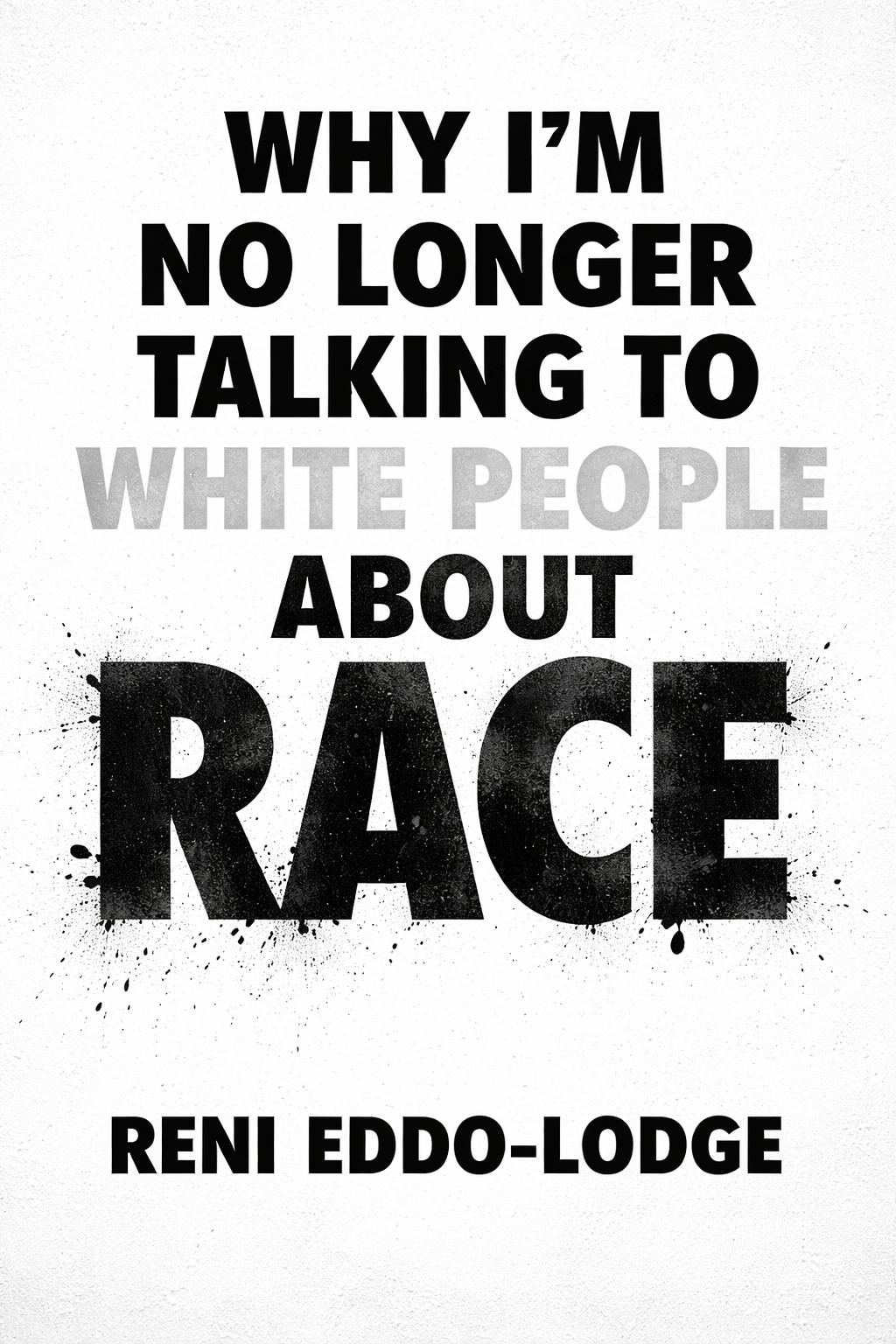
Why I'm No Longer Talking to White People About Race
Chapter Summaries
What's Here for You
Prepare to confront uncomfortable truths and challenge deeply ingrained assumptions. 'Why I'm No Longer Talking to White People About Race' is a searing exploration of race, racism, and white privilege in Britain. Reni Eddo-Lodge dismantles historical narratives, dissects systemic inequalities, and fearlessly confronts the complexities of identity. You'll gain a profound understanding of how historical injustices continue to shape contemporary racial dynamics, the insidious nature of structural racism, and the ways in which white privilege operates, often invisibly. This book is not a comfortable read, but a necessary one, offering a potent blend of historical analysis, personal reflection, and unflinching critique. It's an invitation to move beyond superficial conversations and engage in a deeper, more meaningful dialogue about race—even when it's difficult.
HISTORIES
In "HISTORIES," Reni Eddo-Lodge embarks on a deeply personal and historical excavation, revealing how Britain’s obscured history of slavery and colonialism continues to shape contemporary racial dynamics. She begins with a stark realization during a university module on the transatlantic slave trade, contrasting her own awakening with a white friend's indifference, a divergence that highlights how privilege allows some to remain detached from the violent legacies of the past. Eddo-Lodge vividly recounts her visit to Liverpool, once Britain’s largest slave port, where the weight of history becomes palpable, a sickness in the pit of her stomach. The author underscores that the abolition of slavery in 1833, a mere two centuries ago, is a blink in the eye compared to its 270-year reign, a reign built on stolen black lives and compounded white wealth. She challenges the notion of slavery as a distant event, emphasizing its enduring impact on British society. Delving into Black History Month in the UK, Eddo-Lodge credits Linda Bellos for its inception, aiming to celebrate black contributions and confront historical ignorance. The narrative broadens to include the contributions of Indian and West Indian soldiers in World War I, their sacrifices met with broken promises and racial discrimination, painting a picture of empire that used its colonies but denied them true belonging. The riots of 1919, marked by vicious race hatred and the lynching of Charles Wootton, expose the raw, unaddressed tensions simmering beneath the surface of British society, a darkness illuminated by the repatriation drives that followed, a state-sanctioned erasure. Dr. Harold Moody’s activism and the League of Coloured Peoples emerge as beacons of resistance against systemic racism, yet even their efforts were shadowed by the insidious eugenics movement, exemplified by Rachel Fleming’s research on mixed-race children in Liverpool. The arrival of the Windrush generation and the subsequent Notting Hill riots reveal a cycle of welcome followed by resentment, culminating in discriminatory laws and inadequate race relations acts. Eddo-Lodge recounts the Bristol Bus Boycott, a pivotal moment led by Paul Stephenson, exposing the deep-seated racism within British institutions, and the rise of white nationalist groups like the National Front, stoking anti-immigrant sentiment. She unearths the oppressive “sus laws” and the racialized fear of “mugging,” tools used to target and criminalize black communities. The chapter crescendos with the tragedies of Cherry Groce and Cynthia Jarrett, their stories emblematic of the police brutality and systemic neglect that fueled the 1985 riots, a storm of rage breaking against the shores of injustice. Ultimately, Eddo-Lodge argues that Britain’s racism is not an external force, but woven into the very fabric of the state, demanding a confrontation with uncomfortable truths and a reclamation of forgotten histories, a context black Britain desperately deserves.
THE SYSTEM
In this chapter, Reni Eddo-Lodge dissects the insidious nature of structural racism, using the tragic case of Stephen Lawrence as a stark entry point. The author illustrates how the failure to convict Lawrence’s murderers for years exposed deep-seated institutional flaws. It wasn't simply about individual prejudice, but a systemic failure, a collective blindness. Eddo-Lodge argues that racism isn't confined to overt acts of hatred; it thrives in the unspoken biases that permeate institutions. She explains that structural racism is like a dense fog, obscuring opportunities and subtly directing life outcomes. The author illuminates how easily condemnable white extremism is not the only form of racism. She reveals a critical insight: racism is less about individual moral failings and more about the survival strategy of systemic power. It’s not about good versus evil but about how power protects itself. Eddo-Lodge then presents a grim picture of racial disparities in education, employment, and the justice system, illustrating how black individuals face disadvantages at nearly every turn. Even when black children work harder than their white counterparts, the system is often rigged against them. She emphasizes that color-blindness, the act of not seeing race, becomes a form of compulsory assimilation that perpetuates inequality. It’s a well-intentioned lie that denies the very real material inequalities shaped by history. The author then challenges the notion of meritocracy, suggesting that the over-representation of white middle-aged men in leadership positions is not solely due to talent, but also reflects the advantages conferred by whiteness itself. She examines the debate around positive discrimination, such as the Rooney Rule, highlighting how even mild attempts to level the playing field are met with fierce resistance. Eddo-Lodge recounts her own initial skepticism towards diversity schemes, born from a desire to compete on a level playing field, but acknowledges their necessity after witnessing the lack of black representation in influential roles. The author resolves that dismantling unjust structures requires actively seeing race, understanding who benefits, and challenging the distribution of power and privilege. She urges readers to recognize that in order to achieve true equality, we must confront and deconstruct the racist structures that shape our society.
WHAT IS WHITE PRIVILEGE?
In this chapter, Reni Eddo-Lodge dismantles the elusive concept of white privilege, beginning with a stark childhood memory: a four-year-old Eddo-Lodge wondering when she, a self-perceived ‘good person,’ would turn white, mirroring the television’s skewed moral landscape. She explains how white privilege isn't about individual wealth or ease, but rather the absence of systemic obstacles faced by people of color. It's the default, the 'neutral,' against which all others are measured, a subtle coding of humanity itself. Eddo-Lodge credits Theodore W. Allen with naming white-skin privilege, framing it as an anti-capitalist concern within the labor movement, noting that privilege doesn't mean an easy life, but a life where race is unlikely to be a hindrance. The author then shares a personal anecdote about realizing the inaccessibility of public transport, highlighting how privilege often masks systemic issues from those who benefit. Racism, she argues, isn't mere prejudice; it’s prejudice plus power, a force that shapes life chances on a grand scale. Eddo-Lodge recounts a frustrating conversation where a white acquaintance dismissed her experiences of racism, illustrating how easily discussions can derail into defenses of whiteness. This leads to the core tension: white privilege is both everywhere and nowhere, a hydra-headed beast that silences honest dialogue through fear of social or professional repercussions, like a manipulative blanket of power. The author highlights the backlash Diane Abbott faced after a tweet about race, showcasing how conversations about structural racism can be swiftly diverted into discussions of white victimhood. Eddo-Lodge then explores the complexities of mixed-race families, relaying Jessica's experiences navigating race with a color-blind white family, revealing that mixed-race relationships don't automatically erase racial tensions; instead, they often bring difficult conversations closer to home. Finally, Eddo-Lodge introduces Jennifer Krase, a white American immigrant, who offers insights into dismantling racism and challenges the notion that it isn't a white person's problem, concluding that white privilege, as a political ideology, empowers some at the expense of others, perpetuating a cycle of dominance.
FEAR OF A BLACK PLANET
In this chapter, Reni Eddo-Lodge dissects the pervasive fear underlying much of the rhetoric surrounding race and immigration in Britain, a fear she terms the 'fear of a black planet.' She begins by referencing Enoch Powell's infamous 1968 speech, highlighting how his anxieties about a shift in racial power dynamics reveal a deeper, historical reliance on subjugation to maintain control. Eddo-Lodge argues that this fear manifests in various forms, from political discourse on immigration to concerns about preserving a nebulous 'British identity,' creating a sense that anything non-white seeks to erase white homogeneity. The author shines a light on how easily multiculturalism becomes a scapegoat, a 'dirty word' masking anxieties about black, brown, and foreign people, and how easily anti-immigration sentiment morphs into thinly veiled racism. The narrative tension escalates as Eddo-Lodge recounts her unsettling interview with Nick Griffin, former leader of the British National Party, whose views, though extreme, echo more mainstream anxieties about demographic change and the perceived erosion of white British identity. Griffin's assertion that accommodating difference equates to erasing white Britishness exposes a core fallacy: the inability to see that catering to the majority already exists as the default. Eddo-Lodge pivots to the 'Rhodes Must Fall' movement, illustrating how even legitimate anti-racist protests are twisted and misrepresented as threats to free speech, revealing the subtle yet potent ways in which anti-black sentiment operates. It’s as if the scales of justice are deliberately unbalanced, tilted by those who benefit from the status quo. She underscores that this manipulation protects white people from criticism more than it protects any genuine principle of free expression. Finally, Eddo-Lodge addresses the fear of a 'black planet' in fiction, highlighting the uproar that occurs when non-white actors are cast in traditionally white roles, like James Bond or Hermione Granger. This resistance, she argues, reveals a deep-seated inability to empathize with black humanity, a refusal to see black characters as complex and relatable. The chapter resolves with a call for a more honest and equitable discourse on race, one where critiques of racism are defended with the same fervor as racist statements themselves, recognizing that true freedom of speech demands the courage to challenge bigotry and to redistribute power, rather than invert it.
THE FEMINISM QUESTION
In this chapter, Reni Eddo-Lodge navigates the complex terrain where feminism and race intersect, revealing a landscape often marred by exclusion and misunderstanding. She begins by recounting her frustration with the overwhelmingly white representation in media lauded as feminist, like Lena Dunham's 'Girls,' sparking a crucial question: who is feminism truly fighting for? Eddo-Lodge then recalls her experience on BBC's 'Woman's Hour,' where her attempt to address racism within feminism was met with defensiveness, highlighting the cost of representation when one is forced to defend arguments they don't share. The author reflects on her early embrace of feminism as a tool for self-discovery, a framework to understand the world and find self-worth. However, she soon encountered the exclusionary nature of white feminist spaces, where discussions of race were often unwelcome, creating a sense of isolation. To counter this, Eddo-Lodge joined 'black feminists,' a collective that offered a safe space to voice shared experiences and develop a critical analysis of race and gender. This leads to an exploration of intersectionality, a term coined by Kimberlé Crenshaw, to articulate the unique discrimination faced by black women. The chapter underscores the resistance to intersectional analysis from white feminists, who often dismissed it as jargon, revealing a deeper unwillingness to acknowledge white privilege. Eddo-Lodge argues that white feminism, while not inherently threatening, becomes problematic when it dominates and erases the experiences of women of color, perpetuating a system of inequality. The author challenges the notion that misogyny is a foreign import, pointing to the pervasive sexual violence and objectification of women in British society. Ultimately, Eddo-Lodge calls for a more inclusive and radical feminism, one that confronts class, race, and gender binaries, and strives for liberation for all marginalized people. She envisions a feminism that is utopian in its demands, challenging the very foundations of an unequal world, a world where, in the absence of true intersectionality, injustice will thrive, but there will be more women in charge of it, a prospect Eddo-Lodge finds deeply troubling.
RACE AND CLASS
In this chapter, Reni Eddo-Lodge confronts the persistent question of class in discussions about race, a question that often implies a dismissal of racial inequality as merely a class issue. She challenges the notion that one must choose between addressing race and class, arguing they are deeply intertwined, especially in Britain. Eddo-Lodge begins by dissecting the traditional British understanding of class, rooted in Victorian-era categories and Marxist principles, noting how these definitions have become blurred in the post-industrial era, particularly after the 2008 recession, where job security became a mirage. She reveals a striking finding from the Great British Class Survey: people of color are disproportionately represented in the 'emergent service workers' group, characterized by high social and cultural capital but low economic capital, thus highlighting how racial inequalities are compounded, not erased, by class disparities. A critical insight emerges as Eddo-Lodge examines the impact of governmental policies, revealing how austerity measures disproportionately affect black and minority ethnic communities, exacerbating existing inequalities. The author paints a vivid picture of London's housing crisis, focusing on Tottenham, where new developments cater to affluent newcomers, potentially displacing long-term residents, the word 'urban' becomes a coded term, hinting at the racial undercurrents of gentrification. Eddo-Lodge exposes the flawed logic behind prioritizing affordable home ownership, which, according to Haringey Council's own assessment, may disproportionately benefit white households, further marginalizing black residents. She dismantles the myth of the 'white working class' being uniquely disadvantaged, arguing that this narrative plays into far-right rhetoric and obscures the systemic issues affecting all working-class people, especially those of color. The author underscores that focusing solely on the white working class shifts the blame from those who concentrate wealth to immigrants and people of color, perpetuating a divide-and-rule tactic. Eddo-Lodge challenges the assumption that social mobility and education can shield people of color from racism, citing statistics that show a widening pay gap for black employees, even with higher qualifications, revealing that racism persists regardless of class status. Ultimately, Eddo-Lodge calls for a more nuanced understanding of class in Britain, one that acknowledges the intertwined nature of race and class, and she urges us to question who benefits from perpetuating the myth of a white working class besieged by immigrants, advocating instead for policies that address both racial and class inequalities simultaneously, thus creating a fairer society for all.
THERE’S NO JUSTICE, THERE’S JUST US
In this chapter, Reni Eddo-Lodge grapples with the frustrating communication gap surrounding race, particularly the reluctance of white individuals to confront their complicity in racism. She recounts an exchange with students, highlighting the desire for a premature 'end point' to discussions about race, a sentiment she equates to the fallacy of a 'post-racial' society, a mirage that avoids the necessary discomfort of genuine dialogue. Eddo-Lodge argues that discussions about racism are fundamentally about white identity and anxiety, not merely black identity, urging white individuals to examine why whiteness defines itself against perceived 'immigrant bogey monsters.' She calls for white individuals to move beyond guilt and engage in tangible anti-racist actions, such as providing financial support to relevant groups, intervening in bystander situations, and advocating for anti-racist causes within their own white circles of influence, even when it's unpopular. The author critiques performative anti-racism, such as the sudden concern over the lack of diversity in Jeremy Corbyn's shadow cabinet or the delayed surge of support for victims of the Garissa University attack after the Paris attacks, emphasizing that solidarity must be timely and genuine, not a self-serving display. Eddo-Lodge underscores that racism is a white problem, rooted in the anxieties and hypocrisies of whiteness, and that the responsibility for dismantling it lies with white individuals themselves, who must address it from within. She notes how setting boundaries, like her initial decision to limit discussions about race with white people, paradoxically created more space for her voice to be heard. Eddo-Lodge acknowledges the despair and injustice inherent in the ongoing struggle against racism, urging readers to resist despondency and to find strength in community and self-care. She advocates for recognizing racism as a structural issue, an invisible monolith that seeps into every facet of society, and emphasizes the need to challenge biased agendas and create new narratives. Ultimately, Eddo-Lodge suggests that the task ahead requires collective responsibility, a dismantling of accepted truths, and a commitment to creating a society where black and brown are unequivocally British, and where action, however small, replaces inertia, echoing Terry Pratchett's sentiment: 'There's no justice. Just us.'
Conclusion
Reni Eddo-Lodge's work serves as a potent call to action, urging readers to confront the uncomfortable truths about race and power. It's a journey through historical injustices, systemic inequalities, and the subtle yet pervasive nature of white privilege. The book illuminates how historical events continue to cast long shadows on contemporary society, shaping racial dynamics and reinforcing structural barriers. Emotionally, the book evokes a sense of urgency and frustration, challenging the reader to move beyond passive awareness and engage in active anti-racist work. Practically, it offers a framework for understanding the complexities of race, class, and gender, emphasizing the importance of intersectionality. Ultimately, the book underscores that dismantling racism requires a fundamental shift in perspective, a willingness to challenge biased narratives, and a commitment to redistributing power to create a more just and equitable society. It necessitates a deep interrogation of whiteness itself, placing the onus on those who benefit from the existing system to actively dismantle it from within. Only through genuine acknowledgment, sustained effort, and a willingness to disrupt the status quo can we hope to build a future where race is no longer a barrier to opportunity and equality.
Key Takeaways
Acknowledge that historical events, particularly slavery and colonialism, have lasting repercussions on contemporary racial dynamics and societal structures.
Recognize that privilege can create indifference to historical violence, allowing some to remain detached from its impact.
Understand that Britain's history of racial discrimination is deeply embedded within its institutions, not merely isolated incidents.
Celebrate and amplify the contributions and activism of black Britons who have fought against systemic racism.
Challenge the erasure of black British history and actively seek out and share these narratives to provide context and understanding.
Critically examine language and terminology used to describe events, avoiding terms that reinforce negative stereotypes or obscure the underlying issues.
Confront uncomfortable truths about Britain's past and present to foster genuine progress towards racial equality.
Racism extends beyond overt acts of hatred; it thrives in unspoken biases within institutions, impacting life chances.
Structural racism perpetuates itself through the survival strategies of systemic power, not individual moral failings.
Color-blindness, while well-intentioned, can perpetuate inequality by denying material realities shaped by historical racial disparities.
The notion of meritocracy is challenged by the over-representation of white individuals in leadership, suggesting whiteness itself confers advantages.
Positive discrimination initiatives, even mild ones, often face resistance, revealing a reluctance to disrupt existing power structures.
Dismantling racist structures requires acknowledging and addressing race, understanding who benefits, and challenging the distribution of power.
True equality demands confronting and deconstructing the racist structures that shape society, moving beyond color-blindness towards active awareness.
White privilege is the absence of negative consequences associated with race, not the absence of hardship.
Racism is prejudice plus power, enabling systemic oppression rather than isolated acts of discrimination.
Discussions about race can be easily derailed by defenses of whiteness, often silencing marginalized voices.
White privilege manifests as a fear of social or professional repercussions for challenging racial inequality.
Mixed-race relationships do not inherently resolve racial tensions; they often necessitate more direct conversations about race and privilege.
Dismantling racism requires white individuals to acknowledge their privilege and actively work against racial inequality.
Color-blindness can be detrimental, as it dismisses the lived experiences and specific needs of people of color.
Fear of a black planet reveals a deep-seated anxiety about losing power and control, rooted in a history of subjugation.
Multiculturalism is often weaponized as a scapegoat to mask underlying fears about immigration, race, and the perceived erosion of national identity.
Accusations of stifling free speech are frequently used to silence anti-racist voices and protect white people from criticism.
Resistance to non-white actors in traditionally white roles exposes a limited capacity for empathy and a refusal to recognize black characters as fully human.
True freedom of speech demands the courage to challenge racist ideas and create space for marginalized voices.
The redistribution of power, not the inversion of it, is the goal of anti-racist activism.
Feminist movements often unintentionally prioritize the experiences and perspectives of white women, marginalizing the concerns of women of color.
Intersectionality is crucial for understanding the unique challenges faced by individuals who experience multiple forms of discrimination, such as racism and sexism.
Resistance to intersectionality within feminism often stems from an unwillingness to acknowledge white privilege and address structural racism.
White feminism, when presented as the universal standard, can perpetuate inequality by erasing the experiences and needs of women of color.
Challenging racism and patriarchy simultaneously is essential for creating a truly inclusive and equitable society.
A truly transformative feminism must address systemic issues such as poverty, class inequality, and the limitations imposed by rigid gender binaries.
Demanding equality within an existing unequal system is insufficient; the focus should be on deconstructing and rebuilding the system to serve all individuals.
Challenge the false dichotomy between race and class by recognizing their intersectional impact on inequality.
Acknowledge that traditional class definitions are inadequate for understanding contemporary social stratification, especially for people of color.
Recognize how governmental policies can exacerbate racial inequalities, even when presented as class-neutral solutions.
Critically examine the coded language used in discussions of urban development and gentrification, being aware of its racial implications.
Reject the myth of the 'white working class' as a tool for division, and instead focus on systemic issues affecting all working-class people.
Understand that social mobility and education alone cannot eradicate racism, and that systemic change is necessary.
Advocate for policies that address both racial and class inequalities simultaneously, rather than pitting marginalized groups against each other.
The desire for a premature 'end point' in race discussions often serves to avoid the discomfort of confronting complicity and systemic issues.
Discussions about racism are fundamentally about interrogating white identity and anxieties, not just black identity.
Genuine anti-racist work requires tangible actions, such as financial support, intervention, and advocacy within white circles, rather than performative gestures.
Racism is a problem rooted in the psyche of whiteness, placing the onus on white individuals to address and dismantle it from within.
Setting boundaries can paradoxically create more space for marginalized voices to be heard and respected.
Resisting despondency and cultivating community are crucial for sustaining long-term engagement in anti-racist work.
Dismantling racism requires recognizing its structural nature, challenging biased narratives, and actively creating a more inclusive society.
Action Plan
Actively research and learn about black British history, seeking out sources beyond mainstream narratives.
Reflect on your own privilege and how it might affect your understanding of historical and contemporary racial issues.
Support organizations and initiatives that promote racial justice and equality in Britain.
Challenge discriminatory language and behavior in your own community and sphere of influence.
Advocate for a more inclusive and accurate representation of black British history in education and public discourse.
Engage in open and honest conversations about race with friends, family, and colleagues.
Consider how historical injustices continue to impact present-day inequalities and work towards systemic change.
Educate yourself on the history and impact of structural racism.
Examine your own biases and assumptions about race.
Advocate for policies and practices that promote racial equity in your workplace and community.
Support organizations and initiatives working to dismantle racist structures.
Challenge color-blindness narratives and promote race-conscious approaches.
Actively listen to and amplify the voices of people of color.
Support positive discrimination efforts to level the playing field.
Promote open and honest conversations about race and racism with friends, family, and colleagues.
Reflect on personal experiences and identify ways in which white privilege has positively impacted your life trajectory.
Actively listen to and validate the experiences of people of color when they share their experiences with racism.
Challenge racist jokes, stereotypes, or microaggressions in everyday conversations.
Educate yourself on the history of systemic racism and its ongoing impact on society.
Support organizations and initiatives that promote racial equality and justice.
Examine hiring and promotion practices to identify and address potential biases.
Engage in conversations about race and privilege with family members and friends, even if they are uncomfortable.
Advocate for policies that address racial disparities in education, housing, and employment.
Be mindful of the language used and avoid perpetuating harmful stereotypes or assumptions.
Support and amplify the voices of people of color in media, politics, and other spheres of influence.
Reflect on your own anxieties and biases related to race, immigration, and cultural change.
Challenge the use of 'multiculturalism' as a negative term in conversations about race and identity.
Actively listen to and amplify the voices of marginalized communities in discussions about race and social justice.
Support anti-racist protests and campaigns that challenge systemic inequalities.
Critically examine media representations of race and challenge stereotypes.
Advocate for greater diversity and inclusion in traditionally white spaces.
Speak out against racist statements and actions, even when it's uncomfortable.
Educate yourself on the history and contributions of black feminist thought and other marginalized perspectives within feminism.
Critically examine your own biases and privileges and how they may impact your interactions and perspectives.
Actively listen to and amplify the voices of women of color and other marginalized groups in feminist spaces.
Challenge instances of racism and exclusion within feminist communities and organizations.
Support and advocate for policies and practices that address systemic inequalities based on race, class, gender, and other factors.
Engage in ongoing self-reflection and learning to deepen your understanding of intersectionality and its implications.
Support the work of organizations and activists who are working to advance intersectional feminist goals.
Be willing to have uncomfortable conversations about race and privilege, and to learn from your mistakes.
Advocate for inclusive representation in media, politics, and other spheres of influence.
Research local housing policies and regeneration plans in your community to understand their potential impact on different racial and class groups.
Challenge the use of coded language that perpetuates racial stereotypes in discussions of urban development and social issues.
Support organizations and initiatives that advocate for policies addressing both racial and class inequalities.
Engage in conversations with people from different racial and class backgrounds to broaden your understanding of their lived experiences.
Advocate for diversity and inclusion in workplaces and educational institutions to address the pay gap and other forms of discrimination.
Critically examine the narratives presented by politicians and the media about the 'white working class' and their relationship to immigrants and people of color.
Actively listen to and amplify the voices of people of color in discussions about race, rather than centering your own experiences.
Examine your own biases and assumptions about race, and challenge them through education and self-reflection.
Engage in conversations about race with other white individuals, even when it's uncomfortable or challenging.
Support organizations and initiatives that are working to dismantle systemic racism, through financial contributions, volunteer work, or advocacy.
Intervene in situations where you witness racism or discrimination, and stand in solidarity with the person being targeted.
Set boundaries to protect your mental and emotional well-being, and prioritize self-care to sustain your engagement in anti-racist work.
Recognize and challenge the ways in which racism manifests in your workplace, social circles, and community.
Educate yourself about the history of racism and its ongoing impact on society.
Reject performative gestures of solidarity and instead focus on meaningful actions that create real change.