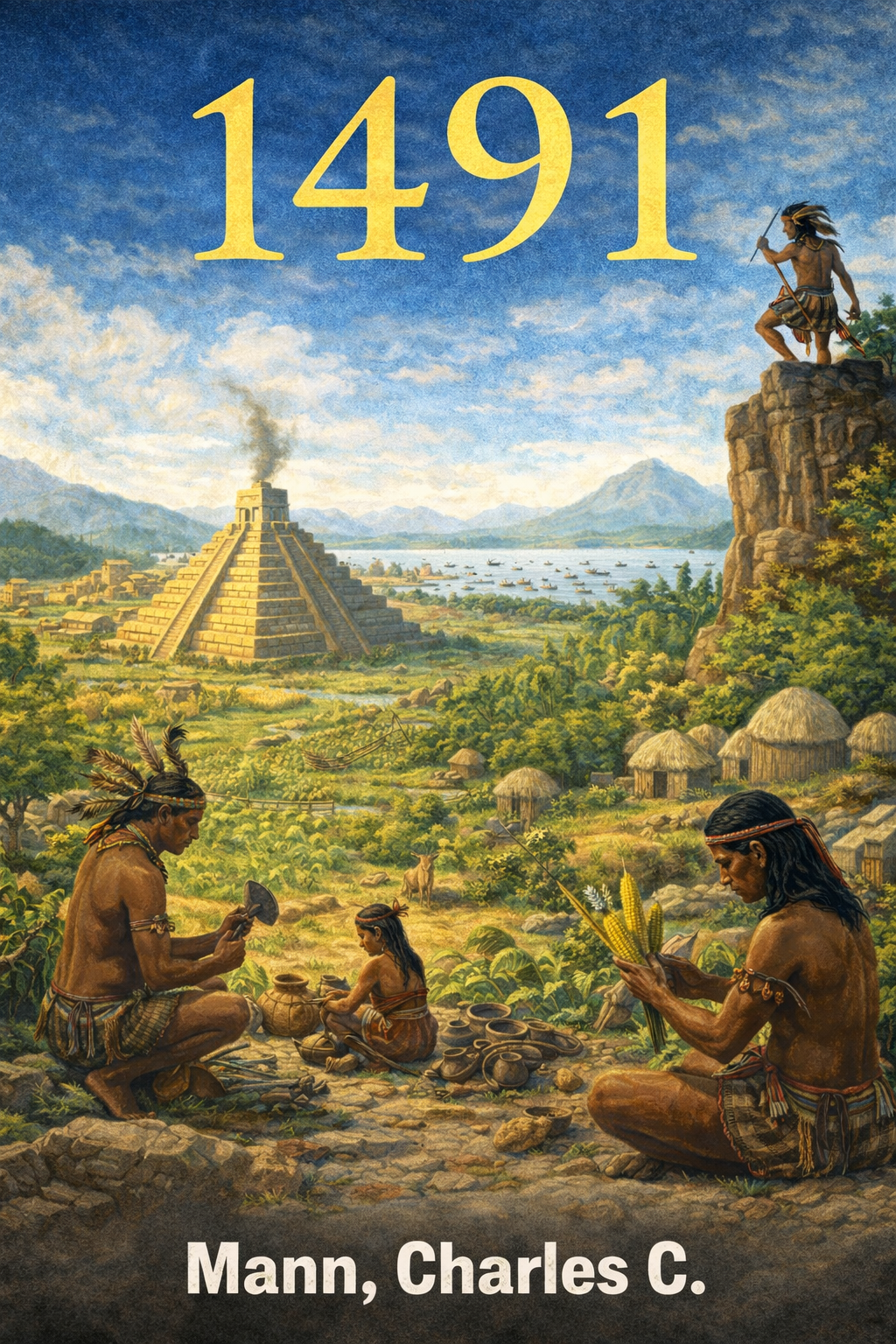
1491
Chapter Summaries
What's Here for You
Prepare to have your understanding of the Americas utterly transformed. Charles C. Mann's "1491" doesn't just present history; it shatters conventional myths and invites you on a breathtaking intellectual adventure. What if the continents you thought were a pristine, sparsely populated wilderness were, in fact, teeming with complex civilizations, sophisticated societies, and landscapes profoundly shaped by human ingenuity long before European arrival? This book is your passport to that astonishing reality. From the air, revealing vast, intentionally sculpted landscapes in the Amazon and Bolivia, to dusty archives uncovering demographic realities that defy imagination, Mann embarks on a journey that will redefine your perception of the past. You'll encounter the strategic brilliance of indigenous leaders navigating treacherous political landscapes, the scientific rigor of archaeologists uncovering ancient urban centers in the desert, and the deep ecological understanding that allowed for the cultivation of maize and cotton on a grand scale. You'll witness the birth of monumental art and complex writing systems, and understand the profound societal structures that governed vast populations. This is more than a historical account; it's a profound re-education. You will gain a deep appreciation for the intellectual, social, and environmental legacy of the peoples who inhabited the Americas for millennia. You'll be equipped with the knowledge to critically examine established narratives and to see the echoes of these ancient achievements in the world around you. The tone is one of awe-inspiring discovery, intellectual rigor, and a deep respect for the peoples whose stories have been too long untold. Get ready to explore a world far richer, more complex, and more vibrant than you ever imagined.
A View from Above
The journey begins with a flight over central Bolivia, revealing a landscape transformed by human hands. Charles C. Mann, through the eyes of archaeologists Clark Erickson and William Bale, introduces us to the Beni, a vast province once thought to be an untouched wilderness. Yet, from the air, countless islands of forest, linked by impossibly straight raised berms, tell a different story – the story of a technologically advanced, populous society that thrived over a thousand years ago. This radical departure from the conventional narrative, taught for decades in schools, posits that the Americas before Columbus were not sparsely populated by small, primitive groups, but were thoroughly marked by humankind. This new scholarship, however, is contentious, met with skepticism from some who see it as politically motivated or a misinterpretation of meager evidence. Dean R. Snow cautions that ethnohistorical records can be manipulated, while Betty J. Meggers denies evidence of large populations in areas like the Beni. The debate is further complicated by its implications for ecological movements, which often rely on the 'pristine myth' of an Edenic pre-Columbian Americas. Mann illustrates this with the Beni, where Erickson argues that indigenous peoples engineered the landscape, creating fish weirs and maintaining grasslands through fire, a practice that shaped a unique ecosystem. The narrative then shifts to Ibibate, a massive mound of broken pottery, evidence, according to Erickson, of a highly structured society that feasted and drank exuberantly. This is contrasted with the starkly different, and tragically mistaken, portrayal of the Sirion people by Allan R. Holmberg in his 1950 book, 'Nomads of the Longbow.' Holmberg depicted them as culturally backward, living in constant want, unaware of their own history. Mann reveals this was a profound error, a 'Holmberg's Mistake,' born from the devastating impact of European diseases in the 1920s, which decimated the Sirion population, leaving them as survivors of a shattered culture, not relics of the Stone Age. The chapter underscores a fundamental shift in understanding: the pre-Columbian Americas were not empty, but teeming with diverse civilizations. From the sophisticated agricultural systems and complex societies like the Tiwanaku and Wari in the Andes, to the vast Maya city-states like Calakmul, and the bustling Mississippian center of Cahokia, a continent of immense human activity is being unveiled. Even the Amazon, once imagined as a pristine rainforest, is now understood to have hosted dense populations practicing unique forms of agroforestry. The realization that the Americas were a landscape profoundly shaped by human ingenuity, far from being a wilderness, challenges our assumptions and invites a re-evaluation of history, a world largely erased by disease and conquest, now slowly returning to view.
Why Billington Survived
Charles C. Mann, in "1491," invites us to peer beyond the familiar narrative of colonial encounters, specifically through the lens of the Wampanoag leader Massasoit's complex dilemma in 1621. Faced with the decimation of his people by disease and the looming threat of the Narragansett, Massasoit gambled on an unprecedented alliance with the newly arrived English settlers, a decision fraught with both potential salvation and unforeseen disaster. The author reveals that the popular image of Tisquantum, or Squanto, as a simple, friendly Indian is a profound oversimplification, obscuring a man of immense resilience and complex motivations, a survivor of European enslavement and a keen observer of their ways, perhaps even picking up the technique of fish fertilization from them. This pivotal moment, the meeting between Massasoit and the Pilgrims, underscores a crucial insight: indigenous societies were not passive recipients of European arrival but active agents attempting to navigate a rapidly changing world, a fact often overlooked in historical accounts that favored divine providence or technological superiority as explanations for European success. Mann explains how the Dawnland, or New England, before contact was a vibrant ecological mosaic supporting diverse, sophisticated societies, like Tisquantum's home settlement of Patuxet, whose inhabitants possessed rich cultural traditions and a deep understanding of their environment, evident in their ingenious wetu homes and communal life, a stark contrast to the often unprepared and struggling European newcomers. The chapter highlights the profound impact of the 1616 epidemic, a devastating wave of disease that wiped out as much as 90 percent of the coastal population, reshaping political landscapes and creating a power vacuum that the Wampanoag, weakened and vulnerable, sought to fill through alliances, demonstrating that indigenous fates were not predetermined but actively shaped by their own choices, even if those choices led to unintended consequences, like the ultimate destruction wrought by European diseases that proved far more potent than their weapons. The narrative tension builds as we see Tisquantum's own ambitious machinations to leverage his unique position between the English and Massasoit, a dangerous game of manipulation that ultimately consumed him, while Massasoit's alliance, though initially effective in holding off the Narragansett, inadvertently paved the way for the massive wave of British immigration that would eventually overwhelm his people, reminding us that even the most astute strategies can have devastating, unforeseen repercussions in the face of overwhelming external forces and the insidious, uncontrollable power of disease.
In the Land of Four Quarters
The author Charles C. Mann begins by recounting the meticulous, almost archaeological work of anthropologist Henry F. Dobyns, who, in the early 1960s, descended into dusty Peruvian archives, seeking to understand the demographic realities of the past. His discovery, stark and immediate like a blow to the head, was a profound disparity between recorded deaths and baptisms, overwhelmingly pointing to European diseases decimating indigenous populations. This observation, initially a side note to his main research on land tenure, would become a cornerstone of his later, transformative work. Mann then paints a vivid picture of the Inca Empire, Tawantinsuyu, in 1491—a vast dominion stretching across diverse terrains, a testament to human ingenuity and organizational prowess, knit together by an ambitious network of roads and a unique system of knotted strings for record-keeping. He explores the ingenious 'vertical archipelago' system developed by Andean cultures to thrive in their challenging mountain environment, a system that fostered resilience but also isolation, broken only by periods of hegemonic rule. The narrative then pivots to the dramatic rise of the Inca, detailing the foundational myth of Pachakuti, the 'World-shaker,' whose transformation from a fleeing prince to an empire builder reshaped not just the Andes but also the historical understanding of the continent. Mann highlights the Inka's remarkable engineering and architectural achievements, their abstract art, and their sophisticated, money-less economic system that, surprisingly, eradicated hunger across their vast territory. Yet, this seemingly invincible empire, as Mann reveals, harbored internal vulnerabilities. The author probes the perplexing question of how Pizarro, with a mere 168 men, could conquer such a powerful empire, moving beyond simplistic explanations of technological superiority. He delves into the nuances of Inka metallurgy, their mastery of textiles and fiber engineering, and the surprising effectiveness of their weaponry, like the sling and incendiary projectiles. However, the true turning point, as uncovered by Dobyns, lies not in swords or horses, but in an unseen enemy: disease. The chapter powerfully illustrates how smallpox, arriving in the Americas long before Europeans established a significant foothold, acted as a devastating prelude, decimating populations and shattering social structures. This 'virgin soil' epidemic, as it's known in epidemiology, decimated the Inca, killing their emperor Wayna Qhapaq and much of his court, igniting a brutal civil war between Atawallpa and Washkar. This internal strife, fueled by the plague's devastating impact and the complex, destabilizing influence of royal mummies clinging to their power, left the empire fractured and vulnerable. Mann concludes by emphasizing that the Inka were not defeated by superior technology alone, but by a devastating cocktail of disease and factionalism, a pattern repeated across the Americas, fundamentally altering the demographic landscape and paving the way for European dominance. The sheer scale of this demographic collapse, with estimates suggesting up to 95% of indigenous populations perished from disease and its aftermath, reshaped Mann's understanding of the Western Hemisphere's pre-Columbian population, revealing a world far more populous and complex than previously imagined.
Frequently Asked Questions
Charles C. Mann, in his profound exploration of the Americas before Columbus, unveils a world far more complex and populated than commonly perceived, challenging the narrative of a pristine wilderness. The chapter opens with the harrowing journey of Hernando De Soto, whose expedition, ostensibly searching for gold, inadvertently unleashed a biological catastrophe through the introduction of pigs. These animals, far more effective carriers of disease than De Soto's small force, decimated indigenous populations, transforming vibrant, populated landscapes into apparent emptiness by the time of La Salle's later arrival. This stark contrast—from thriving towns to deserted lands—ignites a central question: how could such devastation occur? Mann delves into the prevailing theory of disease, positing that the lack of prior exposure to domesticated animals in the Americas left indigenous populations uniquely vulnerable. Unlike Europeans, who coexisted with livestock for millennia, developing resistances to zoonotic diseases, Native Americans had a much more restricted gene pool and limited contact with animals, making them susceptible to novel pathogens. This vulnerability is further illuminated by the scientific understanding of Human Leukocyte Antigens (HLAs), where a limited genetic diversity among Native Americans meant a narrower spectrum of immune responses, leaving entire communities susceptible to diseases that might have been mere childhood afflictions elsewhere. The scale of this depopulation is staggering, with some estimates suggesting a decline of nearly 96 percent in populations like the Caddo, a loss so profound it would empty Yankee Stadium today. Yet, this narrative of inevitable doom is met with skepticism, as direct evidence of disease transmission from De Soto's pigs remains elusive, and the sheer lethality of these supposed epidemics challenges historical precedent. Mann then pivots to the post-contact era, detailing devastating smallpox pandemics during the Revolutionary War and their impact on both Native American allies and colonial armies, illustrating that susceptibility was not solely a pre-contact phenomenon. He highlights the devastating impact on indigenous societies, where family bonds and political structures were shattered, leaving behind 'societies of widows, widowers, and orphans.' The narrative then shifts to the intellectual and cultural richness of the Mexica, detailing their sophisticated society, their philosophical traditions embodied by the 'tlamatini,' and their complex cosmology centered around Huitzilopochtli and the necessity of human sacrifice to maintain cosmic order. This intellectual vibrant civilization, as Mann showcases through the theological debate between Franciscan monks and Mexica priests, was profound, yet ultimately vulnerable. The conquest, while directly attributed to Hernán Cortés, was amplified by internal dissent within the Triple Alliance and, critically, by the devastating impact of European diseases, particularly smallpox, which crippled Tenochtitlan's defenses. Mann grapples with the immense loss, exploring the difficulty of assigning blame, distinguishing between unintended tragedy and deliberate malice. While Europeans may not have intentionally spread disease on a grand scale, their understanding of contagion and their actions certainly contributed to the catastrophe. The chapter concludes by emphasizing that the true tragedy lies not just in the loss of life, but in the silencing of unique intellectual traditions and diverse ways of being, a loss to the entire human enterprise, underscoring the profound importance of recognizing and respecting indigenous peoples today.
Pleistocene Wars
Charles C. Mann, in his chapter 'Pleistocene Wars' from '1491,' plunges us into the deep past, a time before recorded history, where the very origins of humanity in the Americas were a profound mystery, a puzzle that resisted easy answers for centuries. We begin with the intriguing work of Sergio D. J. Pena in Brazil, who, by analyzing DNA in modern populations, sought to uncover traces of ancient peoples, like the enigmatic Lagoa Santa skeletons, whose physical traits suggested a divergence from modern Native Americans. This quest highlights a central tension: how to reconstruct a vanished past when direct evidence is scarce and interpreted through evolving scientific lenses. Pena’s innovative approach, looking for ancient mitochondrial DNA in the Botocudo people, illustrates a core insight: that the past can leave invisible genetic echoes in the present, a testament to human migration and adaptation. The narrative then broadens, detailing the centuries-long intellectual struggle to understand who the first Americans were, moving from biblical interpretations and the 'Lost Tribes of Israel' theory to the seismic impact of Darwinian evolution and the discovery of Ice Age human remains. This intellectual journey is marked by fervent debate, epitomized by the clashes between figures like Charles Abbott, William Henry Holmes, and Aleš Hrdlička, who championed or refuted claims of ancient human presence, revealing a recurring pattern of scientific dogma battling against new, often unwelcome, evidence. The discovery of Folsom points and later, the Clovis culture, initially seemed to solidify a consensus—a specific timeline of migration through an ice-free corridor. Yet, as Mann compellingly shows, this consensus itself became a target for revision, challenged by linguistic, genetic, and archaeological evidence from sites like Monte Verde, pushing the timeline back and suggesting multiple migration waves, perhaps even coastal routes, rather than a single, monolithic entry. The chapter masterfully navigates this evolving scientific landscape, demonstrating how a field once seemingly unified fractures and reforms, with each new discovery, whether genetic or archaeological, demanding a recalibration of our understanding of human history. It’s a story of persistent inquiry, where the quest for the earliest Americans forces us to confront not just the past, but the very nature of scientific discovery itself—a process of tension, challenge, and ultimate, albeit sometimes contentious, revelation, reminding us that the story of human origins is never truly finished, but perpetually being rewritten.
Cotton (or Anchovies) and Maize
The author Charles C. Mann embarks on a journey into the ancient heart of the Americas, beginning in the stark desert valleys of Peru's Norte Chico, a region that, defying conventional wisdom, cradled one of the world's earliest urban civilizations. Here, archaeologists like Jonathan Haas and Winifred Creamer uncover the startling antiquity of sites like Huaricanga, revealing monumental architecture that predates even Sumer, challenging the long-held belief that civilization requires fertile breadbaskets. This discovery forces a reevaluation of history's wellsprings, adding the Peruvian littoral and Mesoamerica to the pantheon of early complex societies. The narrative then pivots to Mesoamerica, specifically Oaxaca, Mexico, where the humble maize kernel, *Zea mays*, is revealed as the linchpin of an agricultural revolution that fundamentally reshaped human societies. Mann explores the intricate journey of maize from its wild ancestor, teosinte, a process so complex it appears almost like deliberate creation, highlighting the ingenuity of ancient peoples in engineering a new species. He contrasts this with the ancient Peruvian coast, where an alternative model, the 'maritime foundations of Andean civilization' hypothesis, suggests that a rich marine ecosystem, not agriculture, initially fueled societal complexity. This sets up a central tension: Was civilization born from the soil or the sea? Mann weaves through these discoveries, revealing how the Norte Chico people, despite an arid environment, mastered irrigation to cultivate cotton, a crucial element for fishing nets and trade, effectively building a civilization on a foundation of exchange between coastal fishers and inland farmers. Simultaneously, in Mesoamerica, the development of maize, coupled with the sophisticated 'milpa' system of polyculture, created a resilient and productive agricultural landscape. The chapter illustrates a striking difference between these two centers of civilization: the relative isolation of Mesoamerica and the Andes, fostering unique, self-directed innovations in governance, agriculture, and culture, a stark contrast to the interconnectedness of Eurasian civilizations. The profound, almost sacred, relationship indigenous peoples have with maize, encapsulated in the phrase 'hombres de maz,' underscores its role not just as a food source but as the very essence of their cultural identity and existence, a testament to thousands of years of cultivation and adaptation.
Writing, Wheels, and Bucket Brigades
The author, Charles C. Mann, invites us on a journey back in time, beginning with the remarkable discovery of the Tres Zapotes stela in 1939. Here, amidst the humid forests of Veracruz, archaeologist Matthew W. Stirling unearthed a stone slab bearing a date of 32 B.C., a find that immediately challenged prevailing notions of Maya civilization and suggested an even older, independent origin for complex society in Mesoamerica. This pivotal discovery, coupled with the subsequent uncovering of colossal Olmec heads and monumental architecture at sites like La Venta, began to paint a picture of a sophisticated culture that predated, and possibly influenced, later Mesoamerican societies, though the very name 'Olmec' itself is a later imposition, a testament to the enduring power of confusing nomenclature. Mann explains that the Olmec, rather than being a singular 'mother culture' that sprang fully formed from nowhere, were likely one of several 'sister cultures' participating in a vibrant ferment of innovation across southern Mexico, a complex interplay of social, aesthetic, and technical advancements. He then pivots to the astonishing development of writing and mathematics in Mesoamerica, highlighting how timekeeping, particularly the intricate Mesoamerican calendar systems and the invention of zero, provided the crucial impetus, a stark contrast to the Fertile Crescent's development driven by accounting. The narrative then shifts to the Andes, exploring the rise of sophisticated civilizations like the Wari and Tiwanaku, societies that mastered their challenging environments through innovative agriculture and monumental construction, yet also reveal a distinct worldview, as seen in the Wari's reliance on bucket brigades for water at Cerro Bal and Tiwanaku's 'Disneyland'-like approach to statecraft, prioritizing facade and ritual over markets and everyday commerce. Mann then introduces the perplexing enigma of the wheel: while Mesoamerican cultures, particularly the Olmec, possessed wheeled toys, they never applied this technology to practical uses like carts or pottery wheels, a seeming 'absurdity' that he attributes not to a lack of intelligence but to differing societal priorities, environmental constraints, and the lack of suitable beasts of burden, illustrating how even advanced civilizations can miss 'obvious' technologies. The chapter culminates in a reflection on the limits of our understanding of ancient peoples' inner lives, exemplified by the Nazca lines and Moche art, reminding us that while we can decipher their technologies and political structures, the affective and aesthetic realms, their deepest feelings and motivations, often remain frustratingly elusive, underscoring the profound complexity of human endeavor across time and culture.
Made in America
Charles C. Mann, in his chapter 'Made in America,' invites us to reconsider the very foundations of our understanding of pre-Columbian North America, moving beyond the simplistic notion of a pristine wilderness untouched by human hands. He begins by plunging us into the dramatic demise of Chak Tok Ichaak, the king of Mutal, on January 14, 378 A.D., illustrating not just the fall of a ruler but the violent shift in power orchestrated by the formidable empire of Teotihuacan, a stark reminder that even the most cosmopolitan city-states were vulnerable to external forces. This event, Mann explains, didn't just end a reign; it initiated a century-long conflict and foreshadowed the eventual unraveling of Maya civilization, a process often misunderstood as a sudden collapse but which, as he reveals, was a complex interplay of factors, including environmental pressures like drought and the Maya's own sophisticated, yet ultimately strained, management of their water resources. Shifting focus to the eastern half of the continent, Mann dismantles the myth of the passive Indian by introducing the transformative power of fire as a tool of landscape management. He recounts how Indigenous peoples, like the Haudenosaunee, intentionally used fire to shape ecosystems, creating park-like forests and vast grasslands that supported abundant game, a practice that fundamentally altered the North American continent long before European arrival. This active stewardship, he argues, challenges the 'Holmberg's Mistake' that native cultures were mere observers rather than shapers of their environment. The narrative then expands to encompass the monumental achievements of the Mississippian cultures, particularly the city of Cahokia, a testament to advanced engineering and complex social organization, with its colossal mounds like Monks Mound, built not on solid ground but on unstable clay, a feat of ingenuity that speaks volumes about their problem-solving capabilities. Yet, even this incredible feat eventually succumbed to environmental challenges, like flooding exacerbated by deforestation, and internal strife, highlighting the fragility of even the most advanced societies when faced with ecological and political crises. Mann underscores that the Indigenous peoples were not static beings, but dynamic agents who actively managed their environments, transforming landscapes through fire and agriculture, creating what he calls a 'prodigious game farm' and 'artificial habitable islands.' The story of the Maya, marked by the protracted war between Kaan and Mutal, further illustrates this point, revealing how their sophisticated water management systems, while enabling growth, also created vulnerabilities that, combined with drought and political failure, contributed to the decline of their southern cities, while northern cities like Chichn Itz, through adaptation and trade, found ways to thrive. Ultimately, Mann presents a compelling vision of Indigenous peoples as active, ingenious, and complex stewards of the land, whose actions, far from leaving no footprint, profoundly shaped the American landscape, leaving us with the profound insight that understanding their history requires acknowledging their agency, their innovations, and their intricate relationship with the natural world, a relationship that was far from passive reverence and involved a deliberate, often dramatic, reshaping of the continent to suit their needs, a lesson that resonates deeply in our own era of environmental challenges.
Amazonia
The vast, enigmatic Amazon basin, long perceived as a pristine wilderness untouched by human hands, is revealed by Charles C. Mann, drawing on the accounts of explorers like Gaspar de Carvajal and the findings of modern researchers, to be a landscape profoundly shaped by its indigenous inhabitants over millennia. The initial narrative tension arises from the scarcity of indigenous voices, forcing reliance on often biased European chronicles, such as Carvajal's account of Francisco de Orellana's harrowing 1541 expedition. Carvajal's report, reviled for its fantastical tales of Amazons, paradoxically contained glimpses of a populous and prosperous land, a vision starkly at odds with the prevailing scientific view, championed by scholars like Betty J. Meggers, that the Amazon's poor soils and harsh climate could only support small, transient slash-and-burn communities. This ecological determinism, a 'green prison' theory, posited that advanced cultures were impossible in the region, leading to the dismissal of evidence suggesting otherwise. However, a paradigm shift, spearheaded by archaeologists like Anna C. Roosevelt, began to challenge these assumptions, proposing that the Marajó Island society, far from being a failed offshoot, was a sophisticated indigenous achievement. The core insight emerges: the Amazon is not a static, natural Eden, but a dynamic, human-made environment, a 'counterfeit paradise' in reverse, where sophisticated societies thrived not by adapting to nature, but by actively shaping it. This is vividly illustrated by the discovery of 'terra preta,' or Indian dark earth, a testament to ancient Amazonians' advanced soil management techniques, particularly 'slash-and-char,' which created fertile land capable of sustaining large populations and complex societies for thousands of years. The chapter resolves by reframing the Amazon as a landscape of human ingenuity, a 'built environment' where ancient peoples practiced advanced forms of agriculture, like cultivating orchards of fruit trees, and developed unique technologies, like terra preta, demonstrating a profound understanding of their ecosystem. This understanding offers a crucial lesson for contemporary conservation, suggesting that recognizing and learning from past human stewardship, rather than perpetuating the myth of an untouched wilderness, is vital for the Amazon's future.
The Artificial Wilderness
The author, Charles C. Mann, reveals a profound truth about the Americas before 1491: far from being pristine, untouched wilderness, the continents were, in fact, profoundly shaped by human hands, a concept that challenges our very notion of 'nature.' Mann explains that for millennia, Native Americans actively managed their environment through sophisticated agricultural practices, controlled burning, and resource management, creating diverse landscapes that supported vast populations and abundant wildlife. This intricate human-ecological relationship, however, was shattered by the arrival of Europeans. The introduction of novel diseases decimated indigenous populations, leading to what historian Francis Jennings termed 'widowed' landscapes. This sudden absence of human oversight triggered an ecological upheaval, a phenomenon the author likens to 'ecological release,' where introduced species, free from their native predators and competitors, ran rampant, transforming ecosystems. We see this in the explosive growth of kudzu in the American Southeast, or feral artichokes strangling the pampas of Argentina, and even in the dramatic population booms of species like bison and deer after Native American hunting pressures were removed. The passenger pigeon, once a symbol of natural bounty, is presented not as a victim of inherent wilderness but as a symptom of ecological disruption; its pre-Columbian numbers were likely far lower, kept in check by Native American management, only to explode into 'outbreak populations' after their human competitors vanished. Mann posits that the 'virgin forests' admired by later European settlers, like Thoreau, were not ancient but a relatively recent invention, an 'artificial wilderness' born from the demographic collapse of indigenous peoples. This inversion of our understanding—that the perceived wilderness was largely a European creation following indigenous devastation—forms the chapter's central tension. The author concludes by urging a shift in perspective: rather than seeking to restore a mythical 1491 wilderness, modern societies must embrace their role as active landscape managers, engaging in a conscious, collaborative effort to shape future environments, much like the original inhabitants did, but with a forward-looking intent. The lesson is not about returning to a past state, but about understanding our agency in creating sustainable futures, acknowledging that all landscapes, wild or managed, are fundamentally human constructs.
The Great Law of Peace
Charles C. Mann, in his exploration of 'The Great Law of Peace' from '1491', invites us to consider a profound cultural divergence, one that echoes even in the brash informality of American customs officers greeting Vladimir Nabokov, a man accustomed to the rigid hierarchies of Europe. This spirit of egalitarianism, a gift from the Americas, finds one of its deepest roots in the Haudenosaunee, a confederacy of six nations that flourished centuries before Columbus. The author explains how this powerful indigenous polity, likely originating from hunter-gatherer ancestors who settled the Finger Lakes region around 1000 A.D. as agriculture took hold, transitioned from inter-tribal conflict to a remarkable system of governance. At the heart of this transformation was the legendary figure of Deganawidah, the Peacemaker, a shamanic outsider who, despite a severe speech impediment, conveyed a vision of unity. He found a powerful voice in Ayenwatha, whose personal tragedy fueled a shared mission to unite the warring nations. The narrative tension rises as they confront Tododaho, an Onondaga leader deeply entrenched in a logic of violence, who ultimately yields to the compelling metaphor of a single arrow versus a bundle of five, symbolizing the strength found in unity. This led to the formation of the Haudenosaunee confederacy and the codification of the Great Law of Peace, a constitution that prioritized consensus, strictly limited governmental power, and established a remarkable balance of authority between men and women. The author reveals the intricate checks and balances within this system: clan mothers chose the male sachems, who were accountable to their people, and crucially, the Great Law itself placed as much emphasis on limiting power as on granting it, with internal affairs left to individual nations. This was a society predicated on the consent of the governed, a libertarian and feminist dream where women held title to land and could influence or reject decisions made by male leaders, a stark contrast to the despotic norms of Europe and Asia. The author highlights the deep roots of this tradition, suggesting, through astronomical calculations and oral histories, that the Haudenosaunee confederacy may date back to the mid-twelfth century, making it one of the oldest continuously existing representative parliaments. This profound emphasis on liberty and equality, a stark contrast to European societies, deeply influenced early colonists. Mann recounts how figures like Benjamin Franklin and John Adams were familiar with Native American life, observing a level of personal autonomy and social equality unknown in Europe, leading many colonists to adopt similar insubordinate attitudes. The author concludes that this indigenous ideal of liberty, a vision of human possibility, has had a far-reaching impact, shaping movements for freedom worldwide and suggesting that even today, beneath the surface, we might recognize a kinship with these ancient peoples, a shared understanding of inherent equality and freedom, a legacy that continues to resonate across cultures and continents. The core dilemma, then, was how to move from a state of perpetual, escalating violence to one of lasting peace and governance, a transformation achieved through a profound redefinition of social and political order.
Conclusion
"1491" by Charles C. Mann fundamentally reshapes our understanding of the Americas before European contact, dismantling the long-held myth of a sparsely populated, pristine wilderness. The book reveals a vibrant tapestry of complex, sophisticated indigenous societies that actively engineered their environments, developed advanced agricultural and hydrological systems, and possessed rich cultural and political structures. The core takeaway is the profound agency of Native American peoples; they were not passive inhabitants but architects of their own destinies, demonstrating remarkable innovation in governance, agriculture, and land management. Emotionally, the book evokes a sense of awe at the scale and ingenuity of these lost civilizations, juxtaposed with a deep sadness for the catastrophic loss brought about by disease and conquest. It challenges the arrogance of historical narratives that have marginalized or erased indigenous contributions, prompting a critical re-evaluation of our past. The "pristine myth" and the "conqueror's narrative" are exposed as dangerous oversimplifications, obscuring the true complexity and resilience of pre-Columbian societies. Practically, "1491" offers vital lessons for the present. The sophisticated, sustainable agricultural techniques like the "milpa" system and Amazonian "terra preta" provide blueprints for addressing modern ecological challenges. Furthermore, the Haudenosaunee Great Law of Peace offers a powerful model of consensus-based governance and cooperative decision-making, highlighting ideals of liberty and self-determination that predate and influenced Western thought. Ultimately, Mann urges us to recognize the enduring legacy of indigenous peoples and to approach history not as a fixed, triumphant narrative, but as a dynamic, often-revisable story of human ingenuity, adaptation, and the profound consequences of cultural encounters.
Key Takeaways
The deep cultural and spiritual significance of maize for indigenous peoples highlights its role as more than just a crop, but a foundational element of identity.
The conventional view of the Americas before European arrival as a sparsely populated wilderness is a misconception; evidence reveals widespread, complex human societies.
Scholarly interpretations of historical and archaeological data are subject to bias and can perpetuate myths, such as the 'pristine myth' of untouched nature, which requires critical re-examination.
The decline of indigenous populations was often a result of catastrophic disease and societal disruption, not a reflection of inherent cultural backwardness or lack of historical development.
Indigenous peoples actively shaped and engineered their environments to support complex societies, creating sophisticated agricultural, hydrological, and land-management systems.
Revisiting historical narratives with new technologies and interdisciplinary approaches can uncover previously hidden civilizations and fundamentally alter our understanding of the past.
The concept of 'agency' is crucial; indigenous peoples were active agents in their history, not passive recipients of fate or external forces.
Indigenous peoples actively strategized and negotiated their own destinies in the face of European arrival, rather than being passive victims.
The narrative of early colonial encounters is often oversimplified, obscuring the complex motivations, resilience, and agency of Native American individuals like Tisquantum.
The devastating impact of European diseases, rather than solely military technology, was a primary factor in the collapse of indigenous societies.
Apparent technological parity between Europeans and indigenous peoples masked profound differences, particularly in the uncontrollable impact of introduced diseases.
Historical accounts frequently suffer from a 'hindsight bias,' attributing European success to inevitable factors rather than acknowledging the complex interplay of indigenous choices and external forces.
Strategic alliances, even those born of desperation, can have unforeseen and catastrophic long-term consequences, altering the trajectory of entire societies.
Recognize that the fall of empires is rarely due to a single factor; disease and internal divisions often pave the way for conquest more effectively than superior weaponry.
Understand that historical demographic estimates can be drastically skewed by the lack of awareness regarding the impact of virgin soil epidemics, necessitating a re-evaluation of pre-contact populations.
Appreciate the sophisticated engineering and societal organization of pre-Columbian civilizations, such as the Inca, demonstrating that technological advancement is not solely defined by European metrics.
Acknowledge that internal political fragmentation and factionalism, exacerbated by catastrophic events like pandemics, can render even the most powerful societies vulnerable to external threats.
Examine how the legacy of disease and its societal impact can fundamentally alter historical narratives and our understanding of past civilizations.
Understand that the 'conqueror's narrative' often overlooks the profound role of biological factors in shaping historical outcomes.
The introduction of European livestock, particularly pigs, acted as an unintentional yet devastating vector for diseases that decimated pre-Columbian indigenous populations.
Genetic homogeneity in Native American populations, stemming from limited animal domestication and a restricted gene pool, created a profound biological vulnerability to novel Old World diseases.
The catastrophic depopulation of the Americas was a complex interplay of disease, conquest, and internal societal factors, leading to the loss of unique cultures and intellectual traditions.
Assigning blame for the New World's demographic disaster is complex, involving both intentional actions and unintended consequences, with the true moral culpability lying in the responsibility to respect and acknowledge the enduring legacy of indigenous peoples.
The intellectual and cultural achievements of pre-Columbian societies, particularly the Mexica, were profound and diverse, representing a significant loss to the global human enterprise when they were extinguished or suppressed.
The scientific understanding of early American history is not static but a dynamic field of evolving theories, constantly reshaped by new evidence from genetics, archaeology, and linguistics.
Ancestral human migrations into the Americas were likely more complex and occurred over longer timescales than initially proposed by the 'Clovis First' model, involving multiple waves and potentially different routes.
Interpreting ancient human remains requires rigorous methodology and a critical evaluation of context, as demonstrated by the debates surrounding the age and significance of various archaeological finds.
Scientific consensus, while valuable, can sometimes mask deeper complexities and hinder the acceptance of unconventional evidence, necessitating a willingness to challenge established paradigms.
The study of human origins is an ongoing process of discovery, where genetic and archaeological data, when integrated, offer profound, albeit sometimes conflicting, insights into our deep past.
The challenge of reconstructing ancient human populations underscores the limitations of current knowledge and the need for continued research to resolve persistent historical puzzles.
Civilization can emerge in seemingly inhospitable environments, challenging the agrarian prerequisite, as demonstrated by the ancient Norte Chico complex.
The development of maize in Mesoamerica represents a profound act of biological engineering, creating a new species essential for societal advancement.
Societal complexity can arise from diverse foundations, with the Peruvian model suggesting maritime resources played a pivotal role alongside, or even preceding, intensive agriculture.
The isolation of early American civilizations fostered unique, independent innovations in governance, agriculture, and culture, contrasting with Eurasian interconnectedness.
The 'milpa' system exemplifies sustainable, long-term agriculture, offering lessons for modern ecological challenges.
The discovery of early dates and sophisticated artifacts challenges preconceived notions of civilization's origins, urging a re-evaluation of established historical narratives.
Complex societies often emerge not as singular 'mother cultures' but as interconnected 'sister cultures' engaged in mutual influence and innovation.
Technological development is not linear; advanced civilizations can possess sophisticated knowledge (like calendars and zero) while overlooking or deprioritizing other seemingly obvious advancements (like the wheel for practical use).
Environmental factors, resource availability, and societal priorities significantly shape the adoption and application of technology, rather than innate intelligence alone.
The development of writing and complex mathematics can be driven by different societal needs, such as timekeeping and astronomical observation in Mesoamerica, paralleling accounting needs in the Fertile Crescent.
Ancient societies developed unique forms of governance and urbanism, prioritizing symbolic authority, ritual, and facade over market-based economies and everyday commerce, demonstrating diverse models of civilization.
Despite extensive archaeological evidence, the inner lives, emotional experiences, and true motivations of ancient peoples often remain elusive, highlighting the inherent limitations in fully reconstructing past human consciousness.
Indigenous peoples were active managers and transformers of North American landscapes, utilizing tools like fire to shape ecosystems for their benefit, rather than passively existing within them.
The collapse of Maya civilization was not a singular event but a complex process driven by multiple factors, including environmental stress, political failures, and the inherent vulnerabilities of their sophisticated water management systems.
Cahokia, a major Mississippian city, demonstrates remarkable engineering and social organization, yet its eventual decline highlights how even advanced societies can falter when ecological challenges intersect with internal political and social instability.
Ancient Indigenous societies developed diverse strategies for survival and prosperity, including sophisticated agricultural techniques and adaptive responses to environmental changes like drought, challenging monolithic narratives of their history.
The historical narrative of Indigenous Americans has often been shaped by misconceptions, such as the idea of a pristine wilderness or a passive relationship with nature, which modern scholarship is actively revising to reveal a more complex and dynamic past.
The history of Indigenous land management and societal adaptation offers valuable lessons for contemporary challenges, emphasizing human agency, innovation, and the consequences of political decisions in the face of environmental pressures.
The prevailing scientific view of Amazonia as an ecologically limited 'green prison' capable only of supporting small, transient slash-and-burn societies has been challenged by archaeological evidence, revealing a history of large, complex, and long-lasting indigenous populations.
Ancient Amazonian peoples were not passive inhabitants adapting to their environment but active agents who profoundly shaped it, creating fertile 'terra preta' soils and managing landscapes through techniques like 'slash-and-char' and sophisticated agroforestry.
The myth of the pristine, untouched Amazonian wilderness is a misconception; much of the landscape is an 'anthropogenic' creation, a testament to millennia of human ingenuity and stewardship.
Understanding ancient Amazonian land management practices, particularly their ability to improve rather than deplete soil, offers critical, potentially transformative lessons for modern ecological challenges and conservation efforts.
European colonial accounts, while often biased, can provide fragmented clues to pre-Columbian Amazonian societies, necessitating careful interpretation to uncover insights obscured by the chroniclers' agendas and misconceptions.
The concept of 'wilderness' as pristine and untouched is a myth; pre-Columbian Americas were extensively managed landscapes shaped by indigenous peoples.
The arrival of Europeans and subsequent epidemics caused a catastrophic collapse of Native American populations, leading to dramatic and often destructive ecological shifts due to the absence of human management.
Introduced species and even native ones can become 'overlords' in new or altered ecosystems when their natural checks and balances, including human activity, are removed, a phenomenon known as 'ecological release.'
The perceived 'virgin wilderness' encountered by early European colonists was largely an unintended consequence of indigenous demographic collapse, an 'artificial wilderness' created by ecological disruption, not pristine nature.
Effective environmental stewardship requires active, informed management and collaboration with natural forces, rather than a romanticized attempt to restore a mythical past state of nature.
The Haudenosaunee Great Law of Peace established a sophisticated system of governance built on consensus, strict limitations of power, and a radical, for its time, balance between male and female authority, offering a model of cooperative decision-making that challenged European despotic norms.
True societal progress from conflict to lasting peace can be achieved through visionary leadership and the strategic unification of disparate groups, even in the face of deeply entrenched opposition and personal tragedy.
The concept of personal autonomy and social equality, deeply ingrained in indigenous North American cultures, significantly influenced early European colonists, fostering a spirit of liberty that became a foundational element of American identity.
The historical narrative of governance and liberty has often overlooked indigenous contributions, with foundational ideals of freedom and self-determination present in Native American societies long before they were articulated in European Enlightenment thought.
The Haudenosaunee model of governance, predating European arrival by centuries, demonstrated a functional, enduring representative democracy rooted in the consent of the governed and a respect for individual freedoms, challenging the notion of European exceptionalism in political thought.
The influence of indigenous political structures and ideals on the formation of Western democratic thought is more substantial and direct than commonly acknowledged, acting as both an inspiration and a practical example for colonists.
Action Plan
Question widely accepted historical narratives and actively seek out alternative interpretations and evidence.
Engage with scientific and historical research critically, considering potential biases and the evolution of understanding over time.
Recognize that environmental landscapes are often the result of long-term human interaction, not solely natural processes.
Seek out and learn about the histories and contributions of indigenous peoples, moving beyond stereotypes.
Understand that societal collapse or perceived 'backwardness' can often be attributed to external factors like disease or political upheaval, rather than inherent cultural limitations.
Appreciate the complexity and diversity of human societies across different times and places.
Actively seek out historical accounts from marginalized perspectives to gain a more complete understanding of past events.
Question simplistic explanations for historical outcomes, looking for the complex interplay of factors, including human agency and unintended consequences.
Recognize that alliances, even those made out of necessity, can create new vulnerabilities and unforeseen long-term risks.
Consider the role of disease as a powerful, often overlooked, agent of historical change.
Analyze the motivations of historical figures not just by their stated goals but by their actions and the context of their survival.
Practice critical thinking by evaluating historical narratives for biases and omissions, particularly regarding the agency of non-dominant groups.
Seek out diverse historical accounts, looking beyond the dominant narratives to uncover overlooked perspectives.
When encountering historical population figures, consider the potential impact of unknown or underestimated factors like disease.
Research the 'vertical archipelago' system to understand how societies adapt to extreme environments.
Explore the concept of 'virgin soil' epidemics and their devastating historical consequences.
Investigate the engineering and cultural achievements of civilizations often overshadowed by their conquerors.
Reflect on how internal divisions and political fragmentation can weaken even the strongest societies.
Seek out and engage with contemporary indigenous voices and scholarship to gain a more complete understanding of their histories and perspectives.
Reflect on the concept of 'unintended consequences' in historical events and consider how seemingly minor actions can have devastating, far-reaching impacts.
Challenge simplistic narratives of history, particularly those that portray entire continents as empty or undeveloped before European arrival.
Consider the biological and cultural factors that contribute to societal vulnerability and resilience in the face of crisis.
Acknowledge the ethical complexities of historical events, distinguishing between direct culpability and shared responsibility for historical outcomes.
Support initiatives that preserve and promote indigenous languages, cultures, and intellectual traditions.
Engage with scientific debates by seeking out diverse perspectives on historical and anthropological questions.
Recognize that established theories, like the 'Clovis First' model, can be overturned by new evidence, fostering a mindset open to revision.
Appreciate the role of interdisciplinary research, understanding how genetics, archaeology, and linguistics contribute to our understanding of the past.
Practice critical thinking by questioning initial assumptions and seeking robust evidence when evaluating claims about human history.
Support ongoing scientific inquiry by staying informed about new discoveries and the evolving nature of knowledge in fields like paleoanthropology.
Explore the concept of 'independent invention' by researching another civilization that developed complex societal structures without significant external influence.
Investigate the 'maritime foundations of Andean civilization' hypothesis further to understand the role of marine resources in early societal development.
Learn about the 'milpa' system of agriculture and consider how its principles of polyculture and ecological complementarity could be applied in modern contexts.
Seek out and sample heirloom or landrace varieties of maize to appreciate the diversity and historical significance of this crop.
Reflect on the deep cultural connections between food and identity, considering how staple crops shape the worldview and traditions of different cultures.
Consider the environmental challenges faced by the Norte Chico and Mesoamerica and how ancient peoples innovated to overcome them.
Research the archaeological evidence for early urbanism outside of the traditionally recognized river valley civilizations.
Challenge your own assumptions about historical timelines and cultural 'firsts' by seeking out evidence that contradicts established narratives.
Consider how different societal priorities might lead to the adoption or non-adoption of technologies, even those that seem obvious.
Explore the concept of 'sister cultures' and how interconnectedness, rather than isolation, can drive innovation.
Reflect on the limitations of historical interpretation and acknowledge the aspects of past human experience that may remain unknowable.
Investigate the development of ancient calendar systems and their connection to mathematics and astronomy.
Examine how environmental conditions and resource management shaped the development of early civilizations.
Seek out diverse perspectives on historical events, recognizing that 'mother culture' narratives can obscure a more complex web of influence.
Seek out and engage with historical accounts that challenge simplistic narratives of Indigenous peoples as passive inhabitants of a pristine wilderness.
Consider how historical land management practices, like the intentional use of fire, have shaped contemporary landscapes.
Analyze the complex factors contributing to societal decline, recognizing that environmental challenges often intersect with political and social failures.
Explore the adaptive strategies employed by ancient cultures, such as the Maya or Mississippians, in response to environmental pressures like drought and resource scarcity.
Reflect on how the concept of 'artificial habitats' applies to both ancient and modern human settlements, and the ongoing work required to maintain them.
Recognize that Indigenous peoples were not monolithic but comprised diverse societies with varied approaches to environmental stewardship and societal organization.
Seek out and critically analyze historical accounts from diverse perspectives, recognizing potential biases and limitations.
Investigate the scientific and archaeological evidence that challenges established narratives about human-environment interactions.
Explore the concept of 'terra preta' and ancient soil management techniques to understand how past societies sustainably enhanced their landscapes.
Consider the implications of human activity in shaping seemingly 'natural' environments, applying this lens to local ecosystems.
Support research and initiatives that aim to learn from indigenous knowledge systems for contemporary environmental solutions.
Re-evaluate the notion of 'pristine wilderness' and recognize the long history of human stewardship in many ecological systems.
Challenge the romanticized idea of 'wilderness' by researching the historical human impact on local ecosystems.
Recognize that ecological change is often a complex interplay of human actions, introduced species, and natural processes.
Consider the long-term consequences of ecological imbalances, such as those caused by the removal of keystone species or human populations.
Shift focus from restoring a mythical past environment to actively managing and shaping future sustainable landscapes.
Engage critically with environmental narratives, questioning assumptions about pristine nature versus human-influenced environments.
Understand that 'nature' is not a static entity but a dynamic arena of interaction between natural and social forces.
Research the foundational principles of the Great Law of Peace and explore its relevance to modern governance.
Consider how the Haudenosaunee emphasis on consensus-building could be applied to contemporary disagreements or group decision-making.
Reflect on the historical narratives you've encountered and seek out perspectives that challenge conventional accounts, particularly those concerning indigenous peoples.
Examine instances where personal autonomy and social equality are championed in your own community or society and consider their origins.
Seek out and engage with literature or historical accounts that highlight the contributions of non-Western cultures to global ideas and practices.
Contemplate the balance between individual liberty and collective responsibility as exemplified by the Haudenosaunee system.
Explore the concept of visionary leadership, as embodied by Deganawidah and Ayenwatha, in fostering unity and peace.