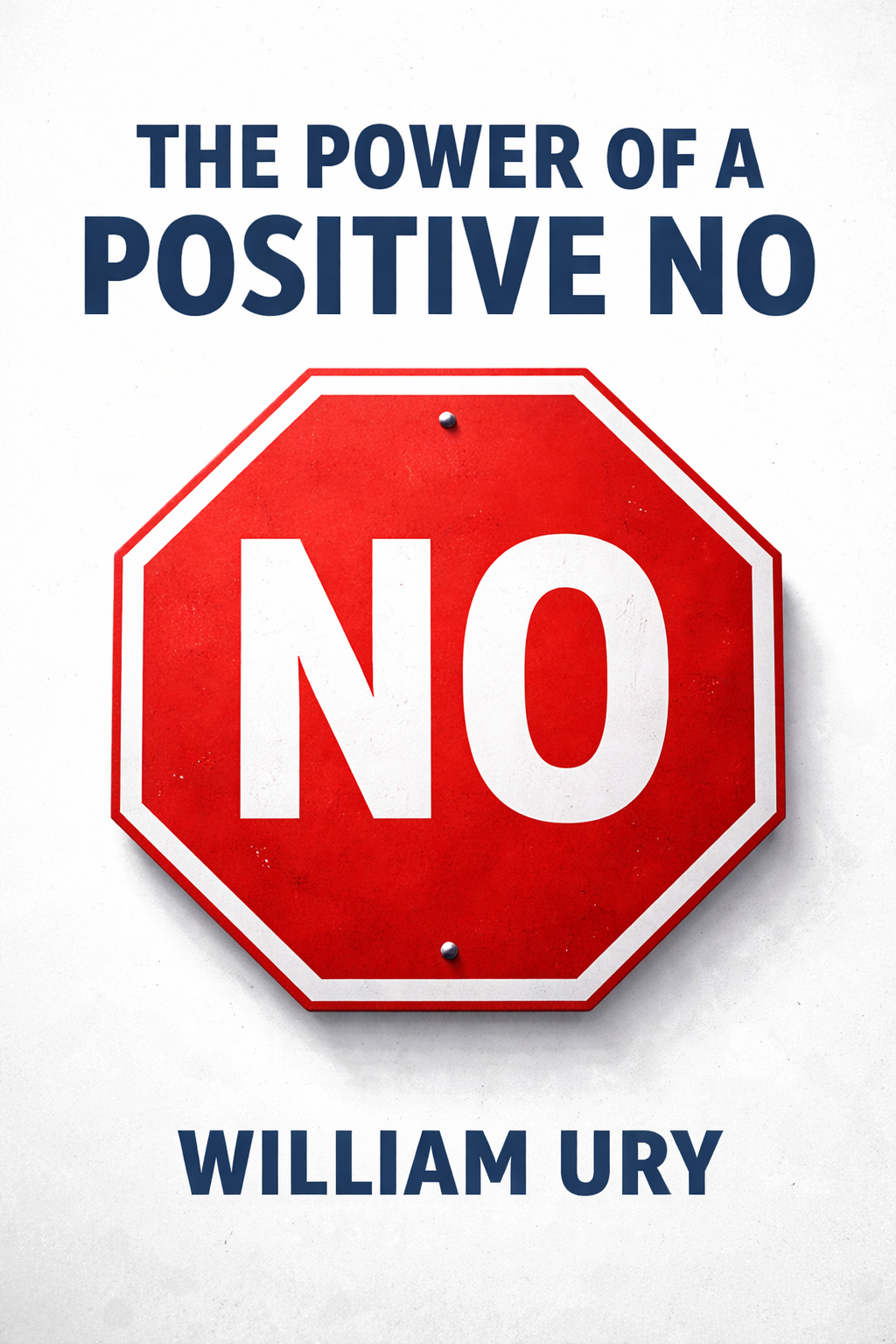
The Power of a Positive No
Chapter Summaries
What's Here for You
Tired of feeling cornered and guilty when you need to say 'No'? 'The Power of a Positive No' offers a refreshing and empowering approach to setting boundaries while strengthening relationships. This book promises to transform your 'No' from a dreaded confrontation into a powerful tool for protecting your values and achieving your goals. You'll gain practical strategies for crafting a 'Positive No' – one that honors your needs, respects the other party, and opens doors to collaborative solutions. Through compelling stories and insightful frameworks, you'll learn to uncover your underlying 'Yes,' assert your boundaries with confidence, and navigate challenging negotiations with grace. Prepare to feel inspired and equipped to say 'No' in a way that feels authentic, constructive, and ultimately, leads to more fulfilling 'Yeses' in your life.
UNCOVER YOUR YES
William Ury, in "The Power of a Positive No," emphasizes that the most effective Nos are rooted in a deeper Yes—a commitment to one's core interests and values. He illustrates this with the poignant story of his relative overcoming alcoholism by focusing on his desire to be present for his grandchildren, showcasing how a powerful Yes fuels a powerful No. Ury argues that the primary obstacle to saying No isn't external opposition but our own reactive tendencies, comparing us to "reaction machines" trapped in fear, guilt, or anger, reminiscent of the samurai story where impulsive anger nearly led to tragedy, a metaphor for how unchecked emotions can obscure our true purpose. Therefore, Ury introduces a method to shift from reactive to proactive, beginning with "going to the balcony"—a mental detachment to gain perspective and calm, much like stepping back from a heated stage performance to see the whole scene. He stresses the importance of taking time-outs to reflect on our Yes, suggesting that even a brief pause can transform a reactive Yes into a proactive No, and advocates for listening to our emotions, not suppressing or acting them out, but understanding them as signals from our core needs, such as the mother who resolved her preschool conflict by addressing her own abandonment fears. Ury urges us to continually ask "Why?" to uncover our underlying interests, needs, and values, which serve as the fuel for an effective No; he differentiates between interests (wants) and needs (basic human drives), highlighting how identifying these deeper motivations, like safety, belonging, respect, freedom, can anchor our resolve. He recounts the Enron scandal, praising Sherron Watkins's courageous stand against unethical practices as a testament to the power of aligning with core values like honesty and integrity. Ultimately, Ury calls for crystallizing our Yes!—distilling our motivations into a single, positive intention, like Nelson Mandela's "Long Walk to Freedom," emphasizing that true strength comes from an indomitable will rooted in a clear intention, and distinguishing between "whether" and "how" to avoid sabotaging our resolve. Finally, he advocates for harnessing our emotions, transforming negative feelings into resolve, drawing inspiration from Mahatma Gandhi's ability to transmute anger into a force for change, concluding that uncovering our Yes grounds us, directs us, and energizes us to deliver a powerful and positive No.
EMPOWER YOUR NO
In "The Power of a Positive No," William Ury underscores that saying No is not merely about denial, but about empowering a deeper Yes. He introduces the concept of 'positive power,' contrasting it with negative power. Ury illustrates this with the story of Rosa Parks, whose refusal to give up her bus seat wasn't a spontaneous act but a deliberate decision backed by years of activism and a clear Plan B—a commitment to challenge segregation, thus showcasing how a seemingly powerless individual can ignite significant change. The author explains that devising a Plan B transmutes fear into confidence, liberating one from feeling like a hostage to others' cooperation, and this psychological freedom is crucial for delivering a powerful No. Ury shares the story of Joan, who transformed her marriage by preparing to separate from her husband if her needs weren't met, demonstrating that standing up to oneself first is paramount. Plan B, or BATNA, is not a fallback option but an alternative to agreement, exemplified by Jim Wier's decision to say No to Wal-Mart, choosing to protect Snapper's core values over short-term profits. This backup plan is not about punishing others but about securing one's interests, a positive power that shifts the focus from control over others to meeting one's own needs. The author urges readers to brainstorm various Plan Bs, considering unilateral actions, exit strategies, and third-party interventions, he also highlights the importance of building a winning coalition, recalling a Zen master story to show that collective action can level the playing field. Furthermore, Ury advises anticipating others' power moves and neutralizing their impact, referencing the Cuban missile crisis as an example of taking away the 'stick' without aggression. Finally, Ury encourages reassessing the decision to say No by asking three questions: Do I have the interest? Do I have the power? Do I have the right?, reinforcing that while saying No may carry costs, it is a fundamental right, a hallmark of a free person. The chapter culminates with the understanding that aligning interests, power, and rights makes one unstoppable, transforming the act of saying No into an act of profound self-respect and empowerment, a journey where fear dissolves into resolve, and the path forward becomes illuminated with the clarity of purpose.
RESPECT YOUR WAY TO YES
In this chapter of *The Power of a Positive No*, William Ury illuminates the pivotal role of respect in transforming a potentially negative 'No' into a constructive outcome. Ury begins by highlighting a central tension: that most 'Nos' unintentionally reject the other party, leading to feelings of shame, humiliation, and ultimately, escalation. He recounts a story of political battling in Venezuela, where disrespect, not political issues, fueled the deepest anger. To counter this, Ury introduces respect as the key ingredient, not in the sense of accommodation, but as positive attention, listening, and acknowledgment. He shares the transformative story of Terry Dobson, an aikido student in Japan, who witnesses an elderly man disarming a violent drunk on a train, not with force, but with simple gestures of respect, revealing the surprising power of this approach. Ury emphasizes that respect begins with self-respect, creating the emotional space to see the other as a fellow human being. He recalls Winston Churchill's polite declaration of war as an example of strength-based respect. The author urges us to 'look again' at the other, to notice with attention, even when fear and anger cloud our judgment. He shares the story of Dominick Misino, a hostage negotiator, who prioritizes politeness to defuse tense situations, illustrating that respect works, even with those who seem least deserving. Ury then underscores the practical benefits of respect, citing his work as a mediator in ethnic wars, where basic human respect was the only way to achieve ceasefires. He shares a story of Celia Carrillo, a teacher who establishes a classroom culture of respect, fostering mutual appreciation and learning. The author identifies two principal ways to demonstrate respect: listening attentively, not to refute, but to understand, and acknowledging the other's point of view, even without agreeing. He uses the example of software developers who improved customer satisfaction by asking clarifying questions to uncover underlying needs. Ury also recounts Bob Iger's approach to quell a shareholder revolt at Disney by acknowledging Roy Disney's concerns. Ultimately, Ury advocates for beginning on a positive note, surprising others with recognition, and affirming relationships to pave the way for a more receptive hearing of your 'No', suggesting that such preparation, like a boxer's unseen training, is vital before delivering the final message.
EXPRESS YOUR YES
William Ury, in this pivotal chapter, illuminates the art of delivering a 'Positive No,' a skill demanding both tact and intention. He frames it as a three-act sequence: first, a 'Yes!' that affirms what truly matters; second, the 'No' itself, a boundary firmly set; and finally, a 'Yes?' that proposes an alternative path. Ury underscores that the 'Yes' is not merely a preamble, but the bedrock upon which a successful 'No' is built. He recounts anecdotes, such as the Air Force Academy student who left to pursue his true calling, illustrating that a 'No' rooted in genuine self-affirmation resonates powerfully. Conversely, a 'No' delivered without explanation, like the abrupt rejection from a bank, leaves the recipient feeling powerless, a stark reminder that context and empathy are paramount. Ury introduces the 'the-statement,' 'I-statement,' and 'we-statement' as tools to articulate one's 'Yes' with clarity and conviction. The 'the-statement' focuses on objective facts, stripping away blame and judgment, while the 'I-statement' allows for vulnerable expression of feelings and needs, making it harder for the other party to challenge. The 'we-statement' broadens the frame, appealing to shared interests or standards, transforming a potentially self-centered 'No' into a collaborative decision. He cautions against the pitfalls of judgmental language, categorical statements, and 'shoulding' on others, which only serve to muddy the message and incite defensiveness. Instead, he advocates for honest candor tempered with empathy, urging us to attack the problem, not the person. Just as a tree bends to the winds but remains rooted, we must learn to express our 'Yes' without apology, standing firm in our values while remaining open to connection. Ury recalls Nelson Mandela's courtroom statement, a powerful 'Yes' to freedom, demonstrating that affirming one's intention is a creative act, shaping a new reality. The chapter culminates with the story of sports agent Bob Woolf, who risked losing a major client by refusing to compromise his principles, ultimately earning the client's respect and trust. Ury posits that a 'Yes' grounded in deep-seated values transforms the 'No' into a value statement, asserting not just a boundary, but a commitment to what truly matters.
ASSERT YOUR NO
In this pivotal chapter of *The Power of a Positive No*, William Ury delves into the core act of asserting one's No, emphasizing its fundamental role in defining boundaries and protecting what truly matters. Ury illuminates how "No" is not merely a word of denial, but a potent expression of one's "Yes"—the underlying values, needs, and interests that warrant safeguarding. He draws a parallel between a cell's membrane, selectively allowing nutrients in while repelling threats, and our own need for boundaries to maintain integrity. A child's triumphant cry of "Stop the swing!" after finding their voice becomes a sensory reminder of the power in setting limits. Ury cautions against both overdoing and underdoing the "No," advocating for a "natural No" that flows effortlessly from one's "Yes," untainted by fear or anger, like his daughter Gabriela's simple, honest refusals. The narrative emphasizes that saying No is key to defining identity, individuality, and even a brand, acting as a selection principle that allows one to be authentically themselves, or an organization to define itself against competitors. The author introduces the concept of "performative speech acts," illustrating how a Positive No isn't just a statement but a commitment that reshapes reality, creating boundaries where none existed before, like David, the Native American, drawing a line with his deep, resonant "Noooh" to protect his religious practices. Ury stresses the importance of respect in delivering a No, advocating for staying connected with the other person, like the Spanish banker who delivers a rejection with elaborate courtesy, preserving the relationship while setting a firm limit. He provides practical phrases for saying No, from a simple "No thanks" to framing it as a policy or a prior commitment, and offers strategies for addressing inappropriate behaviors with phrases like "Stop!" or "That is not OK," while acknowledging that sometimes the most effective No is the one left unsaid, implied through actions and reframing. Ultimately, Ury presents the Positive No as a shield of protection, safeguarding one's Yes without harming the other, a delicate balance of clarity, commitment, and respect.
PROPOSE A YES
In "The Power of a Positive No," William Ury delves into the crucial third element of a truly effective 'No': proposing a 'Yes?' Ury argues that merely stating what one *won't* do is insufficient; the key lies in offering a positive alternative. He begins by illustrating this with a child's innocent wisdom from the film *Hook*, highlighting how offering a 'Yes, but...' can soften even the most vehement rejection. The mayor of Nashville's story becomes a pivotal example, showcasing how Diane Nash's persistent, positive questioning opened a door where anger had only built a wall. Ury emphasizes that a positive proposal isn't a softening of the 'No,' but rather its reinforcement, rooted in the initial 'Yes!' to one's own core interests. He suggests offering a third option when faced with demands, as illustrated by the contrasting stories of families dealing with the desire for a dog, or offering alternative solutions to valued employees. He then transitions to addressing objectionable behavior, stressing the importance of making constructive requests—clear, feasible, positively framed, and respectful. Ury paints a vivid picture: instead of vaguely demanding someone be 'more considerate,' specify the desired behavior, like washing the dishes they use. He highlights the importance of framing requests positively, turning 'Don't think about elephants' into a focus on what *to* think about instead. Even when a plain 'No' is the only option, Ury suggests proposing an outcome of mutual respect, asking for understanding and offering it in return. He underscores that ending on a positive note, much like beginning one, smooths the interaction and preserves the relationship, painting a picture of a positive future where agreement is still possible. Ultimately, Ury urges readers not just to say 'No,' but to follow it with an inviting 'Yes?'—a carefully constructed response that balances firmness with the possibility of collaboration and continued respect.
STAY TRUE TO YOUR YES
In this chapter, William Ury unveils the crucial next step after delivering a Positive No: staying true to the underlying Yes amidst resistance. He frames the challenge as managing others' reactions, acknowledging that a No often triggers painful adjustments and perceived threats, likening it to delivering bad news. Ury draws a parallel to Elisabeth Kbler-Ross's stages of grief—avoidance, denial, anxiety, anger, bargaining, sadness—suggesting that understanding these emotional stages can help navigate the other's response; picture it as a curve of acceptance, where initial resistance gradually gives way. The key, Ury emphasizes, lies in controlling one's own reactions: don't yield, don't attack. He cautions against wavering due to guilt or fear, recounting the tragic Challenger teleconference as a stark example of yielding principles under pressure. Instead, Ury advocates going to the balcony, a mental space of perspective and calm, to pause before responding, breathing deeply to regain composure. He suggests naming the game—identifying the other's tactics like flattery, minimization, or guilt—to detach emotionally and maintain self-control. A physical technique, like Hernn's palm pinch, can further anchor one's focus. Ury underscores the power of not reacting, illustrated by Nelson Mandela's strategic restraint during South Africa's transition from apartheid; sometimes, inaction speaks louder than any defense. Listening respectfully, paraphrasing to ensure understanding, and acknowledging the other's point without conceding one's own are vital tools. The author advises replacing "but" with "Yes, and," fostering a both-and mindset that affirms both parties' needs. He introduces the "Oh? So? No." technique from Al-Anon, a method of neutral acknowledgment followed by a firm No. Ury concludes by urging readers to stand true like a tree, flexible yet firm, navigating the storm of resistance with unwavering commitment to their underlying Yes, ultimately fostering respect and paving the way for future amicable relationships, as demonstrated by Dick Goodwin's resilience in the face of President Johnson's pressure.
UNDERSCORE YOUR NO
In this chapter, William Ury uses the inspiring example of Mahatma Gandhi's salt march to illustrate the power of underscoring a 'Positive No.' Gandhi, facing the might of the British Empire, didn't just refuse; he affirmed life through the simple act of making salt, turning a primal need into a symbol of resistance. Ury explains that underscoring a 'No' means patiently and persistently emphasizing its importance, standing firm without severing relationships. The chapter reveals that when faced with resistance, one can repeat their 'No' consistently, acting as a gentle yet firm breeze that strengthens the trees of personal boundaries. Emily Wilson's refusal to disturb John Kenneth Galbraith for President Johnson exemplifies this unwavering resolve. The detective negotiating with a hostage taker demonstrates how repeating 'No' can de-escalate tense situations. Ury introduces the concept of an 'anchor phrase'—a simple, repeatable statement that reinforces one's position amidst pressure, like a lighthouse in a storm. He cautions against mechanical repetition, advocating instead for 'intentional repetition,' renewing the phrase with each use by reconnecting with the underlying 'Yes,' the core values that fuel the 'No.' If repetition fails, Ury advises educating the other party about the natural consequences of ignoring the 'No,' using reality-testing questions rather than threats to guide them toward understanding. A warning differs from a threat, the author clarifies: a warning educates about inherent consequences, while a threat seeks to impose punishment. The physician group that refused to accept underpayment from a managed-care company illustrates this difference in action. Finally, Ury discusses deploying 'Plan B'—withdrawing cooperation respectfully, as Lysistrata and the women of Athens and Sparta did to end the war, and COPS did to get the city council to free up funds for improving the infrastructure of the poor neighborhoods. He emphasizes that the more power one wields, the more respect one must show, implementing 'Plan B' with restraint and a focus on positive outcomes. The key, Ury stresses, is to meet resistance with persistence, allowing reality to be the teacher, guiding the other toward accepting the new boundaries and fostering a healthier relationship.
NEGOTIATE TO YES
In this chapter, William Ury explores the crucial final step of the Positive No: negotiating to a 'Yes' that protects core interests and strengthens relationships. Drawing from the ancient story of Abraham negotiating with God, Ury illustrates that even in the face of seemingly insurmountable power dynamics, a positive outcome is possible. The goal isn't merely to say No, but to navigate towards a mutually beneficial Yes, whether it be a concrete agreement, a healthier relationship, or an amicable separation, like Ury's own experience with his first wife, transforming a heart-wrenching divorce into a lasting friendship. Consider Katherine Taylor, who turned a potential courtroom battle into a landmark settlement by understanding her counterpart's deeper interests beyond mere legal positions. Ury introduces the concept of building a 'golden bridge,' making it easier for the other party to advance toward a positive solution. This involves addressing unmet needs, considering the opinions of key stakeholders, and repairing any damage to the relationship caused by the No. Negotiating isn't just about reaching any Yes, but the *right* Yes, one that doesn't compromise essential values for short-term gains; like a negotiator lost in the woods, one must step back to see the forest for the trees. Ury emphasizes the importance of helping the other 'win approval' by preparing them for the 'acceptance speech test,' anticipating criticisms and equipping them with persuasive arguments. Face, Ury argues, is not mere ego but a person's sense of honor and self-respect, and protecting it is vital for successful negotiation. Finally, Ury underscores the need to cultivate a healthy relationship, even after saying No, by reaching out, rebuilding confidence, and replenishing goodwill. Just as Mahatma Gandhi transformed his adversary Jan Smuts into an admirer, a Positive No can pave the way for a stronger, more authentic connection, culminating in a Yes that benefits all parties involved, a testament to the power of understanding and respect in negotiation.
Conclusion
"The Power of a Positive No" transcends simple boundary-setting; it's a guide to living a life aligned with core values. The journey begins by understanding that every 'No' should stem from a deeper 'Yes,' a commitment to one's fundamental needs and aspirations. Recognizing our reactive tendencies and cultivating proactive mindfulness, especially by 'going to the balcony' for perspective, is paramount. The book underscores the importance of emotional intelligence – acknowledging and harnessing our feelings to fuel resolve. Developing a robust 'Plan B' empowers us to say 'No' confidently, shifting focus from controlling others to empowering ourselves. Respect is not appeasement, but a powerful tool for connection, requiring self-respect first, followed by active listening and acknowledgment of the other person's humanity. A 'Positive No' is a three-part act: affirming the 'Yes,' setting the boundary, and proposing a 'Yes?' to redirect towards mutual gain. Managing resistance requires empathy, strategic silence, and unwavering commitment to one's 'Yes,' reinforced by an 'anchor phrase' and reality-testing. Ultimately, saying 'No' is not an end, but a strategic step towards a more meaningful 'Yes,' building golden bridges and nurturing relationships even amid disagreement. The book’s wisdom is that delivering an effective 'No' is a declaration of self and a catalyst for a life lived with intention, integrity, and strengthened connections.
Key Takeaways
Effective Nos are rooted in a deeper Yes, reflecting a commitment to one's core interests and values.
The biggest obstacle to saying No is our own reactive tendencies, requiring a shift to a proactive, purposeful mindset.
"Going to the balcony"—detaching mentally to gain perspective—is crucial for uncovering the Yes behind the No.
Listening to and understanding our emotions, rather than suppressing or acting them out, allows us to address unmet core needs.
Continually asking "Why?" helps uncover underlying interests, needs, and values that fuel an effective No.
Crystallizing varied motivations into a single, positive intention—a Yes!—provides clarity and strength.
Harnessing emotions, transforming negative feelings into resolve, empowers us to stand up for what is important.
Develop 'positive power' by creating a Plan B to protect your interests when saying No, shifting from punishing others to empowering yourself.
Transform fear into confidence by devising a Plan B, recognizing that it provides psychological freedom and reduces dependence on others' cooperation.
Distinguish Plan B from fallback options; Plan B is an independent course of action, not a compromise requiring the other's agreement.
Strengthen your Plan B by brainstorming various alternatives, including unilateral actions, exit strategies, and third-party interventions, to enhance your sense of control.
Build a winning coalition to level the playing field when facing more powerful opponents, recognizing that collective action can amplify your voice.
Anticipate the other's power moves and neutralize their impact by taking away their 'stick,' focusing on removing their ability to attack rather than retaliating.
Reassess your decision to say No by evaluating your interests, power, and rights, ensuring alignment before proceeding to protect your boundaries effectively.
Counteract the sting of rejection by prioritizing respect, not as mere accommodation, but as genuine positive attention and acknowledgment of the other person's humanity.
Cultivate self-respect first, as it creates the necessary emotional and mental space to genuinely see and respect others, even in disagreement.
Practice active listening to understand the other person's underlying needs and interests, rather than merely preparing a rebuttal.
Acknowledge the other person's perspective and value, even when delivering a 'No,' to foster connection and demonstrate that the rejection is not personal.
Use surprising gestures of recognition to disarm tension and open doors for constructive dialogue, transforming potential adversaries into willing listeners.
Begin conversations on a positive note by expressing appreciation or acknowledging shared goals, setting a constructive tone for delivering difficult messages.
Remember that demonstrating respect is not a sign of weakness, but a powerful tool for influencing others and achieving mutually beneficial outcomes.
A 'Positive No' requires a foundation of 'Yes,' affirming one's values and intentions before setting a boundary.
Explanatory 'Yes' clarifies motives, preventing misinterpretations and fostering understanding in the other party.
Employing 'the-statements,' 'I-statements,' and 'we-statements' facilitates clear, respectful communication of one's 'Yes'.
Avoid judgmental language and categorical statements to prevent defensiveness and maintain productive dialogue.
Expressing feelings and interests authentically strengthens relationships and promotes mutual respect.
Appealing to shared interests or standards transforms a potentially selfish 'No' into a collaborative decision.
Sometimes, a simple, direct 'No' without explanation is the most effective and respectful response.
Acknowledge that a well-articulated 'No' is fundamentally a declaration and protection of one's core 'Yes,' reflecting underlying values and priorities.
Strive to deliver a 'natural No'—clear, honest, and flowing effortlessly from your 'Yes'—minimizing the influence of fear, anger, or guilt.
Understand that 'No' is essential for defining personal and organizational identity, acting as a selection principle that distinguishes what you are from what you are not.
Frame your 'No' as a commitment to a future course of action, backing it up with personal power and a clear Plan B, thereby creating a new boundary and reshaping social reality.
Deliver your 'No' with respect, seeking to maintain connection and preserve the relationship, even while setting firm limits.
Employ specific phrases and strategies, such as 'I have a policy,' 'Not now,' or reframing the 'No' as a positive statement, to soften the impact and enhance effectiveness.
Recognize that sometimes the most powerful 'No' is unspoken, conveyed through actions, implications, and a clear intention that leaves no room for misinterpretation.
A 'Positive No' is incomplete without proposing a 'Yes?' that redirects attention to a positive outcome, turning potential frustration into an opportunity for mutual gain.
Effective proposals are not a softening of the 'No,' but a reinforcement, ensuring they remain rooted in one's initial 'Yes!' to core interests while addressing the other party's needs.
When saying 'No' to behavior, a constructive request should be clear, feasible, positively framed, and respectful, focusing on specific actions rather than vague attitudes.
Framing requests positively shifts the other person's focus from the unwanted behavior to the desired action, increasing the likelihood of compliance and reducing resistance.
Even when a plain 'No' is necessary, proposing an outcome of mutual respect—explicitly asking for understanding and offering it in return—helps preserve the relationship.
Understand that resistance to your No is a natural emotional process, akin to the stages of grief, requiring patience and empathy.
Control your own reactions by going to the balcony—a mental space of calm and perspective—to avoid yielding or attacking.
Name the game by identifying the other's tactics (flattery, threats, guilt) to detach emotionally and maintain self-control.
Harness the power of not reacting; strategic silence can be more effective than immediate defense, allowing the other's emotions to subside.
Listen respectfully and paraphrase to ensure understanding, acknowledging the other's point without conceding your own.
Adopt a 'Yes, and' mindset instead of an 'either-or' approach to foster collaboration and affirm both parties' needs.
Stand true to your underlying Yes with firmness and flexibility, like a tree bending in the wind, to navigate resistance without breaking.
To effectively say 'No,' underscore it with a 'Yes' by focusing on the underlying values and interests you are protecting.
When faced with resistance, repeat your 'No' consistently and persistently, not as a broken record, but with renewed intention and connection to your core values.
Craft an 'anchor phrase' – a simple, repeatable statement – to reinforce your 'No' when under pressure, preventing others from diverting you from your boundaries.
Educate others about the consequences of not respecting your 'No' through reality-testing questions and warnings, rather than resorting to threats or punishment.
Differentiate between warnings and threats: warnings educate about inherent consequences, while threats impose punishment, often provoking backlash.
When deploying 'Plan B,' withdraw cooperation respectfully and with restraint, leaving the door open for future agreement and healthier relationships.
The greater your power, the more respect you must show when enforcing consequences, ensuring your actions are perceived as fair and aimed at positive change.
Saying No is not the end, but a strategic step toward achieving a more meaningful Yes that aligns with your core interests and values.
A positive outcome in negotiation extends beyond mere agreement; it encompasses strengthened relationships and amicable separations.
Building a 'golden bridge' for the other party involves understanding their unmet needs, addressing stakeholder concerns, and repairing relationship damage.
Effective negotiation focuses on reaching the *right* Yes, which requires protecting essential interests and avoiding compromises that undermine long-term priorities.
Helping the other party 'win approval' involves anticipating criticisms and equipping them with persuasive arguments to gain support from their constituents.
Protecting the other party's 'face'—their sense of honor and self-respect—is crucial for fostering trust and facilitating agreement.
Cultivating a healthy relationship after saying No requires reaching out, rebuilding confidence, and replenishing goodwill through sincere gestures and consistent communication.
Action Plan
Identify your core values and interests; write them down as a reminder.
Practice "going to the balcony" in stressful situations to gain perspective.
Take a time-out when faced with a difficult request to reflect on your needs.
Listen to your emotions and identify the underlying needs they signal.
Ask yourself "Why?" repeatedly to uncover deeper motivations behind your No.
Distill your motivations into a single, positive intention—your Yes!.
Distinguish between "whether" and "how" when considering saying No to avoid self-sabotage.
Harness your emotions and channel them into resolve to stand up for what is important.
Visualize a positive outcome that would satisfy your interests before saying No.
Identify a situation where you need to say No and clarify your underlying Yes.
Brainstorm at least three potential Plan Bs to support your No, considering both unilateral and trilateral options.
Assess your current level of confidence in saying No and identify any fears or anxieties holding you back.
Evaluate whether you have the right to say No in the situation, reinforcing your fundamental right to make decisions for yourself.
Practice anticipating the other person's reaction to your No and develop strategies to neutralize their power moves.
Build a coalition by identifying potential allies who share your interests and can support your position.
Reassess your decision to say No, ensuring that it aligns with your core values and long-term goals.
Communicate your No assertively and respectfully, focusing on your needs and interests without attacking the other person.
Before delivering a 'No,' identify the other person's underlying needs and interests through active listening and clarifying questions.
Practice self-reflection to cultivate self-respect, recognizing your own emotions, needs, and values before engaging in difficult conversations.
Acknowledge the other person's perspective by summarizing their point of view and expressing understanding, even if you disagree.
Identify opportunities to offer surprising gestures of recognition or appreciation to build rapport and goodwill.
Start conversations on a positive note by expressing appreciation for the other person's efforts or highlighting shared goals.
When delivering a 'No,' emphasize that the rejection is not personal by affirming your respect for the individual.
Commit to listening attentively without interrupting or formulating rebuttals, focusing instead on truly understanding the other person's message.
Look for opportunities to 'look again' at someone you may have dismissed, seeking to understand their humanity beyond their behavior.
Before saying 'No,' identify and articulate your underlying 'Yes' – what values or interests are you protecting?
Practice using 'the-statements' to describe problematic behaviors objectively, without blame or judgment.
Construct 'I-statements' to express your feelings and needs clearly and respectfully.
When appropriate, frame your 'No' as a 'we-statement,' appealing to shared interests or values.
Monitor your language for judgmental words or categorical statements and replace them with neutral descriptions.
Reflect on past 'No's you've delivered and identify areas for improvement in your communication style.
Trust your intuition when a situation feels uncomfortable, and don't feel obligated to provide elaborate explanations.
In low-stakes situations, practice saying a simple, direct 'No' without justification.
Identify your core 'Yes'—the values, needs, and interests you want to protect—before considering a 'No'.
Practice delivering a 'natural No' in low-stakes situations to build confidence and refine your approach.
Develop a personal policy on a specific issue to depersonalize your 'No' and signal resolve.
Prepare a Plan B for situations where your 'No' might be challenged, reinforcing your commitment and limit-setting.
When saying 'No', focus on maintaining respect and connection with the other person, seeking to preserve the relationship.
Experiment with different phrases and strategies for saying 'No' to discover what feels most authentic and effective for you.
Reflect on past experiences where you struggled to say 'No' and identify alternative approaches you could have used.
In situations where appropriate, consider reframing your 'No' as a positive statement or offering an alternative solution.
If you are unsure, use the phrase 'Not now' to buy yourself time to consider the request more fully.
Pay attention to your tone of voice and body language when saying 'No', ensuring they align with your words and intent.
When preparing to say 'No,' brainstorm at least three alternative 'Yes?' options that address the other party's needs while respecting your boundaries.
Before addressing an unwanted behavior, write down a clear, specific, and feasible request for a positive action you would like to see instead.
Reframe negative requests into positive ones by focusing on what you *do* want the other person to do, rather than what you want them to stop doing.
Practice delivering a 'Positive No' with a friend or colleague, focusing on maintaining a respectful tone and open body language.
After saying 'No,' explicitly ask for the other person's understanding and acknowledge their perspective, demonstrating mutual respect.
When faced with resistance to your No, identify which stage of acceptance (avoidance, denial, anger, etc.) the other person is in.
Before responding to a challenging reaction, take a 'balcony' break: pause, breathe deeply, and regain perspective.
Practice 'naming the game' by silently labeling the tactics others use to pressure you (e.g., flattery, guilt, threats).
Develop a physical anchor (like pinching your palm) to help you stay grounded and focused during heated exchanges.
Actively listen and paraphrase the other person's concerns to demonstrate understanding and build rapport.
Replace the word 'but' with 'Yes, and' when responding to objections to acknowledge their point while asserting your own.
If you tend to over-accommodate, practice the 'Oh? So? No.' technique to acknowledge without conceding.
Reflect on past situations where you yielded under pressure and identify alternative responses you could have used.
Ask a trusted friend or colleague to act as your 'balcony' by observing your interactions and providing feedback.
When facing a strong emotional reaction, consciously choose not to react immediately; wait for the intensity to subside before responding.
Identify your core 'Yes' – the values and interests that drive your 'No' – to strengthen your resolve.
Craft a personal 'anchor phrase' that you can use repeatedly to reinforce your boundaries in challenging situations.
Practice intentional repetition of your 'No,' focusing on your underlying intention with each iteration.
When faced with resistance, ask reality-testing questions to help the other party understand the consequences of their actions.
Clearly communicate warnings, not threats, to educate others about the natural outcomes of disrespecting your boundaries.
Develop a 'Plan B' that represents your best alternative if your 'No' is not respected, and be prepared to implement it.
If you must withdraw cooperation, do so respectfully, leaving the door open for future negotiation and agreement.
Reflect on situations where you need to say 'No' more effectively and identify specific steps you can take to underscore your message with positive power.
Identify your underlying Yes—the core interests, needs, and values—that drive your No.
Step into the other person's shoes to understand their unmet needs and concerns.
Prepare the other party for their 'acceptance speech' by anticipating criticisms and crafting persuasive responses.
Actively listen to the other party's perspective and acknowledge their feelings.
Look for opportunities to rebuild confidence and replenish goodwill after saying No.
Focus on cultivating a healthy relationship by reaching out and offering support.
Practice empathy and compassion in your interactions with others, even during difficult conversations.