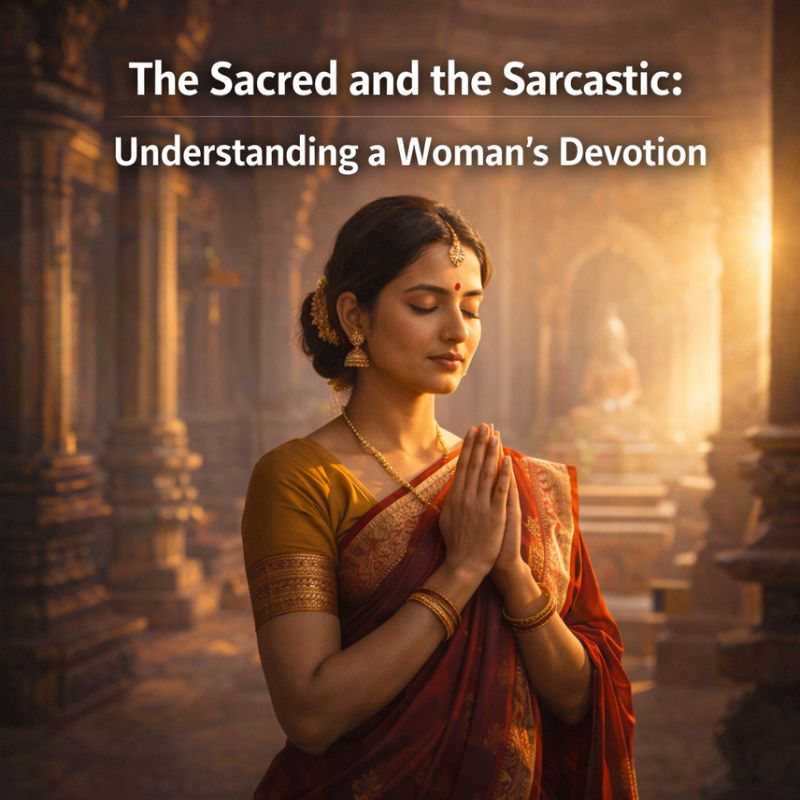
The Sacred and the Sarcastic: Understanding a Woman's Devotion
IndiaDharmaHinduismKrishnaBhagavad GitaDevotionSpiritualityWomenCultureArt
In a world quick to judge and ridicule, a woman's devotion to the divine, particularly to Krishna, often becomes a target of mockery rather than reverence. This is especially true when her devotion transcends conventional norms and finds expression in art, poetry, or lifestyle. The act of ridiculing such devotion, sometimes through the misuse of sacred symbols like Madhubani art, reveals a deeper societal discomfort with female spirituality and autonomy. The essence of the issue lies in the patriarchal tendency to control and define women's expressions of faith. When a woman's bhakti is intense, emotional, or unconventional, it is often misconstrued as obsession, instability, or attention-seeking behavior. This misinterpretation stems from a limited understanding of divine love, reducing it to mere sensual fantasy or dismissing it as a threat to social order. The use of cultural symbols like Madhubani art to mock a female devotee is a betrayal of the art's origins and spirit. Madhubani, created and preserved by women, embodies feminine spirituality and intuitive expression. Weaponizing it against a woman in love with God is a profound irony, turning a sacred tradition into an instrument of shame. The woman who loves Krishna deeply may not prioritize societal expectations such as marriage, fashion, or male validation. This autonomy can be perceived as a threat to conservative minds, leading to mockery disguised as art. However, true devotion transcends the need for external validation or approval. It is a quiet, burning vow that remains steadfast despite misunderstanding and ridicule. The act of mocking a female devotee with sacred art is not a reflection of her devotion but rather a manifestation of the mocker's inability to comprehend divine love in a woman's voice. Like Meera, who faced mockery for her devotion, the modern woman who loves Krishna finds strength in her unwavering faith. Her love is not a performance or a meme but a profound connection to the divine that cannot be diminished by sarcasm or ridicule. Ultimately, the sacredness of her devotion will endure, echoing through time like the voice of Meera in the temple walls.
0:000:00